Grow Better Gardens with Smarter Plant Choices
Discover helpful guides on trees, hedges, fruit plants, edible plants, and beautiful landscape greenery.
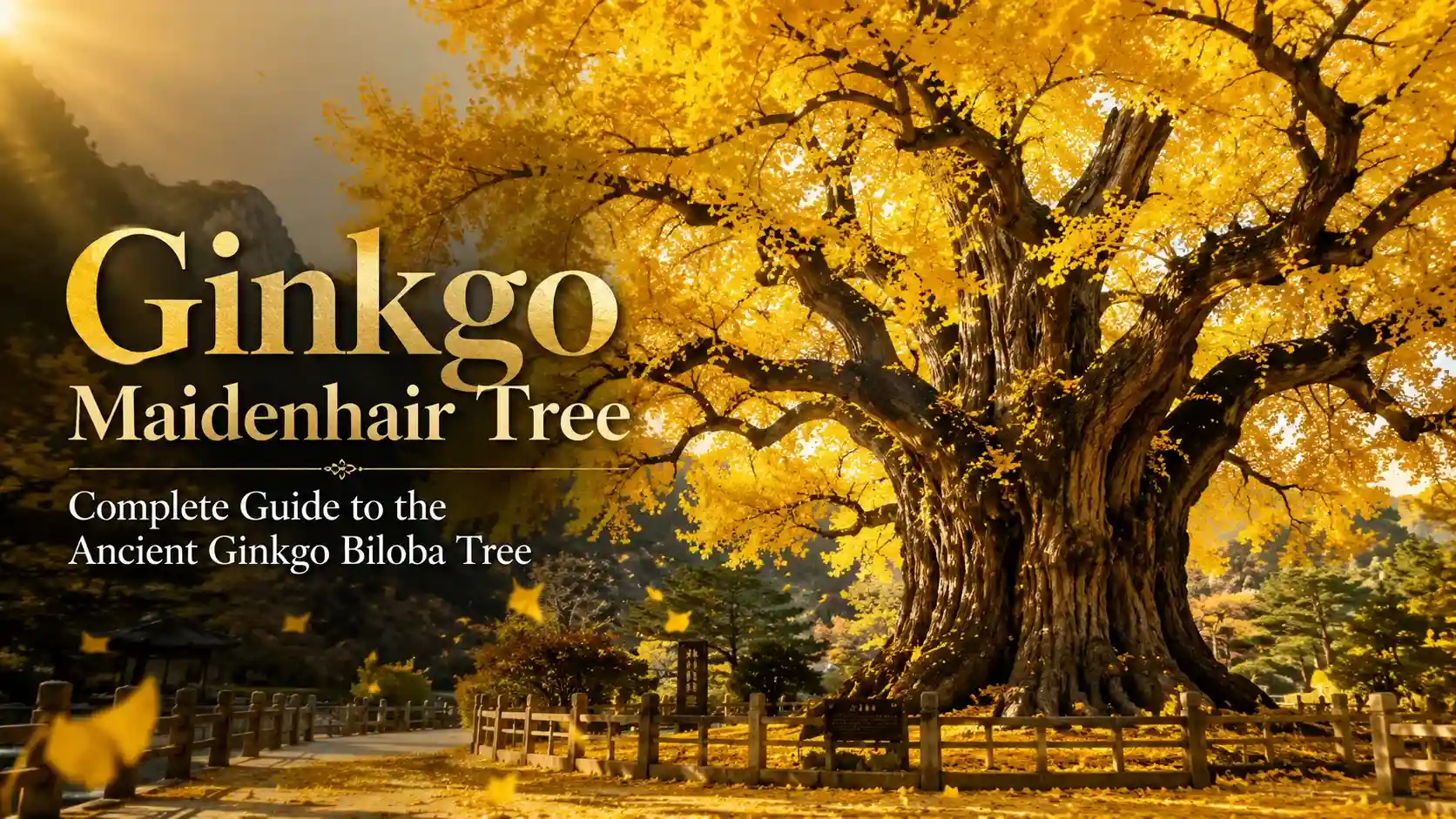
The ginkgo maidenhair tree is one of the oldest surviving tree species on Earth, valued for its remarkable resilience, fan-shaped foliage, and deep botanical history. Scientifically known as Ginkgo biloba, this unique tree has existed for more than 200 million years and is often referred to as a living fossil because of its ancient origins and extraordinary longevity.
The tree is commonly called the maidenhair ginkgo tree, maidenhair tree, or ginkgo biloba maidenhair tree because its delicate fan-shaped leaves closely resemble the foliage of maidenhair ferns. Its striking leaf structure, vibrant golden-yellow fall color, and upright growth habit have made the ginkgo tree highly popular in landscaping, urban planting, botanical collections, and ornamental gardening worldwide.
In addition to its visual appeal, the ginkgo maidenhair tree is known for its pollution resistance, adaptability, and low-maintenance nature. Many gardeners and landscapers choose male ginkgo trees for their clean growth habit, while female trees are recognized for producing distinctive fruit with a strong smell. The species also includes attractive variegated varieties, compact dwarf forms, and large shade trees suitable for different landscape designs.
This complete guide covers beginner-to-advanced information about ginkgo trees, including their leaf shape, growth size, fruit production, smell, planting requirements, care tips, popular varieties, landscaping uses, and long-term maintenance practices.
A ginkgo maidenhair tree is a deciduous ornamental tree species widely admired for its unique fan-shaped leaves, strong environmental adaptability, and extraordinary lifespan. Known as one of the oldest surviving tree species in the world, the ginkgo tree combines ancient botanical heritage with modern landscape value. Its elegant appearance, pollution tolerance, and seasonal golden foliage make it a popular choice for streetscapes, parks, botanical gardens, and residential landscapes.
The scientific name of the ginkgo maidenhair tree is Ginkgo biloba. It belongs to the plant family Ginkgoaceae, a rare and ancient plant lineage that has survived for millions of years with very little evolutionary change.
The tree is known by several common names, including:
Although spellings like “gingko tree” and “gynko tree” are commonly searched online, the correct botanical spelling is Ginkgo biloba.
The term “maidenhair tree” comes from the striking resemblance between ginkgo leaves and the delicate leaflets of maidenhair ferns. Both plants display soft, fan-like foliage with graceful vein patterns that create a similar visual texture.
The name “maidenhair ginkgo tree” became popular because gardeners and botanists noticed this resemblance centuries ago. Unlike most tree leaves, the ginkgo leaf has a broad fan-shaped structure with veins that spread outward evenly instead of branching into a network. This unusual leaf pattern helps distinguish the maidenhair ginkgo from nearly all other deciduous trees.
The ginkgo biloba tree is recognized for its symmetrical growth habit, upright branching structure, and vibrant foliage. Young trees often develop a narrow pyramidal shape, while mature trees form a broader canopy with strong horizontal branches.
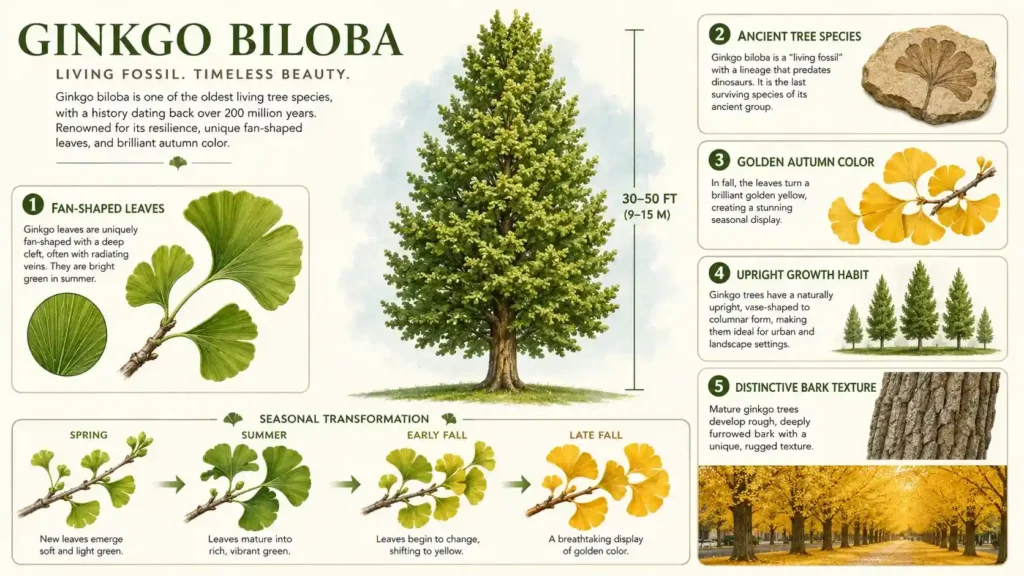
Key visual characteristics include:
Seasonal color transformation is one of the tree’s most admired features. During autumn, ginkgo leaves turn a vivid golden-yellow color before dropping rapidly, often creating a bright carpet of foliage beneath the tree.
| Feature | Details |
| Scientific Name | Ginkgo biloba |
| Common Name | Maidenhair Tree |
| Tree Type | Deciduous |
| Native Origin | China |
| Lifespan | Extremely long-lived |
| Leaf Shape | Fan-shaped |
Ginkgo trees are considered living fossils because they have survived on Earth for more than 200 million years. Their ancient lineage, remarkable resilience, and distinctive appearance make them one of the most scientifically important and visually recognizable tree species in the world. Unlike many modern trees, the ginkgo maidenhair tree has remained largely unchanged for millions of years, making it a unique link between prehistoric plant life and modern landscapes.
The ancient history of Ginkgo biloba is one of the most fascinating stories in botany. Scientists classify the species as a living fossil because fossil records show that ancestors of the modern ginkgo tree existed during the age of dinosaurs.
Ginkgo trees survived multiple extinction events that eliminated countless plant and animal species over millions of years. Their resilience and adaptability allowed them to continue growing while many ancient plant groups disappeared completely.
Historical cultivation of ginkgo trees began primarily in China, where monks preserved and planted the species near temples and sacred gardens. Over time, cultivation spread into Japan and other parts of East Asia. The ginkgo biloba tree Japan connection remains culturally significant because many ancient temple gardens still feature centuries-old specimens.
Temple plantings helped preserve the species through generations, contributing to the survival and global spread of the maidenhair tree.
Ginkgo trees possess several remarkable characteristics that make them unique among ornamental and urban trees.
Important facts about ginkgo trees include:
Because of these qualities, ginkgo trees are commonly planted in busy cities, public parks, university campuses, and commercial landscapes.
The ginkgo tree is highly valued in landscaping because it combines beauty, durability, and low maintenance. Its upright growth habit and symmetrical canopy make it suitable for both formal and natural landscape designs.
Landscape benefits of ginkgo trees include:
Landscape designers often use male ginkgo trees along streets and sidewalks because they remain clean, durable, and visually appealing even in crowded city conditions.
The tree’s dramatic autumn color is another major reason for its popularity. During fall, the canopy transforms into a vivid golden display that creates strong seasonal visual impact in gardens and urban landscapes.
Ginkgo trees provide several environmental benefits that support healthier urban ecosystems and sustainable landscapes.
Key environmental advantages include:
Although ginkgo trees are not major wildlife food sources compared to some native species, they still contribute ecological value by increasing urban greenery and improving environmental conditions in developed areas.
Their ability to survive in polluted environments also makes them important trees for sustainable urban planting projects worldwide.
Different ginkgo varieties vary in size, growth habit, leaf appearance, and landscape purpose. Some varieties develop into large upright shade trees, while others remain compact for smaller gardens or container growing. Certain ornamental cultivars also feature unusual foliage colors and patterns that make them highly desirable in decorative landscapes.
The standard Ginkgo biloba tree is the traditional form commonly planted in streetscapes, parks, and residential landscapes. It typically develops a strong upright growth habit with a pyramidal shape during its early years.
As the tree matures, the canopy gradually widens and becomes more spreading. Standard ginkgo trees are widely used as:
Their durability, pollution resistance, and brilliant golden autumn color make them one of the most dependable ornamental trees for public and private landscapes.
A variegated ginkgo tree is prized for its decorative foliage featuring unusual color patterns. These rare ornamental varieties may display cream, white, yellow, or light green markings across the leaves, creating a striking visual effect.
Variegated forms are often considered collector plants because of their distinctive appearance and limited availability.
Key features of variegated ginkgo varieties include:
Because of their eye-catching foliage, variegated ginkgo trees are frequently planted as specimen trees in ornamental gardens and botanical collections.
Dwarf ginkgo varieties are compact forms developed for smaller landscapes, patios, and container gardening. Unlike standard trees that can become very large over time, dwarf cultivars maintain a slower and more controlled growth habit.
These compact varieties are ideal for:
Dwarf ginkgo trees are especially popular among gardeners who want the beauty and resilience of a ginkgo tree without requiring large planting space.
Their compact growth and low-maintenance nature make them suitable for both beginner and experienced gardeners.
Male and female ginkgo trees differ mainly in their reproductive structures and fruit production. Male trees are generally preferred in landscaping because female trees produce strong-smelling fruit-like seeds.
Female trees develop ginkgo fruit, often referred to as fruit ginkgo biloba or ginkgo berries, after pollination. When these fruits fall and begin decomposing, they release a powerful odor commonly associated with rancid butter or spoiled food. This strong ginkgo berry smell is the primary reason landscapers usually select male cultivars for urban and residential planting.
Male trees offer several practical advantages:
Female trees, however, still hold value in botanical gardens and conservation plantings because they contribute to seed production and species preservation.
| Type | Features | Best Use |
| Male Ginkgo | No fruit | Urban planting |
| Female Ginkgo | Produces fruit | Botanical collections |
| Variegated Ginkgo | Decorative foliage | Ornamental gardens |
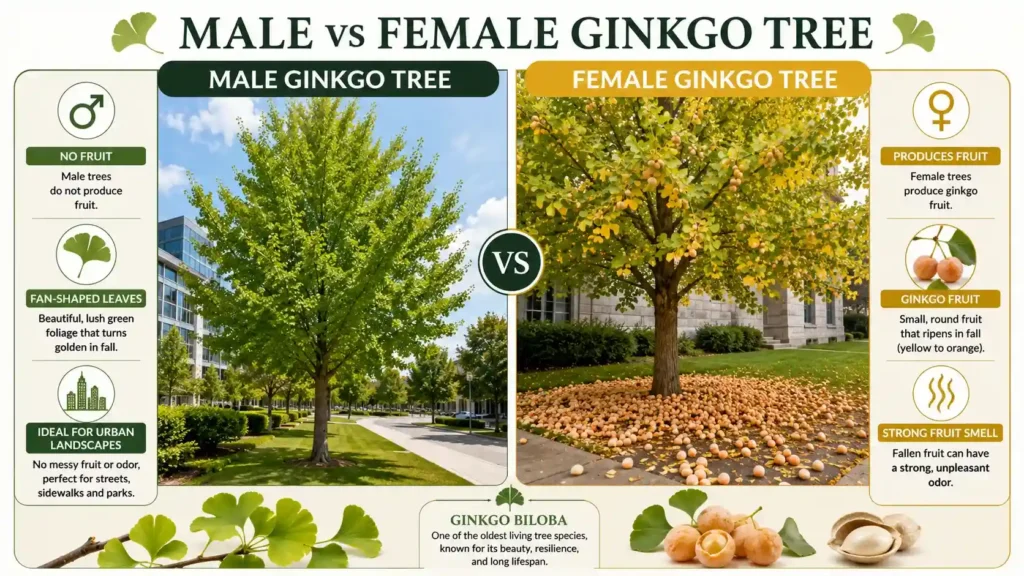
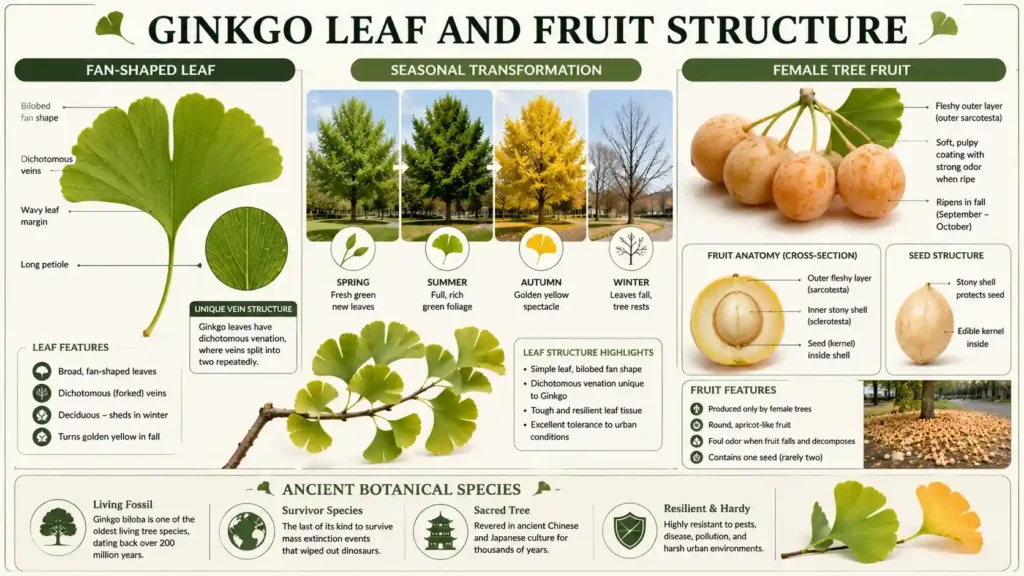
The fan-shaped leaves are the most recognizable feature of the ginkgo tree. Their unusual structure, vibrant seasonal color changes, and ancient botanical characteristics make the maidenhair tree visually different from nearly all other deciduous trees. In addition to its unique foliage, the tree is also known for its fruit production, seed structure, and strong odor associated with female specimens.
The distinctive ginkgo leaf is one of the most iconic features of Ginkgo biloba. Unlike the pointed or lobed leaves found on many deciduous trees, ginkgo leaves display a broad fan-shaped appearance with smooth edges and delicate radiating veins.
Important characteristics of the ginkgo tree leaf include:
The vein structure of ginkgo biloba tree leaves is especially unique because the veins divide evenly across the leaf instead of forming a branching network. This primitive leaf structure is one reason scientists consider the species a living fossil.
A mature ginkgo leaf tree creates a dense canopy filled with elegant foliage that moves gently in the wind. During autumn, the entire tree often changes color rapidly, covering the ground with bright golden leaves.
Common terms associated with the foliage include:
The fruit of ginkgo tree develops only on female trees after pollination. Technically, these structures are not true fruits but seed-like coverings surrounding the reproductive seed.
Ginkgo fruits typically appear:
As the seeds mature, fallen ginkgo biloba fruit begins to release a strong odor, especially after decomposition starts. Although the outer layer can smell unpleasant, the inner seed has culinary uses in some Asian cuisines when prepared properly.
Important terms related to reproduction include:
In several East Asian cultures, processed ginkgo seeds are used in traditional dishes and ceremonial foods. However, raw seeds and fruit should be handled carefully because excessive consumption may cause health concerns.
Female ginkgo trees produce fruit with a strong odor due to naturally occurring chemical compounds in the fleshy outer coating surrounding the seeds.
Many people describe the ginkgo tree smell as similar to:
This distinctive odor becomes strongest when fallen fruits begin breaking down on sidewalks or garden surfaces.
Common search phrases related to the odor include:
The answer to “which ginkgo tree smells” is simple: female ginkgo trees produce the odor because they generate seed-bearing fruit. Male trees do not produce fruit and therefore remain odor-free.
Because of this, landscapers and homeowners often choose male cultivars for streets, residential gardens, and public spaces.
Ginkgo trees originated in China but are now cultivated worldwide because of their exceptional adaptability, ornamental value, and environmental resilience. The ancient maidenhair tree thrives in a wide range of climates and has become a common sight in urban landscapes, parks, botanical gardens, and residential properties across many countries.
The native origin of Ginkgo biloba traces back to China, where the species survived for centuries in protected mountain regions and temple gardens. Botanists believe wild populations became rare over time, while cultivated trees preserved the species through human care and religious planting traditions.
Important native regions and historical areas include:
Temple cultivation played a major role in preserving the species. Chinese monks and gardeners planted ginkgo trees near temples because the tree symbolized endurance, longevity, and resilience.
From China, cultivation gradually spread throughout East Asia, including Japan and Korea, where the maidenhair tree became an important ornamental and cultural species.
Today, ginkgo trees grow in many parts of the world because they tolerate pollution, compacted soil, urban heat, and changing climate conditions. Their adaptability has made them one of the most successful ornamental trees for modern cities.
Ginkgo trees are commonly planted in:
The species is now widely cultivated across North America, Europe, Asia, and Australia.
Popular search terms related to modern cultivation include:
In Australia, ginkgo trees are grown in temperate regions where seasonal temperature changes support healthy leaf development and autumn color transformation.
Urban planting worldwide continues to increase because the tree performs exceptionally well in difficult city environments where many other ornamental trees struggle.
Ginkgo trees are highly adaptable and can grow successfully across a broad range of USDA growing zones. Their strong climate tolerance allows them to survive both cold winters and hot summers once established.
Key climate characteristics include:
Most ginkgo trees grow best in USDA Zones 3–9, depending on the specific cultivar and local environmental conditions.
Because of their climate flexibility, they are suitable for many temperate regions worldwide.
Ginkgo trees can be grown both indoors and outdoors, although outdoor planting is generally preferred for long-term development.
Young or dwarf ginkgo varieties can grow in containers for several years when provided with:
Container growth is especially popular for patios, balconies, bonsai cultivation, and small urban gardens.
However, large standard ginkgo trees eventually require more root space and outdoor conditions to reach full maturity.
Outdoor planting allows the tree to develop its full canopy, root system, and long-term structural strength. Landscape-grown ginkgo trees perform best in areas with:
Space considerations are important because mature trees can become large over time. Proper planting distance from sidewalks, buildings, and other trees helps maintain healthy root and canopy development.
Mature ginkgo trees can grow very large and live for centuries under favorable conditions. Their impressive height, broad canopy, and strong structure make them excellent long-term shade and ornamental trees for parks, streets, and spacious residential landscapes.
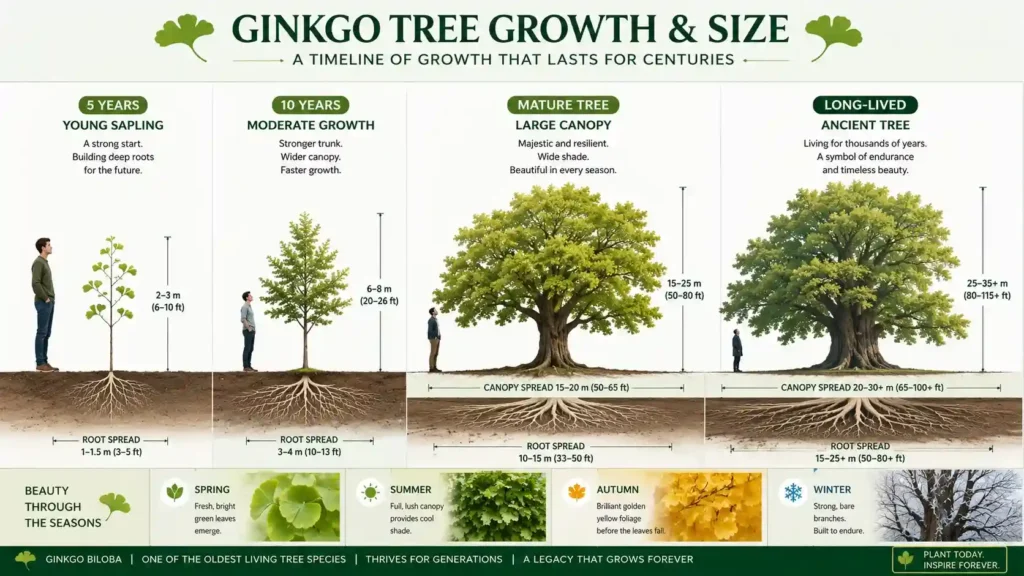
A mature Ginkgo biloba can reach substantial dimensions over time. One of the most common questions gardeners ask is: how tall do ginkgo trees get?
Under normal landscape conditions:
When discussing how tall do ginkgo trees grow, it is important to understand that growth size depends on:
Another frequently asked question is how big does a ginkgo tree get. Standard landscape varieties eventually develop broad canopies with thick trunks and strong branching systems, making them suitable for larger planting areas.
Dwarf varieties remain significantly smaller and are better suited for compact gardens and containers.
Ginkgo trees are generally considered slow-to-moderate growers. Young trees often spend several years establishing strong root systems before noticeable vertical growth accelerates.
Typical growth characteristics include:
Most trees grow approximately 1–2 feet per year under healthy growing conditions. Although the growth rate may seem slow compared to fast-growing shade trees, the ginkgo’s longevity and durability make it a valuable long-term investment for landscapes.
Because of their ancient genetics and resilient structure, ginkgo trees continue developing for many decades and can survive for centuries with proper care.
The root system of a ginkgo tree is relatively deep and stable compared to many aggressive surface-rooting species. This characteristic makes the tree safer for sidewalks and urban planting when properly spaced.
Important root and spacing considerations include:
Although ginkgo roots are generally less invasive than many urban trees, proper planting distance is still important.
Recommended planting guidelines include:
Dwarf and compact cultivars require less space and are often more suitable for smaller residential landscapes.
| Age | Approximate Height |
| 5 Years | Small sapling |
| 10 Years | Moderate growth |
| Mature Tree | Large canopy |
Ginkgo trees are low-maintenance and highly adaptable when planted in suitable conditions. Their strong tolerance to pollution, climate variation, and urban stress makes them one of the easiest long-living ornamental trees to grow. Whether planted in the ground or maintained in containers, a healthy Ginkgo biloba can thrive for decades with proper care and environmental conditions.
Ginkgo trees grow best in well-draining soil that allows roots to develop without excessive moisture buildup. Although the species adapts to different soil types, proper drainage is essential for long-term health.
Ideal soil conditions include:
The preferred soil pH for a ginkgo biloba plant generally ranges from 5.0 to 7.5. However, established trees can tolerate a wider range of soil conditions than many ornamental species.
Heavy waterlogged soil should be avoided because excessive moisture can increase the risk of root problems.
Ginkgo trees perform best in full sun, where they develop stronger branching, denser foliage, and brighter seasonal color.
Benefits of full sun exposure include:
Although full sunlight is ideal, young trees also tolerate partial shade during early development. In hotter climates, light afternoon shade may help reduce stress on newly planted saplings.
For the healthiest growth, most landscape experts recommend at least 6 hours of direct sunlight daily.
Proper watering is especially important during the early years after planting.
Newly planted ginkgo trees require:
The soil should remain lightly moist but never waterlogged.
Once established, mature ginkgo trees become highly drought tolerant. Their deep root systems help them survive dry periods better than many ornamental trees.
Established trees usually require supplemental watering only during:
This drought resistance contributes to the popularity of the ginkgo plant in urban landscapes and low-maintenance gardens.
Ginkgo trees are highly adaptable to different temperature conditions and can survive both cold winters and warm summers.
Important climate characteristics include:
Most varieties tolerate frost, snow, summer heat, and seasonal climate changes without significant problems.
Because of their climate flexibility, ginkgo trees grow successfully across many temperate regions worldwide.
Ginkgo trees generally require minimal fertilization once established, but young trees benefit from balanced nutrients during active growth periods.
Seasonal feeding recommendations include:
Too much fertilizer may encourage overly soft growth and unnecessary stress. In healthy soil, mature trees often grow well with little supplemental feeding.
Container growing is possible for young trees, dwarf varieties, and ornamental cultivars. A ginkgo plant grown in containers can thrive for many years when provided with proper care.
Container-growing recommendations include:
Common search terms related to container cultivation include:
Dwarf and slow-growing cultivars are especially suitable for patios, balconies, bonsai cultivation, and small-space gardening.
Proper care helps ginkgo trees remain healthy, attractive, and structurally strong for decades. Although Ginkgo biloba is considered a low-maintenance ornamental tree, routine maintenance improves growth, canopy structure, and long-term resilience.
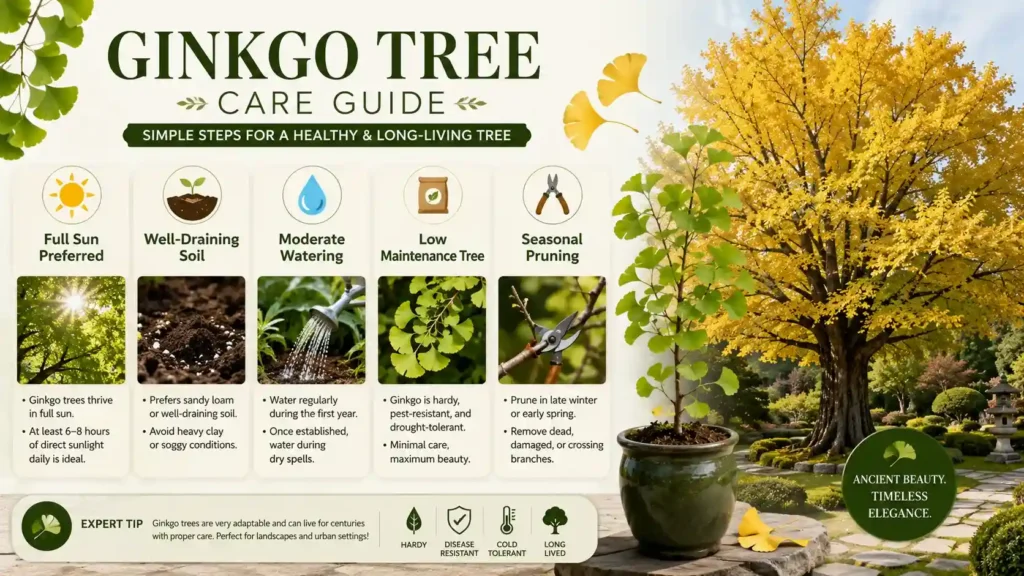
Ginkgo trees benefit from occasional pruning to maintain healthy structure and balanced growth. Young trees especially respond well to early shaping because proper branch development supports stronger mature canopies.
The ideal time to prune ginkgo trees is during late winter or early spring before active growth begins.
Benefits of seasonal pruning include:
Dead, damaged, or crossing branches should be removed promptly to improve airflow and canopy health.
Structural shaping is most important during the early years of growth. Proper shaping encourages:
Excessive pruning should be avoided because mature ginkgo trees naturally develop attractive growth habits with minimal intervention.
Seasonal maintenance helps support healthy growth throughout the year.
During spring, new leaves emerge and active growth begins.
Spring care recommendations include:
Summer care focuses mainly on moisture management.
Important summer practices include:
Established trees tolerate drought better than young saplings.
One of the most recognizable seasonal events is the dramatic fall leaf drop. Ginkgo leaves turn bright golden-yellow before dropping rapidly over a short period.
Fall maintenance includes:
During winter dormancy, growth slows significantly and the tree conserves energy.
Winter care practices include:
Mature ginkgo trees are highly cold-resistant and usually require little winter protection.
Although ginkgo trees are highly resilient, some environmental stresses may occasionally affect growth and appearance.
Yellow leaves may result from:
Improving soil drainage and adjusting watering practices often resolves the issue.
Root rot usually develops in excessively wet or compacted soil.
Prevention methods include:
Early intervention is important because severe root damage can weaken overall tree health.
Leaf scorch may occur during intense heat, drought, or prolonged dry winds.
Common symptoms include:
Deep watering and mulch application help reduce moisture stress.
One reason ginkgo trees are so widely planted is their exceptional natural resistance to pests and diseases.
Ginkgo trees naturally resist many common landscape problems, including:
Their resilience makes them reliable long-term landscape trees.
Although uncommon, occasional issues may include:
Most problems can be minimized through proper planting and maintenance practices.
| Care Factor | Recommendation |
| Sunlight | Full sun preferred |
| Watering | Moderate watering during establishment |
| Fertilization | Light seasonal feeding if needed |
| Mulching | Maintain mulch around root zone |
| Monitoring Growth | Inspect leaves, branches, and soil regularly |
Only female ginkgo trees produce fruit-like seeds with a strong odor. These reproductive structures are one of the most discussed characteristics of the Ginkgo biloba because they affect landscaping choices, maintenance requirements, and public planting decisions.
Although commonly referred to as fruit, the structures produced by female ginkgo trees are technically seed coverings rather than true botanical fruits.
Ginkgo trees are dioecious, meaning male and female reproductive structures grow on separate trees.
Male ginkgo trees produce pollen-bearing cones, while female trees produce ovules that later develop into seed-like fruit structures after pollination.
Key differences include:
Because female trees produce fruit, urban planners and landscapers often select grafted male cultivars for streets and residential landscapes.
Pollination usually occurs during spring when male trees release pollen into the air. Wind carries the pollen to female trees, where fertilization later results in seed development.
As the season progresses:
Fruit production generally begins only after trees reach maturity, which may take many years.
The strong odor produced by female trees is one of the most recognizable features of ginkgo fruit.
Common descriptions of the smell include:
Search phrases commonly associated with this issue include:
The odor develops because the fleshy outer layer contains naturally occurring compounds that release unpleasant smells as the fruit breaks down.
This smell is the main reason why male ginkgo trees are usually preferred for home landscapes, sidewalks, and commercial plantings.
Although the outer fruit layer has a strong odor, the inner seed of the ginkgo tree has culinary uses in several Asian cuisines.
In parts of China, Japan, and Korea, properly prepared ginkgo seeds are sometimes used in:
However, caution is important because raw or improperly prepared seeds may contain compounds that can be harmful in excessive amounts.
Important safety considerations include:
People with allergies or sensitivities should avoid direct contact with the fruit until cleaned properly.
Although ginkgo trees are generally safe landscape plants, certain precautions should be considered when handling fruit and seeds.
Fallen fruit may attract pets because of its texture and smell. Excessive consumption of seeds or fruit material may cause digestive discomfort or toxicity concerns in animals.
Pet safety recommendations include:
Children should not handle or consume raw ginkgo fruit without supervision.
Important precautions include:
The fleshy outer coating of ginkgo fruit may cause skin irritation in sensitive individuals.
Protective measures include:
These precautions are especially important during autumn when mature fruit drops heavily beneath female trees.
Ginkgo trees are widely used as ornamental and urban landscape trees because of their durability, symmetrical growth habit, and striking seasonal color. Their pollution resistance, low-maintenance nature, and long lifespan make Ginkgo biloba one of the most dependable trees for both residential and commercial landscape projects.
For a broader look at landscape tree selection across different climates and garden sizes, see our complete Evergreen, Shade & Landscape Trees Guide.
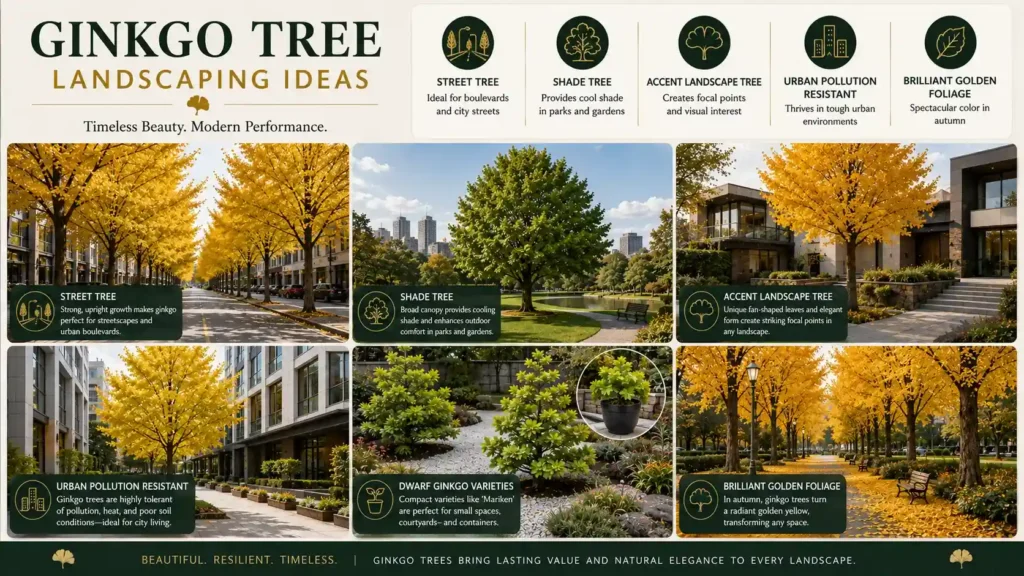
Ginkgo trees fit many landscape styles due to their adaptable size, structured canopy, and elegant foliage.
One of the most common uses of ginkgo trees is urban street planting.
Their popularity comes from:
Cities worldwide frequently plant male ginkgo cultivars along sidewalks, roads, and pedestrian areas because of their durability and clean appearance.
The London Plane Tree is another highly popular urban street tree widely planted alongside ginkgo in city landscapes worldwide.
Large mature ginkgo trees develop broad canopies that provide reliable shade in parks, lawns, and public landscapes.
Benefits as a shade tree include:
Their bright golden autumn foliage also adds dramatic seasonal interest to shaded garden spaces.
Because of their unique fan-shaped leaves and upright growth habit, ginkgo trees also perform exceptionally well as accent trees.
They are often used:
Variegated and dwarf cultivars are especially popular for ornamental accent planting.
Ginkgo trees pair well with many low-maintenance landscape plants that complement their texture and seasonal color.
Good companion plants include:
These plants create layered landscape designs while requiring relatively simple maintenance.
Seasonal contrast planting helps highlight the dramatic golden foliage of the ginkgo tree during autumn.
Popular contrasting plants include:
Combining contrasting textures and colors improves visual depth in garden design.
For dramatic autumn colour contrast, the Liquid Amber Tree is one of the most visually striking companions for ginkgo in temperate garden landscapes.
Ginkgo trees can adapt to both compact gardens and expansive landscapes depending on the selected variety.
Dwarf ginkgo cultivars are ideal for:
Their slower growth and compact size make them easier to manage in limited spaces.
Standard ginkgo trees require significantly more space because mature specimens develop broad canopies and strong root systems over time.
Proper spacing considerations include:
Careful planning is important because mature ginkgo trees can remain part of the landscape for generations.
Landscapers usually prefer male ginkgo trees because they provide all the ornamental benefits of the species without producing foul-smelling fruit.
Advantages of male trees include:
Female trees produce seed-bearing fruit that releases a strong smell after falling and decomposing. To avoid cleanup problems and odor complaints, most commercial nurseries primarily sell grafted male cultivars for landscaping projects.
Choosing the right ginkgo tree depends on its size, variety, growth habit, and intended landscape use. Whether selecting a compact ornamental cultivar or a large shade tree, understanding tree quality and long-term maintenance needs helps ensure healthier growth and better landscape performance.
Before purchasing a Ginkgo biloba, several important factors should be evaluated carefully.
One of the most important considerations is determining whether the tree is male or female.
Male trees are generally preferred because they:
Female trees may still be desirable for:
Most commercial nurseries primarily sell grafted male cultivars for landscaping purposes.
The age of the tree affects both appearance and establishment success.
Younger trees often:
Older trees provide:
However, larger mature specimens may require more careful transplanting.
Healthy roots are essential for successful long-term growth.
When inspecting a tree, look for:
Container-grown and balled-and-burlapped trees should both show stable root development before purchase.
Ginkgo trees are widely available through garden centers, specialty nurseries, online plant retailers, and landscape suppliers.
Common search terms used by buyers include:
Popular varieties sold commercially include:
Buyers should verify cultivar names and sex identification before purchasing, especially for landscape planting near homes or sidewalks.
The ginkgo biloba tree price can vary significantly depending on size, age, cultivar rarity, and nursery quality.
Important ginkgo tree cost factors include:
Small saplings are usually affordable, while mature specimen trees and rare ornamental varieties can be considerably more expensive.
Dwarf and variegated cultivars often command higher prices because of slower growth and limited commercial production.
The best time to plant a ginkgo tree is typically during cooler seasons when environmental stress is lower and root establishment can occur gradually.
Recommended planting seasons include:
Seasonal planting benefits include:
Avoid planting during periods of extreme heat, drought, or frozen ground conditions whenever possible.
Proper watering after planting is especially important during the first growing season to support healthy root development.
Ginkgo trees combine ancient history, medicinal importance, scientific value, and ornamental beauty in a way few other tree species can match. As one of the oldest surviving plant lineages on Earth, Ginkgo biloba continues to attract attention from botanists, landscapers, conservationists, and gardeners worldwide.
Ginkgo trees possess several unusual biological traits that make them distinct from most modern trees.
One of the most remarkable features of the species is its reproductive system.
Key reproductive characteristics include:
This primitive reproductive structure contributes to the tree’s classification as a living fossil.
The fan-shaped leaf structure is another defining biological feature.
Unlike many deciduous trees, ginkgo leaves display:
This leaf structure is considered evolutionarily unique among modern landscape trees.
Ginkgo trees are famous for their extraordinary lifespan.
Many specimens survive for:
Their resilience, disease resistance, and environmental adaptability contribute greatly to their longevity.
Ginkgo trees hold deep cultural significance throughout East Asia, especially in China and Japan.
In Chinese culture, ginkgo trees symbolize:
For centuries, they have been planted near temples, monasteries, and historical gardens.
Traditional cultivation practices helped preserve the species through periods when wild populations became increasingly rare.
Ginkgo trees are also strongly associated with Japanese temple gardens and sacred landscapes.
Their importance in Japan includes:
Many ancient temple grounds still contain massive mature ginkgo trees that are centuries old.
Ginkgo biloba remains a major subject of scientific and botanical research because of its ancient genetics and evolutionary significance.
Researchers study ginkgo trees to better understand:
The species provides valuable insight into prehistoric plant development.
Although widely cultivated today, ginkgo trees remain important for conservation science because they represent one of the oldest surviving seed plant lineages on Earth.
Conservation efforts focus on:
The global popularity of the species also helps support long-term preservation through widespread cultivation.
| Feature | Quick Fact |
| Oldest Living Tree Lineage | More than 200 million years old |
| Pollution Tolerance | Highly adaptable to urban environments |
| Leaf Appearance | Distinctive fan-shaped foliage |
| Fall Color | Bright golden-yellow autumn leaves |
| Lifespan | Extremely long-lived species |
| Landscape Use | Shade, ornamental, and street tree |
The ginkgo maidenhair tree is a resilient, ancient, and visually striking tree valued for its beauty, adaptability, and historical significance. Known scientifically as Ginkgo biloba, this remarkable species has survived for millions of years while continuing to thrive in modern landscapes around the world.
Its fan-shaped foliage, brilliant golden autumn color, pollution resistance, and exceptional longevity make the ginkgo tree one of the most reliable ornamental trees for urban planting, residential gardens, parks, and botanical collections. From compact dwarf varieties to towering mature shade trees, ginkgo trees offer flexible landscape value for both small and large outdoor spaces.
In addition to its ornamental appeal, the species also provides important ecological and environmental benefits. Ginkgo trees help improve urban air quality, reduce heat buildup, absorb carbon, and contribute long-term greenery to developed environments. Their strong resistance to pests, diseases, and environmental stress further increases their value in sustainable landscaping.
The worldwide popularity of the maidenhair tree continues to grow because it combines ancient botanical heritage with practical modern performance. Whether grown for historical interest, decorative foliage, cultural significance, or urban durability, ginkgo trees remain among the most admired and recognizable trees in the world.
Selecting the right variety and following proper planting and care practices are essential for long-term success. Choosing suitable male or female cultivars, providing enough growing space, and maintaining healthy soil and sunlight conditions will help ensure strong growth and lasting landscape beauty for generations.
Ginkgo biloba trees are special because they are considered living fossils that have survived for more than 200 million years. They are known for their fan-shaped leaves, strong resistance to pollution, exceptional lifespan, and brilliant golden autumn foliage. Their resilience and unique botanical history make them one of the most remarkable ornamental trees in the world.
Female ginkgo trees produce seed-like fruit that releases a strong odor when it falls and decomposes. The smell comes from naturally occurring compounds in the fleshy outer coating surrounding the seeds. Male trees do not produce fruit and therefore do not create this odor problem.
Standard ginkgo trees typically grow between 50 and 80 feet tall at maturity, with canopy spreads ranging from 30 to 40 feet. Dwarf cultivars remain much smaller and are better suited for compact gardens and container growing.
Yes, but only female ginkgo trees produce fruit-like seed structures. These seeds develop after pollination and mature during late summer and fall. Male trees do not produce fruit.
Ginkgo biloba trees originated in China but are now cultivated worldwide. They grow successfully in North America, Europe, Asia, and Australia because of their strong adaptability to urban environments and varying climate conditions.
A ginkgo biloba tree has fan-shaped green leaves, upright branching, and a structured canopy. During autumn, the foliage transforms into a bright golden-yellow color before falling rapidly. Mature trees often develop textured gray-brown bark and broad spreading crowns.
Yes, ginkgo trees are highly valued in landscaping because they are durable, low-maintenance, pollution-tolerant, and visually attractive. They are commonly used as street trees, shade trees, accent trees, and ornamental landscape specimens.
Female ginkgo trees produce the strongest odor because they generate seed-bearing fruit. The smell becomes more noticeable after fallen fruit begins decomposing on the ground.
Yes, dwarf and young ginkgo trees can grow successfully in containers when provided with well-draining soil, adequate sunlight, and regular watering. Container growing is popular for patios, balconies, and bonsai cultivation.
Ginkgo trees are extremely long-lived and can survive for hundreds or even thousands of years under suitable conditions. Some historic temple specimens in East Asia are believed to be over a thousand years old.
Ginkgo trees are naturally resistant to many common pests and diseases. Their strong environmental tolerance and durable genetics make them one of the most reliable low-maintenance ornamental trees for urban and residential landscapes.
Yes, ginkgo trees are deciduous trees, meaning they shed their leaves during autumn. Before leaf drop, the foliage turns a vibrant golden-yellow color that creates a dramatic seasonal display.
The best location for planting a ginkgo tree is an area with full sunlight, well-draining soil, and enough space for long-term canopy growth. Standard varieties should be planted away from buildings, sidewalks, and crowded planting zones.
Ginkgo tree roots are generally less aggressive than many urban tree species. Their deeper root systems make them relatively safer for sidewalks and paved areas when planted with proper spacing.
Ginkgo trees grow best in temperate climates with seasonal temperature variation. They tolerate both cold winters and warm summers, making them suitable for a wide range of USDA growing zones.
Ginkgo trees are called living fossils because they have existed for millions of years with very little evolutionary change. Fossil evidence shows that ancient relatives of modern ginkgo trees grew during the time of dinosaurs.