Grow Better Gardens with Smarter Plant Choices
Discover helpful guides on trees, hedges, fruit plants, edible plants, and beautiful landscape greenery.

Evergreen shade and landscape trees form the long-term structural foundation of gardens, parks, streetscapes, and residential landscapes. They provide cooling shade, privacy, habitat value, wind protection, seasonal interest, and environmental benefits that improve both functionality and visual appeal across outdoor spaces.
Evergreen species maintain foliage year-round and are widely used for screening, windbreaks, and permanent garden structure. Deciduous shade trees lose foliage seasonally, creating dense summer shade while allowing winter sunlight into outdoor living areas. Ornamental landscape trees are selected for distinctive foliage colour, flowers, bark texture, canopy shape, or dramatic seasonal display.
Choosing the right evergreen shade and landscape trees depends on several major factors. Climate zone, mature tree size, soil drainage, root behaviour, maintenance requirements, drought tolerance, and intended landscape purpose all influence long-term performance. A tree suited to subtropical Queensland may not perform successfully in Tasmania’s cool climate, while species adapted to Perth’s Mediterranean conditions may struggle in wetter temperate regions.
This guide covers the main categories of landscape trees including evergreen, deciduous shade, and ornamental species commonly used across Australia and the USA. It explains how to identify suitable species for different garden sizes, urban environments, rural properties, streetscapes, privacy screens, and outdoor living areas.
The guide also includes Australian Bureau of Meteorology (BOM) climate zones, USDA Plant Hardiness Zone references, state-by-state suitability for Australian gardeners, growing requirements, watering needs, pruning recommendations, root system considerations, and common tree problems that affect long-term landscape success.
Featured tree profiles include species such as Ginkgo biloba, English Oak, London Plane Tree, Liquid Amber, River Birch, Chinese Elm, Coast Banksia, Coolibah Tree, Spartan Juniper, Leighton Green Cypress, Gleditsia Sunburst, Tipuana Tree, Chinese Tallow Tree, and additional ornamental and screening species covered in the complete category guide. Comparison tables and practical selection guides are included to help homeowners, landscapers, and gardeners choose the most suitable trees for their climate and landscape goals.
This guide is compiled with reference to horticultural best practices, Australian Bureau of Meteorology (BOM) climate zone data, USDA Plant Hardiness Zone systems, and RHS growing guidelines to provide climate-aware, practical, and experience-based landscape tree information.
Landscape trees are woody plants intentionally used in residential gardens, parks, streetscapes, and urban landscapes to provide structure, shade, privacy, environmental value, and ornamental appeal. The main types of evergreen trees for landscaping are broadly divided into evergreen trees, deciduous shade trees, and ornamental landscape trees.
These tree categories serve different landscape purposes. Some create year-round privacy and wind protection, while others provide seasonal shade, autumn colour, flowering displays, or architectural structure. Understanding the differences between evergreen and deciduous species is one of the most important steps in successful landscape planning.
Evergreen trees retain their foliage throughout all four seasons, providing continuous coverage and visual structure year-round. Unlike deciduous species, they do not lose all foliage during autumn and winter, making them highly valuable for privacy screening, windbreaks, and permanent garden framework.
Evergreen landscape trees include both conifers and broadleaf evergreen species. Conifers typically produce needle-like or scale foliage, while broadleaf evergreens maintain wider flat leaves year-round.
Common benefits of evergreen trees include:
Many evergreen species are also highly drought tolerant and adaptable to urban conditions once established.
Popular evergreen landscape tree examples include:
These species are commonly used for hedging, screening, boundary planting, formal gardens, coastal landscapes, and large-scale windbreaks.
Deciduous shade trees shed their foliage during autumn and enter dormancy through winter before producing fresh growth again in spring. These trees are widely planted for broad canopy shade, cooling benefits, and dramatic seasonal colour changes.
One of the biggest advantages of deciduous trees is their seasonal adaptability. Dense foliage provides heavy shade during hot summer months, while leaf drop allows winter sunlight to pass through into gardens and outdoor spaces.
Key characteristics of deciduous shade trees include:
Deciduous trees are especially popular in temperate climates where seasonal temperature variation is significant.
Common deciduous landscape tree examples include:
These trees are frequently planted in parks, avenues, streetscapes, large residential gardens, and outdoor entertaining areas where summer cooling is important.
Ornamental landscape trees are selected primarily for visual impact rather than canopy size or screening performance. Their value comes from flowers, foliage colour, bark texture, branch structure, growth habit, or dramatic seasonal appearance.
Ornamental species may be either evergreen or deciduous depending on the tree type and climate. Many are used as specimen trees or focal points within landscape design.
Key ornamental features may include:
These trees are commonly planted near entrances, courtyards, streetscapes, patios, feature gardens, and modern landscape designs.
Popular ornamental landscape tree examples include:
Many ornamental trees also provide moderate shade and seasonal interest while maintaining manageable mature size for suburban landscapes.
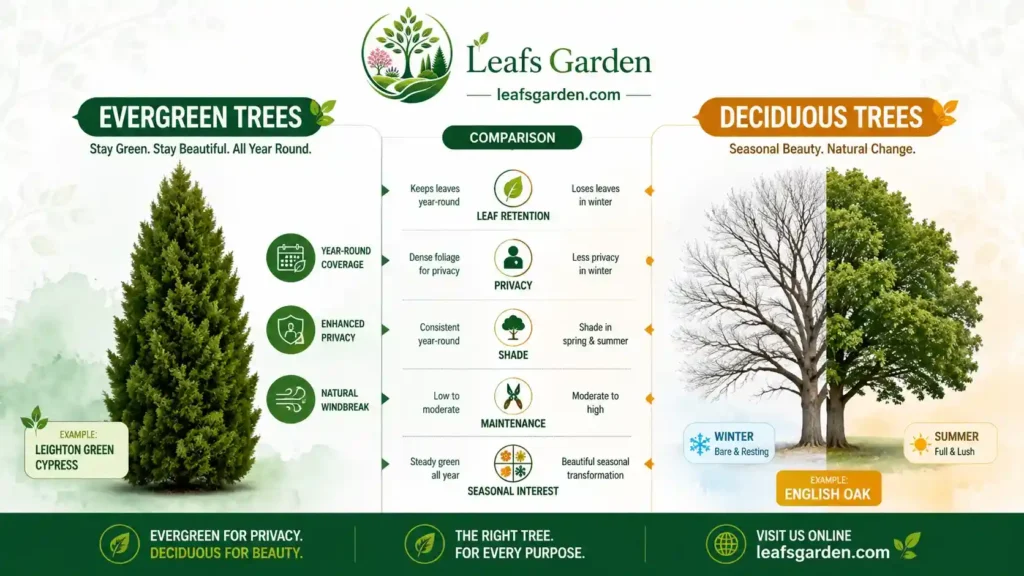
| Feature | Evergreen | Deciduous |
| Leaf retention | Year-round | Seasonal (shed in autumn) |
| Privacy screening | Excellent in all seasons | Limited during winter |
| Shade provision | Moderate and consistent | Maximum during summer |
| Maintenance | Generally lower | Leaf cleanup required |
| Landscape interest | Consistent structure | Seasonal colour and change |
| Common examples | Leighton Green Cypress, Spartan Juniper | English Oak, Liquid Amber |
Choosing the right landscape tree depends on five major factors: available space, climate and hardiness zone, soil conditions, intended landscape purpose, and long-term maintenance requirements. A tree that suits the wrong location can eventually create problems with roots, canopy spread, drainage, excessive maintenance, or poor climate performance.
A proper shade tree selection guide should always focus on mature size, environmental suitability, and long-term landscape function rather than appearance alone. Understanding how to choose landscape trees for your yard helps prevent overcrowding, structural damage, and costly tree removal later.
Available planting space is one of the most important factors when selecting landscape trees. Many species start small but eventually develop large root systems and broad canopies that may overwhelm smaller gardens.
For compact urban gardens or narrow planting strips, columnar or upright trees are usually the best option because they provide vertical structure without excessive canopy spread.
Recommended trees for small gardens include:
These species fit well into courtyards, modern landscapes, narrow side boundaries, and suburban front gardens.
Medium-sized gardens can support broader mid-canopy species that provide moderate shade while remaining manageable in residential landscapes.
Recommended medium-garden trees include:
Large rural properties, parks, and expansive landscapes can accommodate wide-spreading canopy trees with significant mature height and root development.
Best large-property landscape trees include:
Before planting any tree, always check both mature height and mature canopy spread. Many tree-related landscape problems occur because mature size was underestimated at planting time.
Large trees should generally be planted at least 5–10 metres away from:
Proper spacing reduces future root conflicts and structural damage risks.
Climate compatibility determines long-term survival, growth rate, drought tolerance, frost resistance, and overall tree health. Even highly adaptable species perform poorly when planted outside their preferred climate range.
Australian gardeners should consider BOM climate zones, while US gardeners should reference USDA Plant Hardiness Zones. Both systems help determine temperature tolerance and regional suitability.
Frost-sensitive landscape trees generally suit warmer climates including tropical, subtropical, and Mediterranean regions.
Examples include:
These species typically perform best in:
Cold-hardy species tolerate frost, cool winters, and seasonal temperature variation more successfully.
Examples include:
These trees commonly tolerate:
Australian native species are often highly adapted to difficult regional conditions including drought, coastal exposure, poor soils, and heat.
Examples include:
Always verify local climate suitability before purchasing any specimen tree, especially in areas with frost, intense summer heat, strong coastal winds, or prolonged drought.
Soil drainage, texture, fertility, and pH strongly influence root development and long-term tree performance. Most landscape trees grow best in well-draining, moderately fertile soils with stable moisture levels.
However, certain species tolerate more challenging soil conditions better than others.
Trees suitable for wet or periodically waterlogged soils include:
These species tolerate moisture better than many ornamental or evergreen trees.
Trees suited to sandy, dry, or free-draining soils include:
These species are commonly used in coastal gardens, dry landscapes, and low-rainfall regions.
Heavy clay soils can restrict oxygen movement and root expansion, but some trees adapt relatively well with proper soil preparation.
Examples include:
Improving drainage with organic matter and proper soil conditioning helps increase establishment success in clay soils.
Soil pH also affects nutrient availability and overall tree health. Conducting a soil pH test before planting valuable specimen trees is highly recommended, especially when planting species with specific pH preferences.
Different landscape trees serve very different functional purposes. Selecting a species based on its intended role improves long-term landscape performance and reduces maintenance problems.
For privacy screening and dense foliage coverage, evergreen trees are usually preferred because they maintain year-round screening.
Best privacy and screening trees include:
For broad shade and cooling canopy coverage, large deciduous trees are often the best choice because they provide summer shade while allowing winter sunlight through after leaf drop.
Best shade and canopy trees include:
For ornamental impact and visual interest, feature trees with strong foliage colour, flowers, or unique structure are commonly selected.
Best ornamental landscape trees include:
For windbreaks and shelter planting, dense evergreen species perform most effectively.
Best windbreak trees include:
Urban streetscapes require trees that tolerate restricted root zones, heat, pollution, and compacted soils.
Best urban landscape trees include:
For biodiversity and wildlife value, native and ecologically supportive species provide the greatest environmental benefits.
Best wildlife-supporting trees include:
Landscape tree maintenance varies significantly between species. Some require little pruning or seasonal care, while others produce heavy leaf drop, invasive roots, or structural issues that require ongoing management.
Low-maintenance landscape trees generally tolerate drought, require minimal pruning, and maintain stable growth habits.
Examples include:
Moderate-maintenance trees may require occasional shaping, structural pruning, or seasonal cleanup.
Examples include:
Higher-maintenance trees may create recurring landscape issues such as excessive leaf fall, weak branch structure, or seasonal debris.
Examples include:
Understanding long-term maintenance expectations before planting helps homeowners choose landscape trees that match both their property size and maintenance commitment.
Evergreen landscape trees are divided into two main groups: conifer evergreens and broadleaf evergreens. Both types of evergreen trees for landscaping provide year-round foliage, permanent garden structure, visual screening, and long-term landscape stability.
Evergreen species are widely used for:
Unlike deciduous trees, evergreen landscape trees maintain foliage throughout the year, making them highly effective for gardens that require continuous coverage and year-round visual interest.
Conifer landscape trees retain needle-like or scale-type foliage year-round. These trees are among the most popular choices for formal hedges, windbreaks, screening rows, and columnar landscape design.
Most conifer species produce dense growth habits that create excellent visual barriers and shelter from wind exposure. Many are also highly drought tolerant once established.
Key characteristics of conifer evergreen trees include:
Many columnar evergreen trees are especially useful in suburban gardens because they provide vertical structure without excessive horizontal spread.
Leighton Green Cypress is one of the fastest-growing evergreen screening trees used in Australian and international landscapes. Its dense columnar structure makes it highly effective for privacy hedges and windbreaks.
Key features include:
This species is commonly planted along boundaries, rural driveways, and large suburban fences where rapid coverage is required.
Read the complete guide to Leighton Green Cypress for detailed growing, hedge, and care information.
Leighton Green Conifer is a narrower columnar evergreen form suited to tighter planting spaces and modern landscape layouts.
Benefits include:
It works well beside driveways, fence lines, and restricted urban planting zones.
→ [Internal link]
Spartan Juniper is one of the most reliable columnar evergreen trees for formal landscapes and low-maintenance gardens. Its narrow upright form and drought tolerance make it highly popular in contemporary landscape design.
Main characteristics include:
Spartan Juniper is especially useful where vertical structure is needed without excessive width.
→ [Internal link]
Yew Tree species are slow-growing evergreen conifers valued for longevity, dense growth, and formal shaping ability. They are widely used in traditional hedging and topiary gardens.
Important characteristics include:
Yew trees are commonly used in structured European-style landscapes and ornamental hedging.
→ [Internal link]
Broadleaf evergreen trees retain wide flat leaves throughout the year rather than needles or scales. Many also produce flowers, seed pods, or ornamental fruit, adding additional seasonal interest to landscapes.
These evergreen trees are commonly used in warmer climates, temperate coastal regions, wildlife gardens, and naturalistic landscape designs.
Key characteristics include:
Some broadleaf evergreen trees also provide softer, more natural canopy forms compared to formal conifer species.
Coast Banksia is a native Australian evergreen tree highly valued for coastal landscaping, biodiversity support, and pollinator attraction.
Main features include:
It is widely planted in coastal gardens and native Australian landscapes.
→ Read the complete Coast Banksia guide for detailed identification, care, and landscaping information.
Chinese Elm is a semi-evergreen landscape tree known for urban toughness, graceful branching structure, and adaptability to difficult growing conditions.
Key benefits include:
Chinese Elm is frequently used in streetscapes, parks, and residential shade planting.
→ Read the complete Chinese Elm Tree guide for detailed identification, care, bonsai, and growing tips.
Chinese Tallow Tree is widely planted for its dramatic seasonal foliage colour and adaptability to warmer climates, particularly in Perth and Mediterranean-style regions.
Important features include:
Its strong red-orange autumn foliage makes it one of the more visually striking ornamental deciduous landscape species in warmer climates.
→ [Internal link]
Coolibah Tree is an iconic Australian evergreen species adapted to arid and inland landscapes. It is highly drought resilient and capable of surviving difficult environmental conditions.
Major characteristics include:
Coolibah trees are widely used on large rural properties and dry inland landscapes across Australia.
Read the complete Coolibah Trees guide for detailed growing, care, and Australian landscaping information.
Different evergreen landscape trees vary significantly in growth speed, mature size, and intended landscape function. Fast-growing species provide quicker privacy and canopy establishment, while slower-growing trees often require less pruning and develop stronger long-term structure.
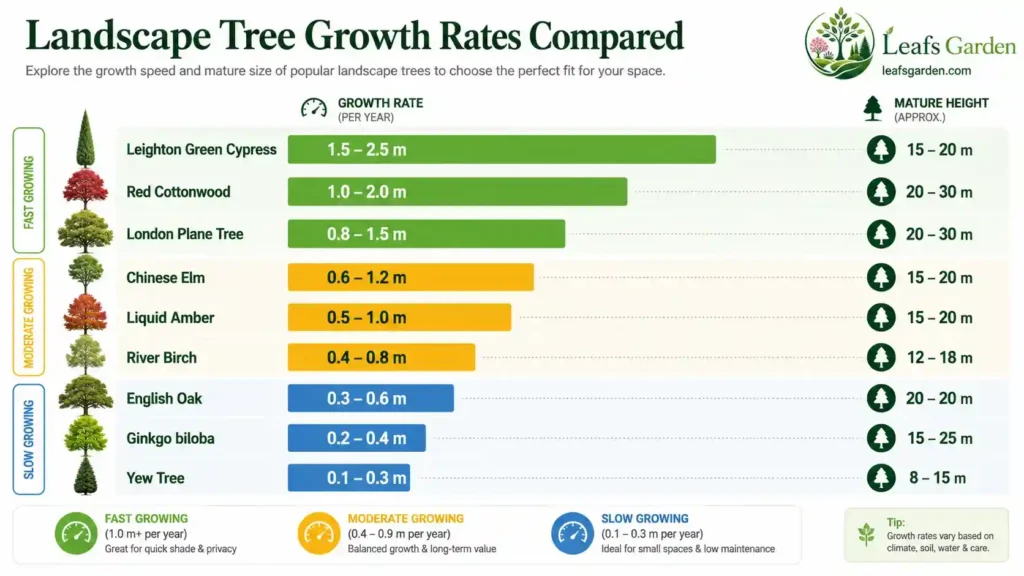
| Tree | Growth Rate | Mature Height | Best Use |
| Leighton Green Cypress | Very fast (60–90cm/year) | 15–25m | Privacy hedge, windbreak |
| Spartan Juniper | Moderate | 4–6m | Formal column, container |
| Coast Banksia | Moderate | 8–15m | Wildlife garden, coastal screen |
| Coolibah Tree | Moderate-fast | 10–20m | Large property, arid landscape |
| Yew Tree | Slow | 4–12m | Hedging, topiary |
Deciduous landscape trees lose their foliage during autumn and produce fresh growth again in spring. These trees are among the best shade trees for garden landscapes because they create dense summer canopy coverage while still allowing winter sunlight to filter through after leaf drop.
This seasonal adaptability makes deciduous shade trees highly valuable in residential landscapes, parks, streetscapes, and outdoor living areas where cooling shade is important during warmer months.
Many deciduous species also provide:
The best deciduous landscape trees combine shade performance, climate adaptability, structural strength, and ornamental appeal.
English Oak is one of the most iconic and historically significant landscape trees in the world. Known for its enormous canopy, exceptional lifespan, and ecological importance, it remains one of the finest large shade trees for cool-temperate landscapes.
Mature English Oaks commonly reach 20–40 metres in height with a broad spreading canopy capable of producing deep dense shade across large outdoor spaces.
Major characteristics include:
English Oak supports hundreds of insect and wildlife species, making it one of the most environmentally valuable deciduous landscape trees available.
This species performs best in:
Because of its eventual canopy size, English Oak is best suited to:
[Internal link: Quercus robur English Oak article]
Liquid Amber is widely planted for its spectacular autumn foliage display, which ranges from orange and red to burgundy and deep purple tones.
This medium-to-large deciduous tree typically reaches 15–25 metres at maturity and develops an attractive pyramidal canopy when young before broadening with age.
Key features include:
Liquid Amber grows best in:
Although highly ornamental, the species may develop surface roots over time. For this reason, it is best planted away from paving, paths, and foundations where root lifting could become problematic.
Liquid Amber is especially popular as:
Read the complete Liquid Amber Tree guide for detailed growing, care, and autumn colour information.
London Plane Tree is one of the most widely planted urban shade trees in the world due to its outstanding tolerance to pollution, compacted soils, drought, and difficult city conditions.
It is recognised for its:
Mature trees can reach 30–40 metres in height with a massive canopy spread, making them highly effective for cooling streetscapes and public spaces.
The bark naturally flakes and sheds, helping the tree tolerate polluted urban environments more effectively than many other deciduous species.
London Plane Tree performs particularly well in:
Because of its large mature size, significant planting space is required.
Read the complete London Plane Tree guide for detailed identification, growth, and care information.
River Birch is a fast-growing deciduous shade tree valued for its peeling cinnamon-coloured bark and tolerance to wet soils.
Unlike many birch species, River Birch handles warmer climates relatively well and remains highly adaptable across a range of landscape conditions.
Key features include:
This species performs especially well in:
River Birch is often planted as a multi-trunk specimen because its bark texture creates strong ornamental interest throughout the year, even during winter dormancy.
Compared to many other birches, it also shows improved heat tolerance in warmer climates.
[Internal link: River Birch article]
Red Cottonwood is one of the largest native deciduous trees in western North America and is valued for its extremely rapid canopy development.
This fast-growing species commonly reaches 20–40 metres in height and performs particularly well in moist environments and large open landscapes.
Important characteristics include:
Red Cottonwood is best suited to:
One major consideration is its seasonal production of cotton-like seed fluff during late spring, which may create maintenance concerns in residential settings.
Due to its size and vigorous root system, it is generally unsuitable for small suburban gardens.
Read the complete Red Cottonwood guide for detailed growing, care, and landscaping information.
| Tree | Mature Height | Autumn Colour | Soil Preference | Best Use |
| English Oak | 20–40m | Brown | Deep, well-drained | Parks, large gardens |
| Liquid Amber | 15–25m | Red-orange-purple | Moist, acidic | Specimen, medium-large garden |
| London Plane Tree | 30–40m | Yellow-brown | Highly adaptable | Street planting, parks |
| River Birch | 12–18m | Yellow | Wet/moist | Medium gardens, waterways |
| Red Cottonwood | 20–40m | Yellow | Moist | Large rural properties |
Ornamental landscape trees are planted primarily for visual impact rather than screening or heavy canopy shade. These trees for year-round interest are valued for their distinctive foliage, seasonal flowers, bark texture, branching form, autumn colour, or architectural appearance within landscape design.
Many ornamental trees function as specimen trees or focal points in gardens, streetscapes, courtyards, and formal landscapes. Some provide dramatic seasonal transformation, while others maintain elegant structure and foliage interest throughout the year.
Common ornamental landscape tree features include:
The best ornamental landscape trees combine visual appeal with adaptability to urban conditions, manageable growth habits, and strong long-term landscape performance.
Ginkgo biloba, commonly called the Maidenhair Tree, is one of the oldest surviving tree species on Earth and is often described as a living fossil. Its ancient lineage, remarkable resilience, and striking autumn foliage make it one of the most recognisable ornamental landscape trees in the world.
The species is especially known for its:
Ginkgo trees are highly resistant to pollution, pests, and difficult urban conditions, making them excellent choices for streetscapes and city planting. Read the complete Ginkgo Maidenhair Tree guide for detailed identification, growing, and care information.
Important planting considerations include:
Ginkgo biloba works especially well in:
Gleditsia Sunburst is a highly ornamental deciduous feature tree known for its bright golden-yellow foliage during spring growth.
As the season progresses, the foliage gradually transitions from vibrant yellow to softer green tones, creating changing visual interest throughout the growing season.
Major characteristics include:
Unlike dense shade trees, Gleditsia Sunburst produces soft dappled shade that allows sunlight to pass through beneath the canopy. This makes it ideal for gardens where filtered light is preferred around lawns, patios, or understory plantings.
The species is widely used in:
It also adapts well to a wide range of soil conditions and urban environments.
[Internal link: Gleditsia Sunburst Tree article]
Bradford Pear is a fast-growing ornamental tree widely planted for its formal rounded crown, dense spring blossom, and colourful autumn foliage.
Its ornamental appeal includes:
Despite its popularity, Bradford Pear has several important structural concerns that should be considered before planting.
Key issues include:
Because of these structural weaknesses, many arborists now recommend alternative ornamental pear cultivars with stronger branching habits.
Always verify local regulations before planting because invasive classifications vary by region.
[Internal link: Pyrus calleryana Bradford article]
Pyrus ‘Capital’, commonly called Capital Pear, is a narrow columnar ornamental pear tree widely used in urban and suburban landscapes where planting space is limited.
Its upright growth habit makes it especially suitable for:
Key ornamental features include:
Compared to Bradford Pear, Capital Pear develops a more structurally stable canopy and is generally considered the preferred ornamental pear for modern urban planting.
The species also tolerates:
[Internal link: Pyrus Capital Pear article]
Tipuana Tree is a large ornamental shade tree widely planted across Australian parks, streetscapes, and public landscapes, particularly in Queensland, New South Wales, and Victoria.
It is highly valued for its:
Depending on climate conditions, Tipuana Tree may behave as semi-deciduous or fully deciduous.
This species performs particularly well in:
Because of its large mature size and broad canopy spread, significant planting space is required.
Read the complete Tipuana Tree Australia guide for detailed growing, care, and landscaping information.
Chinese Tallow Tree is one of the most visually striking ornamental landscape trees for autumn colour in warmer Australian climates, particularly throughout Perth and Western Australia.
The tree produces dramatic seasonal foliage transitions including:
Its seasonal colour contrast makes it highly popular in Mediterranean-style landscapes and ornamental garden settings.
Chinese Tallow Tree is commonly planted in:
However, the species is classified as invasive in some regions internationally and locally. Always verify regional planting regulations before use.
Read the complete Chinese Tallow Tree Perth guide for detailed growing, problems, root system, and care information.
Selecting the right landscape tree requires matching the tree’s natural growth habit, environmental tolerance, canopy structure, and maintenance requirements to the intended landscape purpose. The best trees for privacy and shade are not always the best trees for urban landscaping, small gardens, or difficult climate conditions.
Successful tree selection depends on:
Different landscape situations require different species characteristics to achieve the best long-term results.
Privacy screening trees require dense foliage, reliable coverage, and strong year-round structure. Evergreen species are generally preferred because they maintain foliage in all seasons and provide continuous visual screening.
The most effective privacy trees combine:
Top evergreen trees for privacy screening include:
Leighton Green Cypress is one of the fastest-growing screening trees available and is widely used for large hedges and windbreaks. See the full Leighton Green Cypress guide for hedge spacing, pruning, and problem-solving tips.”
Spartan Juniper works especially well in narrow suburban spaces where upright screening is needed without excessive width.
Coolibah Tree performs effectively in dry inland Australian landscapes where drought resilience is essential.
Yew Tree is highly valued for formal hedging, dense growth, and topiary shaping in cooler temperate regions.
The best shade trees for gardens usually develop broad deciduous canopies that block summer heat while still allowing winter sunlight after seasonal leaf drop.
Large deciduous trees help reduce outdoor temperatures and improve comfort around:
Ideal shade trees should provide:
Top deciduous shade trees include:
English Oak produces deep dense shade and exceptional long-term canopy coverage in large landscapes.
Liquid Amber combines effective summer shade with outstanding autumn colour display. See the full Liquid Amber Tree guide for soil requirements, root system, and maintenance tips.
Gleditsia Sunburst provides softer filtered shade where some sunlight penetration is preferred beneath the canopy.
Tipuana Tree develops a wide spreading canopy that performs especially well in Australian subtropical and warm temperate regions.
London Plane Tree remains one of the most widely used urban shade trees internationally due to its canopy size and environmental tolerance.
Trees for urban landscaping must tolerate difficult environmental conditions including compacted soils, restricted root zones, air pollution, reflected heat, and drought stress.
Urban landscape trees should also possess:
Top urban landscape tree choices include:
London Plane Tree remains one of the most dependable urban planting trees due to its resilience in polluted city conditions. See the full London Plane Tree guide for urban planting, pruning, and problem-solving tips
Chinese Elm performs exceptionally well in streetscapes because of its adaptability and graceful canopy structure. See the full Chinese Elm Tree guide for urban planting, pruning, and problem-solving tips.
Pyrus Capital Pear is highly suitable for narrow urban spaces due to its upright columnar growth habit.
Gleditsia Sunburst provides ornamental value and filtered shade without creating excessively dense canopy cover.
Ginkgo biloba is highly resistant to pollution, pests, and environmental stress, making it one of the toughest ornamental urban trees available. See the full Ginkgo Maidenhair Tree guide for urban planting tips and autumn colour information.
Australia’s climate diversity requires landscape trees that can tolerate heat, drought, coastal exposure, seasonal rainfall variation, and poor soils depending on region.
The best landscape trees for Australian conditions are typically species adapted to local environmental extremes.
Top Australian landscape tree choices include:
Coolibah Tree is highly suited to inland drought-prone environments because of its strong heat and dry-soil tolerance. See the full Coolibah Trees guide for climate suitability, varieties, and maintenance tips.
Coast Banksia performs extremely well in sandy coastal soils and salt-exposed gardens.
Tipuana Tree thrives across many eastern Australian climates including Queensland, New South Wales, and Victoria. See the full Tipuana Tree Australia guide for climate suitability and planting tips.
Chinese Tallow Tree remains popular in Perth and Mediterranean-style Western Australian landscapes due to its autumn colour performance. See the full Chinese Tallow Tree Perth guide for Perth-specific planting and maintenance tips.
Spartan Juniper adapts well across multiple Australian climate regions while maintaining low maintenance requirements.
Small gardens require trees with controlled mature size, manageable root systems, and compact canopy structure. Narrow or moderate-sized species are usually better suited to suburban landscapes than large spreading canopy trees.
The best trees for small gardens should provide:
Recommended small-garden landscape trees include:
Spartan Juniper works especially well where vertical evergreen structure is needed without excessive width.
Pyrus Capital Pear provides strong ornamental value in narrow planting strips and urban courtyards.
Gleditsia Sunburst adds seasonal foliage colour and filtered shade while remaining manageable in medium suburban gardens.
Multi-stem River Birch creates ornamental bark interest and moderate canopy coverage without overwhelming smaller landscapes.
Dwarf forms of Ginkgo biloba allow gardeners to enjoy the species’ distinctive foliage and autumn colour in restricted planting areas.
Most landscape trees share several core growing requirements including suitable sunlight exposure, proper soil drainage, adequate moisture during establishment, and sufficient spacing from buildings and underground infrastructure. Understanding these factors is essential when learning how to choose landscape trees that will remain healthy, structurally stable, and visually attractive long term.
Tree performance is heavily influenced by:
Even highly adaptable species can struggle if planted in unsuitable environmental conditions.
Sunlight exposure directly affects canopy density, foliage colour, flowering performance, and overall tree growth. Most evergreen and deciduous landscape trees perform best in full sun, although some species tolerate partial shade more effectively than others.
Full sun species require at least six hours of direct sunlight per day for optimal growth and canopy development.
Trees that prefer full sun include:
These trees generally develop:
Insufficient sunlight may lead to weak growth, sparse foliage, and reduced ornamental quality.
Some landscape trees adapt well to mixed lighting conditions and can tolerate partial shade during portions of the day.
Species in this category include:
These trees remain suitable for:
Partial shade tolerance can be especially useful in established gardens where surrounding structures or mature trees reduce direct sunlight.
A smaller number of landscape trees tolerate lower-light environments more successfully than sun-demanding species.
Shade-tolerant landscape trees include:
These species adapt more effectively to:
However, even shade-tolerant trees generally perform best with at least moderate natural light exposure.
Soil conditions strongly influence root establishment, nutrient uptake, drainage performance, and long-term tree health. Most landscape trees grow best in moderately fertile soils with reliable drainage and balanced moisture retention.
Poor drainage can lead to:
Different species also prefer different soil pH ranges.
| Tree | Preferred pH | Drainage Preference |
| English Oak | 6.0–7.5 | Well-drained |
| Liquid Amber | 5.5–6.5 (acidic) | Moist, well-drained |
| River Birch | 5.0–6.5 (acidic) | Moist to wet |
| Ginkgo biloba | 5.5–7.5 | Well-drained |
| Coolibah Tree | 6.0–7.5 | Sandy, dry |
| Coast Banksia | 5.5–6.5 | Sandy, well-drained |
| Chinese Elm | 6.0–8.0 | Highly adaptable |
English Oak and Ginkgo biloba prefer reliable drainage and stable soil structure, while River Birch performs exceptionally well in moist or periodically wet conditions.
Coolibah Tree and Coast Banksia are far better adapted to sandy or dry Australian soils than many temperate deciduous species.
Chinese Elm remains one of the most adaptable urban landscape trees due to its tolerance of varying soil conditions and pH levels.
Proper watering during establishment is one of the most important factors affecting long-term tree survival. Newly planted landscape trees require regular moisture until root systems become fully established.
Most trees need consistent watering during the first 1–3 years after planting.
Best watering practices include:
Deep watering improves drought resilience and long-term tree stability.
Mulching around the base of landscape trees also provides major benefits including:
However, mulch should never directly touch the trunk because excessive moisture around the base may increase collar rot risk.
Once fully established, many landscape trees become relatively self-sufficient under normal rainfall conditions.
Exceptions include species such as:
These trees may still require supplemental watering during prolonged dry periods or severe drought.
Most landscape trees benefit from moderate fertilising during early establishment, particularly in nutrient-poor soils. However, excessive fertiliser use can create weak growth, nutrient imbalance, or root stress.
Young trees generally respond best to:
Established mature trees often require little additional fertiliser if growing in reasonably fertile soil conditions.
Important fertilising considerations include:
Soil testing before fertiliser application is strongly recommended because nutrient deficiencies and soil pH issues vary widely between regions and species.
Two major climate zone systems are widely used when selecting landscape trees: Australia’s BOM Climate Zones and the USA’s USDA Plant Hardiness Zones. Understanding climate zones for landscape trees in Australia and USDA zones for landscape trees helps gardeners identify which species are most likely to thrive in their local environment.
Climate zone systems help predict:
Australian BOM zones are based on broader climatic patterns including rainfall, humidity, and seasonal temperature variation. USDA zones primarily focus on minimum winter temperatures and cold-hardiness tolerance.
Using both systems together provides a more accurate understanding of landscape tree suitability across Australia and the United States.
Australia’s Bureau of Meteorology (BOM) climate zone system divides the country into broad climatic regions based on temperature, rainfall, humidity, and seasonal weather patterns. Understanding climate zones for landscape trees Australia is essential because tree performance varies significantly between tropical, coastal, temperate, inland, and alpine environments.
Climate zone selection affects:
Many landscape tree failures occur because species are planted outside their preferred climate range.
| BOM Zone | Zone Name | Key Regions | Characteristics |
| Zone 1 | High Humidity Summer, Warm Winter | Darwin, Cairns, Broome | Hot wet summers; warm dry winters; tropical |
| Zone 2 | Warm Humid Summer, Mild Winter | Brisbane, Townsville, Mackay | Sub-tropical; mild winters; humid summers |
| Zone 3 | Hot Dry Summer, Cool Winter | Perth inland, Broken Hill, Mildura | Hot dry summers; cold nights in winter |
| Zone 4 | Hot Dry Summer, Cold Winter | Canberra, Bathurst, Orange | Distinct seasons; frost in winter |
| Zone 5 | Warm Temperate | Sydney, Adelaide, coastal WA | Mild year-round; moderate rainfall |
| Zone 6 | Mild Temperate | Melbourne, Hobart, ACT elevated | Cool winters; warm summers |
| Zone 7 | Cool Temperate | VIC Highlands, TAS, alpine NSW | Cold winters; mild summers |
| Zone 8 | Alpine | Snowy Mountains, alpine TAS | Very cold; snowfall possible |
Tropical and subtropical regions such as northern Queensland and Darwin generally support frost-sensitive evergreen species including Coast Banksia and Tipuana Tree.
Cool temperate and alpine regions require cold-hardy deciduous species such as English Oak, Ginkgo biloba, River Birch, and Liquid Amber.
Dry inland climates often favour drought-tolerant Australian natives such as Coolibah Tree and adaptable evergreen screening trees like Spartan Juniper.
Different Australian states contain major climate variations that directly affect tree suitability. A species that performs well in Melbourne may struggle in tropical Queensland or alpine Tasmania.
This state-by-state guide helps identify the best landscape trees Queensland gardeners, Perth WA landscapes, shade trees Melbourne properties, and trees for Sydney gardens based on climate adaptability and regional performance.
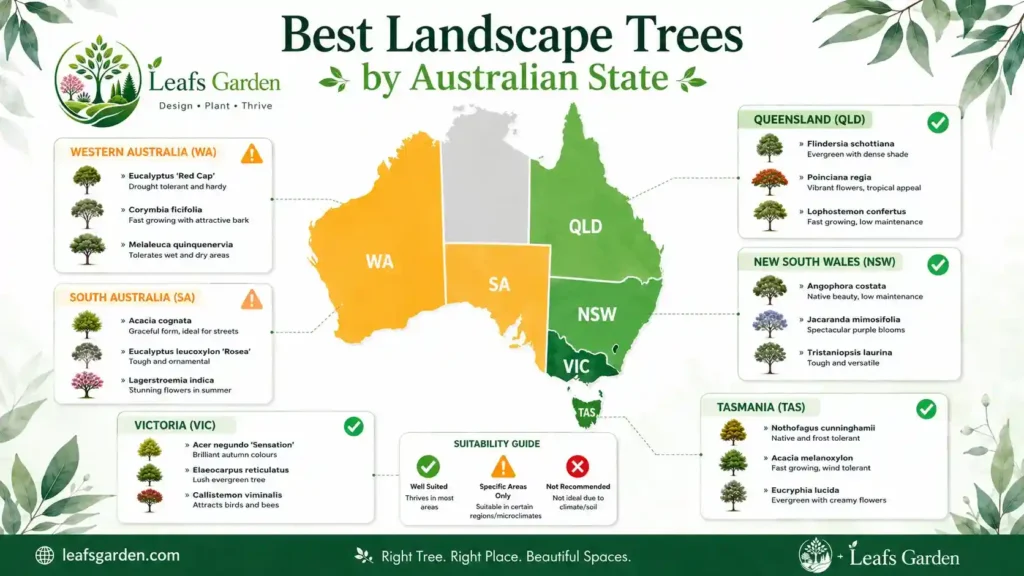
| Tree | QLD | NSW | VIC | WA (Perth) | SA | TAS |
| Leighton Green Cypress | ✅ | ✅ | ✅ | ✅ | ✅ | ✅ |
| Leighton Green Conifer | ✅ | ✅ | ✅ | ✅ | ✅ | ✅ |
| Spartan Juniper | ✅ | ✅ | ✅ | ✅ | ✅ | ✅ |
| Yew Tree | ⚠️ Cool areas only | ✅ Tablelands | ✅ | ⚠️ Hills only | ✅ | ✅ |
| Coast Banksia | ✅ | ✅ | ✅ | ✅ | ✅ | ✅ |
| Coolibah Tree | ✅ | ✅ | ⚠️ Northern VIC | ✅ | ✅ | ❌ |
| Ginkgo biloba | ⚠️ SE QLD | ✅ | ✅ | ⚠️ Hills | ✅ | ✅ |
| English Oak | ❌ | ✅ Cool areas | ✅ | ⚠️ Hills only | ✅ | ✅ |
| Liquid Amber | ⚠️ SE QLD | ✅ | ✅ | ⚠️ Hills | ✅ | ✅ |
| Chinese Elm | ✅ | ✅ | ✅ | ✅ | ✅ | ✅ |
| Red Cottonwood | ❌ | ⚠️ High altitude | ✅ | ❌ | ⚠️ | ✅ |
| London Plane Tree | ✅ | ✅ | ✅ | ✅ | ✅ | ✅ |
| River Birch | ⚠️ SE QLD | ✅ | ✅ | ⚠️ SW WA | ✅ | ✅ |
| Tipuana Tree | ✅ | ✅ | ✅ | ✅ | ✅ | ⚠️ |
| Chinese Tallow Tree | ✅ | ✅ | ⚠️ | ✅ Perth | ✅ | ❌ |
| Gleditsia Sunburst | ✅ | ✅ | ✅ | ✅ | ✅ | ✅ |
| Pyrus Bradford / Capital | ⚠️ SE QLD | ✅ | ✅ | ⚠️ Hills | ✅ | ✅ |
Key:
✅ Well-suited
⚠️ Suitable in specific microclimates only
❌ Not recommended
Evergreen screening trees such as Leighton Green Cypress and Spartan Juniper remain among the most adaptable landscape species across Australia.
Coolibah Tree performs exceptionally well in inland and arid regions but is generally unsuitable for Tasmania due to its cold winters, high rainfall, and consistently moist soils — conditions that conflict directly with the species’ natural adaptation to hot, dry, and drought-prone Australian environments.
English Oak and Liquid Amber achieve their best performance in cooler temperate regions where winter cold supports stronger dormancy and autumn colour development.
The USDA Plant Hardiness Zone system classifies regions according to average annual minimum winter temperatures. USDA zones landscape trees are commonly used throughout the United States to determine winter cold tolerance and planting suitability.
Understanding USDA zones helps identify which trees can survive winter conditions in different US regions.
| Tree | USDA Zones | Best US Regions | Climate Notes |
| English Oak | 5–8 | Pacific Northwest, Northeast, Midwest | Cold-hardy; European origin |
| Ginkgo biloba | 3–9 | Nationwide except deep south | Highly cold-hardy; urban-tolerant |
| Liquid Amber | 5–9 | Southeast, Midwest, Pacific Northwest | Needs winter cold for autumn colour |
| River Birch | 4–9 | East, Southeast, Midwest | Cold-hardy; heat-tolerant |
| Leighton Green Cypress | 6–9 | Pacific Northwest, Southeast, Southwest | Temperate to subtropical |
| Coast Banksia | 9–11 | Southern California, Florida, Hawaii | Warm-climate only |
| Coolibah Tree | 9–11 | Southwest deserts, Southern California | Extreme drought tolerance |
| Tipuana Tree | 9–11 | Southern California, Arizona, Florida | Subtropical/warm temperate |
| Spartan Juniper | 4–9 | Nationwide | Widely adaptable; low maintenance |
| Chinese Elm | 5–9 | Nationwide except coldest zones | Adaptable; urban-tolerant |
| London Plane Tree | 5–9 | East Coast, Midwest, Pacific Coast | Pollution and heat tolerant |
| Gleditsia Sunburst | 4–9 | Midwest, Southeast, Northeast | Urban tolerant; light shade |
| Pyrus Bradford / Capital | 5–9 | Southeast, Midwest, Mid-Atlantic | Bradford invasive in some states |
| Red Cottonwood | 4–8 | Pacific Northwest, Northern Rockies | Large riparian and rural landscapes |
Cold-hardy species such as Ginkgo biloba, River Birch, and English Oak tolerate colder northern climates successfully, while Coast Banksia, Tipuana Tree, and Coolibah Tree remain restricted to warmer subtropical and Mediterranean regions.
Australian BOM zones and USDA hardiness zones measure climate differently, but approximate comparisons can still help gardeners understand broad regional compatibility between Australia and the United States.
Local humidity, rainfall, summer heat, and soil conditions still vary significantly even when temperature ranges appear similar.
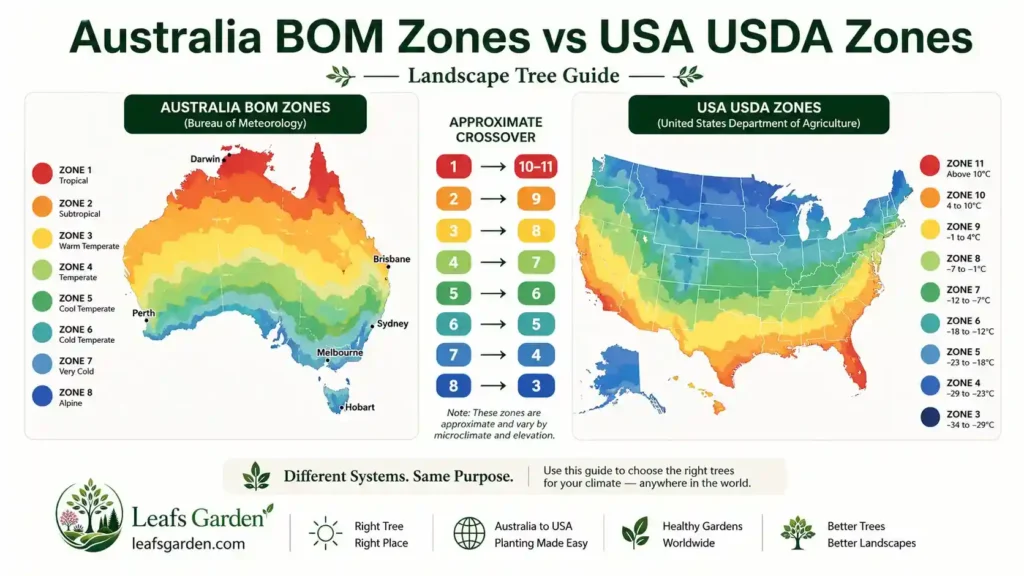
| Australian BOM Zone | Approximate USDA Equivalent | Example AU Region | Example US Region |
| Zone 1 (Tropical) | USDA 12–13 | Darwin, Cairns | Southern Florida, Hawaii |
| Zone 2 (Sub-tropical) | USDA 10–11 | Brisbane, Townsville | Southern California, Gulf Coast |
| Zone 3 (Hot Dry) | USDA 9–10 | Perth inland, Mildura | Arizona, Central Valley California |
| Zone 4 (Hot/Cold) | USDA 8–9 | Canberra, Orange | Pacific Northwest, Mid-Atlantic |
| Zone 5 (Warm Temperate) | USDA 9–10 | Sydney, Adelaide | Pacific Coast California, Carolinas |
| Zone 6 (Mild Temperate) | USDA 8–9 | Melbourne, coastal SA | Pacific Northwest, Virginia |
| Zone 7 (Cool Temperate) | USDA 7–8 | VIC Highlands, Tasmania | New England, Upper Midwest |
| Zone 8 (Alpine) | USDA 5–6 | Snowy Mountains | Rocky Mountains, Northern Midwest |
These approximate crossover references help gardeners compare tree suitability internationally, particularly for species commonly planted in both Australian and American landscapes.
Most landscape trees require relatively low maintenance once fully established, but regular pruning, canopy management, pest monitoring, and proper mulching remain essential for long-term tree health and structural stability.
Good maintenance practices help improve:
Routine maintenance also reduces the risk of branch failure, pest infestations, poor growth habits, and structural instability in mature trees.
Proper pruning improves tree structure, removes damaged growth, and helps maintain healthy canopy development. Incorrect pruning, excessive canopy removal, or pruning at the wrong time of year can weaken trees and increase disease susceptibility.
For most deciduous landscape trees, the best pruning period is:
Dormant-season pruning helps reduce stress while encouraging strong spring growth.
Conifer and evergreen landscape trees require different pruning management. Heavy pruning during hot summer conditions may expose foliage to stress and sun damage.
Best evergreen pruning practices include:
Formal evergreen species such as:
often benefit from light shaping once or twice annually to maintain clean architectural structure.
General pruning guidelines include:
Certain species require more specialised structural pruning.
Bradford Pear is one of the best examples because its naturally weak branch angles increase splitting risk during storms and heavy wind events. Corrective pruning while young helps improve long-term branch structure and reduce canopy failure.
Different landscape trees experience different pest and disease pressures depending on climate, soil drainage, environmental stress, and species susceptibility.
Healthy trees generally show greater resistance to insects and disease problems than stressed or poorly maintained specimens.
| Tree | Common Problem | Recommended Solution |
| Leighton Green Cypress | Cypress canker (Seiridium) | Remove affected branches; improve air circulation |
| English Oak | Oak gall wasps | Usually cosmetic only; rarely serious |
| Liquid Amber | Iron chlorosis | Acidify soil; apply foliar iron supplement |
| Chinese Elm | Elm leaf beetle | Targeted insecticide; maintain tree health |
| Bradford Pear | Fire blight | Remove infected wood; copper spray treatment |
| River Birch | Bronze birch borer | Maintain vigour; avoid drought stress |
| Ginkgo biloba | Very few significant pests | One of the most pest-resistant landscape trees |
| Coast Banksia | Phytophthora root rot | Improve drainage; avoid overwatering |
Many disease issues are linked to poor drainage, excessive stress, compacted soils, or incorrect watering practices.
Improving overall tree health through proper mulching, watering, and pruning often reduces pest susceptibility significantly.
Tree root systems are one of the most important long-term considerations in landscape design. Incorrect placement may eventually damage paving, retaining walls, drainage systems, foundations, or underground utilities.
Some landscape trees produce aggressive shallow root systems capable of lifting surfaces and invading nearby infrastructure.
Trees known for more aggressive surface roots include:
These species should generally be planted well away from:
Other species develop deeper or less invasive root systems that are safer for suburban planting environments.
Trees with deeper root tendencies include:
Once established, these species are generally less likely to create major surface root problems compared to shallow-rooted trees.
Species with relatively non-invasive root systems include:
These trees are often preferred in smaller residential gardens and urban landscapes with restricted planting space.
As a general landscape rule:
Adequate spacing helps reduce future structural conflicts and allows healthy root development.
Landscape tree maintenance requirements change throughout the year depending on growth stage, dormancy cycle, seasonal stress, and climate conditions.
Following a seasonal maintenance schedule helps maintain consistent tree health and canopy performance.
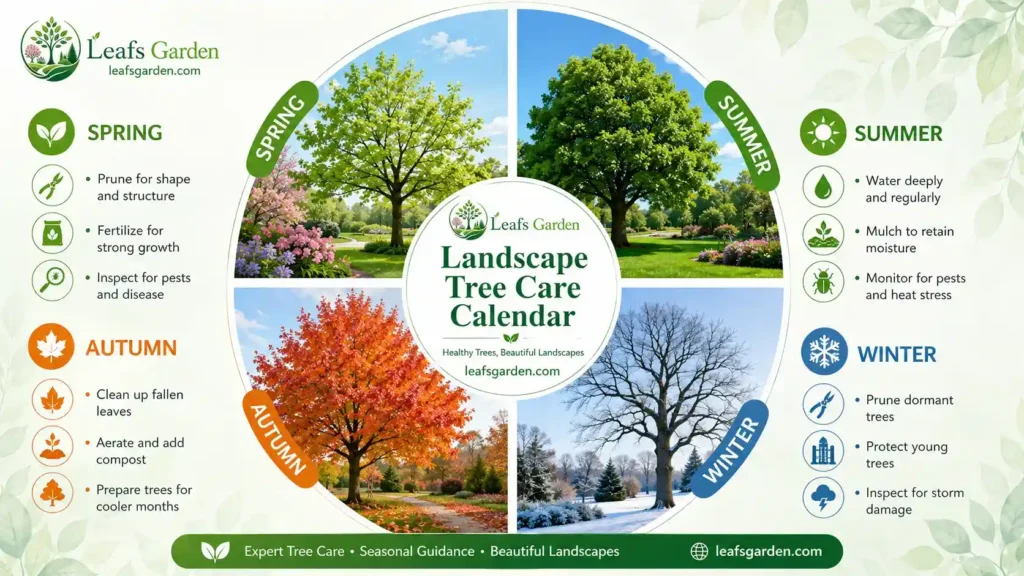
| Season | Key Tasks |
| Spring | Fertilise young trees; inspect for pest activity; light pruning of evergreens |
| Summer | Deep watering during dry periods; monitor pests; avoid heavy pruning |
| Autumn | Apply mulch after leaf drop; structural pruning as deciduous trees enter dormancy |
| Winter | Major structural pruning of deciduous trees; plant dormant bare-root specimens |
Spring and summer focus primarily on active growth management, watering, and pest monitoring.
Autumn and winter are generally the best periods for structural pruning, transplanting, and dormant-season planting for many deciduous species.
Consistent seasonal maintenance helps improve:
Landscape trees provide major environmental and ecological benefits beyond visual beauty and shade. Mature trees improve air quality, reduce urban heat, support biodiversity, stabilise local microclimates, and contribute to long-term carbon sequestration.
Well-planned tree planting also improves:
Both native and non-native landscape trees can contribute environmental value, although native species generally provide stronger ecological support for local wildlife systems.
Trees absorb atmospheric carbon dioxide (CO₂) through photosynthesis and store carbon within their trunk, branches, roots, and woody tissue over long periods.
Large, long-lived landscape trees typically provide the greatest carbon sequestration value because they accumulate more woody biomass over time.
High carbon-storage landscape trees include:
These species can remain in landscapes for decades or even centuries, continuously storing carbon while producing oxygen and improving air quality.
Landscape trees also help reduce airborne pollutants by trapping:
London Plane Tree is especially recognised for its pollution tolerance and ability to trap particulate matter on its rough leaf surfaces and textured bark.
Urban tree canopy plays an important role in improving air quality near:
Urban environments often become significantly hotter than surrounding rural areas due to concrete surfaces, asphalt, buildings, and reduced vegetation. This phenomenon is known as the urban heat island effect.
Landscape trees help reduce urban temperatures through:
Large shade trees can reduce surrounding surface temperatures by approximately 5–10°C depending on canopy size and planting density.
Some of the most effective shade trees for urban cooling include:
These species develop broad canopies that significantly reduce heat buildup around:
Street tree planting also lowers cooling costs in nearby buildings by reducing direct sun exposure on roofs, walls, and paved surfaces.
In warmer climates, strategic shade tree placement can substantially improve outdoor comfort and energy efficiency.
Landscape trees provide critical habitat, shelter, nesting sites, nectar sources, and food resources for birds, insects, pollinators, and other wildlife.
Native species generally support far greater biodiversity value than exotic ornamental trees because local wildlife evolved alongside them.
Ecologically valuable landscape trees include:
English Oak is widely regarded as one of the most biodiverse landscape trees because it supports hundreds of invertebrate species including caterpillars, beetles, and pollinating insects.
Coast Banksia provides highly valuable nectar resources for:
See the full Coast Banksia guide for wildlife value, coastal planting, and care tips.
River Birch, Coolibah Tree, and Ginkgo biloba also contribute important nesting habitat and shelter opportunities for birds and urban wildlife.
Biodiversity-focused landscapes often combine:
However, some ornamental plants may create ecological concerns if they become invasive outside cultivation.
Purple Fountain Grass (Pennisetum setaceum) is classified as invasive in many Australian regions and should be used cautiously. Native ornamental grass alternatives are generally preferred in biodiversity-sensitive landscapes.
→ [Internal link: Purple Fountain Grass Australia]
Landscape trees significantly improve outdoor comfort by moderating wind exposure, reducing noise levels, and creating more stable microclimates around homes and gardens.
Dense evergreen screening trees are particularly effective for:
Leighton Green Cypress is one of the most effective evergreen screening species for reducing visual and acoustic intrusion.
Dense evergreen hedges and tree screens may reduce noise levels by approximately 5–10 decibels depending on planting density and canopy thickness.
Windbreak tree planting also helps:
Large deciduous shade trees contribute major summer cooling benefits by reducing direct solar exposure across lawns, patios, buildings, and outdoor living areas.
Mature canopy trees create more comfortable garden microclimates while improving long-term landscape sustainability and environmental resilience.
This section provides quick-reference profiles for the major evergreen, deciduous, ornamental, and flowering species covered in this guide. These summaries help homeowners, landscapers, and gardeners compare mature size, growth rate, climate suitability, and primary landscape use before exploring full individual growing guides.
The profiles below function as a landscape tree reference hub covering evergreen screening trees, deciduous shade trees, urban canopy species, ornamental feature trees, and Australian climate-adapted landscape plants.
Leighton Green Cypress is one of the fastest-growing evergreen privacy trees used for dense screening and shelterbelts in residential and rural landscapes.
→ Leighton Green Cypress — Complete Growing, Care, Hedge & Problem-Solving Guide
Leighton Green Conifer provides upright evergreen structure and is especially suitable for tight suburban planting spaces.
→ [Full article]
Spartan Juniper is a highly adaptable columnar evergreen tree commonly used in modern landscape design and formal gardens.
→ [Full article]
Yew Trees are long-lived evergreen conifers valued for dense foliage, pruning tolerance, and traditional formal landscape structure.
Coast Banksia is a native Australian evergreen species highly valued for pollinator support, coastal tolerance, and ecological landscaping.
Coolibah Trees are drought-tolerant Australian natives adapted to dry inland environments and large-scale landscape planting.
→ Coolibah Trees: Complete Guide to Coolabah Tree Varieties, Care, Growth, and Australian Uses
Ginkgo biloba is one of the oldest living tree species on Earth and is widely planted for its pollution tolerance and brilliant autumn colour.
→ Ginkgo Maidenhair Tree: Complete Guide to the Ancient Ginkgo Biloba Tree
This profile covers deeper cultivation, growth, maintenance, and ornamental characteristics of Ginkgo biloba.
English Oak is a massive long-lived deciduous shade tree with exceptional biodiversity and canopy value.
Liquid Amber is highly prized for its dramatic red, burgundy, orange, and purple autumn foliage display.
→ The Liquid Amber Tree Looks Magical in Fall Until You See the Ground Beneath It
Chinese Elm is an adaptable semi-evergreen shade tree known for graceful branching and excellent urban tolerance.
→ Chinese Elm Tree Guide: Identification, Care, Problems, Bonsai & Growing Tips
Red Cottonwood is one of the fastest-growing large deciduous trees used for rapid canopy establishment.
→ Red Cottonwood (Hibiscus tiliaceus rubra): Complete Growing, Care & Landscaping Guide
London Plane Tree is one of the world’s most widely planted urban shade trees due to its pollution tolerance and large canopy.
→ London Plane Tree Guide: Identification, Growth, Problems, Allergies, Benefits, and Care
River Birch is valued for its ornamental peeling bark and strong tolerance to moist soil conditions.
Tipuana Tree is a large ornamental shade species recognised for its golden-yellow summer flowers and broad canopy.
→ Tipuana Tree Australia — Complete Guide to the Fast-Growing Tipuana Tipu Tree.
Chinese Tallow Tree is highly valued in Perth and Mediterranean-style landscapes for its vibrant autumn foliage.
→ Chinese Tallow Tree Perth — Benefits, Problems, Growth, Root System & Care Guide
Gleditsia Sunburst provides soft dappled shade and bright golden spring foliage in suburban landscapes.
Bradford Pear is known for dense white spring flowers and colourful autumn foliage, although structural weaknesses require consideration.
Capital Pear is a narrow upright ornamental tree ideal for compact urban planting and formal avenue landscapes.
Purple Fountain Grass is frequently used in landscape design for foliage contrast and architectural texture. However, it is classified as invasive in many Australian regions.
Always verify local planting regulations before use and consider native ornamental grass alternatives where biodiversity concerns exist.
→ [Full article]
Evergreen, shade, and landscape trees form the permanent structural framework of gardens, parks, streetscapes, and outdoor living spaces. The long-term success of any landscape depends heavily on selecting species that match the local climate, available planting space, soil conditions, maintenance expectations, and intended landscape purpose.
Choosing the right tree at the beginning helps prevent future problems related to:
Different landscape trees serve very different functions. Evergreen species provide reliable year-round privacy and wind protection, while deciduous trees deliver seasonal shade and autumn colour. Ornamental feature trees contribute architectural structure, flowers, foliage contrast, and visual focal points within landscape design.
Key landscape tree recommendations include:
Australian gardeners should always check both BOM climate zones and state-specific suitability before purchasing landscape trees. A species that performs well in Melbourne or Tasmania may struggle in tropical Queensland or dry inland Western Australia.
It is also important to consider mature canopy spread and root behaviour rather than focusing only on the tree’s size at planting time. Many landscape conflicts occur because trees eventually outgrow the available space.
Before planting any species, always verify:
Species such as Bradford Pear, Chinese Tallow Tree, and Purple Fountain Grass may be restricted or classified as invasive in certain regions.
For biodiversity and ecological value, native Australian landscape trees generally provide the strongest support for local wildlife, pollinators, and habitat systems. Species such as Coast Banksia and Coolibah Tree contribute significant ecological benefits alongside ornamental and shade value.
Explore the complete species profiles in this category for more detailed growing guides, identification features, climate suitability, maintenance advice, pruning recommendations, and problem-solving information for every tree covered in this guide.
This guide is compiled with reference to Australian Bureau of Meteorology (BOM) climate zone data, USDA Plant Hardiness Zone systems, horticultural best practices, and RHS growing guidelines to provide accurate, climate-aware, and practical landscape tree information.
The best evergreen tree for privacy screening in Australia is generally the Leighton Green Cypress. It grows rapidly at approximately 60–90cm per year, develops dense evergreen foliage, and provides reliable year-round screening across most Australian climate regions. For smaller gardens or narrow suburban spaces, Spartan Juniper is an excellent alternative because of its upright columnar growth habit and lower maintenance requirements. In dry inland or arid Australian landscapes, the Coolibah Tree also performs well as a long-term evergreen screening and windbreak species due to its drought tolerance and strong canopy structure.
Evergreen landscape trees retain foliage throughout the year, providing continuous privacy, wind protection, and structural greenery in all seasons. These trees are commonly used for hedging, screening, and permanent landscape structure. Deciduous landscape trees lose their leaves during autumn and regrow foliage in spring. They provide dense summer shade, allow winter sunlight to pass through after leaf drop, and often produce dramatic autumn colour displays. In most Australian gardens, combining evergreen and deciduous species creates the best balance of year-round structure, seasonal interest, and environmental performance.
The best landscape trees for Australian conditions depend on regional climate and environmental conditions. Recommended species include: Coolibah Tree for arid and inland regions Coast Banksia for coastal and sandy soils Tipuana Tree for subtropical and warm temperate climates Chinese Tallow Tree for Perth and WA landscapes Spartan Juniper for adaptable low-maintenance planting In Australian urban environments, London Plane Tree and Chinese Elm are widely used because they tolerate: Pollution Heat Compacted soils Drought stress Restricted root zones These species perform reliably across many Australian cities and streetscapes.
Landscape tree growth rates vary significantly depending on species, climate, soil quality, and water availability. Fast-growing landscape trees include: Leighton Green Cypress — approximately 60–90cm per year Red Cottonwood — up to 1 metre per year London Plane Tree — approximately 30–60cm per year Moderate-growing species include: Chinese Elm Liquid Amber River Birch Slow-growing trees include: English Oak Yew Tree Ginkgo biloba Although slower-growing species establish more gradually, they often provide superior longevity, structural strength, and ecological value over time.
Bradford Pear trees provide attractive white spring flowers, formal canopy shape, and colourful autumn foliage, making them visually appealing ornamental trees. However, they also have several important disadvantages: Weak branch structure Increased storm splitting risk Structural instability with age Invasive classification in parts of the USA For most modern landscapes, Pyrus Capital Pear is generally considered the better ornamental pear choice because it develops stronger branch structure while still providing similar ornamental qualities and seasonal colour. Always verify local regulations and planting recommendations before using Bradford Pear in Australian landscapes.
Several landscape trees produce exceptional autumn foliage colour across temperate Australian climates. Top autumn-colour landscape trees include: Liquid Amber (Liquidambar styraciflua) — red, orange, burgundy, and purple Ginkgo biloba — brilliant golden yellow River Birch — warm yellow tones Chinese Tallow Tree — red and orange foliage Pyrus Capital Pear — red, orange, and purple autumn colour Among these species, Liquid Amber is widely regarded as one of the most dramatic autumn-colour trees for Australian gardens due to its intense seasonal foliage display.
London Plane Tree is widely regarded as one of the most pollution-tolerant landscape trees used in Australian and international urban planting. The species performs exceptionally well in difficult city environments because it tolerates: Air pollution Heat stress Compacted soils Drought conditions Urban infrastructure pressure Its distinctive bark naturally sheds accumulated grime and pollutants, helping maintain long-term tree health in dense urban areas. Other highly pollution-tolerant landscape trees include: Chinese Elm Ginkgo biloba Gleditsia Sunburst These species are commonly used in streetscapes, urban parks, and roadside planting throughout Australian cities.