Grow Better Gardens with Smarter Plant Choices
Discover helpful guides on trees, hedges, fruit plants, edible plants, and beautiful landscape greenery.
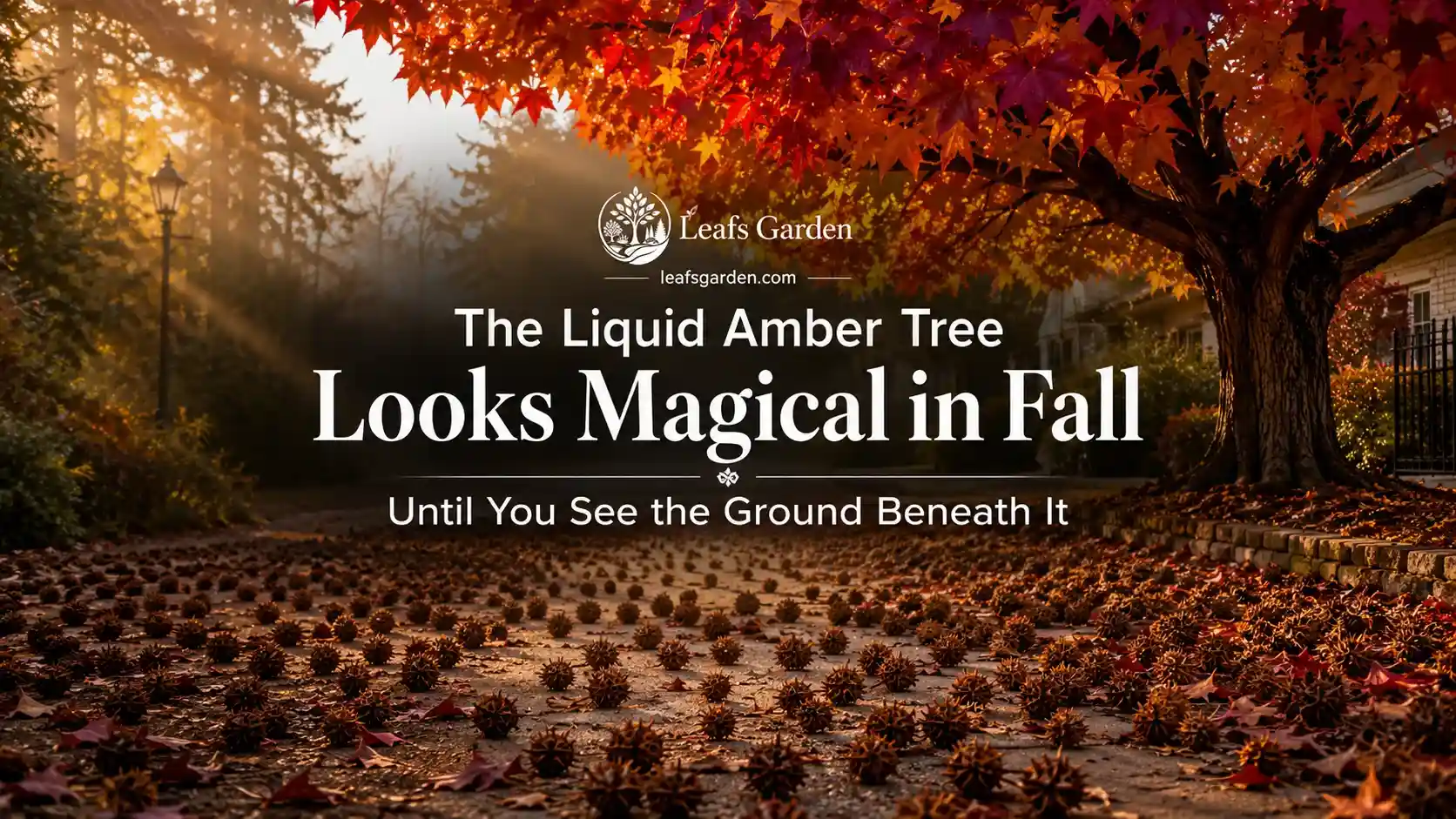
Liquid amber is a deciduous ornamental tree known for its star-shaped leaves, vibrant autumn foliage, and spiky seed balls called sweetgum balls or “gumballs from trees.” The tree is scientifically known as Liquidambar styraciflua and is commonly called the american sweetgum tree, sweetgum tree, liquidambar sweet gum, or amber tree.
The liquid amber tree is widely planted in Australia, North America, and urban landscapes because of its fast growth, strong shade canopy, and dramatic seasonal color. During autumn, the foliage changes into bright shades of yellow, orange, red, and purple, making the liquid amber plant a major feature tree in parks, streetscapes, and residential gardens.
Liquidambar Australia plantings are especially popular in cooler temperate regions where the tree develops stronger autumn color. Along with its ornamental appeal, the american sweet gum is also known for surface roots, heavy leaf drop, and spiky seed pods that can create maintenance challenges.
Despite these drawbacks, the liquid amber tree remains one of the most popular deciduous landscape trees for large gardens, shade planting, and autumn-focused landscapes worldwide.
The liquid amber tree is a fast-growing deciduous hardwood tree scientifically known as Liquidambar styraciflua. It is widely grown as an ornamental shade tree because of its colorful autumn foliage, strong vertical growth, and distinctive spiky seed pods.
This species belongs to the sweetgum group and is commonly planted in parks, streets, and large residential landscapes across North America and Australia.
The botanical name of the liquid amber tree is Liquidambar styraciflua. It belongs to the Altingiaceae plant family, a small group of flowering hardwood trees known for resin production and ornamental foliage.
The genus Liquidambar includes several deciduous tree species valued for autumn color and landscape use. The term “styraciflua” means “flowing with styrax,” referring to the aromatic resin historically extracted from the tree.
Common names for Liquidambar styraciflua include:
The tree is often referred to as liquidambar sweet gum in horticulture and landscaping discussions.
The liquid amber tree is native to parts of the Eastern United States, Central America, and Mexico. In its natural habitat, it commonly grows in moist lowlands, woodland edges, and river valleys with fertile soil.
Over time, Liquidambar styraciflua was introduced into Australia, Europe, and other temperate regions because of its ornamental value and reliable autumn color.
Today, liquidambar Australia plantings are especially common in:
The tree performs best in regions with distinct seasonal temperature changes.
The sweetgum tree gets its name from the aromatic resin or gum produced inside the bark and trunk tissues. This resin was historically used for medicinal purposes, chewing gum products, and traditional remedies in parts of North America.
The resin produced by the american sweetgum tree is sometimes compared to amber because of its glossy appearance and sticky texture. However, sweetgum resin is not the same as fossilized amber.
The main difference is:
This natural resin production is one of the defining characteristics of the liquid amber plant.
| Term | Meaning |
| Liquid Amber | Ornamental deciduous tree |
| Sweetgum | Common name for Liquidambar |
| Liquidambar styraciflua | Scientific name |
Liquid amber trees are recognized by their star-shaped leaves, corky bark, upright growth habit, and spiky seed balls commonly called “gumballs from trees.” These distinctive features make the liquid amber tree easy to identify in parks, streetscapes, and large landscapes.
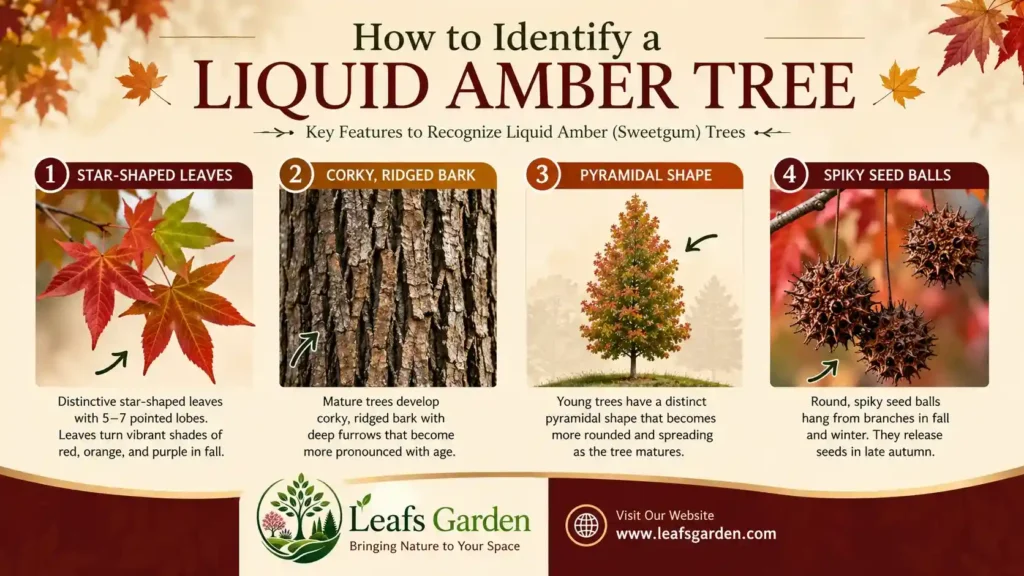
The combination of vibrant autumn color and textured bark gives the sweetgum tree strong ornamental value throughout the year.
Liquid amber leaves are star-shaped with pointed lobes that resemble maple leaves at first glance. Most leaves have 5 to 7 sharply pointed lobes with a glossy surface and symmetrical shape.
During the growing season, the foliage remains deep green. In autumn, the leaves develop dramatic seasonal color changes including:
This intense color transformation is one of the main reasons the liquidambar sweet gum is widely planted in ornamental landscapes.
Although the liquid amber tree is often compared to maple trees, there are noticeable differences in leaf structure.
Liquid amber vs maple leaf differences include:
The liquid amber maple comparison is common because both trees produce strong autumn color, but their seed structures and bark patterns are completely different.
The bark of the american sweetgum tree develops deep ridges and furrows as the tree matures. Younger branches often display corky wing-like growths that add texture during winter.
Young liquid amber trees naturally form a pyramid-shaped canopy with strong vertical growth. As the tree ages, the canopy becomes broader and more rounded.
Typical growth habit features include:
This structured shape makes the liquid amber plant popular as a shade tree and avenue planting species.
The sweetgum tree produces round spiky seed pods commonly known as sweetgum balls or “gumballs from trees.” These seed balls hang from long stems and remain attached to the tree after leaf drop.
Each spiky pod contains multiple seed capsules that open over time to release seeds for birds and wildlife.
Wildlife interactions include:
Despite their ecological benefits, sweetgum balls are considered messy in residential landscapes because they accumulate heavily beneath mature trees.
Common cleanup concerns include:
Fruitless liquidambar cultivars are often selected in urban landscapes to reduce this issue.
Liquid amber trees are considered fast-growing deciduous hardwood trees with a tall upright structure. Mature trees can become very large under ideal growing conditions.
Typical mature size includes:
The tree develops rapidly during its early years, especially in fertile moist soil with full sun exposure.
Key growth characteristics include:
Many healthy liquid amber trees can live for more than 100 years when grown in suitable climates.
| Feature | Description |
| Leaves | Star-shaped |
| Fruit | Spiky seed balls |
| Growth | Fast-growing |
| Fall Color | Red, orange, purple |
Several Liquidambar species exist worldwide, but Liquidambar styraciflua is the most widely grown ornamental type. Different species and cultivars vary in size, canopy shape, seed production, and climate adaptability.
Modern liquidambar selections are commonly used in parks, streetscapes, urban gardens, and residential landscapes because growers can choose forms suited to different space requirements.
Liquidambar styraciflua, commonly called the american sweetgum tree, is the most popular and widely planted liquid amber species. It is native to the Eastern United States and parts of Central America.
This species is known for:
The liquidambar sweet gum is commonly planted as:
Because of its large mature size, the standard sweetgum tree is best suited for spacious landscapes and open planting areas.
Liquidambar formosana is an Asian liquidambar species native to regions of China, Taiwan, and surrounding parts of East Asia. It is sometimes called the Chinese sweetgum.
Compared to Liquidambar styraciflua, this species has several differences:
Although less common in Western landscaping, Liquidambar formosana is valued in botanical collections and some temperate ornamental gardens.
Modern liquid amber cultivars are bred to improve shape, reduce seed pod mess, or fit smaller urban spaces. These selections are increasingly popular in contemporary landscape design.
Common cultivar types include:
Columnar liquidambar cultivars develop narrow upright growth with reduced canopy spread.
These are ideal for:
Fruitless liquid amber cultivars produce very few or no spiky seed balls. These varieties are widely used in public landscapes where maintenance reduction is important.
Main advantages include:
Dwarf liquid amber trees stay more compact and manageable than standard sweetgum trees.
These cultivars are suitable for:
Urban-friendly selections are increasingly preferred in modern landscaping because they provide autumn color without the extreme size and maintenance demands of older varieties.
| Variety | Size | Seed Balls | Best Use |
| Standard Sweetgum | Large | Yes | Large landscapes |
| Fruitless Cultivar | Medium | Minimal | Urban gardens |
| Dwarf Forms | Compact | Few | Small spaces |
Liquid amber trees grow best in full sun, moist fertile soil, and temperate climates with seasonal temperature changes. Proper growing conditions help the tree develop stronger growth, healthier foliage, and more vibrant autumn color.
Although the liquid amber tree is adaptable, it performs best when planted in locations with enough space, good drainage, and consistent moisture during establishment.
Liquid amber trees prefer temperate climates with warm summers and cool winters. Seasonal temperature variation is important for producing strong autumn foliage color.
The american sweetgum tree generally grows well in:
The tree has moderate heat tolerance but may develop weaker autumn color in constantly warm climates.
Frost tolerance characteristics include:
In extremely hot or dry regions, the liquidambar sweet gum may require additional irrigation and protection from prolonged drought stress.
Liquid amber trees grow best in deep fertile soil with reliable moisture retention and good drainage. Rich loamy soil supports faster establishment and healthier root development.
Ideal soil conditions include:
The liquid amber plant generally prefers slightly acidic soil rather than highly alkaline conditions.
Soil performance comparison:
Poorly drained heavy clay soil can increase the risk of root stress and fungal disease problems.
Full sun is essential for healthy liquid amber tree growth and strong autumn color development. Trees planted in shaded locations often develop weaker branching structure and less vibrant foliage.
For best performance, the tree should receive:
Watering is especially important during the establishment stage.
Young sweetgum trees require:
Once mature, the american sweet gum develops moderate drought tolerance, although prolonged dryness may reduce growth rate and autumn color intensity.
Liquid amber trees benefit from balanced nutrients during active growth periods. Fertilizer application is most useful in poor soils or when nutrient deficiencies appear.
Important nutrient needs include:
Slow-release fertilizers are commonly used in spring to support healthy seasonal growth.
Organic mulching provides several benefits for the liquidambar tree:
A layer of organic mulch around the base of the tree also helps reduce moisture stress during hot weather.
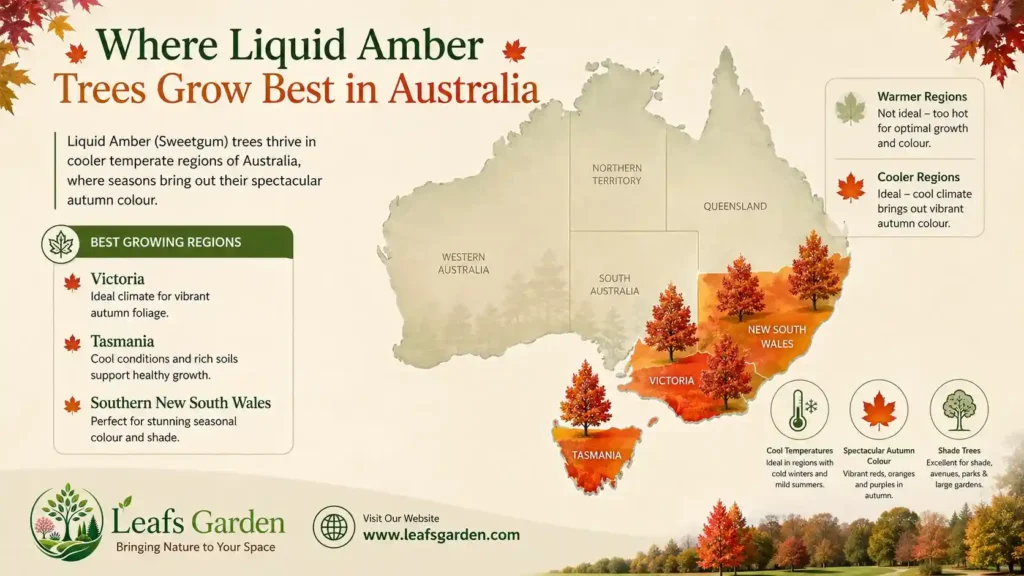
Liquid amber trees are widely planted in Australia because of their striking autumn foliage, rapid growth, and strong ornamental value. The tree performs especially well in cooler temperate climates where seasonal temperature changes enhance leaf color.
Although liquidambar Australia plantings are highly popular, gardeners must also manage issues such as surface roots, heavy leaf drop, and messy seed balls in some landscapes.
Liquid amber trees are valued in Australian landscaping for their dramatic seasonal appearance and reliable shade canopy. During autumn, the foliage transforms into bright shades of yellow, orange, red, and purple, creating one of the strongest fall displays among deciduous trees.
The liquidambar sweet gum is commonly used as:
The tree is also popular because of its:
In many Australian cities, the american sweetgum tree is planted along roadsides and public gardens to provide seasonal landscape interest.
Liquid amber trees grow best in cool temperate regions of Australia where winter cooling supports stronger autumn color development.
Best-performing regions commonly include:
Areas with cold nights and seasonal climate variation generally produce deeper red and purple foliage tones.
In warmer coastal or subtropical regions, the liquid amber plant may develop:
Climate suitability has a major impact on the ornamental quality of liquidambar Australia landscapes.
Despite their beauty, liquid amber trees can create several maintenance and landscaping challenges in Australian gardens.
One of the most common problems is aggressive surface root growth. Mature roots may lift pavements, interfere with lawns, and spread into nearby planting zones.
Other common liquid amber tree problems Australia gardeners face include:
The spiky seed pods can become hazardous on pathways, driveways, and paved surfaces when large numbers accumulate beneath mature trees.
Some gardeners also report allergy-related concerns caused by pollen, leaf litter, or airborne debris during seasonal transitions.
Because of these issues, the american sweet gum is often considered a high-maintenance deciduous tree in smaller residential landscapes.
Liquid amber trees are generally better suited for medium to large landscapes rather than compact urban gardens. Standard varieties can become very large over time and develop broad root systems.
Important space considerations include:
The root system of mature liquidambar trees may interfere with:
For smaller gardens, dwarf or fruitless liquidambar cultivars are usually more suitable because they require less maintenance and produce fewer seed balls.
Gardeners seeking low-maintenance landscaping often choose alternative deciduous trees with smaller root systems and reduced litter production.
| Pros | Cons |
| Stunning fall color | Messy seed balls |
| Fast-growing shade tree | Surface roots |
| Attractive foliage | Large mature size |
Liquid amber trees can experience root issues, pest infestations, fungal diseases, and seasonal maintenance problems. Although the tree is highly ornamental, mature specimens may become difficult to manage in smaller residential landscapes.
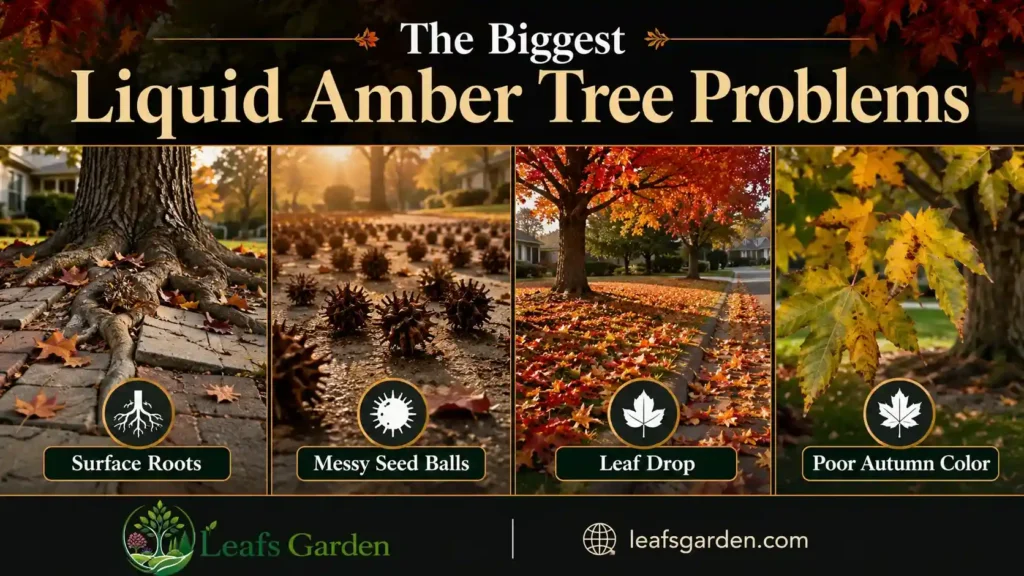
Many common liquid amber tree problems are linked to root behavior, climate conditions, soil quality, and heavy seasonal litter production.
Surface root development is one of the most common problems associated with the liquid amber tree. As the tree matures, large roots often spread close to the soil surface in search of moisture and oxygen.
Common root-related issues include:
The american sweetgum tree can become problematic when planted too close to structures, narrow pathways, or underground services.
Root systems are especially aggressive in:
Root barriers and proper planting distance can help reduce long-term structural damage.
Liquid amber leaves may develop discoloration, scorching, or weak autumn color under unsuitable growing conditions.
Yellowing leaves are commonly linked to:
Leaf scorch may appear during periods of:
Poor autumn color is another common issue in warm climates where the tree does not receive enough seasonal cooling.
Factors reducing foliage color intensity include:
Healthy soil conditions and full sun exposure improve overall foliage quality in the liquidambar sweet gum.
Liquid amber trees are generally hardy but can develop fungal diseases and trunk disorders under environmental stress.
Common liquidambar diseases include:
Canker disease may cause:
Root rot is more likely to occur in poorly drained soil where excess moisture damages root tissues.
Sweet gum tree disease symptoms often include:
Good drainage and proper airflow around the canopy help reduce disease pressure.
Several insects may feed on liquid amber foliage, bark, or sap tissues. Most pest problems are manageable when detected early.
Common pests affecting the sweetgum tree include:
Aphids commonly produce sticky honeydew that may lead to black sooty mold growth on leaves and branches.
Scale insects can weaken the tree by extracting sap from stems and branches, while caterpillars may chew foliage during active feeding periods.
Healthy established trees are generally more resistant to severe pest damage.
Liquid amber trees are often considered messy because they produce large amounts of seasonal litter throughout the year.
Main maintenance concerns include:
The spiky seed pods are one of the most disliked features of mature american sweet gum trees because they accumulate heavily beneath the canopy.
Cleanup challenges commonly involve:
Fruitless liquidambar cultivars are frequently planted in urban landscapes to reduce maintenance demands.
| Problem | Cause | Solution |
| Yellow leaves | Nutrient deficiency | Soil correction |
| Root lifting | Surface roots | Root barriers |
| Poor color | Warm climate | Better location |
Proper planting and seasonal care help liquid amber trees establish strong root systems, healthy canopy growth, and vibrant autumn foliage. Correct site selection and ongoing maintenance are especially important because the tree can become large and long-lived.
The liquid amber tree performs best when planted in spacious locations with full sun, deep soil, and good drainage.
Choosing the right planting location is essential for long-term tree health. The american sweetgum tree should be planted away from buildings, pathways, underground pipes, and narrow garden spaces because of its spreading root system and mature canopy size.
Important site selection considerations include:
Spacing recommendations depend on the cultivar and mature tree size.
General spacing guidelines include:
Planting depth is also important for successful establishment.
When planting a liquidambar tree:
Proper planting depth helps prevent root stress and trunk disease.
Young liquid amber trees require consistent moisture during the establishment period. Deep watering encourages stronger root development and improves drought resistance over time.
During early growth stages, the tree benefits from:
Newly planted sweetgum trees are more vulnerable to drought stress than mature specimens.
Mulching around the base of the tree helps improve early establishment by:
Organic mulch such as bark chips or composted material is commonly recommended for the liquid amber plant.
Liquid amber trees usually require only moderate pruning once established. Structural pruning during early growth helps create a balanced canopy and strong branch framework.
The best pruning season is typically during winter dormancy when the tree has dropped its leaves.
Routine maintenance may include:
Heavy pruning is generally avoided because it may stimulate excessive new growth or stress the tree.
Managing the shape of young liquidambar trees helps maintain:
Periodic inspections also help identify pest problems, fungal disease symptoms, and branch damage early.
Liquid amber tree care changes throughout the year based on seasonal growth patterns and climate conditions.
Spring is the active growth period for new leaves and shoots.
Spring care commonly includes:
During summer, the tree may require additional watering in dry or hot conditions.
Important summer care practices include:
Autumn is the heaviest maintenance period for sweetgum trees because of leaf and seed pod drop.
Typical autumn tasks include:
In winter, the liquid amber tree enters dormancy and slows active growth.
Winter maintenance often involves:
Seasonal care helps maintain the ornamental value, health, and structural strength of mature liquidambar trees.
Liquid amber trees provide ornamental beauty, seasonal shade, wildlife value, and commercial timber applications. Their strong autumn color and large canopy make them one of the most widely used deciduous landscape trees in temperate regions.
Beyond landscaping, the american sweetgum tree also contributes to urban cooling, biodiversity support, and traditional resin production.
Liquid amber trees are highly valued in ornamental landscaping because of their fast growth, symmetrical structure, and vibrant autumn foliage.
The tree is commonly used as a:
Its tall upright growth and dense canopy provide strong summer shade in parks, residential gardens, and public streetscapes.
The liquidambar sweet gum is especially popular in:
During autumn, the foliage becomes a major visual feature with bright shades of yellow, orange, red, and purple.
For a complete overview of deciduous and evergreen landscape trees suited to Australian and temperate climates, see our Evergreen, Shade & Landscape Trees guide.
Liquid amber trees provide several environmental benefits in urban and suburban landscapes. Their large canopy supports ecosystem health while improving environmental quality in developed areas.
Key environmental advantages include:
Birds and small animals may use the sweetgum tree for shelter, nesting, and seasonal feeding. Pollinators are also attracted to spring flowering structures.
The broad canopy of mature liquid amber trees helps reduce heat buildup in cities by:
Like many large deciduous trees, the american sweet gum also contributes to long-term carbon storage through continuous wood growth and biomass accumulation.
Liquid amber wood has commercial value for timber production and woodworking applications. The wood of Liquidambar styraciflua is commonly marketed as sweetgum timber.
The timber is used for:
Sweetgum wood is valued for its:
Although it is not considered among the hardest hardwoods, the timber remains useful for decorative woodworking and commercial veneer applications.
The sweetgum tree has a long history of resin use in traditional medicine and natural products. Aromatic resin extracted from the bark and trunk was historically collected by Indigenous communities and early settlers.
Traditional uses of sweetgum resin included:
The resin was valued because of its sticky texture and aromatic properties.
Historically, liquid amber resin was sometimes compared to natural amber because of its glossy appearance. However, the resin produced by living sweetgum trees differs completely from fossilized amber formed over millions of years.
Today, the historical significance of sweetgum resin remains an important part of the liquid amber tree’s botanical and cultural background.
Liquid amber trees offer outstanding ornamental beauty, rapid shade development, and vibrant autumn foliage. However, they also require significant space and regular maintenance because of their large size, surface roots, and spiky seed pods.
Before planting a liquid amber tree, it is important to balance its visual benefits against its long-term maintenance demands.
Liquid amber trees are widely planted because of their strong ornamental and landscape value. Their dramatic seasonal appearance makes them one of the most recognizable deciduous feature trees in temperate climates.
Major advantages include:
The american sweetgum tree is especially valued for its vibrant autumn display, with foliage turning shades of:
The liquidambar sweet gum also develops quickly in suitable conditions, making it useful for creating shade and vertical structure in large landscapes.
Additional benefits include:
Because of these features, the liquid amber plant remains popular in parks, streetscapes, and large residential gardens.
Despite its visual appeal, the liquid amber tree can become difficult to manage in smaller or low-maintenance landscapes.
The biggest disadvantages include:
Sweetgum seed balls are one of the most common complaints among gardeners. These hard spiky pods accumulate heavily beneath mature trees and can create maintenance and safety concerns on pathways and lawns.
Surface root systems may also cause:
The mature size of the american sweet gum makes it unsuitable for many compact residential gardens. Standard varieties require significant canopy space and long-term root clearance.
For smaller landscapes, fruitless or dwarf liquidambar cultivars are often more manageable alternatives.
| Suitable For | Not Ideal For |
| Large yards | Tiny gardens |
| Parks | Narrow pathways |
| Autumn landscapes | Low-maintenance spaces |
Liquid amber trees resemble maple trees because both produce lobed leaves and colorful autumn foliage. However, they differ in seed structure, bark texture, canopy shape, and overall growth habit.
The liquid amber maple comparison is common in landscaping because both trees are popular ornamental deciduous species used for shade and seasonal color.
Liquid amber and maple leaves can appear similar from a distance, but their structure differs noticeably when viewed closely.
Liquid amber leaves typically have:
Maple leaves usually have:
The american sweetgum tree often develops a more polished, glossy foliage texture compared to many maple species.
Another major difference involves seed production:
This is one of the easiest ways to distinguish the two trees during autumn and winter.
Liquid amber trees generally develop a more upright and pyramidal structure during early growth. Mature trees later form a broad spreading canopy.
Typical liquid amber growth characteristics include:
Maple trees vary widely depending on species but often develop:
The liquidambar sweet gum is usually better suited for very large landscapes because of its mature size and vigorous growth habit.
Both liquid amber and maple trees are highly valued for autumn foliage, but their color intensity and variation can differ.
Liquid amber trees commonly display:
Maple trees may produce:
One advantage of the liquid amber tree is its ability to display multiple colors simultaneously on a single canopy under ideal conditions.
However, maples often provide more consistent autumn color performance across a wider range of climates and cultivars.
Another outstanding autumn-colour ornamental tree worth considering is the Ginkgo Maidenhair Tree, which produces brilliant golden-yellow foliage and performs well in similar temperate climates.
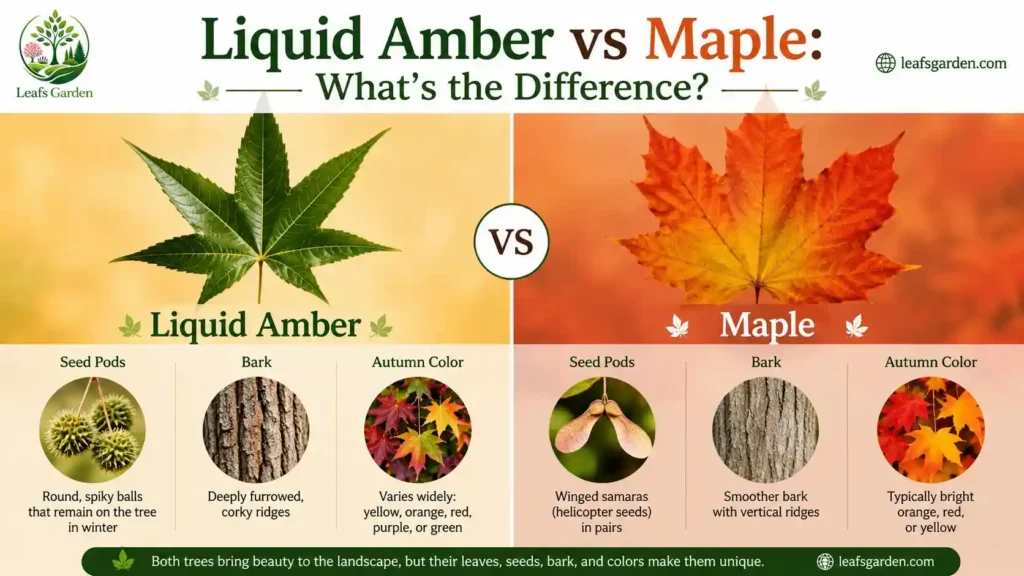
The better landscaping choice depends on climate, available space, and maintenance expectations.
Liquid amber trees are generally better for:
Maple trees are often better for:
The american sweetgum tree provides dramatic structure and seasonal impact but requires more space and maintenance because of its root system and spiky seed balls.
For gardeners prioritizing lower maintenance, many maple species are considered more practical. For maximum autumn drama and strong vertical presence, the liquid amber plant remains one of the most visually striking deciduous landscape trees.
Liquid amber trees are visually striking deciduous trees valued for their vibrant autumn foliage, rapid growth, and strong ornamental appeal. The tree is easily recognized by its star-shaped leaves, corky bark, and distinctive spiky sweetgum seed balls.
Throughout this guide, the liquid amber tree has been identified as a large ornamental hardwood tree that performs best in full sun, fertile soil, and temperate climates. Its dramatic seasonal color and dense shade canopy make the american sweetgum tree highly popular in parks, avenue plantings, and large residential landscapes.
The tree also comes with important considerations. Common liquid amber problems include invasive surface roots, messy seed pods, heavy leaf drop, and large mature size. In liquidambar Australia landscapes, the tree performs especially well in cooler temperate regions where autumn color develops more intensely.
Ongoing maintenance is important for healthy long-term growth. Proper planting distance, seasonal watering, pruning, mulching, and regular cleanup all help reduce maintenance challenges while improving tree performance.
Overall, the liquidambar sweet gum is best suited for:
For gardeners with enough space and willingness to manage seasonal cleanup, the liquid amber tree remains one of the most impressive deciduous ornamental trees for creating dramatic autumn color and long-term landscape impact.
A liquid amber tree is a deciduous ornamental hardwood tree scientifically known as Liquidambar styraciflua. It is recognized for its star-shaped leaves, colorful autumn foliage, and spiky seed balls called sweetgum balls. The tree is widely planted in parks, streetscapes, and large gardens for shade and seasonal landscape appeal.
Yes, liquid amber and sweetgum usually refer to the same tree species, Liquidambar styraciflua. The terms american sweetgum tree, liquidambar sweet gum, and liquid amber tree are commonly used interchangeably in landscaping and horticulture. “Sweetgum” is the common name, while “Liquidambar” is the botanical genus name.
Liquid amber tree roots can become aggressive and invasive as the tree matures. Surface roots may lift pavements, damage lawns, and interfere with nearby structures or drainage systems. Because of their spreading root systems, sweetgum trees should be planted well away from: Pathways Driveways Building foundations Underground pipes
Liquid amber trees produce spiky seed pods as part of their natural reproductive cycle. These seed balls contain multiple seed capsules that open to release seeds for wildlife dispersal. The seed pods commonly fall during autumn and winter, creating the “gumballs from trees” effect often associated with sweetgum trees.
Liquid amber trees can perform very well in Australian gardens, especially in cooler temperate regions where autumn color develops strongly. They are popular in: Victoria Tasmania Southern New South Wales Cool elevated regions However, the trees may become too large for small gardens and can create maintenance issues because of seed balls, leaf drop, and surface roots.
Liquid amber trees are considered fast-growing deciduous trees. Under suitable conditions, young trees can establish quickly and develop strong vertical growth. Growth speed depends on factors such as: Soil quality Sunlight exposure Moisture availability Climate conditions Mature trees can eventually reach heights of 18–30 meters.
Common liquid amber tree problems include: Surface root damage Messy seed pod drop Heavy autumn leaf litter Poor autumn color in warm climates Fungal diseases Pest infestations The american sweetgum tree can also require regular seasonal maintenance in residential landscapes.
Yes, liquid amber trees are deciduous and naturally lose their leaves during autumn and winter dormancy. Before leaf drop, the foliage typically changes into bright shades of: Yellow Orange Red Purple The tree remains dormant during winter before producing new foliage again in spring.