Grow Better Gardens with Smarter Plant Choices
Discover helpful guides on trees, hedges, fruit plants, edible plants, and beautiful landscape greenery.

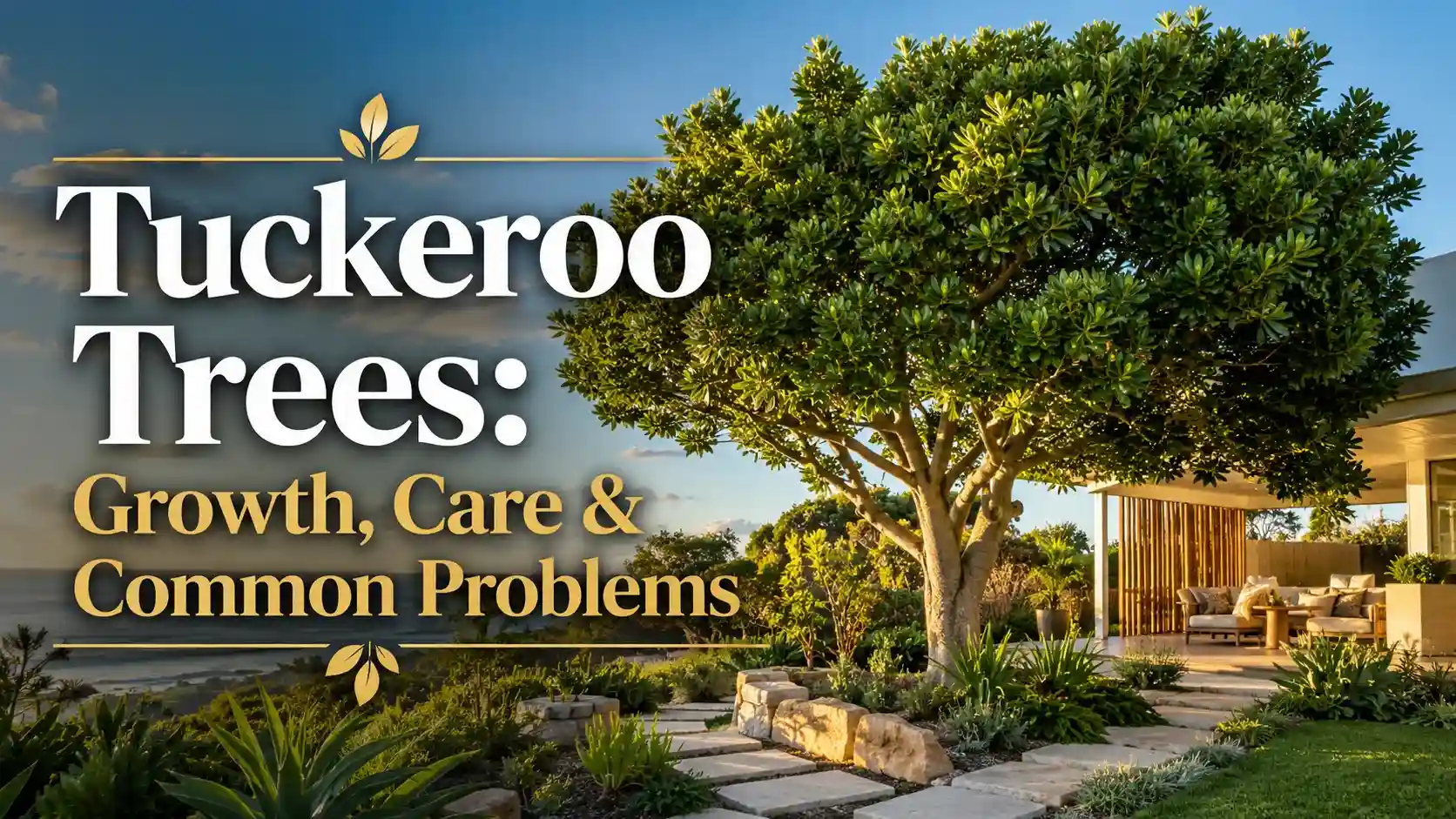
Tuckeroo trees are versatile Australian native shade trees valued for their dense canopy, coastal tolerance, and low-maintenance growth habit. Scientifically known as Cupaniopsis anacardioides, the species is widely used in residential gardens, parks, streetscapes, and commercial landscapes throughout Australia. The popularity of the cupaniopsis anacardioides tuckeroo continues to grow because it adapts well to urban conditions while providing reliable shade and attractive evergreen foliage.
The cupaniopsis tuckeroo is especially appreciated for its moderate growth rate, compact root behavior, and resilience in coastal environments.
Gardeners often refer to detailed guides on hedging and screening plants to choose species that combine evergreen structure, low-maintenance growth, and reliable shade for residential and urban landscaping.
Many homeowners and landscapers choose tuckeroos for backyard planting due to their ability to tolerate wind, salt spray, drought periods, and heat. With glossy green leaves, seasonal flowers, and decorative fruit capsules, the tuckeroo tree combines ornamental appeal with practical landscaping value.
Tuckeroo trees are evergreen native Australian trees commonly planted as ornamental shade trees in urban and coastal regions. They belong to the Sapindaceae family and naturally occur along eastern coastal areas of Australia. The species performs exceptionally well in streetscapes, residential gardens, school grounds, and public parks because of its adaptability and relatively easy care requirements.
Known for forming a rounded canopy with dense foliage, tuckeroos provide effective cooling shade while maintaining a tidy appearance compared to many larger landscape trees. Their balanced growth habit makes them suitable for both medium-sized residential spaces and large public planting projects.
The tuckeroo tree, or Cupaniopsis anacardioides, is a medium-sized evergreen species recognized for its glossy foliage, orange-yellow fruit capsules, and strong tolerance to harsh environmental conditions. Native to coastal Australia, the tree thrives in sandy soils, windy areas, and warm climates where many ornamental species struggle.
Key characteristics of the tuckeroo tree include:
Because of these traits, the cupaniopsis anacardioides tuckeroo is widely planted in modern urban landscaping projects where durability and visual appeal are both important.
The tuckeroo plant has become one of the most reliable native landscape trees in Australia due to its ability to adapt to different environmental conditions with minimal maintenance. Landscapers frequently select the species for urban planting because it handles pollution, compacted soils, and coastal exposure better than many non-native shade trees.
Several factors contribute to its popularity:
In residential landscaping, tuckeroos are often planted to create natural shade zones, improve privacy, and add greenery without requiring excessive pruning or watering.
|
Feature |
Benefit |
|
Growth Habit |
Rounded, dense evergreen canopy |
| Shade Value |
Provides reliable cooling shade |
|
Maintenance |
Low-maintenance once established |
| Urban Suitability |
Performs well in streets and parks |
|
Coastal Tolerance |
Handles salt spray and wind exposure |
| Landscaping Appeal |
Attractive foliage and ornamental fruit |
|
Water Needs |
Moderate during establishment, lower later |
| Native Value |
Supports Australian native landscaping |
The growing demand for cupaniopsis tuckeroo planting reflects the increasing preference for durable, climate-adapted native trees in Australian landscaping. Whether used in public spaces or backyard gardens, tuckeroos offer a practical combination of beauty, shade, and resilience.
The tuckeroo tree is a native Australian evergreen species widely planted for shade, coastal resilience, and urban landscaping. Known for its dense canopy and glossy foliage, the tree is commonly used in streetscapes, residential gardens, public parks, and commercial developments throughout warm Australian regions.
The species adapts well to difficult environmental conditions, including salty coastal air, heat, wind exposure, and periods of drought once established. Because of its manageable growth habit and relatively low maintenance needs, the tuckeroo has become one of the most dependable native landscape trees in Australia.
The botanical name of the tuckeroo tree is Cupaniopsis anacardioides. It belongs to the Sapindaceae family, which also includes several tropical and subtropical flowering trees and shrubs.
|
Classification |
Details |
|
Botanical Name |
Cupaniopsis anacardioides |
| Common Name |
Tuckeroo |
|
Family |
Sapindaceae |
| Plant Type |
Evergreen tree |
|
Native Region |
Coastal Australia |
| Growth Habit |
Medium-sized shade tree |
The species naturally occurs along the eastern and northern coastal regions of Australia, particularly in Queensland and New South Wales. In native habitats, the tree commonly grows near rainforests, coastal dunes, and warm subtropical environments.
The tuckeroo is also sometimes referred to as the carrotwood tree because of its bright orange fruit capsules that open to reveal glossy black seeds. In some landscaping references, the species may appear under the name cupaniopsis anacardioides carrotwood, especially in international horticultural markets.
Although the names are often used interchangeably, the Australian term “tuckeroo” is more commonly used in native landscaping and residential gardening contexts.
The tuckeroo tree is known by several common names depending on region, nursery labeling, and landscaping usage.
Common names include:
In Australia, “tuckeroo” is the most widely recognized and preferred name. The variation “tuckaroo tree” appears occasionally in local gardening discussions and informal plant references.
Outside Australia, particularly in some subtropical regions overseas, the species is more commonly marketed as carrotwood because of its colorful fruit appearance. Despite the naming differences, these terms generally refer to the same species: Cupaniopsis anacardioides.
The tuckeroo tree is native to coastal Australia and naturally grows in warm subtropical and tropical regions. Its natural distribution extends across eastern coastal areas, where it thrives in sandy soils, coastal forests, and lowland rainforest margins.
The tree performs best in climates that provide:
Because of its natural adaptation to harsh coastal conditions, the tuckeroo tolerates salt spray and windy environments exceptionally well. This makes it highly valuable for urban landscaping projects near beaches, roadsides, and exposed residential developments.
The species also thrives in urban environments because it can tolerate:
These characteristics explain why tuckeroo trees are frequently planted in modern Australian cities, where durable, low-maintenance native trees are increasingly preferred for sustainable landscaping.
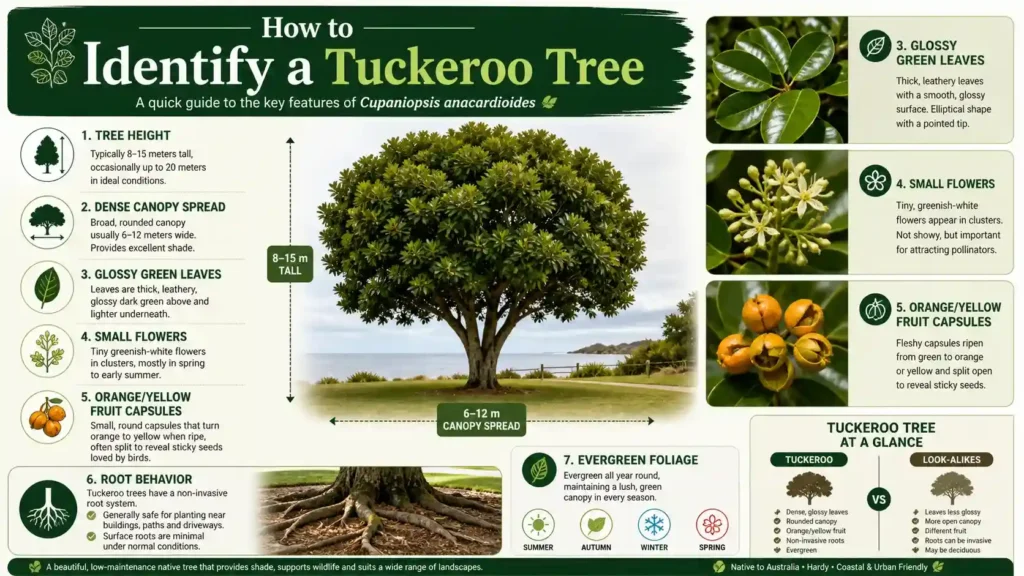
The tuckeroo tree is easily recognized by its rounded evergreen canopy, glossy foliage, and decorative orange-yellow fruit capsules. Its balanced growth habit and adaptable structure make it one of the most practical native Australian trees for urban and residential landscapes.
Correct identification is important when selecting tuckeroo trees for shade, streetscapes, or backyard planting because several closely related varieties and similar species are also available in nurseries.
The average tuckeroo tree height ranges between 8 and 15 meters at maturity, depending on climate, soil quality, and available growing space. In ideal coastal conditions, some mature specimens may grow taller, while trees planted in smaller residential spaces often remain more compact with regular maintenance.
|
Feature |
Average Size |
|
Mature Height |
8–15 meters |
| Canopy Spread |
5–10 meters |
|
Growth Habit |
Rounded and dense |
| Root Behavior |
Moderately non-invasive |
The mature canopy spread creates dense shade coverage, making the species highly effective for cooling outdoor spaces and reducing heat around buildings and paved surfaces.
The root system of the tuckeroo is generally considered less aggressive than many large shade trees. While roots still require adequate space, they are usually manageable when planted correctly away from foundations, retaining walls, and underground infrastructure.
Because of its controlled growth habit, the tree is suitable for:
In residential settings, tuckeroo trees are often selected because they provide reliable shade without developing excessively invasive roots or oversized canopies.
The tuckeroo tree features glossy dark green foliage that remains attractive throughout the year. The leaves are compound, leathery, and slightly oval-shaped, helping the tree maintain a dense and polished appearance even during dry periods.
The foliage is one of the major ornamental features of the species because it creates a lush evergreen canopy suitable for both formal and naturalistic landscapes.
|
Feature |
Description |
| Leaves |
Glossy, dark green, evergreen |
| Flowers |
Small greenish-white clusters |
|
Fruit |
Orange-yellow capsules |
| Seeds |
Shiny black seeds inside fruit |
The tuckeroo flower is relatively small and understated compared to highly ornamental flowering trees. Flowers typically appear in clusters during warmer months and attract pollinators such as bees and insects.
After flowering, the tree produces decorative fruit capsules that change from green to orange or yellow as they mature. These capsules eventually split open to reveal shiny black seeds, creating strong visual contrast against the foliage.
| Season |
Tree Activity |
|
Spring |
Active foliage growth |
| Summer |
Flower development |
|
Late Summer to Autumn |
Fruit maturation |
| Autumn |
Fruit capsules open |
The seasonal fruit display is one reason tuckeroo trees are appreciated in ornamental landscaping projects.
The terms fine leaf tuckeroo and fine leaved tuckeroo are commonly used in nurseries and landscaping discussions to describe tuckeroo varieties with narrower or more delicate foliage characteristics.
In most cases, these names refer to slight variations in leaf appearance rather than completely separate species. Both types maintain the same core growth characteristics, including evergreen foliage, rounded canopy structure, and strong environmental tolerance.
|
Feature |
Fine Leaf Tuckeroo |
Fine Leaved Tuckeroo |
|
Leaf Appearance |
Narrower foliage | Softer, finer texture |
| Canopy Style | Slightly lighter appearance |
Dense ornamental look |
|
Landscape Use |
Modern gardens | Decorative streetscapes |
| Maintenance | Low |
Low |
These foliage variations are popular in ornamental landscaping because they provide a softer visual texture while retaining the durability and adaptability associated with standard tuckeroo trees.
Landscape designers often use these forms in:
The tuckeroo tree is sometimes compared with Cupaniopsis parvifolia, another species within the same genus. Although both trees share similar evergreen characteristics, they differ in leaf structure, canopy density, and overall landscaping use.
|
Feature |
Tuckeroo (Cupaniopsis anacardioides) |
Cupaniopsis parvifolia |
|
Leaf Size |
Larger glossy leaves | Smaller finer leaves |
| Canopy Density | Dense shade canopy |
More open canopy |
|
Growth Habit |
Rounded and broad | Slightly lighter structure |
| Shade Production | High |
Moderate |
|
Coastal Tolerance |
Excellent | Good |
| Urban Suitability | Very high |
Moderate to high |
The tuckeroo generally provides heavier shade and stronger urban durability, making it more suitable for streets, parks, and large residential landscapes.
For smaller or compact garden screening, Lilly Pilly varieties provide similar evergreen coverage and can be planted alongside tuckeroos for layered, low-maintenance hedging.
By comparison, cupaniopsis parvifolia is often preferred for smaller ornamental spaces where a lighter canopy and finer foliage texture are desired.
For most residential and public landscaping applications, the tuckeroo remains the more widely planted and commercially available option due to its dependable growth habit and long-term performance.
The tuckeroo tree is known for its steady and dependable growth habit, making it a popular choice for long-term landscaping projects in Australia. While it is not considered an extremely fast-growing species, it develops at a reliable moderate pace and gradually forms a dense evergreen canopy suitable for shade and urban planting.
One of the biggest advantages of the tuckeroo is its balance between manageable growth and long-term durability. The tree establishes relatively quickly in suitable conditions while maintaining strong structural stability over time.
The average tuckeroo tree growth rate is considered moderate under normal growing conditions. Young trees typically establish steadily during the first few years before increasing canopy development as the root system matures.
In ideal environments with proper sunlight, drainage, and watering, a tuckeroo can develop into a substantial shade tree within several years.
|
Tree Stage |
Approximate Growth Timeline |
|
Young Establishment |
1–3 years |
| Early Canopy Development |
3–5 years |
|
Medium Shade Tree |
5–10 years |
| Mature Landscape Tree |
10–20 years |
Growth speed can vary depending on environmental conditions. In nutrient-rich coastal soils with regular moisture and full sunlight, the tree often grows faster and develops denser foliage.
Tuckeroo trees grow faster when they receive:
Growth may slow under conditions such as:
Although the species is adaptable, optimal conditions significantly improve canopy density, foliage quality, and overall tree health.
Several environmental and maintenance factors influence the overall health and growth performance of tuckeroo trees.
Well-drained soil is one of the most important requirements for healthy tuckeroo growth. Sandy loam and moderately fertile soils generally produce the best results.
Poorly drained soil can lead to:
Adding compost and organic matter can improve soil structure and encourage stronger root establishment.
Young tuckeroo trees require regular watering during establishment, especially in hot or dry weather. Consistent moisture supports root development and faster canopy growth during the first few years.
Once mature, the species becomes more drought tolerant and usually requires less supplemental watering.
|
Tree Age |
Watering Needs |
| Newly Planted |
Frequent deep watering |
|
Young Trees |
Moderate regular watering |
| Mature Trees |
Occasional deep watering during drought |
Overwatering should be avoided because constantly wet soil may weaken roots and slow healthy growth.
Tuckeroo trees perform best in full sun. Direct sunlight promotes:
While the species can tolerate partial shade, insufficient sunlight may reduce overall growth vigor.
One reason tuckeroo trees are widely planted in Australia is their excellent tolerance to coastal conditions.
The species handles:
This environmental adaptability allows tuckeroo trees to maintain healthy growth in locations where many ornamental trees struggle.
Balanced fertilization can improve growth rates, particularly in nutrient-poor soils.
Useful nutrients for tuckeroo trees include:
Slow-release fertilizers and organic mulches are generally preferred because they provide gradual nutrient availability without excessive soft growth.
The tuckeroo tree is considered a long-living landscape species when properly maintained. In suitable environments, healthy trees can remain productive and visually attractive for several decades.
The typical lifespan of a tuckeroo tree ranges from 40 to 60 years or more depending on climate, soil conditions, and ongoing maintenance practices.
|
Factor |
Impact on Longevity |
| Soil Drainage |
Strong influence |
|
Water Management |
High importance |
| Pruning Quality |
Helps structural stability |
|
Pest Prevention |
Reduces long-term decline |
| Sunlight Exposure |
Supports canopy health |
Over decades, mature tuckeroo trees benefit from occasional maintenance to preserve structural strength and healthy canopy development.
Long-term maintenance usually includes:
Because of their resilience, moderate growth rate, and extended lifespan, tuckeroo trees remain one of the most dependable choices for sustainable urban and residential landscaping.
Growing a healthy tuckeroo plant requires the right balance of sunlight, soil drainage, watering, and planting location. Although the species is considered relatively low maintenance once established, proper early care plays a major role in long-term growth, canopy development, and structural stability.
Because tuckeroo trees naturally adapt to coastal Australian conditions, they are highly suitable for warm residential landscapes, streetscapes, and public planting projects. With correct planting techniques and environmental conditions, the tree develops into a durable evergreen shade tree with strong drought and wind tolerance.
Tuckeroo trees grow best in warm subtropical and coastal climates where temperatures remain relatively mild throughout the year. The species naturally prefers humid conditions with consistent sunlight and moderate rainfall.
|
Condition |
Preferred Range |
| Temperature |
18°C–32°C |
|
Sunlight |
Full sun preferred |
| Frost Exposure |
Mild frost tolerance |
|
Climate Type |
Coastal and subtropical |
| Wind Tolerance |
High |
The tuckeroo performs exceptionally well in coastal environments because it tolerates:
Although the species is primarily suited to warm climates, mature trees can tolerate occasional light frost once established. Young plants, however, are more vulnerable to cold damage and benefit from protection during severe winter conditions.
In inland regions, tuckeroo trees can still grow successfully if they receive:
The adaptability of the species is one reason it remains popular in both residential and urban Australian landscapes.
Tuckeroo trees grow best in well-drained soil that allows roots to develop without becoming waterlogged. Good drainage is essential because excessive moisture around the roots may increase the risk of fungal diseases and root stress.
|
Soil Factor |
Preferred Condition |
|
Drainage |
Well-drained |
| Soil Texture |
Sandy loam to loam |
|
Soil pH |
Slightly acidic to neutral |
| Salt Tolerance |
High |
The species tolerates a wide range of soil types, including sandy coastal soils and moderately clay-based soils if drainage is improved.
Tuckeroo trees generally prefer a soil pH between 6.0 and 7.5, although established trees can adapt to slightly broader ranges.
One major advantage of the species is its high salt tolerance, making it highly suitable for:
Adding organic compost and mulch around the planting area can improve moisture retention and soil structure during establishment.
Tuckeroo trees grow most effectively in full sun, where they develop dense foliage, stronger branches, and healthier canopy structure.
|
Light Condition |
Growth Performance |
|
Full Sun |
Best growth and canopy density |
| Partial Shade |
Slower growth, lighter canopy |
While the species tolerates partial shade, prolonged low-light conditions may reduce flowering, slow growth, and create thinner foliage coverage.
Young tuckeroo trees require regular watering while roots establish. Deep watering encourages stronger root growth and improves drought resistance later in life.
|
Tree Stage |
Watering Frequency |
| Newly Planted |
2–3 times weekly |
|
Young Trees |
Weekly deep watering |
| Mature Trees |
Occasional watering during drought |
Important watering considerations include:
Once mature, tuckeroo trees become significantly more drought tolerant and usually survive extended dry conditions better than many ornamental landscape trees.
Proper planting location is important for long-term tree health and safe canopy development. Backyard tuckeroo trees should be planted where they have enough space to expand naturally without interfering with structures or underground systems.
|
Structure |
Recommended Distance |
|
House Foundations |
4–6 meters |
| Driveways |
3–5 meters |
|
Pools |
5 meters or more |
| Underground Pipes |
Safe clearance recommended |
Although tuckeroo roots are considered less invasive than many large shade trees, proper spacing still helps prevent future structural conflicts and supports healthy root expansion.
Root spread precautions are especially important in smaller residential gardens where limited space may restrict natural growth.
Growing a tuckeroo tree Perth gardeners can successfully maintain requires attention to heat management and watering practices, especially during dry summers.
Perth’s Mediterranean-style climate differs from the humid coastal regions where tuckeroo trees naturally occur, but the species still adapts well when provided with suitable care.
|
Challenge |
Recommended Solution |
|
Extreme Summer Heat |
Deep watering during heatwaves |
| Dry Conditions |
Apply thick organic mulch |
|
Sandy Soil |
Improve soil with compost |
| Wind Exposure |
Protect young trees during establishment |
Young trees in Perth may require more frequent irrigation during the first few years compared to coastal eastern Australian climates.
Heat and drought considerations are especially important during summer because prolonged dry conditions can stress newly planted trees. Applying mulch around the root zone helps conserve moisture, regulate soil temperature, and reduce water evaporation.
Once fully established, tuckeroo trees generally handle Perth’s heat and dry periods well, making them increasingly popular for sustainable low-maintenance landscaping in Western Australia.
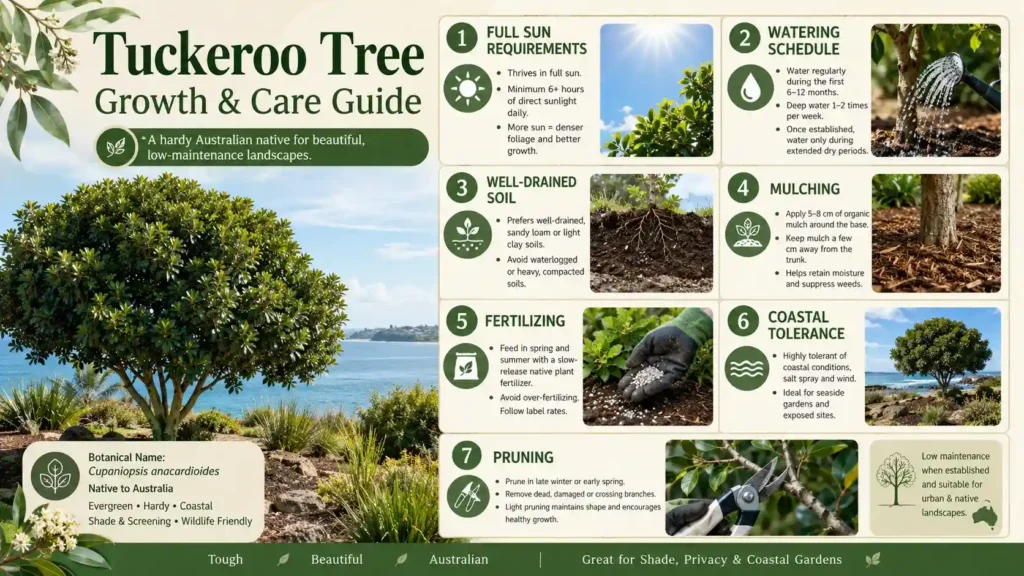
Tuckeroo trees are considered relatively low-maintenance once established, but regular care helps maintain healthy growth, dense foliage, and strong branch structure over the long term. Proper pruning, watering, fertilizing, and mulching all contribute to improved canopy development and better resistance to environmental stress.
Routine maintenance is especially important during the early growth stages when the tree is developing its root system and overall structure.
Pruning helps maintain the natural rounded canopy of the tuckeroo tree while improving airflow, structural balance, and shade distribution. Although the species usually develops a tidy form naturally, occasional shaping encourages stronger branch spacing and healthier long-term growth.
The ideal time to prune tuckeroo trees is during late winter to early spring before active seasonal growth begins.
Pruning during this period helps:
Light maintenance pruning can also be performed throughout the year when necessary.
Proper canopy management improves both appearance and structural stability.
Important canopy maintenance practices include:
Regular canopy care also reduces the risk of storm-related branch damage in windy coastal areas.
One of the primary reasons homeowners plant tuckeroo trees is for shade. Strategic shaping during early growth stages helps develop a broad and dense canopy suitable for cooling outdoor spaces.
To create an effective shade structure:
When properly managed, mature tuckeroo trees form reliable evergreen shade that performs well in residential gardens, parks, and urban landscapes.
Tuckeroo trees generally have moderate nutrient needs and often grow successfully in average garden soils. However, occasional fertilizing can improve foliage density, root development, and overall canopy health, especially in nutrient-poor soils.
|
Nutrient |
Benefit |
| Nitrogen |
Supports leaf and canopy growth |
|
Phosphorus |
Encourages root development |
| Potassium |
Improves stress resistance |
Slow-release fertilizers are usually preferred because they provide steady nutrient availability without encouraging excessive weak growth.
Organic mulch is highly beneficial around tuckeroo trees because it gradually improves soil quality while helping conserve moisture.
Suitable mulch materials include:
Mulch should be spread evenly around the root zone while keeping it slightly away from the trunk to prevent moisture-related bark problems.
Mulching plays a major role in maintaining healthy tuckeroo trees, especially in warm and drought-prone climates.
| Benefit |
Impact |
|
Moisture Retention |
Reduces soil drying |
| Temperature Regulation |
Protects roots from heat |
|
Weed Suppression |
Reduces competition |
| Soil Improvement |
Adds organic matter over time |
Proper mulching significantly improves water efficiency by slowing evaporation from the soil surface.
A thick mulch layer helps maintain consistent soil moisture levels around the root zone. This is especially valuable for young tuckeroo trees during establishment and for mature trees during extended dry periods.
Mulching also reduces temperature fluctuations in the soil, protecting roots from extreme summer heat.
Mulch helps suppress weeds that compete with the tree for nutrients and moisture. Reduced weed growth improves root access to water while lowering overall maintenance requirements.
For best results:
Many homeowners ask, are tuckeroo trees messy compared to other landscape trees. Overall, tuckeroo trees are considered moderately tidy, especially when compared with large deciduous species that shed heavy seasonal foliage.
However, like most flowering and fruiting trees, they do produce some natural debris throughout the year.
|
Material |
Seasonal Activity |
| Leaves |
Occasional shedding |
|
Flowers |
Light seasonal drop |
| Berries/Fruit Capsules |
Moderate fruit litter |
The berries and fruit capsules are usually the main concern for some homeowners. As the fruit matures and drops, it may create minor litter beneath the canopy, particularly in paved areas or near pools.
Leaf drop is generally moderate because the tree is evergreen and sheds foliage gradually rather than all at once.
Flower drop is typically light and short-lived compared to heavily flowering ornamental species.
In most residential landscapes, tuckeroo trees are still considered relatively low maintenance because:
Proper placement away from pools, paved entertainment spaces, and high-traffic walkways can further reduce maintenance concerns associated with fruit and leaf litter.
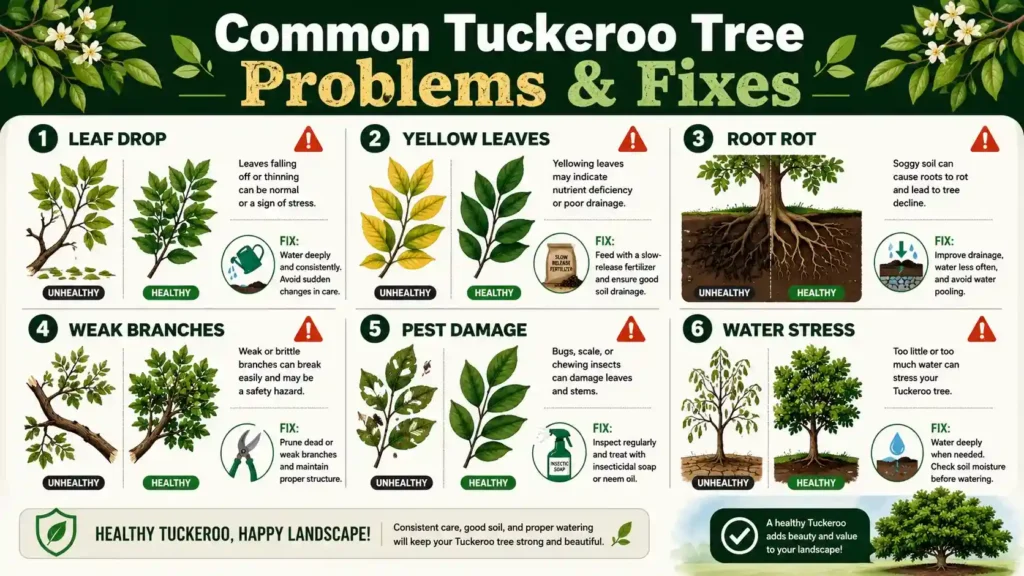
Although tuckeroo trees are considered hardy and adaptable, they can still develop health issues when exposed to poor growing conditions, environmental stress, or improper maintenance. Early identification of problems helps prevent long-term damage and supports healthier canopy growth.
Most tuckeroo tree issues are related to watering imbalance, soil conditions, nutrient deficiencies, or environmental exposure rather than severe disease outbreaks.
Homeowners may occasionally notice changes in foliage density, branch strength, or growth performance. These issues are often linked to environmental stress or improper care during establishment.
|
Problem |
Possible Cause |
| Leaf Drop |
Water stress or seasonal shedding |
|
Weak Branching |
Poor pruning or rapid uneven growth |
| Slow Growth |
Nutrient deficiency or poor soil |
|
Yellowing Leaves |
Drainage or nutrient issues |
| Sparse Canopy |
Lack of sunlight or root stress |
Leaf drop is one of the most common concerns with tuckeroo trees. While occasional shedding is normal for evergreen species, excessive foliage loss may indicate stress.
Potential causes include:
Young trees are particularly sensitive during establishment.
Weak branching may develop when trees grow too quickly under excessive fertilization or when structural pruning is neglected during early growth stages.
Branches may become vulnerable to:
Regular pruning helps strengthen branch structure and improve canopy balance.
Slow development is often linked to environmental limitations such as:
Improving growing conditions usually restores healthier growth rates over time.
Environmental stress is a major factor affecting tuckeroo health, especially in newly planted trees.
Stress conditions may include:
Healthy mature trees are generally resilient, but younger specimens require closer monitoring.
Many homeowners become concerned when they notice a tuckeroo tree losing leaves. In most cases, moderate leaf shedding is natural, but excessive foliage loss usually signals stress or imbalance.
|
Cause |
Effect on Tree |
| Water Stress |
Wilting and leaf drop |
|
Nutrient Deficiency |
Yellowing and thinning foliage |
| Seasonal Shedding |
Normal gradual leaf replacement |
|
Poor Drainage |
Root stress and canopy decline |
| Heat Stress |
Dry or curled leaves |
Both overwatering and underwatering can trigger leaf loss.
Underwatering may cause:
Overwatering may lead to:
Deep but infrequent watering is generally the best approach for established trees.
Lack of nutrients can weaken overall foliage health and reduce canopy density.
Common deficiency symptoms include:
Applying balanced slow-release fertilizer and organic mulch often improves recovery.
Some leaf drop is completely normal because evergreen trees continuously replace older foliage throughout the year.
Seasonal shedding is usually:
If the canopy remains generally healthy and green, occasional shedding is rarely a serious concern.
Tuckeroo trees are relatively resistant to severe infestations, but some pests and diseases can still affect weakened or stressed trees.
Understanding tuckeroo tree pests and diseases helps homeowners identify problems early and apply preventive care before major damage occurs.
|
Pest |
Typical Symptoms |
|
Scale Insects |
Sticky residue and leaf weakening |
| Aphids |
Distorted new growth |
|
Leaf-Eating Caterpillars |
Chewed foliage |
| Borers |
Branch decline and structural weakness |
Most insect issues become more serious when trees are already stressed by drought or poor soil conditions.
Fungal problems are usually linked to excessive moisture or poor airflow within dense canopies.
Potential fungal symptoms include:
Proper pruning improves airflow and reduces humidity around foliage.
Root rot is one of the most serious tuckeroo tree health problems and is commonly caused by poorly drained soil.
Signs of root rot may include:
Preventing waterlogged conditions is essential for long-term root health.
Preventive maintenance significantly reduces the likelihood of disease and pest problems.
Important preventive practices include:
Healthy trees are naturally more resistant to environmental stress and insect activity.
Recovering an unhealthy tuckeroo tree requires identifying the underlying cause and correcting environmental or maintenance problems as early as possible.
|
Problem Area |
Recommended Solution |
| Poor Drainage |
Improve soil structure |
|
Water Stress |
Adjust watering schedule |
| Nutrient Deficiency |
Apply balanced fertilizer |
|
Weak Growth |
Increase sunlight exposure |
| Compacted Soil |
Aerate and add organic matter |
Improving soil quality is often the first step in restoring unhealthy trees.
Helpful soil improvement methods include:
Healthy soil supports stronger root development and better nutrient absorption.
Proper watering is critical for tree recovery.
Best watering practices include:
Consistent moisture balance helps stabilize root health and encourages new foliage growth.
With proper care and early intervention, most tuckeroo tree problems can be corrected before serious long-term damage occurs.
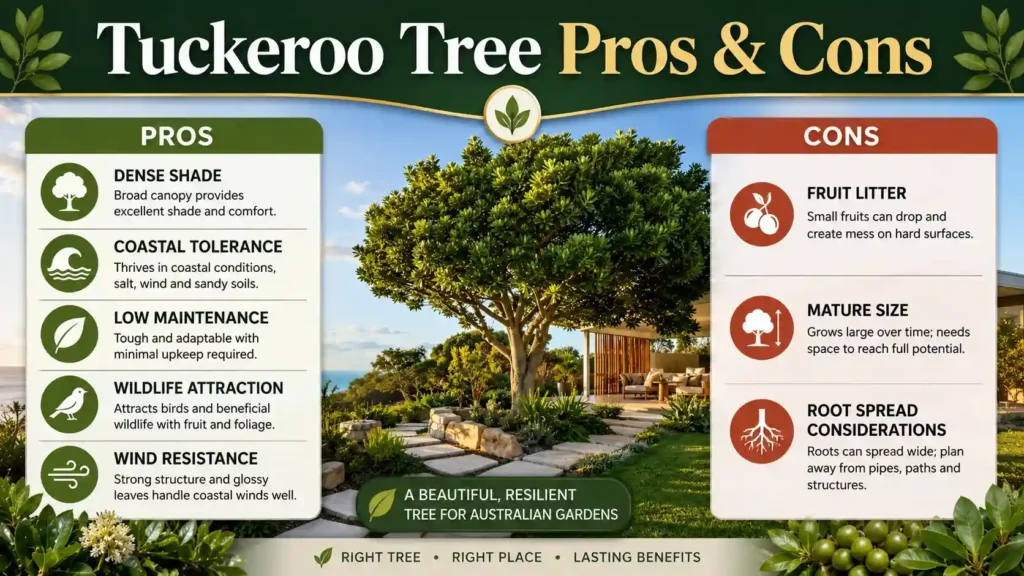
Tuckeroo trees are widely valued in Australian landscaping because they combine shade, durability, and coastal resilience in a relatively low-maintenance package. However, like any landscape tree, they also have limitations that should be considered before planting.
Understanding both the advantages and potential drawbacks helps homeowners choose the right location and determine whether the species suits their landscape goals.
The tuckeroo tree offers several practical and ornamental benefits that make it highly suitable for residential gardens, parks, streetscapes, and coastal developments.
|
Benefit |
Landscaping Value |
| Low Maintenance |
Requires limited ongoing care |
|
Dense Shade |
Provides effective cooling coverage |
| Wind Resistance |
Handles exposed conditions well |
|
Coastal Tolerance |
Thrives near coastal environments |
| Wildlife Attraction |
Supports birds and pollinators |
One of the biggest advantages of tuckeroo trees is their relatively low maintenance requirement once established.
The species generally needs:
Compared to many fast-growing ornamental shade trees, tuckeroos produce manageable debris levels and maintain a naturally balanced canopy shape.
Tuckeroo trees develop a rounded evergreen canopy that creates reliable shade throughout the year.
Benefits of the dense canopy include:
This strong shade performance makes the species especially useful for backyard seating areas and urban streetscapes.
The species is naturally adapted to coastal Australia and performs well in windy environments.
Strong wind resistance makes tuckeroo trees suitable for:
The dense branching structure also improves long-term stability when properly maintained.
Tuckeroo trees tolerate salty air and sandy soils better than many ornamental species.
Important coastal advantages include:
These characteristics explain why the species is frequently planted near beaches and waterfront landscapes.
The flowers and fruit of the tuckeroo tree attract various forms of wildlife, including:
This makes the tree beneficial for biodiversity-friendly landscaping and native garden environments.
Although tuckeroo trees have many strengths, homeowners should also consider some potential disadvantages before planting.
|
Drawback |
Potential Impact |
| Fruit Litter |
Minor cleanup around paved areas |
|
Large Mature Size |
Requires adequate space |
| Root Spread |
Needs safe planting distance |
The fruit capsules produced by mature tuckeroo trees can create seasonal litter beneath the canopy.
Common concerns include:
While the litter level is generally moderate compared to heavily fruiting species, placement away from high-traffic areas may reduce maintenance.
Tuckeroo trees can become fairly large over time, especially in ideal coastal climates.
Potential size-related concerns include:
Proper planning and spacing are important before planting in smaller residential landscapes.
Although tuckeroo roots are usually less aggressive than many large shade trees, they still require sufficient growing space.
Root spread precautions include:
Correct planting location greatly reduces future structural concerns.
A tuckeroo tree is an excellent choice for many Australian landscapes, particularly where homeowners want reliable shade, coastal tolerance, and low-maintenance greenery.
The species performs especially well in:
|
Landscape Type |
Suitability |
| Coastal Gardens |
Excellent |
|
Urban Streets |
Excellent |
| Public Parks |
Excellent |
|
Small Courtyards |
Moderate |
| Large Residential Yards |
Very Good |
For residential gardens, tuckeroo trees work best when planted in areas with enough space for mature canopy development.
The tree is particularly suitable for homeowners seeking:
Smaller properties may still accommodate tuckeroo trees if canopy size and planting distances are carefully managed.
Tuckeroo trees are highly valued in urban planting projects because they tolerate conditions that commonly stress ornamental trees.
Urban advantages include:
These qualities make the species one of the most dependable native shade trees for modern Australian landscaping and sustainable urban design.
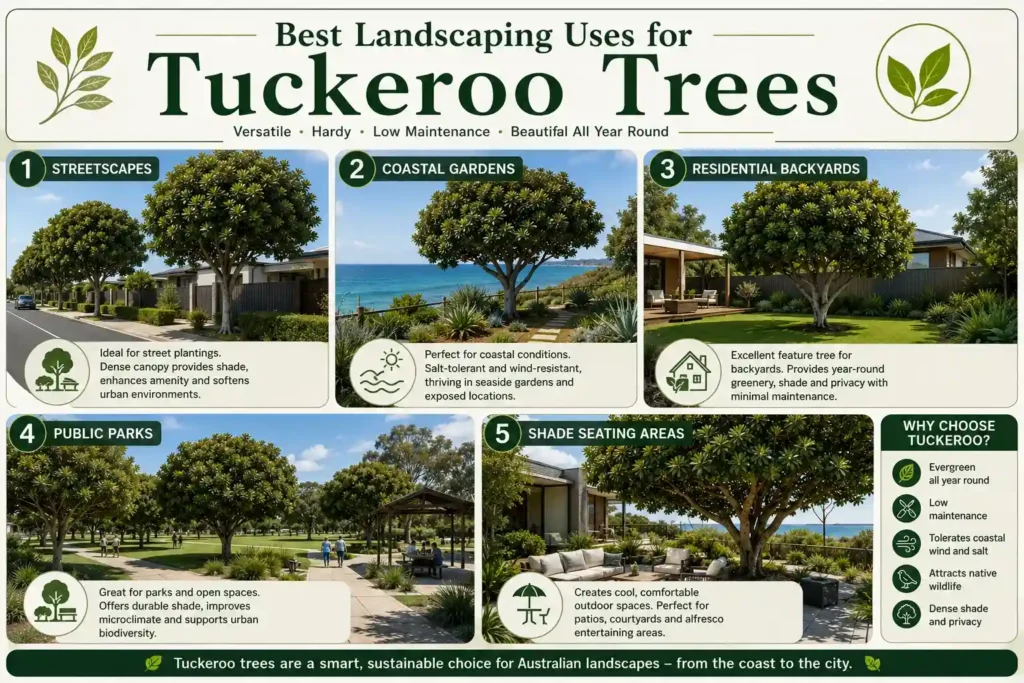
Tuckeroo trees are widely used in Australian landscaping because of their adaptability, evergreen canopy, and strong tolerance to urban and coastal conditions. Their balanced growth habit and dependable shade make them suitable for both public and residential planting projects.
Landscape designers frequently select tuckeroo trees for areas that require long-term durability, low maintenance, and year-round visual appeal.
The tuckeroo tree performs well in a wide variety of landscape environments, especially where heat, wind, or coastal exposure limit the success of more delicate ornamental species.
|
Location Type |
Suitability |
|
Streetscapes |
Excellent |
| Coastal Gardens |
Excellent |
|
Public Parks |
Very High |
| Residential Yards |
Very Good |
|
School Grounds |
Very Good |
| Urban Developments |
Excellent |
Tuckeroo trees are commonly planted along streets because they tolerate:
Their dense evergreen canopy also helps reduce heat buildup in urban areas while improving visual greenery along roads and walkways.
The moderate root behavior of the species makes it more manageable than many larger shade trees used in streetscape planting.
The tuckeroo is especially valuable in coastal gardens due to its natural adaptation to salty air and sandy soils.
Benefits for coastal landscaping include:
The tree maintains healthy foliage even in exposed beachfront environments where many ornamental species struggle.
Public parks often use tuckeroo trees because they provide dependable long-term shade with relatively low maintenance requirements.
Park landscaping advantages include:
Their dense canopy also creates comfortable shaded recreational areas in warm climates.
In residential landscapes, tuckeroo trees are frequently used as feature shade trees or boundary plantings.
They are suitable for:
Proper spacing allows the canopy to develop fully while minimizing future maintenance concerns.
One of the most important landscaping functions of the tuckeroo tree is shade production. The species develops a rounded evergreen canopy that provides effective sun protection throughout the year.
Tuckeroo trees form dense foliage coverage that helps block direct sunlight and create cooler outdoor environments.
|
Feature |
Benefit |
|
Dense Evergreen Canopy |
Year-round shade |
| Broad Crown Structure |
Wide coverage area |
|
Moderate Height |
Suitable for urban landscapes |
| Thick Foliage |
Reduced heat penetration |
The canopy structure also helps reduce glare and soften harsh summer conditions in residential and public spaces.
The cooling benefits of tuckeroo trees are especially valuable in Australian climates where heat management is important.
Shaded landscapes may help:
Because the species remains evergreen, these benefits continue throughout most of the year.
Companion planting around tuckeroo trees improves landscape diversity while helping create visually balanced native garden designs.
The best companion plants are species that tolerate:
Evergreen shrubs such as Viburnum Tinus work well in these mixed plantings, providing additional year-round screening and complementing the dense canopy of tuckeroo trees.
| Plant Type |
Suitable Examples |
|
Native Shrubs |
Westringia, Grevillea |
| Ground Covers |
Native violet, pigface |
|
Grasses |
Lomandra, kangaroo grass |
| Flowering Plants |
Kangaroo paw, callistemon |
These native combinations create low-maintenance landscapes that complement the natural appearance of tuckeroo trees.
Because tuckeroo trees adapt well to dry conditions once mature, they pair effectively with drought-tolerant landscaping designs.
Popular drought-friendly combinations include:
Applying mulch around companion plants also improves moisture retention and reduces overall irrigation needs.
The versatility of tuckeroo trees makes them highly valuable in sustainable landscaping projects focused on shade, durability, and climate resilience.
Tuckeroo trees are often compared with other shade and ornamental landscape trees because of their versatility, evergreen foliage, and low-maintenance growth habit. Understanding how the species differs from similar trees helps homeowners and landscapers choose the most suitable option for specific garden sizes and environmental conditions.
The tuckeroo is especially valued for balancing moderate growth, reliable shade, and coastal resilience without becoming excessively difficult to manage.
The terms “tuckeroo” and “carrotwood tree” are frequently used interchangeably because both names commonly refer to Cupaniopsis anacardioides. However, some regional landscaping discussions separate the names based on usage, location, or ornamental preference.
|
Feature |
Tuckeroo | Carrotwood Tree |
| Botanical Species | Cupaniopsis anacardioides |
Cupaniopsis anacardioides |
|
Evergreen Foliage |
Yes | Yes |
| Coastal Tolerance | Excellent |
Excellent |
|
Shade Capability |
High | High |
| Growth Habit | Rounded canopy |
Rounded canopy |
In most Australian landscaping contexts, “tuckeroo” is the preferred native name, while “carrotwood” is more commonly used internationally.
|
Aspect |
Tuckeroo | Carrotwood |
| Common Usage Region | Australia |
International markets |
|
Landscaping Focus |
Native landscaping | Ornamental planting |
| Naming Origin | Indigenous Australian term |
Fruit appearance reference |
The name carrotwood comes from the tree’s orange-yellow fruit capsules, which resemble carrot-like coloring when mature.
Regardless of naming differences, both terms generally describe the same species with identical growth characteristics and maintenance requirements.
Compared with many ornamental shade trees, the tuckeroo offers a strong combination of environmental resilience, evergreen foliage, and manageable maintenance.
|
Feature |
Tuckeroo Tree |
Typical Ornamental Shade Trees |
|
Foliage Type |
Evergreen | Often deciduous |
| Maintenance Needs | Low to moderate |
Moderate to high |
|
Coastal Tolerance |
Excellent | Variable |
| Root Aggressiveness | Moderate |
Sometimes invasive |
|
Shade Density |
Dense | Variable |
| Drought Tolerance | Good once established |
Species dependent |
Tuckeroo trees generally develop:
Many ornamental shade trees may grow faster initially but often require:
The tuckeroo’s controlled growth habit makes it easier to manage in urban and residential landscapes.
Compared to many ornamental species, tuckeroo trees usually require:
This lower-maintenance profile contributes significantly to the species’ popularity in Australian urban planting projects.
Although tuckeroo trees are manageable compared to many large shade species, smaller gardens may still require more compact alternatives.
Homeowners with limited space often prefer trees with:
|
Tree Option |
Main Benefit |
| Cupaniopsis parvifolia |
Finer foliage and lighter canopy |
|
Crepe Myrtle |
Compact ornamental flowering |
| Lilly Pilly |
Dense screening and moderate size |
|
Dwarf Magnolia |
Controlled evergreen growth |
| Ornamental Pear |
Upright compact structure |
For smaller landscapes, the following strategies improve tree suitability:
In compact residential spaces, smaller evergreen native trees may provide better long-term balance between shade, maintenance, and available growing area.
However, for medium to large gardens, the tuckeroo remains one of the most practical Australian native shade trees because of its durability, environmental tolerance, and attractive evergreen canopy.
|
Feature |
Details |
| Scientific Name |
Cupaniopsis anacardioides |
|
Common Name |
Tuckeroo Tree |
| Mature Height |
Variable depending on climate |
|
Growth Rate |
Moderate |
| Sun Requirement |
Full Sun |
|
Soil Type |
Well-drained |
| Native Region |
Coastal Australia |
|
Fruit Type |
Orange/yellow capsules |
| Maintenance Level |
Low to Moderate |
Maintaining healthy tuckeroo trees over the long term requires consistent care, proper planting practices, and early attention to environmental stress. Although the species is naturally hardy and adaptable, following expert maintenance strategies helps improve canopy density, structural stability, and overall tree lifespan.
Healthy tuckeroo trees are more resistant to drought, pests, disease, and urban stress conditions, making preventive care especially valuable.
Strong long-term growth begins with proper establishment during the early years after planting. Consistent maintenance and healthy soil conditions support stronger root systems and balanced canopy development.
|
Practice |
Benefit |
| Plant in Full Sun |
Encourages dense canopy growth |
|
Use Well-Drained Soil |
Reduces root stress |
| Apply Organic Mulch |
Conserves moisture and improves soil |
|
Water Deeply |
Encourages deeper root development |
| Prune Strategically |
Maintains structural balance |
Additional expert recommendations include:
Deep watering during establishment is especially important because it encourages roots to grow downward rather than remaining near the soil surface.
Healthy root systems improve:
Many tuckeroo tree problems develop because of preventable maintenance mistakes. Avoiding these common errors helps maintain healthier growth and reduces long-term structural issues.
|
Mistake |
Potential Problem |
| Overwatering |
Root rot and leaf yellowing |
|
Poor Drainage |
Root stress and fungal issues |
| Planting Too Close to Structures |
Future canopy and root conflicts |
|
Excessive Pruning |
Weak regrowth and canopy imbalance |
| Insufficient Sunlight |
Sparse foliage and slow growth |
One of the most common problems is excessive watering, especially in poorly drained soils.
Too much moisture may lead to:
Watering should always be adjusted according to climate, rainfall, and soil drainage.
Planting tuckeroo trees too close to houses, driveways, or underground infrastructure may create future maintenance challenges as the canopy and root system mature.
Proper spacing supports:
Heavy or poorly timed pruning can weaken branch structure and reduce canopy quality.
Avoid:
Light structural pruning is usually more effective than aggressive cutting.
Seasonal maintenance helps keep tuckeroo trees healthy throughout the year while reducing environmental stress and improving long-term performance.
|
Task |
Purpose |
|
Inspect New Growth |
Detect early stress signs |
| Apply Slow-Release Fertilizer |
Support active growth |
|
Refresh Mulch |
Improve moisture retention |
| Light Pruning |
Shape canopy if needed |
Spring is the ideal period for active growth support and canopy development.
|
Task |
Purpose |
| Deep Water During Heatwaves |
Prevent drought stress |
|
Monitor Leaf Condition |
Identify heat damage |
| Check Soil Moisture |
Maintain healthy root zone |
Summer care is especially important for young trees and recently planted specimens.
|
Task |
Purpose |
| Remove Fallen Fruit |
Reduce cleanup buildup |
|
Inspect Branch Structure |
Prepare for storms |
| Maintain Mulch Layer |
Protect soil moisture |
Autumn is a useful time to evaluate overall canopy health before cooler weather arrives.
|
Task |
Purpose |
| Structural Pruning |
Improve branch balance |
|
Reduce Excess Watering |
Prevent root problems |
| Monitor Frost Exposure |
Protect young trees |
Winter maintenance should focus on structural improvement and protecting roots from excessive moisture.
By following proper seasonal care routines and avoiding common maintenance mistakes, tuckeroo trees can remain healthy, attractive, and structurally strong for decades in both residential and urban landscapes.
Tuckeroo trees remain one of the most reliable and versatile native Australian landscape trees because of their dense evergreen canopy, coastal resilience, and relatively low-maintenance growth habit. Their ability to tolerate heat, wind, salt exposure, and urban conditions makes them highly suitable for residential gardens, streetscapes, parks, and large-scale landscaping projects.
The steady growth rate of the tuckeroo allows it to develop into an effective long-term shade tree without becoming excessively difficult to manage. With proper pruning, watering, and soil care, the species maintains healthy foliage, balanced structure, and strong environmental resistance for decades.
From backyard shade planting to urban landscaping, the tuckeroo offers excellent practical and ornamental value. Its durable canopy, moderate maintenance needs, and adaptability to Australian climates continue to make it a preferred choice for homeowners, landscapers, and councils alike.
Proper planting location, well-drained soil, and consistent early care are the keys to long-term success. When established correctly, tuckeroo trees provide lasting shade, visual appeal, and sustainable landscape performance for many years.
A mature tuckeroo tree typically grows between 8 and 15 meters tall depending on climate, soil quality, and available growing space. Trees planted in ideal coastal conditions often grow larger and develop broader canopies, while residential garden specimens may remain more compact with regular pruning and limited root space.
Tuckeroo trees are considered moderately tidy compared to many large ornamental or deciduous trees. They do produce some fruit capsules, leaf shedding, and light flower drop throughout the year, but the debris is generally manageable. Proper placement away from pools, patios, and paved entertainment areas can reduce cleanup needs.
The tuckeroo tree has a moderate growth rate. Young trees establish steadily during the first few years and gradually develop into mature shade trees over time. Growth speed improves in full sun, well-drained soil, and warm coastal climates with consistent watering during establishment.
A tuckeroo tree losing leaves may be experiencing water stress, nutrient deficiency, poor drainage, or seasonal foliage replacement. Mild shedding is normal for evergreen species, but excessive leaf drop can indicate environmental stress or root problems. Checking watering practices and soil conditions usually helps identify the cause.
Yes, tuckeroo trees are popular for backyard landscaping because they provide dense evergreen shade, tolerate Australian climates well, and require relatively low maintenance once established. They are especially suitable for medium to large residential gardens where there is enough room for canopy development.
Common pests affecting tuckeroo trees include scale insects, aphids, caterpillars, and occasional borers. Most infestations are manageable when trees remain healthy and properly maintained. Stress caused by drought, poor drainage, or nutrient imbalance can increase susceptibility to pest problems.
Yes, tuckeroo trees can grow successfully in Perth when provided with proper watering and soil preparation during establishment. The species tolerates heat and dry conditions relatively well once mature, although young trees may require additional irrigation during extreme summer temperatures.
The scientific name of the tuckeroo tree is Cupaniopsis anacardioides. It belongs to the Sapindaceae family and is native to coastal regions of Australia.
Tuckeroo trees are generally considered to have moderately non-invasive root systems compared to many large shade trees. However, they still require appropriate planting distance from foundations, pools, and underground infrastructure to prevent future issues as the tree matures.
Established tuckeroo trees have good drought tolerance and can handle dry periods better than many ornamental species. Young trees, however, require regular deep watering during their establishment phase to develop strong root systems.
Yes, tuckeroo trees are highly valued for coastal landscaping because they tolerate salt spray, sandy soils, wind exposure, and high temperatures exceptionally well. Their natural coastal adaptation makes them one of the most reliable native Australian trees for beachfront and seaside planting.
The best time to plant a tuckeroo tree is during spring or early autumn when temperatures are moderate and soil moisture is more stable. These conditions help reduce transplant stress and encourage stronger root establishment before extreme summer heat or winter cold arrives.
Yes, tuckeroo trees are evergreen, meaning they retain their foliage throughout the year. Their glossy green canopy provides year-round shade and ornamental value in both residential and urban landscapes.
Newly planted tuckeroo trees should be watered deeply several times per week during establishment. Mature trees usually require occasional deep watering during prolonged dry periods, especially in hotter inland climates. Overwatering should be avoided because excessively wet soil may damage roots.