Grow Better Gardens with Smarter Plant Choices
Discover helpful guides on trees, hedges, fruit plants, edible plants, and beautiful landscape greenery.

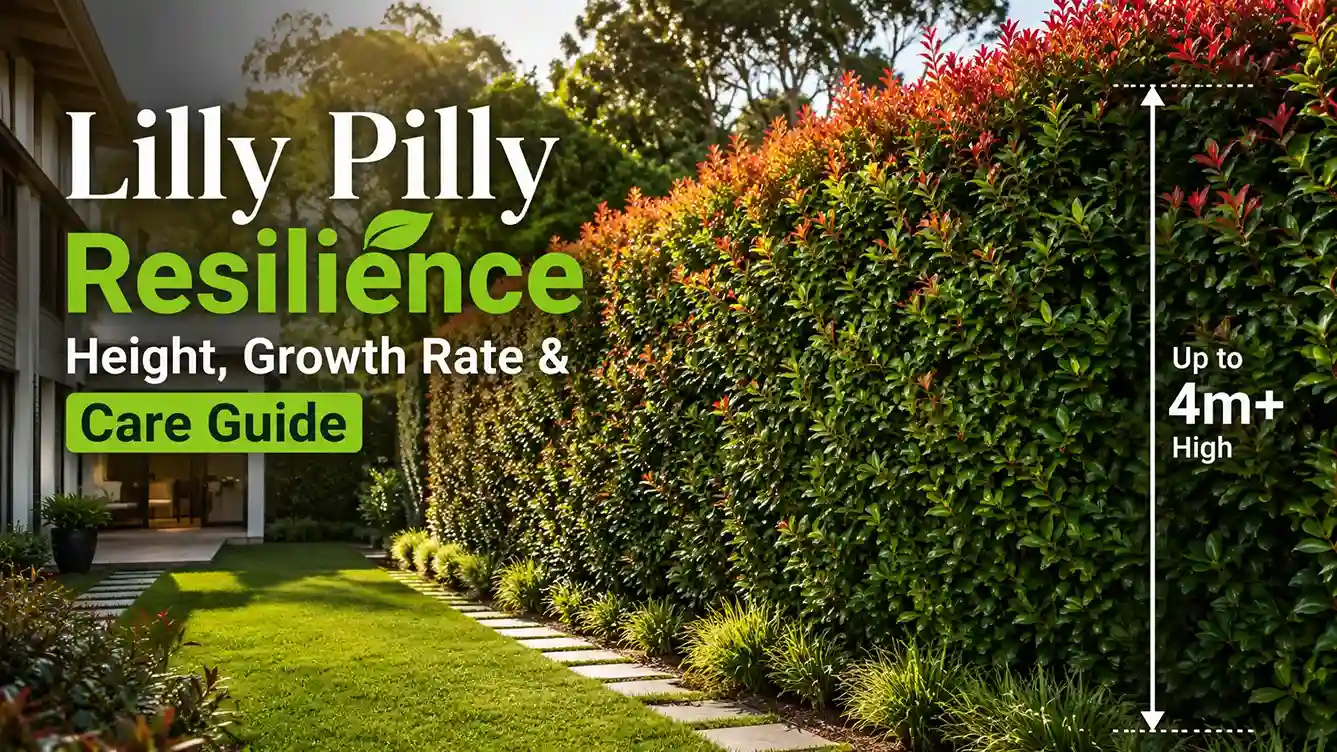
Lilly pilly resilience is one of the most popular hedge plants in Australia due to its fast growth, dense evergreen foliage, and strong resistance to psyllid damage. Part of the syzygium australe resilience group, this attractive screening plant is widely used for privacy hedges, boundary planting, and modern landscape designs. Many gardeners choose resilience lilly pilly because it maintains a healthy appearance with less pest-related maintenance compared to older varieties. A mature lilly pilly australe resilience hedge can reach impressive heights while remaining easy to shape through pruning. This syzygium resilience variety is also valued for its adaptable growth rate, flexible spacing options, reliable hedge performance, straightforward care requirements, and reduced common problems associated with traditional syzygium australe lilly pilly plants.
The scientific name of Lilly Pilly Resilience is Syzygium australe, a native Australian rainforest species widely grown for hedging and screening. The term “lilly pilly” is the common name used for several plants within the Syzygium genus, which includes many popular ornamental hedge varieties.
Understanding the relationship between these plant names helps reduce confusion when choosing the right cultivar:
Many gardeners encounter different naming variations in nurseries and online plant listings. Terms such as syzygium resilience lilly pilly, syzygium resilience – lilly pilly, and australe lilly pilly are often used interchangeably, even though they usually refer to the same psyllid-resistant cultivar known as Resilience.
This naming overlap can create confusion, especially because many syzygium cultivars share similar foliage and growth habits. However, Resilience is specifically valued for its strong hedge performance, fast growth, and improved resistance to common lilly pilly pests.
Lilly Pilly Resilience is widely planted because it combines ornamental appeal with reliable hedge performance. It is considered one of the easiest syzygium varieties to maintain in residential landscapes.
Key features include:
This variety performs well in several landscape applications, including:
Because of its thick foliage coverage and rapid establishment, many homeowners use Lilly Pilly Resilience as a natural alternative to fencing.
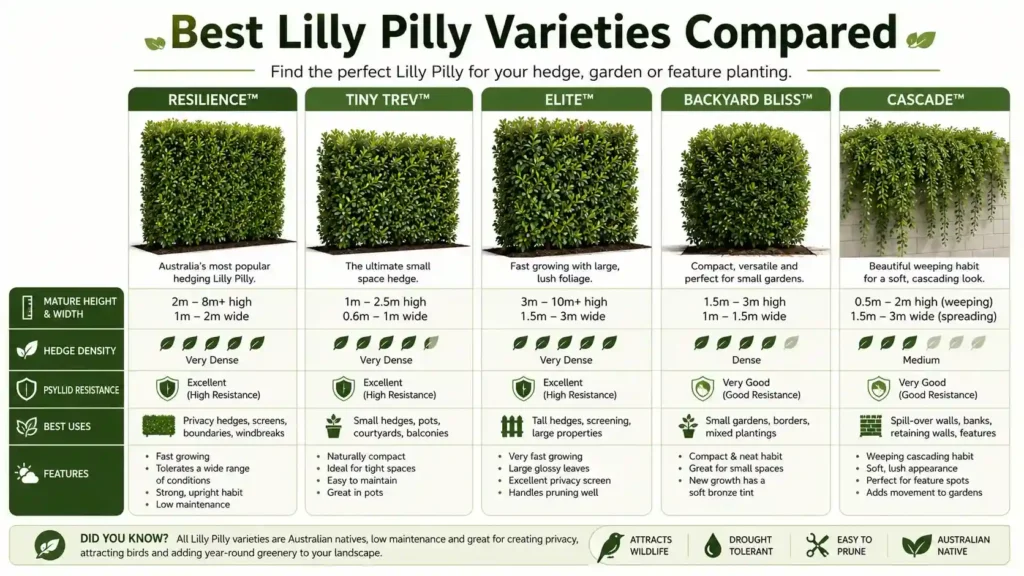
Several lilly pilly cultivars are available in Australia, but each variety differs in mature size, pest resistance, and ideal landscape use.
Many gardeners combine resilience lilly pilly with other Australian native hedge plants to achieve a dense, low-maintenance screening solution that thrives in local conditions.
Some are better suited for compact gardens, while others are designed for tall privacy hedges or feature planting.
| Variety | Height | Psyllid Resistance | Best Use |
| Resilience | 4–8 metres | Excellent | Privacy hedges and screening |
| Tiny Trev | 1.5–3 metres | Good | Compact hedges and small gardens |
| Elite | 6–10 metres | Very good | Tall formal hedges |
| Backyard Bliss | 4–6 metres | Moderate | Backyard screening |
| Cascade | 2–4 metres | Moderate | Decorative hedges and shaping |
Popular varieties such as syzygium elite and lilly pilly elite are commonly selected for taller formal hedges due to their upright growth habit. Smaller-growing cultivars like syzygium australe tiny trev are more suitable for narrow garden beds and low-maintenance suburban landscapes.
Some gardeners also compare Resilience with varieties like syzygium up and away, which is known for its vertical growth and compact width. However, Resilience remains one of the most widely chosen options because it balances fast growth, dense foliage, and dependable psyllid resistance in a broad range of climates.
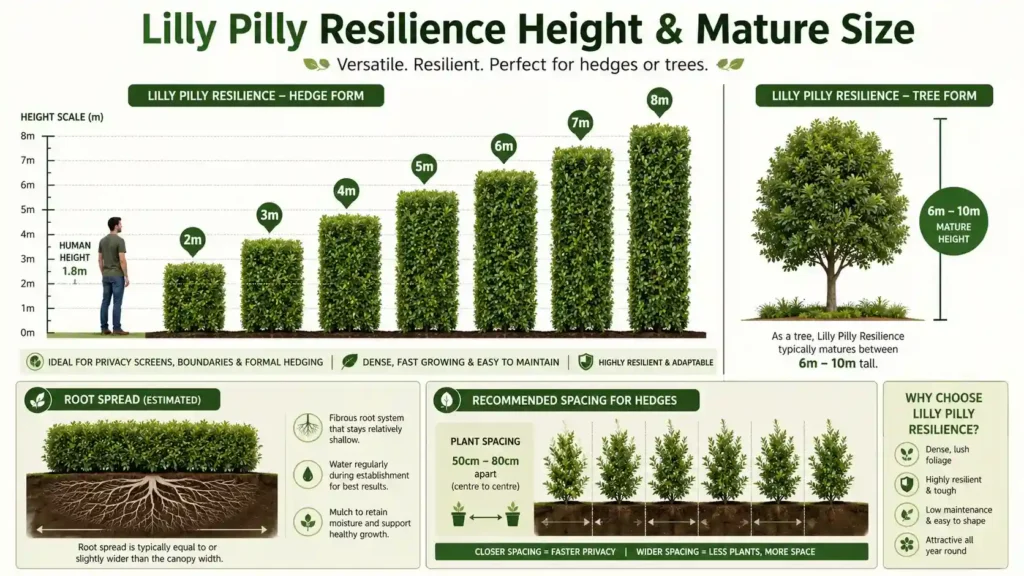
Lilly Pilly Resilience is considered a medium-to-tall growing hedge plant that can quickly establish dense privacy coverage in residential gardens. Under ideal growing conditions, the typical mature lilly pilly height ranges between 4 and 8 metres, with a spread of approximately 2 to 4 metres depending on pruning and spacing.
When maintained as a formal hedge, the plant is usually kept between 2 and 5 metres tall for easier maintenance and consistent screening. In contrast, an unpruned lilly pilly tree can grow significantly taller and develop a broader canopy over time.
The term syzygium resilience height commonly refers to the plant’s mature hedge potential rather than its maximum natural height. Most homeowners trim the plant regularly to maintain a dense, compact form suitable for suburban boundaries and privacy screens.
In tree form, this syzygium tree develops:
Because of its vigorous growth habit, many gardeners choose to plant syzygium varieties where long-term vertical screening is needed.
A well-maintained Resilience hedge typically grows between 3 and 5 metres tall, making it suitable for privacy planting around fences, driveways, and property boundaries. In larger gardens, some hedges are allowed to reach 6 metres or more for maximum screening.
The final hedge size depends largely on:
Regular trimming helps maintain a compact shape while encouraging denser foliage growth from the base upward. Without pruning, the hedge can gradually transition into a taller tree-like structure.
Compared with other varieties, Resilience sits among the taller lilly pilly cultivars commonly used for screening. While it may not always be considered the absolute tallest lilly pilly, it is one of the most practical fast-growing hedge options for residential landscapes because of its balance between height, density, and pest resistance.
Some larger syzygium varieties can exceed 10 metres in ideal conditions, but these often require more maintenance and space management than Resilience.
At maturity, Lilly Pilly Resilience generally develops a spread of 2 to 4 metres depending on pruning style and growing conditions. Hedges clipped regularly tend to remain narrower and denser, while unpruned plants form wider canopies.
The root system is typically non-invasive when planted correctly, but adequate spacing from structures and drainage systems is still recommended. Like many hedge species, roots naturally spread wider in search of moisture and nutrients.
For best long-term performance, avoid planting too close to:
Ideal garden placement includes:
Its dense evergreen foliage makes it highly effective for blocking neighbouring views, reducing wind exposure, and softening hard landscape lines. This strong screening ability is one reason many homeowners choose to plant syzygium hedges instead of traditional fencing alternatives.
Several environmental and maintenance factors directly influence how quickly and how tall Lilly Pilly Resilience grows.
Full sun encourages the fastest and healthiest growth. While the plant tolerates partial shade, reduced sunlight can slow growth and decrease foliage density.
Rich, well-draining soil supports stronger root development and improved canopy growth. Poor soil conditions may limit overall lilly pilly height and foliage quality.
Consistent watering is especially important during establishment. Young plants require steady moisture to develop deep root systems and vigorous vertical growth.
Balanced slow-release fertilizers encourage faster hedge thickening and healthier foliage production. Seasonal feeding can significantly improve growth performance.
Warm temperate and subtropical climates generally produce the best growth rates. In cooler regions, growth may slow during winter months, although established plants remain relatively hardy.
When properly maintained, a healthy lilly pilly tree or hedge can provide dense evergreen screening for many years while remaining manageable through routine pruning and care.
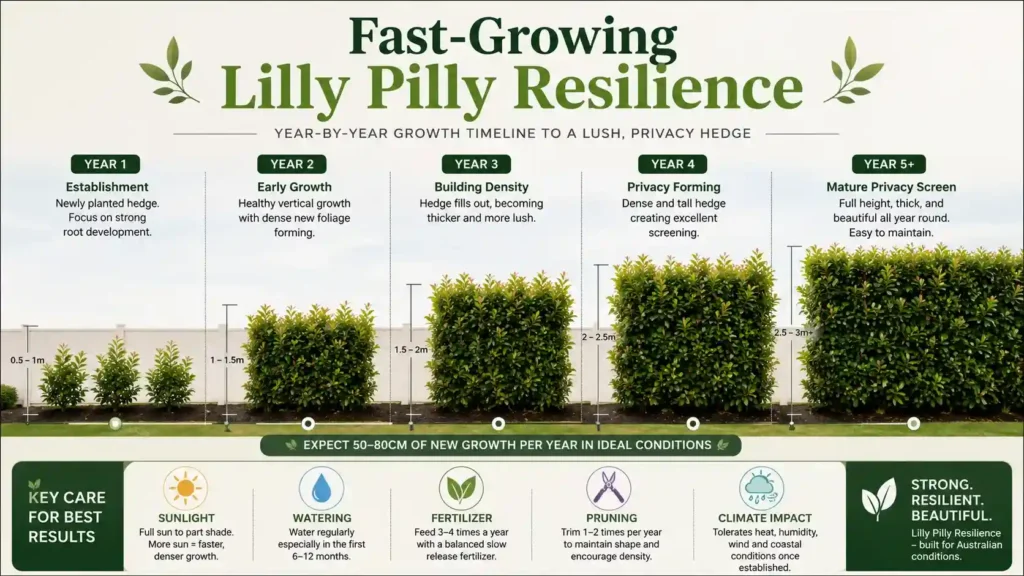
Lilly Pilly Resilience is widely recognised as a fast-growing Australian hedge plant suitable for privacy screening and boundary planting. Under favourable conditions, the average lilly pilly resilience growth rate is approximately 50 centimetres to 1 metre per year during the active growing season.
This rapid development makes it one of the preferred choices for homeowners wanting quick hedge coverage without waiting many years for maturity. Young plants establish relatively quickly and begin producing dense foliage early when given adequate water, sunlight, and nutrients.
Several characteristics contribute to its fast-growing hedge reputation:
Compared with slower ornamental hedges, mature lilly pillys can form effective privacy screens within only a few growing seasons. When left unpruned, some plants may gradually develop into a larger lily pily tree with increased height and canopy spread.
Because of its reliable performance and manageable maintenance requirements, Resilience is commonly planted in both residential and commercial landscapes.
The growth speed of Lilly Pilly Resilience can vary depending on climate, soil quality, and local environmental conditions.
In coastal regions, the plant generally performs well due to moderate temperatures and higher humidity levels. Established hedges tolerate coastal winds reasonably well once roots are fully developed. Growth remains steady provided the soil drains effectively and salt exposure is not excessive.
Warm subtropical climates often produce the fastest growth rates for lillypilly trees. Consistent warmth, seasonal rainfall, and longer growing periods encourage vigorous foliage production and rapid hedge thickening.
In these conditions, plants may achieve:
In cooler climates, growth tends to slow during winter months, particularly in areas affected by frost. However, established lilly pillys still maintain healthy evergreen foliage in many temperate regions.
While overall annual growth may be slightly reduced, proper care and protected planting positions can still support strong hedge performance.
Healthy growing conditions play a major role in maximising hedge establishment and long-term plant performance. Gardeners wanting quicker screening results can improve growth by following several basic maintenance practices.
When maintained correctly, Lilly Pilly Resilience can quickly form a dense evergreen hedge while remaining easier to manage than many other fast-growing screening plants.
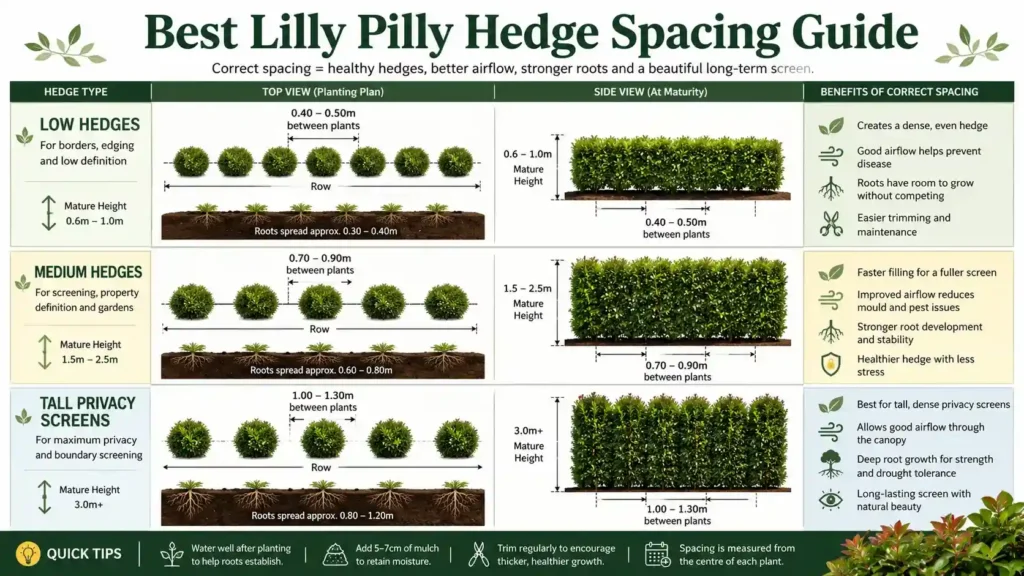
Correct spacing is essential for creating a healthy, dense, and long-lasting hedge. Proper lilly pilly resilience spacing allows each plant to develop strong roots, maintain airflow, and form even foliage coverage without excessive competition.
The ideal spacing depends on:
For most residential hedges, plants are commonly spaced between 1 and 1.5 metres apart. This distance allows the foliage to merge naturally while still giving roots enough room to establish properly.
Standard hedge planting usually follows these recommendations:
A compact hedge requires tighter planting distances to encourage rapid foliage connection. Gardeners wanting a thick formal hedge often position plants closer together.
Compact spacing works best for:
For a taller resilience lilly pilly hedge, slightly wider spacing is usually recommended. This allows stronger root development and reduces excessive crowding as plants mature.
Tall screening hedges benefit from:
A well-planned lilly pilly resilience hedge can create effective year-round privacy while maintaining healthy growth over many years.
Different hedge heights require different planting distances to balance density and healthy development.
| Desired Hedge Height | Recommended Plant Spacing |
| Low hedge | 70 cm – 1 metre apart |
| Medium hedge | 1 – 1.2 metres apart |
| Tall screen hedge | 1.2 – 1.5 metres apart |
Lower hedges usually require tighter spacing for immediate fullness, while taller privacy screens benefit from additional room for mature growth and root expansion.
Incorrect hedge spacing is one of the most common causes of poor hedge performance. Over time, overcrowded plants may develop weaker growth, thinning foliage, and increased disease risk.
Planting too closely can initially create fast hedge coverage, but mature plants often begin competing heavily for sunlight, nutrients, and moisture.
Common overcrowding problems include:
Dense planting without enough spacing restricts air movement between branches and leaves. Poor airflow can increase humidity levels within the hedge, encouraging fungal diseases and pest activity.
Proper spacing helps maintain:
When plants are positioned too closely together, roots compete aggressively for water and nutrients. This competition may slow growth and reduce overall hedge health.
To avoid root competition:
Correct spacing from the beginning helps create a stronger, healthier hedge that requires less corrective maintenance in the future.
Proper growing conditions are essential for maintaining healthy foliage, steady growth, and long-term hedge performance. Good sunlight exposure and well-prepared soil greatly improve overall lilly pilly care and help the plant develop dense evergreen coverage.
Lilly Pilly Resilience grows best in:
Although the plant tolerates some shade, full sun generally produces:
A healthy lilly pilly plant performs best in rich, well-draining soil with good organic content. Ideal soil types include:
Heavy compacted soil may restrict root development and increase the risk of root disease if drainage is poor.
Good drainage is critical, especially during establishment. Waterlogged soil can lead to:
Raised garden beds and improved organic matter can help increase drainage in heavier soils.
Lilly Pilly Resilience generally prefers slightly acidic to neutral soil conditions, with an ideal pH range between 5.5 and 7.0. However, the plant is adaptable and can tolerate a range of garden soil conditions when maintained properly.
Watering requirements vary depending on plant age, climate conditions, and soil type. Understanding how often to water lilly pilly plants helps maintain healthy root systems and consistent foliage growth.
Newly planted hedges require regular watering while roots establish.
Recommended watering guidelines:
The soil should remain consistently moist but not waterlogged.
Once fully established, mature hedges become more drought tolerant and usually require less frequent irrigation.
Established plants generally benefit from:
Lilly Pilly Resilience has moderate drought tolerance once established, but prolonged dry conditions may still affect:
Applying mulch around the root zone helps retain moisture and reduce water stress during hot weather.
Regular feeding and mulching support stronger root growth, healthier foliage, and faster hedge establishment.
The best fertilizers for Lilly Pilly Resilience include:
Avoid excessive high-nitrogen feeding, which may encourage overly soft growth.
A simple feeding schedule helps maintain healthy year-round growth:
| Season | Fertilizing Recommendation |
| Spring | Apply slow-release fertilizer for active growth |
| Early Summer | Light supplementary feeding if needed |
| Autumn | Mild feeding in warmer climates |
| Winter | Usually not required |
Organic mulch provides several advantages:
Keep mulch slightly away from the trunk base to prevent excessive moisture buildup around stems.
Routine trimming is important for maintaining the shape, density, and appearance of a Lilly Pilly hedge.
Most hedges benefit from pruning:
Light, regular trimming usually produces denser and healthier foliage than heavy infrequent cutting.
The ideal pruning periods are:
Avoid heavy pruning during frost periods or extreme summer heat.
To encourage a thick hedge structure:
Proper maintenance keeps the hedge compact, healthy, and visually dense while reducing long-term care problems.
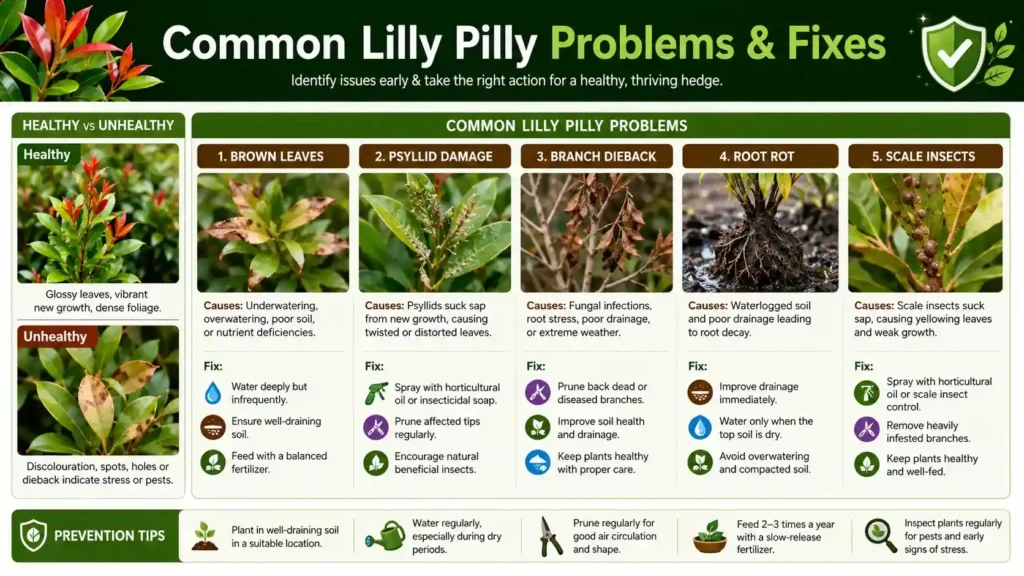
One of the most common concerns among gardeners is: why is my lilly pilly leaves turning brown? Browning foliage can occur for several reasons, including watering issues, environmental stress, and nutrient imbalances.
Understanding the cause early helps prevent long-term damage and improves overall plant recovery.
Insufficient moisture is a major reason for lilly pilly leaves turning brown, especially during hot or windy conditions. Dry soil limits water uptake and places stress on the foliage.
Common signs include:
Deep watering and consistent moisture are important during warm weather and establishment periods.
Excess water can also create serious lilly pilly problems by reducing oxygen around the roots. Waterlogged soil may weaken the plant and eventually lead to root disease.
Symptoms often include:
Improving drainage and adjusting watering frequency usually helps correct the issue.
A lack of essential nutrients may cause pale foliage, weak growth, and browning leaves. Nitrogen, iron, and magnesium deficiencies are among the most common nutritional issues affecting hedge performance.
Applying a balanced slow-release fertilizer can help restore healthy foliage colour and growth.
Extreme heat and prolonged dry winds can scorch exposed foliage, particularly in newly planted hedges. Heat stress often appears as:
Mulching and deep watering help reduce temperature stress around the root zone.
Another common issue is lilly pilly branches dying, which may result from root damage, disease, or poor soil conditions.
Root rot commonly develops when soil remains excessively wet for extended periods. Fungal pathogens attack weakened roots, reducing the plant’s ability to absorb water and nutrients.
Signs of root rot include:
Some fungal infections spread through dense foliage during humid conditions or poor airflow. Diseased branches may gradually die back if left untreated.
Removing affected growth and improving ventilation can help reduce fungal spread.
Poor drainage is one of the leading causes of long-term problems with lilly pilly hedges. Compacted soil traps excess moisture and weakens root systems over time.
Improving soil structure with organic matter and raised planting areas can significantly improve plant health.
Although Lilly Pilly Resilience is known for its durability, several pests and diseases may still affect some plants under stressful conditions.
Psyllids are small sap-sucking insects that commonly attack traditional lilly pilly varieties. Damage usually appears as:
Many gardeners choose Resilience specifically because of its improved psyllid resistance.
Scale insects attach themselves to stems and leaves while feeding on plant sap. Heavy infestations may weaken growth and encourage sooty mould development.
Regular inspection and horticultural oil treatments can help control outbreaks.
Leaf spot diseases create dark patches or spotting across foliage, especially in humid conditions with limited airflow.
Prevention methods include:
Different cultivars may experience slightly different pest sensitivities, growth issues, or maintenance challenges.
| Variety | Common Problems |
| Backyard Bliss | Can develop thinner growth if heavily shaded |
| Cascade | More prone to shaping and density issues |
| Big Red | Larger size may require more frequent pruning |
Some gardeners report backyard bliss lilly pilly problems related to slower dense hedge formation in low-light conditions. Likewise, lilly pilly cascade problems may include less compact growth compared with formal hedge cultivars.
Certain larger varieties are also associated with syzygium big red problems, particularly excessive height growth and increased pruning maintenance in smaller gardens.
Lilly Pilly Resilience is specifically valued because it helps minimise many traditional hedge issues.
Key advantages include:
Compared with older cultivars, fewer lilly pilly resilience problems are typically reported when plants are grown in suitable conditions with proper care.
Its naturally compact growth habit and stronger pest resistance make it one of the most reliable hedge varieties for modern Australian gardens.
Lilly Pilly Resilience is one of the most versatile evergreen hedge plants used in Australian landscaping. Its dense foliage, upright growth habit, and fast establishment make it suitable for a wide range of residential garden applications.
Privacy screening is the most common use for Lilly Pilly Resilience. The plant forms a thick evergreen barrier that helps block neighbouring views, reduce visual exposure, and create a more secluded outdoor space.
For homeowners working with narrower garden beds or tighter side boundaries, smaller cultivars like Lilly Pilly Smithii Minor are especially suitable because they maintain dense coverage without crowding the space.
Benefits of using it as a privacy screen include:
Its strong vertical growth also makes it ideal for narrow side boundaries where space is limited.
Homeowners often consult a detailed guide on hedging and screening plants to select species that provide optimal coverage, growth habit, and seasonal appeal for their landscapes.
Many homeowners use Lilly Pilly Resilience to replace traditional fencing or soften hard property lines. Formal boundary hedges create a neat and structured appearance while still providing natural greenery throughout the year.
Boundary hedge advantages include:
Regular trimming helps maintain a dense and uniform hedge structure.
Because of its compact evergreen canopy, Lilly Pilly Resilience also works effectively as a windbreak in exposed gardens. Thick foliage helps reduce wind movement and protects surrounding plants from drying conditions.
Windbreak planting is especially useful for:
Although commonly grown as a hedge, Lilly Pilly Resilience can also be shaped into an attractive feature tree. When allowed to grow naturally, the plant develops a fuller canopy and more prominent trunk structure.
Selective pruning helps create a balanced tree form while maintaining healthy branching. Gardeners often remove lower branches gradually to expose the trunk and encourage upward canopy development.
Feature tree shaping works well for:
The glossy green foliage combined with soft red new growth provides strong ornamental value throughout the year.
Lilly Pilly feature trees can complement both modern and traditional landscape designs. Their dense foliage and adaptable structure allow them to work well in:
Many gardeners also use decorative lighting around mature plants to highlight foliage texture and canopy structure at night.
Choosing suitable companion plants helps create a balanced and low-maintenance landscape design around Lilly Pilly hedges and feature trees.
Native species pair especially well with Lilly Pilly because they often share similar soil and climate preferences.
Popular companion plants include:
These plants add texture, colour variation, and biodiversity while maintaining a cohesive Australian garden style.
For easy-care landscapes, many gardeners combine Lilly Pilly with drought-tolerant shrubs, ornamental grasses, and mulched garden beds.
Low-maintenance combinations help:
Using layered planting designs with groundcovers and medium-height shrubs also helps soften hedge lines and create a more natural landscape appearance.
Lilly Pilly Resilience is widely available through local nurseries, landscape suppliers, and large garden retailers across Australia. Buying from a reputable garden center helps ensure the plants are healthy, correctly identified, and suitable for local growing conditions.
Before purchasing, inspect plants carefully for signs of strong growth and overall health.
Look for:
Avoid plants showing:
Healthy plants establish faster and usually develop more reliable hedge growth after planting.
The ideal plant size depends on budget, hedge goals, and desired establishment speed.
Common nursery sizes include:
Smaller plants often establish quickly because roots adapt faster to surrounding soil conditions. Larger plants provide more immediate coverage but may require additional watering during establishment.
Many homeowners purchase hedge plants through major retailers such as Bunnings because of wide availability and convenient access.
Searching for terms like lilly pilly bunnings, bunnings lilly pilly, or lillypilly bunnings commonly reveals multiple hedge and screening varieties suitable for residential landscaping.
Depending on seasonal stock and location, stores may offer:
Gardeners specifically searching for lilly pilly resilience bunnings or bunnings lilly pilly resilience may find both smaller starter plants and more advanced hedge-ready sizes available.
Some locations also stock feature-sized plants suitable for shaping into ornamental trees, often listed under terms like lilly pilly tree bunnings.
Before purchasing from larger retail stores, inspect plants closely because stock quality can vary.
Important things to check include:
It is also useful to confirm:
Comparing different lilly pilly varieties bunnings stocks can help homeowners choose the most suitable option for their available garden space and maintenance preferences.
Selecting the correct variety depends on the intended landscape use, available space, and desired maintenance level.
Some varieties are specifically bred for dense hedging, while others perform better as ornamental trees or decorative landscape features.
Hedge-focused varieties generally provide:
Feature tree varieties often develop:
Lilly Pilly Resilience is commonly chosen because it performs well in both applications with regular maintenance.
Fast-growing varieties are ideal for:
Compact varieties work better for:
Choosing the right growth habit early helps reduce future pruning requirements and improves long-term garden management.
Lilly Pilly Resilience is one of the most reliable and widely planted hedge varieties for Australian gardens. With an average mature height ranging from 4 to 8 metres, it provides excellent flexibility for both compact hedges and taller privacy screens. Regular pruning allows homeowners to easily control hedge size while maintaining dense evergreen coverage throughout the year.
The popularity of Resilience comes from its strong combination of fast growth, attractive foliage, and improved psyllid resistance. Compared with many traditional hedge plants, it establishes quickly, responds well to trimming, and requires relatively low ongoing maintenance once fully established.
Its adaptability also makes it suitable for:
For homeowners wanting a fast-growing privacy hedge that offers dense foliage, reliable performance, and easier long-term care, Lilly Pilly Resilience remains one of the best hedge choices available.
Lilly Pilly Resilience typically grows between 4 and 8 metres tall at full maturity. When maintained as a hedge, most homeowners keep it trimmed between 2 and 5 metres for easier maintenance and privacy screening.
The average growth rate of Lilly Pilly Resilience is around 50 centimetres to 1 metre per year under ideal conditions. Warm temperatures, full sun, regular watering, and fertile soil can help accelerate growth.
Most hedges perform well when plants are spaced between 1 and 1.5 metres apart. Closer spacing creates a denser hedge more quickly, while wider spacing allows better airflow and long-term root development.
Yes, Lilly Pilly Resilience is widely known for its strong psyllid resistance. This makes it a popular choice for gardeners wanting a healthier hedge with fewer pest-related problems compared with older lilly pilly varieties.
Lilly pilly leaves turning brown is commonly caused by underwatering, overwatering, heat stress, nutrient deficiencies, or poor drainage. Identifying the exact cause early helps prevent further plant decline.
Young plants generally need deep watering two to three times per week during establishment. Mature hedges usually require weekly deep watering during dry conditions, although rainfall and climate can affect watering frequency.
Yes, Lilly Pilly Resilience can grow successfully in large pots and containers if provided with quality potting mix, regular watering, and routine pruning. Container-grown plants may require more frequent feeding and moisture monitoring than garden-planted hedges.
Yes, mature plants can attract birds because of their dense foliage and seasonal berries. The thick evergreen growth also provides useful shelter for small garden wildlife.
A balanced slow-release fertilizer designed for native or evergreen plants usually works best. Feeding during spring and early summer supports stronger foliage growth and healthier hedge development.
Established plants can tolerate light frost in many temperate regions. However, young plants may require protection during severe cold conditions until roots become fully established.
Most formal hedges benefit from pruning two to four times per year. Regular light trimming encourages denser foliage and helps maintain a clean hedge shape.
Lilly Pilly roots are generally considered non-invasive when planted correctly. However, adequate spacing from foundations, pipes, and retaining walls is still recommended to avoid future root competition or maintenance issues.