Grow Better Gardens with Smarter Plant Choices
Discover helpful guides on trees, hedges, fruit plants, edible plants, and beautiful landscape greenery.

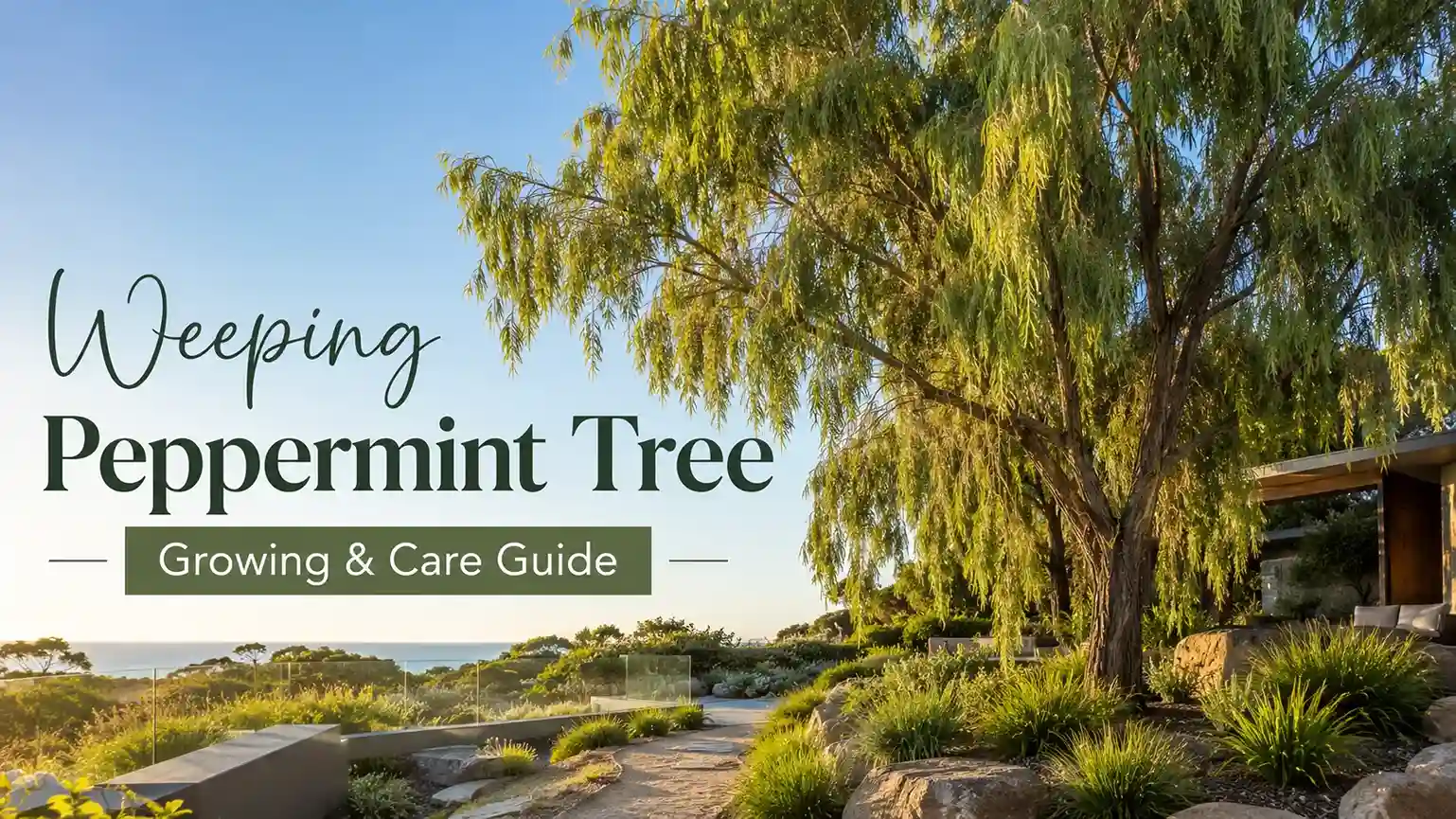
The weeping peppermint tree (Agonis flexuosa) is a graceful Australian native tree widely admired for its elegant weeping branches, aromatic foliage, and strong adaptability to coastal conditions. Commonly known as the western australian peppermint tree, wa peppermint tree, willow myrtle, peppermint willow, or australian peppermint tree, this evergreen species is especially popular in Western Australia landscaping due to its drought tolerance and attractive ornamental appearance. Its long, narrow leaves release a peppermint-like fragrance when crushed, while the cascading growth habit makes it a striking shade and feature tree. Agonis flexuosa is commonly used in residential gardens, streetscapes, coastal landscapes, and larger outdoor spaces where low-maintenance native trees are preferred.
The weeping peppermint tree is a highly recognizable Australian native evergreen valued for its graceful hanging branches, fragrant foliage, and excellent adaptability to warm coastal climates. Known scientifically as Agonis flexuosa, this ornamental tree is widely planted in gardens, parks, and streetscapes throughout Australia, especially in coastal and Mediterranean-style regions. Its elegant appearance and relatively low maintenance needs have made it one of the most popular native landscaping trees in Western Australia.
| Feature | Details |
| Botanical Name | Agonis flexuosa |
| Family | Myrtaceae |
| Common Type | Evergreen native tree |
| Native Origin | Western Australia |
| Growth Habit | Weeping ornamental tree |
The botanical name of the species is Agonis flexuosa, and it belongs to the Myrtaceae family, which also includes eucalyptus, bottlebrush, and tea trees. The species is native to the coastal parts of Western Australia, where it naturally grows in sandy soils and exposed coastal environments.
The tree is commonly called a peppermint tree because its narrow leaves release a fresh peppermint-like aroma when crushed. This natural fragrance is one of the defining characteristics of the species and contributes to its popularity as both a shade and ornamental landscape tree.
The weeping peppermint tree is known by several regional and horticultural names across Australia. These names are often used interchangeably in nurseries and landscaping discussions.
Common names include:
In many gardening communities, the species is also referred to as the peppermint tree western australia due to its strong association with coastal landscapes in that region. The terms peppermint tree australia and west australian peppermint tree are also widely searched by homeowners and landscapers looking for native drought-tolerant trees.
The natural habitat of Agonis flexuosa is concentrated in the southwest coastal regions of Western Australia. It thrives naturally near coastlines, sandy plains, and open woodland environments where temperatures remain relatively mild throughout the year.
Its strong coastal adaptability makes it highly suitable for areas exposed to:
The peppermint tree wa performs especially well in Mediterranean-type climates with warm dry summers and cool wet winters. Because of this adaptability, the species has become a preferred landscaping tree for coastal suburbs, public parks, and residential gardens throughout many parts of Australia.
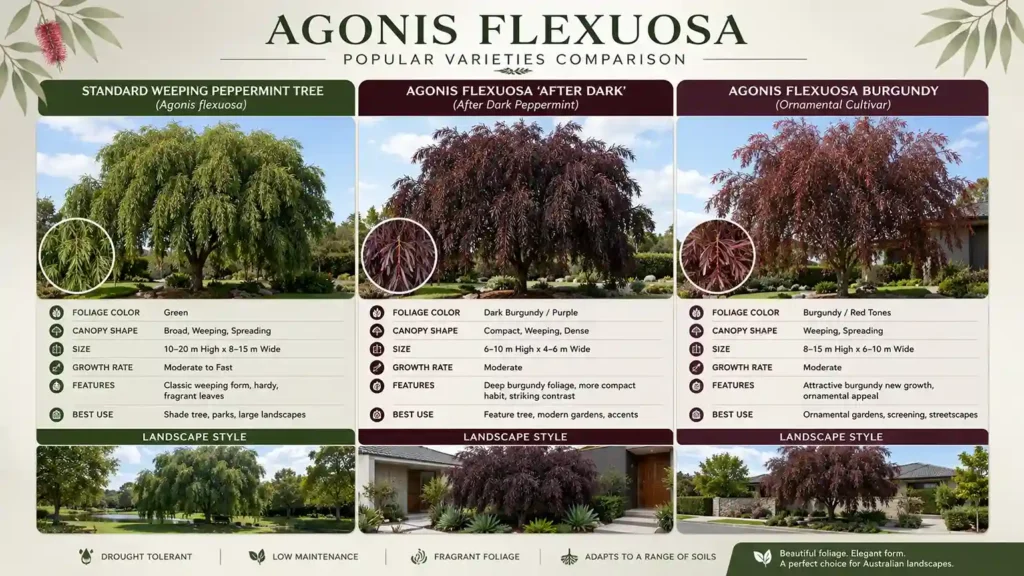
The weeping peppermint tree is easily recognized by its flowing canopy, slender aromatic leaves, and naturally elegant shape. Its soft weeping structure gives the tree a relaxed ornamental appearance that works well in both residential and coastal landscapes. Mature trees develop a broad canopy with dense evergreen foliage that provides year-round shade and visual interest.
The mature size of a weeping peppermint tree can vary depending on soil quality, climate, and growing conditions.
| Growth Feature | Average Size |
| Mature Height | 8–15 meters |
| Canopy Spread | 6–10 meters |
| Growth Rate | Moderate to fast |
| Tree Form | Broad weeping canopy |
One of the most distinctive features of Agonis flexuosa is its graceful weeping structure. The branches arch downward naturally, creating a soft cascading appearance similar to a willow tree. This elegant habit makes it a highly desirable ornamental tree for larger gardens, streetscapes, and parks.
Young trees typically establish quickly and may show moderate to fast growth under ideal conditions. In warm coastal climates with regular watering during establishment, the tree can produce vigorous annual growth. Once mature, the canopy becomes denser and more spreading while maintaining its characteristic drooping form.
The peppermint tree leaves are long, narrow, and slightly curved with a soft textured appearance. Their fine foliage creates a light, airy canopy that moves attractively in the wind.
Key foliage characteristics include:
The leaves release a refreshing scent due to the natural oils present in the foliage, which is one reason the species earned the name peppermint tree.
The bark is rough and fibrous with a brown to gray coloration that becomes more textured as the tree matures. Older specimens often develop twisted trunks and branches that add ornamental value.
Flowering usually occurs from spring into early summer. The tree produces small white flowers along the stems, creating a delicate display across the canopy.
Flower characteristics include:
The root system of the weeping peppermint tree is considered moderately spreading rather than aggressively invasive. However, mature trees still require adequate planting space because the roots naturally expand outward as the canopy develops.
Root behavior depends heavily on:
In residential landscapes, planting too close to driveways, paving, or underground pipes may eventually create problems if roots seek moisture beneath structures. For this reason, landscape designers usually recommend allowing sufficient clearance from buildings and hard surfaces.
Recommended planting distances:
| Structure | Suggested Distance |
| Driveways | 4–6 meters |
| Pipes and drains | 5 meters minimum |
| House foundations | 6–8 meters |
Despite its spreading roots, Agonis flexuosa is still widely considered suitable for residential landscapes when planted in properly sized spaces.
The weeping peppermint tree is an evergreen species, meaning it retains foliage throughout the year rather than shedding all leaves seasonally like deciduous trees.
Its evergreen characteristics provide several landscaping benefits:
Although the tree keeps its foliage year-round, minor seasonal leaf drop is still natural. During dry weather or environmental stress, older leaves may yellow and fall while fresh new growth continues to emerge.
Seasonal appearance changes are generally subtle. The canopy remains green in all seasons, with slight flowering and fresh growth flushes appearing mainly during warmer months.
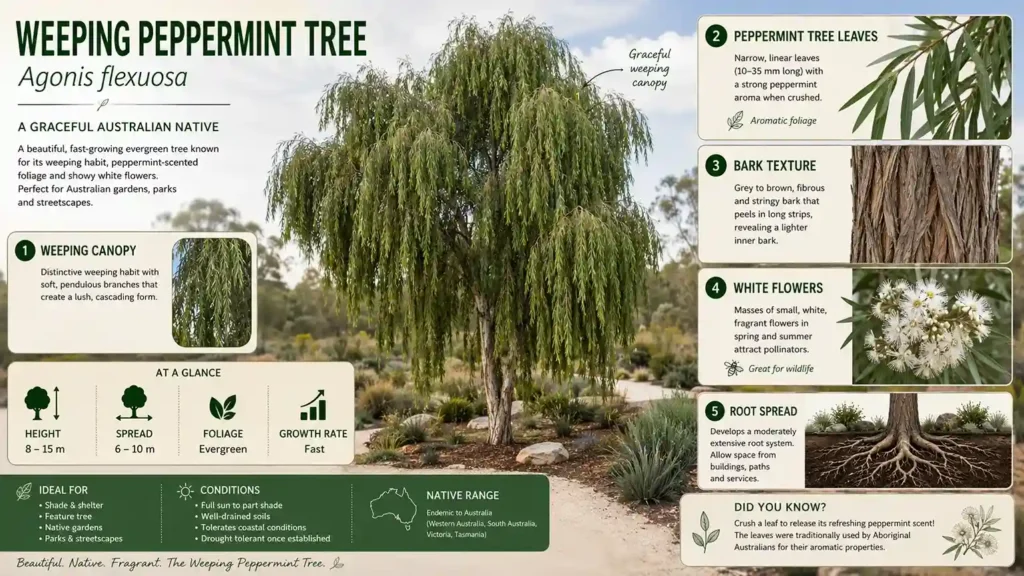
Several ornamental forms of Agonis flexuosa are grown across Australian landscapes, each offering unique foliage color, growth characteristics, and decorative value. While the traditional green form remains the most widely planted, darker cultivars have become increasingly popular in modern residential and commercial landscaping projects.
The standard weeping peppermint tree is the traditional green foliage variety commonly seen in parks, streetscapes, and coastal gardens throughout Australia.
Key characteristics include:
This classic form develops the familiar weeping appearance associated with mature peppermint trees and is often selected for shade planting, wind protection, and native landscaping. Its naturally flowing canopy works particularly well in larger gardens where the tree has enough room to spread fully.
The traditional variety is also valued for:
| Feature | Benefit |
| Evergreen foliage | Year-round visual appeal |
| Aromatic leaves | Pleasant peppermint fragrance |
| Dense canopy | Effective shade production |
| Coastal resilience | Performs well near the ocean |
The agonis after dark peppermint tree is one of the most striking ornamental cultivars of Agonis flexuosa. It is highly valued for its dramatic foliage color and elegant architectural form.
Distinctive features include:
Unlike the traditional green form, ‘After Dark’ creates bold visual contrast in landscapes and is frequently used as a feature tree in modern garden designs. The foliage color intensifies under full sun, giving the tree a rich almost black-purple appearance from a distance.
Landscape designers often use this cultivar for:
Its refined weeping habit combined with dark foliage makes it one of the most decorative Australian native trees for residential landscaping.
The agonis flexuosa burgundy variety is another ornamental selection known for its reddish-purple foliage tones and compact growth habit.
Main features include:
Although similar in appearance to ‘After Dark,’ the burgundy variety may display slightly lighter foliage tones depending on climate and sunlight exposure. In cooler seasons, the foliage can develop deeper red and bronze shades that increase its decorative value.
Differences from the standard peppermint tree include:
| Standard Variety | Burgundy Variety |
| Green foliage | Burgundy-purple foliage |
| Traditional landscape look | Modern ornamental appearance |
| Larger natural spread | Often slightly more compact |
| Softer visual effect | Stronger color contrast |
Because of its rich foliage color, this cultivar is commonly used in decorative native gardens where stronger visual impact is desired.
The names willow myrtle agonis flexuosa and agonis flexuosa willow myrtle are commonly used for ornamental forms that emphasize the tree’s elegant drooping habit and fine-textured foliage.
These variants are appreciated for:
Compared with standard peppermint tree forms, willow myrtle selections often appear slightly more refined and decorative in landscape settings. Their flowing branch structure creates a softer visual texture that blends well with coastal and native garden designs.
Ornamental differences among willow myrtle variants may include:
These trees are especially popular in Australian gardens where naturalistic planting styles and low-maintenance native species are preferred.
The weeping peppermint tree is widely appreciated for its ornamental beauty, durability, and adaptability to Australian climates. However, like any large landscape tree, it also comes with a few limitations that should be considered before planting. Understanding both the advantages and potential drawbacks helps homeowners choose the right location and growing conditions for long-term success.
The weeping peppermint tree offers several practical and ornamental benefits that make it a popular choice in Australian landscaping.
Once established, Agonis flexuosa shows strong drought tolerance and performs well in dry climates with limited summer rainfall. Its adaptability to sandy soils and coastal conditions makes it especially suitable for water-wise gardens.
Benefits of its drought resistance include:
The broad weeping canopy creates excellent natural shade, making the tree valuable for residential landscapes, parks, and outdoor sitting areas.
Shade-related advantages:
Mature trees develop dense evergreen foliage that provides year-round coverage.
The flexible branch structure and coastal origins of the species help it tolerate windy environments better than many ornamental trees. This is one reason the tree is commonly planted in coastal suburbs throughout Western Australia.
Its wind-resistant qualities make it useful for:
One of the strongest ornamental features of the tree is its graceful cascading form. The naturally drooping branches create a soft flowing appearance that adds movement and texture to landscapes.
Visual landscaping benefits include:
As an Australian native species, the weeping peppermint tree supports local biodiversity by attracting beneficial insects and birds.
Wildlife benefits include:
Despite its many strengths, the weeping peppermint tree may not suit every landscape situation.
Although the roots are not considered highly invasive, mature trees can develop moderately spreading root systems that require space.
Potential issues may include:
Proper planting distance is important to avoid future structural problems.
The tree naturally sheds leaves, bark fragments, and seasonal flowers throughout the year. In high-traffic areas, this can create extra garden maintenance.
Common cleanup concerns:
While generally hardy, Agonis flexuosa can occasionally experience pest or fungal issues under poor growing conditions.
Possible problems include:
Most issues can be minimized through proper watering, pruning, and drainage management.
Mature weeping peppermint trees can become quite large, making them unsuitable for very restricted planting spaces.
Considerations include:
| Landscape Factor | Requirement |
| Canopy Spread | Wide open space |
| Root Expansion | Adequate soil area |
| Height Clearance | Suitable overhead space |
| Sunlight Access | Full sun preferred |
Planting too close to buildings or fences may lead to overcrowding as the tree matures.
The weeping peppermint tree can work in some small gardens, but careful placement is essential due to its mature size and spreading canopy.
Best placement recommendations include:
In compact urban landscapes, dwarf or compact native species are often easier to manage long-term. However, larger suburban properties can successfully accommodate mature peppermint trees when sufficient space is available.
| Environment | Suitability |
| Urban Gardens | Moderate with proper spacing |
| Coastal Suburbs | Excellent |
| Rural Properties | Excellent |
| Large Residential Blocks | Very suitable |
| Small Courtyards | Usually unsuitable |
In rural and coastal settings, the tree performs exceptionally well because it has room to develop its natural weeping structure without crowding nearby structures or plants.
Growing a weeping peppermint tree successfully requires the right balance of climate, sunlight, soil drainage, and early maintenance. Agonis flexuosa is considered relatively easy to establish in suitable Australian conditions, especially in coastal and Mediterranean-style regions. Once mature, the tree becomes highly resilient and low maintenance.
The weeping peppermint tree grows best in warm temperate and Mediterranean climates with mild winters and dry summers. It naturally thrives in coastal Western Australia, where temperatures remain moderate throughout the year.
| Condition | Preferred Range |
| Ideal Temperature | 15°C–30°C |
| Frost Tolerance | Light frost only |
| Heat Tolerance | High once established |
| Humidity Preference | Moderate coastal humidity |
Young trees are more sensitive to severe frost, especially during early establishment. Mature specimens tolerate heat and dry conditions far better than cold inland climates.
The tree performs exceptionally well in coastal regions because of its natural salt and wind tolerance. It is commonly planted near beaches, coastal suburbs, and exposed landscapes.
Growing suitability:
In hotter inland environments, occasional deep watering during extended dry periods helps maintain healthy growth.
Good soil drainage is one of the most important requirements for healthy Agonis flexuosa growth. Poorly drained soil increases the risk of root disease and reduced vigor.
The tree prefers free-draining soils that allow moisture to move through the root zone without remaining waterlogged.
Best soil conditions include:
Heavy compacted soils should be improved before planting.
| Soil Type | Suitability |
| Slightly acidic | Excellent |
| Neutral soil | Very good |
| Mildly alkaline | Usually tolerated |
| Highly alkaline | Less suitable |
The ideal soil pH generally falls between 6.0 and 7.5.
| Soil Type | Performance |
| Sandy Soil | Excellent drainage and growth |
| Loamy Soil | Ideal balanced performance |
| Heavy Clay Soil | Poor drainage risk |
| Waterlogged Soil | Unsuitable |
In clay-heavy gardens, raised planting areas or soil amendments may help improve drainage and root health.
The weeping peppermint tree grows best in full sun where it can develop dense foliage and strong branching structure.
| Light Condition | Growth Result |
| Full Sun | Best growth and foliage density |
| Partial Shade | Slower growth and lighter canopy |
| Heavy Shade | Weak structure and sparse foliage |
For optimal performance, the tree should receive at least 6–8 hours of direct sunlight daily. Full sun also improves foliage color intensity in darker ornamental cultivars such as ‘After Dark.’
Proper watering during the establishment phase is essential for developing a healthy root system.
During the first 1–2 years after planting:
Deep watering encourages stronger root development compared to shallow frequent watering.
Once established, the weeping peppermint tree becomes highly drought tolerant and can survive extended dry periods with minimal supplemental watering.
Established tree benefits include:
However, occasional deep watering during extreme heat can improve canopy health and reduce stress.
Agonis flexuosa generally requires only light feeding, especially when planted in reasonably fertile soil.
Recommended fertilizer types include:
Native plants are often sensitive to excessive phosphorus, so fertilizers specifically designed for Australian natives are preferred.
Excess fertilizer can damage roots and cause weak unnatural growth.
Common overfeeding problems:
For mature trees, light seasonal feeding during spring is usually sufficient for healthy long-term growth.
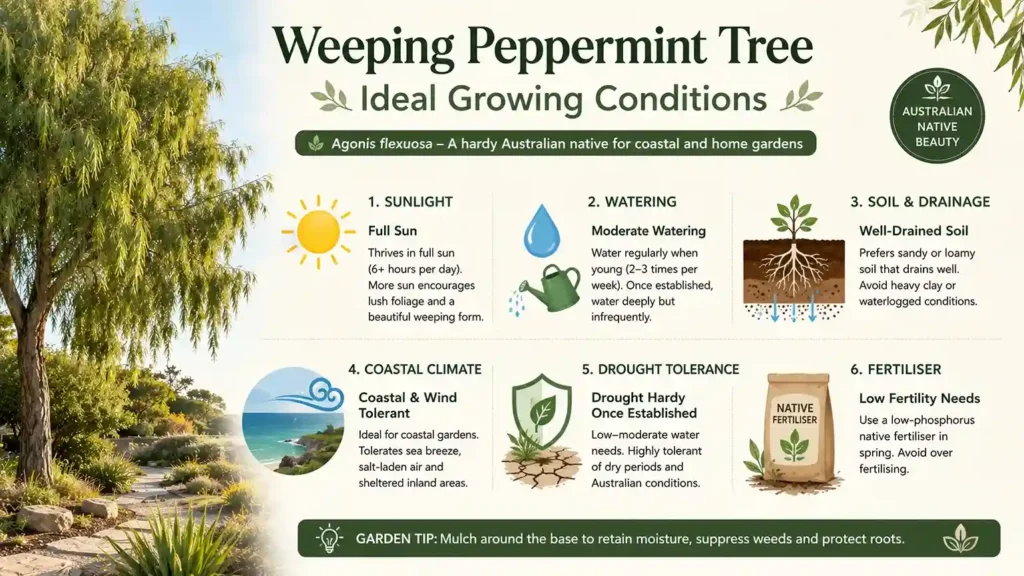
Proper care helps the weeping peppermint tree maintain healthy foliage, strong branch structure, and long-term drought resistance. Although Agonis flexuosa is considered relatively low maintenance once established, regular pruning, mulching, and monitoring for pests can significantly improve its overall health and appearance.
Routine pruning helps preserve the graceful weeping form of the tree while improving airflow and structural strength.
The ideal time to prune a weeping peppermint tree is during late winter to early spring before vigorous new growth begins.
Best seasonal timing:
| Season | Pruning Suitability |
| Late Winter | Excellent |
| Early Spring | Very good |
| Summer | Light trimming only |
| Autumn | Moderate pruning only |
Avoid heavy pruning during extreme heat or prolonged dry conditions because this may stress the tree.
The naturally cascading structure is one of the tree’s most attractive features. Pruning should focus on preserving the flowing branch habit rather than forcing a rigid shape.
Recommended maintenance practices:
Minimal shaping generally produces the best ornamental appearance.
Dead, damaged, or diseased branches should be removed promptly to reduce stress and improve air circulation within the canopy.
Benefits of removing dead growth:
Always use clean sharp pruning tools to minimize disease transmission.
Mulching is highly beneficial for young and mature peppermint trees, especially in dry Australian climates.
A quality mulch layer helps stabilize soil moisture and reduces rapid evaporation during hot weather.
Benefits include:
Organic mulches such as bark chips, wood mulch, or leaf mulch work particularly well.
Mulch also helps protect shallow feeder roots from heat stress and soil compaction.
Proper mulching guidelines:
| Mulching Practice | Recommendation |
| Mulch Depth | 5–8 cm |
| Distance From Trunk | Keep 10–15 cm clear |
| Best Material | Organic coarse mulch |
| Renewal Frequency | Once or twice yearly |
Avoid piling mulch directly against the trunk because excessive moisture buildup can encourage fungal issues.
Although Agonis flexuosa is generally hardy, some pests and fungal conditions can occasionally affect stressed or poorly maintained trees.
The most common insect-related problems include:
Signs of infestation may include yellowing leaves, sticky residue, or distorted new growth.
Poor drainage and excessive moisture can increase the likelihood of fungal disease.
Potential fungal problems:
Waterlogged soil is one of the biggest risk factors for root-related disease problems.
Preventative care is the most effective way to maintain tree health.
Recommended prevention methods:
Healthy established trees are usually far more resistant to pests and environmental stress.
The weeping peppermint tree is generally considered a moderate to fast-growing Australian native tree under favorable conditions.
| Growth Stage | Average Annual Growth |
| Young Trees | 60–100 cm per year |
| Mature Trees | Slower steady growth |
| Ideal Conditions | Faster canopy development |
Growth is usually most vigorous during the first several years after planting.
Several environmental factors influence how quickly the tree develops.
Major growth factors include:
Trees planted in full sun with good drainage and occasional deep watering typically establish faster and develop fuller canopies. Poor soil conditions or restricted root space may slow growth considerably.
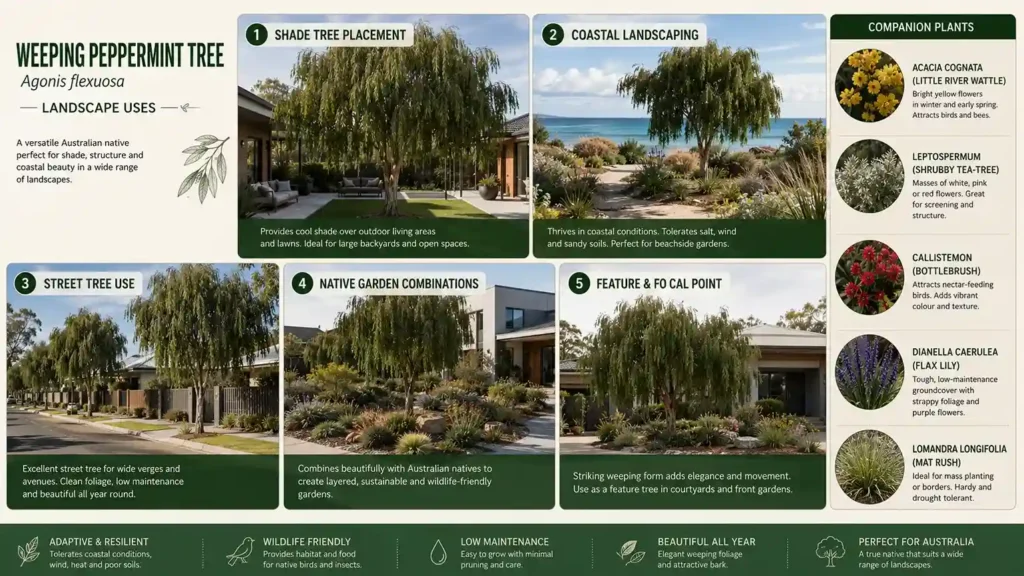
The weeping peppermint tree is widely used in Australian landscaping because of its elegant appearance, evergreen canopy, and strong adaptability to coastal conditions. Its soft cascading branches and drought tolerance make it suitable for both ornamental and practical landscape applications.
Gardeners often refer to comprehensive guides on hedging and screening plants to determine which species provide the best combination of coverage, privacy, and low-maintenance beauty in Australian gardens.
From residential gardens to public streetscapes, Agonis flexuosa remains one of the most versatile native trees for Australian outdoor spaces.
The graceful structure and dense canopy of the weeping peppermint tree make it highly valuable in home landscapes.
One of the most common uses of Agonis flexuosa is as a shade tree. Mature specimens develop broad evergreen canopies that help cool outdoor spaces naturally.
Benefits as a shade tree include:
The tree works especially well in larger lawns and open garden areas.
The naturally flowing branches and elegant silhouette make the peppermint tree an excellent ornamental feature tree.
Feature planting advantages:
Dark foliage cultivars such as ‘After Dark’ are particularly popular as statement trees in modern landscape designs.
Because of its tolerance to wind, dry conditions, and urban environments, the tree is frequently planted along streets and public spaces.
Street tree benefits:
| Benefit | Landscaping Value |
| Drought tolerance | Reduced irrigation needs |
| Evergreen canopy | Permanent greenery |
| Flexible branches | Better wind performance |
| Native species | Supports local biodiversity |
Its relatively adaptable root system also makes it suitable for wider verge and boulevard planting when sufficient space is available.
The weeping peppermint tree is exceptionally well suited to coastal landscapes due to its natural adaptation to Western Australian coastal environments.
The species tolerates salt-laden air better than many ornamental trees, making it highly effective for gardens near beaches and exposed coastal suburbs.
Coastal benefits include:
Its flexible weeping branches help the tree withstand strong coastal winds without suffering major structural damage.
Wind-resistant qualities:
These characteristics explain why the species is commonly planted throughout coastal regions of Western Australia.
The weeping peppermint tree combines beautifully with other weeping native trees and australian native weeping trees in naturalistic landscape designs.
Popular landscape combinations include:
The soft cascading structure of Agonis flexuosa contrasts effectively with upright shrubs and textured native planting schemes.
Other Australian native trees such as Tuckeroo Trees can be paired with weeping peppermint to create layered, visually interesting hedges and screens in residential gardens.
| Companion Plant | Landscape Benefit |
| Kangaroo Paw | Flower contrast |
| Coastal Rosemary | Drought-tolerant layering |
| Lomandra | Texture and edging |
| Banksia | Wildlife support |
| Native Violet | Groundcover beneath canopy |
Combining multiple weeping native species can create a relaxed Australian garden style with layered texture and year-round visual appeal.
Complementary species such as Hakea Pincushion provide striking floral contrast and additional vertical structure when planted alongside weeping peppermint trees.
Searches for peppermint trees perth are extremely common because the species performs exceptionally well in Perth’s climate and sandy soils.
Perth conditions closely resemble the natural habitat of Agonis flexuosa.
Ideal Perth conditions include:
These environmental conditions allow the tree to establish successfully with relatively low maintenance.
| Perth Condition | Tree Performance |
| Sandy Soil | Excellent |
| Coastal Wind | Excellent |
| Summer Heat | Very good |
| Drought Conditions | High tolerance |
| Heavy Clay Soil | Less suitable |
Because of its strong compatibility with local conditions, the weeping peppermint tree remains one of the most widely recommended native trees for Perth residential and coastal landscaping projects.
The weeping peppermint tree is often compared with other Australian native ornamental trees because of its graceful structure and aromatic foliage. While several species share similar appearances or common names, Agonis flexuosa has distinct characteristics that separate it from other weeping and peppermint-type trees.
The terms peppermint tree and willow myrtle are frequently used interchangeably when referring to Agonis flexuosa. In many cases, both names describe the same species, although some ornamental cultivars may be marketed more commonly under one name than the other.
| Feature | Peppermint Tree | Willow Myrtle |
| Botanical Species | Agonis flexuosa | Agonis flexuosa |
| Evergreen Foliage | Yes | Yes |
| Weeping Habit | Yes | Yes |
| Aromatic Leaves | Yes | Yes |
| Australian Native | Yes | Yes |
Both forms feature narrow leaves, cascading branches, and strong coastal adaptability.
Differences are usually related to cultivar selection or nursery naming rather than species separation.
Minor ornamental differences may include:
In landscaping use, both names generally refer to the same attractive native evergreen tree.
Although both belong to the Myrtaceae family and share aromatic foliage, weeping peppermint trees and eucalyptus peppermint trees are quite different in growth habit and appearance.
| Feature | Weeping Peppermint (Agonis flexuosa) | Eucalyptus Peppermint Trees |
| Leaf Shape | Narrow and soft | Longer and tougher |
| Texture | Fine and flexible | Firmer and leathery |
| Canopy Appearance | Dense and flowing | Taller and more open |
The leaves of Agonis flexuosa create a softer finer texture compared with most eucalyptus species.
The growth structure of the two tree groups differs significantly.
Weeping peppermint tree characteristics:
Eucalyptus peppermint tree characteristics:
Both trees release aromatic oils from their leaves, but the fragrance profile differs slightly.
| Tree Type | Fragrance Character |
| Agonis flexuosa | Soft peppermint-like scent |
| Peppermint Eucalyptus | Stronger menthol-eucalyptus aroma |
The scent of Agonis flexuosa is generally milder and more subtle.
The agonis tree is commonly compared with other australian native weeping trees because of its ornamental structure and drought resistance.
| Tree Type | Maintenance Level |
| Agonis flexuosa | Low to moderate |
| Weeping Bottlebrush | Moderate |
| Weeping Lilly Pilly | Moderate |
| Weeping Melaleuca | Moderate to high |
The weeping peppermint tree usually requires less pruning than many ornamental natives because of its naturally attractive growth habit.
Compared with some larger Australian native trees, Agonis flexuosa typically develops a more manageable root system.
Root behavior comparison:
Proper spacing still remains important for mature tree development.
One of the strongest advantages of the agonis tree is its excellent drought performance after establishment.
| Tree Type | Drought Tolerance |
| Agonis flexuosa | High |
| Weeping Bottlebrush | Moderate to high |
| Weeping Lilly Pilly | Moderate |
| Weeping Birch | Low |
Its ability to tolerate dry summers and coastal conditions makes it one of the most reliable weeping native trees for Australian climates.
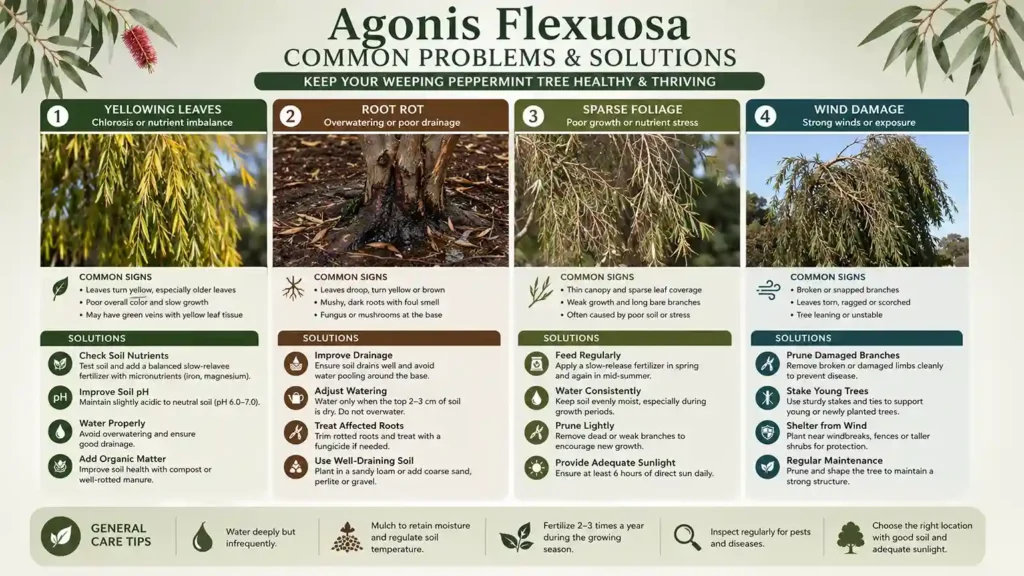
Although the weeping peppermint tree is considered hardy and relatively low maintenance, environmental stress, drainage issues, and improper care can still lead to health problems. Early identification of symptoms helps prevent long-term decline and improves the chances of recovery.
Yellowing leaves are one of the most common issues seen in Agonis flexuosa. The problem may affect isolated branches or spread throughout the canopy depending on the underlying cause.
Common causes of yellowing foliage include:
| Symptom | Possible Cause |
| Yellow lower leaves | Natural aging or overwatering |
| Pale overall canopy | Nutrient deficiency |
| Yellow leaves with wilting | Root problems |
| Patchy discoloration | Pest or fungal stress |
Recommended corrective actions:
Minor seasonal yellowing is sometimes normal, but widespread discoloration usually indicates environmental stress.
Root rot is one of the most serious health problems affecting weeping peppermint trees, especially in poorly drained soil.
Root rot commonly develops when roots remain saturated for extended periods.
High-risk conditions include:
| Symptom | Description |
| Wilting foliage | Even when soil is wet |
| Yellowing leaves | Progressive canopy decline |
| Sparse growth | Reduced vigor |
| Soft dark roots | Root decay underground |
Advanced root rot can eventually lead to canopy collapse if not corrected early.
The best prevention strategy is proper drainage management.
Preventative measures:
Slow growth or thin canopy development usually indicates environmental stress or unsuitable growing conditions.
Poor growth may result from:
Young trees often establish slowly if root systems are stressed during planting.
To encourage healthier growth:
Healthy trees normally produce dense evergreen foliage once properly established.
Although Agonis flexuosa is naturally wind tolerant, severe storms and prolonged coastal winds may still cause branch damage.
| Problem | Cause |
| Broken branches | Strong storm winds |
| Canopy thinning | Constant exposure |
| Branch drop | Deadwood or stress |
| Leaning growth | Uneven wind exposure |
Older trees with dense canopies may become more vulnerable if dead branches are not removed regularly.
Recommended prevention strategies:
Flexible branches help the tree tolerate wind better than many rigid ornamental species.
A stressed weeping peppermint tree can often recover if the underlying issue is corrected early.
Common warning signs include:
| Recovery Action | Purpose |
| Deep watering | Restore root moisture |
| Improve drainage | Prevent root suffocation |
| Apply mulch | Stabilize soil temperature |
| Remove dead growth | Reduce stress load |
| Check for pests | Prevent further decline |
For ongoing tree health:
Most healthy established peppermint trees recover well once proper growing conditions are restored.
The weeping peppermint tree can be propagated successfully through both seeds and cuttings. While seed propagation is commonly used for growing large numbers of trees, cuttings are often preferred when gardeners want to preserve the exact characteristics of ornamental cultivars such as ‘After Dark’ or Burgundy forms.
Propagation from seeds is one of the most natural methods for growing Agonis flexuosa.
Seeds are typically collected from mature woody capsules after flowering has finished and the seed pods begin drying naturally on the tree.
Important seed collection tips:
| Step | Recommendation |
| Seed Tray | Use free-draining propagation mix |
| Planting Depth | Light surface covering only |
| Moisture | Keep lightly moist |
| Temperature | Warm conditions preferred |
| Sunlight | Bright indirect light |
Seeds usually germinate best in warm spring conditions with consistent moisture and airflow.
Under suitable conditions, germination commonly occurs within:
Young seedlings should remain protected from harsh direct heat until stronger root systems develop.
Cuttings are widely used to propagate ornamental forms of Agonis flexuosa because they produce genetically identical plants.
Semi-hardwood cuttings taken from healthy new growth generally provide the best results.
Recommended cutting features:
| Step | Recommendation |
| Cutting Medium | Free-draining sandy mix |
| Rooting Hormone | Optional but helpful |
| Humidity | Moderate humidity preferred |
| Watering | Light regular moisture |
| Light | Bright filtered light |
Lower leaves are usually removed before planting to reduce moisture loss.
Cuttings may begin producing roots within several weeks under warm stable conditions. Rooting speed depends on humidity, temperature, and plant health.
Conditions that improve success rates include:
Timing plays an important role in successful propagation.
| Season | Propagation Suitability |
| Spring | Excellent |
| Early Summer | Very good |
| Autumn | Moderate |
| Winter | Poor |
Spring and early summer are generally considered the best periods because active growth improves rooting and seedling establishment.
Warm temperatures combined with longer daylight hours encourage stronger root development and healthier early growth.
Young peppermint trees require careful early maintenance while root systems establish.
Important care practices include:
Young plants should remain consistently moist but never waterlogged.
| Growth Stage | Watering Frequency |
| Newly Germinated Seedlings | Light frequent moisture |
| Young Potted Plants | Moderate regular watering |
| Newly Planted Trees | Deep watering weekly |
Overwatering is one of the most common causes of failure during early establishment.
To encourage stronger long-term growth:
With proper care, young Agonis flexuosa trees usually establish steadily and develop into hardy drought-tolerant landscape trees over time.
| Feature | Details |
| Botanical Name | Agonis flexuosa |
| Common Names | Peppermint tree, Willow Myrtle |
| Native Region | Western Australia |
| Tree Type | Evergreen |
| Mature Height | 8–15 meters |
| Growth Rate | Moderate to fast |
| Sunlight Needs | Full sun |
| Drought Tolerance | High |
| Root Behavior | Moderate spreading roots |
| Best Use | Shade & ornamental landscaping |
The weeping peppermint tree remains one of the most popular Australian native trees because of its elegant weeping structure, evergreen foliage, and strong adaptability to coastal and dry climates. Agonis flexuosa combines ornamental beauty with practical landscape benefits, making it highly valued in residential gardens, parks, and streetscapes throughout Australia.
Its graceful canopy, drought tolerance, wind resistance, and relatively low maintenance requirements make it an excellent choice for homeowners seeking a long-lasting shade or feature tree. The species performs especially well in coastal environments and Mediterranean-style climates such as Western Australia and Perth, where sandy soils and dry summers suit its natural growing preferences.
For home landscapes, the tree works best as:
With proper planting space, good drainage, occasional pruning, and moderate watering during establishment, the weeping peppermint tree can remain healthy and visually attractive for many years. Its combination of resilience, graceful appearance, and Australian native character continues to make it one of the most reliable ornamental trees for modern landscapes.
A mature weeping peppermint tree typically grows between 8 and 15 meters tall with a canopy spread of around 6–10 meters. Growth size depends on climate, soil quality, watering, and available space. Trees planted in ideal coastal conditions usually develop larger spreading canopies.
Agonis flexuosa is generally considered a moderate to fast-growing Australian native tree. Young trees can grow approximately 60–100 cm per year under favorable conditions with full sun, good drainage, and regular watering during establishment.
The roots of the weeping peppermint tree are moderately spreading rather than aggressively invasive. However, mature trees still require sufficient planting distance from driveways, foundations, and underground pipes to prevent potential root-related issues over time.
Young peppermint trees can be grown in large containers for several years, especially compact ornamental cultivars. However, because the tree eventually develops a broad canopy and expanding root system, long-term container growth is usually not ideal for larger standard varieties.
Yellowing leaves are commonly caused by: Overwatering Poor drainage Nutrient deficiencies Root stress Pest problems Improving soil drainage and adjusting watering practices often helps restore healthy foliage growth.
Yes, the western australian peppermint tree is highly drought tolerant once established. Mature trees perform very well in dry summers and coastal climates with minimal supplemental watering.
Willow myrtle and peppermint tree are commonly used names for Agonis flexuosa. In most cases, they refer to the same species. The name “willow myrtle” is often used to highlight the tree’s graceful weeping appearance and fine-textured foliage.
Yes, Agonis flexuosa is exceptionally suitable for coastal gardens because it tolerates: Salt-laden air Strong coastal winds Sandy soils Dry summer conditions Its natural coastal adaptability makes it one of the best Australian native trees for seaside landscaping.
Yes, the tree can attract small native birds, pollinators, and beneficial insects. Its flowers provide nectar sources, while the dense canopy offers shelter and nesting protection.
The best time to plant a weeping peppermint tree is during autumn or spring when temperatures are milder and soil moisture is more stable. These conditions help young roots establish more successfully before extreme summer heat.
Mature trees can tolerate light frost, but young trees are more sensitive to freezing temperatures. In colder inland regions, frost protection during early establishment may be necessary.
No, the tree usually requires only light maintenance pruning. Occasional removal of dead, damaged, or overcrowded branches is generally enough to maintain its natural weeping shape and canopy health.
Yes, the peppermint willow tree develops a broad evergreen canopy that provides excellent year-round shade. It is commonly planted in larger gardens, parks, and residential landscapes for this purpose.
The tree grows best in well-drained sandy or loamy soil with slightly acidic to neutral pH. Poorly drained heavy clay soils may increase the risk of root rot and reduced growth performance.