Grow Better Gardens with Smarter Plant Choices
Discover helpful guides on trees, hedges, fruit plants, edible plants, and beautiful landscape greenery.
Hedging & screening plants are one of the most effective ways to create natural privacy, improve garden structure, and enhance outdoor spaces. From compact urban courtyards to large suburban landscapes, living screens offer a softer and more attractive alternative to artificial fencing. Around the world, homeowners use evergreen hedges and dense screening plants to reduce noise, block unwanted views, and create year-round greenery. In Australian gardens, demand for drought-tolerant and low-maintenance privacy plants continues to grow, especially native species suited to local climates. Whether you are a beginner gardener or planning a complete landscape upgrade, choosing the right hedge plant is essential for long-term growth, appearance, and maintenance success.
Unlike artificial fencing, living privacy screens add texture, seasonal interest, cooling shade, and wildlife value to outdoor areas. Evergreen hedging plants are especially popular because they maintain dense foliage throughout the year, making them ideal for privacy and boundary planting. Many homeowners also prefer natural screens because they blend more naturally into the landscape while increasing garden appeal.
Globally, screening plants are widely used in residential gardens, commercial landscapes, and modern outdoor designs. Fast-growing hedges provide quick privacy solutions, while structured formal hedges create clean architectural lines. Informal screening plants, on the other hand, offer a softer and more relaxed garden style.
Choosing the correct hedging plant matters because every species has different growth habits, mature sizes, maintenance needs, and climate preferences. Some plants thrive in coastal conditions, while others perform better in dry regions or frost-prone gardens. Understanding these differences helps homeowners avoid overcrowding, excessive pruning, and poor long-term performance.
Popular options such as Pittosporum are commonly used for dense evergreen privacy hedges due to their fast growth and formal appearance. Flowering choices like Viburnum tinus provide both screening and seasonal visual interest. Many gardeners also explore native alternatives through guides focused on Australian Native Hedge Plants for improved drought tolerance and wildlife support.
Hedging and screening plants are landscape plants used to create privacy, define boundaries, reduce exposure, and improve garden structure. While both serve similar purposes, they differ in appearance, growth style, and maintenance requirements. Some are shaped into neat formal hedges, while others grow naturally as relaxed privacy screens.
A hedge plant is typically a dense shrub or small tree grown closely together to form a structured border or living wall. Hedges are commonly used to frame gardens, line pathways, separate outdoor spaces, and create formal landscape designs.
Formal hedges are regularly pruned to maintain a clean and uniform shape. These hedges are popular in traditional gardens, modern landscapes, and front yard borders because they provide a polished appearance throughout the year.
Common features of hedge plants include:
Hedge plants can be either evergreen or deciduous.
| Hedge Type | Characteristics | Best Use |
| Evergreen Hedges | Keep foliage year-round | Privacy, permanent screening |
| Deciduous Hedges | Lose leaves seasonally | Seasonal interest, cooler climates |
Evergreen hedges are the most popular choice for privacy because they maintain dense coverage in every season. Plants like Pittosporum are widely used for formal evergreen hedging due to their compact growth and reliable structure.
Deciduous hedges, while less common for privacy, can still create attractive seasonal garden borders with changing foliage colors and textures.
Screening plants are used primarily to block unwanted views, increase privacy, and soften outdoor spaces. Unlike formal hedges, screening plants are usually allowed to grow in a more natural and informal style.
These plants may include:
Natural privacy screens are commonly used around patios, fences, pools, balconies, and neighboring properties. Some gardens use a single row of plants, while others combine trees and shrubs to create layered landscape screening for better depth and visual appeal.
Trees are often selected for height and shade, while shrubs provide lower-level density and coverage.
| Plant Type | Main Advantage |
| Screening Trees | Height, shade, long-distance privacy |
| Screening Shrubs | Dense coverage, compact growth, easier maintenance |
Informal screening styles are especially popular in modern residential gardens because they create a softer and more natural landscape appearance compared to tightly clipped hedges.
Flowering and evergreen screening plants such as Viburnum tinus are frequently used because they combine privacy with decorative foliage and seasonal flowers.
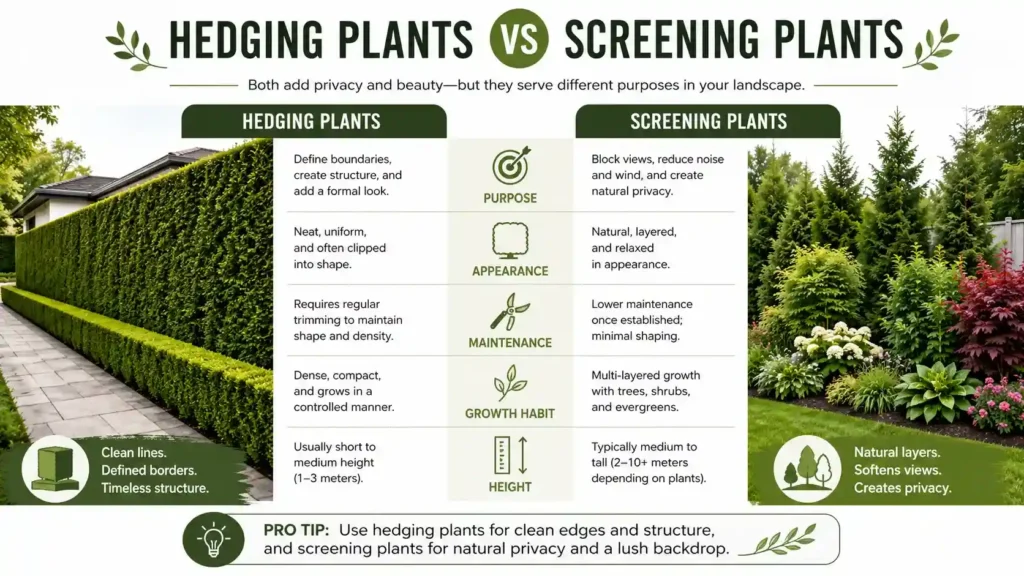
Although hedging and screening plants are closely related, they are used differently in landscape design.
| Feature | Hedging Plants | Screening Plants |
| Purpose | Structured borders and formal definition | Privacy and visual blocking |
| Appearance | Neat, trimmed, uniform | Natural, relaxed, layered |
| Maintenance Needs | Frequent pruning | Moderate or light pruning |
| Growth Habit | Compact and controlled | Freer and wider growth |
| Height Expectations | Usually low to medium height | Medium to tall height |
Hedging plants are ideal for creating formal garden lines and organized outdoor spaces. Screening plants focus more on privacy, shade, and reducing visibility between properties.
The best choice depends on garden size, desired maintenance level, climate conditions, and the amount of privacy needed.
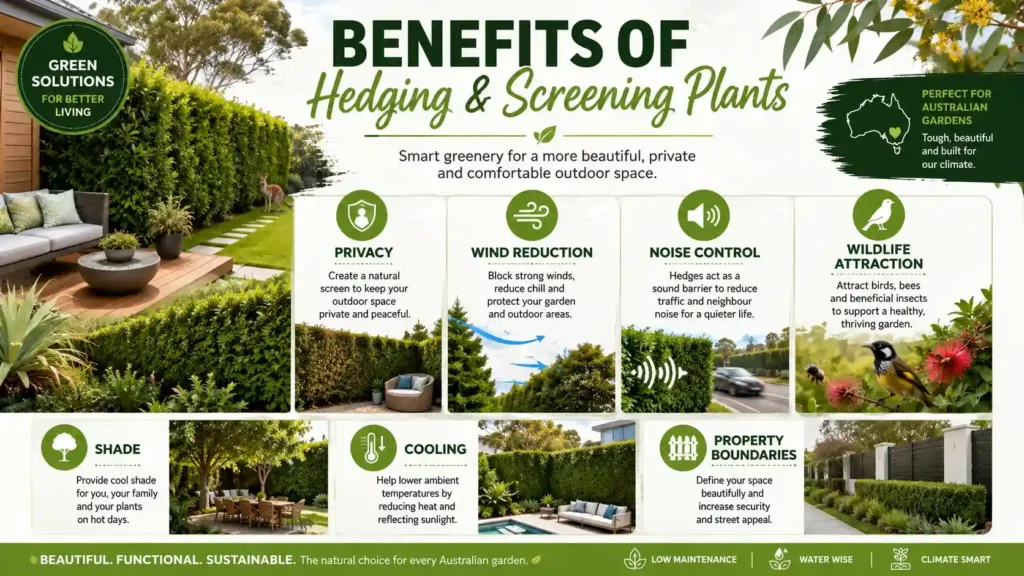
Hedging and screening plants provide far more than basic privacy. They improve outdoor comfort, enhance landscape design, support wildlife, and create healthier garden environments. From compact suburban homes to large residential properties, natural screens offer practical and long-term landscaping value.
One of the biggest advantages of hedging and screening plants is natural privacy. Dense evergreen foliage helps block neighboring views, reduce street visibility, and create more secluded outdoor spaces without relying on harsh fencing materials.
Privacy hedges are commonly used around:
Unlike artificial barriers, living screens blend naturally into the landscape and continue improving in appearance as they mature. Fast-growing screening plants are especially popular for homeowners seeking quicker privacy solutions.
Evergreen species provide year-round coverage, making them more reliable than seasonal plants that lose foliage during colder months.
Dense hedges can significantly reduce wind exposure and help soften outside noise. Thick foliage acts as a natural barrier that slows airflow and absorbs sound vibrations from roads, neighbors, and surrounding urban environments.
Benefits of wind-blocking hedges include:
Noise-reducing screening plants are commonly used near busy streets, shared fences, and suburban developments where additional sound buffering is beneficial.
Layered planting designs using shrubs and trees often provide the best overall wind and noise protection.
Hedging plants improve landscape structure and visual balance. Formal hedges create clean architectural lines, while informal screening plants soften outdoor spaces with natural greenery and texture.
Key landscape benefits include:
Flowering hedge plants can also add fragrance and decorative value throughout the year. Structured garden borders help landscapes appear more polished and professionally designed.
Popular evergreen hedges such as Pittosporum are widely used for modern garden structure because of their dense growth and tidy appearance.
Many hedging and screening plants support local biodiversity by providing shelter, nesting spaces, flowers, and food sources for wildlife.
Benefits for wildlife include:
Native screening plants are especially valuable in eco-friendly gardens because they are naturally adapted to local ecosystems and require fewer resources to thrive.
Flowering species such as Viburnum tinus can attract beneficial pollinators while still functioning as dense privacy hedges.
Screening trees and tall hedges can help reduce heat exposure around homes and outdoor living areas. Dense foliage filters sunlight, creates shaded zones, and lowers surrounding temperatures during hot weather.
Cooling benefits include:
In warmer climates, strategically placed screening plants can make outdoor areas significantly more usable during summer months.
Hedging plants create natural property divisions without making gardens feel enclosed or overly harsh. Living borders provide a softer and more attractive alternative to traditional fencing.
Benefits of hedge boundaries include:
Formal hedges are often used for clean boundary lines, while informal screening plants create more relaxed separations between outdoor spaces. Choosing the right plant size and growth habit is important for maintaining balanced and manageable borders over time.
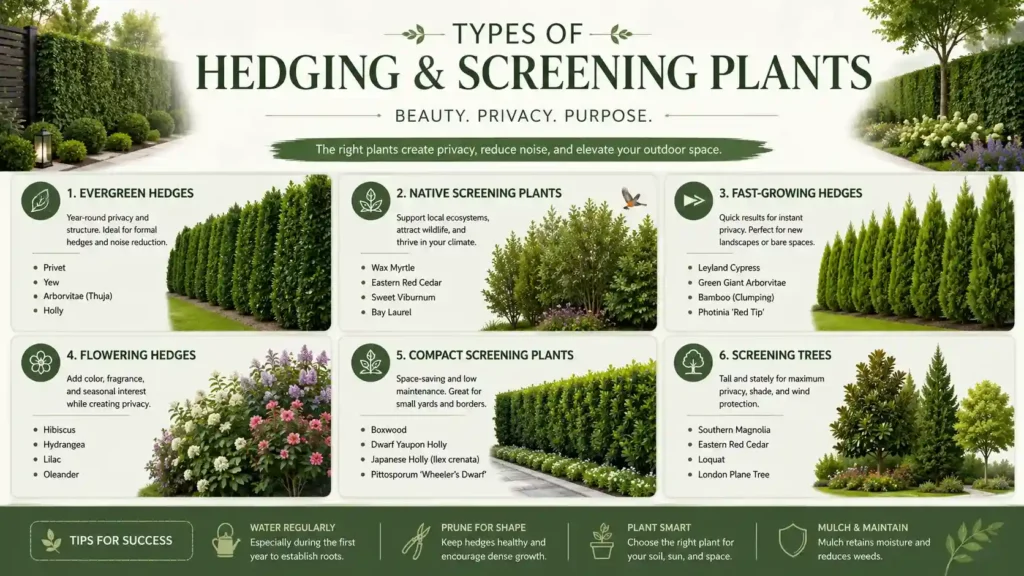
Hedging and screening plants come in many forms, ranging from compact evergreen shrubs to tall privacy trees. The best option depends on climate, available space, maintenance expectations, and the level of privacy required. Some plants are grown for dense year-round coverage, while others are selected for flowers, wildlife benefits, or fast growth.
Evergreen hedging plants are among the most popular choices for privacy and garden borders because they maintain foliage throughout the year. Their dense growth habit creates reliable screening in every season, making them ideal for residential landscapes and suburban gardens.
Key benefits of evergreen hedges include:
Many evergreen species also respond well to pruning, allowing homeowners to maintain formal hedge shapes or structured garden borders with ease.
Popular evergreen hedging options include:
| Plant | Main Features |
| Pittosporum | Dense foliage, fast growth, coastal tolerance |
| Viburnum tinus | Evergreen growth with seasonal flowers |
| Syzygium luehmannii | Attractive foliage, compact screening, native appeal |
These evergreen varieties are commonly used for privacy screens, front yard hedges, and boundary planting.
Native screening plants are increasingly popular in sustainable and eco-friendly landscaping. These plants are naturally adapted to local climates and generally require less water, fertilizer, and maintenance once established.
Benefits of native screening plants include:
Australian native hedge plants are especially valued for their ability to handle heat, dry periods, and coastal exposure while supporting birds, bees, and native ecosystems.
Popular native screening choices include:
| Plant | Main Benefits |
| Tuckeroo | Coastal tolerance and shade |
| Hakea laurina | Decorative flowers and drought tolerance |
| Hakea sericea | Wildlife attraction and dense growth |
Many gardeners also explore broader guides focused on Australian Native Hedge Plants when selecting privacy species for local conditions.
Fast-growing screening plants are ideal for homeowners who want quicker privacy or rapid landscape coverage. These plants can establish dense foliage relatively quickly when planted in suitable soil and climate conditions.
Advantages of fast-growing screening plants include:
However, faster growth often comes with increased pruning and maintenance needs. Regular trimming may be necessary to control size and maintain dense coverage.
Popular fast-growing screening plants include:
| Plant | Growth Characteristics |
| Lilly Pilly | Dense growth and fast privacy coverage |
| Orange Jasmine | Fragrant flowers with compact screening |
| Syzygium australe | Strong screening performance and pruning response |
Many homeowners choose varieties like Goodbye Neighbours Lilly Pilly for rapid screening in suburban landscapes.
Compact screening plants are ideal for smaller gardens, narrow side yards, courtyards, and urban landscapes where space is limited. These plants provide privacy without overwhelming tight outdoor areas.
Benefits of narrow screening plants include:
Compact screening plants are commonly used along fences, pathways, driveways, and property edges where wider hedges may become difficult to manage.
Popular narrow screening choices include:
| Plant | Best Use |
| Lilly Pilly Smithii Minor | Small gardens and narrow borders |
| Syzygium smithii | Dense vertical screening |
| Native narrow screening varieties | Urban privacy planting |
Many gardeners also use guides focused on Native Screening Plants for Narrow Spaces when selecting compact privacy options.
Flowering hedge plants combine privacy with ornamental value. These plants provide dense foliage while also producing colorful or fragrant blooms that improve garden appearance and support pollinators.
Benefits of flowering hedges include:
Flowering screening plants are often used around patios, entertaining areas, and entry gardens where visual appeal is important.
Popular flowering hedge plants include:
| Plant | Key Feature |
| Orange Jasmine | Fragrant white flowers |
| Viburnum tinus | Seasonal blooms with evergreen coverage |
| Hakea laurina | Unique flowers and wildlife attraction |
These plants work well in both formal and informal landscape designs.
Screening trees are used for tall privacy solutions, shade creation, and large-scale landscaping. Popular options include Weeping Peppermint Tree and other small feature trees. They are ideal for blocking multi-story views while improving outdoor comfort and visual structure.
Benefits of screening trees include:
Screening trees are often combined with lower shrubs to create layered privacy planting with improved depth and density.
Popular screening tree options include:
| Tree | Main Benefits |
| Weeping Peppermint | Shade and soft foliage texture |
| Tuckeroo | Coastal suitability and evergreen coverage |
| Small feature trees | Compact shade and layered landscaping |
Tall screening trees are especially useful in large residential gardens, boundary planting, and modern landscape designs where vertical privacy is needed.
Choosing the right hedging and screening plants is essential for long-term garden success. Climate conditions, available space, mature plant size, sunlight exposure, and maintenance needs all influence how well a hedge performs over time. Selecting plants that match the environment and landscape goals helps prevent overcrowding, poor growth, and excessive upkeep.
Climate is one of the most important factors when selecting privacy plants and hedges. Some species thrive in warm tropical regions, while others perform better in cooler or drier environments.
Tropical and humid regions benefit from fast-growing evergreen plants that tolerate heat and moisture. Popular tropical screening plants often feature dense foliage and rapid growth for year-round privacy.
Best characteristics for tropical climates:
Plants such as Orange Jasmine are commonly used in warm regions because of their dense growth and fragrant flowers.
Temperate gardens support a wide range of evergreen and flowering hedges. Plants suited to moderate seasonal changes generally provide stable year-round performance with manageable maintenance requirements.
Popular choices for temperate climates often include:
Coastal landscapes require salt-tolerant and wind-resistant plants capable of handling exposed conditions.
Important features for coastal hedging plants include:
Plants like Pittosporum and Tuckeroo are commonly selected for coastal gardens because of their resilience and dense evergreen foliage.
Dry climates and drought-prone areas benefit from water-efficient native plants and hardy evergreen species.
Best features for dry-region hedges:
Australian native hedging plants are especially valuable in these environments because they are naturally adapted to harsh growing conditions.
Frost-sensitive plants may struggle in colder regions, making cold-tolerant species a better long-term option.
When choosing hedges for frost-prone areas, look for:
Selecting climate-appropriate plants improves survival rates and reduces maintenance problems over time.
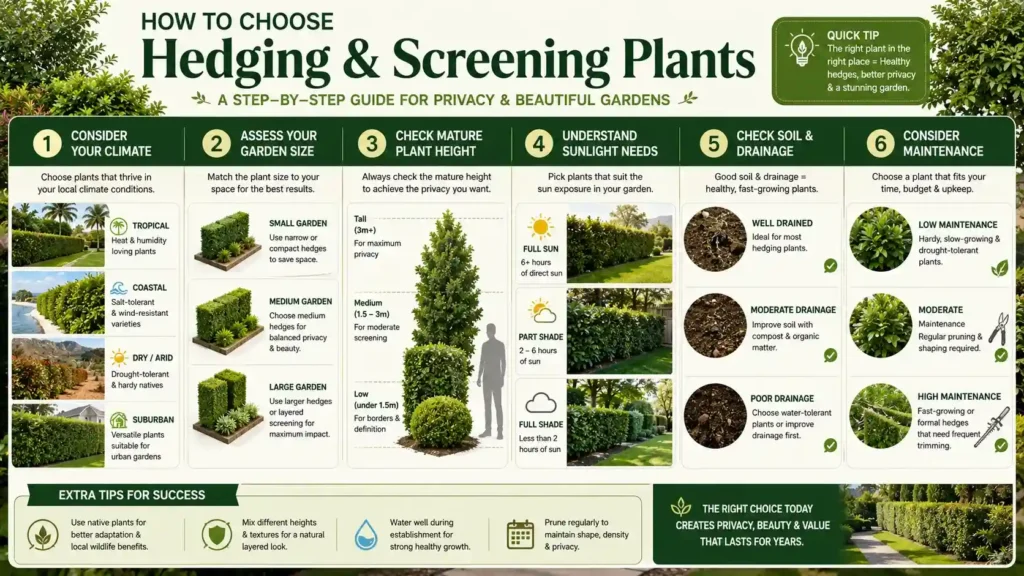
Garden size directly affects the type of hedge or screening plant that will work best in the landscape.
| Garden Size | Best Plant Types |
| Large Landscapes | Tall screening trees and broad hedges |
| Compact Gardens | Narrow evergreen shrubs |
| Urban Backyards | Controlled-growth privacy plants |
| Narrow Spaces | Upright compact screening species |
Large landscapes can accommodate wide-spreading trees and layered screening designs, while compact gardens benefit from manageable shrubs with controlled growth habits.
Urban backyards often require plants that provide privacy without overwhelming outdoor spaces. In narrow side yards or tight boundaries, compact varieties such as Lilly Pilly Smithii Minor are commonly preferred.
One of the most common landscaping mistakes is choosing plants without considering their mature size. A small nursery plant can eventually become too large for its location if growth expectations are ignored.
Important considerations include:
Before planting, homeowners should determine how tall and wide the hedge will become at maturity. This helps avoid overcrowding, excessive trimming, and structural garden problems later.
Fast-growing varieties may require more regular maintenance to keep them within manageable size limits. Guides such as Lilly Pilly Resilience Height can help estimate long-term growth expectations for popular hedge varieties.
Larger screening trees and Small Feature Trees should also be positioned carefully to prevent future root or shading issues.
Different hedging plants perform best under specific sunlight and soil conditions. Matching plants to the correct environment improves growth, foliage density, and overall health.
Many evergreen screening plants thrive in full sun and develop denser foliage when exposed to consistent sunlight.
Benefits of full sun conditions include:
Some hedging plants tolerate partial shade and perform well in sheltered gardens or narrow side areas with limited direct light.
Shade-tolerant species are useful for:
Good drainage is essential for healthy root development. Poorly drained soil can lead to root rot, weak growth, and plant decline.
Well-draining soil supports:
Some fast-growing hedges require nutrient-rich soil for optimal performance, while native species often adapt well to lower-fertility conditions.
Adding organic matter and mulch can improve soil quality and support healthier hedge establishment.
Maintenance expectations should always match the homeowner’s available time and gardening goals. Some hedges require frequent trimming, while others remain naturally compact with minimal upkeep.
Low-maintenance screening plants are ideal for busy homeowners or large landscapes where constant pruning is impractical.
Characteristics of low-maintenance hedges include:
Formal hedges generally require more frequent trimming to maintain sharp lines and uniform growth. Informal screening plants usually need lighter seasonal pruning.
| Hedge Style | Typical Maintenance |
| Formal Hedges | Frequent shaping and trimming |
| Informal Screens | Occasional light pruning |
Newly planted hedges require regular watering during establishment. Mature drought-tolerant plants often need significantly less irrigation once fully rooted.
Disease-resistant and pest-tolerant plants reduce long-term maintenance problems and improve overall hedge reliability.
Native plants are often naturally more resilient in local climates, making them a practical choice for sustainable landscaping and easier long-term care.
Different gardens require different types of hedging and screening plants. Some homeowners prioritize dense privacy, while others need fast growth, low maintenance, compact sizing, or decorative flowering features. Choosing plants based on specific landscape needs helps create more effective and manageable outdoor spaces.
Privacy plants are selected for their dense foliage, evergreen coverage, and reliable growth habits. The best privacy hedges create natural barriers that block views while improving the overall appearance of the landscape.
Important features of privacy plants include:
Popular privacy hedge choices include:
| Plant | Privacy Benefits |
| Pittosporum | Dense evergreen growth and formal screening |
| Lilly Pilly | Fast-growing privacy coverage |
| Viburnum tinus | Evergreen foliage with decorative flowers |
Evergreen screening plants are especially effective because they maintain coverage throughout the year.
Fast-growing hedges are ideal for homeowners who want quicker screening results and faster garden establishment. These plants can rapidly create privacy when grown in suitable soil and climate conditions.
Benefits of fast-growing hedge plants include:
Popular fast-growing options include:
| Plant | Growth Features |
| Syzygium australe | Dense growth and strong pruning response |
| Orange Jasmine | Fast establishment with fragrant flowers |
| Lilly Pilly | Vigorous growth and evergreen coverage |
Fast-growing hedges generally require more regular pruning and maintenance to control their size and shape.
Low-maintenance screening plants are best suited for homeowners who want reliable privacy without constant trimming or watering.
Characteristics of low-maintenance hedges include:
Popular low-maintenance screening plants include:
| Plant | Low-Maintenance Advantages |
| Pittosporum | Easy shaping and durable growth |
| Tuckeroo | Hardy coastal and drought tolerance |
| Viburnum tinus | Reliable evergreen structure |
Native species are often easier to maintain because they are naturally adapted to local environmental conditions.
Narrow screening plants are ideal for compact gardens, urban backyards, side boundaries, and courtyards where horizontal space is limited.
Benefits of narrow hedging plants include:
Recommended narrow screening plants include:
| Plant | Best Use |
| Lilly Pilly Smithii Minor | Tight boundaries and compact gardens |
| Syzygium smithii | Upright evergreen privacy |
| Native compact screening varieties | Urban landscapes and side yards |
Many gardeners also explore Native Screening Plants for Narrow Spaces to find compact native privacy options suitable for smaller outdoor areas.
Native hedge plants are widely used for sustainable landscaping, drought tolerance, and wildlife-friendly gardens. These plants are adapted to regional climates and often require less water and maintenance once established.
Benefits of native hedging plants include:
Popular native hedge plants include:
| Plant | Main Benefits |
| Tuckeroo | Coastal tolerance and evergreen screening |
| Hakea laurina | Decorative flowers and drought tolerance |
| Syzygium luehmannii | Dense foliage and attractive growth |
Many homeowners also use broader Australian Native Hedge Plants guides when planning eco-friendly landscapes.
Flowering screening plants combine decorative blooms with practical privacy benefits. These plants are popular for gardens where appearance, fragrance, and pollinator support are important.
Advantages of flowering screening plants include:
Popular flowering hedge plants include:
| Plant | Flowering Benefits |
| Orange Jasmine | Fragrant white flowers and dense foliage |
| Viburnum tinus | Seasonal blooms with evergreen coverage |
| Hakea laurina | Unique flowers and wildlife value |
These plants work well in both modern and traditional landscape designs.
Screening trees are best for large-scale privacy, shade creation, and layered landscaping. Tall evergreen trees can block overlooking views while improving outdoor comfort and visual structure.
Benefits of screening trees include:
Popular screening tree options include:
| Tree | Main Advantages |
| Weeping Peppermint | Elegant foliage and shade creation |
| Tuckeroo | Hardy evergreen screening |
| Small feature trees | Compact vertical privacy and landscaping |
Many gardens combine screening trees with lower shrubs to create layered privacy and a more natural landscape appearance.
Some hedging and screening plants are consistently popular because of their reliability, appearance, and adaptability in residential landscapes. These plants are widely used for privacy, garden borders, wind protection, and decorative screening across many climate conditions.
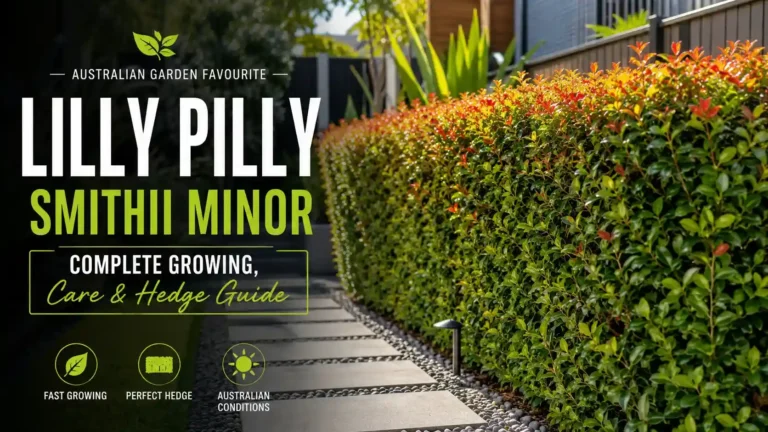
Lilly Pilly is one of the most widely used hedging plants in Australian landscaping. Known for its fast growth, dense foliage, and strong pruning response, it is commonly planted for privacy screens, formal hedges, and boundary planting.
Key features of Lilly Pilly include:
Popular hedge varieties offer different growth habits and mature sizes, making Lilly Pilly suitable for both compact urban gardens and larger landscapes.
Common uses include:
Popular varieties often referenced in landscaping include:
| Variety | Main Use |
| Lilly Pilly Smithii Minor | Compact hedging for narrow spaces |
| Syzygium australe | Rapid privacy screening |
| Syzygium luehmannii | Dense evergreen landscaping |
Many homeowners also research Lilly Pilly Resilience Height and Goodbye Neighbours Lilly Pilly when selecting fast-growing privacy varieties for suburban landscapes.
Pittosporum is a highly popular evergreen hedge plant valued for its dense growth, coastal tolerance, and clean formal appearance.
Key benefits of Pittosporum include:
Pittosporum is commonly used in:
Its dense branching structure allows it to form highly effective privacy screens while maintaining a tidy appearance with regular pruning. Many gardeners choose Pittosporum Hedge varieties for structured evergreen landscaping.
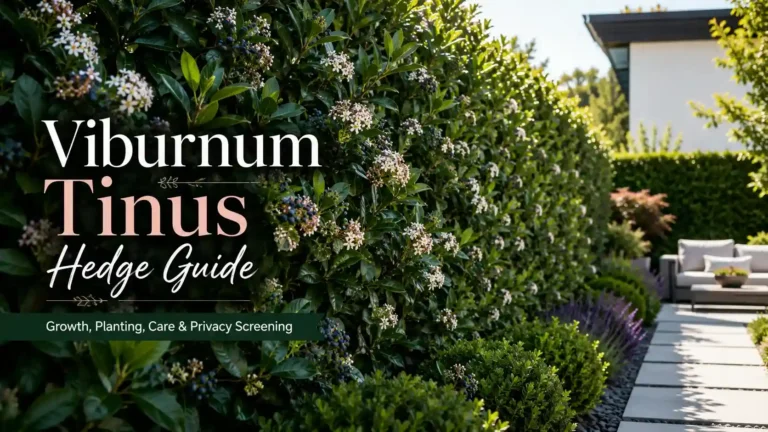
Viburnum tinus is a versatile hedge plant that combines evergreen privacy with seasonal flowers. It is widely used for decorative hedges, screening, and soft landscape borders.
Advantages of Viburnum include:
Viburnum works well in both formal and informal garden settings and is commonly planted near outdoor entertaining areas because of its ornamental appearance.
Popular landscape applications include:
Many homeowners choose Viburnum Tinus Hedge varieties when they want a balance between privacy and visual interest.
Orange Jasmine is a popular tropical and subtropical hedge plant known for its fragrant white flowers and compact evergreen growth.
Key features include:
Orange Jasmine is commonly used in:
Its attractive flowers also help support pollinators such as bees and butterflies while adding seasonal fragrance to outdoor spaces.
Hakea varieties are admired for their native Australian beauty, Hakea Pincushion, wildlife attraction, and drought tolerance. These hardy native shrubs, including Hakea Laurina Dwarf, are often used in eco-friendly landscapes and low-water gardens.
Benefits of Hakea plants include:
Popular Hakea varieties include:
| Plant | Main Features |
| Hakea laurina | Decorative flowers and screening value |
| Hakea sericea | Dense growth and bird attraction |
Hakea plants are commonly used in native landscapes, wildlife gardens, and drought-tolerant privacy planting.
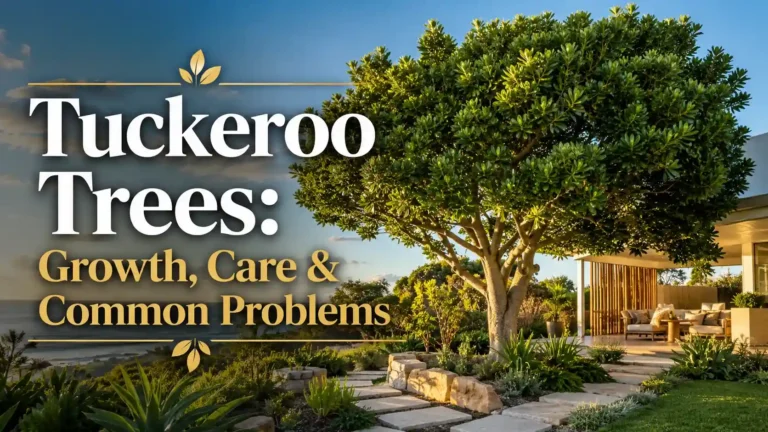
Tuckeroo is a reliable native screening tree valued for its coastal suitability, evergreen foliage, and shade benefits.
Key advantages include:
Tuckeroo Trees are widely used in:
Their manageable growth habit and resilience make them suitable for both residential and commercial landscapes where long-term evergreen screening is needed.
Proper planting is essential for establishing healthy hedging and screening plants. Good preparation, correct spacing, and consistent early care help plants develop strong root systems, dense foliage, and long-term screening performance. Whether planting evergreen hedges, native shrubs, or screening trees, following the right process improves growth and reduces future maintenance problems.
The best planting time depends on climate conditions and plant type, but most hedging and screening plants establish best during mild weather.
Ideal planting periods include:
These seasons allow roots to establish before extreme summer heat or winter cold arrives.
Avoid planting during:
In warmer Australian regions, autumn planting is often preferred because cooler temperatures reduce plant stress while soil remains warm enough for root growth.
Healthy soil is one of the most important factors for successful hedge establishment. Preparing the planting area properly improves drainage, nutrient availability, and root development.
Steps for soil preparation:
Good drainage is especially important because waterlogged soil can damage roots and reduce plant health.
Different plants have different soil preferences:
| Plant Type | Preferred Soil Conditions |
| Evergreen Hedges | Well-draining fertile soil |
| Native Plants | Adaptable, lower-fertility soil |
| Flowering Hedges | Nutrient-rich soil with moisture balance |
Preparing the soil correctly helps hedging plants establish faster and develop stronger long-term growth.
Correct plant spacing is essential for creating dense and healthy privacy screens. Plants placed too closely may compete for nutrients and airflow, while plants spaced too far apart can leave visible gaps.
Spacing depends on:
General spacing guidelines:
| Hedge Type | Typical Spacing |
| Compact Hedges | Closer spacing for dense coverage |
| Large Screening Shrubs | Wider spacing for airflow |
| Screening Trees | Greater spacing based on mature canopy |
Fast-growing plants usually fill gaps more quickly, while slower-growing species may need tighter spacing during planting.
When planting screening trees, adequate spacing is especially important to avoid overcrowding and excessive root competition later.
Newly planted hedges require regular watering during establishment. Consistent moisture helps roots settle into the surrounding soil and reduces transplant stress.
Important watering guidelines include:
Young hedges generally need more frequent watering during their first growing season. Once established, drought-tolerant and native plants often require significantly less irrigation.
Deep watering is usually more effective than shallow frequent watering because it encourages stronger root growth.
Mulching helps conserve moisture, regulate soil temperature, and suppress weed growth around newly planted hedges.
Benefits of mulch include:
Organic mulch should be spread around the base of plants while keeping it slightly away from stems and trunks to prevent rot.
Fertilizing may also support faster establishment and healthier foliage growth.
General fertilizing tips:
| Plant Type | Fertilizer Needs |
| Fast-Growing Hedges | Moderate feeding during growth |
| Native Plants | Low-phosphorus fertilizers if required |
| Flowering Hedges | Balanced fertilizers for bloom support |
Over-fertilizing should be avoided because excessive growth can weaken hedge structure and increase maintenance requirements.
The first year is critical for healthy hedge development. Proper early care encourages dense foliage, stronger branching, and improved long-term screening performance.
Important early growth care practices include:
Light shaping during early growth can help hedges become denser over time. Removing weak or damaged growth also improves plant structure and airflow.
Young screening plants may require temporary support in exposed or windy areas until roots become fully established.
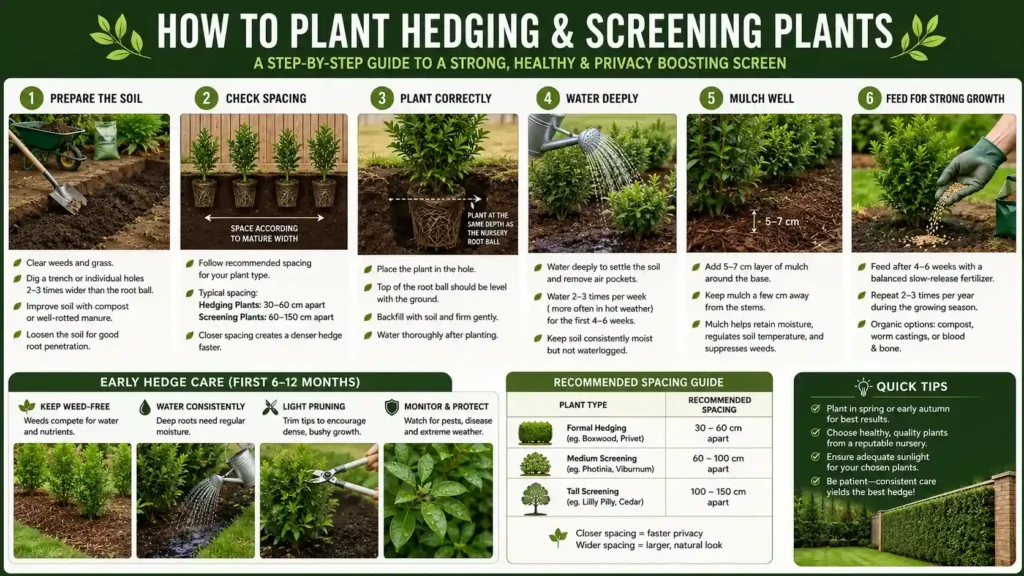
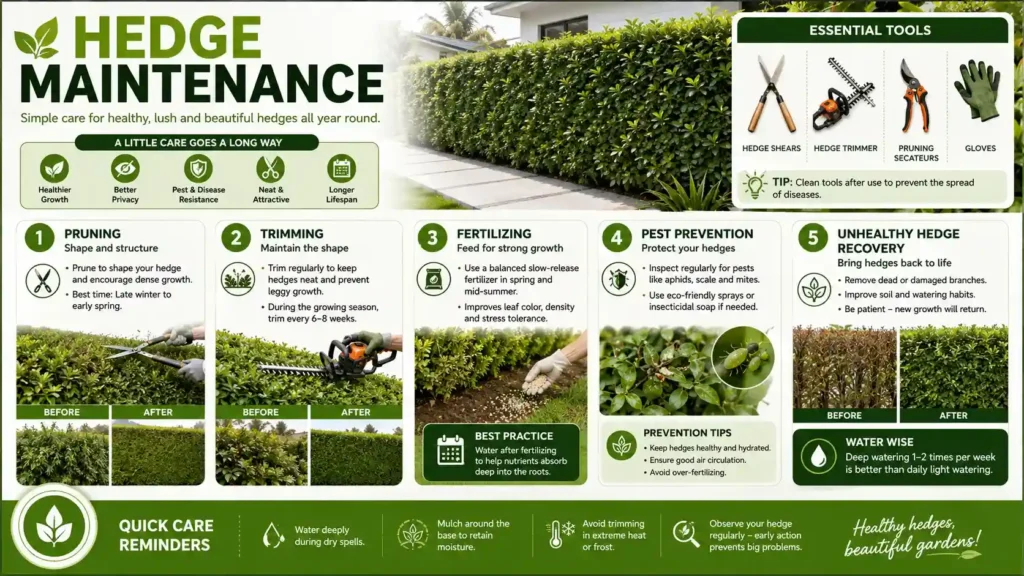
Regular maintenance keeps hedging and screening plants healthy, dense, and visually attractive. Proper pruning, fertilizing, watering, and pest management all contribute to stronger growth and longer-lasting privacy coverage. Well-maintained hedges also develop better structure, improved foliage density, and greater resistance to environmental stress.
Pruning is essential for maintaining hedge shape, encouraging dense branching, and controlling plant size. Correct pruning techniques help hedges remain healthy while preventing sparse or uneven growth.
Key hedge pruning principles include:
Formal hedges generally require more frequent shaping to maintain clean lines and structured borders. Informal screening plants usually need lighter pruning to preserve their natural appearance.
A slightly tapered hedge shape is often recommended:
This allows sunlight to reach lower branches and helps prevent thinning near the bottom of the hedge.
Important pruning tools include:
| Tool | Best Use |
| Hand pruners | Small branches and shaping |
| Hedge trimmers | Large hedge surfaces |
| Loppers | Thick stems and woody growth |
Avoid excessive pruning during extreme heat or frost conditions, as this can stress plants and slow recovery.
The trimming frequency depends on plant species, growth rate, and desired hedge style.
| Hedge Type | Typical Trimming Frequency |
| Fast-Growing Formal Hedges | Several times per year |
| Moderate-Growth Hedges | Seasonal trimming |
| Informal Screening Plants | Light occasional pruning |
Fast-growing privacy plants such as Lilly Pilly may require more regular trimming to maintain dense growth and manageable size.
Signs that screening plants need trimming include:
Regular light trimming is usually more effective than infrequent heavy pruning because it encourages healthier and denser foliage development.
Fertilizing supports healthy foliage, stronger root systems, and vigorous hedge growth. Different plant types have different nutrient requirements, so fertilizer selection should match the species and growing conditions.
General fertilizing guidelines include:
Fertilizer recommendations by plant type:
| Plant Type | Fertilizer Preference |
| Evergreen Hedges | Balanced slow-release fertilizers |
| Native Plants | Low-phosphorus fertilizers |
| Flowering Hedges | Fertilizers supporting blooms and foliage |
Organic compost and mulch can also gradually improve soil quality and support long-term hedge health.
Over-fertilizing can lead to:
Moderate feeding combined with healthy soil management usually produces the best long-term results.
Hedges and screening plants can develop problems when growing conditions, maintenance, or spacing are poor.
Common hedge issues include:
Several factors may contribute to unhealthy hedge growth:
| Problem | Possible Cause |
| Yellow Leaves | Poor drainage or nutrient imbalance |
| Thin Foliage | Lack of pruning or insufficient sunlight |
| Root Problems | Overwatering or compacted soil |
| Browning Tips | Heat stress or inconsistent watering |
Identifying problems early helps prevent long-term damage and improves recovery success.
Healthy hedges are naturally more resistant to pests and diseases. Preventative care is often more effective than treating severe infestations later.
Important prevention practices include:
Common hedge pests may include:
Fungal diseases are more likely to develop in overly wet or crowded planting conditions.
Native plants and climate-adapted hedges often show stronger natural resistance to pests and environmental stress.
Unhealthy hedges can often recover with proper care and gradual improvement of growing conditions.
Steps to revive struggling hedges include:
Light rejuvenation pruning may encourage new growth in sparse hedges, but severe cutting should be done carefully to avoid excessive stress.
Recovery times vary depending on:
Consistent care and proper maintenance usually help hedging plants regain healthier foliage and improved screening performance over time.
Many hedge and screening problems develop because of poor planning, incorrect plant selection, or inconsistent maintenance. Avoiding common mistakes helps hedges establish properly, remain healthy long-term, and provide better privacy and landscape performance.
One of the most common mistakes is selecting plants based only on appearance without considering climate, growth habit, or maintenance requirements.
Problems caused by poor plant selection include:
Before choosing a hedge plant, homeowners should evaluate:
For example, tropical plants may struggle in frost-prone regions, while large screening trees may overwhelm compact urban gardens.
Selecting adaptable species such as Pittosporum or native screening plants often improves long-term reliability and reduces maintenance issues.
Many hedging plants appear compact when young but eventually reach much larger mature sizes. Ignoring mature height and width can lead to overcrowding, root problems, and excessive pruning demands.
Common issues caused by poor size planning include:
Important factors to consider include:
| Growth Factor | Why It Matters |
| Mature Height | Long-term privacy and maintenance |
| Mature Width | Spacing and overcrowding prevention |
| Root Spread | Nearby structures and pathways |
| Growth Speed | Future trimming requirements |
Fast-growing hedges may require more space than initially expected, especially in smaller gardens.
Planting hedges too closely together is a frequent mistake that can negatively affect airflow, root development, and long-term plant health.
Overcrowded hedges may develop:
Proper spacing allows plants to:
Spacing should always be based on mature plant width rather than the size of young nursery plants.
Incorrect watering is one of the leading causes of hedge decline. Both overwatering and underwatering can damage root systems and weaken overall growth.
Healthy watering practices include:
Drought-tolerant native plants often require significantly less water once established compared to fast-growing exotic species.
Neglecting pruning can cause hedges to become uneven, sparse, or excessively large. Regular trimming encourages denser branching and helps maintain the desired shape.
Problems caused by insufficient pruning include:
Formal hedges generally require more regular trimming, while informal screening plants may only need occasional shaping.
Light and consistent pruning is usually more effective than severe cutting after long periods of neglect.
Planting species outside their suitable climate zone often results in poor performance, slow growth, or plant failure.
Climate-related problems may include:
| Climate Issue | Potential Damage |
| Frost Exposure | Leaf burn and branch damage |
| Extreme Heat | Sun stress and dehydration |
| Coastal Salt Exposure | Leaf scorch and reduced growth |
| Dry Conditions | Poor foliage density |
Choosing plants adapted to local environmental conditions greatly improves long-term success.
Australian native screening plants are often preferred because they naturally tolerate regional weather patterns, drought conditions, and local soil types more effectively than non-adapted species.
Australian gardens often experience diverse climate conditions ranging from tropical humidity to coastal exposure, dry inland heat, and seasonal frost. Because of this, selecting the right hedging and screening plants is especially important for long-term success. Many homeowners prefer hardy evergreen species and native plants that can tolerate local environmental conditions while still providing reliable privacy and landscape value.
Across Australia, hedging plants are commonly used for:
Native and climate-adapted species are increasingly popular because they generally require less water, fewer chemical treatments, and lower maintenance once established.
Australian native screening plants are widely valued for their resilience, environmental adaptability, and ability to support local wildlife. Many native species thrive in Australian soils and climate conditions with minimal intervention.
Benefits of native screening plants include:
Popular Australian native screening plants include:
| Plant | Main Benefits |
| Tuckeroo | Coastal resilience and evergreen coverage |
| Syzygium luehmannii | Dense foliage and fast privacy growth |
| Hakea laurina | Decorative flowers and drought tolerance |
Many homeowners also explore broader Australian Native Hedge Plants guides when planning sustainable privacy landscaping.
Coastal gardens require plants that can tolerate salt-laden winds, sandy soils, and exposed environmental conditions. Standard hedge plants may struggle near the coast if they are not adapted to these conditions.
Important characteristics of coastal hedge plants include:
Popular coastal hedge choices include:
| Plant | Coastal Advantages |
| Pittosporum | Excellent wind and salt tolerance |
| Tuckeroo | Reliable coastal screening and shade |
| Lilly Pilly | Dense evergreen privacy in suitable coastal areas |
Coastal hedges are often used to reduce wind exposure while improving outdoor comfort and garden protection.
Water-efficient hedging plants are increasingly important in regions affected by dry summers and water restrictions. Drought-tolerant hedges help maintain privacy and garden structure with lower long-term irrigation needs.
Benefits of drought-tolerant hedging plants include:
Popular drought-tolerant hedge plants include:
| Plant | Drought Benefits |
| Hakea laurina | Excellent dry-climate adaptability |
| Pittosporum | Hardy evergreen performance |
| Tuckeroo | Strong tolerance once established |
Native Australian species are often preferred in drought-prone gardens because they naturally adapt to low-rainfall conditions.
Suburban gardens often require hedging plants that provide privacy without becoming excessively large or difficult to maintain. Dense evergreen plants are especially popular for screening neighboring properties, fences, and outdoor entertaining areas.
Important qualities for suburban privacy plants include:
Popular suburban privacy plants include:
| Plant | Best Features |
| Lilly Pilly | Fast-growing suburban privacy |
| Pittosporum | Structured evergreen screening |
| Viburnum tinus | Decorative privacy with flowers |
Many homeowners choose Goodbye Neighbours Lilly Pilly varieties because of their dense growth and quick screening performance in suburban landscapes.
Hedge plant spacing depends on the mature width and growth habit of the species being planted. Compact hedges are usually planted closer together for denser coverage, while larger shrubs and screening trees require wider spacing for airflow and root development.
General spacing considerations include:
| Hedge Type | Spacing Approach |
| Compact Hedges | Closer planting for dense screening |
| Medium Shrubs | Moderate spacing for airflow |
| Screening Trees | Wider spacing based on mature canopy |
Always base spacing on mature plant size rather than the size of young nursery plants.
Australian native plants are highly effective for screening because they tolerate local climate conditions while supporting wildlife and pollinators.
Popular native screening plants include:
These native species are commonly used in eco-friendly landscapes and drought-tolerant gardens.
The best hedge plants for Australian gardens are those suited to regional climate conditions, soil types, and maintenance preferences. Popular choices include:
| Plant | Main Benefit |
| Lilly Pilly | Fast-growing privacy screening |
| Pittosporum | Coastal and formal hedging |
| Viburnum tinus | Decorative evergreen coverage |
| Tuckeroo | Native shade and screening |
Australian native plants are often preferred because they adapt well to local environmental conditions and generally require less long-term maintenance.
Choosing the right hedging and screening plants is essential for creating healthy, attractive, and long-lasting outdoor spaces. Climate conditions, available garden space, sunlight exposure, and mature plant size should always guide plant selection to ensure better growth and easier long-term maintenance.
Evergreen hedges provide reliable year-round privacy, while native screening plants offer improved drought tolerance, wildlife support, and adaptability to local conditions. Fast-growing plants can deliver quicker privacy solutions, but they may also require more frequent pruning and ongoing care. Compact hedging plants are often better suited to urban gardens and narrow spaces where controlled growth is important.
Before planting, homeowners should carefully consider:
Proper planning helps prevent overcrowding, excessive pruning, poor airflow, and future landscape problems. Selecting climate-appropriate plants also improves resilience against heat, drought, frost, and coastal exposure.
For gardeners looking to expand their landscaping knowledge, exploring related plant guides can provide additional insight into native screening plants, evergreen hedges, flowering privacy shrubs, and compact urban screening solutions.
Well-planned hedging and screening plants not only improve privacy but also enhance garden structure, support wildlife, reduce noise, and create more comfortable outdoor living environments for years to come.
Evergreen species with dense foliage such as Lilly Pilly, Pittosporum, and Viburnum tinus provide year-round privacy and strong screening coverage.
Fast-growing options include Lilly Pilly varieties, Syzygium australe, and Orange Jasmine. These plants establish privacy quickly but require more frequent trimming.
Compact plants like Lilly Pilly Smithii Minor are ideal for small gardens, side yards, and urban spaces, providing vertical privacy without spreading too wide.
Low-maintenance hedges include Pittosporum, Tuckeroo, and hardy native species that require minimal watering and pruning once established.
Evergreen plants like Pittosporum, Lilly Pilly, Viburnum tinus, and Syzygium luehmannii provide consistent year-round coverage.
Spacing depends on mature width and growth habit. Compact hedges are planted closer for density, while taller screening shrubs and trees need wider spacing for airflow and root growth.
Australian native plants such as Tuckeroo, Hakea laurina, and Syzygium luehmannii are highly effective for sustainable, drought-tolerant screening.
Popular choices include Lilly Pilly, Pittosporum, Viburnum tinus, and Tuckeroo, which are suited to regional climates and suburban landscapes.
Select salt-tolerant, wind-resistant species like Pittosporum or Tuckeroo to ensure healthy growth near the coast.
Yes. Tall evergreen and screening trees such as Tuckeroo or layered plantings of compact and fast-growing shrubs can provide shade, reduce heat, and create comfortable outdoor spaces.
Native and flowering hedge plants like Viburnum tinus, Hakea laurina, and Orange Jasmine support pollinators, birds, and beneficial insects while still serving as privacy screens.
Regular pruning, seasonal fertilizing, appropriate watering, and monitoring for pests and diseases ensure strong growth, dense coverage, and longevity for all hedge and screening plants.