Grow Better Gardens with Smarter Plant Choices
Discover helpful guides on trees, hedges, fruit plants, edible plants, and beautiful landscape greenery.
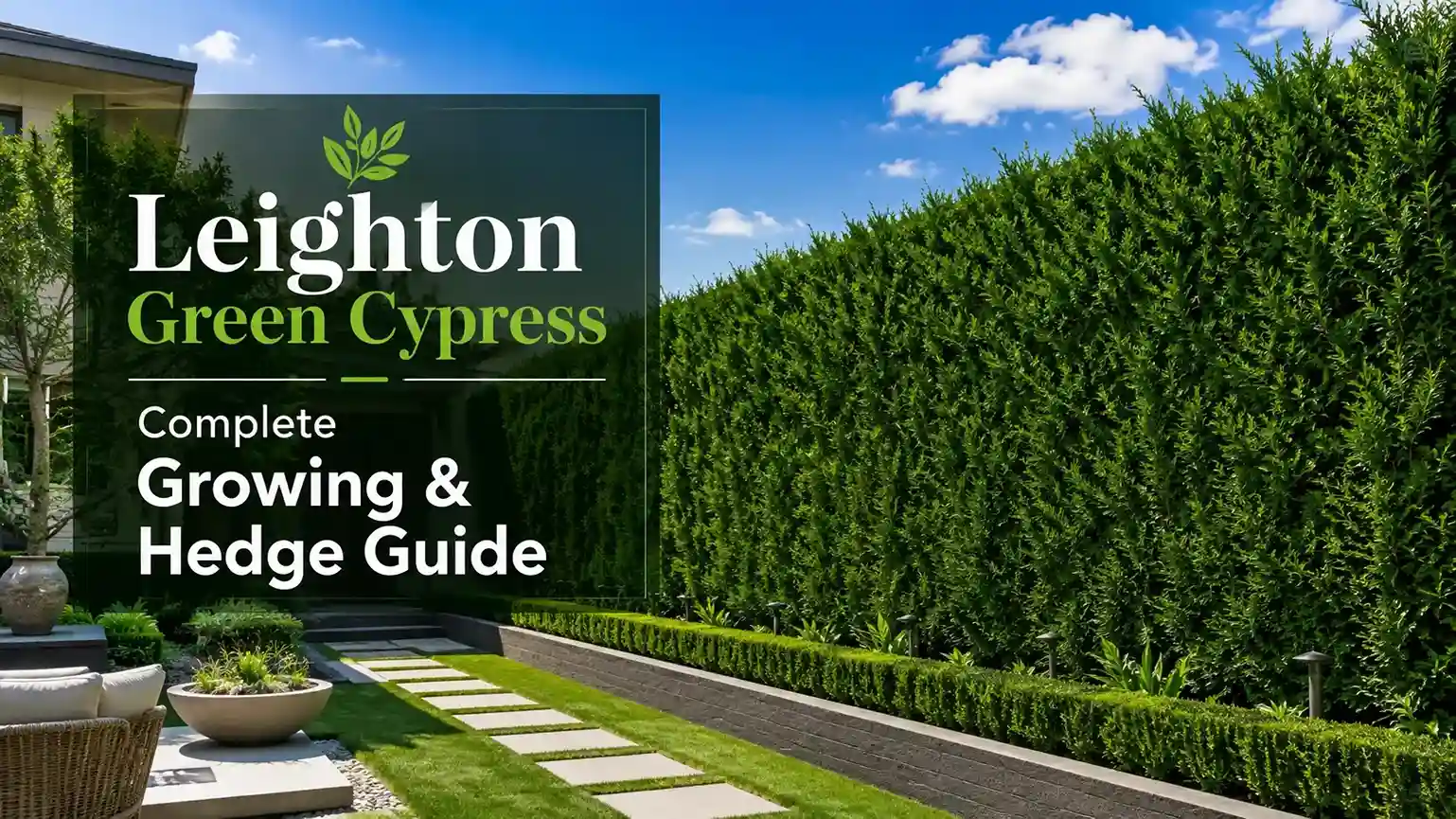
Leighton Green Cypress is a fast-growing evergreen conifer widely planted for privacy hedges, windbreaks, boundary screening, and ornamental landscaping. Botanically classified as Cupressocyparis leylandii ‘Leighton Green’, this vigorous hybrid conifer is valued for its dense green foliage, upright growth habit, and ability to create thick evergreen hedges in a relatively short time. Commonly searched under names such as cupressocyparis leighton green, cupressocyparis leylandii leighton green, and cupressus leightons green, the tree remains one of the most popular hedge conifers in Australia, New Zealand, and the UK.
Known simply as leighton green, leightons green, leighton greens, or cypress leighton green, this hardy screening plant adapts well to residential gardens and larger landscapes. The leightons green cypress conifer is especially popular in Australian landscaping because of its rapid growth rate, year-round evergreen structure, and excellent hedge-forming performance in temperate climates.
Leighton Green Cypress is a vigorous evergreen Leylandii conifer known for dense green foliage and rapid hedge formation. It is widely planted as a privacy screen, windbreak, and landscape hedge because of its fast growth, thick branching structure, and year-round evergreen appearance.
The scientific name of Leighton Green Cypress is Cupressocyparis leylandii ‘Leighton Green’. It belongs to the Cupressaceae family, which includes many popular evergreen conifers used in landscaping and hedging.
Leighton Green is a hybrid conifer developed from crosses between Monterey Cypress (Cupressus macrocarpa) and Nootka Cypress (Callitropsis nootkatensis). This hybrid background gives the tree strong growth vigor, dense foliage production, and adaptability across different climates.
Related botanical terms commonly associated with this conifer include:
Because of its hybrid nature, Leighton Green combines the rapid growth of Leylandii conifers with improved hedge density and reliable evergreen structure.
Leighton Green Cypress is known by several common names in gardening and landscaping industries, including:
These names are often used interchangeably in plant nurseries, hedge guides, and landscaping discussions.
Leighton Green Cypress does not occur naturally in the wild because it is a cultivated hybrid conifer. It originated from Leyland Cypress breeding selections developed for fast-growing hedge and screening purposes.
Over time, Leighton Green became highly popular in:
Its adaptability, dense evergreen foliage, and fast hedge establishment made it one of the most widely planted screening conifers in residential and commercial landscapes.
In Australian gardens, Leighton Green Cypress is commonly used for:
Its upright growth habit and ability to tolerate regular trimming make it especially effective for formal hedges and dense green barriers.
| Feature | Details |
| Botanical Name | Cupressocyparis leylandii ‘Leighton Green’ |
| Plant Type | Evergreen Conifer |
| Growth Habit | Upright & Dense |
| Main Use | Privacy Hedge |
| Growth Speed | Fast Growing |
Leighton Green Cypress grows tall quickly and develops dense evergreen foliage ideal for privacy screening. Its rapid growth, thick branching habit, and upright structure make it one of the most reliable conifers for hedging, wind protection, and large-scale landscape screening.
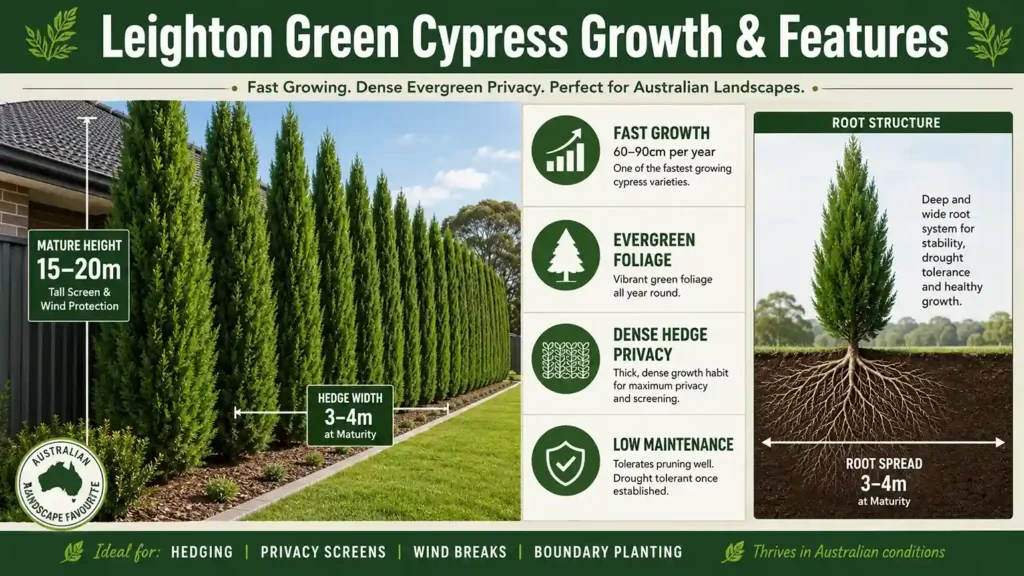
Leighton Green Cypress is considered a large evergreen conifer with strong vertical growth. Under suitable growing conditions, it can quickly form a tall, dense hedge within only a few years.
Typical mature dimensions include:
Because of its vigorous upright habit, the tree is frequently used where homeowners need fast privacy from neighboring properties, roads, or open spaces. Its dense structure also makes it valuable as a windbreak in exposed gardens and rural landscapes.
The naturally pine tall appearance of mature Leighton Green Cypress gives landscapes a structured evergreen backdrop throughout the year. Unlike many slower-growing screening trees, this conifer quickly creates substantial vertical coverage.
Leighton Green Cypress produces soft green evergreen foliage with dense layered branching. The foliage consists of flattened sprays of scale-like leaves that remain vibrant throughout most seasons.
Key foliage characteristics include:
Compared with some other conifers, Leighton Green often appears fuller and softer in texture. Pencil pine varieties usually develop a more rigid and narrow form, while some traditional cypress species can appear coarser or more open in branching structure.
The thick foliage density is one of the main reasons this conifer performs exceptionally well as a privacy hedge.
The leighton green growth rate is considered very fast for an evergreen hedge conifer. In favorable conditions, young trees can grow approximately 60–100 cm per year.
The leighton green conifer growth rate depends on several factors, including:
This rapid development allows the tree to establish privacy screens much faster than many alternative hedge plants.
| Plant | Growth Speed | Growth Habit |
| Leighton Green Cypress | Fast | Dense & Upright |
| Pencil Pine Hedge | Slow | Narrow Vertical |
| Lillian Cypress | Moderate | Compact |
| Castlewellan Gold Hedge | Moderate | Broad & Golden |
Compared with a pencil pine hedge, Leighton Green creates wider and denser coverage much more quickly. Lillian Cypress generally grows slower and stays more compact, while Castlewellan Gold hedge varieties offer colorful foliage but require more space management.
The leighton green lifespan can extend for several decades when planted in suitable conditions and maintained properly.
Healthy trees commonly remain productive and attractive for:
Long-term performance depends heavily on:
Without maintenance, mature trees may become oversized or develop thinning lower branches over time. Regular hedge management helps preserve dense foliage and structural balance.
The leighton green root system is generally shallow-to-moderately spreading rather than deeply invasive. Like many fast-growing conifers, the roots expand outward to support rapid top growth and moisture absorption.
Important root characteristics include:
Although the root system is not typically destructive, overcrowded planting or poorly drained soil can increase root stress and stability problems.
Good drainage is especially important because constantly wet soil may contribute to root rot and reduced vigor. Proper planting distance and balanced watering help maintain strong root development and long-term hedge stability.
Leighton Green Cypress roots are generally non-invasive but can spread aggressively in poor planting conditions or near structures. Like many fast-growing evergreen conifers, the root system naturally expands outward in search of moisture and stability, especially when trees are overcrowded or growing in compacted soil.
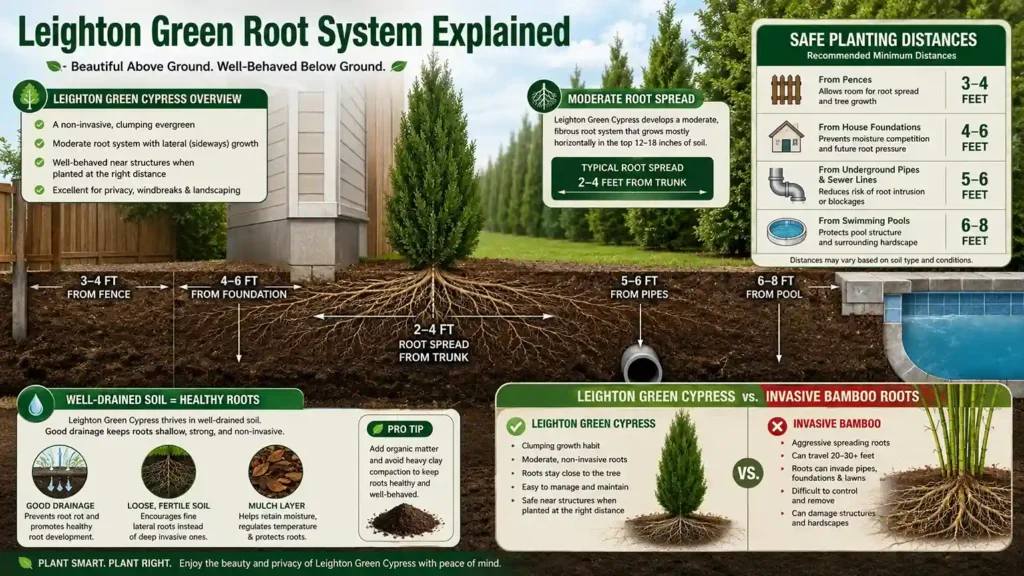
The root system of Leighton Green Cypress is usually shallow to moderately deep with a wide lateral spread. Instead of producing extremely deep taproots, the tree develops outward-growing roots that support rapid foliage growth and hedge density.
Key root characteristics include:
In dry conditions, roots may travel further in search of water. This moisture-seeking tendency is common in many Leylandii conifers and explains why planting location matters near underground infrastructure.
Although the roots are not considered highly destructive, unmanaged trees planted too close to structures may eventually create pressure around nearby surfaces or drainage areas.
Proper spacing is one of the most important ways to avoid root-related issues with Leighton Green Cypress.
Recommended planting distances include:
| Structure | Recommended Distance |
| Fences | 1.5–2 metres |
| House foundations | 3–5 metres |
| Water pipes | 3 metres or more |
| Swimming pools | 4–6 metres |
These distances help reduce future competition for moisture and minimize the risk of root congestion near built structures.
For hedge planting, spacing between individual trees should also allow enough room for healthy root expansion and airflow.
Root problems with Leighton Green Cypress usually develop because of environmental stress or poor planting practices rather than true invasive behavior.
Common causes include:
In tightly planted hedges, roots compete heavily for water and nutrients. This competition can weaken tree health and increase instability during storms or prolonged drought periods.
Poor drainage is another major issue. Waterlogged soil limits oxygen around the roots, increasing the likelihood of fungal diseases and root rot.
Most Leighton Green root problems can be prevented through correct planting and long-term maintenance.
Best practices include:
Balanced watering is especially important. Excessive irrigation encourages shallow surface roots, while inconsistent watering may stress the tree and increase aggressive moisture-seeking behavior.
Regular monitoring also helps identify early signs of root stress, including poor growth, leaning trees, thinning foliage, or persistent yellowing.
| Plant | Root Aggressiveness |
| Leighton Green Cypress | Moderate |
| Bamboo | High |
| Pencil Pine | Low |
| Leyland Cypress | Moderate |
Leighton Green Cypress thrives in sunny locations with well-draining soil and regular early watering. When planted in suitable conditions, this fast-growing evergreen conifer establishes quickly and develops dense foliage ideal for privacy hedges, windbreaks, and landscape screening.
Leighton Green Cypress performs best in temperate climates with moderate rainfall and good seasonal airflow. It adapts well to a variety of growing conditions but grows most vigorously in regions without extreme prolonged heat or severe freezing conditions.
Recommended USDA growing zones include:
The tree is widely planted across Australia because of its adaptability and rapid hedge growth. Among australian conifers, Leighton Green is considered one of the most reliable options for large evergreen screens and boundary hedges. For a complete overview of landscape tree options suited to Australian climates, see our Evergreen, Shade & Landscape Trees guide.
It performs particularly well in:
As one of the more commonly used australian conifer trees, it suits both residential gardens and larger rural properties. Many gardeners also choose it among coniferous trees in australia because it maintains dense foliage throughout the year and tolerates regular hedge trimming.
Leighton Green Cypress grows best in full sun conditions where it receives at least 6–8 hours of direct sunlight daily.
Ideal light conditions include:
Although the tree can tolerate partial shade, insufficient sunlight may reduce foliage density and slow overall growth. Hedges planted in deep shade often become thinner and less uniform over time.
Consistent sunlight exposure also helps reduce fungal problems by improving air circulation through the foliage.
Well-draining soil is essential for healthy Leighton Green Cypress growth. The tree tolerates different soil textures but struggles in permanently wet or compacted ground.
Preferred soil conditions include:
Ideal soil pH range:
Drainage is one of the most important factors for long-term success. Poor drainage can lead to root stress, fungal disease, and reduced growth performance.
Heavy clay soil may still support growth if improved with:
Leighton Green Cypress requires regular watering during establishment but becomes more drought tolerant as it matures.
Young plants need:
The first 12–18 months are critical for root establishment. Allowing the soil to dry excessively during this period may slow growth and reduce hedge density.
Once established, mature trees are moderately drought tolerant and usually require less supplemental watering.
However, prolonged dry periods may still cause:
Deep occasional watering is generally more beneficial than frequent shallow irrigation because it encourages stronger root development.
Leighton Green Cypress benefits from seasonal feeding, especially during active growth periods in spring and early summer.
Recommended fertilizer practices include:
Conifer fertilizer products rich in micronutrients help maintain healthy foliage color and steady growth.
Avoid fertilizing during:
Overfeeding may encourage weak, overly soft growth that becomes more vulnerable to pests and environmental stress.
Mulching helps maintain healthy root conditions and improves moisture stability around Leighton Green Cypress.
Benefits of mulching include:
Recommended mulch materials:
Apply mulch approximately:
Keeping mulch slightly away from the base of the trunk helps prevent excess moisture buildup and reduces the risk of fungal problems around the stem.
Leighton Green is one of the most popular fast-growing conifer hedges for privacy and wind protection. Its dense evergreen foliage, rapid vertical growth, and strong screening ability make it a preferred hedge plant for residential gardens, rural properties, and commercial landscapes.
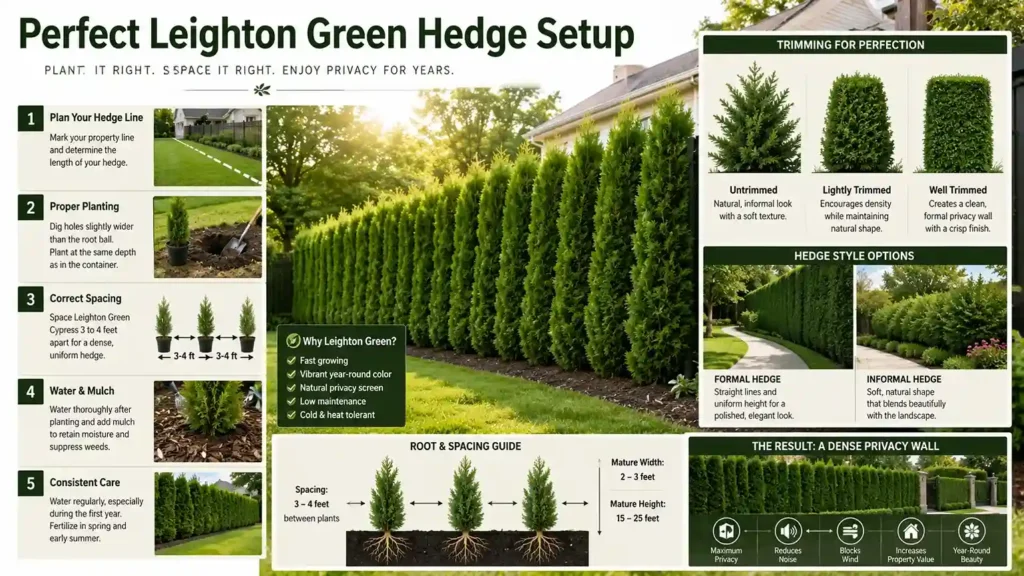
Leighton Green Cypress performs exceptionally well as a hedge because it develops thick branching and consistent evergreen coverage throughout the year.
Key advantages include:
The tree quickly forms a living green wall that reduces visibility, filters noise, and creates natural landscape boundaries. Because of its rapid growth rate, many homeowners choose Leighton Green when they need privacy in a shorter time frame.
Its upright habit also helps maintain a clean hedge appearance without becoming excessively wide too quickly.
Correct spacing is essential for building a healthy and long-lasting hedge. Proper distance between plants allows roots to establish evenly while maintaining airflow through the foliage.
| Hedge Purpose | Recommended Spacing |
| Dense privacy hedge | 1–1.5 metres apart |
| Medium screening hedge | 1.5–2 metres apart |
| Large windbreak planting | 2–3 metres apart |
A successful hedge cypress layout should balance density with long-term maintenance access. Planting trees too closely may initially create faster screening, but overcrowding often leads to poor airflow and root competition later.
For an effective cypress hedge setup:
Using guide lines during planting helps create a uniform hedge structure from the beginning.
Regular pruning is important for controlling hedge height and maintaining dense branching.
Leighton Green hedges respond best to:
Frequent light pruning encourages thicker foliage and prevents sparse internal growth.
A formal hedge is:
This style works well for:
An informal hedge has:
This approach suits:
Maintaining hedge width narrower at the top and slightly broader at the base also improves sunlight penetration and keeps lower foliage healthy.
Different hedge conifers vary in growth speed, density, and maintenance needs.
| Hedge Plant | Growth Speed | Density | Maintenance |
| Leighton Green | Fast | Dense | Moderate |
| Pencil Pine | Slow | Narrow | Low |
| Leylandii Hedge | Fast | Dense | Moderate |
| Pine Hedge | Moderate | Medium | Low |
Leighton Green stands out because it combines fast growth with thick evergreen screening. Pencil Pine works better for narrow spaces, while traditional pine hedges usually require less trimming but provide less dense privacy.
Leighton Green Cypress combines well with several evergreen screening species to create layered landscapes and visually balanced hedge systems.
Popular companion conifer hedge plants include:
These conifers for hedges can be used to create:
For large-scale urban and street landscaping, the London Plane Tree is one of the most widely planted companion canopy species alongside evergreen screening hedges.
Many gardeners also pair Leighton Green with other conifer trees for hedging to improve visual texture and year-round color variation.
Among leylandii hedging conifers, Leighton Green remains one of the most popular choices because of its dense growth habit, strong adaptability, and effective privacy performance.
Most Leighton Green problems are caused by poor drainage, overcrowding, or lack of airflow. Although this evergreen conifer is generally hardy and fast growing, environmental stress and improper maintenance can lead to foliage discoloration, weak growth, pest infestations, and fungal disease.
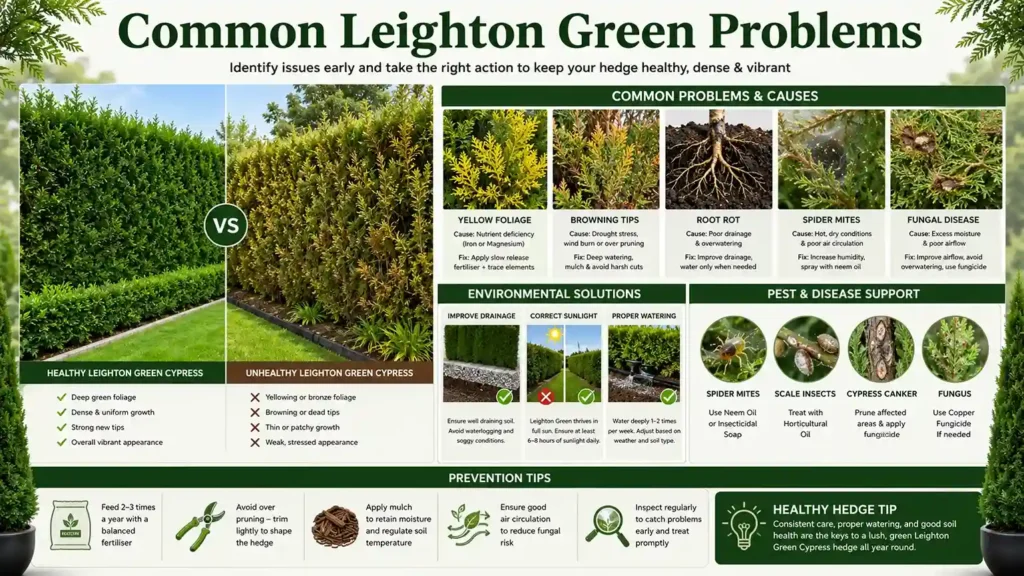
Early identification and proper care are important for maintaining healthy hedge density and long-term plant vigor.
Yellowing foliage is one of the most common issues affecting Leighton Green Cypress. Discoloration usually begins on inner branches or lower foliage before spreading outward.
Both overwatering and underwatering can cause foliage yellowing.
Signs include:
Waterlogged soil is especially harmful because roots lose oxygen in saturated conditions.
Insufficient nutrients may also contribute to yellow foliage, particularly deficiencies involving:
Poor soil quality and compacted ground often reduce nutrient absorption efficiency.
Brown foliage tips are commonly associated with environmental stress or root disturbance.
Extended hot weather and dry winds can dehydrate foliage, especially in newly planted hedges.
Symptoms include:
Root stress from construction, compacted soil, or excessive digging may reduce moisture uptake and trigger browning.
Maintaining steady moisture levels helps reduce sudden foliage stress during seasonal temperature extremes.
Leighton Green Cypress can occasionally attract common conifer pests, particularly when plants are weakened by drought or poor airflow.
Aphids feed on sap and may cause:
Bagworms create protective cases attached to branches and feed on foliage.
Heavy infestations may lead to:
Spider mites are more common during hot dry weather.
Signs include:
Healthy, well-maintained hedges are generally more resistant to pest outbreaks.
Fungal diseases are most likely to develop in wet, poorly ventilated conditions.
Root rot commonly occurs in waterlogged soil and may cause:
Poor drainage is the leading cause of this condition.
Cypress canker is a serious fungal disease affecting branches and stems.
Symptoms may include:
Infected branches should be removed promptly to reduce disease spread.
Weak or uneven growth usually results from unsuitable environmental conditions.
Compacted soil limits:
This can significantly slow hedge establishment.
Leighton Green Cypress prefers full sun for dense growth. Excessive shade may lead to:
| Problem | Likely Cause | Solution |
| Yellow Leaves | Overwatering | Improve drainage |
| Browning | Heat stress | Deep watering |
| Sparse Growth | Lack of sun | Increase sunlight |
| Root Rot | Wet soil | Better drainage |
Regular light pruning helps maintain dense foliage and prevents oversized growth. Proper maintenance improves hedge appearance, encourages healthy branching, and reduces the risk of disease caused by overcrowding or poor airflow.
Because Leighton Green Cypress is a fast-growing evergreen conifer, routine trimming is important for keeping hedges neat, balanced, and manageable over the long term.
The best time to prune Leighton Green Cypress is during active growing seasons when the tree can recover quickly and produce fresh foliage.
| Season | Pruning Suitability | Notes |
| Spring | Excellent | Encourages dense new growth |
| Early Summer | Very Good | Ideal for hedge shaping |
| Late Summer | Moderate | Light trimming only |
| Winter | Limited | Avoid heavy pruning |
Spring and early summer are usually the preferred pruning periods because growth activity is strongest during these months.
Avoid aggressive pruning during:
Light maintenance trimming throughout the growing season helps preserve hedge density without overstressing the plant.
Leighton Green Cypress hedges generally require regular trimming because of their rapid growth rate.
Frequent light trimming produces better results than infrequent heavy cutting. This approach encourages compact branching and prevents the hedge from becoming overly woody or sparse inside.
Fast-growing hedges may need additional shaping during periods of strong spring growth.
Improper pruning can permanently affect hedge appearance and growth structure.
One of the most common mistakes is cutting too deeply into mature brown interior wood.
Older wood often:
For best results, maintain green foliage on the outer hedge surface during trimming.
Removing excessive foliage at once can stress the tree and weaken its natural growth pattern.
Over-pruning may lead to:
Gradual shaping over time is safer and produces a fuller hedge structure.
Consistent maintenance helps Leighton Green Cypress remain healthy, dense, and visually attractive for many years.
Good airflow reduces moisture buildup and lowers the risk of fungal disease.
To improve circulation:
Proper spacing also helps sunlight reach lower foliage.
Mulching supports healthy root conditions by:
Organic mulch materials such as bark chips or composted wood are commonly recommended.
Consistent watering is especially important during:
Avoid constantly saturated soil because excessive moisture may contribute to root problems and reduced vigor.
Deep occasional watering is generally more beneficial than frequent shallow irrigation, especially for mature hedges.
Leighton Green is a cultivar of Leyland Cypress with denser foliage and strong hedge performance. Both are fast-growing evergreen conifers widely used for screening, windbreaks, and privacy hedges, but Leighton Green is often preferred for its fuller appearance and improved hedge density.
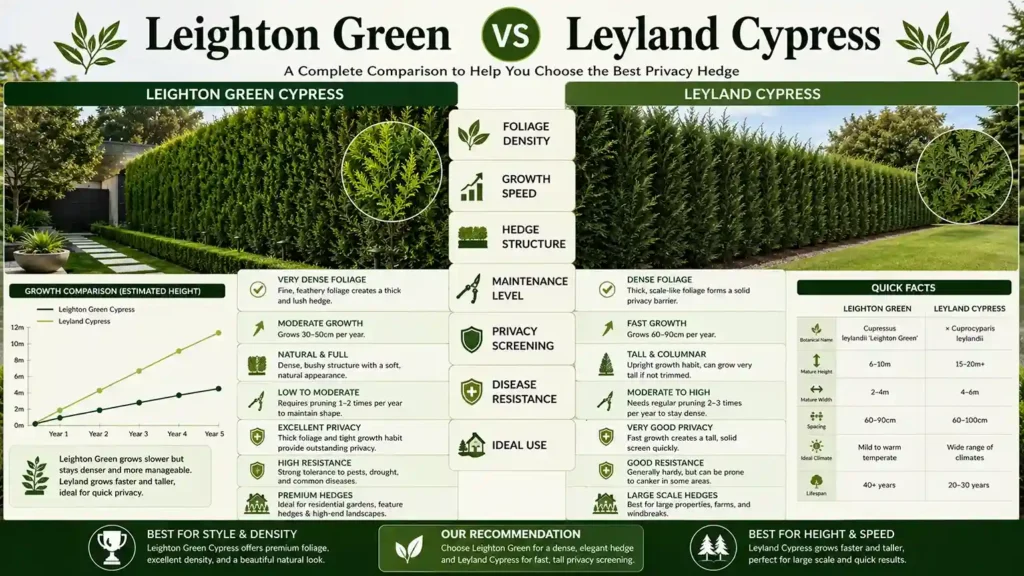
| Feature | Leighton Green | Leyland Cypress |
| Foliage Density | Higher | Moderate |
| Hedge Use | Excellent | Excellent |
| Growth Speed | Fast | Very Fast |
| Maintenance | Moderate | Moderate |
| Wind Tolerance | High | High |
Leighton Green is generally considered better for privacy because of its denser foliage and thicker branching structure.
Privacy advantages of Leighton Green include:
Traditional Leyland Cypress grows rapidly but may develop a slightly looser structure if not trimmed consistently. In comparison, Leighton Green naturally forms a thicker hedge with less visible spacing between branches.
For homeowners seeking year-round privacy and noise reduction, Leighton Green is often the preferred choice.
Standard Leyland Cypress usually grows slightly faster than Leighton Green under ideal conditions.
Typical annual growth rates include:
Although Leyland Cypress may establish height more quickly, Leighton Green often balances strong growth with improved hedge density and structure.
Growth speed can still vary depending on:
Both trees are considered among the fastest-growing evergreen hedge conifers used in landscaping.
Both varieties require moderate maintenance, especially when used as formal hedges.
However, Leighton Green may be slightly easier to manage long term because its dense growth habit responds well to regular shaping.
| Maintenance Area | Leighton Green | Leyland Cypress |
| Trimming Frequency | Moderate | Moderate to High |
| Density Control | Easier | Requires regular shaping |
| Hedge Appearance | Naturally dense | Can become uneven |
| Overgrowth Risk | Moderate | Higher |
Leyland Cypress may become oversized more quickly because of its extremely vigorous growth rate. Without consistent pruning, large hedges can become difficult to reshape.
Leighton Green generally maintains a tidier appearance with structured trimming and is often favored for manageable residential hedge systems.
Healthy Leighton Green trees should have dense green foliage, strong central growth, and healthy roots. Choosing high-quality plants at the beginning greatly improves hedge establishment, long-term growth, and resistance to pests or disease problems.
When selecting Leighton Green Cypress for hedging or screening, it is important to inspect the overall structure, root health, and foliage condition before planting.
Careful plant inspection helps prevent future growth problems and reduces the risk of introducing disease into the landscape.
Healthy roots should appear:
Avoid plants showing:
A strong root system improves early establishment and long-term hedge stability.
Quality Leighton Green trees should display:
Sparse or patchy foliage may indicate stress, poor maintenance, or insufficient light during nursery production.
Inspect plants carefully for symptoms such as:
Healthy conifers should look vigorous and evenly colored without major dieback or discoloration.
Both container-grown and ground-grown Leighton Green trees have advantages depending on planting goals and site conditions.
Benefits include:
These are commonly chosen for residential hedge planting.
Advantages include:
However, ground-grown trees may require more recovery time after transplanting because roots are disturbed during lifting.
Medium-sized Leighton Green Cypress trees often establish more successfully than oversized specimens.
Recommended planting sizes include:
| Tree Size | Best Use |
| 50–80 cm | Budget hedge planting |
| 1–1.5 metres | Most common hedge size |
| 1.5–2 metres | Faster privacy screening |
| 2+ metres | Instant impact planting |
Smaller trees frequently adapt faster after planting and develop stronger root systems over time.
Larger trees may provide quicker screening but usually require:
Leighton Green Cypress is widely available throughout Australia from nurseries and landscape suppliers.
Common retail search terms include:
Australian garden centers commonly stock Leighton Green because of its popularity as a fast-growing privacy hedge and windbreak tree.
Availability may vary depending on:
Specialist conifer nurseries often provide larger hedge-grade specimens and bulk planting options for landscape projects.
Many buyers search online using terms such as:
When purchasing online or from local suppliers, compare:
Choosing vigorous healthy plants from reputable nurseries improves hedge performance and reduces long-term maintenance problems.
Leighton Green Cypress performs best outdoors due to its mature size and sunlight requirements. This fast-growing evergreen conifer needs open space, strong light exposure, and proper airflow to maintain healthy growth and dense foliage.
Although young plants can temporarily grow in containers, long-term indoor cultivation is generally unsuitable because of the tree’s vigorous root system and large mature size.
Leighton Green Cypress can grow in pots during its early stages, but container growth usually requires additional maintenance and regular size control.
Successful container growth depends on:
Potted trees dry out faster than ground-planted specimens and may require more frequent irrigation during warm weather.
Over time, container-grown trees may experience:
Because Leighton Green naturally develops into a tall evergreen screening tree, long-term pot culture is usually practical only when:
For large privacy hedges and mature screening applications, in-ground outdoor planting remains the preferred option.
Leighton Green Cypress is widely used in outdoor landscapes because of its rapid growth, dense evergreen foliage, and excellent screening ability.
Its thick branching structure helps reduce wind exposure around:
Multiple rows can create highly effective evergreen wind barriers.
Leighton Green is commonly planted along:
Its upright growth habit allows property borders to remain visually neat while providing year-round greenery.
One of the most popular uses for Leighton Green Cypress is dense privacy screening.
Benefits include:
Its evergreen structure makes it highly effective for blocking neighboring views and creating enclosed outdoor spaces.
Leighton Green Cypress combines well with many evergreen and structural landscape plants.
Popular pairing options include:
These combinations help create layered evergreen hedges with varying textures and heights.
Leighton Green works especially well in australian garden design because it complements both formal and natural landscapes.
It suits:
Its strong vertical structure provides contrast against flowering shrubs and lower evergreen plants.
In native Australian garden designs, Coast Banksia is a popular evergreen companion species that pairs well with structured screening conifers like Leighton Green.
In green hedge layouts, Leighton Green is often used as:
The dense foliage and reliable growth pattern make it one of the most versatile evergreen conifers for large-scale outdoor landscaping projects.
Leighton Green Cypress is commonly propagated through semi-hardwood cuttings. This propagation method is preferred because it produces plants that remain genetically identical to the parent tree, preserving the dense foliage and fast-growing hedge characteristics of the original cultivar.
Propagation is usually performed during the warmer growing months when stems are partially mature but still flexible enough to root successfully.
Semi-hardwood cuttings are the most reliable way to propagate Leighton Green Cypress.
Healthy parent plants should have:
Using sterilized pruning tools also helps reduce the risk of fungal infection during propagation.
Leighton Green Cypress cuttings generally root within several weeks under suitable conditions.
| Condition | Approximate Rooting Period |
| Warm humid conditions | 6–8 weeks |
| Cooler conditions | 8–12 weeks |
| Low humidity environments | Slower rooting |
Rooting speed depends on factors such as:
Consistent warmth and moderate humidity usually improve propagation success rates.
A well-draining propagation mix is essential for healthy root development.
Recommended propagation media include:
An effective soil mix should provide:
Heavy compacted soils should be avoided because excessive moisture around cuttings may encourage rot.
Keeping the propagation medium lightly moist rather than saturated helps improve rooting success.
Young Leighton Green Cypress plants require stable growing conditions during early establishment.
Once rooted successfully, young plants can slowly transition into full sun conditions.
Early pruning is generally unnecessary during the first growth stage, but damaged or weak growth should be removed promptly to encourage stronger development.
Proper early care helps young plants establish healthier root systems and improves long-term hedge performance after transplanting.
Several evergreen conifers provide similar hedge performance depending on climate and maintenance needs. While Leighton Green Cypress is highly valued for its dense growth and fast privacy screening, some landscapes may benefit from narrower, slower-growing, or lower-maintenance hedge alternatives.
Different hedge conifers offer unique advantages in terms of size, foliage texture, color, and growth rate.
Pencil Pine is a tall narrow evergreen conifer commonly used where vertical screening is needed in limited spaces.
Key features include:
It works especially well for:
Lillian Cypress is a compact evergreen conifer known for dense foliage and manageable growth.
Benefits include:
This option suits gardeners seeking a more controlled hedge size with reduced pruning requirements.
Castlewellan Gold is a golden evergreen conifer valued for decorative foliage color and screening ability.
Main characteristics include:
It is often planted to create visual contrast in evergreen landscapes.
Leylandii conifers are among the closest alternatives to Leighton Green Cypress.
Advantages include:
However, Leylandii hedges may require more frequent trimming because of their vigorous growth rate.
Several pine hedge species are also used for evergreen screening.
Common qualities include:
Pine hedges generally produce less dense screening than Leighton Green but can work well in naturalistic landscapes.
For rapid privacy and quick hedge establishment, some conifers outperform slower ornamental varieties.
| Hedge Plant | Growth Speed | Screening Density |
| Leylandii Conifer | Very Fast | Dense |
| Leighton Green Cypress | Fast | Dense |
| Castlewellan Gold | Moderate | Medium |
| Pine Hedge Species | Moderate | Medium |
Leylandii conifers are typically the fastest-growing option, while Leighton Green balances strong growth with better foliage density and hedge structure.
Fast-growing hedges generally require:
Some evergreen hedges are easier to maintain long term because of slower growth and naturally compact forms.
These alternatives usually require:
Low-maintenance hedges are often preferred for:
In restricted planting areas, narrow-growing conifers are often more practical than broad hedge species.
| Plant | Growth Habit | Best Use |
| Pencil Pine | Tall & Narrow | Tight spaces |
| Lillian Cypress | Compact Upright | Small gardens |
| Leighton Green | Broad Dense | Large screening |
| Castlewellan Gold | Broad | Decorative hedges |
Pencil Pine is one of the best options for narrow boundaries because it grows vertically with minimal lateral spread.
Lillian Cypress also works well in compact landscapes where moderate screening and easier maintenance are priorities.
Leighton Green Cypress remains one of the best evergreen hedging conifers for fast privacy, dense growth, and adaptable landscaping use. Its rapid growth rate, thick evergreen foliage, and strong screening performance make it a highly reliable choice for residential gardens, rural properties, and large landscape projects.
One of the biggest advantages of Leighton Green is its excellent hedge value. The tree quickly develops into a dense living screen that provides year-round privacy, wind protection, and visual structure. Compared with many slower-growing conifers, it establishes effective coverage much faster while maintaining a neat upright appearance.
Its strong growth speed also makes it suitable for:
Despite being a vigorous grower, Leighton Green Cypress remains relatively manageable with regular light pruning and proper long-term maintenance. Good spacing, balanced watering, drainage management, and seasonal trimming all help maintain healthy dense foliage and strong root development.
The evergreen structure of Leighton Green ensures consistent visual coverage throughout the year, making it especially valuable in temperate landscapes where permanent screening is needed.
With proper planting techniques and ongoing care, Leighton Green Cypress continues to be one of the most dependable evergreen hedge conifers for fast-growing, attractive, and functional landscaping applications.
Leighton Green Cypress is a fast-growing evergreen conifer that can grow approximately 60–100 cm per year under suitable conditions. Growth speed depends on sunlight, soil quality, watering, drainage, and overall maintenance. Regular pruning and seasonal feeding also help maintain vigorous hedge development.
Leighton Green roots are generally considered moderately spreading rather than highly invasive. However, roots can expand aggressively in search of moisture if planted too close to structures or in poorly drained soil. Proper spacing from foundations, pipes, and fences helps prevent root-related problems.
For dense privacy hedges, Leighton Green plants are usually spaced about 1–1.5 metres apart. Wider spacing of 1.5–2 metres may be used for larger screens or windbreaks. Correct spacing improves airflow, root health, and long-term hedge density.
Brown foliage is commonly caused by: Heat stress Drought conditions Root damage Poor drainage Fungal disease Transplant stress Regular deep watering, mulching, and good drainage management help reduce browning problems.
Yes, Leighton Green Cypress performs very well in many Australian temperate climates. It is widely planted throughout Australia for privacy hedges, windbreaks, and evergreen screening because of its adaptability and rapid growth.
Leighton Green is a cultivar of Leyland Cypress known for denser foliage and improved hedge structure. Standard Leyland Cypress often grows slightly faster, while Leighton Green usually provides fuller evergreen coverage and a more compact hedge appearance.
Yes, regular trimming helps maintain a narrower hedge shape. Frequent light pruning encourages dense branching and prevents excessive outward growth. Formal hedge shaping is usually easier when pruning begins early during establishment.
If left unpruned, Leighton Green Cypress can reach heights of 10–20 metres or more. In hedge applications, it is commonly maintained between 2–5 metres depending on landscape requirements.
Yes, Leighton Green Cypress is an evergreen conifer that retains its foliage throughout the year. Its dense green structure makes it highly effective for permanent privacy screening and year-round landscape coverage.
Established trees are moderately drought tolerant once roots are fully developed. However, newly planted hedges require regular watering during the establishment period to support healthy growth and foliage density.
Leighton Green grows best in well-draining soil with moderate fertility. Loamy or sandy soils with slightly acidic to neutral pH are generally ideal. Poor drainage should be corrected before planting to reduce the risk of root rot.
Yes, the dense evergreen branching and upright growth habit make Leighton Green an excellent windbreak tree. It is commonly used around rural properties, open gardens, and exposed landscapes to reduce strong wind impact.
Formal hedges usually require trimming 2–3 times per year to maintain a neat shape and dense foliage. Informal hedges may need less frequent pruning depending on desired appearance and growth rate.
Leighton Green Cypress tolerates partial shade but performs best in full sun. Reduced sunlight may slow growth and create thinner foliage, especially in dense hedge plantings.
Common pests include: Aphids Spider mites Bagworms Healthy trees with good airflow and balanced watering are generally more resistant to pest infestations.