Grow Better Gardens with Smarter Plant Choices
Discover helpful guides on trees, hedges, fruit plants, edible plants, and beautiful landscape greenery.
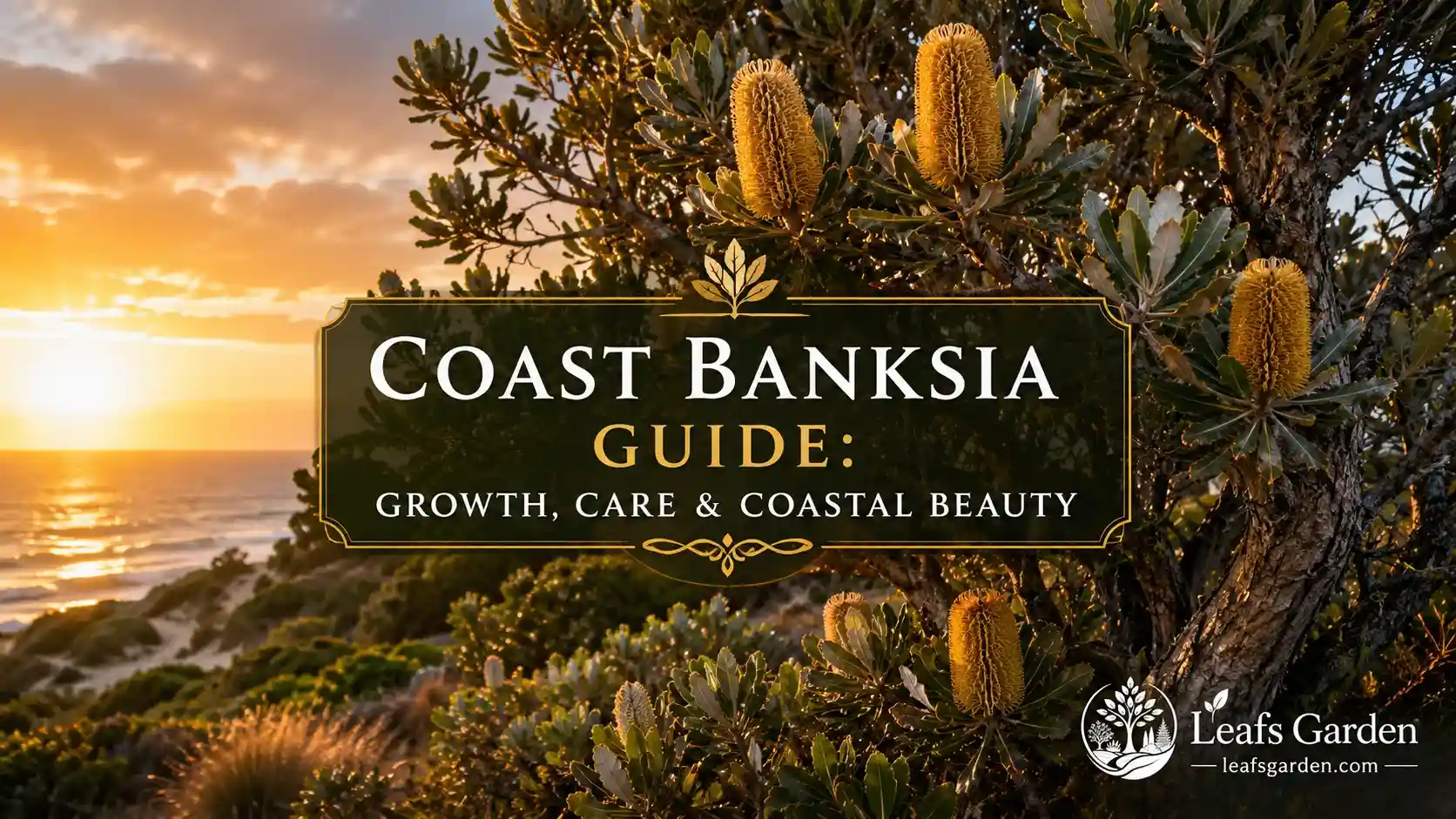
Coast banksia is a resilient Australian native tree admired for its striking yellow flower spikes, evergreen foliage, and exceptional ability to thrive in harsh coastal conditions. Scientifically known as Banksia integrifolia, this iconic coastal banksia species naturally grows along eastern Australia and remains one of the most reliable native trees for home landscapes.
The coast banksia tree is widely valued in banksia Australia gardens because it tolerates salty winds, sandy soils, drought, and exposed coastal environments better than many ornamental trees. Its attractive silver-backed leaves, woody seed cones, and nectar-rich flowers also make it highly beneficial for birds, bees, and native wildlife.
This native banksia can grow as a medium-sized tree, compact shrub, or dwarf landscaping form depending on the variety and growing conditions. Many gardeners choose banksia integrifolia for coastal screening, wildlife gardens, erosion control, and low-maintenance native landscaping because of its adaptability and year-round visual appeal.
Coast banksia is an evergreen Australian native tree species scientifically known as Banksia integrifolia. It is one of the most widely grown native banksia trees in Australia because of its strong coastal tolerance, hardy growth habit, and ornamental yellow flower spikes.
The botanical name of coast banksia is Banksia integrifolia. This species belongs to the Proteaceae family, a large group of flowering plants that includes many well-known Australian native species such as grevilleas, waratahs, and other banksia varieties.
Coast banksia is commonly known by several names, including:
Banksia integrifolia is naturally found along the eastern coastline of Australia. Its native distribution stretches across multiple regions, including:
In natural environments, coastal banksia commonly grows near beaches, sand dunes, rocky coastal cliffs, and open forests. Its ability to tolerate salt spray, sandy soils, and strong coastal winds makes it one of the most adaptable banksia Australia species for both natural ecosystems and residential landscapes.
Coast banksia has a distinctive evergreen appearance with leathery green leaves, golden flower spikes, and rugged textured bark that make it easy to identify in Australian coastal landscapes.
The foliage of Banksia integrifolia remains green throughout the year, giving the tree strong ornamental value in all seasons. One of its most recognizable features is the silver-white underside of the leaves, which becomes highly visible when coastal winds move through the canopy.
Banksia leaves are typically:
Young leaves often have slightly toothed edges, while mature leaves usually become smoother as the tree ages.
The flowers of coastal banksia appear as upright cylindrical spikes covered with hundreds of tiny nectar-rich blooms. These flower spikes are usually bright yellow, although some variations may appear pale cream over time. Flowering spikes attract birds, bees, butterflies, and other pollinators.
After flowering, the tree develops woody seed cones that remain attached to the branches for long periods. These rough cone structures contain seeds protected inside thick follicles, which are adapted to Australia’s fire-prone environments.
Mature coast banksia trees develop rugged grey-brown bark with a coarse and textured appearance. Older trunks often become deeply furrowed, adding visual character to the landscape.
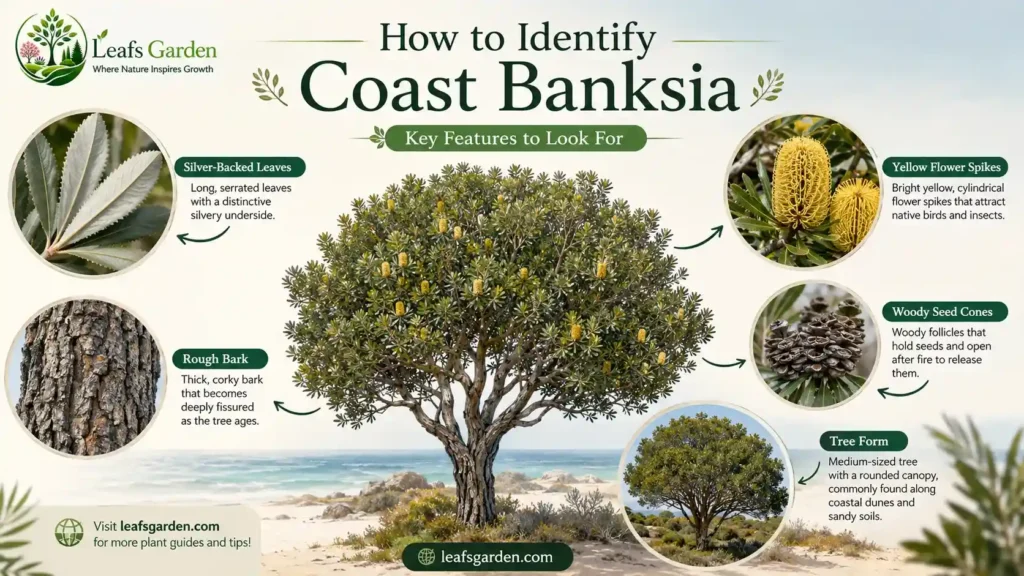
Coast banksia can grow as either a medium-sized tree or a dense shrub depending on the variety, climate, and growing conditions.
A typical coast banksia tree height ranges from around 4 to 16 metres tall, although some mature specimens can grow even larger in ideal coastal environments. The spread can vary between 3 and 8 metres, creating a broad rounded canopy over time.
Banksia integrifolia generally grows at a moderate to fast rate in coastal climates with full sun and well-draining soil. Young trees establish relatively quickly, especially in sandy soils near the coast.
Growth habit can vary significantly:
Because of this flexibility, native banksia varieties are widely used in coastal gardens, wildlife landscapes, and urban native plantings throughout Australia.
| Feature | Details |
| Scientific Name | Banksia integrifolia |
| Common Name | Coast Banksia |
| Plant Type | Evergreen native tree |
| Mature Height | Variable |
| Flower Color | Yellow |
| Native Region | Australia |
Different banksia types vary in size, flower shape, foliage color, and landscape use. Some grow into large coastal trees, while others remain compact shrubs or low-growing groundcovers suited to smaller gardens.
Banksia integrifolia is the most widely grown coastal banksia species in Australia. It is highly valued for its durability, evergreen foliage, and ability to tolerate difficult seaside conditions.
This native banksia naturally handles:
Because of its toughness and adaptability, coast banksia is considered one of the best trees for Australian coastal gardens, native landscapes, and erosion-prone environments. It is commonly planted as a feature tree, windbreak, wildlife habitat tree, or large screening plant.
The species can appear as a medium-sized tree, dense shrub, or naturally spreading coastal form depending on the growing environment.
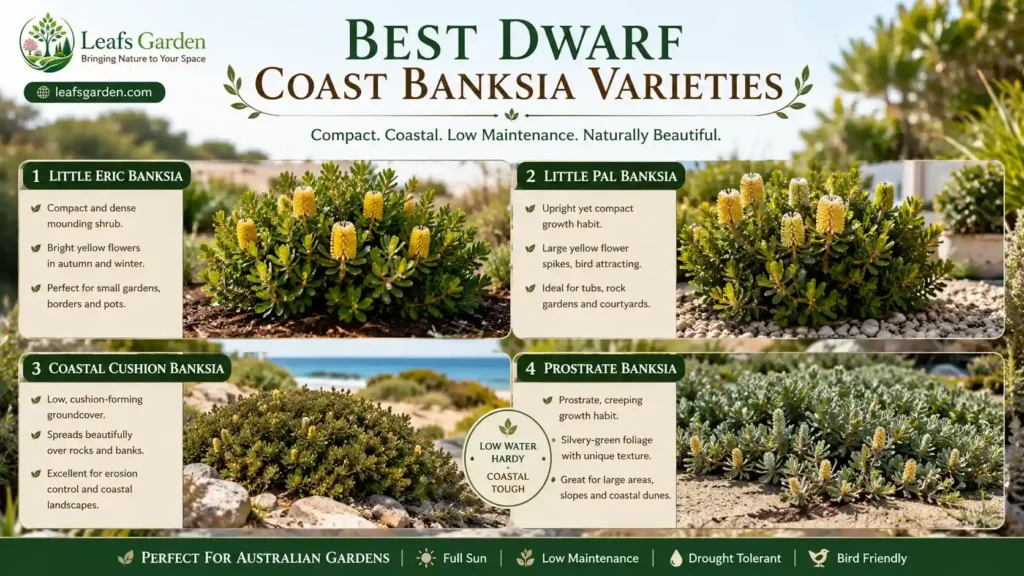
Dwarf coast banksia varieties are compact forms of Banksia integrifolia bred for smaller landscapes, containers, and low-maintenance native gardens.
These smaller selections provide the same attractive foliage and flower spikes as full-sized coastal banksia trees while remaining easier to manage in limited spaces.
Popular uses for dwarf banksia varieties include:
Common banksia integrifolia dwarf selections include:
Little Eric is a compact dwarf coastal banksia with dense foliage and bright yellow flower spikes. It performs well in coastal gardens and small urban landscapes where space is limited.
Little Pal is a low-growing native banksia variety known for its compact habit and attractive silvery foliage. It is commonly used for native borders and informal low hedges.
Coastal Cushion Banksia forms a dense spreading mound with strong wind tolerance and low-maintenance growth. Its compact shape makes it suitable for exposed coastal locations and erosion control.
Prostrate Banksia integrifolia is a groundcover form that spreads horizontally rather than growing upright. This dwarf coastal banksia is commonly planted on slopes, coastal dunes, and large landscape beds where low-growing native coverage is needed.
Prostrate banksias are low-growing banksia varieties that spread horizontally across the ground instead of developing into upright trees or tall shrubs.
The term “prostrate banksia” refers to banksia forms with a naturally spreading groundcover growth habit. These plants stay close to the soil surface while gradually expanding outward, making them highly useful for practical landscaping applications.
Most prostrate banksia varieties feature:
Prostrate forms of Banksia integrifolia are especially popular in coastal landscapes because they tolerate sandy soils, salt spray, and exposed conditions extremely well.
Best landscaping uses for prostrate banksias include:
Because of their spreading growth habit and low water needs, prostrate native banksia selections are commonly used in sustainable Australian landscaping projects.
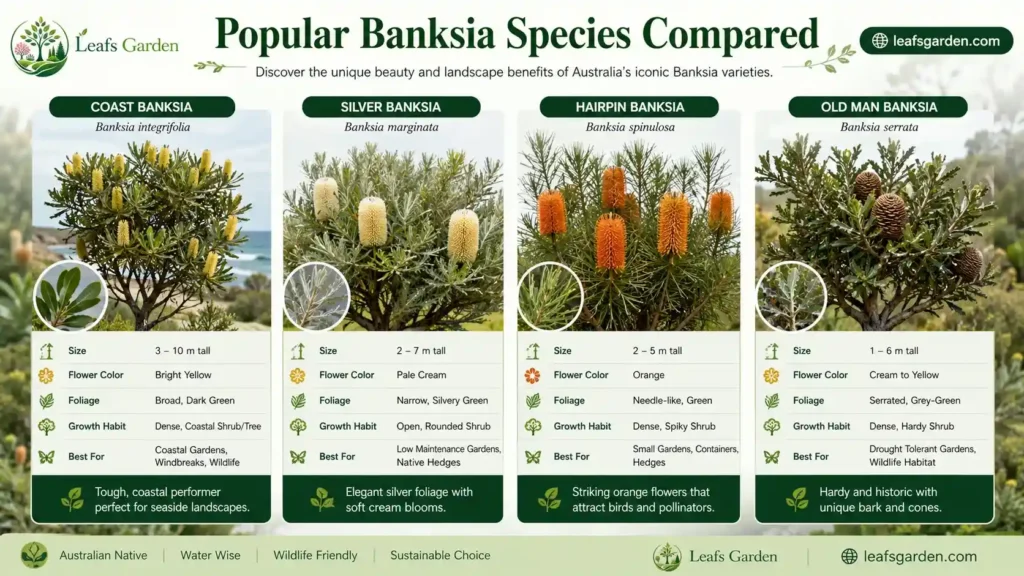
Different banksia species vary in mature size, flower color, climate preference, and landscaping function. Some are best suited for coastal gardens, while others perform better in wildlife habitats or compact residential spaces.
Banksia marginata, commonly called Silver Banksia, is a hardy species with pale yellow flowers and dense foliage. It is widely used as a windbreak and screening plant because of its adaptability and strong branching habit.
Banksia serrata, often known as Old Man Banksia, is a large rugged species recognized for its deeply serrated leaves, large woody cones, and grey-yellow flower spikes. It is highly valuable for wildlife habitat planting.
Banksia spinulosa, or Hairpin Banksia, is a compact species producing vibrant orange and gold flower spikes. Its smaller size makes it ideal for smaller gardens and decorative native landscaping.
Banksia ericifolia is admired for its bright orange flower spikes and fine needle-like foliage. It performs well in native gardens focused on bird attraction and pollinator support.
Banksia baueri is known for its unusually large woolly flower heads and ornamental appearance. Although less common in residential landscapes, it is highly valued by native plant collectors and specialty gardens.
| Species | Height | Flower Color | Best Use |
| Coast Banksia | Medium-Large | Yellow | Coastal gardens |
| Silver Banksia | Medium | Pale Yellow | Windbreaks |
| Hairpin Banksia | Small | Orange/Gold | Small gardens |
| Old Man Banksia | Large | Grey-Yellow | Wildlife habitat |
Coast banksia flowers attract birds and pollinators while the leaves help tolerate harsh coastal conditions. The combination of evergreen foliage, nectar-rich blooms, and woody seed structures makes Banksia integrifolia one of Australia’s most recognizable native plants.
Banksia flowers grow in dense cylindrical spikes made up of hundreds of tiny individual flowers packed closely together. These upright blooms are one of the defining features of the coast banksia tree.
The most common coast banksia flower color is soft yellow to golden yellow, creating the classic yellow banksia tree appearance seen across coastal Australia. Flower spikes can vary in size depending on the age and variety of the plant.
Banksia flowers color variations exist across different species, including:
Many ornamental banksia species are specifically grown for their dramatic flower colors and wildlife value.
Banksia flower spikes are highly attractive to:
The flowers also dry well and are commonly used in native floral arrangements.
Coast banksia typically flowers from late summer through winter, although flowering periods can vary depending on climate and local growing conditions.
Mature Banksia integrifolia trees often produce heavy flowering displays during cooler months when many other plants are less active. This makes the species especially valuable for winter nectar production.
The flowers produce abundant nectar that supports native wildlife throughout the flowering season. Pollinators commonly attracted to coastal banksia include:
Consistent flowering is usually strongest in full sun and well-drained soil conditions.
Banksia leaves are thick, leathery, and specially adapted for tough Australian coastal environments.
The foliage of coast banksia remains evergreen year-round, helping the tree maintain strong visual appeal and environmental resilience. Mature leaves are usually dark green on the upper surface with a distinctive silver or whitish underside.
Key foliage characteristics include:
The silver underside of the leaves helps reflect sunlight and reduce moisture loss during hot coastal conditions. This adaptation improves drought tolerance and protects the tree from harsh environmental exposure.
The dense foliage also provides shelter for birds and beneficial insects.
Banksia seed cones are woody structures that develop after flowering and remain attached to the branches for many years.
These rough-textured cones contain seed follicles that protect developing seeds until environmental conditions become suitable for release. In many banksia species, seed release is linked to heat and fire exposure.
This fire adaptation allows native banksia plants to regenerate naturally after bushfires. The cones open gradually when exposed to intense heat, releasing seeds onto nutrient-rich ground.
Banksia seedling growth stages typically include:
Young coast banksia seedlings require excellent drainage and sunlight to establish successfully. Once established, they become highly resilient coastal plants with strong drought and wind tolerance.
Coast banksia grows best in full sun with well-draining soil and low-maintenance care. Once established, Banksia integrifolia becomes highly resilient to drought, coastal winds, sandy soils, and challenging Australian conditions.
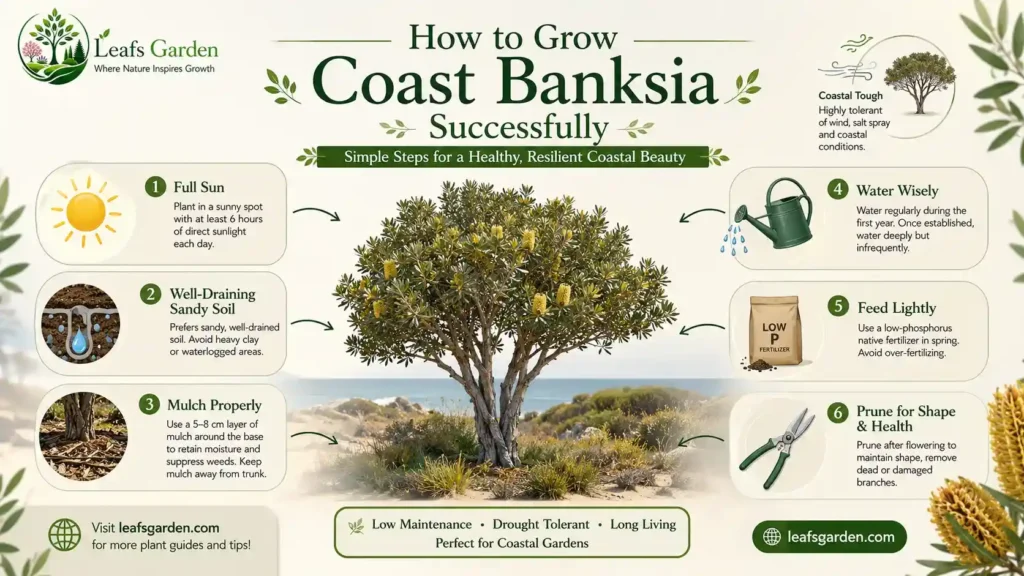
Coast banksia naturally thrives in Australian coastal climates with mild winters, sunny conditions, and good airflow.
Banksia integrifolia performs best in:
This native banksia has strong heat tolerance and handles intense summer sun extremely well once established. Mature trees also tolerate moderate frost, although young plants may require protection during severe cold events.
In USDA terms, coast banksia generally grows best in:
The species adapts particularly well to eastern Australian coastal regions where winters remain relatively mild and drainage stays consistent.
Coast banksia prefers sandy, free-draining soil with low nutrient levels.
Excellent drainage is one of the most important factors for healthy growth. Poor drainage can quickly lead to root stress and fungal diseases such as root rot.
Ideal soil conditions include:
Heavy clay soils should be improved before planting by increasing drainage and reducing water retention around the roots.
Banksia integrifolia is highly sensitive to excessive phosphorus. Standard garden fertilizers often contain phosphorus levels that can damage native banksia roots.
For best results:
This phosphorus sensitivity is common among many Australian native plants within the Proteaceae family.
Coast banksia grows best in full sun and develops stronger flowering, denser foliage, and healthier root systems with maximum sunlight exposure.
Ideal light conditions include:
Although coastal banksia becomes highly drought tolerant once mature, young trees require regular watering during the establishment stage.
Watering recommendations:
Overwatering is one of the most common causes of coast banksia problems, especially in poorly drained gardens.
Proper planting helps coast banksia establish faster and develop a stronger long-term root system.
Select a planting area with full sun exposure and good airflow. Avoid heavily shaded or waterlogged positions.
If soil drains poorly, improve it before planting using coarse sand or raised garden beds. Fast drainage is essential for healthy banksia roots.
Place the root ball at the same depth as it was growing in the nursery container. Avoid burying the trunk too deeply.
Apply mulch around the base to retain moisture and suppress weeds, but keep mulch away from direct contact with the trunk.
Water regularly during the first growing season while the roots establish. Reduce watering gradually once the plant becomes established and drought tolerant.
Established coast banksia trees require minimal maintenance compared to many ornamental trees. Once properly established, Banksia integrifolia generally needs only occasional pruning, careful fertilizing, and basic root protection to remain healthy and vigorous.
Coast banksia benefits from light pruning to maintain shape, encourage denser growth, and remove old flower spikes.
The best time to prune is usually after flowering finishes. Light seasonal pruning helps improve airflow and encourages compact healthy growth.
Young coast banksia trees can be shaped early to develop:
Avoid aggressive pruning into old bare wood because some banksia species recover slowly from severe cutting.
Dead flower spikes and damaged branches should be removed regularly to improve appearance and reduce unnecessary plant stress.
Basic pruning tasks include:
Coast banksia requires only small amounts of fertilizer because it naturally grows in low-nutrient Australian soils.
The safest option is a low-phosphorus native fertilizer specifically designed for Australian native plants. Excess phosphorus can damage sensitive roots and reduce overall plant health.
Important fertilizer guidelines include:
High-phosphorus fertilizers may cause root burn, leaf yellowing, and reduced growth in Banksia integrifolia and other Proteaceae species.
Slow-release native fertilizers are usually the safest long-term option.
Mulching helps coast banksia retain soil moisture, regulate root temperature, and reduce weed competition in coastal gardens.
A light organic mulch layer around the base of the tree provides several benefits:
In exposed coastal environments, mulch also helps reduce rapid soil drying caused by wind and intense sun.
For best results:
Healthy root protection is especially important during the establishment stage and prolonged dry weather.
Dwarf coast banksia varieties can grow successfully in large containers when provided with excellent drainage and proper native plant care.
Compact cultivars such as Little Eric and other dwarf banksia selections are commonly used for:
Container-grown banksia plants require:
The best potting mix recommendations include sandy, free-draining native plant mixes with low phosphorus content. Heavy moisture-retaining soils should be avoided because waterlogged roots can quickly lead to root problems.
Potted coast banksia plants may require more regular watering than garden-grown specimens, especially during hot weather, but the soil should still dry slightly between watering cycles.
Most coast banksia problems are caused by poor drainage, pests, or unsuitable soil conditions. Although Banksia integrifolia is generally hardy and low-maintenance, improper growing conditions can lead to leaf discoloration, reduced flowering, root disease, and pest activity.
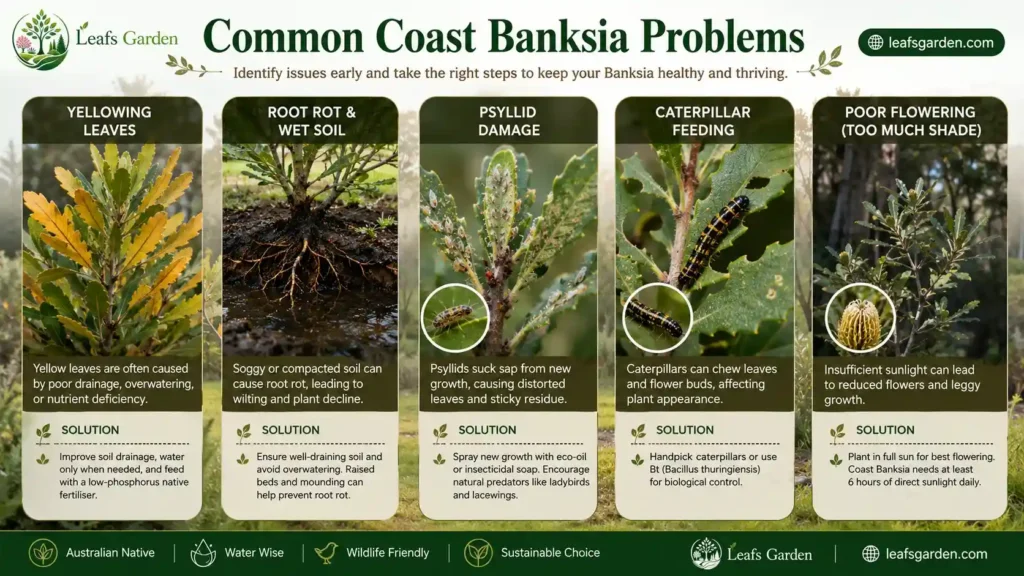
Yellow leaves on coast banksia are usually linked to nutrient imbalance, excessive moisture, or unsuitable soil conditions.
Common causes include:
Overwatering is one of the most frequent problems because native banksia roots prefer fast-draining conditions. Constantly wet soil can reduce oxygen around the roots and weaken the plant.
Soil pH issues may also affect nutrient absorption, especially in alkaline soils where important minerals become less available.
To correct yellowing foliage:
Healthy coast banksia foliage should remain deep green with silver undersides throughout most of the year.
Root rot is one of the most serious coast banksia problems and is commonly associated with poorly drained soil.
Banksia integrifolia can become vulnerable to Phytophthora, a destructive soil-borne fungal disease that attacks sensitive root systems in wet conditions.
Common symptoms of root rot include:
The risk increases significantly in waterlogged gardens or areas with heavy clay soil.
Preventing root rot involves:
Early drainage correction is critical because severe Phytophthora infections can permanently damage the tree.
Coast banksia occasionally experiences pest issues, especially when plants become stressed or weakened.
Psyllids are small sap-sucking insects that may cause distorted new growth and leaf damage. Mild infestations are usually manageable with healthy plant care and natural predators.
Caterpillars sometimes feed on banksia foliage and flower spikes. Minor chewing damage is usually not harmful, but heavy infestations may reduce plant vigor.
Scale insects attach to stems and leaves while feeding on plant sap. Severe infestations may lead to sticky residue, weakened growth, and leaf decline.
Healthy growing conditions usually help coast banksia resist serious pest problems naturally.
Coast banksia may stop flowering when environmental conditions or maintenance practices become unsuitable.
The most common causes include:
Banksia integrifolia flowers best in full sun conditions. Trees growing in shaded locations often develop reduced flowering and weaker growth.
Excess fertilizer, especially high-phosphorus products, may encourage foliage growth while suppressing flower production.
Incorrect pruning can also remove developing flower buds if branches are cut at the wrong time of year.
| Problem | Cause | Solution |
| Yellow leaves | Drainage issues | Improve soil |
| No flowers | Shade/pruning | More sunlight |
| Wilting | Root rot | Reduce watering |
Coast banksia is widely used in Australian landscaping because of its coastal toughness and wildlife value. Its adaptability, evergreen foliage, and nectar-rich flowers make Banksia integrifolia suitable for both practical and ornamental landscape designs.
For a complete comparison of evergreen and native landscape trees suited to Australian conditions, see our Evergreen, Shade & Landscape Trees guide.
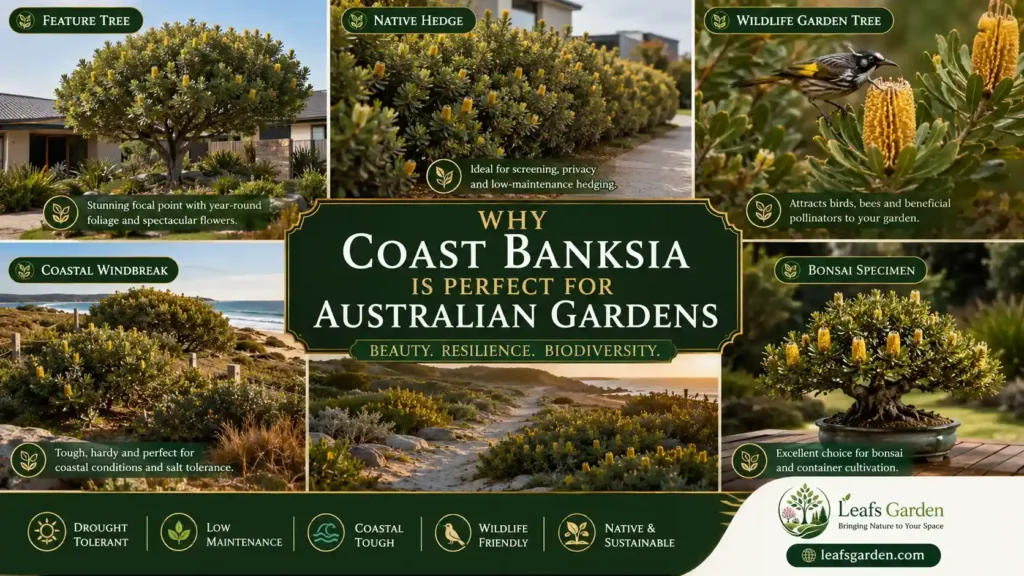
Coast banksia works well in a wide range of Australian garden styles, especially native and coastal landscapes.
Common landscaping uses include:
Large coast banksia trees create attractive feature specimens with textured bark, silver-backed foliage, and striking yellow flower spikes. Mature trees provide year-round structure and visual interest.
Dense-growing forms of native banksia can be planted as informal hedges or natural privacy screens. Their hardy foliage tolerates wind and coastal exposure extremely well.
Banksia integrifolia is highly valued in wildlife-friendly gardens because the flowers provide nectar for birds, bees, butterflies, and beneficial insects.
For large-scale native Australian landscaping, Coolibah Trees are another highly adaptable native species commonly planted alongside coast banksia in dry inland and arid environments.
The strong wind and salt tolerance of coastal banksia makes it highly effective for coastal screening and protection planting near beaches and exposed seaside properties.
For fast-growing evergreen screening in non-coastal gardens, Leighton Green Cypress is one of the most popular alternative screening trees used across Australian temperate landscapes.
Dwarf coast banksia varieties are ideal for smaller gardens where full-sized native trees may become too large.
Compact cultivars provide the same native character and flower display while remaining easier to manage in limited spaces.
Popular small-garden uses include:
Many dwarf banksia options maintain dense foliage and attractive flowering without requiring extensive pruning.
Compact cultivars commonly used in small landscapes include:
These smaller forms are especially useful in modern low-maintenance Australian landscapes.
Coast banksia can also be grown successfully as a bonsai when carefully pruned and maintained.
Banksia bonsai cultivation focuses on controlling root growth, encouraging compact branching, and maintaining miniature proportions while preserving the natural rugged appearance of the species.
Basic banksia bonsai care includes:
Dwarf and naturally compact coast banksia varieties are usually easier to manage as bonsai specimens.
Because Banksia integrifolia develops textured bark and attractive foliage over time, mature bonsai plants can become highly ornamental display specimens.
Coast banksia provides major ecological value in both natural ecosystems and residential landscapes.
The nectar-rich flowers attract a wide range of wildlife, including:
The dense foliage also creates shelter and nesting habitat for small birds and beneficial garden species.
Environmental benefits of coastal banksia include:
Its extensive root system helps stabilize sandy coastal soils, making the species valuable for erosion-prone environments and habitat rehabilitation projects across Australia.
Different banksia species suit different climates, garden sizes, and landscaping goals. While coast banksia is highly valued for coastal resilience and adaptability, other banksia varieties may offer different flower colors, growth habits, or garden uses.
Coast banksia and Silver Banksia are both hardy Australian native trees, but they differ in appearance and landscape function.
Coast banksia (Banksia integrifolia) is better suited to harsh coastal environments because of its exceptional salt and wind tolerance. It also develops larger canopies and stronger coastal adaptability.
Silver Banksia, commonly associated with Banksia marginata in landscaping discussions, typically has a denser growth habit and slightly paler flower spikes. It is often used as a windbreak or screening tree in inland native gardens.
Key differences include:
Old Man Banksia (Banksia serrata) is larger and more rugged in appearance than coast banksia.
Banksia serrata develops heavily serrated leaves, thicker woody cones, and deeply textured bark. It is commonly used in wildlife habitat restoration and larger natural landscapes.
Compared to Old Man Banksia, coast banksia typically offers:
Old Man Banksia is often chosen for larger properties and natural bushland-style landscapes.
Hairpin Banksia (Banksia spinulosa) is much smaller and more compact than coast banksia.
This species is especially popular in small gardens because of its bright orange and gold flower spikes and manageable size. Unlike the medium-to-large coast banksia tree, Hairpin Banksia works well in tight residential spaces and decorative borders.
Main differences include:
Hairpin Banksia is often preferred for ornamental native gardens with limited space.
Heath Banksia (Banksia ericifolia) is known for its fine needle-like foliage and vivid orange flower spikes.
Compared to coast banksia, Heath Banksia has a softer shrubby appearance and is commonly used in bird-attracting native gardens. It performs especially well in well-drained sandy soils and open sunny conditions.
Coast banksia generally provides:
Heath Banksia is often selected for colorful flowering displays and pollinator-focused gardens.
| Feature | Coast Banksia | Silver Banksia | Hairpin Banksia |
| Size | Medium-Large | Medium | Compact |
| Flowers | Yellow | Cream | Orange |
| Coastal Tolerance | Excellent | Moderate | Moderate |
Coast banksia is generally safe and environmentally beneficial in Australian landscapes. Banksia integrifolia is widely planted in residential gardens, coastal developments, and native restoration projects because of its ecological value, low toxicity risk, and adaptability to Australian conditions.
Coast banksia is generally considered non-toxic to pets and children when grown in home gardens.
The tree does not have a reputation for dangerous sap, poisonous foliage, or highly toxic seeds like some ornamental plant species. This makes native banksia a relatively safe choice for family-friendly landscapes.
Basic safe handling practices still include:
The woody seed cones and rough bark may feel sharp or abrasive, but the plant itself is not commonly associated with serious toxicity problems.
Coast banksia is naturally adapted to Australian fire-prone environments and plays an important role in native fire ecology.
Like many Australian native plants, Banksia integrifolia has evolved with bushfire conditions over thousands of years. Its woody seed cones are specially adapted to survive environmental stress and release seeds after fire events.
Important fire-related characteristics include:
Although coast banksia is more resilient than many non-native species, no plant should be considered completely fireproof. Proper landscape spacing and vegetation management remain important in bushfire-prone areas.
Coast banksia has major ecological value in Australian native ecosystems.
The species supports biodiversity by providing:
Banksia integrifolia is also widely used in habitat restoration and coastal rehabilitation projects because of its ability to establish in difficult environments.
Environmental benefits include:
Because of its adaptability and ecological importance, coast banksia remains one of the most valuable native landscape trees in Australia.
Coast banksia naturally grows along eastern Australian coastal regions and sandy environments. Banksia integrifolia is highly adapted to coastal exposure, salt spray, sandy soils, and wind-prone landscapes, making it one of the most widespread native banksia species on Australia’s east coast.
New South Wales is one of the primary natural habitats of coast banksia.
Throughout coastal NSW, Banksia integrifolia commonly grows in:
The species is especially common near Sydney and surrounding coastal regions where sandy soils and ocean exposure create ideal growing conditions.
In New South Wales landscapes, coast banksia often forms an important part of native coastal ecosystems by supporting birds, pollinators, and erosion control.
Coast banksia also grows naturally across many coastal areas of Queensland.
In Queensland, the species adapts well to:
Northern populations often develop slightly different growth forms because of warmer temperatures and varying environmental conditions.
Banksia integrifolia is widely planted throughout Queensland in:
Its drought tolerance and salt resistance make it highly reliable in coastal Queensland conditions.
Coast banksia is highly specialized for survival in coastal sand dune environments.
Several natural adaptations help the species thrive in unstable sandy soils, including:
These features allow coastal banksia to stabilize sand dunes and reduce erosion along exposed shorelines.
The thick leathery leaves and silver undersides also help reduce moisture loss in harsh coastal conditions where strong sun and drying winds are common.
Because of its dune-stabilizing ability, Banksia integrifolia is frequently used in coastal rehabilitation and environmental restoration programs across Australia.
Western Australia contains a very large diversity of banksia species, many of which differ significantly from east coast varieties such as coast banksia.
Western Australian banksias are often known for:
In comparison, east coast species like Banksia integrifolia are generally better adapted to:
While Western Australian banksias are highly ornamental, coast banksia remains one of the most practical and durable species for eastern Australian coastal landscapes and native garden projects.
Some coast banksia cultivars are better suited for compact gardens, hedges, or containers. Choosing the right Banksia integrifolia variety depends on available space, coastal exposure, wildlife goals, and overall landscape design.
Dwarf coast banksia varieties are ideal for small gardens, courtyards, and low-maintenance native landscapes.
These compact forms provide the same attractive foliage and flower spikes as larger coast banksia trees while remaining easier to manage.
Popular dwarf coast banksia types include:
These smaller cultivars are commonly used for:
Most dwarf banksia selections maintain dense evergreen foliage and strong coastal tolerance.
Coast banksia is considered one of the best banksia species for strong coastal wind exposure.
Banksia integrifolia naturally tolerates:
Its thick leathery leaves and flexible branching structure help reduce environmental stress in harsh seaside locations.
For highly exposed coastal gardens, the best options usually include:
These varieties are commonly planted as windbreaks, coastal screens, and erosion-control plantings.
Banksias are among the best Australian native plants for attracting birds and pollinators.
Coast banksia is especially valuable in wildlife gardens because its nectar-rich flowers support:
The dense evergreen canopy also provides shelter and nesting habitat for small birds.
Banksia varieties commonly used in wildlife-focused gardens include:
Combining several banksia species can help extend flowering periods and increase biodiversity in native landscapes.
Some banksia species establish and grow faster than others, particularly in sunny coastal environments.
Coast banksia is considered one of the faster-growing native banksia trees when planted in:
Fast-growing banksia varieties commonly include:
Growth speed depends heavily on drainage, climate, sunlight, and soil quality. Young plants usually establish fastest when protected from waterlogging and excessive fertilizer.
Fast-growing banksia varieties are commonly used for:
Coast banksia is one of Australia’s most versatile native trees thanks to its durability, wildlife value, and attractive flowers. Banksia integrifolia is widely used in coastal landscapes because it tolerates wind, salt spray, sandy soil, and drought while still providing year-round ornamental appeal.
Its evergreen foliage, yellow flower spikes, and strong environmental adaptability make coastal banksia suitable for home gardens, wildlife landscapes, erosion control projects, and native coastal planting schemes across Australia.
Coast banksia combines ornamental beauty, ecological value, and coastal toughness in one adaptable Australian native tree. Banksia integrifolia remains one of the most reliable choices for Australian landscapes because it tolerates harsh coastal conditions while still providing attractive foliage, striking flower spikes, and valuable wildlife habitat.
This native banksia performs best in full sun, sandy or well-draining soil, and open coastal environments where its natural drought and salt tolerance can fully develop. It is especially well suited for:
From large feature trees to compact dwarf cultivars and prostrate groundcover forms, coast banksia offers flexible landscaping options for gardens of almost every size.
Its ability to attract birds and pollinators, stabilize coastal soils, and thrive in difficult conditions is one of the main reasons it continues to rank among the best native landscape trees in Australia.
For the best long-term results, choose a coast banksia variety that matches your available space, climate conditions, and landscaping goals. Compact dwarf selections work well for small gardens and containers, while larger forms are ideal for coastal screening, habitat planting, and feature tree use.
A coast banksia tree typically grows between 4 and 16 metres tall depending on the variety, climate, and growing conditions. Dwarf cultivars remain much smaller and are better suited for compact gardens and containers.
Yes, Banksia integrifolia is generally considered a moderate to fast-growing Australian native tree, especially in coastal climates with full sun and well-draining sandy soil.
Popular dwarf coast banksia varieties include Little Eric Banksia, Little Pal Banksia, and Coastal Cushion Banksia. These compact forms are ideal for small gardens, low hedges, and container growing.
Yes, coast banksia can grow successfully in pots when planted in a large container with free-draining native potting mix. Dwarf banksia varieties usually perform best in containers.
Coast banksia roots are not generally considered highly invasive. However, mature trees can develop broad root systems, so adequate planting distance from structures and paving is still recommended.
Coast banksia usually flowers from late summer through winter, although flowering times may vary depending on climate and local growing conditions.
Yes, coast banksia is one of the best native trees for coastal gardens because it tolerates salt spray, strong winds, sandy soil, and drought conditions extremely well.
Coast banksia typically grows larger and has stronger coastal tolerance, while Silver Banksia is often denser and commonly used for screening and windbreak planting.
Prune coast banksia lightly after flowering to maintain shape, remove dead flower spikes, and encourage denser growth. Avoid cutting heavily into old bare wood.
Banksia leaves usually turn yellow because of poor drainage, overwatering, nutrient imbalance, or unsuitable soil conditions. Improving drainage and reducing excessive watering often helps restore healthy foliage.