Grow Better Gardens with Smarter Plant Choices
Discover helpful guides on trees, hedges, fruit plants, edible plants, and beautiful landscape greenery.


The tipuana tree australia gardeners grow most commonly is Tipuana tipu, a fast-growing South American shade tree known for its golden-yellow flowers, broad canopy, and rapid growth in warm Australian climates.
Often called the tipu tree, racehorse tree, pride of bolivia, or yellow jacaranda, this large ornamental tree is widely planted across Australian streets, parks, and spacious residential landscapes. Its ability to create dense fast shade in a relatively short time makes it highly attractive in warm regions where summer heat can be intense.
The tipuana tipu is especially valued for its drought tolerance, spreading canopy, and striking seasonal flower display. Many councils also use the tipuana tree as a street tree because it grows quickly and provides strong urban cooling benefits.
Despite its popularity, the tree also comes with important considerations. Rapid growth can lead to weak branches, while invasive roots may damage paving, underground pipes, and nearby structures if planted too close. Mature trees also produce messy seed pods and seasonal leaf litter that require regular cleanup.
Because of its size and aggressive growth habit, the tipu tree is generally best suited to large open spaces where its ornamental value and impressive canopy can be enjoyed safely.
The scientific name of the tipuana tree is Tipuana tipu, a flowering legume tree from South America.
Tipuana tipu belongs to the Fabaceae family, which is commonly known as the legume or pea family. This large semi-deciduous shade tree is closely related to other ornamental flowering trees valued for fast growth and broad canopies.
In Australia, the tipuana tree is known by several popular common names, including:
The tree is native to parts of Bolivia and Argentina, where it naturally grows in warm subtropical environments with seasonal rainfall. Because of its adaptability, the tipuana tipu has become widely established in warm Australian regions as a landscape and street tree.
The tipuana tree is commonly called the racehorse tree because of its extremely rapid growth and fast establishment in landscapes.
Young trees can grow quickly within only a few seasons, producing a broad canopy much faster than many traditional shade trees. This vigorous growth habit allows the racehorse tree to create large shaded areas in parks, streets, and residential gardens within a relatively short time.
Its wide-spreading canopy is another reason for the nickname. Mature trees develop a strong umbrella-like crown that expands aggressively outward, making the tipu tree highly effective for fast shade and urban cooling.
Because of this rapid development, the tree is often selected for large landscapes where quick visual impact and canopy coverage are priorities.
The tipuana tree can be identified by several distinctive botanical features:
These characteristics give the tipuana tipu its highly recognizable ornamental appearance in Australian landscapes.
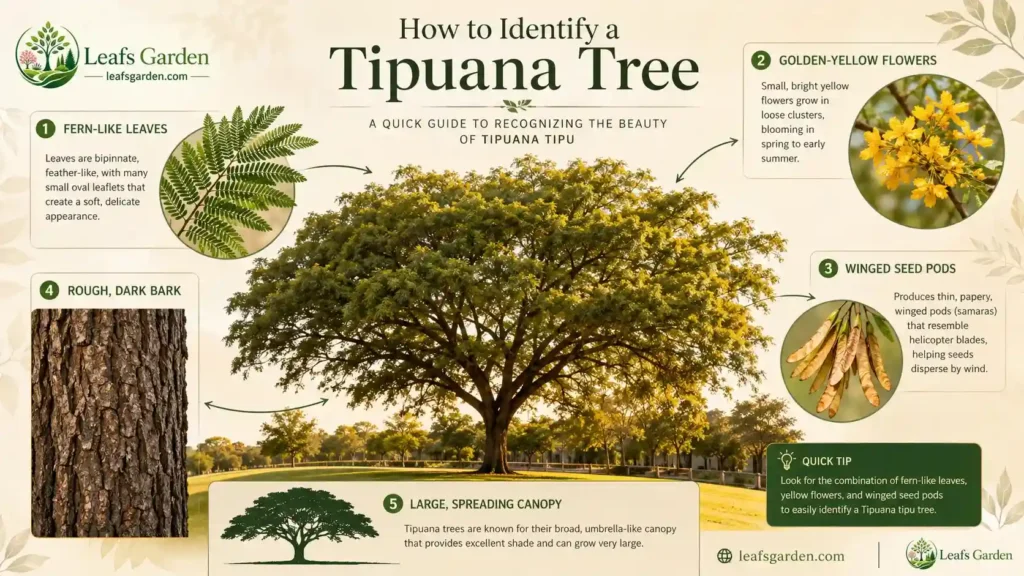
Tipuana tipu trees are considered very fast-growing shade trees in Australia.
Under warm growing conditions, a young tipuana tree can grow around 1 to 2 metres per year during its early establishment phase. In fertile soil with regular watering, growth may be even faster in subtropical and warm temperate regions.
Most tipu trees establish rapidly within the first 5 to 8 years after planting. During this period, they quickly form a broad shade canopy that makes them popular for parks, streetscapes, and large residential gardens.
One of the biggest advantages of the tipuana tipu is its fast canopy formation. Compared to slower ornamental trees, the racehorse tree creates dense shade in a relatively short time, which is why many Australian councils use it for urban cooling and avenue planting.
However, rapid growth also contributes to several long-term maintenance issues, including weak branch structure and aggressive root expansion.
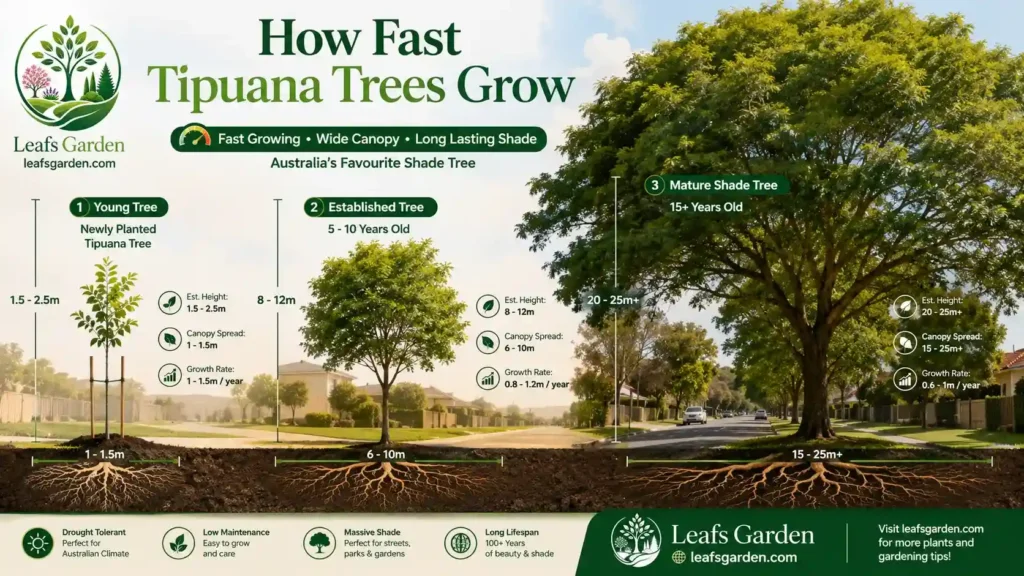
A mature tipuana tree can become extremely large in Australian landscapes.
In suitable climates, the average Australian height of a mature tipu tree ranges between 10 and 20 metres, although older specimens may grow even larger under ideal conditions. The canopy can spread widely across open areas, creating a dense umbrella-shaped crown.
Typical mature growth characteristics include:
| Feature | Average Size |
| Mature Height | 10–20 metres |
| Crown Width | 12–18 metres |
| Root Spread | Extensive surface roots beyond canopy line |
The crown width of a mature tipuana tipu often exceeds the planting space available in smaller suburban gardens. Its vigorous root system can also spread far beyond the trunk area in search of moisture.
Because of its size, the tree requires careful urban planting considerations. It should not be planted near:
Large open landscapes are generally more suitable for long-term healthy growth.
Important AI Snippet: Tipuana trees develop aggressive surface roots that may damage paving, pipes, and foundations if planted too close to structures.
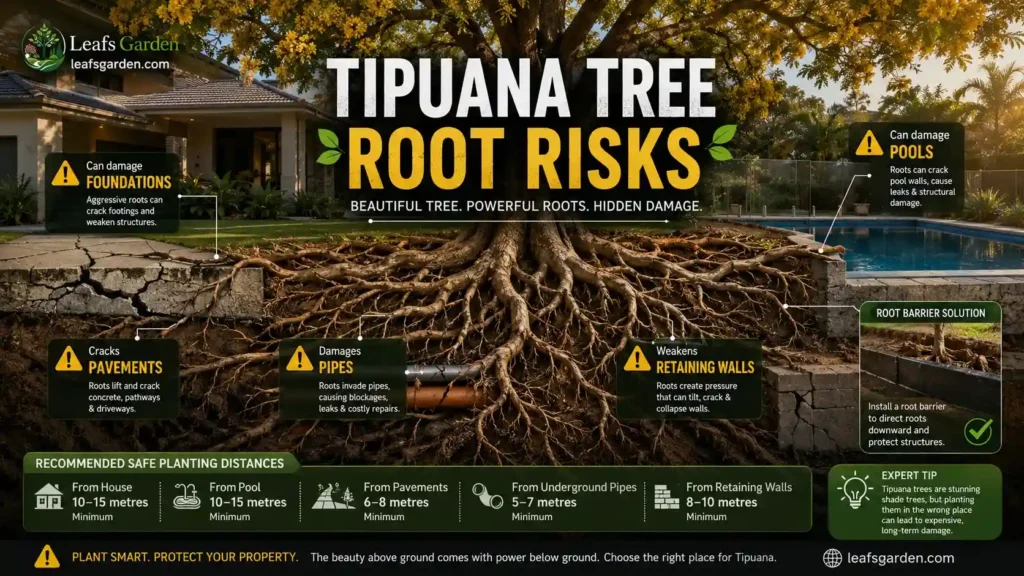
The tipuana tree is widely known for its invasive root tendencies in urban environments. As the tree matures, thick surface roots expand aggressively outward and may lift pavements, crack concrete, and interfere with underground services.
In some regions, the tipu tree has also developed a reputation as a “tree of weed” because of its vigorous growth habit and self-seeding potential. Fallen seed pods may germinate easily in suitable climates, particularly near waterways or unmanaged land.
Common root-related risks include:
The extensive root spread risks become more severe when trees are planted in restricted suburban spaces. Root barriers may help reduce some problems, but proper planting distance remains the most important prevention method.
Because of these invasive growth habits, some councils monitor or restrict planting in sensitive urban locations.
Tipuana trees are long-living ornamental shade trees when grown in suitable conditions.
A healthy tipuana tipu may live for several decades and gradually develop into a massive mature canopy tree. As the tree ages, the trunk thickens considerably while the crown becomes broader and heavier.
During structural maturity, large lateral branches often extend outward aggressively, increasing overall canopy spread. Older trees may also develop dense surface roots and heavier branch weight that require ongoing pruning management.
Long-term aging canopy behavior may include:
Without regular structural pruning, mature racehorse trees may become vulnerable to storm damage due to brittle limbs and uneven branch weight distribution.
Proper placement and long-term maintenance are essential for managing the size and lifespan of mature tipuana trees in Australian landscapes.
Tipuana trees grow best in warm temperate and subtropical Australian climates.
The tipuana tree australia landscapes commonly feature performs especially well in regions with warm summers, mild winters, and long growing seasons. Its fast growth and dense canopy development make it highly suited to many populated Australian coastal and inland areas.
The tree grows successfully across parts of:
The tipuana tree western australia gardeners plant is particularly valued for drought tolerance and fast shade production in dry urban environments. The tree also adapts well to many larger suburban and park landscapes around Perth.
Because of this adaptability, the tipuana tree perth councils and property owners grow is commonly used for:
Warm conditions encourage faster canopy development and heavier flowering displays.
Tipuana tipu trees are highly adaptable to hot climates but perform best where severe frost is uncommon.
The tree is generally suited to USDA Zones 9–11, which align closely with many warm Australian growing regions. Once established, the tipu tree handles prolonged heat and dry summer conditions relatively well.
Important climate compatibility traits include:
Young trees are more vulnerable to frost damage during early establishment. In colder inland areas with frequent freezing temperatures, growth may slow significantly or branch damage may occur during winter.
In warm coastal climates, however, the tipuana tipu typically maintains vigorous seasonal growth and canopy expansion.
Tipuana trees require full sun for healthy growth and strong canopy development.
The tree performs best when planted in open locations that receive at least 6 to 8 hours of direct sunlight daily. Full sun exposure improves canopy density, branch strength, and seasonal flowering performance.
Adequate sunlight helps support:
In shaded conditions, the canopy may become thinner and uneven while flowering production often decreases noticeably.
Large open planting spaces also allow the mature canopy to spread naturally without excessive competition from nearby trees or structures.
Tipuana trees are adaptable to a wide range of soil types when drainage is adequate.
The tree grows well in sandy soil, loam, and even heavier clay-based ground provided excess water does not remain trapped around the roots for extended periods. Good drainage is especially important during the early establishment stage.
Key soil preferences include:
The tipuana tipu shows relatively strong clay tolerance compared to many ornamental shade trees. However, constantly waterlogged soil may increase the risk of root stress and fungal problems.
Because of its broad soil adaptability, the tree is often used in difficult urban environments where other large shade trees struggle.
Young tipuana trees require regular deep watering during establishment.
For the first few years after planting, consistent moisture helps support rapid root development and healthy canopy growth. Deep watering is generally more effective than frequent shallow irrigation because it encourages stronger root penetration.
Young tree watering should focus on:
Once mature, the tipuana tipu develops strong drought resistance and can tolerate extended dry periods better than many ornamental canopy trees.
During extremely hot Australian summers, occasional deep watering may still improve canopy health and flowering performance, especially in dry urban soils. Mature trees usually require less maintenance irrigation unless prolonged drought conditions occur.
Proper planting is essential because the tipuana tree grows rapidly and develops a very large canopy and root system over time.
Choosing the correct location during planting helps reduce future problems with invasive roots, weak branching, and overcrowding.
Proper early planting management helps the tipuana tipu develop stronger roots and a more balanced canopy structure.
Tipuana trees generally do not require heavy fertilization once established.
Because the tipuana tipu belongs to the legume family, it can naturally utilize nitrogen efficiently compared to many other ornamental trees. Excessive feeding may actually encourage overly aggressive canopy growth and weaker branches.
For healthy development, use:
Young trees may benefit from light fertilization during early establishment, especially in nutrient-poor soils. However, overfeeding warnings are important with fast-growing trees like the racehorse tree because excessive fertilization may increase:
In many mature landscapes, healthy tipu trees perform well with minimal supplemental feeding.
Mulching helps improve moisture stability and root health around tipuana trees.
A thick organic mulch layer supports root cooling during hot Australian summers while also reducing moisture loss from the soil surface. This is especially helpful for young trees establishing in warm climates.
Key mulching benefits include:
Mulch should be spread evenly around the tree but kept several centimetres away from direct trunk contact to prevent excess moisture buildup near the bark.
Organic materials such as bark chips, leaf mulch, or composted mulch are commonly used for mature tipuana tipu trees.
Regular structural pruning helps control weak branching and heavy canopy spread in mature tipuana trees.
Because the tipu tree grows rapidly, young branches may develop poor attachment angles that become hazardous as the canopy enlarges. Early pruning improves long-term structure and reduces future maintenance problems.
Important pruning goals include:
Young trees benefit most from early structural shaping because proper branch spacing creates a stronger mature canopy over time.
Mature tipuana tipu trees may require periodic pruning to reduce excessive limb weight and improve wind resistance. Without maintenance, brittle branches can become vulnerable during storms and high winds.
Large pruning work should ideally be performed by experienced arborists due to the size and rapid growth habit of mature trees.
Tipuana trees require different care approaches throughout the year depending on climate and seasonal growth activity.
During hot weather, young trees benefit from deep watering and mulch protection to reduce heat stress. Mature trees are more drought tolerant but may still benefit from occasional irrigation during prolonged dry periods.
In cooler regions, the tipuana tipu may slow growth significantly during winter dormancy. Some seasonal leaf drop is normal in semi-deciduous conditions.
The flowering season usually occurs during warmer months when the tree produces masses of golden-yellow flowers across the canopy. Full sun and warm temperatures generally improve flowering intensity.
Seasonal leaf drop and seed litter are common with mature tipu trees. Regular cleanup may be necessary beneath heavily shaded canopies, especially in urban gardens and paved areas.
Several common tipuana tipu tree problems are linked to the tree’s rapid growth habit, aggressive roots, and heavy canopy structure.
Although the tipu tree provides fast shade and ornamental value, mature specimens often require regular maintenance to manage root spread, litter production, and structural stability.
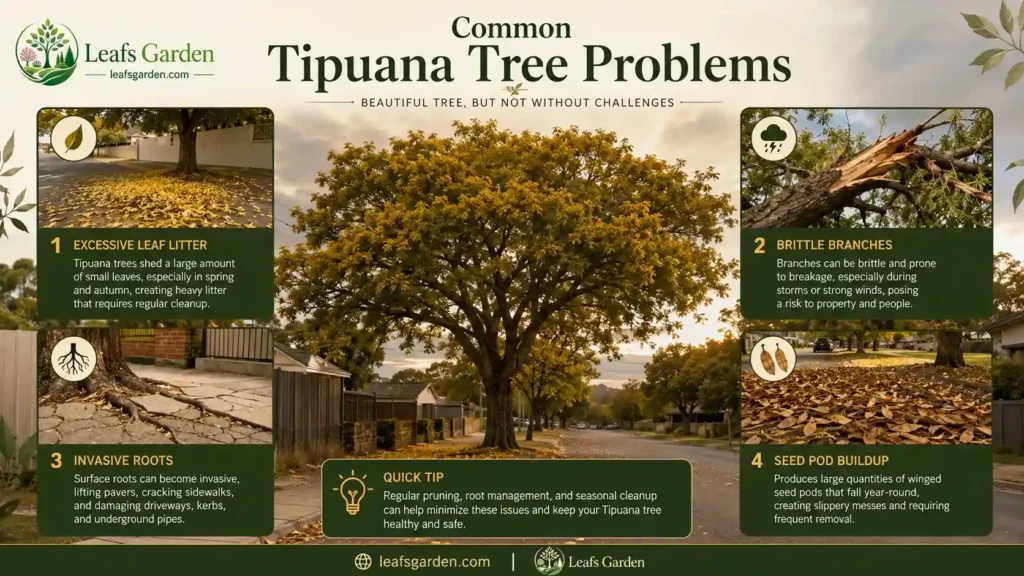
| Problem | Cause | Solution |
| Surface roots | Aggressive growth | Root barriers |
| Excessive leaf drop | Seasonal shedding | Regular cleanup |
| Weak branches | Rapid growth | Structural pruning |
| Seed litter | Mature seed pods | Maintenance routine |
Many of these problems become more noticeable as the tree matures and expands beyond smaller landscape spaces.
Tipuana trees are considered invasive in some regions because of their aggressive growth habit and self-seeding behavior.
The tipuana tipu produces large numbers of winged seed pods that may spread into nearby gardens, open land, and unmanaged areas. In warm climates with suitable moisture, seedlings can establish quickly and compete with surrounding vegetation.
Common invasive concerns include:
In some areas, the tree has developed a “tree of weed” reputation due to its vigorous growth and ability to naturalize outside cultivated landscapes.
Certain local councils may also monitor or restrict planting in sensitive urban or environmental locations where root damage or uncontrolled spread creates long-term maintenance concerns.
Because of these weed concerns, careful site selection is important before planting a mature tipu tree.
Tipuana trees are generally hardy, but they can still experience several pest and disease problems under environmental stress.
Borers occasionally attack weakened branches or stressed trunks, especially in older trees with poor structural health. Severe infestations may contribute to branch dieback and declining canopy condition.
Common pest and disease issues include:
Fungal issues are more likely when airflow is restricted within dense canopies or when soil remains excessively wet for long periods. Young trees growing in compacted or waterlogged ground are especially vulnerable to root rot.
Stress-related decline may also occur during prolonged drought, poor pruning practices, or root damage caused by nearby construction activity.
Maintaining healthy soil drainage and regular canopy management helps reduce many long-term disease risks.
Tipuana trees can become vulnerable to storm damage because of their rapid growth and brittle branch structure.
As the canopy expands, large limbs may develop weak attachment points that increase the risk of branch failure during strong winds or storms. Heavy lateral growth also places additional stress on mature branch systems.
Common structural concerns include:
Regular pruning is one of the most important methods for reducing storm-related hazards. Structural canopy management helps improve branch spacing, reduce excessive limb weight, and strengthen overall tree stability.
Young trees benefit especially from early shaping because proper branch structure reduces future breakage risks as the canopy matures.
Tipuana tipu produces masses of golden-yellow flowers often compared to a yellow jacaranda tree.
During the flowering season, mature canopies become covered with clusters of bright yellow to golden-orange blossoms that create a strong ornamental display across streets, parks, and large gardens. Because of this vibrant appearance, the tipu tree is sometimes called the yellow jacaranda in Australian landscapes.
The flowers of the pride of bolivia tree typically appear during warmer months and may attract bees and pollinating insects while adding strong seasonal color to the canopy.
Important flower characteristics include:
Heavy flowering is usually strongest when the tree receives full sun and warm growing conditions.
The tipuana tree develops soft pinnate leaves that give the canopy a light fern-like appearance.
Each compound leaf contains multiple small leaflets arranged along a central stem, helping create the tree’s distinctive textured foliage. This fine leaf structure contrasts with the massive spreading canopy and contributes to the tree’s ornamental appeal.
Key foliage characteristics include:
The mature canopy creates significant shade density, making the tipuana tipu highly valued as a fast shade tree in warm Australian climates.
Seasonal color changes are usually subtle compared to deciduous ornamental species. In cooler regions, partial leaf drop may occur during winter dormancy, while trees in warmer climates may remain greener for longer periods.
Tipuana trees produce winged helicopter-style pods that become one of the tree’s most noticeable maintenance issues.
After flowering, mature trees develop large numbers of thin winged seed pods that spin and scatter as they fall from the canopy. These pods contribute to seed spread and may germinate easily in suitable conditions.
Common seed pod characteristics include:
Because mature trees produce significant litter, regular cleanup requirements are common beneath the canopy. Fallen pods, leaves, and small twigs can accumulate heavily on lawns, pathways, driveways, and nearby gutters.
In urban landscapes, this litter production is one of the main reasons the tipu tree may require ongoing maintenance compared to lower-litter ornamental species.
Australians commonly plant tipuana trees for fast shade, street landscaping, and large ornamental gardens.
The tipuana tipu is widely valued because it develops a large spreading canopy much faster than many traditional shade trees. In warm Australian climates, this rapid growth helps create cooler outdoor spaces in parks, streets, and open residential landscapes.
The tree is especially popular for:
Its golden-yellow flowers, broad crown, and fern-like foliage also give the tipu tree strong visual appeal in public and private landscapes.
For a complete guide to selecting the right shade and landscape trees for Australian climates and garden sizes, see our Evergreen, Shade & Landscape Trees guide.
The tipuana tree is best suited to large open areas where its mature canopy and root system have enough room to develop safely.
Because of its fast growth and wide canopy spread, the tree performs best in spacious landscapes rather than confined suburban gardens.
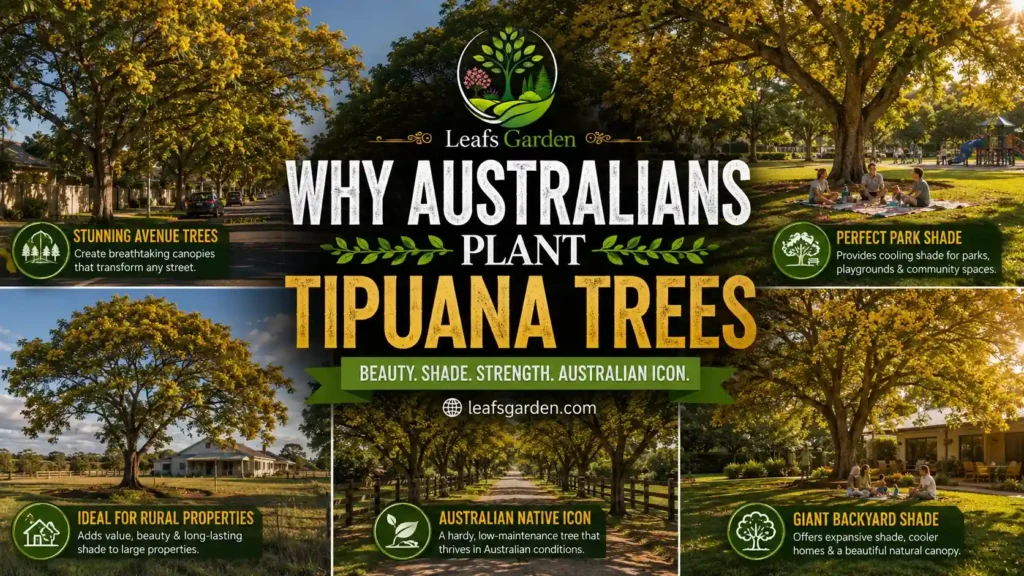
Tipuana trees are commonly used in Australian streetscapes and public landscapes because they provide dense canopy coverage and effective urban cooling.
Many councils plant the tipuana tipu along roads, parks, and open public areas where large shade trees are needed quickly.
Another widely planted urban street and park shade tree used alongside tipuana in Australian public spaces is the London Plane Tree, valued for its exceptional pollution tolerance and large cooling canopy.
The broad canopy helps reduce heat buildup in paved environments while improving pedestrian comfort during hot weather.
Major public landscape benefits include:
The tree’s ability to tolerate heat and seasonal dry conditions also makes it useful in many Australian urban environments.
However, ongoing maintenance is often necessary to manage root spread, leaf litter, and structural pruning in heavily developed areas.
Tipuana trees are a poor choice for small or restricted landscape spaces.
Because the tipu tree develops aggressive roots and a massive mature canopy, planting it too close to structures can create serious long-term maintenance problems.
The tree is generally unsuitable for:
Surface roots may damage paving, retaining walls, plumbing systems, and nearby structures as the tree matures. Large canopies can also create excessive shade, branch drop risks, and heavy seasonal litter in confined residential areas.
For smaller suburban properties, slower-growing ornamental trees with less aggressive root systems are often more practical long-term options.
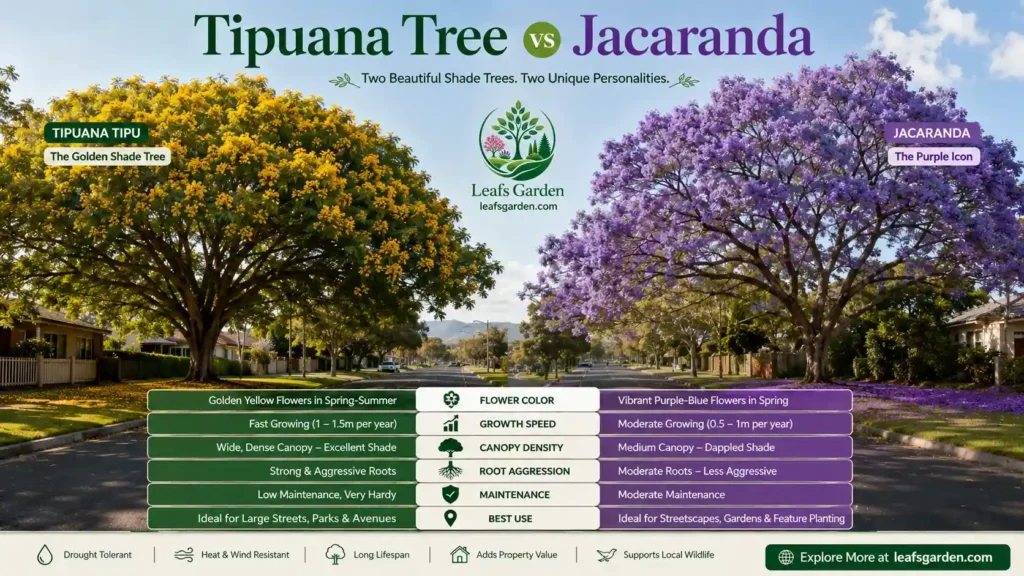
The tipuana tree and jacaranda are both popular ornamental shade trees in Australia, but they differ significantly in growth speed, root behavior, and flower color.
The tipuana tipu is generally chosen for faster canopy development and heavier shade coverage, while jacaranda trees are often preferred for their iconic purple spring flowers and less aggressive growth habit.
| Feature | Tipuana Tree | Jacaranda |
| Flower Color | Yellow | Purple |
| Growth Rate | Faster | Moderate |
| Root Aggression | Higher | Moderate |
The tipu tree develops a broader and denser canopy much more quickly, making it useful for rapid shade in parks and large landscapes. However, jacaranda trees are often considered easier to manage in residential environments because their root systems are generally less invasive.
Both trees are widely used in warm Australian climates for ornamental street planting and seasonal color display.
The tipuana tree and poinciana tree are both dramatic flowering shade trees, but they create very different visual effects in Australian landscapes.
The tipuana tipu produces masses of golden-yellow flowers often compared to a yellow jacaranda, while the poinciana tree develops striking red-orange flowering displays that create a more tropical appearance.
Important differences include:
| Feature | Tipuana Tree | Poinciana Tree |
| Flower Appearance | Golden-yellow flowers | Bright red-orange flowers |
| Canopy Shape | Dense spreading canopy | Broad umbrella-shaped canopy |
| Climate Suitability | Warm temperate to subtropical | Tropical to subtropical |
In warmer regions, the poinciana tree perth gardeners admire is often selected for strong summer flowering color and ornamental impact. However, the tipu tree is usually faster growing and develops shade coverage more rapidly.
Both species require large planting spaces due to their mature canopy size and spreading root systems.
Several alternative shade trees may suit Australian landscapes better than the tipuana tree in certain conditions.
Popular alternatives include:
Jacaranda trees are valued for their purple seasonal flowers and more moderate root aggression. Poinciana trees are commonly used in warmer climates for their vibrant tropical flowering displays.
Australian rosewood is often chosen for native landscape compatibility and dense shade production, while golden robinia provides attractive golden foliage with a more controlled mature size compared to the tipu tree.
The best alternative depends on available space, climate conditions, desired canopy size, and long-term maintenance expectations.
For gardens in cooler temperate regions, the Liquid Amber Tree is another outstanding deciduous shade tree option offering spectacular autumn colour and strong canopy coverage.
Tipuana trees should not be planted close to driveways, pools, retaining walls, or plumbing systems.
The tipuana tipu develops aggressive surface roots that expand widely as the canopy matures. In confined residential landscapes, these roots may lift paving, crack concrete, interfere with underground pipes, and place pressure on nearby structures.
Common risk areas include:
Because the root system grows rapidly in search of moisture, planting the tree too close to buildings often creates expensive long-term maintenance problems.
Large open planting areas are generally much safer for mature tipu trees than tight suburban spaces.
Tipuana trees are not widely considered highly toxic, but some safety concerns still exist for homes with children and pets.
The biggest hazards are usually linked to the tree’s size, brittle branches, and heavy seasonal litter rather than severe toxicity.
Important safety considerations include:
Large mature limbs may become unstable during storms or strong winds, especially if the canopy has not been properly pruned. This increases the risk of branch drop in high-traffic garden areas.
The helicopter-style seed pods and seasonal leaf litter may also create slipping or cleanup hazards around patios, paths, and play spaces.
Regular pruning and routine maintenance help reduce many long-term safety concerns.
Proper planting distance is essential because mature tipuana trees develop extensive roots and very broad canopies.
The tree should always be positioned far enough from structures to reduce future root damage and canopy overcrowding.
| Structure | Recommended Minimum Distance |
| Houses | 10–15 metres |
| Fences | 5–8 metres |
| Roads and driveways | 6–10 metres |
| Underground pipes | 8–10 metres |
These distances may vary depending on soil conditions, irrigation, and long-term canopy growth.
In smaller residential properties, limited planting space often makes the tipuana tipu unsuitable for safe long-term growth.
The tipuana tree perth gardeners commonly search for is usually available through larger landscape nurseries and specialist shade tree growers in Western Australia.
Because the tree performs well in warm temperate and dry summer climates, many Perth suppliers stock young tipuana tipu trees for large residential gardens, rural properties, and street landscaping projects.
Availability may vary depending on:
Before purchasing, growers often recommend checking whether the planting location has enough space for the tree’s mature canopy and aggressive root system.
Tipuana trees for sale are commonly available across many warm Australian regions through retail nurseries, wholesale tree suppliers, and specialist growers.
The tipuana tree for sale market is strongest in areas where fast-growing shade trees are commonly used for landscaping and urban cooling. Young trees are usually sold in various container sizes ranging from small nursery pots to advanced landscape specimens.
Common purchasing sources include:
When searching for tipuana trees for sale or a tipu tree for sale, it is important to check:
Because mature tipu trees become extremely large, many nurseries recommend them only for spacious landscapes and open planting areas.
The availability of tipuana tree bunnings stock may vary depending on region, season, and local nursery supply programs.
Some larger garden centres occasionally stock young tipuana tipu trees in suitable climates, while other locations may focus more heavily on alternative ornamental shade species.
In some cases, gardeners comparing fast-growing landscape trees may also encounter alternatives such as golden robinia bunnings selections, which are sometimes promoted for ornamental foliage and controlled canopy size.
Because stock changes frequently, availability is usually best confirmed directly with local stores or specialist nursery suppliers.
| Pros | Cons |
| Extremely fast growth | Aggressive roots |
| Excellent shade canopy | Messy seed pods |
| Drought tolerant | Weak branches |
| Beautiful yellow flowers | Requires large space |
| Strong landscape impact | High maintenance in suburbs |
The tipuana tree is highly valued for its rapid canopy development, dense shade, and ornamental golden-yellow flowers. In large open landscapes, the tree can create dramatic visual impact while also helping reduce heat in outdoor spaces.
However, the tipuana tipu is not suitable for every property. Its aggressive roots, heavy litter production, and massive mature canopy often create maintenance problems in smaller suburban gardens.
For best long-term results, the tree should only be planted where there is enough space to safely manage its size, root spread, and structural growth.
The tipuana tree australia landscapes feature most successfully is best suited to large open spaces where its fast growth, massive shade canopy, and ornamental flowers can be appreciated safely.
The tipuana tipu remains one of the fastest-growing ornamental shade trees used in warm Australian climates. Its broad canopy, drought tolerance, and golden-yellow flowering display make it highly valuable for parks, avenues, rural properties, and spacious gardens.
However, the tree also requires careful long-term management. Aggressive roots, heavy litter production, and weak branching can create significant maintenance problems when planted too close to homes or confined suburban spaces.
For the best results, the tipu tree should only be planted in locations with enough room for mature canopy spread and root expansion. Proper pruning, structural maintenance, and thoughtful placement are essential for reducing future damage risks.
When given adequate space and responsible care, the tipuana tree can become a striking landscape feature that provides decades of shade, cooling, and ornamental value in Australian environments.
A mature tipuana tree in Australia commonly grows between 10 and 20 metres tall with a very wide spreading canopy. In ideal warm climates, some older trees may become even larger over time.
Yes, tipuana tree roots are considered aggressive and invasive in many urban environments. Mature roots can damage paving, underground pipes, retaining walls, and nearby structures if planted too close to buildings.
The tipuana tree is called the racehorse tree because of its extremely fast growth rate. Young trees establish quickly and produce broad shade canopies within only a few years.
Yes, the tipuana tree can grow well in Perth’s warm climate because it tolerates heat and seasonal dry conditions. However, it is best suited to large open spaces rather than small suburban gardens due to its size and root spread.
The tipuana tipu is semi-deciduous and may lose part of its foliage during winter, especially in cooler climates. In warmer Australian regions, leaf drop is often lighter and shorter in duration.
Yes, mature tipuana trees can be messy. They commonly drop leaves, flowers, small branches, and winged seed pods throughout different seasons, creating regular cleanup requirements beneath the canopy.
The main difference is flower color and growth habit. Tipuana trees produce golden-yellow flowers and grow faster with more aggressive roots, while jacaranda trees produce purple flowers and usually have a more moderate growth rate.
Tipuana trees are generally not recommended for small gardens. Their massive canopy size, aggressive roots, and heavy litter production make them more suitable for large open landscapes and spacious properties.