Grow Better Gardens with Smarter Plant Choices
Discover helpful guides on trees, hedges, fruit plants, edible plants, and beautiful landscape greenery.

Tuscarora crape myrtle is a fast-growing ornamental Tuscarora Crape Myrtle known for its coral-pink flowers, attractive bark, long summer blooming season, and excellent heat tolerance. This flowering crepe myrtle is widely grown as both a feature tree and landscape plant because it combines vibrant color with relatively low maintenance requirements.
The variety is especially popular in warm regions of Australia, the southern USA, and other warm temperate climates where hot summers encourage heavy flowering. Many gardeners choose this crepe myrtle tree because it handles drought well once established and continues blooming during periods of intense summer heat.
In Australia, Tuscarora performs strongly in cities such as Brisbane, Sydney, Perth, and other sunny regions where lagerstroemia trees thrive in full sun. Its ability to tolerate dry conditions and produce months of flowers makes it one of the most reliable ornamental trees for suburban gardens and streetscapes.
Across the southern United States, the purple/pink crape myrtle tree is valued for its long flowering display, smooth decorative bark, and vibrant autumn foliage. The deciduous nature of the plant also provides seasonal interest throughout the year, including colorful summer flowers and textured winter trunks.
The landscape value of Tuscarora crape myrtle is another major reason for its popularity. It can be grown as:
Because of its strong flowering performance and manageable size, crepe myrtle Australia growers often use this variety in modern low-maintenance garden designs.
| Feature | Details |
| Botanical Name | Lagerstroemia indica × fauriei ‘Tuscarora’ |
| Common Name | Tuscarora Crape Myrtle |
| Plant Type | Deciduous flowering ornamental tree |
| Mature Size | 5–7 m tall and 4–6 m wide |
| Flower Color | Coral-pink to deep pink flowers |
| Growth Rate | Fast-growing |
| Blooming Season | Summer to early autumn |
| Climate Suitability | Warm temperate and subtropical climates |
| USDA Zones | 7–10 |
| Australian Suitability | Performs well in Brisbane, Sydney, Perth, and similar climates |
Tuscarora crape myrtle is a hybrid cultivar developed from species within the Lagerstroemia genus. It is widely recognized for combining strong disease resistance with large colorful flower clusters and vigorous summer growth.
The botanical classification of this crape myrtle lagerstroemia variety is:
The crepe myrtle genus contains many ornamental flowering trees and shrubs that are commonly grown in warm climates. Among the different lagerstroemia varieties, Tuscarora is especially valued for its coral-pink blooms, smooth bark, and upright growth habit.
Modern hybrid crape myrtle cultivars were bred to improve:
Because of these traits, Tuscarora remains one of the most widely planted ornamental lagerstroemia trees in residential landscapes and public gardens.
Direct Answer: It can grow as both a multi-stem shrub and small ornamental tree.
Tuscarora is highly versatile in landscape design. Gardeners can shape it into either a dense flowering shrub or a small upright tree depending on pruning style and planting goals.
The difference between a crepe myrtle shrub vs tree mainly comes from training and maintenance:
Many homeowners ask whether a crepe myrtle is a bush or tree because young plants often start with several stems from the base. Over time, pruning can transform the plant into a more structured ornamental specimen.
As a standard crepe myrtle, Tuscarora develops:
When grown naturally as a shrub, it creates:
Tuscarora crape myrtle is known for its vibrant summer flowers and attractive year-round appearance. The plant provides changing seasonal interest, making it one of the most decorative flowering trees for warm climates.
Its most recognizable feature is the large clusters of coral-pink crepe myrtle flowers that appear throughout summer. In hot sunny conditions, flowering can continue for several weeks or even months.
The foliage also adds ornamental value:
The bark is another standout feature. Mature plants develop smooth peeling bark that reveals lighter tones underneath, creating texture and winter interest after the leaves fall.
Key visual characteristics include:
Because of these features, Tuscarora works well as both a specimen tree and a flowering focal point in landscape designs.
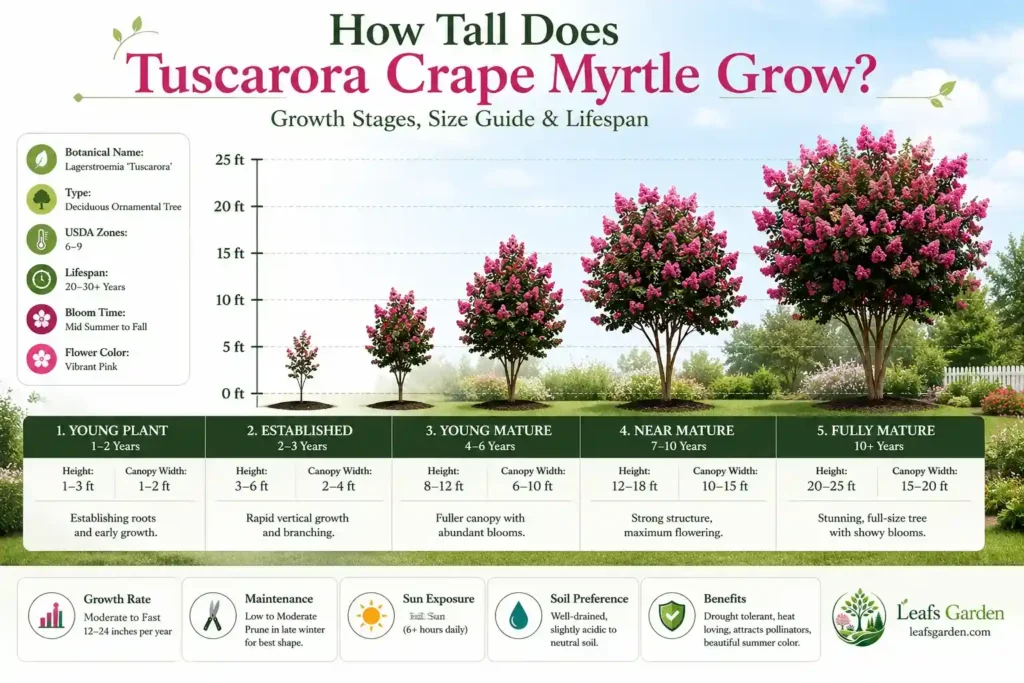
Tuscarora is considered a medium-to-large crape myrtle with a relatively fast growth habit in warm climates. Mature size depends on climate, soil quality, sunlight exposure, and pruning style.
Many gardeners searching “how tall does a crepe myrtle get” are often surprised by how large mature Tuscarora specimens can become when planted in ideal conditions.
| Feature | Average Size |
| Mature Height | 5–7 metres |
| Mature Width | 4–6 metres |
| Growth Speed | Fast-growing |
| Average Lifespan | 30–50+ years |
The crepe myrtle height can increase quickly during the first several years after planting, especially in sunny regions with long summers.
Typical crape myrtle growth rate factors include:
Under ideal growing conditions, gardeners often notice how fast a crape myrtle tree grows during peak summer growth periods. Young trees may establish rapidly and begin producing flowers within the first few growing seasons.
Direct Answer: Tuscarora performs best in warm sunny climates with hot summers.
Tuscarora crape myrtle thrives in regions that receive long periods of summer heat and strong sunlight. The plant performs especially well in warm temperate, subtropical, and Mediterranean-style climates where summers are dry or moderately humid.
In Australia, this ornamental flowering tree adapts well to many coastal and inland regions with reliable summer warmth. It is commonly planted in suburban gardens, streetscapes, and public landscapes because of its strong heat tolerance and long flowering season.
Across the USA, Tuscarora grows particularly well in southern states where summers are hot and humid. It is widely planted in:
Mediterranean climates are also highly suitable because the plant enjoys:
One reason for the popularity of Tuscarora is its humidity tolerance. Unlike some ornamental flowering trees, this variety continues blooming reliably even during humid summer conditions when airflow and sunlight are adequate.
Ideal climate conditions include:
Tuscarora crape myrtle grows best in USDA Zones 7–10 where winter temperatures remain moderate and summers are warm enough to support strong flowering.
In Australia, crepe myrtles Australia gardeners commonly grow Tuscarora successfully in several major regions.
Well-suited Australian locations include:
Crepe myrtle Brisbane gardens benefit from the long warm growing season and high summer temperatures that encourage heavy flowering and rapid growth.
Crepe myrtle Canberra plantings can also perform well, although colder winters may cause earlier dormancy and slower seasonal growth compared to subtropical regions.
Climate suitability by region:
| Region | Suitability |
| Brisbane | Excellent |
| Sydney | Excellent |
| Perth | Excellent |
| Canberra | Good |
| Adelaide | Good to Excellent |
In cooler climates, flowering may begin slightly later, while hotter regions often produce longer bloom periods and faster seasonal growth.
Tuscarora crape myrtle requires full sun for the best flowering performance and healthy growth.
Gardeners often ask whether crape myrtle prefers sun or shade. Direct Answer: Full sun is strongly preferred because flowering decreases significantly in shaded conditions.
For the healthiest growth, the plant should receive:
Strong crepe myrtle sun exposure improves:
Can crepe myrtle grow in shade? Yes, partial shade is tolerated, but flowering usually becomes weaker and less consistent. Excessive shade may also increase the risk of fungal problems because moisture remains on the foliage for longer periods.
Signs of insufficient sunlight include:
For maximum summer blooms, planting in a bright open location is highly recommended.
Tuscarora adapts to many soil types but performs best in well-drained fertile soil with moderate organic matter.
Healthy crape myrtle soil should allow water to drain efficiently while still retaining enough moisture for root development. Waterlogged soil can stress roots and reduce overall plant vigor.
Ideal crepe myrtle growing conditions include:
Recommended soil characteristics:
| Soil Factor | Preferred Condition |
| Drainage | Well-drained |
| Soil pH | Slightly acidic to neutral |
| Organic Matter | Moderate |
| Soil Texture | Loam or sandy loam |
Adding compost or aged organic matter can improve:
Heavy clay soils may require soil improvement before planting to prevent poor drainage and root stress. In sandy soils, mulch and compost help maintain moisture during hot summer periods.
Although Tuscarora is drought tolerant after establishment, proper soil preparation greatly improves long-term flowering and canopy growth.
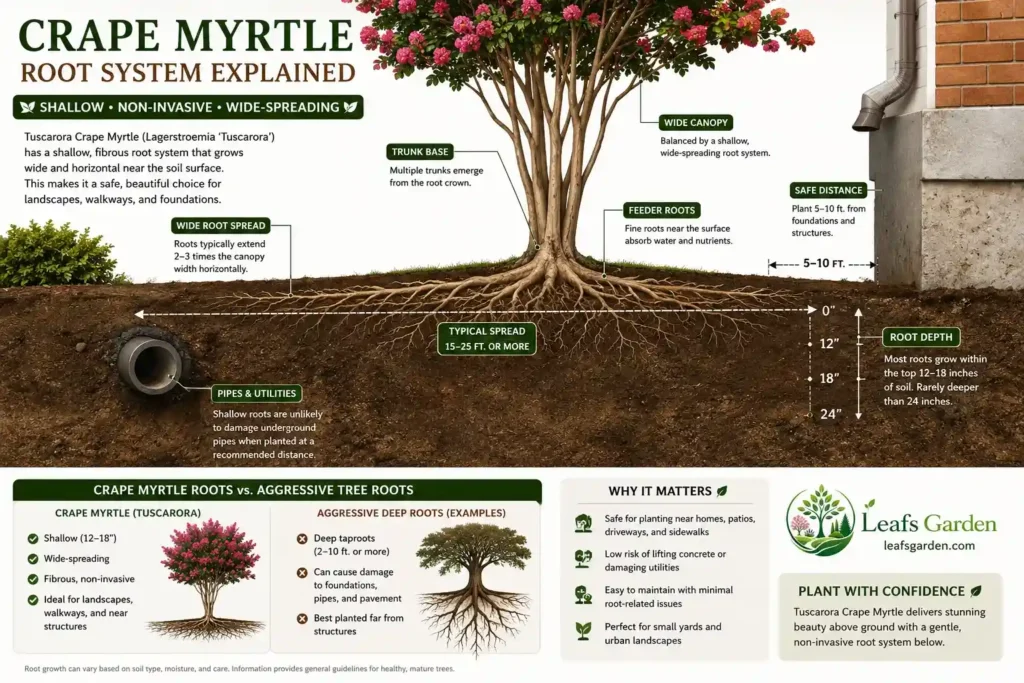
Direct Answer: Crape myrtle roots are generally non-invasive and rarely damage foundations or pipes.
Many homeowners ask, “Are crepe myrtle roots invasive?” because they want to plant ornamental trees close to homes, patios, or driveways. Tuscarora crape myrtle is considered one of the safer landscape trees for residential planting because its root system is relatively shallow and non-aggressive compared to large shade trees.
Does crape myrtle have invasive roots? In most cases, no. The roots spread outward near the soil surface rather than producing thick destructive roots that aggressively lift structures.
The root system typically:
Can crepe myrtle roots damage pipes? Damage is uncommon in healthy plumbing systems. However, like most trees, roots may move toward leaking pipes or constantly moist soil areas if water is present.
Tuscarora is generally considered safe near:
Compared to larger invasive-rooted trees, crape myrtle is widely regarded as a lower-risk ornamental planting option.
Tuscarora crape myrtle develops a shallow spreading root structure rather than a deep taproot system.
Many gardeners searching “how deep do crepe myrtle roots go” expect deep structural roots, but most feeder roots remain close to the soil surface where oxygen and moisture are more available.
Typical crepe myrtle root depth characteristics include:
Do crepe myrtles have deep roots? Generally, no. The plant relies more on wide surface-level root expansion than deep penetration.
Several factors influence crepe myrtle root depth:
In loose fertile soil, roots may spread more efficiently and support faster growth. In compacted clay soil, roots often remain even closer to the surface.
Because the root system is relatively shallow, mulching helps:
The crape myrtle tree root system is fibrous, spreading, and relatively compact compared to large shade trees. The roots are designed more for efficient moisture absorption than aggressive deep anchoring.
The root system of crepe myrtle trees usually expands outward gradually as the canopy matures. Most active feeder roots remain in the upper soil zone where nutrients and water are easiest to access.
Key root structure features:
Root growth pattern overview:
| Root Feature | Typical Behavior |
| Root Depth | Shallow to moderate |
| Root Spread | Wide and horizontal |
| Aggressiveness | Low |
| Pipe Damage Risk | Minimal |
| Foundation Risk | Rare with proper spacing |
Infographic Suggestion:
Create a “Root Spread vs Root Depth Comparison” infographic showing:
This type of visual helps explain how the crape myrtle tree root system behaves in residential landscapes.
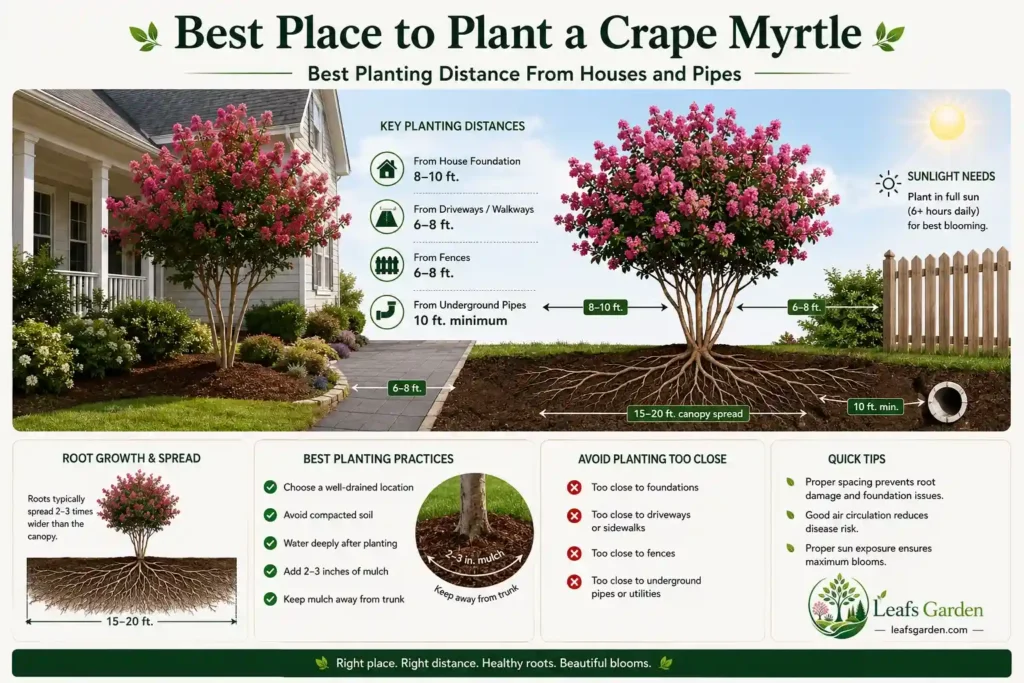
Proper crape myrtle spacing improves airflow, reduces root competition, and protects nearby structures.
The best place to plant a crepe myrtle is in a sunny open location with enough room for mature canopy growth and root expansion.
Recommended planting distances:
| Structure | Recommended Distance |
| House Foundation | 3–5 metres |
| Water Pipes | 2–3 metres |
| Driveways | 2–3 metres |
| Fences | 1.5–2 metres |
| Other Trees | 3–5 metres |
Spacing recommendations depend on:
Good crape myrtle spacing provides:
Avoid planting too close to:
When given adequate space, Tuscarora crape myrtle develops a healthier canopy, stronger flowering performance, and a more balanced root system over the long term.
The best time to plant crape myrtle depends on climate conditions and seasonal temperatures. Planting during mild weather helps roots establish before extreme summer heat or winter cold arrives.
In Australia, crepe myrtle planting time is usually best from:
These seasons allow steady root development while temperatures remain moderate. In warmer Australian regions, autumn planting is often preferred because soil temperatures stay warm enough for root growth.
Recommended Australian planting periods:
| Region | Best Planting Time |
| Brisbane | Autumn to early spring |
| Sydney | Autumn and spring |
| Perth | Autumn and winter |
| Canberra | Spring after frost risk |
In the USA, the best time to plant crape myrtle is generally:
Planting before peak summer heat helps reduce transplant stress and encourages stronger establishment during the first growing season.
When to plant crepe myrtle tree for best results:
Avoid planting during:
Proper planting helps Tuscarora crape myrtle establish faster and produce healthier flowering growth over the long term.
Select a site that receives at least 6–8 hours of direct sunlight daily. Full sun improves flowering, bark development, and canopy structure.
Avoid:
Improve soil before planting by adding:
Healthy soil preparation improves:
Dig a planting hole:
Do not plant too deeply because buried trunks can increase stress and reduce airflow around the base.
After planting, water deeply to settle the soil around the roots and remove air pockets.
Young trees require:
Apply mulch around the base to conserve moisture and regulate soil temperature.
Keep mulch:
Benefits of mulching include:
Direct Answer: Yes, dwarf or young specimens can grow successfully in containers.
A crepe myrtle in pots can perform very well when given enough sunlight, drainage, and root space. Container growing is especially useful for patios, courtyards, balconies, and smaller gardens.
Young or compact varieties adapt best to container conditions, although larger Tuscarora plants may eventually outgrow smaller pots.
For a healthy crepe myrtle container setup, use:
A potted crepe myrtle usually requires:
Container growing advantages:
To improve flowering in pots:
Choosing the right crepe myrtle underplanting helps create a balanced landscape design while improving visual contrast around the tree.
When deciding what to plant around crepe myrtle, select plants that enjoy:
Popular companion plants include:
| Companion Plant | Benefit |
| Lavender | Fragrant drought-tolerant color |
| Salvia | Long flowering season |
| Liriope | Low-maintenance border planting |
| Ornamental Grasses | Texture and movement |
Lavender pairs especially well with coral-pink flowers because the soft purple tones complement the bright summer blooms.
Salvia adds:
Liriope works effectively as:
Ornamental grasses provide:
Good underplanting combinations improve:
In gardens where a compact evergreen flowering companion is preferred near the base of crape myrtles, dwarf flowering gum varieties provide vibrant seasonal colour and manageable growth that pairs naturally with warm-climate ornamental planting schemes.
Avoid overcrowding around the trunk so airflow remains strong and root competition stays manageable.
Tuscarora crape myrtle becomes relatively drought tolerant once established, but young plants need regular watering during their first few growing seasons.
Understanding crepe myrtle water requirements is important because both overwatering and underwatering can reduce flowering performance and root health.
Young newly planted trees need:
Established trees usually require less irrigation because mature root systems can tolerate short dry periods more effectively.
How much water do crepe myrtles need depends on:
General watering guide:
| Plant Stage | Watering Needs |
| Newly Planted | Frequent deep watering |
| Young Trees | Moderate regular watering |
| Established Trees | Occasional deep watering during drought |
Proper watering practices include:
Signs of underwatering:
Signs of overwatering:
Morning watering is usually best because it allows foliage and soil surfaces to dry properly during the day.
Tuscarora benefits from balanced feeding during active growth periods, especially in nutrient-poor soil.
The best fertilizer for crepe myrtle trees usually contains moderate nitrogen levels with balanced phosphorus and potassium to encourage flowering without excessive leafy growth.
A slow-release fertilizer is often preferred because it provides nutrients gradually throughout the growing season.
Good feeding options include:
Compost improves:
Phosphorus balance is especially important because excessive nitrogen can reduce flower production and create overly soft leafy growth.
Recommended crepe myrtle fertiliser practices:
Many gardeners also use homemade fertilizer for crepe myrtles such as:
However, homemade amendments should still be used moderately to avoid nutrient imbalance.
Avoid:
Balanced nutrition helps support:
Strong flowering depends mainly on sunlight, proper fertilization, and correct pruning practices.
Many gardeners asking “why isn’t my crepe myrtle blooming” are usually dealing with one of three common problems:
Full sun is the most important factor for heavy flowering.
To improve blooming:
Low sunlight commonly causes:
Balanced feeding improves flower production, but excessive nitrogen often creates leafy growth with fewer flowers.
How to get a crepe myrtle to bloom more effectively:
Incorrect pruning can reduce flowering and damage the natural shape of the tree.
Good pruning practices include:
Avoid severe topping because it may weaken flowering quality and produce unattractive regrowth.
If a crepe myrtle is not flowering well, improving sunlight exposure and reducing excessive fertilizer are usually the first corrections to make.
Tuscarora changes throughout the year, and seasonal care helps maintain healthy growth and reliable flowering.
Crepe myrtle spring growth begins as temperatures rise and new foliage emerges from dormancy.
Spring care tasks include:
This is also the main active growth period for roots and canopy development.
Summer is the peak flowering season.
During hot weather:
Healthy summer conditions produce:
Crepe myrtle in the fall develops colorful foliage before leaf drop. Depending on climate conditions, leaves may turn:
Autumn care focuses on:
The decorative bark also becomes more visible as leaves drop.
Crepe myrtle winter dormancy is completely normal for deciduous varieties like Tuscarora.
During winter:
Winter is often the best season for:
Even without leaves, mature Tuscarora trees remain attractive because of their smooth peeling bark and sculptural branch form.
Direct Answer: Softwood cuttings root fastest in warm humid conditions.
Crepe myrtle propagation by cuttings is one of the easiest and most reliable ways to grow new Tuscarora plants that remain genetically identical to the parent tree.
Many gardeners ask, “Can you root a crepe myrtle?” Yes, healthy softwood cuttings taken during active growth usually root successfully when moisture and warmth are maintained consistently.
The best cuttings are:
How to root crepe myrtle cuttings step by step:
Under good conditions, roots often begin forming within several weeks.
Best conditions for propagation:
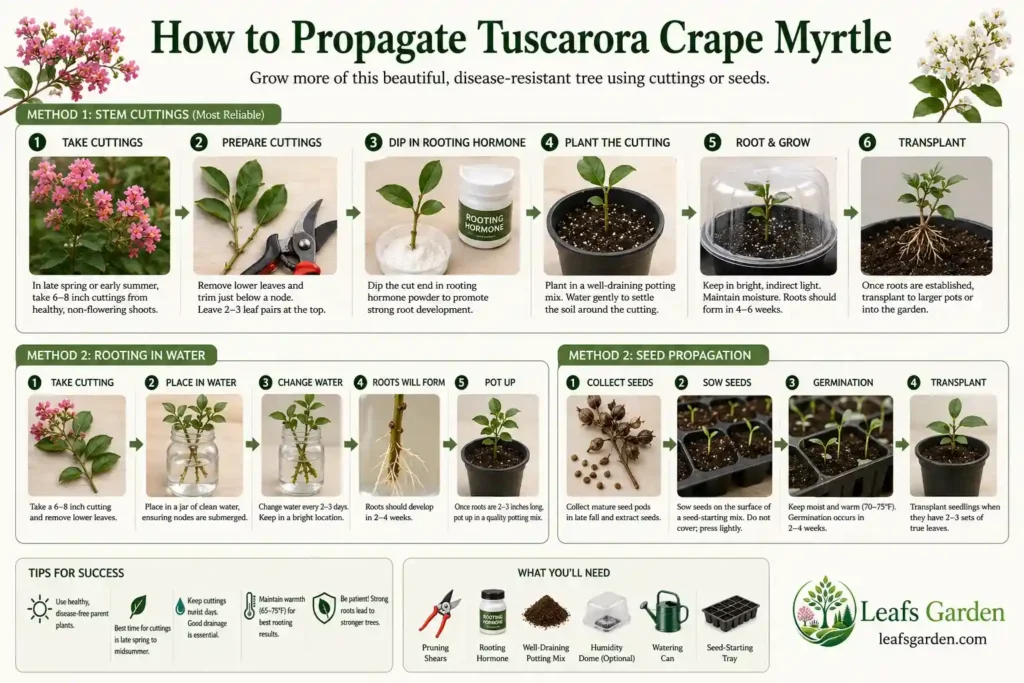
Rooting crepe myrtle in water is possible, although success rates are often lower compared to soil or propagation mix methods.
Some gardeners prefer crepe myrtle rooting in water because it allows visible root development before transplanting.
Basic water-rooting process:
For stronger long-term growth, many growers eventually transfer rooted cuttings into potting mix once healthy roots appear.
Warm temperatures and clean water greatly improve propagation success.
It is also possible to grow crape myrtle from seed, although seed-grown plants may vary slightly from the parent cultivar.
Growing from seed is slower than propagation by cuttings, but it can be useful for:
Seeds are usually collected from mature dried seed capsules that develop after flowering finishes.
To collect seeds:
Healthy seeds are typically:
Crepe myrtle seed germination works best in warm bright conditions.
Steps for planting crepe myrtle seeds:
Gardeners wanting to grow crape myrtle from seed should expect slower early growth compared to rooted cuttings.
Important germination factors include:
Seed-grown plants may take several years before reaching mature flowering size.
Poor flowering is one of the most common concerns among gardeners growing Tuscarora crape myrtle. In most cases, blooming problems are linked to sunlight, fertilizer imbalance, or pruning mistakes.
If you are wondering, “Why isn’t my crepe myrtle blooming?” the following causes are usually responsible.
Insufficient sunlight is one of the biggest reasons for weak flowering.
Tuscarora requires:
Excessive shade may cause:
Trees planted near buildings or large shade trees often produce fewer flower clusters.
Too much nitrogen encourages leafy growth instead of flowers.
This problem commonly occurs when:
Overfertilized trees may show:
Balanced feeding is usually better than heavy fertilization.
Improper pruning can reduce flowering and damage the tree’s natural shape.
Common pruning mistakes include:
Tuscarora blooms on new growth, so light structural pruning during dormancy is usually the safest approach.
How to get a crepe myrtle to bloom more effectively:
If a crepe myrtle is not flowering consistently, correcting these environmental and maintenance issues often restores blooming performance within the next growing season.
Tuscarora crape myrtle is relatively disease resistant, but some environmental conditions can still create foliage problems and seasonal stress.
Powdery mildew appears as a white dusty coating on leaves and young shoots.
It is more common in:
Symptoms include:
Improving sunlight and airflow usually helps reduce mildew pressure.
Aphids are small sap-feeding insects that commonly appear during active growth periods.
Signs of aphid activity include:
Natural predators such as ladybirds often help control populations naturally.
Leaf spot diseases may develop during extended wet or humid conditions.
Common symptoms:
Preventive care includes:
Root stress can affect both foliage quality and flowering.
Common causes include:
Root stress symptoms may include:
Healthy soil and proper watering greatly reduce long-term root problems.
Direct Answer: Crape myrtles can be moderately messy during flowering and seasonal leaf drop, but most gardeners consider the ornamental value worth the cleanup.
Many homeowners ask, “Are crape myrtles messy?” because the tree naturally sheds flowers, seed pods, and leaves throughout the year.
Typical seasonal debris includes:
Flower drop is most noticeable during peak summer blooming periods when large flower clusters begin fading naturally.
During autumn and winter:
Despite this seasonal litter, Tuscarora is still considered cleaner than many larger ornamental trees because:
To reduce mess:
Most gardeners view the seasonal cleanup as minor compared to the long flowering season, decorative bark, and strong landscape value Tuscarora provides.
Tuscarora and Natchez are two of the most widely planted ornamental crape myrtle varieties, but they differ in flower color, mature size, bark appearance, and overall landscape use.
Tuscarora is usually chosen for its coral-pink blooms and medium-sized structure, while crepe myrtle Natchez is known for its larger size and white flowers.
Comparison overview:
| Feature | Tuscarora Crape Myrtle | Natchez Crape Myrtle |
| Flower Color | Coral-pink | Pure white |
| Mature Height | 5–7 metres | 6–9 metres |
| Bark Appearance | Smooth cinnamon-grey bark | Creamy exfoliating bark |
| Growth Rate | Fast-growing | Very fast-growing |
| Growth Habit | Upright rounded form | Broad vase-shaped canopy |
| Best Use | Small to medium gardens | Larger landscapes and streets |
Tuscarora is often preferred for:
Natchez is commonly selected for:
Both varieties offer:
For gardeners who prefer an evergreen alternative with year-round structure alongside deciduous flowering trees, silver princess gum is a native Australian option that delivers vibrant pink-red blooms and attractive silvery foliage across a similarly warm climate range.
The main difference between dwarf and standard crape myrtles is mature size, canopy structure, and landscape application.
A standard crape myrtle grows into a small ornamental tree with noticeable trunk structure and elevated branching. Tuscarora falls into this larger ornamental category.
Standard forms are commonly used for:
Typical standard crape myrtle characteristics:
In contrast, a miniature crepe myrtle stays compact and shrub-like, making it suitable for:
Dwarf crepe myrtle Australia gardeners often choose compact cultivars because they fit modern urban landscapes with limited space.
Advantages of dwarf varieties:
Advantages of standard varieties:
Choosing between dwarf and standard forms depends mainly on:
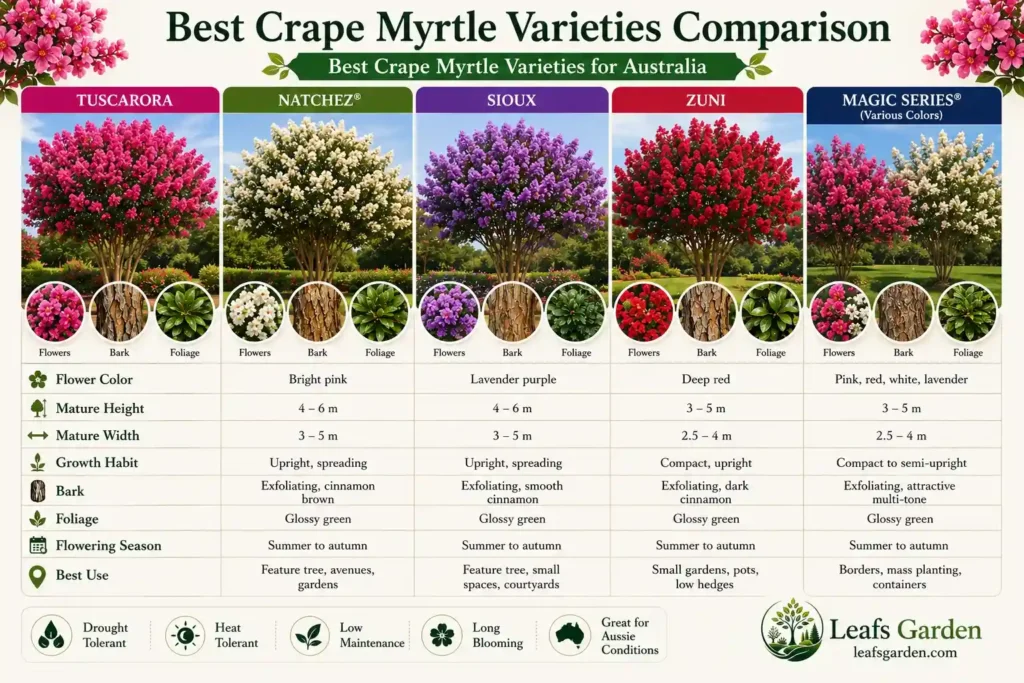
Several crepe myrtle varieties Australia gardeners commonly grow perform exceptionally well in warm climates with strong summer heat.
Popular Australian varieties include:
Indian Summer varieties are known for:
These cultivars perform especially well in warmer Australian regions.
Lagerstroemia Sioux crape myrtle is valued for its:
Sioux adapts well to many Australian climate zones and remains popular in suburban landscapes.
Zuni is a smaller compact variety with:
It is often chosen for:
The crepe myrtle Magic Series includes compact modern cultivars bred for:
Crepe myrtle Magic Series plants are especially useful for:
Best Australian conditions for crape myrtles include:
Because of their adaptability, long flowering season, and heat tolerance, modern lagerstroemia varieties continue growing in popularity across Australian residential landscapes.
Tuscarora crape myrtle is highly valued in landscape design because it combines long summer flowering, manageable size, decorative bark, and strong heat tolerance. Its versatility allows it to fit both formal and relaxed garden layouts.
Tuscarora works well as a small ornamental shade tree in residential landscapes. Mature trees develop a broad canopy that provides filtered summer shade without becoming excessively large.
Benefits as a shade tree include:
It is especially suitable for:
Many gardeners use Tuscarora as a feature tree because of its coral-pink blooms and attractive trunk structure.
As a specimen planting, the tree creates strong visual impact during:
Gardeners looking to explore additional flowering tree options for similar landscape roles will find a wide range of seasonal and structural choices covered in this complete ornamental flowering trees for beautiful landscapes guide.
Feature tree placement works best in:
The vibrant flowering canopy helps create a strong seasonal focal point in both traditional and contemporary gardens.
Tuscarora can also be planted in rows to create a flowering screen or semi-formal hedge.
Benefits of hedge planting:
When planted closely together, the trees form:
Regular pruning helps maintain a balanced hedge shape while encouraging dense branching.
Tuscarora is commonly planted along driveways because its upright growth habit and ornamental bark create a clean formal appearance.
Driveway planting advantages include:
Its non-invasive root behavior makes it safer than many larger shade trees for residential hardscape areas.
Direct Answer: Yes, Tuscarora can be used as a flowering hedge when planted with proper spacing and regular pruning.
A crepe myrtle hedge creates seasonal privacy while adding vibrant summer flowers and autumn color to the landscape.
For hedge planting, trees are usually spaced closer together than specimen plantings to encourage canopy connection over time.
Benefits of a crape myrtle hedge:
Hedge-style planting works best in:
Pruning requirements depend on the desired appearance:
Adequate airflow between plants remains important to reduce disease pressure and maintain healthy flowering growth.
Tuscarora can adapt surprisingly well to smaller landscapes when properly pruned and maintained.
Many homeowners choose small crepe myrtle trees because they provide ornamental value without the overwhelming size of larger shade trees.
In compact gardens, Tuscarora works well as:
Careful pruning can help maintain:
A crepe myrtle in container settings can also perform well, especially while young.
Container growing advantages:
For healthy container growth:
Although mature Tuscarora specimens may eventually outgrow smaller pots, container culture remains highly effective for patios, balconies, and smaller urban gardens.
Direct Answer: Most Tuscarora crape myrtles are deciduous.
Many gardeners ask, “Are crepe myrtles evergreen?” In most climates, Tuscarora behaves as a deciduous ornamental tree, meaning it naturally sheds its leaves during autumn and winter dormancy.
A crepe myrtle deciduous growth cycle is completely normal and forms part of the tree’s seasonal beauty.
Do crepe myrtles lose their leaves every year? Yes. As temperatures cool and daylight decreases, the foliage gradually changes color before dropping naturally.
Typical seasonal leaf cycle:
Leaf drop intensity depends on:
In warmer subtropical regions, some crape myrtles may hold leaves slightly longer, but Tuscarora is still generally considered deciduous rather than evergreen.
The deciduous nature of the tree provides several benefits:
Temporary winter leaflessness is a healthy and expected part of the plant’s annual growth cycle.
Tuscarora remains visually attractive during winter even after the leaves fall because of its smooth decorative bark and sculptural branch structure.
As dormancy begins:
One of the most ornamental winter features is the bark. Mature trunks develop peeling outer bark that reveals lighter tones underneath, creating a textured layered appearance.
Winter bark colors may include:
This bark beauty gives the tree year-round landscape value even outside the flowering season.
Winter is also the preferred pruning season because the bare branch structure becomes easier to see and shape.
Dormant-season pruning usually focuses on:
Light winter pruning supports:
Avoid excessive pruning or severe topping because aggressive cutting can weaken the natural form of the tree.
Even during dormancy, Tuscarora continues providing ornamental value through:
Tuscarora crape myrtle is one of the most reliable ornamental flowering trees for warm-climate gardens. Its coral-pink blooms, smooth decorative bark, drought tolerance, and long flowering season make it a strong choice for both residential and landscape planting projects.
This easy-care tree performs especially well in Australian gardens because it handles:
The plant’s non-invasive root system is another major advantage for homeowners who want a flowering feature tree near patios, driveways, or foundations without major root concerns.
Tuscarora also provides year-round ornamental value through:
Whether grown as a specimen tree, flowering hedge, or container plant, this lagerstroemia variety adapts well to many garden styles and climate conditions.
Before planting, choose the right crape myrtle variety based on:
Selecting the proper variety ensures healthier growth, better flowering performance, and a more balanced long-term landscape design.
Tuscarora is considered a fast-growing ornamental crape myrtle. Under warm sunny conditions with good soil and regular watering during establishment, it can grow quickly during the active summer season. Growth speed depends on climate, sunlight, soil quality, and maintenance.
The best fertilizer for crape myrtle trees is usually a balanced slow-release fertilizer with moderate nitrogen levels. Compost and organic matter also improve long-term soil health. Avoid excessive nitrogen because it may reduce flowering and encourage excessive leafy growth.
Crape myrtle roots are generally considered non-invasive and rarely damage foundations when planted with proper spacing. The root system is typically shallow and spreading rather than aggressively deep or structural.
In Australia, crepe myrtles usually flower from late spring through summer and into early autumn depending on climate conditions. Warmer regions such as Brisbane and Perth often experience longer flowering periods due to extended summer heat.
Yes, Tuscarora crape myrtle can grow successfully in pots, especially while young. Large containers with good drainage, full sun exposure, and regular watering help maintain healthy flowering and root development.
A mature Tuscarora crape myrtle typically reaches around 5–7 metres in height with a spread of approximately 4–6 metres. Size may vary depending on pruning style, climate, and growing conditions.
The most common reasons for poor flowering include: Too much shade Excess fertilizer Incorrect pruning Insufficient sunlight Poor airflow Full sun and balanced fertilizing usually improve blooming performance significantly.
Yes, Tuscarora performs very well in both Brisbane and Perth climates. Its strong heat tolerance, drought resistance, and long flowering season make it highly suitable for warm Australian regions with sunny conditions.