Grow Better Gardens with Smarter Plant Choices
Discover helpful guides on trees, hedges, fruit plants, edible plants, and beautiful landscape greenery.
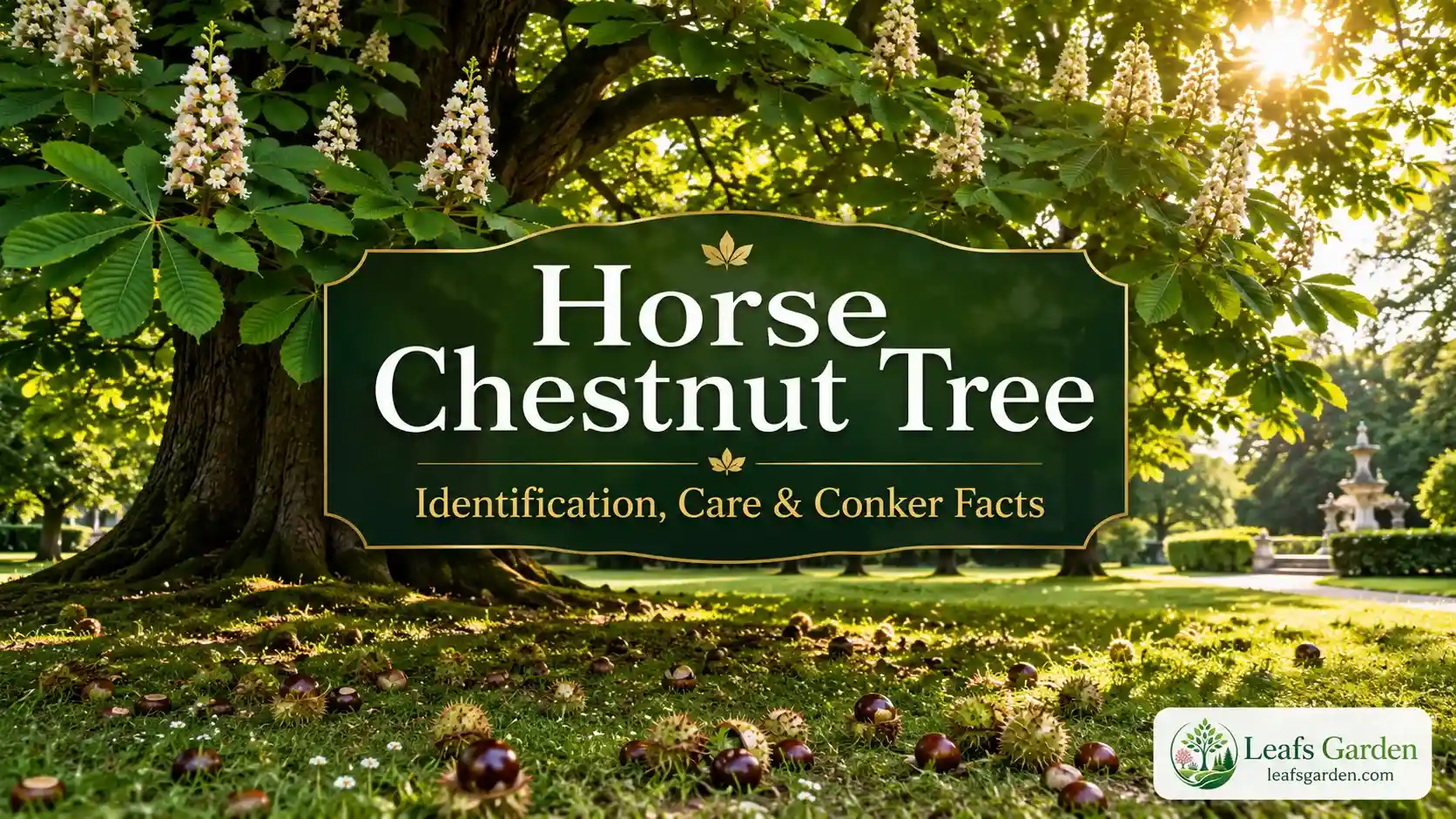
Horse chestnut tree (Aesculus hippocastanum) is a large ornamental deciduous tree known for its broad canopy, upright white flower spikes, and glossy brown conkers. It is widely planted in parks, avenues, and large landscapes because of its strong visual presence and dense seasonal shade. The tree is especially recognizable during spring flowering and autumn conker production.
This guide explains:
| Feature | Details |
| Scientific Name | Aesculus hippocastanum |
| Common Name | Horse Chestnut Tree |
| Plant Type | Deciduous ornamental tree |
| Native Region | Balkans / Europe |
| USDA Zones | 3–8 |
| Mature Height | 50–75 ft |
| Main Feature | Conkers, flowers, large leaves |
| Edibility | Not edible for humans |
Horse chestnut tree is a large flowering ornamental tree famous for producing conkers and distinctive palm-shaped leaves. It is commonly planted in parks, streets, estates, and large gardens because of its broad shade canopy and striking seasonal appearance. The tree is best known for its upright white flower clusters in spring and glossy brown seeds inside spiky green husks during autumn.
Aesculus hippocastanum is the scientific name of the common horse chestnut tree. It belongs to the Sapindaceae family, which also includes maples and soapberry plants.
Key classification details include:
The term “hippocastanum” comes from historical Greek and Latin references connected to horses and chestnut-like seeds. Despite the name, horse chestnut trees are not true chestnut trees from the Castanea genus.
Horse chestnuts are the glossy brown seeds produced by horse chestnut trees. These seeds are commonly called conkers and develop inside thick green spiky husks.
Horse chestnuts differ completely from edible chestnuts. Although both have shiny brown seeds, horse chestnuts contain toxic compounds and should not be eaten by humans.
Important differences include:
Horse chestnut trees are native to the Balkan regions of southeastern Europe. They naturally grew in mountainous forests with cool temperatures and moist soils.
Over time, the tree spread across Europe because of its ornamental value. It later became widely planted in Australia, North America, and other temperate regions.
Horse chestnut trees were historically planted in:
Their rapid growth and dense canopy made them popular shade trees in urban environments.
The name “horse chestnut” comes from historical European folklore and early medicinal practices involving horses. In some traditions, the seeds were believed to help treat horse coughs and respiratory problems.
The word “chestnut” was added because the seeds visually resemble edible chestnuts. However, this often causes confusion because the two trees are botanically unrelated.
The naming confusion exists because:
Today, the term “conker tree” is also commonly used for horse chestnut trees in many regions.
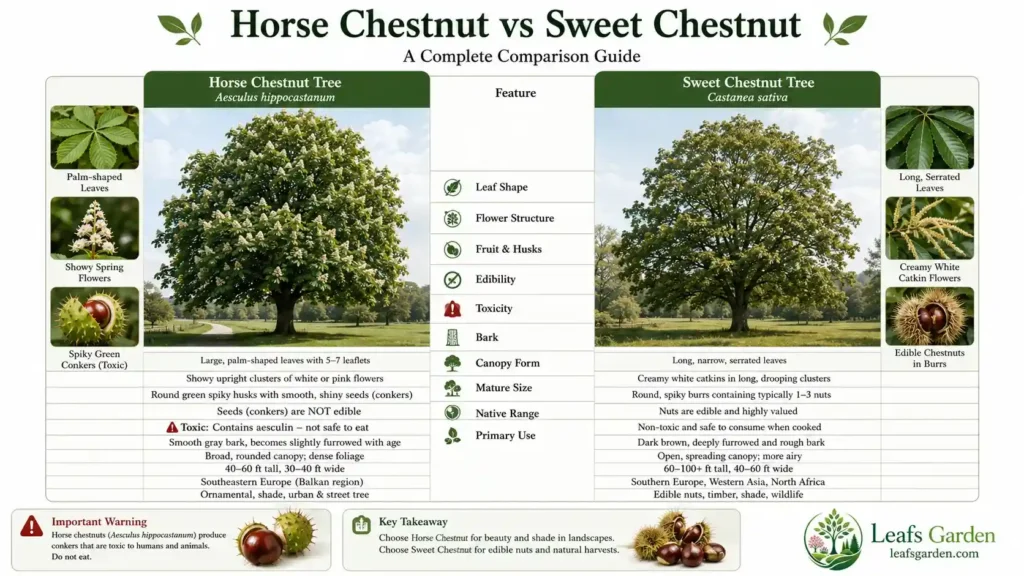
Horse chestnut trees are easy to recognize by their large leaves, upright flower clusters, and spiky green conker shells. Mature trees develop a broad rounded canopy and become highly noticeable in parks, streets, and large landscapes.
Horse chestnut tree leaves are large palmately compound leaves that spread outward like fingers from a single central point. This is one of the easiest ways to identify the tree.
Key leaf characteristics include:
Seasonal leaf color changes are also noticeable throughout the year.
The leaves create dense shade because of their broad size and layered canopy growth.
Among other deciduous ornamental trees prized for seasonal foliage and elegant autumn displays, silver birch trees offer a contrasting lighter canopy structure that pairs well alongside larger shade specimens in mixed landscape designs.
Horse chestnut tree flowers grow in tall upright clusters often called flower spikes or panicles. These flowers appear during spring and are one of the tree’s main ornamental features.
Chestnut tree flowers typically have:
A flowering chestnut tree becomes highly decorative during late spring when the blooms stand above the foliage like candles.
Flowering season usually occurs during:
The flowers also attract bees and pollinators during active blooming periods.
Horse chestnut tree conkers are glossy brown seeds that develop inside thick green spiky husks. These seeds are among the most recognizable features of the tree.
Important conker characteristics include:
Conkers from horse chestnut tree usually fall during autumn after the husks split open naturally.
Horse chestnut conker appearance differs from edible chestnuts because:
The fallen seeds are traditionally used in conker games in many European countries.
Horse chestnut trees develop a thick trunk, wide canopy, and strong branching structure as they mature. Large mature specimens create a rounded symmetrical appearance in landscapes.
Growth habit characteristics include:
Most mature trees reach:
Horse chestnut trees are moderately fast-growing during early years and can live for many decades under suitable conditions.
The bark gradually becomes rougher and more textured as the tree ages.
A conker tree looks large, dense, and highly ornamental throughout the growing season. Seasonal changes make the tree easy to identify at different times of the year.
Spring identification features:
Autumn identification features:
Common visual characteristics include:
| Feature | Horse Chestnut Tree |
| Leaves | Palm-shaped |
| Flowers | Upright white spikes |
| Fruit | Spiky green conkers |
| Seeds | Brown glossy conkers |
| Height | Very large |
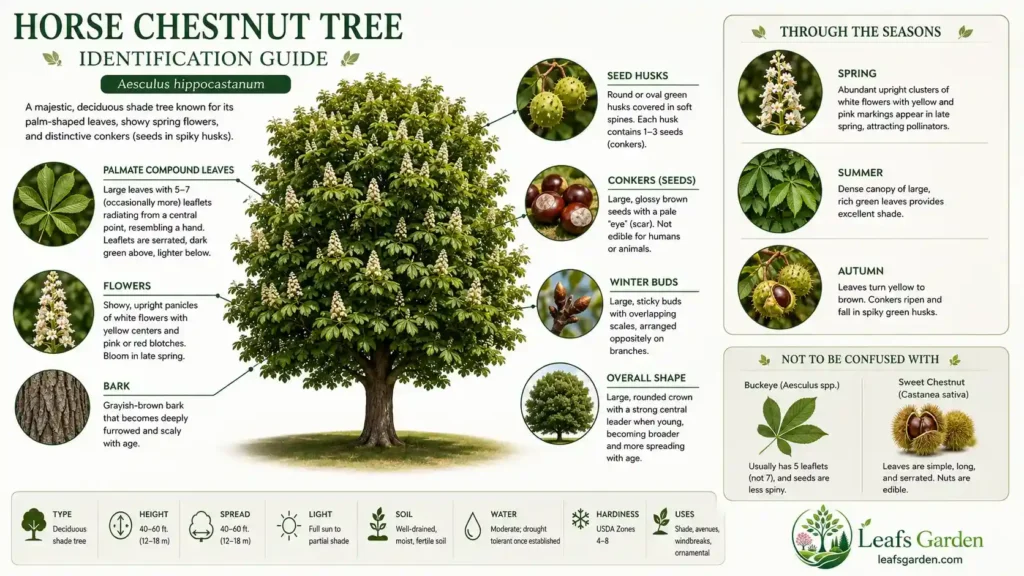
Horse chestnut and sweet chestnut trees are completely different species with different seeds, leaves, and edibility. Although their seeds look somewhat similar, the trees belong to separate botanical groups and have major differences in appearance, safety, and landscape use.
Horse chestnut vs chestnut comparisons usually focus on leaves, seed structure, and edibility. Many people confuse the two trees because both produce shiny brown seeds during autumn.
Key species comparison differences include:
Chestnut vs horse chestnut identification also differs visually.
Horse chestnut trees typically have:
Sweet chestnut trees usually have:
Chestnuts vs horse chestnuts is one of the most common tree identification confusions in temperate landscapes.
Conkers are not edible chestnuts. They are the seeds produced by horse chestnut trees and contain toxic compounds that make them unsafe for human consumption.
The confusion happens because:
However, major seed structure differences exist.
Horse chestnut conkers usually have:
Edible chestnuts usually have:
Toxicity concerns are important because horse chestnuts contain aesculin and other compounds that may cause poisoning symptoms if eaten.
Horse chestnut and sweet chestnut leaves are very different in structure and appearance, making leaf shape one of the easiest identification methods.
| Feature | Horse Chestnut | Sweet Chestnut |
| Leaf Shape | Palm-shaped | Long serrated |
| Fruit Shell | Thick spiky husk | Fine spiny burr |
| Edibility | Toxic | Edible |
Horse chestnut leaves grow as compound leaflets spreading from one central point, while sweet chestnut leaves are simple elongated leaves with serrated edges.
Flower structure comparison between these trees is very noticeable during spring flowering.
Horse chestnut trees produce:
Sweet chestnut trees produce:
Conkers vs edible chestnuts also differ internally and externally.
Horse chestnut seeds:
Sweet chestnut seeds:
Seed casing differences are one of the easiest ways to separate the two species during autumn.
Horse chestnut trees are generally better for ornamental landscaping because of their dramatic flowers, dense shade, and strong visual structure.
Landscaping advantages of horse chestnut trees include:
Sweet chestnut trees are often preferred for:
Maintenance needs also differ.
Horse chestnut trees may require:
Sweet chestnut trees may require:
For ornamental landscapes and parks, horse chestnut trees are usually considered more visually striking because of their flower spikes and broad canopy structure.
Horse chestnuts are not safe for human consumption because they contain toxic compounds. Although the seeds may resemble edible chestnuts, horse chestnuts can cause poisoning symptoms in humans and animals if consumed.
Horse chestnuts contain a toxic compound called aesculin, along with other naturally occurring chemicals that can affect the digestive system and nervous system.
Human safety concerns exist because eating raw horse chestnuts may lead to:
The concentration of toxic compounds is highest in:
Children are especially at risk because the shiny brown seeds may appear edible or resemble sweet chestnuts.
Horse chestnuts can also be harmful to animals. Pets and livestock may experience poisoning symptoms if they consume conkers, leaves, or other tree parts.
Risks for pets include:
Livestock concerns are more serious when large quantities are eaten. Horses, cattle, and deer may occasionally consume fallen conkers during autumn, especially when forage is limited.
Wildlife interactions differ because some wild animals can tolerate small amounts more effectively than domestic pets. However, horse chestnuts are generally not considered an important wildlife food source.
Despite toxicity concerns, horse chestnut extracts have been studied and used in traditional herbal medicine under controlled processing methods.
Herbal extract uses may include:
Medicinal research has mainly focused on escin, a compound extracted from horse chestnut seeds.
However, safety warnings are extremely important.
Raw horse chestnut parts should never be self-prepared or consumed because improper processing may leave dangerous toxic compounds active. Only professionally manufactured and regulated products are considered for medicinal use.
Eating a conker may cause poisoning symptoms ranging from mild digestive discomfort to more severe reactions depending on the amount consumed.
Common poisoning symptoms include:
Emergency precautions should be taken immediately if a child or pet consumes horse chestnuts.
Important safety steps include:
Child safety information is especially important during autumn because fallen conkers are attractive to children due to their shiny appearance. Parents should supervise young children around horse chestnut trees and avoid accidental ingestion.
Horse chestnut trees grow best in cool climates with full sun, moist soil, and plenty of space. These large ornamental trees develop extensive root systems and broad canopies, so proper planting conditions are important for long-term healthy growth.
Horse chestnut tree planting should begin with selecting a large open site that allows enough room for future canopy and root expansion.
Best planting season usually includes:
These periods help roots establish before extreme summer heat or winter frost.
Site selection is important because mature horse chestnut trees become very large. Ideal planting locations include:
Avoid planting too close to buildings, driveways, or underground structures because the tree develops a broad root spread over time.
Healthy horse chestnut saplings establish faster and adapt better after planting. Young trees should have strong stems, healthy roots, and disease-free foliage.
Healthy sapling characteristics include:
Container vs bare-root trees each have advantages.
Container-grown trees:
Bare-root trees:
Early growth stages focus heavily on root establishment before rapid canopy expansion begins.
Horse chestnut trees prefer fertile well-draining soil that retains moderate moisture without becoming waterlogged.
Ideal soil conditions include:
Soil pH preferences are usually:
Heavy compacted soil may reduce root health and increase stress problems over time.
Adding compost or organic matter can improve:
Horse chestnut trees grow best in full sun conditions where they receive strong daily light exposure.
Full sun requirements generally include:
Watering young trees is especially important during the first few growing seasons.
Young trees benefit from:
Mature trees become moderately drought tolerant once established, but prolonged dry conditions may still cause:
Horse chestnut trees prefer cool temperate climates and perform best in regions with moderate summers and cold winters.
Recommended USDA zones include:
Cool climate preference is one reason the tree thrives in many European and northern temperate landscapes.
Heat stress issues become more common in:
Excessive heat may lead to:
Trees planted in cooler climates generally maintain healthier foliage throughout the season.
Horse chestnut trees require significant spacing because of their mature size and extensive canopy spread.
Mature tree size may reach:
Distance from buildings should usually allow enough room for:
Root spread considerations are important near:
Large open planting areas help reduce long-term maintenance problems and allow the tree to develop its natural structure fully.
| Requirement | Ideal Condition |
| Sunlight | Full sun |
| Soil | Moist, fertile |
| Water | Moderate |
| Climate | Cool temperate |
| Space | Large landscape |
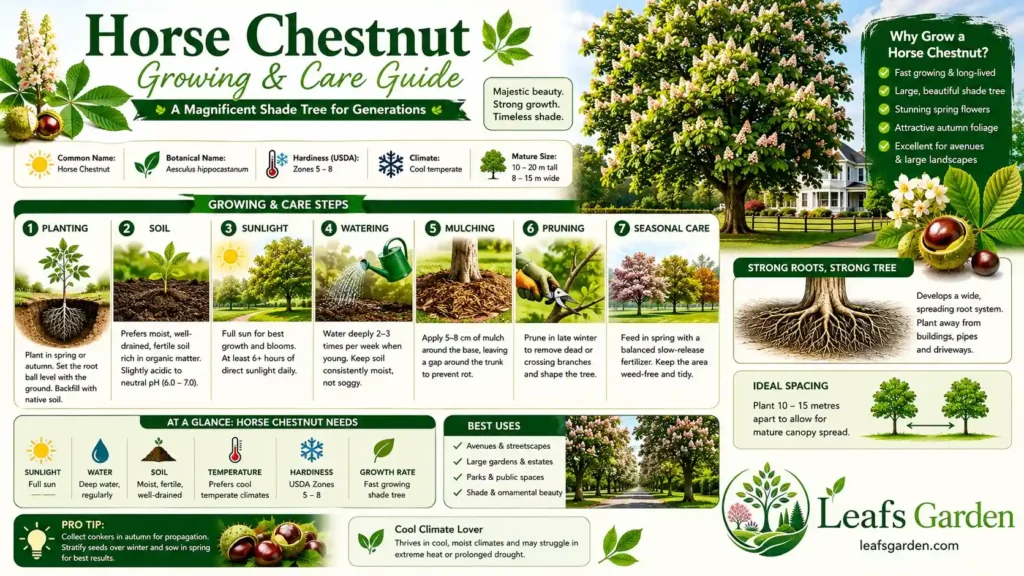
Regular watering, mulching, pruning, and monitoring pests help horse chestnut trees stay healthy for decades. Proper seasonal care improves canopy growth, flowering performance, and resistance to environmental stress.
Horse chestnut trees need consistent moisture, especially during early growth stages. Young trees require more frequent watering than mature established specimens.
Young vs mature tree watering differs significantly.
Young trees need:
Mature trees usually require:
Seasonal watering tips include:
Proper watering helps reduce:
Horse chestnut trees benefit from moderate feeding with balanced nutrients that support foliage, root development, and seasonal growth.
Organic compost is commonly used to improve:
Slow-release fertilizers work well because they provide steady nutrition over time without excessive rapid growth.
Important nutrient requirements include:
Over-fertilizing should be avoided because excessive nutrient buildup may stress roots and weaken long-term growth stability.
Mulching helps horse chestnut trees maintain stable soil conditions throughout the year. A proper mulch layer protects roots and improves moisture balance.
Main mulching benefits include:
Organic mulch materials may include:
Mulch should be placed around the root zone while keeping space around the trunk base to reduce moisture-related bark problems.
Pruning helps maintain healthy structure and removes damaged or diseased growth from horse chestnut trees.
Removing damaged branches improves:
Best pruning season is usually:
Pruning during dormancy reduces stress and improves healing after cuts.
Shaping mature trees mainly focuses on:
Heavy pruning is generally unnecessary because horse chestnut trees naturally develop broad symmetrical crowns.
Winter and seasonal care help horse chestnut trees recover from environmental stress and prepare for new growth cycles.
Frost management is especially important for young saplings in colder climates.
Protective care may include:
Autumn cleanup helps reduce disease pressure around the tree.
Seasonal cleanup tasks include:
Conker collection is also common during autumn when mature seeds fall naturally from split husks. Fallen conkers should be cleared from walkways and public areas to reduce slipping hazards and accidental ingestion by pets or children.
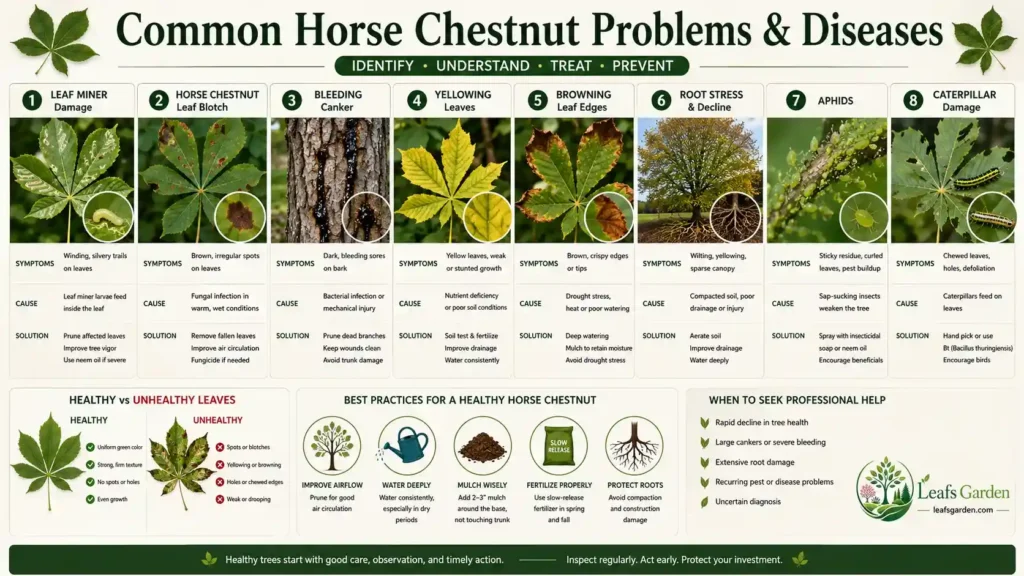
Leaf diseases, pests, and environmental stress are the most common problems affecting horse chestnut trees. Early identification and proper care help reduce long-term damage and maintain healthy foliage and canopy growth.
Horse chestnut leaf miner is one of the most common pests affecting horse chestnut trees. The larvae feed inside leaves, causing visible damage throughout the growing season.
Common symptoms include:
Leaf browning often begins during mid to late summer as pest activity increases.
Prevention methods may include:
Repeated yearly infestations may weaken overall tree vigor over time.
Fungal diseases can damage leaves, bark, and root systems of horse chestnut trees, especially in poorly drained or humid conditions.
Bleeding canker is one of the most serious diseases affecting mature trees.
Common symptoms include:
Leaf blotch disease commonly causes:
Root rot issues develop when soil remains excessively wet for long periods.
Root-related symptoms may include:
Good drainage and airflow help reduce many fungal disease problems.
Yellow leaves and browning foliage are often caused by environmental stress or nutrient imbalance.
Water stress is a major cause of leaf discoloration.
Common watering-related issues include:
Nutrient deficiencies may also contribute to:
Heat damage becomes more common during hot dry summers, especially outside cool temperate climates.
Heat stress symptoms include:
Consistent moisture and mulching help reduce stress-related foliage damage.
Several insect pests may affect horse chestnut trees during active growing seasons.
Aphids commonly feed on young shoots and leaves, causing:
Scale insects may appear as small bumps attached to bark or stems and can weaken overall tree health.
Caterpillar damage may include:
Healthy mature trees often tolerate minor pest activity, but severe infestations may require monitoring and treatment.
| Problem | Possible Cause | Solution |
| Brown leaves | Heat stress | Deep watering |
| Leaf spots | Fungus | Improve airflow |
| Poor growth | Soil issues | Fertilize |
Horse chestnut trees can grow in cooler parts of Australia but may struggle in extremely hot climates. These ornamental trees prefer temperate conditions with moderate summer temperatures, reliable moisture, and fertile soil.
Horse chestnut Australia growing conditions are most suitable in cool temperate regions where summers are mild and winters provide seasonal dormancy.
Suitable Australian climates generally include:
Horse chestnut trees perform better in climates that resemble their native European growing conditions. Consistent soil moisture and protection from extreme heat improve long-term tree health.
Horse chestnut tree Australia care mainly focuses on moisture management and reducing heat stress during hot periods.
Water management is important because Australian summers can become dry and stressful for large deciduous trees.
Helpful watering practices include:
Heat protection may help reduce foliage damage in warmer regions.
Protection methods include:
Soil considerations are also important for healthy growth.
Ideal soil conditions include:
Poor dry soil often increases leaf scorch and stress symptoms.
Horse chestnut trees grow best in Australia’s cooler southern and elevated regions.
Suitable growing areas commonly include:
These locations usually provide:
Trees planted in mild climates generally maintain healthier foliage and stronger seasonal growth.
Australian conditions can create several challenges for horse chestnut trees, especially in hot or dry regions.
Heat stress is one of the most common problems.
Excessive heat may cause:
Dry summers can increase water stress and weaken tree vigor over time if irrigation is insufficient.
Leaf scorch is also common in exposed hot locations.
Symptoms of leaf scorch include:
Planting horse chestnut trees in cooler landscapes with reliable moisture greatly improves long-term success in Australia.
Horse chestnut trees are mainly valued for ornamental beauty, shade, and historical landscape use. Their large canopy, decorative flowers, and seasonal conkers make them popular in parks, estates, and public landscapes.
Horse chestnut trees are widely planted as large ornamental shade trees because of their impressive size and strong visual structure.
Shade tree value is one of their biggest advantages.
The dense canopy helps provide:
Avenue planting is common because horse chestnut trees develop symmetrical crowns and attractive seasonal appearance.
This makes them one of the most structurally impressive selections covered in this complete ornamental flowering trees for beautiful landscapes guide, where canopy form, seasonal colour, and landscape scale are key planning factors.
They are often used for:
Park landscaping benefits include:
Their broad canopy also creates strong focal points in open landscapes.
Horse chestnut trees support local ecosystems by providing seasonal resources for insects and urban wildlife.
Pollinator attraction increases during flowering season when the tree produces nectar-rich blooms.
For gardens where year-round pollinator support is a priority, red flowering gum is another strong choice that extends nectar availability across warmer months with vibrant evergreen flowering displays.
Common pollinators attracted include:
Urban cooling is another important environmental benefit.
Large mature trees help reduce:
The canopy also improves comfort in parks and public areas during warm weather.
Biodiversity support comes from:
Although horse chestnuts are not major wildlife food trees, they still contribute positively to urban ecological balance.
Horse chestnut trees have strong historical and cultural importance throughout Europe and other temperate regions.
Conker games became especially popular among children in Britain and parts of Europe. The glossy brown seeds were traditionally collected during autumn and used in competitive playground games.
European garden history frequently includes horse chestnut trees because they were planted in:
Their dramatic flowers and wide canopy made them symbols of classic ornamental planting.
Traditional uses historically included:
Today, horse chestnut trees remain among the most recognizable ornamental deciduous trees in many temperate landscapes.
Horse chestnut trees are among the most recognizable ornamental trees in Europe and are famous for their conkers. Their massive size, decorative flowers, and seasonal seed production have made them culturally important in parks, gardens, and historic landscapes for centuries.
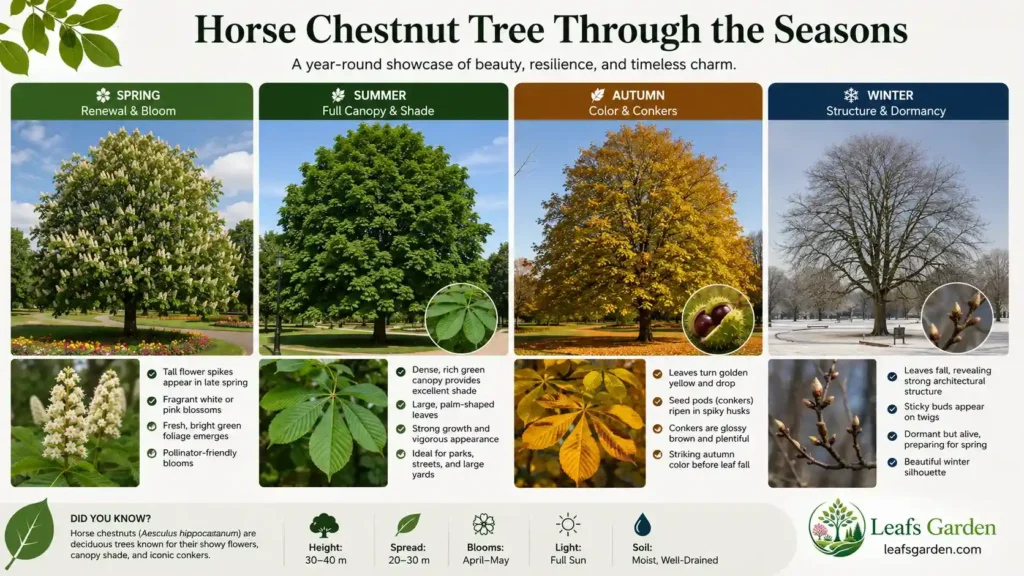
Conkers became popular mainly through traditional children’s games played in the United Kingdom and other parts of Europe. The glossy brown seeds of the horse chestnut tree were collected during autumn and used in competitive playground games.
Traditional games usually involved:
The cultural significance of conkers grew because horse chestnut trees were widely planted in schools, parks, and public spaces, making the seeds easy to collect every autumn.
In many regions, conkers became associated with:
Even today, horse chestnut trees are strongly connected with autumn nostalgia and traditional conker collecting.
Horse chestnut trees are long-living ornamental trees capable of surviving for many decades under suitable growing conditions.
Healthy mature trees may live for:
Long-living specimens are often found in:
Historic trees can develop:
Many old horse chestnut trees become landmark specimens because of their impressive scale and historical value.
Horse chestnut trees have several unusual botanical features that make them easy to identify throughout the year.
Large sticky buds are one of the most distinctive winter characteristics. The buds appear shiny and resin-coated before opening in spring.
Other unique characteristics include:
The flower spike structure is especially striking during spring flowering.
These upright blooms:
The combination of giant leaves, decorative flowers, and glossy conkers gives horse chestnut trees one of the most recognizable appearances among ornamental deciduous trees.
Horse chestnut trees are impressive ornamental landscape trees valued for their flowers, shade, and iconic conkers. Their broad canopy, seasonal beauty, and strong visual structure make them popular choices for parks, estates, and large gardens.
Key reasons gardeners and landscapers value horse chestnut trees include:
Despite their chestnut-like appearance, horse chestnuts are not edible and should be kept away from children and pets because of their toxic compounds.
These trees also require:
Horse chestnut trees combine:
while needing careful placement and awareness of toxicity. With proper growing conditions and long-term space planning, horse chestnut trees can become striking landscape specimens that provide shade, structure, and ornamental interest for generations.
Horse chestnut tree is a large deciduous ornamental tree known for conkers, white flowers, and palm-shaped leaves. It is commonly planted in parks and large landscapes for shade and seasonal beauty.
No, horse chestnuts are toxic and should not be eaten. They contain compounds such as aesculin that may cause poisoning symptoms in humans and animals.
Horse chestnut leaves are large palm-shaped compound leaves with several leaflets radiating from one central point. The leaves create a dense canopy and often turn yellow or brown during autumn.
Horse chestnuts are toxic ornamental seeds produced by Aesculus hippocastanum, while sweet chestnuts are edible nuts produced by Castanea species. The trees also differ in leaf shape, flower structure, and seed husks.
Conkers are seeds from horse chestnut trees, not edible chestnuts. They grow inside thick green spiky husks and are mainly known for traditional conker games.
Horse chestnut trees grow moderately fast and can become very large over time. Under suitable conditions, young trees establish quickly and eventually develop broad mature canopies.
Yes, horse chestnut trees can grow in Australia, especially in cooler temperate regions such as Tasmania, Victoria, and elevated highland areas. They may struggle in extremely hot or dry climates.