Grow Better Gardens with Smarter Plant Choices
Discover helpful guides on trees, hedges, fruit plants, edible plants, and beautiful landscape greenery.
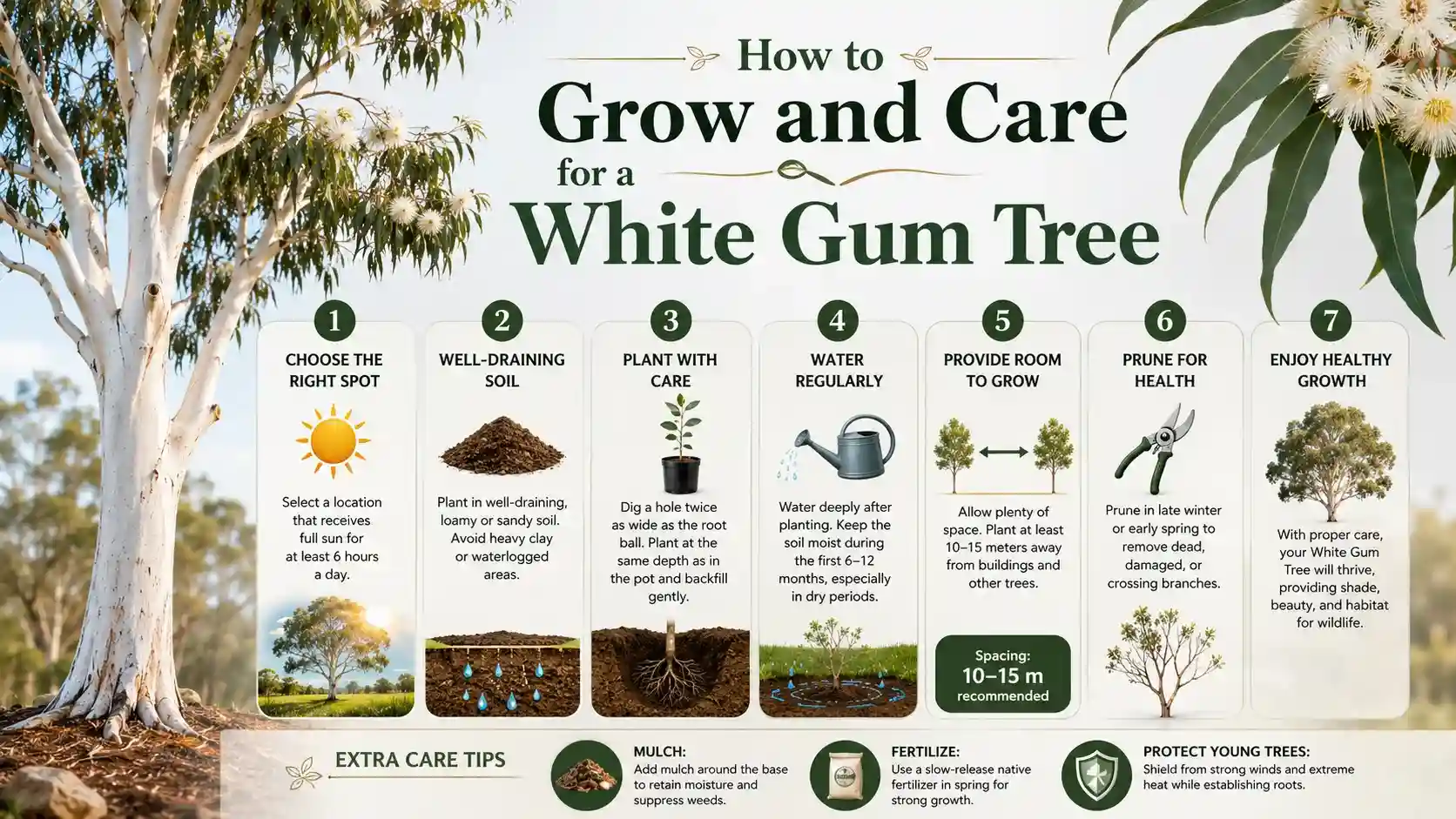
A white gum tree is a striking type of eucalyptus known for its smooth white bark, fast growth, and strong presence in Australian landscapes. These trees are widely valued for their ornamental beauty, hardy nature, and adaptability in both urban and rural environments. Many homeowners and landscapers choose white bark eucalyptus trees because they create a clean architectural look while also providing shade, privacy, and habitat support for wildlife.
The white gum eucalyptus belongs to the eucalyptus family, one of the most recognized groups of native Australian trees. Different varieties feature creamy white trunks, aromatic foliage, and seasonal flowers that attract birds and pollinators. From the tropical white eucalyptus to cool-climate species, the eucalyptus white gum remains a popular Australian gum tree for gardens, parks, and roadside planting throughout Australia and other warm regions worldwide.
A gum tree is a common name used for many tree species that belong to the eucalyptus group. In Australia, the term “gum tree” is widely associated with eucalyptus trees because many species produce a sticky sap or gum from their bark. These trees are known for their aromatic leaves, rapid growth, and distinctive bark textures.
Many people ask, “Is eucalyptus a gum tree?” The answer is yes. Most gum trees are part of the eucalyptus category, although the term “gum tree” may also include related genera such as Corymbia and Angophora. In everyday use, eucalyptus and gum tree are often used interchangeably, especially in Australia.
There is also confusion about the difference between gum tree vs eucalyptus. Technically, eucalyptus refers to the scientific genus, while gum tree is the broader common name used to describe various Australian native trees with gum-producing characteristics.
The gumtree scientific name depends on the species. For example:
These species all belong to the larger eucalyptus group.
The white gum tree belongs to the eucalyptus genus, one of the largest groups of flowering trees in the world. Eucalyptus trees are part of the Myrtaceae family, a plant family that also includes bottlebrush and tea trees.
Here is the basic botanical classification of the eucalyptus plant:
| Classification | Details |
| Kingdom | Plantae |
| Family | Myrtaceae |
| Genus | Eucalyptus |
| Common Group | Gum Trees |
| Native Region | Australia |
The botanical name of eucalyptus varies by species. For example, the eucalyptus tree scientific name for Wallangarra White Gum is Eucalyptus scoparia, while tropical white gum is known as Eucalyptus alba. Each species has unique bark color, leaf shape, and growth habits, but all remain part of the eucalyptus family.
The eucalyptus genus contains hundreds of tree species ranging from giant forest trees to smaller ornamental varieties used in landscaping.
White gum trees are native to Australia and form an important part of the country’s natural landscape. The gum trees of Australia dominate forests, woodlands, grasslands, and coastal regions across the continent. Their ability to survive drought, poor soils, and harsh temperatures makes them one of the most adaptable native tree groups in the world.
Many people wonder where eucalyptus trees are found naturally. Most species originate in Australia, although some also grow in nearby regions such as Tasmania and parts of Indonesia. Today, eucalyptus trees are cultivated globally in warm and temperate climates.
Where do eucalyptus grow best? These trees thrive in areas with:
Gum trees in Australia can be found in nearly every state, including Western Australia, Queensland, New South Wales, and Victoria. Different species adapt to different environments, from dry inland woodlands to tropical coastal forests.
One of the easiest ways to recognize a white gum tree is by its bright white or pale cream bark. Many species develop smooth trunks that naturally shed older bark layers, creating a clean and striking appearance. This feature makes white barked trees highly desirable in landscaping, public parks, and roadside planting.
The smooth white eucalyptus bark often appears powdery or slightly glossy under sunlight. Some species display patches of gray, pink, or cream tones as the bark peels away seasonally. Bark shedding is a natural process that helps the tree remove parasites, fungi, and excess heat.
For accurate gum tree bark identification, look for these common features:
Several species are known as a Western Australian eucalypt with white bark, including wandoo and salmon gum. These trees are widely recognized for their pale trunks and durable hardwood.
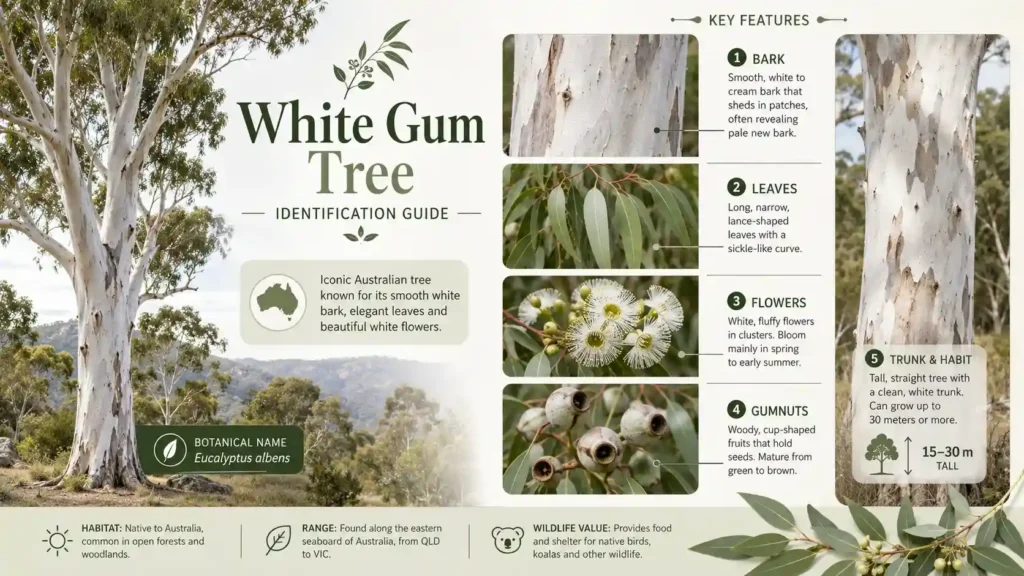
White gum trees produce narrow, leathery leaves rich in aromatic oils. Gum tree leaves are usually green to blue-green and hang vertically to reduce moisture loss in hot climates. Juvenile leaves may appear rounder, while mature leaves become long and lance-shaped.
There are different types of eucalyptus leaves depending on the species. Some ornamental varieties, such as silver dollar gum, feature rounded juvenile foliage commonly used in floral arrangements.
Key leaf characteristics include:
Gum flowers are another identifying feature. Most white flowering varieties produce clusters of fluffy blossoms filled with nectar-rich stamens. Flower color ranges from white and cream to pink and red depending on the species.
After flowering, the tree develops woody seed capsules commonly called gum tree nuts or gumnuts. A gumnut eucalyptus tree produces these hard capsules in different sizes and shapes. Gumnuts contain seeds that help regenerate eucalyptus forests after fire or drought.
Many white gum species are classified as fast growing gum trees because they establish quickly and develop strong vertical growth within a few years. Growth speed depends on climate, soil quality, water availability, and species type.
Some white gums become towering forest trees, while others remain compact enough for residential gardens. Small gum trees are increasingly popular in modern landscaping because they provide ornamental value without excessive canopy spread.
Many compact eucalyptus selections are now favored for residential gardens where manageable growth and decorative foliage are equally important.
Examples include:
| Tree Type | Approximate Height |
| Smallest gum tree varieties | 6–10 feet |
| Medium ornamental gums | 20–40 feet |
| Large white gum species | 60–150+ feet |
The smallest gum tree varieties are often cultivated for urban gardens and compact outdoor spaces where root control is important.
Tree height and spread vary significantly between species. Some develop narrow upright canopies, while others form broad crowns suitable for shade planting.
The growth rate and lifespan of eucalyptus trees are impressive. Many species grow rapidly during their early years and can survive for several decades under suitable conditions. In ideal environments, some large species may live well over 100 years.
People often ask, “How long do gum trees live?” The answer depends on the species, but most healthy eucalyptus trees are considered long-living landscape trees.
The gum tree root system is extensive and designed to search efficiently for moisture. Most species develop both deep anchor roots and widespread surface roots. This aggressive root structure helps trees survive drought but can create challenges near buildings and underground utilities.
Root spread near homes is one of the most important considerations before planting a white gum tree. Large species should be positioned far from:
White gums are also known for high water usage, especially during active growth periods. In dry regions, mature trees can absorb significant amounts of groundwater.
Some species may become invasive outside their native habitat if not managed properly. Fast-growing roots and self-seeding behavior can allow eucalyptus trees to spread into surrounding landscapes.
Safety considerations are important because older gum trees may shed bark, branches, or limbs during storms and drought stress. Proper pruning, spacing, and species selection help reduce structural risks and improve long-term tree stability.
Eucalyptus scoparia, commonly known as Wallangarra White Gum, is one of the most popular ornamental eucalyptus species in Australia. This elegant tree is valued for its smooth white trunk, dense canopy, and excellent adaptability in residential landscapes.
The Eucalyptus scoparia Wallangarra White Gum is widely planted as a street tree and feature tree because of its clean appearance and relatively manageable growth habit. Compared to larger eucalyptus species, E scoparia develops a more compact crown, making it suitable for gardens, parks, and urban planting.
Key characteristics include:
This white gum eucalyptus also produces clusters of soft white flowers that attract bees and birds. As a white flowering gum tree, it adds both ornamental and ecological value to outdoor spaces.
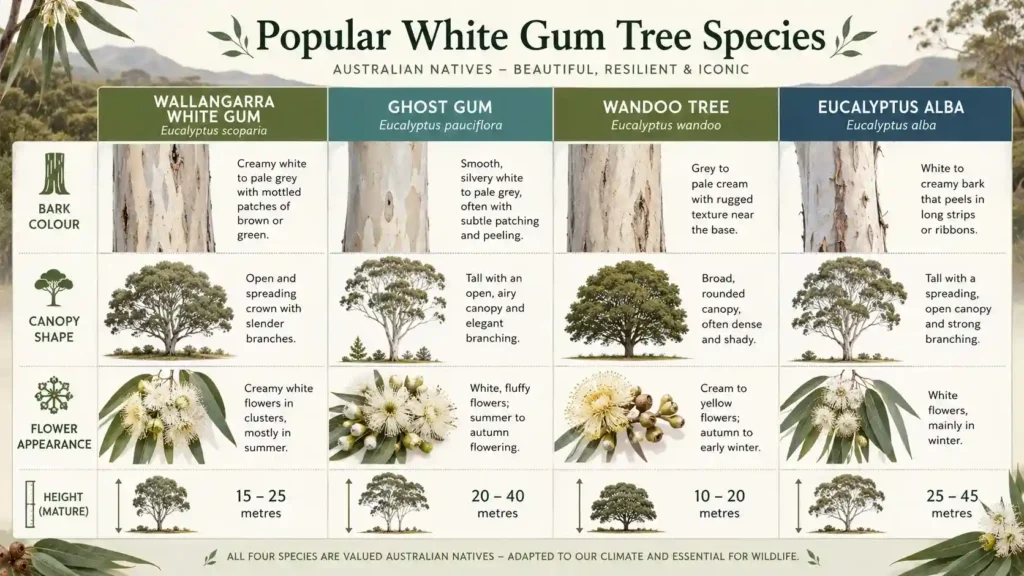
Eucalyptus alba is another well-known white eucalyptus tree recognized for its striking pale bark and adaptability to tropical climates. Native to northern Australia and nearby regions, this species thrives in warm environments with seasonal rainfall.
The bark of Eucalyptus alba ranges from creamy white to light gray and peels naturally as the tree matures. Its open canopy and upright form make it a visually appealing tropical white bark eucalyptus for large landscapes and rural properties.
Important features of Eucalyptus alba include:
| Feature | Description |
| Bark Color | White to pale cream |
| Climate | Tropical and subtropical |
| Growth Habit | Upright and spreading |
| Foliage | Narrow aromatic leaves |
| Uses | Shade, landscaping, habitat support |
This species is commonly planted for erosion control, wind protection, and ornamental landscaping in warm climates.
The wandoo tree is a distinctive Western Australian eucalyptus species famous for its smooth pale bark and highly durable hardwood. Wandoo trees naturally grow in dry woodland regions and are extremely tolerant of heat and drought conditions.
The trunk typically displays cream, white, or light gray bark that peels in patches over time. Mature trees form broad canopies that provide shade and habitat for wildlife.
Wandoo timber is highly valued because of its exceptional hardness and durability. Traditionally, wandoo wood has been used for:
Due to its strength and density, wandoo remains one of the most respected Australian hardwood species.
Ghost gum trees are among the most visually recognizable eucalyptus species in Australia. Their bright white trunk appearance creates a dramatic contrast against natural landscapes, especially during sunrise, sunset, or moonlight.
These trees belong mainly to species such as Corymbia aparrerinja and are commonly found in central and northern Australia. The trunk remains smooth and brilliantly white throughout most of the year, giving the tree its “ghost” appearance.
The landscaping value of ghost gums is extremely high because they provide:
Ghost gum trees are frequently planted in parks, resorts, and large residential properties where their striking bark can become a focal feature.
Australia contains hundreds of eucalyptus species, including many closely related gum trees with ornamental or commercial value.
Some notable examples include:
“Some ornamental gum species are also appreciated for their silvery foliage and highly decorative flowering habits in native garden designs.
These species vary in size, bark texture, foliage shape, and environmental adaptation, but all belong to the broader eucalyptus and Australian gum tree group.
Australia is home to an enormous variety of eucalyptus and gum tree species. There are hundreds of types of gum trees across the country, ranging from towering forest trees to small ornamental varieties used in urban landscaping.
The term “gum tree” generally refers to trees within the eucalyptus group, although related genera such as Corymbia and Angophora are also included. These gumtree types are adapted to different climates, rainfall levels, and soil conditions throughout Australia.
The main types of gum trees in Australia are commonly grouped by bark texture, habitat, and growth characteristics.
Major Australian gum tree groups include:
| Gum Tree Group | Main Characteristics |
| Stringybark | Thick fibrous bark |
| Ironbark | Dark rough bark with hard timber |
| Box Eucalypts | Dense bark and rounded crowns |
| Bloodwoods | Rough bark with resinous sap |
| Peppermints | Aromatic leaves with rough bark |
| Smooth-Barked Gums | White or cream peeling bark |
| Mallee Eucalypts | Multi-stemmed smaller forms |
Smooth-barked gums are among the most visually recognizable types because of their pale trunks and ornamental appearance. Many white gum species belong to this category.
Australia’s climate diversity allows different gumtree types to thrive in:
This ecological adaptability explains why eucalyptus trees dominate so much of the Australian landscape.
There are more than 700 known species of eucalyptus, making it one of the world’s largest tree genera. Many common eucalyptus tree species are widely cultivated for landscaping, timber production, shade, and environmental restoration.
Some Australian eucalyptus tree species are famous for their ornamental bark, while others are valued for hardwood timber or essential oil production.
Popular eucalyptus tree varieties include:
These species of eucalyptus differ greatly in:
Some eucalyptus tree varieties can grow over 200 feet tall, while dwarf forms remain compact enough for small gardens and residential landscaping.
Western Australia contains some of the country’s most distinctive eucalyptus forests and woodland ecosystems. The region supports many native Western Australian gum trees that are specially adapted to dry summers and nutrient-poor soils.
Several Western Australian eucalyptus trees are recognized for their striking bark colors, hardwood quality, and drought tolerance.
Common eucalyptus species western Australia include:
| Species | Key Feature |
| Wandoo | Smooth pale bark and dense hardwood |
| Salmon Gum | Salmon-colored trunk |
| Marri | Rough bark with large gum nuts |
| Jarrah | Durable red hardwood |
| Tuart | Coastal limestone adaptation |
| Gimlet | Twisted shiny trunk |
| Powderbark | White powdery bark texture |
Many Western Australian gum trees are important for both ecological and commercial purposes. Their forests provide habitat for birds, mammals, and pollinators while also supporting timber industries.
Western Australian eucalyptus trees are especially valued for:
These species play a major role in Australia’s biodiversity and remain some of the most iconic native trees in the country.
A white flowering gum tree is admired for its soft clusters of creamy white blossoms that appear against green foliage and pale bark. These flowers are produced by many eucalyptus species and are one of the main reasons flowering gums are popular in ornamental landscaping.
Unlike traditional flowers with visible petals, eucalyptus blooms consist mainly of dense stamens that create a fluffy or brush-like appearance. The flowers often grow in clusters and produce large amounts of nectar.
A white flowering eucalyptus may bloom during different seasons depending on the species and local climate. Some varieties flower in spring and summer, while others bloom during autumn or early winter.
Common flower characteristics include:
A flowering eucalyptus tree can significantly enhance the visual appeal of gardens, parks, and streetscapes. The contrast between white flowers and smooth white bark creates a clean and elegant landscape appearance.
Many flowering gum tree species are also valued for their ability to bloom consistently under warm and dry conditions.
White flowering gum trees provide important environmental benefits by supporting pollinators and native wildlife. Their nectar-rich flowers attract a wide range of beneficial species throughout the flowering season.
Birds and bees attraction is one of the most valuable ecological features of eucalyptus trees. The blossoms supply food for:
Flowering gum trees also help strengthen native ecosystem support by providing shelter, nesting areas, and food sources for animals living in eucalyptus woodlands and urban green spaces.
The dense canopy and year-round foliage create habitat stability while fallen bark and leaves contribute organic matter to the soil ecosystem.
Because of these ecological advantages, many councils and conservation projects continue planting native eucalyptus species in parks, roadsides, and restoration areas.
White flowering gum trees are highly valued as ornamental landscape trees because they combine attractive bark, evergreen foliage, and seasonal flowers in a single species.
Many designers choose these white trees for landscaping because they create strong visual contrast and work well in both modern and natural-style gardens.
Trees with decorative bark and seasonal flowering displays are often included in broader ornamental planting schemes designed for Australian-style landscapes.
Popular landscaping uses include:
An Australian tree with white flowers can become a focal point in residential and commercial landscapes, especially when planted against darker foliage or stone features.
Street trees and garden feature trees are commonly selected from smaller or medium-sized eucalyptus species that offer manageable growth habits and attractive flowering displays.
The combination of white bark, aromatic leaves, and seasonal flowers makes flowering gum trees some of the most recognizable and versatile native Australian landscape trees.
White gum trees grow best in warm, sunny environments with good airflow and well-drained soil. Most eucalyptus species are naturally adapted to Australian climates, making them highly tolerant of heat, dry weather, and seasonal drought conditions.
Sunlight requirements are important for healthy growth. White gum trees typically need:
Poor light conditions can reduce flowering, weaken branch development, and slow overall growth.
Soil drainage is another major factor. Eucalyptus roots do not perform well in constantly wet or compacted soil. Well-draining sandy or loamy soil is ideal for preventing root rot and fungal problems.
Suitable soil conditions include:
| Soil Feature | Recommended Condition |
| Drainage | Fast-draining |
| Soil Type | Sandy or loamy |
| pH Range | Slightly acidic to neutral |
| Moisture | Moderate during establishment |
Climate suitability varies between species, but most white gums thrive in:
Some tropical species tolerate humidity well, while alpine eucalyptus species can survive colder temperatures and occasional frost.
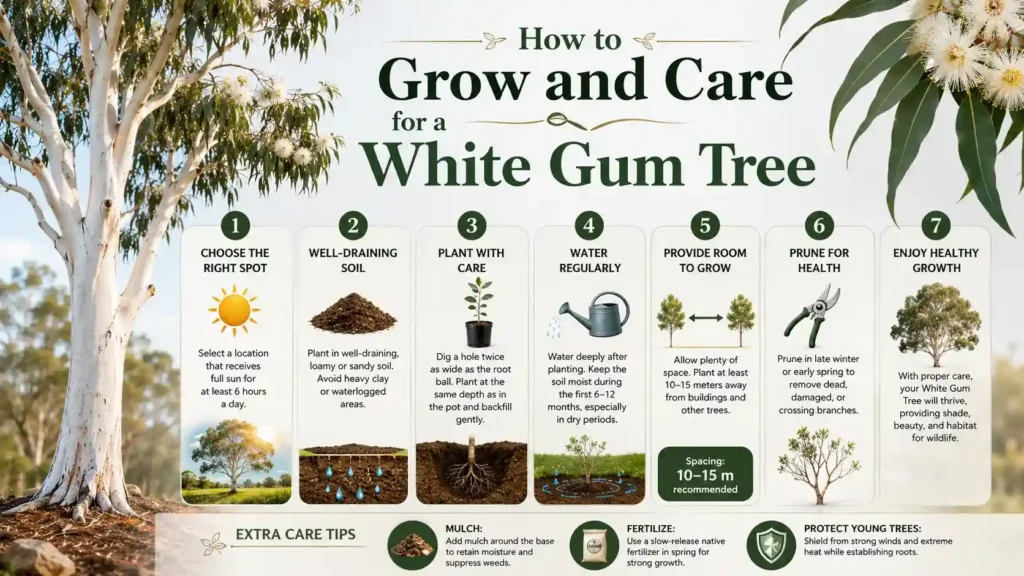
Proper gum tree plant setup helps establish strong root growth and long-term stability. White gum trees should be planted in open areas where mature height and root spread can be accommodated safely.
Basic planting steps include:
Spacing recommendations depend on the species size. Small ornamental gums may need only 10–15 feet of spacing, while larger eucalyptus trees may require 30–50 feet or more from buildings and nearby trees.
Proper spacing improves:
Watering after planting is essential during the establishment period. Young white gum trees need consistent moisture until roots become established.
General watering guidelines include:
Most mature eucalyptus trees become drought tolerant once fully established.
White gum trees are relatively low-maintenance but still benefit from occasional pruning and monitoring. Proper care helps maintain tree structure, reduce hazards, and improve appearance.
Pruning methods should focus on:
Heavy pruning is usually unnecessary for healthy eucalyptus trees. Over-pruning may stress the tree and encourage unstable regrowth.
Managing gum tree branches is important because some species naturally shed limbs during hot weather or drought conditions. Regular inspections help identify weak or overextended branches before they become hazardous.
Homeowners should also expect periodic bark shedding as part of the tree’s natural growth cycle.
Cleaning fallen bark and leaves may be necessary because eucalyptus trees can produce significant debris, especially during windy or dry conditions. Routine cleanup helps reduce fire risk and keeps landscaped areas tidy.
Although eucalyptus trees are generally hardy, they can still experience several common problems under poor growing conditions.
Typical pests affecting white gum trees include:
These pests may damage foliage, weaken growth, or stress young trees.
Root issues are commonly linked to poor drainage or planting trees too close to structures. Overwatering and compacted soil can lead to fungal root diseases and instability.
Some fast-growing species may also develop weak branches, particularly if they grow too quickly in fertile conditions. Weak limb attachment increases the risk of branch drop during storms or drought stress.
Drought stress can cause:
Proper watering during extended dry periods helps reduce stress and maintain healthy canopy growth.
Regular monitoring, correct planting location, and proper maintenance are the most effective ways to keep a white gum tree healthy and structurally stable over time.
White gum trees are widely planted for landscaping because they combine rapid growth, attractive bark, and evergreen foliage in a single tree. Their smooth white trunks and tall canopies create a striking visual feature in residential gardens, parks, and large outdoor spaces.
Many species are used as privacy screens because of their dense foliage and upright growth habit. When planted in rows, white gums can provide natural screening from roads, neighboring properties, and wind exposure.
Key landscaping benefits include:
A fast-growing shade tree like a white gum can quickly cool outdoor areas and improve comfort in warm climates. Large species are often planted near open lawns, rural properties, and streets where broad shade coverage is needed.
The ornamental value of white gum trees also makes them popular as:
Their combination of bark texture, flowering displays, and aromatic foliage adds year-round interest to landscapes.
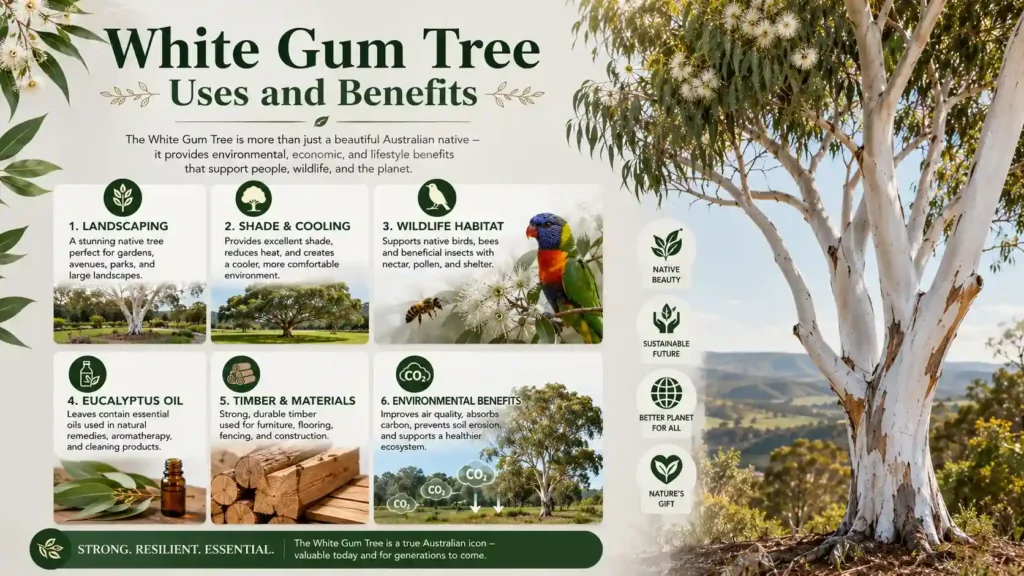
Several eucalyptus species produce dense, durable hardwood used in construction and industrial applications. Among the most respected hardwoods is wandoo wood, known for its exceptional strength and resistance to wear.
Wandoo timber is commonly used for:
Because of its density and hardness, wandoo remains one of Australia’s premium native hardwood materials.
Many eucalyptus hardwood applications extend beyond construction. Eucalyptus timber is also used for:
| Application | Common Use |
| Furniture | Durable hardwood furniture |
| Firewood | High heat output |
| Flooring | Wear-resistant surfaces |
| Poles and posts | Outdoor structural use |
| Woodworking | Decorative timber products |
The fast growth rate of some eucalyptus species also supports commercial timber plantations in several countries.
White gum trees play a major role in supporting ecosystems and improving environmental stability. Their large canopies and deep root systems contribute valuable ecological benefits in both natural forests and urban landscapes.
One major advantage is wildlife habitat creation. Eucalyptus trees provide food, nesting sites, and shelter for many species including:
The flowers, bark, and foliage all contribute to biodiversity support.
Soil stabilization is another important benefit. Extensive root systems help reduce erosion on slopes, roadsides, and degraded landscapes. In rural regions, gum trees are often planted to stabilize soil and reduce wind damage.
White gum trees also contribute to carbon absorption by storing carbon dioxide through rapid growth and long-term biomass production. Large eucalyptus forests are considered important natural carbon sinks that help support climate regulation.
Additional environmental benefits include:
Eucalyptus trees are widely recognized for their aromatic foliage and essential oil production. Many species contain natural oils rich in compounds such as eucalyptol, which is commonly used in medicinal and household products.
Traditional eucalyptus gum uses have existed for generations, especially in Indigenous Australian practices and herbal remedies.
Common uses include:
The aromatic foliage releases a strong refreshing scent, particularly when leaves are crushed or exposed to heat. This fragrance is one reason eucalyptus trees are commonly planted near walkways, gardens, and outdoor living areas.
Traditional uses of eucalyptus leaves and oils have included:
Today, eucalyptus oil remains widely used in personal care products, aromatherapy, and wellness industries around the world.
White gum trees and blue gum eucalyptus trees belong to the same eucalyptus family, but they differ in appearance, growth habit, and common uses.
White gums are mainly recognized for their smooth white bark and ornamental landscape value. Blue gums, especially Southern Blue Gum (Eucalyptus globulus), are larger and more commonly grown for timber and essential oil production.
Key differences include:
| Feature | White Gum | Blue Gum |
| Bark Color | White to cream | Blue-gray to brown |
| Main Use | Landscaping and shade | Timber and oil production |
| Growth Habit | Ornamental and upright | Very tall and fast-growing |
| Foliage | Green to blue-green | Blue-green aromatic leaves |
| Popular Feature | Bright white trunk | Rapid growth |
Blue gum species generally grow taller and faster than most ornamental white gums. White gums, however, are often preferred in residential landscaping because of their cleaner trunk appearance and manageable canopy shape.
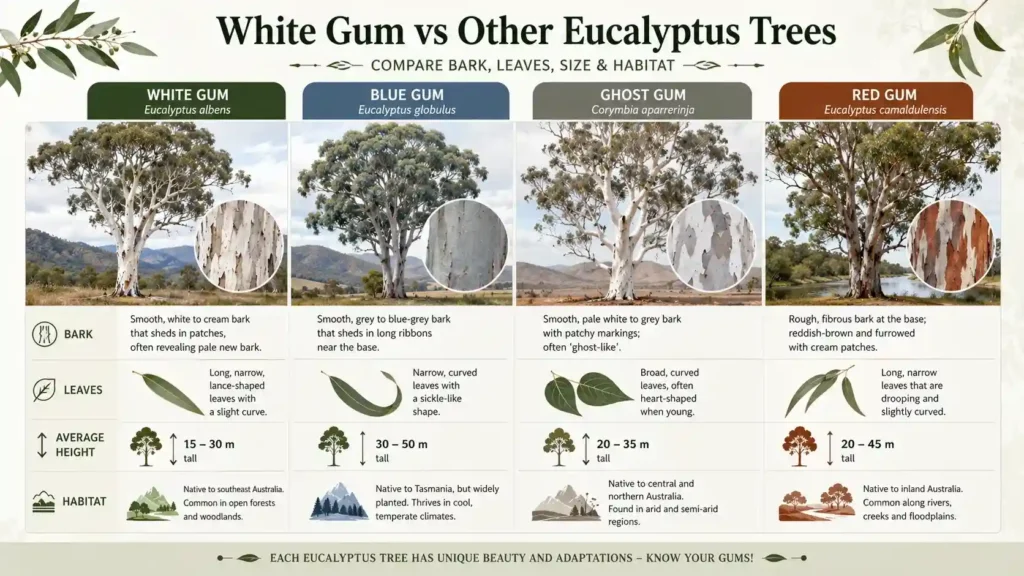
White gum and ghost gum trees are frequently confused because both feature pale bark. However, ghost gum trees usually display a much brighter and more reflective trunk appearance.
Ghost gums are famous for their almost glowing white bark, especially at night or under strong sunlight. White gum trees often have creamier tones and denser canopies.
Main differences include:
In terms of landscaping value, both species are highly ornamental, but ghost gums are often selected as dramatic feature trees because of their striking bark contrast.
Red gum trees differ significantly from white gum species in bark color, habitat preference, and overall appearance.
River Red Gum (Eucalyptus camaldulensis) is one of Australia’s most iconic eucalyptus species and is commonly found near rivers, floodplains, and wetlands.
Comparison highlights include:
| Feature | White Gum | Red Gum Tree |
| Bark Color | White or cream | Red-brown and gray |
| Habitat | Dry to moderate climates | Riverbanks and wetlands |
| Appearance | Smooth pale trunk | Rougher bark texture |
| Landscaping Use | Ornamental feature tree | Large shade and habitat tree |
| Water Needs | Moderate to low | Higher moisture tolerance |
Red gum trees usually develop broader canopies and larger trunk diameters than many white gum species.
Identifying gum trees requires observing several important characteristics because Australia contains hundreds of eucalyptus species with varying bark, leaves, and growth habits.
The most reliable features used for identifying gum trees include:
For example:
Many gardeners and arborists use Australian gum trees identification pictures to compare bark patterns, leaves, and gumnuts when determining species.
Accurate gum tree identification Australia resources often include:
| Identification Feature | Importance |
| Bark appearance | One of the easiest visual clues |
| Leaves | Helps identify mature vs juvenile growth |
| Gumnuts | Species-specific shape differences |
| Flowers | Color and arrangement vary |
| Habitat location | Helps narrow species range |
Because some eucalyptus species look similar, professional identification may sometimes be necessary for large mature trees or rare regional varieties.
Eucalyptus trees represent one of the largest and most diverse tree groups in the world. Many people ask, “How many species of eucalyptus are there?” Current botanical research estimates that there are more than 700 recognized eucalyptus species globally.
Most of these species are native to Australia, making the country the primary center of eucalyptus diversity. In fact, when people ask how many eucalyptus species in Australia exist, the answer is that the vast majority of known species naturally grow across Australian forests, woodlands, and dry inland regions.
These species vary greatly in:
Some eucalyptus species remain small ornamental trees, while others become massive forest giants exceeding 200 feet in height.
Australia’s diverse climate zones have allowed eucalyptus trees to evolve into highly specialized forms capable of surviving:
This adaptability is one reason eucalyptus trees dominate so much of the Australian landscape.
One of the most recognizable traits of many eucalyptus trees is their peeling bark. Gum trees naturally shed bark as part of their normal growth cycle.
The outer bark layer gradually loosens and falls away in strips, flakes, or patches. This process helps the tree maintain healthy trunk tissue and remove harmful organisms.
Reasons gum trees shed bark include:
Smooth-barked species such as white gum and ghost gum are especially known for dramatic seasonal bark shedding.
Fresh bark underneath often appears brighter and cleaner, helping maintain the tree’s ornamental appearance.
The bright bark color of many white gum species is more than just decorative. White bark helps the tree survive harsh environmental conditions, particularly in hot Australian climates.
Light-colored bark reflects sunlight more effectively than dark bark, helping reduce trunk temperature during extreme heat. This protection is especially important in dry inland regions with intense solar exposure.
Benefits of white bark include:
| White Bark Advantage | Benefit to the Tree |
| Heat reflection | Prevents overheating |
| Sun protection | Reduces bark damage |
| Pest reduction | Limits parasite buildup |
| Temperature control | Supports internal moisture balance |
The smooth surface of white bark also makes it harder for insects, moss, and fungi to establish themselves on the trunk.
This natural adaptation contributes to the long-term resilience of many white eucalyptus species.
White gum trees and other eucalyptus species play a central role in Australian ecosystems. They provide food, shelter, and environmental stability across forests, grasslands, and woodland habitats.
Many native animals rely directly on eucalyptus trees, including:
Eucalyptus forests also help regulate local ecosystems by supporting soil stability, moisture retention, and biodiversity.
One of the most unique ecological traits of gum trees is their adaptation to bushfires. Many eucalyptus species can survive fire through:
This fire adaptation allows eucalyptus forests to regenerate naturally after wildfires, making them a critical part of Australia’s ecological balance.
White gum trees are not only iconic Australian landscape trees but also essential components of the country’s natural environmental systems.
| Feature | White Gum Tree |
| Botanical Name | Eucalyptus scoparia / Eucalyptus alba |
| Family | Myrtaceae |
| Bark Color | White to cream |
| Native Region | Australia |
| Growth Rate | Fast |
| Flower Color | White |
| Lifespan | Long-living |
| Root System | Wide-spreading |
| Uses | Landscaping, timber, shade |
White gum trees are among the most recognizable and versatile members of the eucalyptus family. Their smooth white bark, evergreen foliage, fast growth, and seasonal flowers make them highly valued across Australian landscapes and gardens. From ornamental species like Wallangarra White Gum to larger native eucalyptus varieties, these trees provide both visual appeal and practical environmental benefits.
In landscaping, white bark eucalyptus trees are widely used for shade, privacy screening, feature planting, and wildlife-friendly garden design. Their elegant trunks and aromatic foliage create strong year-round interest in parks, streetscapes, and residential properties.
The continued popularity of white gum trees comes from their adaptability, drought tolerance, and distinctive appearance. However, proper identification and care remain important when selecting a species for planting. Understanding growth size, root spread, and climate suitability helps ensure healthy long-term development and safer landscape placement.
With the right maintenance and location, a white gum tree can become a durable, attractive, and valuable addition to both natural and designed outdoor spaces.
Yes, a white gum tree is a type of eucalyptus tree. The term “gum tree” is commonly used in Australia to describe many species within the eucalyptus family. White gum trees are known for their pale bark, aromatic leaves, and ornamental value.
The scientific name depends on the species. Two common white gum species are Eucalyptus scoparia (Wallangarra White Gum) and Eucalyptus alba (White Gum). Both belong to the Myrtaceae family and the eucalyptus genus.
White gum trees grow naturally in Australia, especially in woodland, coastal, and dry inland regions. Different species are adapted to tropical, subtropical, and temperate Australian climates.
Most white gum trees are considered fast-growing. Under suitable sunlight, soil, and moisture conditions, some species can grow several feet per year during their early development stages.
White gum tree roots can spread widely, especially in large eucalyptus species. Planting too close to foundations, pipes, or paved areas may cause structural problems over time. Proper spacing is important before planting.
Popular white flowering eucalyptus trees include: Eucalyptus scoparia Eucalyptus alba Ghost gum species Silver dollar gum eucalyptus Snow gum varieties These trees are valued for their white flowers, ornamental bark, and landscape appeal.
A white bark gum tree is usually identified by: Smooth white or cream-colored bark Peeling trunk surface Aromatic eucalyptus leaves Gumnuts and clustered flowers Tall upright growth habit Bark appearance is often the easiest identifying feature.
Yes, many white gum trees naturally shed bark throughout the year. Bark shedding helps remove parasites, fungi, and damaged outer layers while also helping regulate trunk temperature.
Yes, smaller and medium-sized white gum species are commonly used in residential gardens. They provide shade, ornamental beauty, and wildlife support. Choosing the correct species size is important for long-term space management.
White gum trees attract birds, bees, butterflies, and pollinators because their flowers produce abundant nectar. They also provide shelter and nesting habitat for native wildlife.
Most eucalyptus white gum species are highly drought tolerant once established. Their deep root systems and adaptive foliage help them survive dry Australian climates.
The lifespan varies by species and growing conditions, but many white gum trees are long-living and can survive for several decades. Large native eucalyptus species may live well over 100 years.
Yes, many councils and landscapers use white gum trees as street trees because of their attractive bark, rapid growth, and shade-producing canopy. Compact ornamental species are especially popular in urban planting projects.
White bark eucalyptus trees remain popular because they combine fast growth, striking bark color, evergreen foliage, and strong drought tolerance. Their clean architectural appearance suits both modern and natural landscape designs.