Grow Better Gardens with Smarter Plant Choices
Discover helpful guides on trees, hedges, fruit plants, edible plants, and beautiful landscape greenery.
A small eucalyptus tree is becoming one of the most popular choices for modern home gardens, compact courtyards, and space-conscious landscapes. Unlike the massive gum trees commonly associated with the Australian bush, many dwarf eucalyptus varieties and small eucalypts are naturally compact, manageable, and highly ornamental. These smaller forms offer attractive bark, aromatic foliage, colorful flowers, and fast growth without overwhelming limited garden spaces. From dwarf flowering gums to bushy mallee forms, there are many species suited to urban gardens and container growing. This guide covers the most popular types, species identification, growth habits, care requirements, landscaping uses, and the best small eucalyptus varieties for different climates and garden styles.
|
Feature |
Details |
|
Common Names |
Small eucalyptus tree, dwarf gum tree, dwarf eucalyptus |
| Family |
Myrtaceae |
|
Native To |
Australia |
| Height Range (Dwarf) |
1.5m – 8m depending on species |
|
Growth Rate |
Moderate to fast |
| Leaf Types |
Round, narrow, lemon-scented, blue-grey |
|
Flower Colors |
White, red, pink, yellow, cream |
| Climate Suitability |
Temperate, Mediterranean, semi-arid |
A small eucalyptus tree refers to compact-growing eucalypt trees that are better suited to residential gardens, courtyards, urban landscapes, and smaller outdoor spaces. Unlike towering forest gums, dwarf eucalyptus and small eucalypts are selected or naturally adapted to remain manageable in size while still providing the signature foliage, bark, flowers, and fragrance associated with Australian gum trees.
These compact forms may grow as upright trees, multi-stemmed mallee forms, or dense shrub-like specimens. Some species resemble a rounded eucalyptus bush, while others develop into elegant ornamental trees with smooth trunks and open canopies. Depending on the species, a small eucalyptus tree can be used for screening, wildlife planting, container growing, or feature landscaping.
Many gardeners choose a dwarf eucalyptus because it delivers the visual appeal of traditional gum trees without the extreme height or broad canopy spread common in larger Australian species.
The biggest difference between standard eucalyptus species and dwarf forms is overall mature size. Full-size eucalyptus trees can exceed 30–60 meters in natural forests, while compact varieties are specifically valued for smaller landscapes.
| Type | Average Height |
Canopy Spread |
| Full-Size Eucalyptus | 20–60m+ |
Very wide |
|
Small Eucalypts |
3–8m | Compact to moderate |
| Dwarf Eucalyptus | 1.5–5m |
Narrow to bushy |
Some dwarf flowering gums remain under 3 meters, while others classified as small eucalyptus trees may still reach 6–8 meters under ideal conditions.
Small eucalyptus species grow in two main forms:
Mallee forms are especially popular in water-wise landscaping because they provide texture, habitat value, and strong drought tolerance.
The term “small eucalyptus” is relative within the eucalyptus world. Since many wild gum trees become extremely large, even an 8-meter tree may still be considered compact by Australian native tree standards.
Factors affecting final size include:
Because of this variation, checking the mature height of each dwarf eucalyptus species is essential before planting.
The eucalyptus tree family belongs to the botanical family Myrtaceae, a large plant group that also includes bottlebrushes, tea trees, lilly pillies, and myrtles. Eucalyptus spp are among the most recognizable native trees in Australia and dominate many natural ecosystems across the continent.
Historically, many species were grouped under the genus Eucalyptus, but modern botanical classification now separates some species into closely related genera such as Corymbia.
|
Genus |
Characteristics |
|
Eucalyptus |
Traditional gum trees and mallee forms |
| Corymbia |
Includes lemon-scented gums and bloodwoods |
Many popular ornamental dwarf eucalyptus varieties come from both genera.
Australia is home to more than 800 species of eucalyptus, making it one of the most diverse native tree groups in the world. These eucalypts of Australia range from towering forest giants to compact arid-zone mallees and low-growing ornamental shrubs.
The enormous diversity of species of eucalyptus allows gardeners to choose trees suited to:
This adaptability is one reason small eucalyptus trees continue to grow in popularity across both Australian and international landscapes.
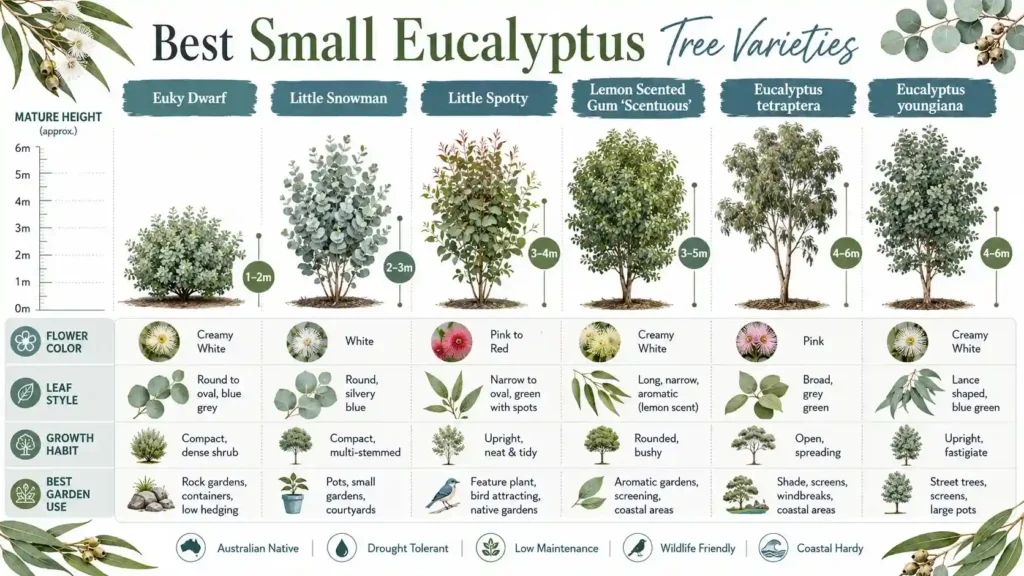
There are many types of eucalyptus trees suited to compact gardens, urban landscapes, and smaller outdoor spaces. Some eucalyptus tree species are naturally low-growing, while others are specially cultivated dwarf forms selected for reduced height, ornamental flowers, attractive bark, or compact canopies. These eucalyptus varieties include flowering gums, mallee forms, snow gums, and lemon-scented species adapted to different climates across Australia.
Many of these compact ornamental species are also widely used in broader flowering tree landscapes designed for smaller residential gardens and native-style planting schemes.
The wide diversity of eucalyptus tree types allows gardeners to select trees for cold regions, dry inland landscapes, coastal gardens, wildlife planting, or decorative courtyard use. Many common eucalyptus tree species used in residential landscaping come from Australian eucalyptus tree species known for their adaptability and fast growth.
|
Species |
Common Name | Height | Flower Color | Special Feature |
| E. leucoxylon ‘Euky Dwarf’ | Euky Dwarf | 3–6m | Pink/Red/Cream |
Most popular dwarf street tree |
|
Corymbia citriodora |
Lemon Scented Gum | 8–25m (dwarf: 4–6m) | White | Strong lemon fragrance |
| E. pauciflora ‘Little Snowman’ | Little Snowman | 3–5m | White |
Snow gum, grey-green foliage |
|
E. mannifera ‘Little Spotty’ |
Little Spotty | 4–6m | White | Spotted bark, ghost gum type |
| E. gillii | Giles Mallee | 2–5m | Cream/Yellow |
Arid zones, bushy mallee form |
|
E. stoatei |
Scarlet Pear Gum | 3–5m | Red | WA native, ornamental |
| E. tetraptera | Square-fruited Mallee | 1–3m | Red |
Coastal WA, unusual square fruits |
|
E. youngiana |
Large-fruited Mallee | 3–6m | Pink/Red | Arid WA, ornamental |
| E. foecunda | Narrow-leaved Mallee | 2–4m | White/Cream |
Bushy, multi-stemmed |
|
E. leucoxylon ‘Rosea Dwarf’ |
Dwarf Rosea | 3–5m | Pink | Compact flowering form |
| E. miniata | Darwin Woollybutt | 10–20m (included as note) | Orange-red |
Tropical species |
The euky dwarf is one of the most widely planted compact flowering gums for suburban landscapes and streetscapes. Officially known as Eucalyptus leucoxylon ‘Euky Dwarf’, this ornamental cultivar is valued for its manageable size, long flowering season, and adaptability to smaller gardens.
Many gardeners specifically choose compact flowering gums because they combine manageable size with extended seasonal flowering and strong wildlife appeal.
The euky dwarf tree typically grows between 3–6 meters tall with a spread of around 2–4 meters, making it ideal for courtyards, driveways, and urban planting schemes. Unlike larger gum trees, the euky dwarf gum maintains a compact canopy while still producing abundant nectar-rich flowers.
Key features of eucalyptus leucoxylon euky dwarf include:
The euky dwarf gum tree is commonly used in:
This compact dwarf sugar gum cultivar is also popular because it is widely available through Australian nurseries and garden retailers, including Bunnings.
The lemon scented gum is one of the most recognizable Australian native trees due to its fragrant foliage and smooth pale trunk. Scientifically classified as Corymbia citriodora, this species was previously grouped under Eucalyptus citriodora, and both names are still commonly used in horticulture.
In natural conditions, corymbia citriodora can grow 25 meters or taller. However, compact cultivated forms such as Corymbia citriodora Scentuous have made this species suitable for smaller residential gardens.
|
Feature |
Details |
|
Scientific Name |
Corymbia citriodora |
| Common Names |
Lemon scented eucalyptus tree, lemon gum eucalyptus |
|
Dwarf Cultivar |
‘Scentuous’ |
| Mature Height |
4–6m |
|
Bark |
Smooth white to pale grey |
| Leaf Feature |
Strong lemon fragrance |
The foliage of c. citriodora contains aromatic oils commonly associated with:
The compact cultivar corymbia scentuous or dwarf lemon scented gum maintains the species’ signature fragrance while offering a more manageable height for suburban planting.
Other commonly used names include:
This smaller form performs best in full sun and warm climates with well-drained soil.
The eucalyptus little snowman is a compact cultivar within the snow gum group, prized for its cold tolerance and attractive silver-grey foliage. Officially known as Eucalyptus pauciflora ‘Little Snowman’, this dwarf form is especially suitable for cooler climates and frost-prone gardens.
The little snowman eucalyptus usually reaches 3–5 meters in height and develops a rounded canopy with smooth decorative bark. White flowers appear seasonally and attract pollinators including birds and beneficial insects.
Because of its alpine heritage, eucalyptus pauciflora little snowman performs better in cool temperate regions than many heat-loving gum species. It is commonly used in:
Its compact size and soft foliage color also make it popular in contemporary Australian garden design.
The little spotty eucalyptus is a compact ornamental selection derived from Brittle Gum species. Known botanically as Eucalyptus mannifera ‘Little Spotty’, this tree is admired for its decorative spotted bark and tidy growth habit.
The eucalyptus mannifera little spotty typically grows between 4–6 meters tall, forming a moderately dense canopy suitable for suburban planting.
The bark of eucalyptus little spotty develops contrasting patches that create year-round visual interest, especially in winter landscapes.
This cultivar performs best in:
Because of its manageable size and ornamental bark, Little Spotty is increasingly used as an alternative to larger gum species in urban gardens.
Several lesser-known Australian eucalyptus tree species are also highly valued for ornamental landscaping, wildlife habitat, and compact growth habits.
Eucalyptus gillii is a hardy arid-zone mallee species with a naturally bushy form. It typically grows 2–5 meters tall and produces cream to yellow flowers suited to dry inland climates and low-water gardens.
Known for its dramatic red flowers, eucalyptus stoatei is an ornamental WA eucalyptus species ideal for feature planting. This pink eucalyptus tree relative grows around 3–5 meters tall and attracts nectar-feeding birds.
Eucalyptus tetraptera is famous for its unusual square-shaped gum nuts and striking red flowers. This compact coastal Western Australian species often remains under 3 meters, making it one of the smallest gum tree options available.
Eucalyptus youngiana is a highly ornamental mallee species from arid Western Australia. It produces large decorative fruits and pink to red flowers, making it popular in native landscaping and collector gardens.
The bushy multi-stemmed form of eucalyptus foecunda makes it useful for screening and habitat gardens. This compact species typically reaches 2–4 meters and tolerates dry conditions well.
Additional compact ornamental types include:
Many of these WA eucalyptus species are highly adapted to drought conditions and poor soils, making them valuable for sustainable landscaping in warm climates.
The wide diversity of eucalyptus leaves types is one of the easiest ways to identify different eucalyptus species. Small eucalyptus trees can display dramatically different foliage depending on their age, species, and growing conditions. Some varieties develop rounded juvenile leaves, while others produce long narrow aromatic foliage associated with traditional gum trees.
Many eucalyptus leaf types also change as the tree matures. Juvenile foliage may appear silver-blue and rounded, while adult leaves become elongated and darker green. Understanding these eucalyptus types of leaves helps gardeners distinguish between ornamental dwarf forms, mallee species, and larger forest gums.
Round juvenile foliage is one of the most desirable ornamental traits in compact eucalyptus varieties. A round leaf eucalyptus tree is especially popular in modern landscaping and floral design because of its soft blue-grey tones and symmetrical leaf shape.
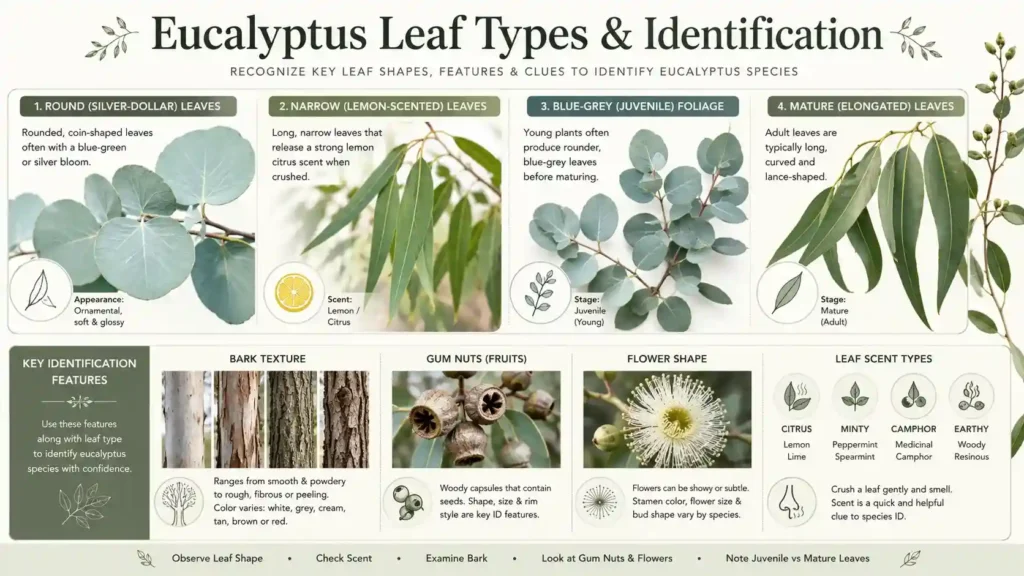
Many eucalyptus species produce two distinct foliage stages:
|
Foliage Stage |
Characteristics |
|
Juvenile Leaves |
Rounded, softer, blue-grey or silver |
| Adult Leaves |
Longer, narrower, darker green |
In many species, the rounded juvenile leaves disappear as the plant matures. However, some compact forms and mallee species retain decorative rounded foliage for much longer.
Common small eucalyptus varieties with attractive rounded foliage include:
A eucalyptus tree with round leaves is often grown specifically for:
The silver-dollar eucalyptus remains one of the most recognized ornamental types due to its silvery-blue foliage and strong visual texture.
Not all small eucalyptus species have rounded leaves. Many develop narrow, lance-shaped foliage designed to reduce moisture loss in hot Australian climates.
Leaf shape is an important identification feature among eucalyptus species. Long narrow foliage is common in:
The highly aromatic leaves of Corymbia citriodora are among the most distinctive in the eucalyptus family. This lemon-scented species produces elongated glossy leaves rich in fragrant oils.
|
Feature |
Description |
|
Leaf Shape |
Long and narrow |
| Aroma |
Strong lemon fragrance |
|
Color |
Bright to medium green |
| Common Species |
Corymbia citriodora |
The fragrant foliage of lemon-scented varieties is commonly associated with:
Blue-grey juvenile foliage is also common in many small eucalypts during their early growth stages. This soft silvery coloration adds ornamental value and contrasts well against darker landscape plants.
Many gardeners ask, “what does eucalyptus look like” because eucalyptus species can vary dramatically in shape, bark texture, leaf color, and canopy structure. Despite this diversity, most eucalyptus trees share several recognizable features.
|
Feature |
Typical Appearance |
|
Bark |
Smooth, peeling, fibrous, mottled, white, or grey |
| Leaves |
Round, narrow, blue-grey, or green |
|
Flowers |
White, pink, red, cream, yellow |
| Fruit |
Woody gum nuts or capsules |
One of the most distinctive features of eucalyptus trees is their bark. Depending on species, trunks may appear:
Some ornamental species, especially ghost gums and spotted gums, are planted specifically for their striking trunk color and bark patterns.
Eucalyptus foliage often contains aromatic oils released when crushed. Flowers usually appear fluffy or brush-like due to their prominent stamens and are highly attractive to birds and pollinators.
Flower colors may include:
Another defining feature of eucalyptus trees is their woody seed capsules, commonly called gum nuts. These capsules vary greatly in size and shape between species and are often used for species identification.
Some species produce:
The unusual capsules of certain mallee species, such as Eucalyptus tetraptera, are considered highly ornamental in native gardens and floral displays.
Eucalyptus species are among the most adaptable trees in the world, thriving across a wide range of climates and landscapes. Many gardeners ask where do eucalyptus grow because these trees are strongly associated with Australia, yet numerous species now grow successfully in other regions with similar environmental conditions.
From dry inland deserts to cool mountain forests, Australian eucalypts occupy an enormous range of habitats. Their adaptability, rapid growth, and ornamental qualities have also made small eucalyptus species popular in Mediterranean and temperate gardens worldwide.
The natural home of eucalyptus trees Australia is the Australian continent, where these trees dominate vast ecosystems and native bushland environments. Australia eucalyptus trees evolved across highly diverse climates ranging from tropical northern regions to cold alpine mountain zones.
|
Climate Type |
Eucalyptus Presence |
|
Tropical |
Northern Australia |
| Semi-arid |
Inland regions |
| Mediterranean |
Southern coastal areas |
|
Temperate |
Eastern Australia |
| Alpine |
Snow gum regions |
The eucalyptus tree Australia landscape is incredibly varied, which explains why there are hundreds of species adapted to different growing conditions.
Australian gum tree species form the backbone of many ecosystems across the country. In forests, woodlands, and scrublands, eucalyptus often serves as the dominant canopy tree.
These trees support:
Eucalyptus plant Australia habitats range from towering wet forests in Tasmania and Victoria to low-growing mallee shrublands in arid Western Australia.
Australian eucalypts grow in nearly every state and territory, including:
Different species evolved to survive drought, frost, heat, wind, and nutrient-poor soils, making eucalyptus one of the most diverse tree groups in the Southern Hemisphere.
Although eucalyptus trees are native to Australia, many species are now cultivated globally. Gardeners frequently ask where can eucalyptus grow because these trees adapt well to regions with warm sun, good drainage, and mild winters.
Eucalyptus is commonly grown in:
In these areas, the climate often resembles parts of southern Australia, particularly dry summers and mild winters.
|
Region |
Suitable Conditions |
| Mediterranean climates |
Excellent |
|
Coastal temperate areas |
Very good |
| Mild frost regions |
Species-dependent |
|
Tropical zones |
Suitable for selected species |
| Severe cold climates |
Limited species only |
Frost tolerance varies significantly between species. Snow gum relatives and alpine forms tolerate freezing temperatures, while tropical species require warmer conditions year-round.
Small eucalypts are often better suited to non-Australian gardens because they:
Compact cultivars such as dwarf flowering gums and mallee forms are especially popular in residential gardens outside Australia.
Most eucalyptus species are relatively easy to grow when planted in suitable conditions. Understanding climate and soil preferences is important for healthy root development and long-term growth.
Most eucalyptus species prefer:
Many species tolerate poor soils remarkably well, especially arid-zone mallee eucalyptus forms. However, waterlogged or compacted soil can increase the risk of root diseases.
Eucalyptus generally performs best in:
Insufficient sunlight may lead to weak growth, sparse foliage, or poor flowering.
Young eucalyptus trees require regular watering during establishment, but many become drought-tolerant once mature.
|
Growth Stage |
Water Requirement |
| Newly planted |
Moderate regular watering |
|
Established trees |
Low to moderate |
| Container-grown plants |
More frequent watering |
Some species from wetter climates need additional moisture during prolonged dry periods, while desert mallees tolerate extended drought conditions.
|
Species |
Frost Tolerance |
|
Eucalyptus pauciflora ‘Little Snowman’ |
High |
| Eucalyptus leucoxylon ‘Euky Dwarf’ |
Moderate |
| Corymbia citriodora |
Low to moderate |
|
Eucalyptus mannifera ‘Little Spotty’ |
Moderate to high |
| Eucalyptus gillii |
Moderate |
Selecting species suited to local climate conditions is one of the most important factors for successful long-term growth.
Small eucalyptus species are widely valued for their rapid establishment, attractive structure, and relatively manageable mature size. Many fast growing eucalyptus trees can quickly provide shade, screening, wildlife habitat, and ornamental value within just a few years of planting.
Growth speed, final height, canopy spread, and root development vary significantly depending on species, climate, soil conditions, and watering practices. Some compact mallee forms remain shrub-sized for decades, while upright dwarf flowering gums may develop into medium-sized ornamental trees.
Most fast growing eucalyptus species establish quickly in warm climates with full sun and well-drained soil. Under ideal conditions, many small eucalyptus trees grow approximately 1–2 meters per year during their early growth stages.
|
Tree Type |
Approximate Annual Growth |
|
Dwarf flowering gums |
0.5–1.5m |
| Mallee eucalyptus forms |
0.5–1m |
|
Upright small trees |
1–2m |
| Fast-growing lemon-scented forms |
Up to 2m |
Fast growth is one reason eucalyptus is commonly used in:
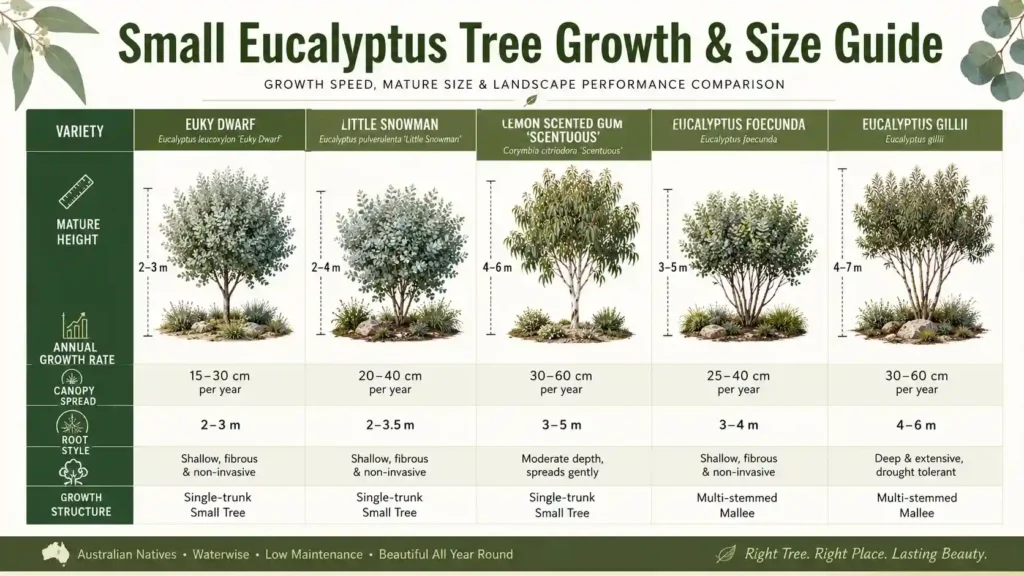
Growth habit strongly influences development speed and structure.
Mallee forms often invest more energy into basal stems and underground lignotubers, while upright trees prioritize canopy height.
Several environmental conditions influence how quickly a small eucalyptus tree matures.
|
Factor |
Impact on Growth |
| Climate |
Warm climates encourage faster growth |
|
Soil Drainage |
Poor drainage slows root development |
| Water Availability |
Moderate moisture improves early growth |
|
Sunlight |
Full sun essential for vigorous growth |
| Frost Exposure |
Cold damage may reduce growth speed |
Overwatering or heavy fertilization can sometimes weaken eucalyptus growth by encouraging soft, unstable foliage.
The mature size of a small eucalyptus tree depends on species selection and local growing conditions. While classified as compact compared to forest gums, some ornamental forms can still become medium-sized landscape trees.
|
Species |
Mature Height |
Approximate Spread |
|
E. tetraptera |
1–3m | 2–4m |
| E. foecunda | 2–4m |
2–5m |
|
E. pauciflora ‘Little Snowman’ |
3–5m | 2–4m |
| E. leucoxylon ‘Euky Dwarf’ | 3–6m |
2–4m |
|
E. mannifera ‘Little Spotty’ |
4–6m | 3–5m |
| Corymbia citriodora ‘Scentuous’ | 4–6m |
2–4m |
Canopy density varies between species. Some trees maintain narrow upright forms, while others become broad and bushy with age.
Compact eucalyptus varieties may still require space for:
Before planting, gardeners should account for:
The root system of eucalyptus trees is one of the most important planning considerations in residential landscapes. Root depth, spread, and moisture-seeking behavior vary between species and soil conditions.
A more detailed root discussion is covered below.
The root systems of small eucalyptus trees are generally less aggressive than those of massive forest gums, but proper spacing is still essential.
Most eucalyptus trees develop:
In dry climates, roots may travel considerable distances searching for moisture.
|
Root Characteristic |
Typical Behavior |
| Deep roots |
Improve drought tolerance |
|
Surface feeder roots |
Absorb rainfall and nutrients |
| Lateral spread |
Moderate to extensive depending on species |
Root growth is heavily influenced by:
Small eucalyptus species are generally less problematic than giant forest gums, but some varieties can still interfere with nearby structures if planted too close.
Potential issues include:
Most compact ornamental forms are considered manageable when correctly positioned.
|
Structure |
Recommended Distance |
|
House foundations |
5–10m |
| Water pipes |
3–5m |
|
Fences |
2–4m |
| Driveways |
3–5m |
Species with vigorous growth or larger mature canopies should be planted farther away from buildings.
Mallee eucalyptus species differ from standard single-trunk trees because they develop:
Compared to upright tree forms, mallee roots are often:
This makes mallee eucalyptus species useful for:
Growing a small eucalyptus plant is relatively straightforward when the right species and growing conditions are selected. Most dwarf eucalyptus varieties establish quickly, tolerate dry conditions once mature, and thrive in sunny positions with good drainage.
Many gardeners choose miniature flowering gum trees because they provide fast growth, attractive foliage, and ornamental flowers without the massive size of traditional gum trees. Proper planting techniques and early care are important for developing strong roots and healthy long-term structure.
Correct planting is one of the most important factors in successful small eucalyptus plant growing. Young eucalyptus trees dislike poor drainage and root disturbance, so site preparation should be done carefully before planting.
The ideal planting season depends on local climate conditions.
| Climate Type |
Best Planting Time |
|
Temperate regions |
Spring or autumn |
| Warm Mediterranean climates |
Autumn |
|
Cold climates |
Spring after frost |
| Semi-arid areas |
Early cooler season |
Planting during mild weather allows roots to establish before extreme summer heat or winter cold.
Most eucalyptus small plant varieties perform best in:
Before planting:
Eucalyptus generally performs poorly in waterlogged conditions.
Young eucalyptus should be planted at the same depth as their nursery container. Planting too deeply can increase the risk of stem rot and poor root development.
|
Plant Type |
Suggested Spacing |
| Compact dwarf forms |
2–4m |
|
Mallee species |
3–5m |
| Upright small trees |
4–6m |
Spacing should account for:
After planting:
Some compact species grow successfully in large containers, especially dwarf flowering gums and mallee forms.
Suitable container-grown species include:
|
Requirement |
Recommendation |
| Pot Size |
Large deep container |
|
Drainage |
Essential |
| Soil Mix |
Free-draining native potting mix |
|
Watering |
Regular but not excessive |
| Position |
Full sun |
Container-grown eucalyptus may require:
Small eucalyptus species can be propagated through seed, cuttings, or grafting depending on the cultivar and desired growth characteristics.
Seed propagation is the most common method for growing many eucalyptus species.
Most eucalyptus seeds germinate quickly under warm conditions.
However, seed-grown plants may vary in:
Propagation from cuttings is less common but possible with some small eucalyptus species.
Cuttings are usually taken from:
Challenges with cuttings include:
Professional nurseries often use controlled environments and rooting hormones to improve success.
Many ornamental dwarf flowering gums are produced through grafting rather than seed propagation.
Common grafted cultivars include:
| Benefit |
Explanation |
|
Improved disease resistance |
Stronger rootstock |
| Consistent flower color |
True-to-type growth |
|
Better adaptability |
Enhanced soil tolerance |
| Reliable growth habit |
Predictable mature size |
Grafted miniature flowering gum trees are especially valuable in regions where soil diseases or difficult growing conditions affect standard seedlings.
Small eucalyptus species are generally low-maintenance once established, but proper care during the first few years is essential for healthy growth, flowering, and long-term stability. Most compact eucalyptus varieties tolerate heat, drought, and poor soils better than many ornamental trees, making them suitable for modern low-water landscapes.
Whether growing a bushy eucalyptus form, a compact mallee species, or a small flowering gum, consistent early care helps establish stronger roots and healthier canopy development.
Water requirements vary depending on species, soil type, and climate conditions. Newly planted eucalyptus trees need more consistent moisture than mature specimens.
During the first 1–2 years after planting:
Deep watering encourages stronger downward root growth and improves drought resistance later.
Once established, most small eucalyptus species become relatively drought-tolerant.
|
Growth Stage |
Water Requirement |
| Newly planted |
Moderate regular watering |
|
Establishing roots |
Deep occasional watering |
| Mature trees |
Low to moderate |
Many bushy eucalyptus species from arid regions survive extended dry periods with minimal supplemental irrigation.
Small flowering gum varieties and mallee eucalyptus species are often highly drought-adapted because of:
However, prolonged severe drought may still reduce flowering or increase stress-related pest problems.
Most eucalyptus species require very little fertilizer compared to many ornamental landscape plants.
In most soils, eucalyptus benefits from:
Excessive feeding can produce:
Eucalyptus species are sensitive to high phosphorus levels.
⚠️ Avoid:
Many Australian native fertilizers are specifically formulated for Myrtaceae species and are safer for dwarf eucalyptus trees.
Pruning helps maintain shape, improve airflow, and encourage healthy canopy structure in dwarf eucalyptus varieties.
The best time to prune most eucalyptus species is:
Avoid heavy pruning during extreme heat or wet humid periods.
Basic pruning goals include:
Use clean sharp tools to minimize disease risk.
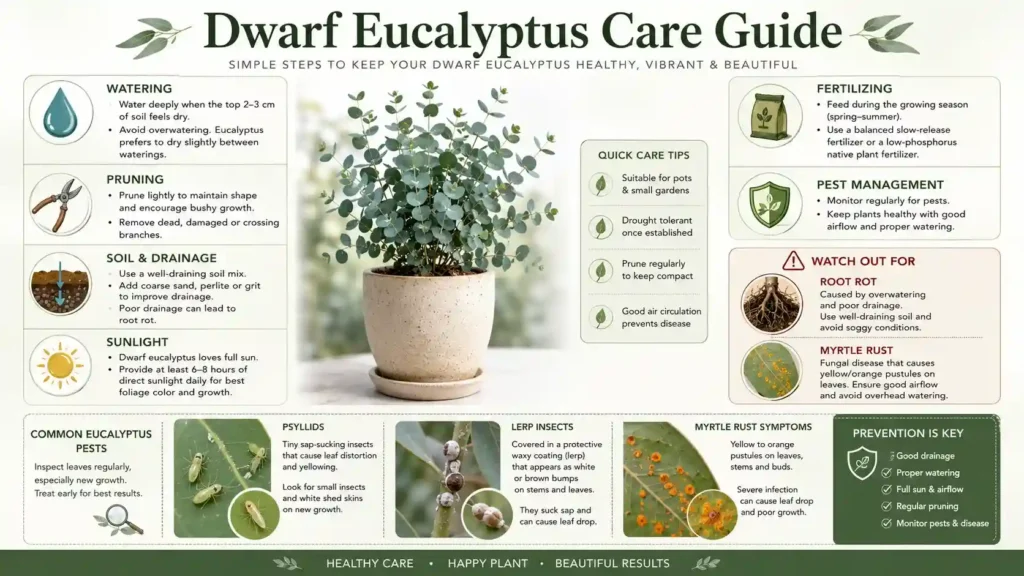
Bushy eucalyptus types and mallee species can be lightly tip-pruned to encourage denser branching.
Techniques for maintaining compact growth:
This approach is especially useful for:
Young trees benefit from formative pruning during early growth stages.
| Pruning Goal |
Purpose |
|
Central leader selection |
Improves structure |
| Lower branch removal |
Creates trunk clearance |
|
Shape balancing |
Encourages symmetry |
| Weak branch removal |
Prevents breakage |
Proper formative pruning reduces future structural problems and improves long-term appearance.
Although eucalyptus species are generally hardy, certain pests and diseases can affect both ornamental and native plantings.
Small sap-feeding insects that create protective sugary coverings called lerps on leaves.
Signs include:
These insects feed on new growth and may distort leaves or weaken young plants.
A chewing insect that damages fresh shoots and developing foliage.
Symptoms include:
Healthy trees usually recover well from minor infestations.
A serious soil-borne disease associated with poor drainage and overly wet conditions.
Symptoms:
Prevention focuses on:
⚠️ Myrtle Rust Alert: Puccinia psidii (myrtle rust) is a significant fungal disease affecting Myrtaceae family plants including eucalyptus. Signs include yellow/orange pustules on young leaves and stems. Report suspected cases to your local biosecurity authority.
This fungal disease can spread rapidly under humid conditions and may affect:
|
Problem |
Prevention Strategy |
|
Root rot |
Improve drainage |
| Psyllids |
Encourage beneficial insects |
|
Myrtle rust |
Monitor young growth regularly |
| Stress-related pests |
Maintain healthy growing conditions |
General management practices include:
Healthy, well-positioned eucalyptus trees are usually more resistant to both pests and disease outbreaks.
Small eucalyptus trees are highly versatile landscape plants used in modern native gardens, compact urban spaces, wildlife landscapes, and low-water garden designs. Their attractive bark, aromatic foliage, colorful flowers, and fast growth make them valuable feature plants for both residential and public landscaping.
From upright street trees to bushy mallee trees, compact eucalyptus species provide year-round structure and strong visual contrast while supporting birds and pollinators. Many gardeners also choose a small flowering gum for its ornamental flowers and manageable canopy size.
Small eucalyptus species can serve multiple functions in landscape design depending on their size, shape, and growth habit.
Compact flowering gums are widely used as urban street trees because they combine manageable height with ornamental flowers and drought tolerance.
One of the most commonly planted varieties is:
This cultivar is especially popular because it offers:
Its compact canopy makes it suitable for:
Many compact eucalyptus varieties work well as feature trees in enclosed outdoor spaces.
Ideal traits for courtyard planting include:
Popular courtyard species include:
The sculptural trunks and blue-grey foliage of many species complement contemporary architectural landscapes.
Some bushy eucalyptus species provide effective natural screening while maintaining a softer appearance than dense hedge plants.
Suitable screening types include:
Benefits of eucalyptus privacy planting:
Proper spacing is important to maintain airflow and healthy canopy development.
Many small flowering gum species are highly beneficial for native wildlife because they produce nectar-rich flowers and dense protective canopies.
Wildlife commonly attracted to eucalyptus includes:
Flowering varieties with pink, red, or cream blossoms are especially valuable in pollinator-friendly gardens.
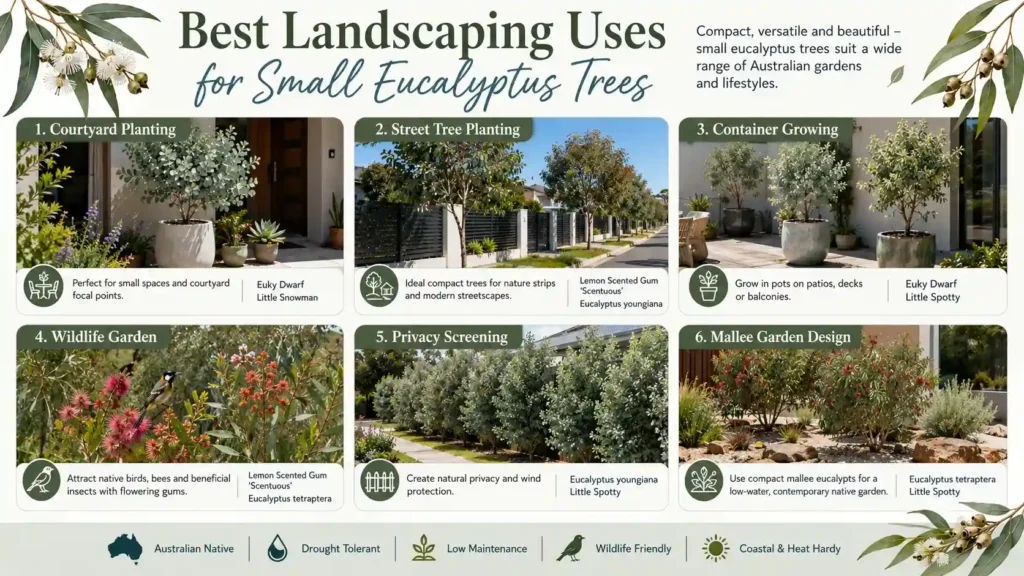
Several compact eucalyptus species adapt well to container growing when planted in appropriately sized pots with excellent drainage.
|
Species |
Suitability for Containers |
| Euky Dwarf |
Excellent |
|
Little Snowman |
Very good |
| Eucalyptus tetraptera |
Good |
|
Compact mallee forms |
Good |
| Dwarf flowering gum cultivars |
Excellent |
Container-grown eucalyptus is often used for:
Drainage is the most important factor for healthy potted eucalyptus growth.
Recommended container conditions:
|
Requirement |
Recommendation |
|
Sunlight |
Full sun |
| Watering |
Moderate and consistent |
|
Pot Depth |
Deep containers preferred |
| Repotting |
Every few years if rootbound |
Overly wet potting soil may increase the risk of root diseases, especially during cooler months.
Mallee eucalyptus species are among the most distinctive and useful forms for compact native landscaping.
A mallee gum differs from traditional single-trunk eucalyptus trees because it develops:
This growth style evolved in harsh Australian climates where fire, drought, and poor soils are common.
|
Feature |
Description |
| Growth Habit |
Multi-stemmed |
|
Height |
Usually low to medium |
| Canopy Form |
Bushy and spreading |
|
Drought Tolerance |
Very high |
| Landscape Style |
Naturalistic and native |
The architectural branching patterns of mallee eucalyptus species create strong visual texture in landscape designs.
Popular compact mallee trees include:
These species are especially useful in:
Mallee gum species provide ecological benefits beyond ornamental landscaping.
Benefits include:
Their extensive root systems and dense lower branching make them effective for naturalistic landscape restoration and sustainable garden design.
Small eucalyptus trees provide a combination of ornamental, ecological, and practical benefits that make them highly valuable in modern landscapes. From compact courtyard gardens to larger wildlife-focused planting schemes, these trees offer attractive foliage, colorful flowers, drought tolerance, and strong environmental value.
Many dwarf eucalyptus species are especially useful in low-maintenance and water-wise gardens because they adapt well to challenging growing conditions while still providing year-round visual appeal.
Flowering eucalyptus species are among the best native trees for supporting wildlife in Australian-style landscapes.
Their nectar-rich flowers attract:
Dense canopies and bushy mallee forms also provide:
Red and pink flowering gums are particularly effective at attracting pollinators during flowering seasons.
Some ornamental varieties are especially valued for their vivid flowering displays and ability to attract birds throughout the warmer months.”
Many small eucalyptus species produce fragrant leaves rich in essential oils. These aromatic compounds are released naturally in warm weather or when foliage is lightly crushed.
Sensory benefits include:
Lemon-scented species such as Corymbia citriodora are especially popular in sensory gardens because of their strong citrus fragrance.
The foliage of some species is also associated with:
Most small eucalyptus trees become highly drought-tolerant after their root systems establish.
Key drought-adapted traits include:
This makes compact eucalyptus varieties suitable for:
Compared to many ornamental exotic trees, established eucalyptus species often require significantly less supplemental irrigation.
Small eucalyptus species provide multi-season ornamental value through their foliage, bark, flowers, and growth form.
|
Feature |
Visual Value |
|
Bark |
Smooth, mottled, white, or decorative peeling textures |
| Flowers |
Pink, red, white, yellow, or cream blossoms |
|
Foliage |
Blue-grey, silver, green, or aromatic leaves |
| Structure |
Sculptural branching and trunk form |
Many compact gum trees remain evergreen year-round, helping maintain consistent garden structure even during cooler seasons.
Decorative bark becomes especially prominent in:
Like other trees, eucalyptus species contribute to environmental health through carbon capture and oxygen production.
Benefits include:
Fast-growing small eucalyptus trees may absorb carbon relatively quickly during their active growth years. Their evergreen canopies also provide continuous foliage cover that contributes to year-round environmental benefits.
Because many compact species thrive with relatively low water and maintenance requirements, they are increasingly used in sustainable landscape design and climate-adaptive planting schemes.
Although small eucalyptus trees offer many landscaping and environmental benefits, they also come with certain drawbacks and management considerations. Understanding these potential issues helps gardeners choose suitable planting locations and maintain healthier, safer landscapes.
Eucalyptus trees naturally shed leaves, bark, flowers, and gum nuts throughout the year. In dry climates, this organic material can accumulate beneath the canopy and increase fire risk.
Contributing factors include:
Species with dense canopies or heavy bark shedding may require more regular garden maintenance in fire-prone regions.
| Precaution |
Purpose |
|
Remove dry leaf litter regularly |
Reduces fuel buildup |
| Avoid planting close to structures |
Improves fire safety |
|
Maintain spacing between plants |
Reduces fire spread |
| Prune dead branches |
Improves airflow and safety |
This consideration is especially important in Mediterranean and semi-arid climates.
Some eucalyptus species produce natural chemical compounds that may suppress the growth of nearby plants. This process is known as allelopathy.
Potential effects include:
Fallen leaves and roots may release compounds into the surrounding soil, particularly in dry conditions.
Plants commonly affected include:
For this reason, dense underplanting beneath eucalyptus trees can sometimes be difficult.
Certain eucalyptus species contain oils and compounds that may be toxic if consumed by pets.
Animals potentially affected include:
Symptoms of eucalyptus toxicity may include:
Young pets are generally at greater risk because they may chew fallen leaves or bark.
Even compact eucalyptus species can develop extensive root systems over time. While small ornamental forms are usually less aggressive than giant forest gums, improper placement may still create problems near built structures.
Potential risks include:
|
Structure |
Recommended Distance |
|
House foundations |
5–10m |
| Water pipes |
3–5m |
|
Retaining walls |
3–5m |
| Paved surfaces |
3–5m |
Proper species selection and spacing significantly reduce long-term structural concerns.
⚠️ Safety Note: Eucalyptus essential oil is toxic if ingested by pets and children. Keep fallen leaves and oils away from pets. Always wear gloves when handling large quantities of foliage.
Eucalyptus tetraptera and Eucalyptus foecunda are among the smallest gum tree varieties and can remain under 2–3 meters tall. The popular dwarf gum cultivar 'Euky Dwarf' typically grows around 3–6 meters and is widely used in compact landscapes.
Dwarf eucalyptus varieties are commonly available at Bunnings Warehouse, local nurseries, and specialist Australian native plant nurseries. Popular options include dwarf flowering gum Bunnings selections and dwarf lemon scented gum Bunnings cultivars.
Yes, many compact varieties such as Euky Dwarf and Little Snowman grow well in containers with proper drainage, full sun, and large deep pots. A small eucalyptus plant in a container may require more frequent watering and occasional repotting.
Most fast growing eucalyptus trees can grow around 0.5–1 meter per year under good conditions. Warm climates, full sunlight, and moderate watering usually improve growth speed.
Yes, the cultivar 'Scentuous' is a compact form of Corymbia citriodora. This dwarf lemon scented gum usually reaches 4–6 meters tall and retains the species’ signature lemon fragrance and smooth pale bark.
Yes, approximately 800+ eucalyptus species are native to Australia. These eucalypts of Australia grow across diverse environments including tropical forests, dry inland regions, and alpine climates.
Silver dollar eucalyptus (Eucalyptus cinerea) is one of the best-known round leaf eucalyptus species. Several mallee forms and juvenile eucalyptus varieties also produce attractive rounded blue-grey foliage.