Grow Better Gardens with Smarter Plant Choices
Discover helpful guides on trees, hedges, fruit plants, edible plants, and beautiful landscape greenery.

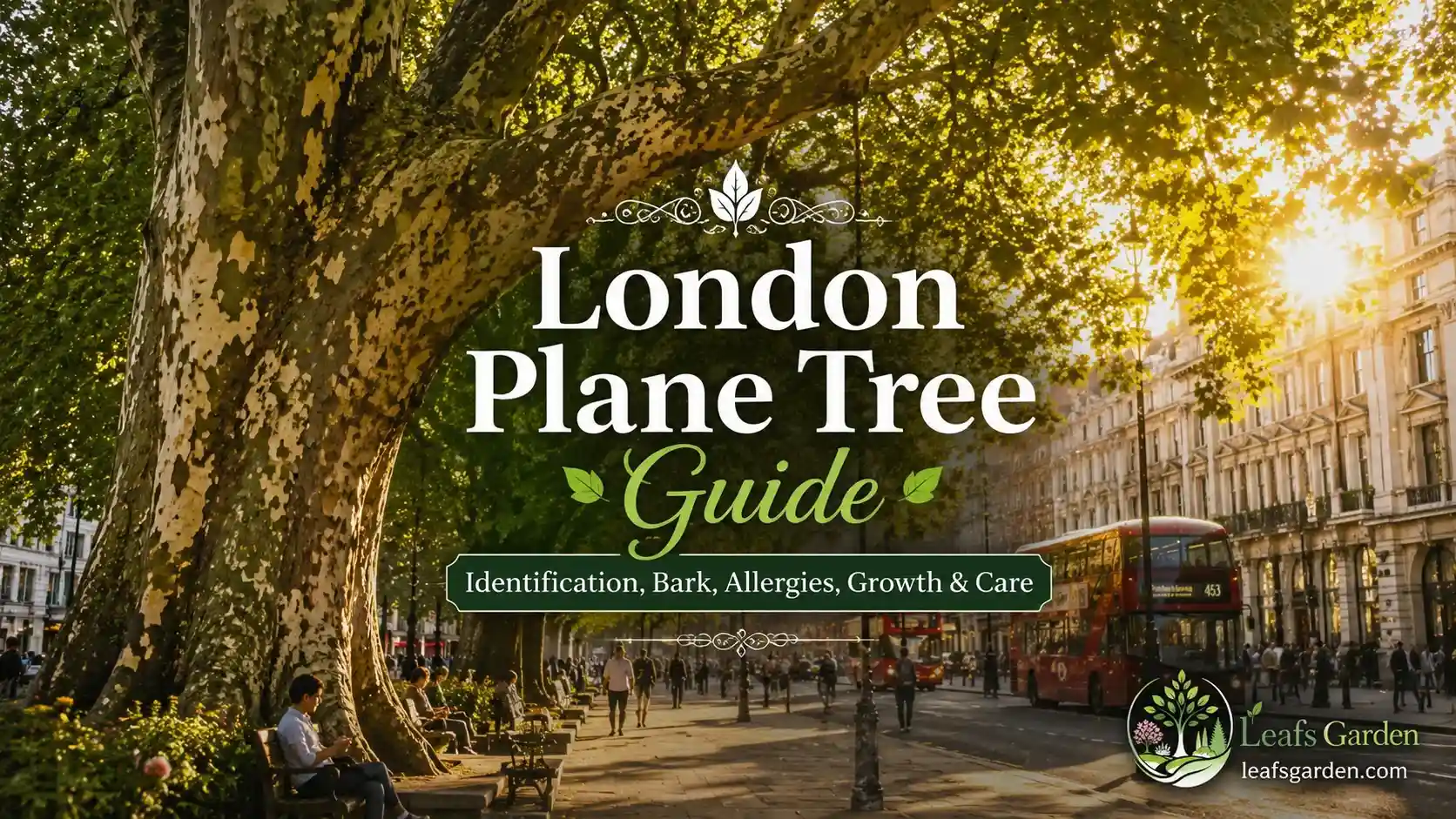
The London plane tree is a fast-growing hybrid shade tree widely planted in urban environments because of its pollution tolerance, massive canopy, and distinctive peeling bark. Known scientifically as a cross between the American sycamore and Oriental plane, the london plane became one of the most recognizable city trees in the world.
Plane trees in London became iconic during the industrial era because they survived smoke, compacted soil, traffic pollution, and difficult street conditions better than many other species. Today, london planes still dominate historic boulevards, public avenues, and famous green spaces such as Hyde Park because of their durability and strong urban adaptability.
The london plane tree is also commonly called the english plane tree and is widely recognized for its rapid growth rate, camouflage-like bark, broad leaves, and excellent shade production. In many cities, plane tree london plantings help reduce urban heat while improving streetscape appearance and canopy coverage.
One of the easiest ways to identify london plane trees is by their exfoliating bark, which peels away in patches to reveal cream, olive, and gray tones underneath. Their large maple-like leaves, hanging seed balls, and towering mature size also make identification easier throughout the seasons.
Although plane trees london landscapes benefit greatly from these trees, they are also associated with allergies and seasonal pollen irritation. Fine hairs from leaves and airborne plane tree pollen may trigger sneezing, throat irritation, and respiratory discomfort in sensitive individuals during peak seasons.
The london plane is also becoming increasingly relevant in parts of Australia because of its drought tolerance, adaptability, and ability to grow in urban conditions. Many councils and landscapers use the tree in city parks, public gardens, and urban boulevards where a large shade canopy is needed.
The scientific name of the London plane tree is Platanus × acerifolia, a hybrid species from the Platanaceae family. This large deciduous shade tree was developed naturally from a cross between the American sycamore (Platanus occidentalis) and the Oriental plane (Platanus orientalis).
The platanus acerifolia london plane is one of the most successful urban trees ever planted because of its strong adaptability to pollution, pruning, drought, and compacted city soils. The platanus london plane is especially common along streets, boulevards, and public parks where long-term shade and environmental resilience are important.
The platanus x acerifolia london plane tree is widely recognized for its peeling bark, broad canopy, and rapid growth habit. As a mature platanus tree, it can develop into a massive landscape feature capable of surviving difficult urban conditions for decades.
Unlike many sensitive ornamental species, the London plane performs well in dense city environments. Its hybrid genetics give it stronger disease tolerance and better environmental resistance than many related sycamore species.
| Feature | Details |
| Botanical Name | Platanus × acerifolia |
| Common Names | London plane, English plane tree |
| Family | Platanaceae |
| Type | Deciduous shade tree |
| Native Origin | Hybrid species |
London plane trees became popular because they tolerate smoke, compacted soil, pruning, and polluted urban air better than many other trees. Their resilience made them one of the most reliable urban planting choices during the rapid expansion of Victorian cities.
During the industrial period in London, heavy coal smoke and poor air quality damaged many traditional tree species. The london plane proved unusually resistant to pollution because its bark naturally sheds in patches, helping remove accumulated soot and contaminants from the trunk surface.
Victorian planners widely planted plane trees in london along streets, public squares, and transportation corridors because the trees could survive difficult roadside conditions. Their strong root systems, rapid growth, and ability to recover from pruning also made them ideal for crowded urban environments.
Today, the london tree remains one of the defining features of many historic boulevards and parks across the city. Large mature specimens line avenues, pedestrian walkways, and green public spaces including Hyde Park, where the london plane continues to provide shade, cooling, and visual character.
Another reason the london plane became so widespread is its ability to withstand compacted soils and restricted planting spaces beside roads. Many urban species struggle under traffic stress, heat reflection, and limited root space, but London plane trees adapted exceptionally well to these conditions.
Because of this durability, the species eventually became one of the most planted city trees not only in London but also in major urban areas worldwide.
The bark of the London plane tree peels naturally in patches, revealing cream, olive, and gray patterns underneath. This exfoliating surface creates the distinctive camouflage-style appearance that makes the species easy to recognize in urban landscapes.
The london plane tree bark continuously sheds as the tree grows. This natural peeling process helps remove pollutants, dust, fungi, and soot that collect on the outer bark surface. Many arborists believe this self-cleaning characteristic contributed to the tree’s success in heavily polluted cities.
Young trees usually develop smoother bark, while mature trunks display larger peeling sections with dramatic color contrast. In older specimens, the trunk may appear mottled with green, tan, silver, gray, and cream patches across the surface.
The bark pattern becomes especially noticeable during winter when leaves drop and the trunk structure becomes fully visible. Large mature London plane trees often develop highly ornamental bark textures that stand out in parks and streetscapes.
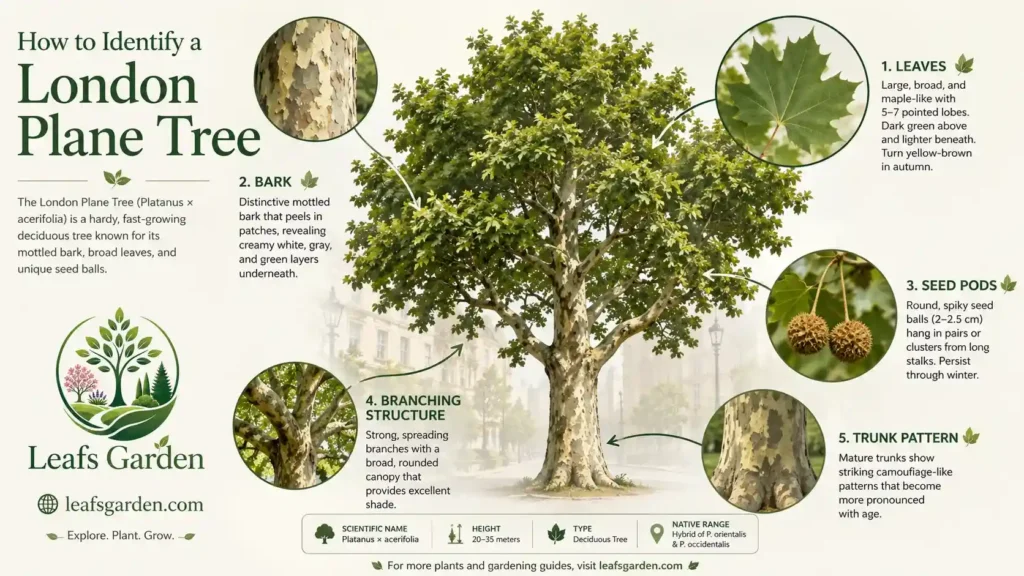
London plane tree leaves are broad, maple-like leaves with 3–5 lobes and coarse texture. Their large size, thick surface, and pointed lobes make them one of the easiest features for identifying the species.
A typical london plane tree leaf is wider and tougher than many maple leaves. Most london plane leaves have noticeable veins, coarse edges, and a slightly speckled underside. During the growing season, the foliage remains deep green before turning yellow-brown in autumn.
The london plane tree leaves are arranged alternately along the branches and can grow quite large on mature trees. In fall, many leaves dry slowly and contribute to seasonal leaf litter beneath the canopy.
A mature london plane leaf is often confused with sycamore or maple foliage because of its similar lobed shape. However, the plane tree leaf usually feels thicker and rougher than a true maple leaf. Many plane tree leaves also display more irregular texture and spotting underneath.
The london planetree leaf changes color seasonally depending on climate and moisture conditions. In cooler climates, foliage may turn yellow or bronze before leaf drop, while trees in warmer urban environments may retain green tones longer into autumn.
| London Plane Leaf | Maple Leaf |
| Thicker texture | Softer texture |
| Larger size | Smaller size |
| Speckled underside | Smooth underside |
London plane trees produce round hanging seed balls that remain on the tree through winter. These distinctive spherical clusters are one of the easiest ways to identify the species after the leaves have fallen.
The london plane tree seed pods usually appear in pairs or single dangling balls suspended from long stems. As they mature, the seed structures gradually dry and break apart, releasing fine hairy seeds into the air during windy conditions.
Flowering typically begins in spring shortly after new leaves emerge. London plane trees produce small, inconspicuous flowers that are not highly ornamental but play an important role in reproduction and pollen production.
During the flowering season, pollen release can become significant in heavily planted urban areas. Wind carries the pollen across streets and parks, which is one reason some people experience seasonal irritation around mature plane trees.
Seed dispersal mainly occurs from late autumn through winter. The dried seed balls slowly fragment over time, spreading lightweight seeds through wind movement. The fine hairs attached to seeds may also contribute to throat and respiratory irritation in sensitive individuals.
Winter identification is relatively easy because mature London plane trees maintain several distinctive features even without foliage. Arborists often identify the species by:
In many urban landscapes, the remaining seed balls and mottled bark make the London plane one of the easiest deciduous trees to recognize during winter dormancy.
London plane trees grow quickly and can add several feet of growth each year in ideal conditions. Their vigorous development is one reason they are widely used for urban shade planting and boulevard landscaping.
The london plane tree growth rate is considered fast for a large deciduous shade tree. Young trees establish rapidly when planted in full sun with adequate moisture and well-drained soil. In favorable climates, annual growth may exceed several feet during the early establishment years.
The london plane sycamore growth rate is also influenced by soil quality, rainfall, root space, and urban stress levels. Trees planted in open parks or large landscapes generally grow faster than specimens restricted by pavement or compacted roadside soils.
A mature London plane tree can eventually reach impressive dimensions. Many specimens develop:
The species is also known for its long lifespan. In suitable conditions, mature trees may survive well over a century while continuing to provide dense canopy coverage and environmental benefits.
Root development becomes significant as the tree ages. Young roots establish deeply at first, but mature surface roots can spread widely in search of moisture and oxygen. In urban settings, these roots sometimes interfere with sidewalks, curbs, drains, and nearby infrastructure.
| Age | Approximate Height |
| 1 Year | Young sapling |
| 5 Years | Medium shade tree |
| 20+ Years | Large mature canopy |
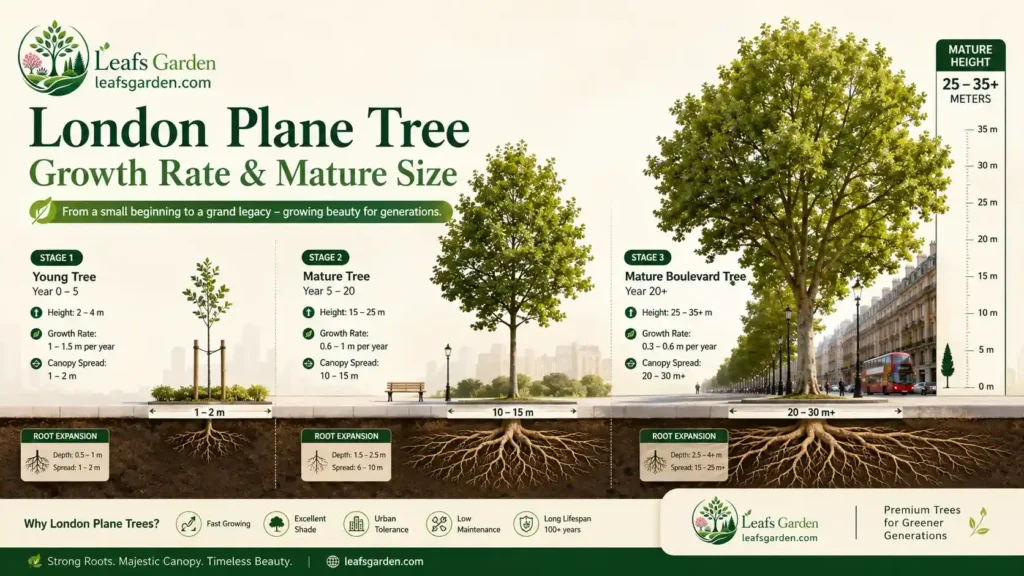
Mature London plane trees can become massive boulevard trees with wide spreading crowns. Their towering structure and dense canopy make them one of the most influential shade trees in urban landscapes.
Large mature specimens create extensive cooling benefits by reducing heat absorption from roads, pavements, and nearby buildings. In heavily developed cities, London plane trees help lower urban heat buildup while improving pedestrian comfort along streets and public parks.
The wide canopy also provides:
Because of their enormous mature size, these trees require significant planting space. Their trunks thicken substantially over time, and canopy expansion may eventually dominate smaller streetscapes if not managed properly.
Root expansion is one of the most important long-term considerations. Mature roots can lift pavement, affect drainage systems, and compete with nearby landscaping. For this reason, arborists usually recommend planting London plane trees away from fragile paving, narrow planting strips, and small residential foundations.
Despite these infrastructure concerns, the species remains one of the most effective large-scale urban shade trees because of its resilience, longevity, and environmental performance.
London plane trees grow best in temperate climates with moderate rainfall and full sun. They perform especially well in regions with warm summers, cool winters, and enough space for large canopy development.
The london plane tree australia landscape industry commonly uses this species in urban streets, parks, and public gardens because of its adaptability to difficult environmental conditions. Many london plane trees australia plantings are found in cooler southern regions where seasonal climate patterns support healthy growth.
A mature plane tree australia specimen can tolerate:
The species shows moderate to strong drought tolerance once established. Young trees still require consistent moisture during the first several growing seasons, but mature specimens become more resilient to temporary dry periods.
London plane trees also have good frost tolerance compared to many ornamental shade trees. Winter dormancy allows them to survive cold conditions while resuming vigorous growth in spring.
Australian adaptability is strongest in temperate areas with reliable winter cooling and moderate rainfall. The tree is especially valued in urban environments because it handles city stress better than many traditional landscape species.
London plane trees prefer moist, well-drained soil and full sunlight for strongest growth. Although highly adaptable, proper site conditions improve canopy density, trunk development, and long-term tree health.
The species grows best when roots have access to deep soil and adequate moisture during establishment. Mature trees become more tolerant of varying soil conditions, including compacted urban ground and roadside planting strips.
Full sun is important for healthy canopy growth and strong branch structure. Trees planted in shaded areas may develop thinner crowns and weaker growth patterns.
Deep watering encourages stronger root establishment during the first few years after planting. Once mature, the tree generally requires less supplemental irrigation except during prolonged drought.
Mulching around the base helps conserve moisture, regulate soil temperature, and reduce weed competition. Organic mulch should be kept away from direct contact with the trunk to prevent moisture-related bark issues.
Good soil drainage is important because waterlogged conditions may increase the risk of fungal diseases and root stress. Despite this, London plane trees still tolerate urban soils better than many sensitive shade species.
Regular pruning helps maintain safe branch structure and healthy canopy growth. Because London plane trees can become extremely large, routine maintenance is important for both safety and long-term urban management.
The best pruning seasons are typically late winter or dormant periods before spring growth begins. Pruning during dormancy improves visibility of branch structure and reduces stress on the tree.
Maintenance usually focuses on:
Managing large branches becomes increasingly important as mature trees expand. Heavy limbs may eventually require professional arborist care, especially in streetscapes and public parks.
Urban maintenance often includes regular inspections for structural safety, disease symptoms, and root-related pavement issues. Many municipalities schedule cyclical pruning programs to control canopy spread in dense city environments.
Leaf litter cleanup is another routine maintenance consideration. During autumn, large volumes of fallen leaves and seed debris may collect beneath mature trees, especially along sidewalks, gutters, and public roads.
London plane trees can trigger allergies because their pollen and fine leaf hairs may irritate sensitive people. In many urban areas, seasonal exposure to airborne particles from mature trees becomes a common respiratory concern during spring and early summer.
A plane tree allergy is usually linked to pollen release and the microscopic hairs found on young leaves and seed structures. These particles can become airborne during dry or windy weather, especially in streets heavily planted with mature plane trees.
Many people affected by plane tree allergies experience irritation when pollen concentrations rise during the flowering season. The issue may become more noticeable in dense urban environments where multiple large trees release pollen at the same time.
A london plane tree allergy may affect individuals differently depending on local climate, weather conditions, and overall pollen sensitivity. Some people experience only mild irritation, while others may develop stronger respiratory symptoms.
Common environmental triggers associated with london plane tree allergies include:
The irritation linked to plane trees allergy problems is not caused only by pollen. Fine fibers from leaves and seed balls may also contribute to throat and skin discomfort in sensitive individuals.
In large cities where mature London planes dominate streetscapes, plane tree pollen and plane trees pollen can remain suspended in the air for extended periods during peak flowering seasons.
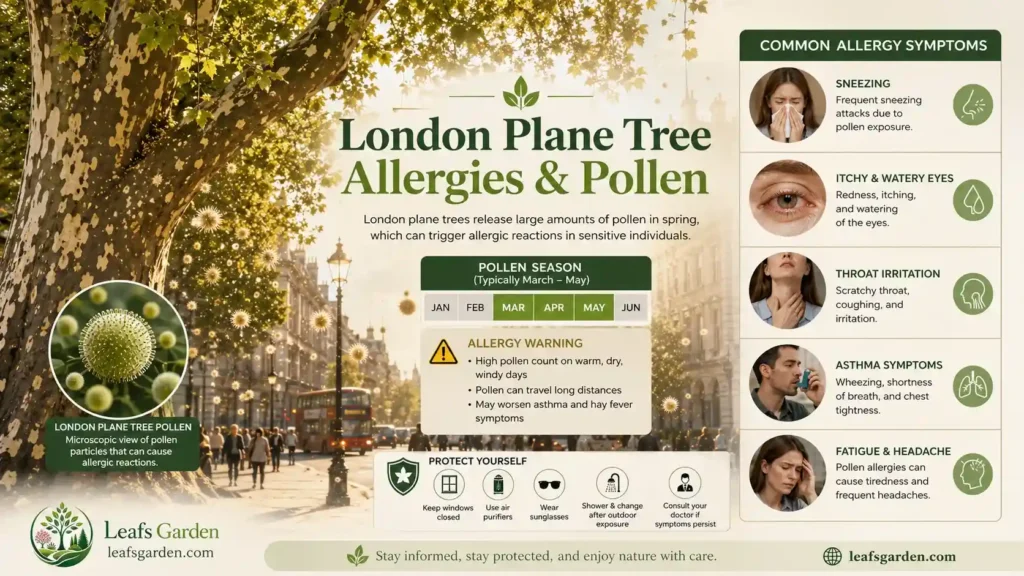
Plane tree pollen allergies often cause sneezing, itchy eyes, coughing, and throat irritation. Symptoms usually become worse during dry spring weather when airborne particles spread more easily through urban environments.
People sensitive to pollen may notice symptoms while walking beneath mature trees, especially during flowering and seed dispersal periods. In heavily planted city streets, irritation may persist throughout the seasonal pollen cycle.
Some individuals with asthma or respiratory sensitivity may experience increased breathing discomfort during high pollen days. Fine hairs released from leaves and seed structures can also irritate exposed skin and airways.
Plane tree pollen is a known seasonal allergy trigger in several Australian cities, especially Melbourne. Large numbers of mature street trees contribute to seasonal airborne pollen levels during spring.
Plane tree allergy melbourne concerns are widely discussed because many urban streets and boulevards contain dense plantings of mature London plane trees. During peak pollen release, dry winds can carry particles across surrounding neighborhoods and public spaces.
The timing of pollen season usually begins in spring as flowers emerge and trees enter active growth. Warm temperatures combined with windy conditions often increase airborne pollen movement throughout the city.
Dry weather effects can intensify symptoms because pollen and leaf fibers remain suspended in the air longer. Rainfall usually reduces temporary pollen concentrations by washing particles from the atmosphere.
Many discussions surrounding plane trees melbourne allergies focus on balancing urban shade benefits with public health concerns. While London plane trees provide cooling, pollution filtering, and streetscape value, some councils and planners now consider allergy impacts when selecting future street tree species.
London plane trees are valued for shade, pollution tolerance, and long lifespan. Their ability to survive difficult urban conditions has made them one of the most widely planted city trees in the world.
The species performs exceptionally well beside roads, commercial districts, parks, and dense urban developments where many other trees struggle. Its rapid establishment and broad canopy provide long-term environmental and landscaping benefits.
One of the biggest advantages of the London plane tree is its resistance to urban pollution. The tree tolerates smoke, dust, compacted soils, and traffic-related stress better than many traditional shade species.
Fast growth allows young trees to establish canopy coverage relatively quickly. This makes the species useful for streetscape projects, boulevard planting, and urban cooling programs where rapid shade development is important.
The strong shade canopy helps reduce pavement temperatures, improve pedestrian comfort, and soften harsh urban environments. Mature trees can significantly lower localized heat buildup during summer months.
Another major benefit is the ornamental bark. The peeling camouflage-style trunk creates year-round visual interest, especially during winter when leaves are absent.
Because of their size and longevity, London plane trees also contribute long-term ecological value by supporting urban biodiversity, filtering airborne particles, and improving city landscape structure over decades.
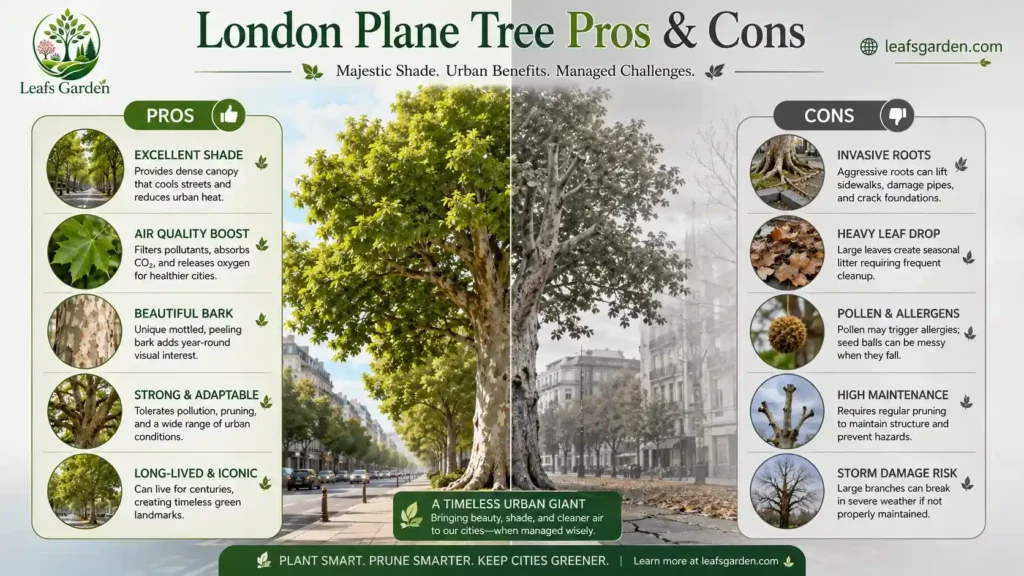
Despite their strengths, London plane trees can create maintenance issues because of roots, pollen, and heavy leaf drop. Their massive mature size and aggressive growth habit often require long-term management in urban and residential landscapes.
When evaluating london plane tree pros and cons, the biggest concerns usually involve allergies, infrastructure impact, and seasonal maintenance demands. Although the tree performs exceptionally well in cities, its scale can create problems in restricted planting spaces.
Allergies are one of the most discussed drawbacks. Pollen and fine leaf hairs may irritate sensitive individuals during spring and early summer. In heavily planted urban streets, airborne particles can become especially noticeable during dry windy weather.
Aggressive roots are another major issue. Mature roots often spread widely beneath sidewalks and roads searching for moisture and oxygen. Over time, this may contribute to:
Messy seed pods and seasonal leaf litter also increase cleanup requirements. During autumn and winter, mature trees can shed large volumes of leaves, bark fragments, and seed material across streets, parks, and residential properties.
Pruning costs may become significant as the canopy expands. Large mature branches often require professional arborist maintenance to manage structural safety, clearance over roads, and storm damage prevention.
Despite these disadvantages, many cities still prioritize London plane trees because their environmental benefits often outweigh maintenance concerns in large urban landscapes.
| Pros | Cons |
| Fast growth | Allergy concerns |
| Pollution tolerant | Large root system |
| Urban hardy | Seasonal litter |
| Excellent shade | Heavy maintenance |
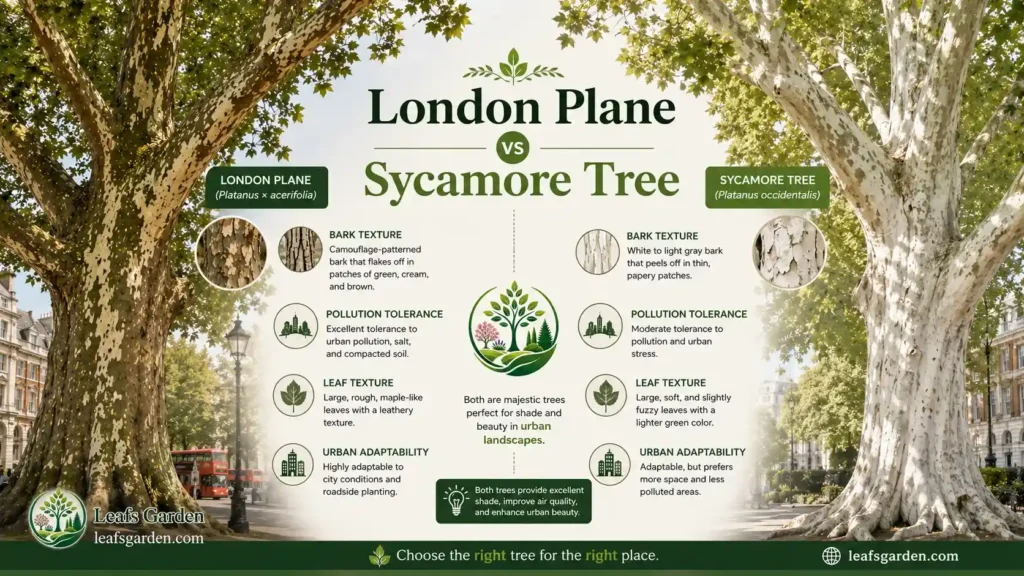
London plane trees and sycamore trees are closely related but not identical species. Although they share similar leaves, bark patterns, and overall appearance, they differ in origin, environmental tolerance, and urban performance.
The london plane sycamore relationship exists because the London plane tree was partly developed from the American sycamore species. As a hybrid tree, it inherited characteristics from both the American sycamore and the Oriental plane.
A mature london plane sycamore tree generally performs better in polluted urban environments than a pure American sycamore. This improved adaptability is one reason the species became one of the most widely planted city trees worldwide.
Many people also use the term london sycamore tree when referring to London plane trees because the foliage resembles sycamore leaves. However, arborists still classify them as separate though closely related trees.
One of the easiest differences to notice is the bark. London plane trees usually develop stronger camouflage-style peeling patterns, while American sycamores often show brighter white upper bark sections.
The London plane also tends to tolerate pruning, traffic pollution, and compacted urban soils more effectively than the American sycamore, making it a preferred choice for city boulevards and streetscapes.
| Feature | London Plane | American Sycamore |
| Bark | Camouflage patches | Whiter bark |
| Pollution tolerance | Very high | Moderate |
| Leaf texture | Thicker | Softer |
| Urban planting | Extremely common | Less common |
Mature plane trees can develop strong roots that interfere with pavements, drains, and foundations. Their aggressive root expansion is one of the most important long-term management concerns in urban landscapes.
As London plane trees mature, surface roots often spread widely beneath sidewalks, roads, and nearby structures searching for moisture and oxygen. In restricted planting spaces, these roots may gradually lift pavement, crack curbs, and place pressure on underground infrastructure.
Common infrastructure issues associated with mature plane trees include:
Root problems become more likely when trees are planted too close to buildings, driveways, retaining walls, or underground utility lines. Large boulevard trees require significant underground space to support healthy long-term growth.
Proper site planning helps reduce future damage risks. Arborists often recommend:
London plane trees may suffer from anthracnose, cankers, and fungal infections in poor conditions. Although generally considered durable urban trees, environmental stress can increase vulnerability to disease problems.
Anthracnose is one of the most common issues affecting plane trees. This fungal disease may cause:
Cankers can also develop on weakened branches or damaged bark areas. In severe cases, infections may reduce branch health and structural strength over time.
Poor drainage, drought stress, compacted soils, and repeated environmental stress often increase susceptibility to fungal infections. Trees growing in crowded urban conditions may experience additional pressure from pollution and heat stress.
Routine maintenance improves overall tree health and reduces disease risk. Healthy watering practices, proper pruning, and improved soil conditions help strengthen resistance against many common problems.
| Problem | Possible Cause | Solution |
| Yellow leaves | Poor drainage | Improve soil |
| Sparse canopy | Drought stress | Deep watering |
| Bark damage | Disease | Prune affected areas |
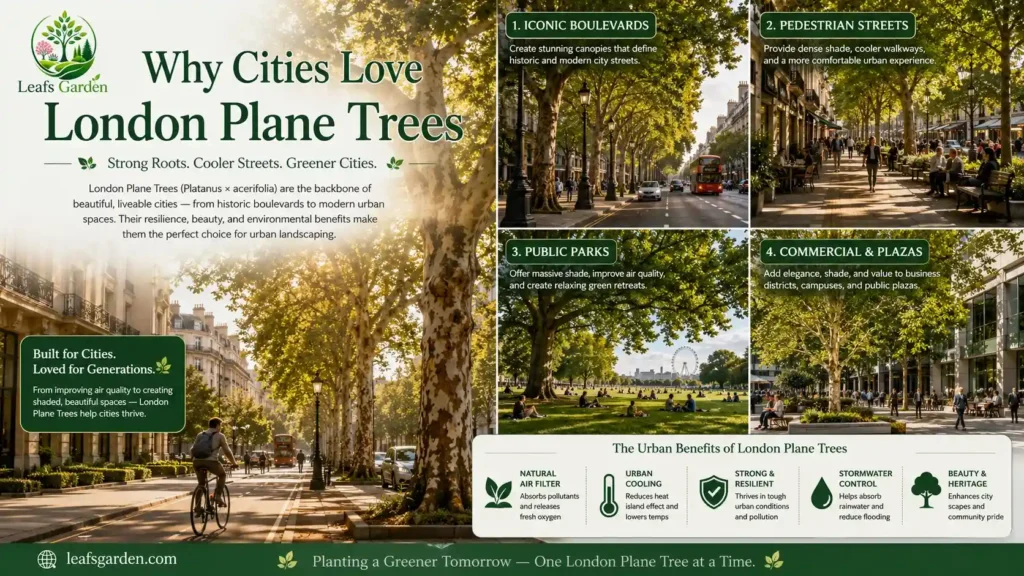
Cities use London plane trees because they provide shade, air filtering, and visual beauty in harsh urban environments. Their durability and adaptability make them one of the most reliable large-scale urban landscape trees.
London plane trees are especially valued for boulevard planting because they tolerate pollution, compacted soils, heat reflection, and repeated pruning better than many other shade species. Their broad canopies create strong visual structure along roads, pedestrian corridors, and major city avenues.
For a complete overview of shade and landscape trees suited to Australian urban and residential climates, see our Evergreen, Shade & Landscape Trees guide.
In many public parks, mature London plane trees provide dense summer shade that improves comfort for pedestrians and recreational spaces. Their towering canopies help reduce direct sunlight exposure while cooling paved urban environments.
Cooling benefits are one of the tree’s most important environmental contributions. Large mature canopies reduce urban heat buildup by:
Another major advantage is pollution filtration. The dense foliage helps trap airborne particles, dust, and urban pollutants while contributing to improved air quality in heavily developed city areas.
The tree’s distinctive bark, strong structure, and seasonal character also add visual beauty to streetscapes and civic landscapes throughout the year.
London plane trees work best in large landscapes where their mature size can be accommodated safely. Because the species eventually develops an enormous canopy and extensive roots, careful placement is important.
The tree is generally unsuitable for very small gardens or confined planting strips. Mature growth can overwhelm tight residential spaces and create long-term maintenance concerns if planted too close to buildings or paved areas.
Large yards provide enough room for canopy expansion and root development without major structural conflicts. In spacious residential properties, London plane trees can become impressive long-term shade features.
Streetscapes benefit from the species because of its pollution tolerance and ability to withstand difficult roadside conditions. Many municipalities continue using the tree for urban canopy projects and boulevard enhancement.
For smaller streetscapes and urban gardens where a more manageable canopy size is needed, the Chinese Elm Tree is one of the most popular alternative street tree options planted alongside London plane in Australian cities.
Public gardens and civic landscapes also benefit from the tree’s dramatic scale, shade coverage, and ornamental bark patterns. In commercial landscapes, mature London plane trees help soften large buildings, parking areas, and paved environments while improving pedestrian comfort.
London plane trees are excellent large shade trees for spacious landscapes, but they may not suit small yards or allergy-sensitive areas. Their fast growth, pollution tolerance, and massive canopy make them highly valuable in the right setting.
The species performs best where there is enough room for long-term root expansion and canopy development. Large public landscapes, wide streets, and spacious residential properties usually provide the safest environment for healthy mature growth.
Before planting, it is important to consider:
London plane trees are especially useful in urban environments because they tolerate pollution, compacted soil, and heat better than many other shade trees.
For warm subtropical Australian climates where faster canopy establishment is a priority, the Tipuana Tree is another widely planted large shade tree commonly used alongside London plane in parks and streetscapes.
However, heavy leaf litter, seed debris, and allergy concerns may become problematic in smaller residential spaces.
| Good Choice If… | Avoid If… |
| You need shade | You have severe pollen allergies |
| Large space available | Small garden |
| Urban pollution present | Near fragile paving |
The London plane tree remains one of the world’s most successful urban trees because of its resilience, shade, and adaptability. Its ability to tolerate pollution, compacted soil, drought, and difficult city conditions has made it a dominant feature of streetscapes, boulevards, and public parks worldwide.
The species is easy to identify through its peeling camouflage-style bark, broad maple-like leaves, and hanging winter seed balls. Fast growth and massive canopy development also make it one of the most effective large shade trees for urban cooling and environmental improvement.
Proper care is important for long-term success. Full sun, deep establishment watering, occasional pruning, and adequate planting space help maintain healthy structure and canopy performance over time.
Although the tree offers major advantages, it also comes with considerations. Seasonal pollen, allergy concerns, aggressive roots, heavy leaf litter, and infrastructure conflicts may become problematic in restricted spaces or allergy-sensitive areas.
Understanding the full pros and cons helps property owners, landscapers, and urban planners make better planting decisions. In large landscapes with proper maintenance and sufficient root space, London plane trees can provide decades of shade, environmental benefits, and strong visual impact.
For landscape planning or future tree selection research, it is always best to evaluate mature size, site conditions, maintenance needs, and long-term urban compatibility before planting.
London plane trees grow quickly and can add several feet of new growth each year under ideal conditions. Young trees establish rapidly in full sun with adequate moisture and enough root space. Their fast growth rate is one reason they are widely used for boulevard planting and urban shade projects.
Yes, London plane trees are considered one of the best urban shade trees because they tolerate pollution, compacted soils, pruning, drought, and roadside stress extremely well. Cities commonly plant them along streets, in public parks, and on urban boulevards because of their durability and cooling canopy benefits.
Yes, London plane trees can cause allergies in sensitive individuals. Their pollen and fine leaf hairs may trigger sneezing, itchy eyes, throat irritation, coughing, and respiratory discomfort during the flowering season. Symptoms are often worse during dry and windy spring weather.
A London plane tree leaf is broad, maple-like, and usually has 3–5 pointed lobes with a coarse texture. The leaves are typically larger and thicker than many maple leaves and often have a slightly speckled underside. During autumn, the foliage may turn yellow-brown before dropping.
A mature London plane tree can become extremely large, often reaching heights of 70–100 feet or more with a broad spreading canopy. Mature specimens also develop thick trunks and extensive root systems, making them better suited for spacious landscapes and urban planting areas.
Yes, London plane trees can be messy because they drop large amounts of leaves, bark flakes, seed pods, and fine fibers throughout the year. Mature trees may also require regular pruning and seasonal cleanup, especially in streetscapes and residential areas.
Yes, London plane trees can grow successfully in many parts of Australia, particularly in temperate regions with moderate rainfall and seasonal cooling. They are commonly planted in urban environments because of their drought tolerance, pollution resistance, and strong shade canopy.