Grow Better Gardens with Smarter Plant Choices
Discover helpful guides on trees, hedges, fruit plants, edible plants, and beautiful landscape greenery.

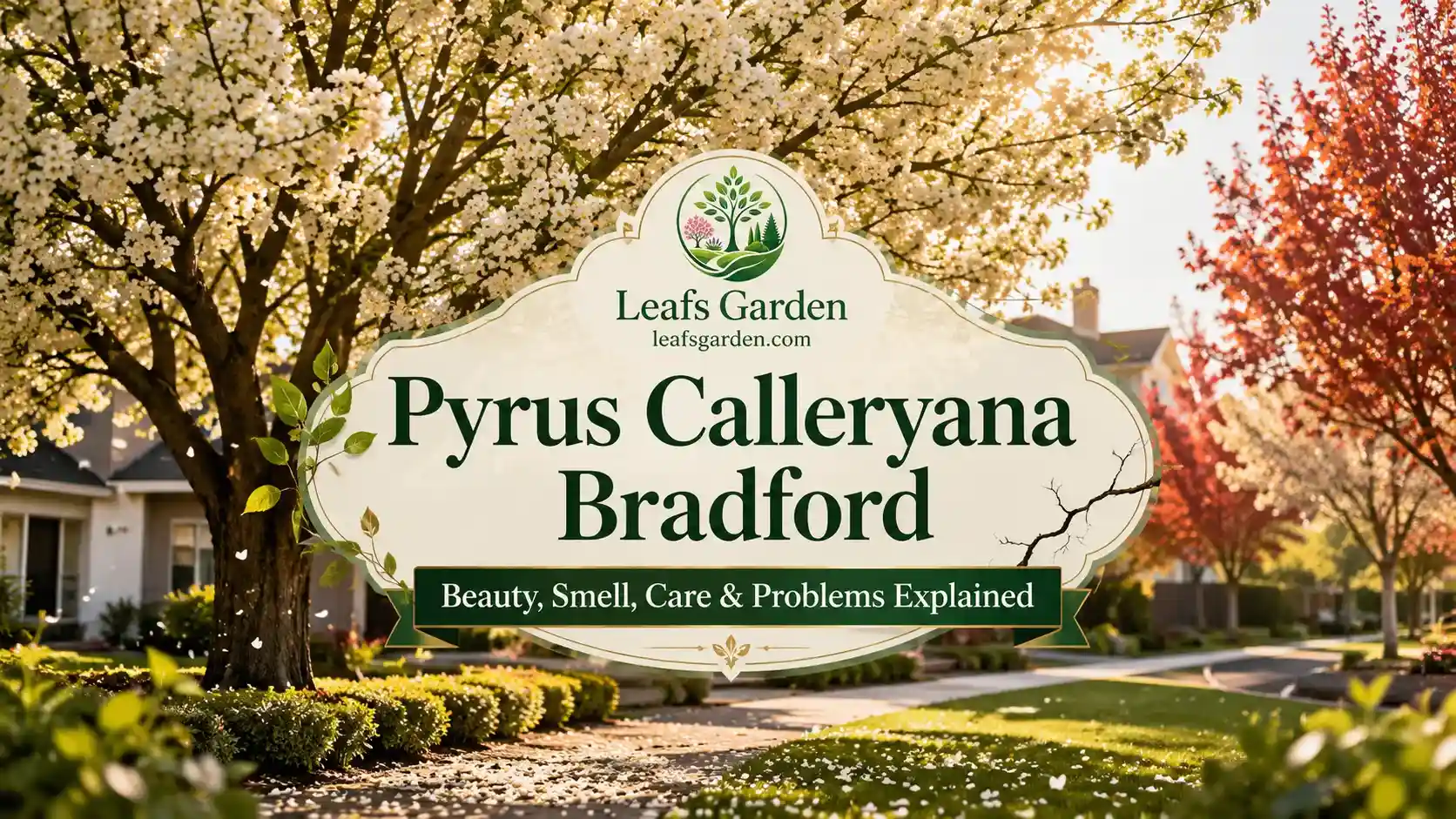
Pyrus calleryana Bradford, commonly known as the Bradford pear tree or Bradford ornamental pear, is a fast-growing flowering ornamental pear tree valued for its bright white spring blossoms, dense rounded canopy, and vibrant autumn foliage. It became widely popular in Australia, the USA, and other temperate urban landscapes because it grows quickly, adapts well to city conditions, and delivers strong seasonal color throughout the year.
In Australia, ornamental pear trees are commonly planted along streets, suburban gardens, commercial landscapes, and modern residential developments because they tolerate cool temperate climates, urban pollution, and compact spaces. The tree’s neat shape and dramatic red, orange, and purple autumn leaves make it especially attractive for Australian streetscapes and decorative front-yard planting.
In the USA, Bradford pear trees gained popularity during the mid-20th century as one of the most widely planted ornamental landscape trees. Their rapid establishment, symmetrical growth habit, and heavy spring flowering made them a preferred urban tree for parks, sidewalks, and housing developments. However, over time, structural weaknesses and invasive concerns began changing public opinion about the tree.
One reason many people search for Pyrus calleryana Bradford is its unusual flower smell. Common search queries include:
The flowers are visually striking but often produce a strong odor that many people compare to rotting fish or chemical-like smells during peak blooming season. Despite this issue, the tree remains popular because of its ornamental value and reliable seasonal display.
Another major concern involves weak branch structure. Bradford pear trees frequently develop narrow branch angles that can split during storms, strong winds, or heavy growth periods. This structural weakness is one of the biggest long-term maintenance problems associated with the species.
Today, gardeners and landscapers often compare Bradford pear with related ornamental pear trees such as the Callery pear, Chanticleer pear, Aristocrat pear, and Cleveland pear tree. These alternatives are commonly chosen for stronger branching structure, improved urban performance, or lower invasive risk while still providing the classic flowering ornamental pear appearance.
Pyrus calleryana Bradford is a flowering ornamental pear cultivar developed from the Callery pear species for landscaping and decorative urban planting. It is widely known for its fast growth, symmetrical crown, white spring flowers, and colorful autumn foliage, making it one of the most recognized ornamental pear trees in urban landscapes.
Unlike edible pear trees, Bradford pear is primarily grown for ornamental value rather than fruit production. It became especially popular in streetscapes, suburban gardens, parks, and commercial developments because of its strong visual appeal and adaptability to different soil and climate conditions.
Pyrus calleryana Bradford belongs to the rose family, which also includes apples, quinces, cherries, and traditional pear trees. It is a cultivated ornamental selection developed specifically for decorative landscape use.
The original Callery pear species is native to parts of China, Vietnam, Korea, and nearby regions of East Asia. The species was introduced into the United States during the early 1900s for agricultural research and disease resistance programs.
The Bradford pear cultivar was later developed in the USA and became commercially popular during the 1960s because of its uniform branching pattern, rapid establishment, and attractive flowering display. It quickly became one of the most widely planted ornamental pear trees in American urban landscaping before spreading into international markets including Australia.
Bradford pear trees became extremely popular because they combined fast growth with strong ornamental performance. Landscapers and city planners valued the tree for its tidy appearance and ability to adapt to difficult urban environments.
Key reasons for its popularity include:
In Australia, Bradford ornamental pear trees became popular in cool temperate regions because they provide strong seasonal color without requiring high maintenance during establishment. Their upright form also works well in modern residential developments and avenue plantings.
In the USA, the tree became a dominant ornamental species in suburban developments, parking lots, shopping districts, and public streets because of its visual uniformity and quick landscape impact.
Bradford pear and Callery pear are closely related, but they are not exactly the same thing. Callery pear refers to the entire species, while Bradford pear is one specific cultivated variety within that species.
In simple terms:
Over time, additional cultivars such as Chanticleer pear, Aristocrat pear, and Cleveland pear tree were developed from the same species to improve branch strength and urban performance.
| Feature | Bradford Pear | Callery Pear Species |
| Growth Habit | Dense upright | Variable |
| Fruit Production | Minimal | More fruit |
| Invasiveness | Moderate concern | Higher concern |
| Structure | Weak branching | Stronger variability |
Bradford pear trees are recognized by their white spring flowers, glossy leaves, rounded canopy, and strong ornamental appearance. The tree develops a dense symmetrical shape that stands out in suburban gardens, city streets, and ornamental landscapes throughout Australia, the USA, and other temperate regions.
Its seasonal transformation is one of the easiest identification features. Bradford ornamental pear trees display masses of white blossoms in spring, rich green foliage during summer, and vibrant red, orange, and purple foliage in autumn.
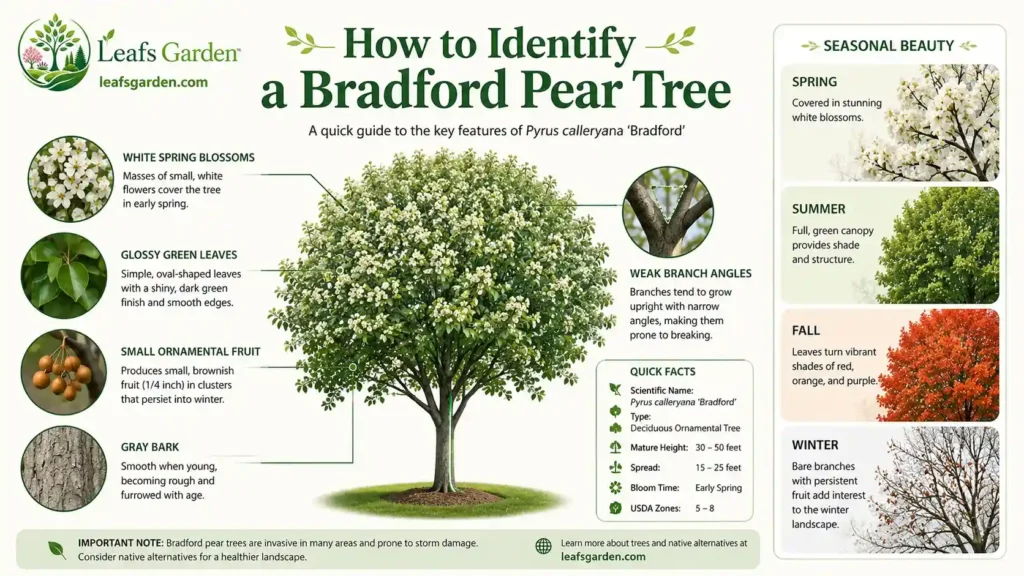
Bradford pear is considered a fast-growing ornamental pear tree with rapid establishment during its early years. This quick growth is one of the main reasons it became popular for urban landscaping and residential planting.
Young Bradford pear trees often grow quickly within the first decade, producing dense branching and a full ornamental shape relatively fast compared to many other flowering landscape trees.
In Australia, growth speed is usually strongest in cool temperate and mild coastal climates where summers are warm but not excessively dry. Cities with seasonal variation often produce better autumn color and stronger flowering performance.
In the USA, Bradford pear trees grow rapidly across many temperate regions, particularly in areas with moderate rainfall and fertile soil. Warm southern climates may increase growth speed, although heat stress can sometimes reduce foliage quality during dry summers.
Average growth rate commonly ranges between:
Bradford pear trees develop glossy foliage and dense branching that create a polished ornamental appearance throughout most of the growing season.
One of the tree’s strongest visual features is its autumn foliage color. As temperatures cool, leaves often change into:
This dramatic seasonal display is one reason ornamental pear trees remain popular in Australian and American landscapes.
The bark is usually:
Bradford pear trees are also known for weak branch angles. Many branches grow tightly upward from narrow attachment points, creating structural weakness as the canopy matures.
Common structural issues include:
These structural weaknesses are one of the biggest long-term concerns associated with Pyrus calleryana Bradford.
Bradford pear blossoms are among the tree’s most recognizable ornamental features. During spring, the canopy becomes covered in dense clusters of bright white flowers before most leaves fully emerge.
The flowering display creates the classic “pear blossom tree” appearance commonly seen in ornamental streetscapes and suburban gardens.
In Australia, flowering usually occurs from:
In the USA, bloom time generally occurs:
Cool temperate regions often produce:
While visually attractive, the flowers are also known for producing a strong unpleasant odor during peak bloom periods.
Bradford pear trees produce small ornamental fruit rather than large edible pears. The fruit is usually less noticeable than the flowers or foliage, but it still plays a role in wildlife attraction and seed spread.
Pyrus calleryana fruit often remains on the tree into autumn and early winter after leaf drop.
The fruit may attract:
Animals can help spread seeds into surrounding areas, which contributes to invasive concerns in some regions of the USA.
Although Bradford pear produces less fruit than many Callery pear varieties, fallen fruit can still create minor maintenance issues such as:
Fruit production may increase when Bradford pear cross-pollinates with nearby ornamental pear cultivars such as Chanticleer pear or Cleveland pear tree.
Bradford pear flowers are widely known for producing an unpleasant odor often compared to rotting fish or strong chemical smells. Although the tree is admired for its heavy white spring blossoms, the strong flower scent is one of the most common complaints associated with Pyrus calleryana Bradford.
Many homeowners notice the smell most strongly during peak flowering season when large numbers of blossoms open at the same time. In dense urban plantings, the odor can become especially noticeable along streets, parks, and residential areas.
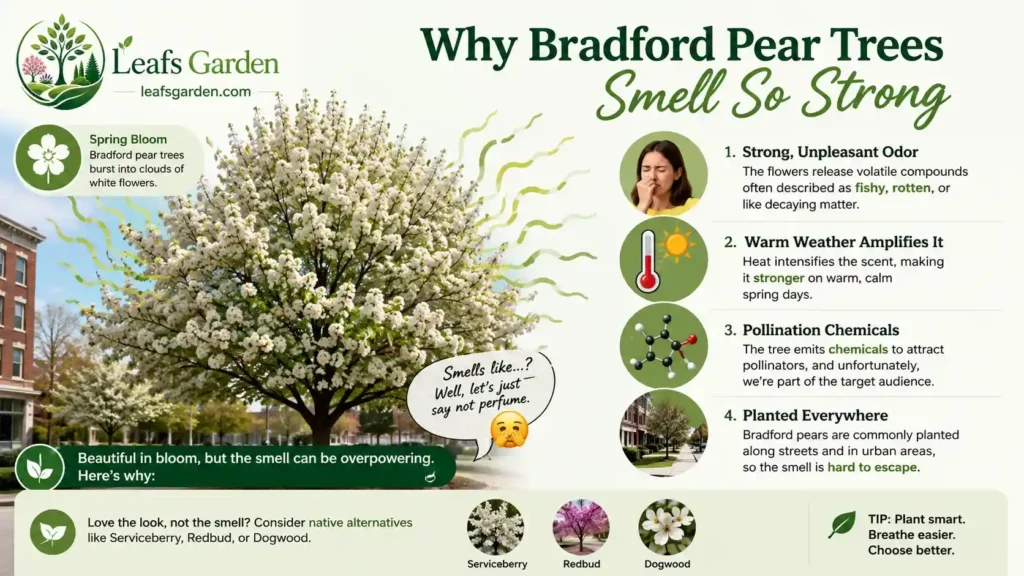
The unpleasant smell comes from natural chemical compounds released during flower pollination. These compounds help attract pollinating insects, but many people find the scent overpowering or unpleasant.
The odor becomes stronger when:
Bradford pear trees produce extremely dense flower clusters, which increases the concentration of floral scent during spring.
Because of this strong odor, many people search online using phrases such as:
Despite the smell issue, the visual flowering display still makes Bradford ornamental pear trees popular in many landscapes.
Not all ornamental pear trees produce the same level of odor. Some cultivars have milder flower smells, while others remain strongly scented during bloom periods.
Chanticleer pear trees usually produce a slightly milder scent compared to Bradford pear. They are often preferred because they combine better branch strength with less noticeable odor.
Cleveland pear trees may still produce a floral odor, but many gardeners consider it less intense than Bradford pear during peak flowering.
Manchurian ornamental pear trees are often chosen in Australia because they generally produce:
Ornamental pear cultivars commonly considered less offensive include:
However, smell intensity can still vary depending on climate, flowering density, humidity, and local growing conditions.
The Bradford pear smell is usually temporary and mainly occurs during active flowering season. Most trees only produce the strongest odor for a short period during peak bloom.
Typical flowering duration:
Weather conditions strongly influence how noticeable the smell becomes.
Warm temperatures can:
Cool or windy conditions often reduce odor buildup around the tree.
Humidity and still air can trap the smell around flowering branches, making it more noticeable near homes, sidewalks, and streetscapes.
The odor is usually strongest:
Bradford pear trees are considered invasive in several parts of the USA because they cross-pollinate with other Callery pear cultivars. Although the original Bradford pear was once believed to produce very little viable fruit, cross-pollination between ornamental pear varieties eventually allowed fertile seeds to spread into surrounding landscapes.
This invasive behavior has become a major environmental concern in parts of North America, especially where multiple Callery pear cultivars grow close together.
Bradford pear trees can spread beyond urban plantings into roadsides, grasslands, forests, and unmanaged natural areas. Once cross-pollination occurs, the resulting offspring often behave very differently from the original ornamental cultivar.
Wild seedlings commonly establish in:
Birds frequently eat the small ornamental fruit and spread seeds across large distances, increasing naturalization problems in many states.
One of the biggest invasive problems involves the offspring produced through cross-pollination. Unlike cultivated Bradford pear trees, wild descendants often develop:
These thorny populations can outcompete native vegetation and become difficult to remove once established.
Invasive Callery pear populations may negatively affect ecosystems by:
Because of these concerns, several parts of the USA now discourage or restrict new Bradford pear planting programs.
In Australia, Bradford ornamental pear trees are still commonly used in urban landscaping, particularly in cool temperate cities and suburban developments. They remain popular because of their tidy form, seasonal color, and suitability for structured streetscape planting.
Bradford pear trees are widely planted in:
The tree performs especially well in southern Australian regions with cooler winters and distinct seasonal changes.
Bradford pear is generally best suited to:
Extremely tropical or humid climates are usually less suitable for strong flowering and autumn foliage performance.
Some Australian councils and landscape planners increasingly prefer alternative ornamental pear cultivars with:
Restrictions and planting recommendations can vary by local region, biodiversity priorities, and council landscape policies.
Despite criticism in some countries, ornamental pear trees remain widely used in Australia because they provide:
Trees such as Chanticleer pear, Cleveland pear tree, and Manchurian ornamental pear are also commonly planted alongside Bradford pear in Australian urban landscapes.
Bradford pear trees are more widely criticized for structural weakness than for aggressive root damage. While the roots are not usually considered highly invasive compared to some large shade trees, structural problems above ground are common as the tree matures.
Bradford pear trees naturally form narrow branch angles that create weak attachment points between limbs and the trunk.
This often leads to:
The problem becomes worse as the canopy becomes denser and heavier over time.
Storm damage is one of the most recognized Bradford pear problems. Mature trees frequently split during:
Large branches may suddenly break because the tree’s branching structure is naturally weak.
Bradford pear roots are generally:
In most residential landscapes, roots are not considered highly destructive to foundations when trees are planted with proper spacing.
Compared with more aggressive root systems, Bradford pear roots are usually less problematic than:
However, planting too close to:
can still create maintenance concerns over time.
Bradford pear trees grow best in full sun with well-draining soil and moderate watering during establishment. These ornamental pear trees are adaptable to many urban conditions, but proper climate, soil, and moisture balance significantly improve flowering performance, autumn foliage color, and long-term tree health.
Pyrus calleryana Bradford is valued in both Australia and the USA because it tolerates pollution, seasonal temperature changes, compacted soils, and many common landscaping conditions better than many ornamental flowering trees.
Bradford pear trees perform best in cool temperate and mild warm-temperate climates where seasonal variation encourages flowering and autumn color development.
The tree thrives in regions with:
Cool temperate climates usually produce:
Once established, Bradford ornamental pear trees can tolerate periods of dry weather better than many soft ornamental species.
Inland adaptability improves when:
However, prolonged drought may reduce flowering quality and increase stress during extreme heat periods.
Bradford pear trees tolerate moderate summer heat reasonably well, especially in:
Excessive extreme heat combined with dry winds may cause:
Pyrus calleryana Bradford has good frost tolerance once mature. Established trees usually handle:
Late spring frost can occasionally damage early flowers in colder climates.
Bradford pear trees are adaptable to different soil types, but healthy root development depends on drainage and balanced soil conditions.
One reason ornamental pear trees became popular in urban landscaping is their ability to tolerate:
Despite this adaptability, waterlogged conditions should still be avoided.
Good drainage is important because overly wet soil may contribute to:
The ideal soil remains:
Raised planting areas can improve drainage in difficult landscapes.
Bradford pear trees prefer:
Ideal pH range:
The species remains relatively adaptable compared to many sensitive flowering ornamentals.
Sunlight exposure strongly influences flowering density, canopy shape, and autumn foliage color intensity.
Bradford pear trees perform best in:
Full sun encourages:
Partial shade may reduce flowering intensity and weaken canopy density.
Young Bradford pear trees need regular watering during establishment, especially in warm Australian climates or dry summer regions.
Recommended watering approach:
Deep soaking encourages stronger root development and improved drought resilience.
Once mature, Bradford ornamental pear trees develop moderate drought tolerance.
Established trees usually handle:
Extended drought may still cause:
Proper feeding and mulching help maintain healthy foliage, stronger flowering performance, and balanced seasonal growth.
Light feeding during early spring can support:
Balanced slow-release fertilizers are generally preferred for ornamental pear trees.
Organic mulch provides several important benefits:
Common mulch materials include:
Mulch should be kept slightly away from the trunk to prevent moisture buildup around the bark.
Excessive nitrogen fertilizer may cause:
Balanced nutrition is more beneficial than aggressive fertilizing for long-term Bradford pear stability.
Proper planting improves structural stability, flowering performance, and long-term ornamental value. Bradford pear trees establish faster and develop healthier root systems when planted in suitable soil, proper sunlight, and correctly spaced landscape positions.
Careful planting is especially important because Pyrus calleryana Bradford naturally develops weak branch structure over time. Strong early establishment helps improve long-term tree performance in both Australian and USA landscapes.
Planting during cooler seasons helps Bradford ornamental pear trees establish roots before extreme summer heat or dry conditions arrive.
In Australia, the best planting periods are usually:
Autumn planting is often preferred because:
Cool temperate Australian climates generally provide the best establishment conditions for ornamental pear trees.
In the USA, ideal planting times commonly include:
Fall planting is widely recommended because it allows root systems to establish before summer stress and heat.
Bare-root Bradford pear trees are:
They usually establish quickly when planted correctly during cooler seasons.
Container-grown trees offer:
However, circling roots should always be loosened before planting.
Proper planting technique improves root establishment and helps reduce future structural problems.
Select a position with:
Bradford pear trees flower best in open sunny landscapes.
The planting hole should be:
Avoid planting too deeply because this may reduce root oxygen and weaken tree health.
If soil drains poorly:
Well-draining soil reduces root stress and disease risk.
The root flare should remain:
Improper root flare placement may contribute to long-term decline.
Immediately after planting:
Young Bradford pear trees benefit more from deep occasional watering than shallow daily watering.
Apply organic mulch around the tree base to:
Keep mulch several centimeters away from the trunk to prevent bark moisture problems.
Proper spacing improves airflow, canopy development, and long-term structural performance.
Bradford pear trees should generally be planted:
This spacing helps reduce future canopy crowding and storm damage risks.
For avenue or urban planting:
Urban planners often use ornamental pear trees because of their uniform growth habit and seasonal visual appeal.
Overcrowding may increase:
Adequate spacing allows Bradford ornamental pear trees to maintain healthier canopy structure and stronger ornamental performance over time.
Routine pruning and seasonal care are essential because Bradford pear trees develop weak branch structures over time. Proper maintenance helps improve canopy balance, flowering quality, structural stability, and long-term ornamental appearance.
Although Pyrus calleryana Bradford is considered relatively adaptable, neglected trees often become vulnerable to storm damage, overcrowded branching, and disease problems as they mature.
Pruning is one of the most important maintenance tasks for Bradford ornamental pear trees because the species naturally develops narrow branch angles and weak limb attachments.
The ideal pruning period is usually:
Dormant pruning improves visibility of branch structure and reduces stress during active growing periods.
Avoid heavy pruning during:
Proper pruning helps reduce the risk of:
Key pruning goals include:
Early structural pruning is especially important while the tree is young.
Young Bradford pear trees benefit from structural training that encourages:
Without proper structural pruning, mature trees often become top-heavy and unstable during severe weather.
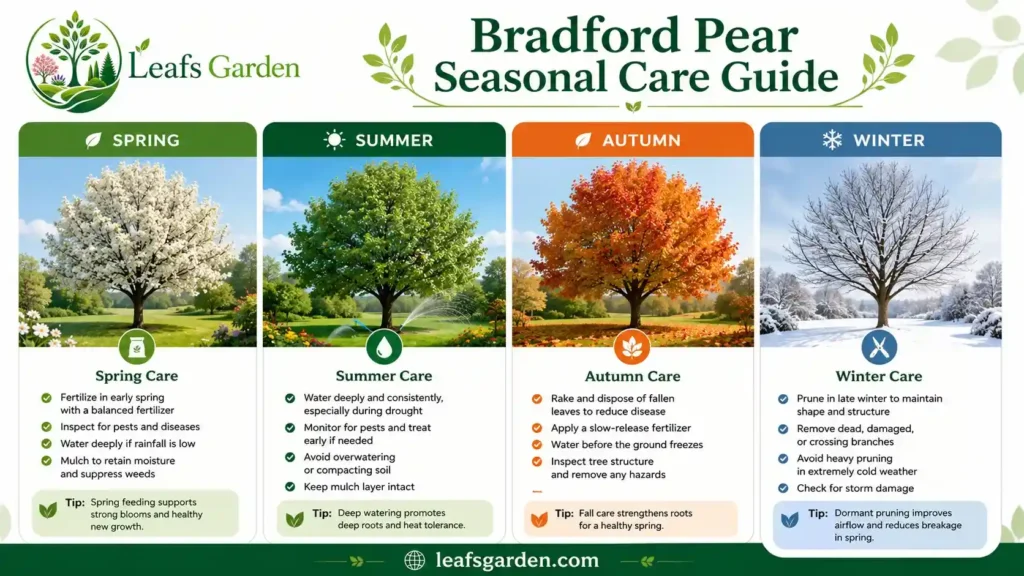
Seasonal maintenance keeps Bradford pear trees healthier throughout the year and supports flowering, foliage quality, and root health.
| Season | Main Care Task |
| Spring | Fertilize and inspect flowers |
| Summer | Deep watering |
| Autumn | Leaf cleanup |
| Winter | Structural pruning |
During spring:
Summer maintenance focuses on:
Young trees need more regular watering than established trees.
Autumn is ideal for:
Removing fallen leaves may help reduce fungal disease problems.
Winter is commonly used for:
Dormant season pruning improves long-term structural stability.
Bradford pear trees are generally hardy, but several pests and diseases can still affect ornamental performance and canopy health.
Fire blight is one of the most serious diseases affecting ornamental pear trees.
Common symptoms include:
Prompt pruning of infected branches helps reduce spread.
Leaf spot diseases may cause:
Good airflow and proper watering practices help minimize fungal problems.
Scale insects attach to stems and branches while feeding on plant sap.
Signs include:
Heavy infestations may require horticultural oil treatment.
Poor drainage increases the risk of root rot problems.
Common causes include:
Healthy drainage is critical for root system stability.
Bradford pear trees may develop several common maintenance issues during their lifespan.
Yellowing foliage may result from:
Checking soil moisture and drainage conditions is often the first step.
Reduced flowering can occur because of:
Full sun exposure improves bloom performance significantly.
Branch breakage is extremely common in mature Bradford pear trees because of their naturally weak branching structure.
Risk factors include:
Preventive pruning helps reduce major failures.
General decline symptoms may include:
Tree decline is often linked to:
Older Bradford pear trees frequently require more maintenance than newer ornamental pear cultivars such as Chanticleer pear or Cleveland Select pear.
Many gardeners now prefer stronger and lower-maintenance ornamental trees instead of Bradford pear. Although Pyrus calleryana Bradford remains popular for its flowering display and autumn color, concerns about weak branching, storm damage, unpleasant flower smell, and invasive potential have encouraged landscapers to choose alternative ornamental trees.
Modern urban planting programs in Australia and the USA increasingly favor ornamental pear cultivars and native flowering trees with improved structural strength, lower maintenance needs, and better ecological performance.
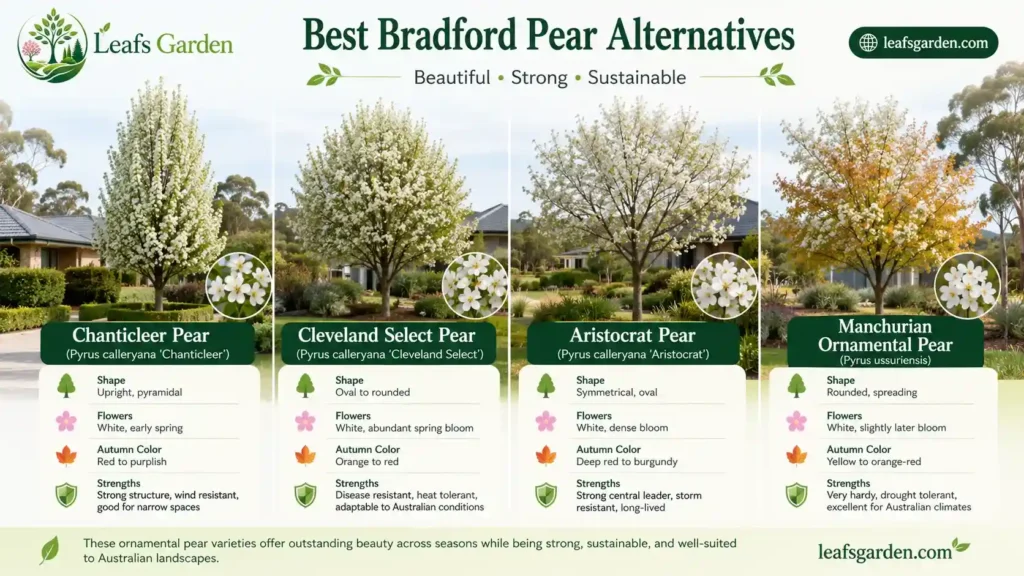
Several ornamental pear varieties provide similar seasonal beauty while improving branch structure and long-term landscape reliability.
Chanticleer pear, also called Capital pear, is one of the most widely recommended alternatives to Bradford pear.
Key advantages include:
Its vertical form makes it especially suitable for:
Aristocrat pear is another improved Callery pear cultivar known for:
It still delivers the classic white spring blossoms and colorful autumn foliage associated with ornamental pear trees.
Cleveland Select pear became popular because it combines:
Many urban planners consider Cleveland pear trees a more durable replacement for Bradford ornamental pear in streetscape projects.
Manchurian ornamental pear is widely planted in Australia because of its:
It is commonly used in:
Many Australian gardeners now prefer native flowering trees that support biodiversity while still providing ornamental value and seasonal beauty.
Popular native white flowering alternatives include:
These trees can provide:
Non-invasive ornamental trees are increasingly preferred in sustainable landscape design because they:
The Ginkgo Maidenhair Tree is one of the most popular non-invasive ornamental alternatives, offering brilliant golden autumn colour, exceptional longevity, and strong urban pollution tolerance in similar cool temperate Australian climates.
Native species are often favored in environmentally sensitive areas and biodiversity-focused urban projects.
Compared to invasive ornamental species, native Australian trees may provide:
This shift toward biodiversity-friendly landscaping is becoming more common across Australian councils and modern residential developments.
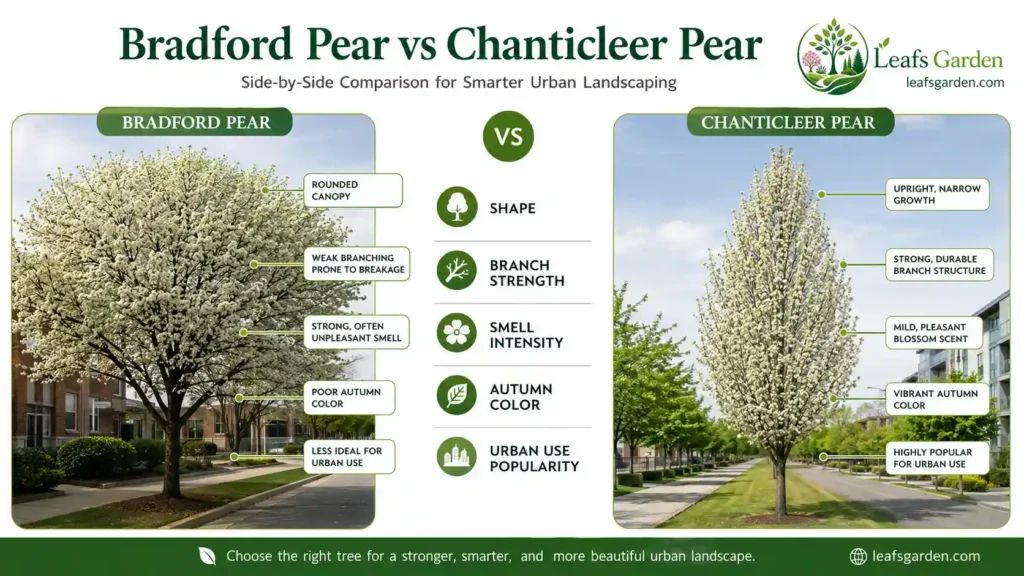
Chanticleer pear is frequently considered the strongest ornamental replacement for Bradford pear because it maintains a similar flowering appearance while improving structural reliability.
| Feature | Bradford Pear | Chanticleer Pear |
| Branch Strength | Weak | Stronger |
| Shape | Rounded | Upright |
| Smell | Stronger | Slightly milder |
| Urban Use | Declining | Increasing |
Many landscapers now prefer Chanticleer pear for:
While Bradford pear trees still appear in older landscapes, newer ornamental planting projects increasingly favor stronger and more stable alternatives.
Bradford pear trees are commonly used as feature trees, street trees, and seasonal ornamental landscape trees. Their dense symmetrical canopy, heavy spring flowering, and colorful autumn foliage make them highly attractive in formal gardens, suburban developments, and urban streetscapes.
Pyrus calleryana Bradford is especially valued for creating strong visual impact across multiple seasons while maintaining a neat ornamental appearance.
For a complete guide to ornamental and deciduous landscape trees suited to Australian cool temperate and urban climates, see our Evergreen, Shade & Landscape Trees guide.
Bradford ornamental pear trees are widely used in landscapes that require seasonal color, structured form, and rapid visual establishment.
Bradford pear trees work well as front yard feature trees because they provide:
Their rounded growth habit creates a balanced focal point near lawns, driveways, and entry pathways.
Many cities historically planted Bradford pear trees along streets and boulevards because they:
Rows of flowering ornamental pear trees create dramatic seasonal displays during spring and autumn.
Bradford pear trees are popular in autumn-focused landscapes because their foliage often changes into:
This strong autumn transformation makes them useful in:
For an even more dramatic autumn colour display in similar temperate Australian climates, the Liquid Amber Tree is one of the most striking deciduous companion trees to plant alongside Bradford pear.
During spring bloom, Bradford pear trees become major visual focal points because of their dense white flower clusters.
They are commonly used:
The flowering canopy creates strong contrast against lawns and surrounding evergreen plants.
Companion planting helps soften the dense canopy structure of Bradford ornamental pear trees while improving seasonal landscape layering.
Ornamental grasses pair well with Bradford pear because they provide:
Popular combinations include:
Flowering shrubs help extend seasonal interest beneath ornamental pear trees.
Common companion shrubs include:
These layered plantings improve visual depth and garden balance.
Autumn perennials complement the tree’s fall foliage display while adding seasonal texture and color.
Popular choices include:
These combinations enhance autumn garden aesthetics without overpowering the tree canopy.
Bradford pear trees are valued because they create strong visual transitions throughout the year, making landscapes feel dynamic across changing seasons.
The tree delivers noticeable visual change through:
This continuous seasonal transformation is one reason ornamental pear trees remain popular worldwide.
The spring flowering display creates:
Flowering Bradford pear avenues are especially dramatic when multiple trees bloom simultaneously.
Autumn foliage is one of the strongest ornamental features of Pyrus calleryana Bradford.
The tree can produce:
In cool temperate climates, the autumn display often becomes the tree’s most attractive landscape feature.
Bradford pear trees are generally not highly toxic, but fallen fruit and weak branches can create maintenance and safety concerns. While Pyrus calleryana Bradford is commonly planted in residential gardens and urban landscapes, homeowners should still consider structural risks, flower sensitivity, and proper planting distance before choosing this ornamental pear tree.
Most safety concerns are related more to branch failure and seasonal maintenance rather than severe toxicity.
Bradford ornamental pear trees are usually considered relatively safe around pets and children when compared to highly toxic ornamental plants. However, some minor concerns can still occur in home landscapes.
Bradford pear trees produce small ornamental fruit that may attract:
The fruit is not commonly grown for human consumption and may cause:
Fallen fruit can also create slippery surfaces on pathways and patios during seasonal drop periods.
Some people may experience seasonal irritation during flowering periods because Bradford pear trees produce heavy pollen and strong floral compounds.
Possible reactions include:
Sensitivity levels vary depending on individual pollen tolerance and local climate conditions.
One of the most commonly discussed issues is the strong flower odor produced during spring bloom.
Some individuals may be sensitive to:
The smell is usually temporary but can become more noticeable:
Structural weakness is one of the biggest long-term safety concerns associated with Bradford pear trees. Mature trees often develop unstable branching patterns that increase the risk of storm damage.
Bradford pear trees are known for:
During severe weather, branches may fail because of:
Older trees are especially vulnerable to storm-related damage.
Limb splitting is extremely common in mature Bradford ornamental pear trees because many branches grow from narrow attachment angles.
This can lead to:
Routine structural pruning helps reduce risk but does not completely eliminate the tree’s natural structural weakness.
To improve safety around homes, Bradford pear trees should generally be planted:
Proper spacing reduces the chance of:
Many landscapers now prefer stronger ornamental pear cultivars such as Chanticleer pear or Cleveland Select pear for residential planting because of their improved branch stability.
Pyrus calleryana Bradford remains one of the most recognizable ornamental pear trees because of its fast growth, dense canopy, bright white spring blossoms, and dramatic autumn foliage. The tree became highly popular in residential landscapes, urban streetscapes, and commercial developments because it delivers strong seasonal beauty with relatively quick establishment.
Its ornamental value is still one of its biggest strengths. During spring, Bradford pear trees create striking flowering displays that transform streets and gardens with masses of white blossoms. In autumn, the foliage often changes into vibrant red, orange, purple, and bronze tones, making the tree a major seasonal focal point in cool temperate landscapes.
The rapid growth rate also contributed to its popularity in Australia, the USA, and many other temperate regions worldwide. Landscapers and urban planners appreciated how quickly the tree created shade, structure, and visual impact in developing residential and commercial areas.
However, Bradford ornamental pear trees are also widely criticized for several long-term problems. The most common concerns include:
The flower odor remains one of the tree’s most discussed characteristics. Although many people admire the dense white blossoms, others strongly dislike the smell produced during peak flowering periods.
Despite these criticisms, Bradford pear trees continue to appear in landscapes because they still provide:
In Australia, Bradford pear remains especially popular in cool temperate cities and suburban developments where seasonal foliage color is highly valued. The tree performs best in regions with moderate summers and cooler winters that support flowering and autumn leaf transformation.
In the USA, many older urban landscapes still contain mature Bradford pear trees, although newer planting programs increasingly favor stronger ornamental pear cultivars with improved structural stability.
Across temperate global landscapes, ornamental pear trees continue to be widely used because they combine:
For long-term success, choosing the right ornamental pear cultivar is important. Trees such as Chanticleer pear, Cleveland Select pear, Aristocrat pear, and Manchurian ornamental pear are often preferred for their stronger branching structure, reduced maintenance concerns, and improved urban durability.
The best choice ultimately depends on:
When planted in suitable conditions and properly maintained, ornamental pear trees can still provide impressive seasonal beauty in gardens, streetscapes, and urban landscapes for many years.
Bradford pear trees produce strong-smelling flower compounds during pollination. The dense white spring blossoms release an odor that many people compare to rotting fish or chemical-like smells. The scent is usually strongest during peak flowering periods in warm weather and humid conditions.
Bradford pear is not considered as aggressively invasive in Australia as it is in some parts of the USA, but concerns about ornamental pear spread are increasing in certain regions. Some councils and landscapers now prefer alternative ornamental trees or improved pear cultivars with lower environmental risk.
Pyrus calleryana Bradford is considered a fast-growing ornamental pear tree. Under good conditions, it commonly grows around 30–60 cm per year. Growth speed depends on climate, soil quality, watering, and sunlight exposure.
Most Bradford pear trees live around 15–25 years, although some may survive longer with proper maintenance. Structural weakness often shortens lifespan because mature trees become vulnerable to branch splitting and storm damage over time.
Bradford pear roots are generally not considered highly invasive compared to aggressive root systems such as willow or poplar trees. However, roots can still spread widely in search of moisture and may create problems if planted too close to pavements, driveways, or underground utilities.
Popular alternatives include: Chanticleer pear Cleveland Select pear Aristocrat pear Manchurian ornamental pear These ornamental pear cultivars are often preferred because they provide: Stronger branch structure Improved urban durability Better long-term stability Reduced storm damage risk
Yes, Bradford pear trees produce small ornamental fruit. The fruit is hard, round, and much smaller than edible pears. Although fruit production is usually limited compared to wild Callery pear trees, cross-pollination with nearby ornamental pear cultivars can increase fruiting.
Bradford pear trees can tolerate moderately hot Australian summers once established, especially in cool temperate and mild inland climates. However, prolonged extreme heat and dry winds may cause stress, leaf scorch, and reduced foliage quality without deep watering and proper mulching.