Grow Better Gardens with Smarter Plant Choices
Discover helpful guides on trees, hedges, fruit plants, edible plants, and beautiful landscape greenery.

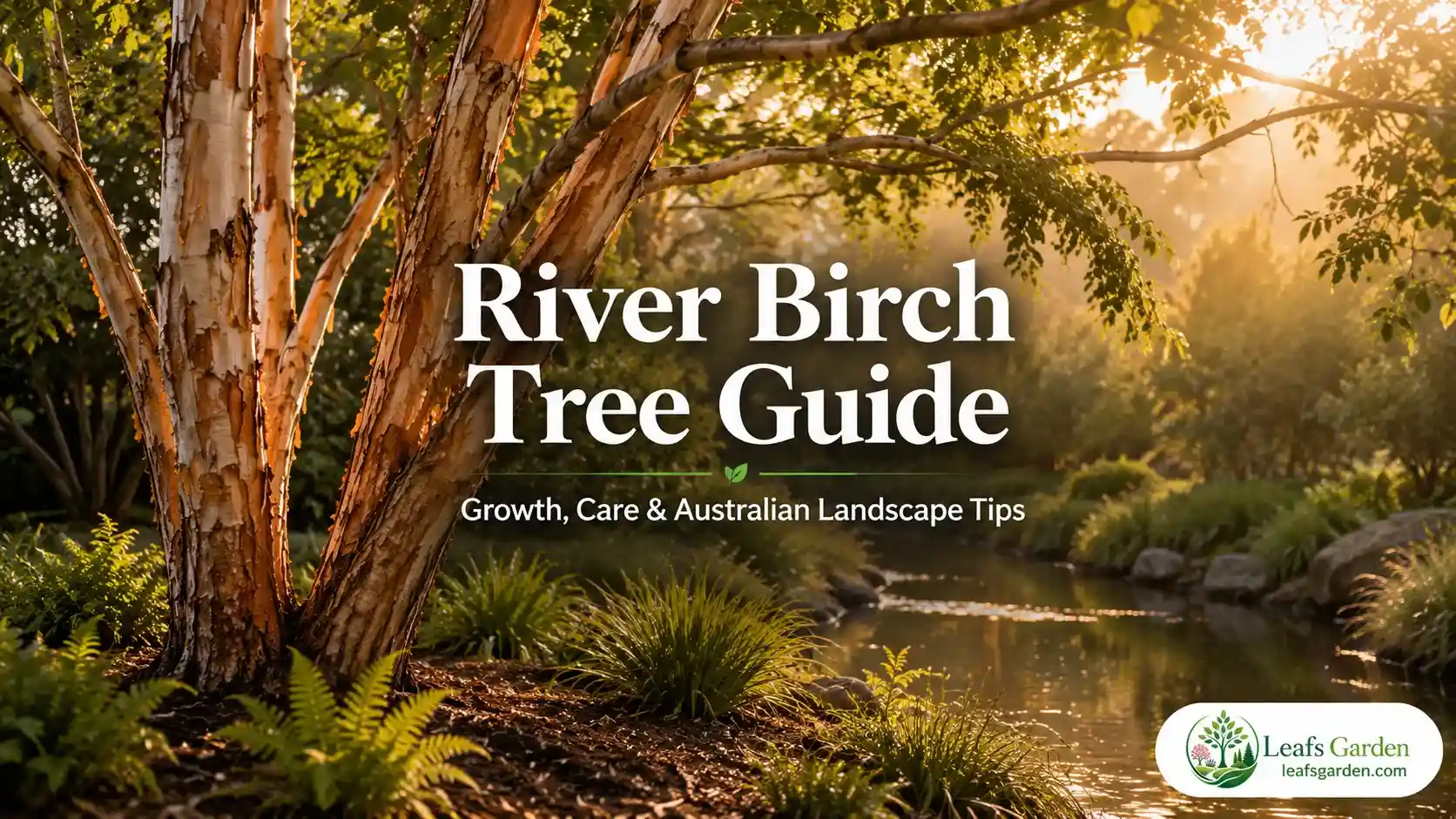
River birch (Betula nigra) is a fast-growing ornamental tree valued for its peeling bark, elegant branching structure, and strong tolerance for moist soils. Native to the eastern United States, this deciduous birch species naturally grows along riverbanks, floodplains, and wet woodland areas. Today, the river birch tree is widely planted in residential landscapes, parks, and water gardens because it combines rapid growth with year-round visual appeal.
Unlike many traditional birch trees, Betula nigra handles humidity and warmer conditions more effectively. This improved heat tolerance has increased interest in river birch Australia planting projects, especially in cooler subtropical regions and moisture-rich gardens. In Australian landscaping, the term “tropical birch” is sometimes loosely connected with river birch due to its adaptability in warmer climates compared to silver birch varieties.
River birch stands out for its cinnamon-colored peeling bark that reveals layers of cream, salmon, and brown tones. The tree often develops a graceful multi-trunk growth habit, creating a softer and more natural appearance in landscapes. Its shallow moisture-seeking root system prefers consistently damp soil, while its fast canopy growth makes it useful as a shade tree and ornamental feature.
Because of its decorative bark, climate adaptability, and naturalistic appearance, river birch has become popular in modern landscape design across the USA and selected temperate parts of Australia.
| Feature | Details |
| Botanical Name | Betula nigra |
| Common Name | River Birch |
| Family | Betulaceae |
| Native Region | Eastern USA |
| Growth Rate | Fast |
| Mature Height | 12–21 m |
| Best Climate | Temperate to subtropical |
| Australian Suitability | Limited but possible in cooler/wet areas |
River birch is a deciduous birch species valued for decorative bark, fast growth, and strong moisture tolerance. It is widely planted as an ornamental landscape tree because it adapts better to warm and humid conditions than many other birch varieties. The tree is especially known for its peeling bark, graceful canopy, and ability to grow near waterlogged soils.
Betula nigra river birch belongs to the Betulaceae family, commonly known as the birch family. This group includes alder, hazel, hornbeam, and several ornamental birch species grown across temperate climates.
The scientific classification of the betula birch tree is:
| Classification | Details |
| Botanical Name | Betula nigra |
| Common Name | River Birch |
| Plant Type | Deciduous Tree |
| Family | Betulaceae |
| Genus | Betula |
| Origin | Eastern United States |
Among trees in the birch family, river birch is considered one of the most heat-tolerant species. Unlike many cold-climate birches, birch Betula nigra performs better in humid summers and wet soils.
The term birch Betula is commonly used to describe all species within the Betula genus, but river birch has unique characteristics that separate it from silver birch, paper birch, and Himalayan birch varieties.
River birch differs from many ornamental birch trees because it tolerates heat, humidity, and wet conditions more successfully. This makes it more suitable for warmer regions where traditional birch species struggle.
Key differences include:
Many birch trees develop white bark, but river birch produces darker exfoliating bark with curly peeling layers. This bark texture gives the tree strong winter interest and ornamental value throughout the year.
River birch also grows faster than many cold-climate birches. Its rapid canopy development makes it popular as a shade tree in parks, streetscapes, and naturalistic landscapes.
River birch is native to the eastern and southeastern United States. In its natural habitat, it commonly grows along riverbanks, floodplains, stream edges, and wet woodland areas.
The species evolved in environments with:
This wetland adaptation explains why river birch performs well near ponds, drainage areas, and water gardens. The tree naturally develops extensive moisture-seeking roots that help stabilize soil near waterways.
River birch became popular worldwide because it combines ornamental beauty with environmental adaptability. Landscape designers value the species for:
Today, river birch is planted across North America, Europe, and selected temperate regions of Australia.
River birch and tropical birch are not always the same tree, although the names are sometimes used interchangeably in Australia. This creates confusion among gardeners and nursery buyers.
In some Australian regions, the term tropical birch tree may refer to:
The phrase Betula nigra tropical birch is sometimes used informally because river birch handles warmth and humidity better than silver birch. However, true river birch remains a temperate deciduous species native to the USA.
Key differences between true river birch and local tropical birch references may include:
True river birch loses its leaves in winter and prefers consistent soil moisture. Some Australian “tropical birch” trees may remain semi-evergreen and tolerate hotter conditions more effectively.
River birch trees are easily recognized by their peeling bark, soft triangular leaves, and elegant branching structure. The species develops a loose, natural-looking canopy that gives landscapes a lighter and more graceful appearance than many dense shade trees.
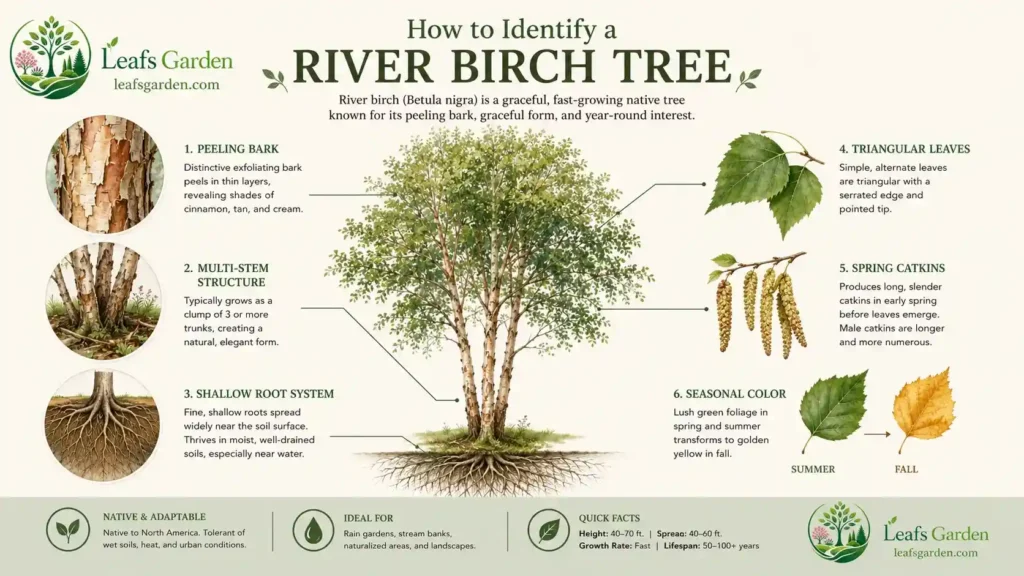
River birch bark is one of the tree’s most distinctive ornamental features. Mature trunks develop curly peeling bark with rich cinnamon tones that gradually expose layers of salmon, cream, tan, and brown underneath.
This exfoliating bark creates strong visual texture throughout the year. As older bark peels away naturally, the trunk develops a rugged layered appearance that becomes more decorative with age.
Young river birch trees usually have:
Older trees develop:
The bark provides excellent winter ornamental interest because the trunk remains visually attractive even after the leaves fall. In cool-season gardens, the peeling bark often becomes the tree’s main landscape feature.
Leaves on a birch tree are generally small, thin, and lightly textured. River birch leaves have a triangular to diamond-shaped form with pointed tips and finely serrated edges.
The leaves of birch trees usually move easily in the wind due to their lightweight structure, giving the canopy a soft shimmering appearance.
River birch leaf characteristics include:
| Feature | Description |
| Leaf Shape | Triangular to oval |
| Leaf Edge | Serrated |
| Leaf Texture | Slightly glossy |
| Summer Color | Medium green |
| Autumn Color | Yellow to golden yellow |
Seasonal color changes are less dramatic than some colder-climate birches, but river birch still produces attractive autumn foliage before leaf drop.
Compared with silver birch autumn color, river birch foliage often appears warmer and less intensely golden. Silver birch typically develops brighter yellow foliage in cooler climates, while river birch performs more consistently in humid conditions.
River birch tree size varies depending on climate, soil moisture, and growing conditions. Mature trees commonly reach 12–21 meters tall with a broad spreading canopy.
The mature canopy spread often ranges from:
River birch naturally develops a graceful branching structure with lightly arching limbs. This softer form makes it suitable for naturalistic and informal landscape designs.
Two common growth forms include:
| Growth Form | Characteristics |
| Multi-Stem | More ornamental, natural appearance |
| Single Trunk | Taller canopy, traditional shade-tree form |
Multi-stem river birch trees are especially popular because they highlight the peeling bark across several trunks instead of only one main stem.
River birch produces small flowers called catkins. These elongated flower clusters appear in spring and play an important role in pollination and seed development.
The tree produces:
After pollination, the female catkins mature into small seed clusters that release lightweight seeds.
These seeds support:
Although the flowers are not highly ornamental, they contribute ecological value to the landscape by supporting pollinators and native habitat systems.
River birch also produces seasonal seed drop, which can naturally spread seedlings in moist environments.
The root system of river birch trees is relatively shallow compared to deep-rooted forest trees. The roots spread outward near the soil surface where moisture levels remain more stable.
Important root characteristics include:
Because river birch naturally grows near waterways, its roots are adapted to consistently moist conditions. In dry climates, the tree may struggle if irrigation is insufficient.
Compared with the silver birch root system, river birch roots generally tolerate wetter soil conditions more effectively. Silver birch roots prefer cooler and better-drained soils, while river birch handles periodic flooding and damp ground more successfully.
The shallow roots can sometimes compete with nearby lawns and garden plants for water, especially during hot weather. Mulching around the root zone helps reduce moisture loss and protects surface roots from heat stress.
River birch grows best in moist soil, full sun, and temperate climates with reliable moisture throughout the year. Although this species tolerates heat better than many birch trees, it still performs best in cooler regions where roots remain consistently damp and protected from extreme summer stress.
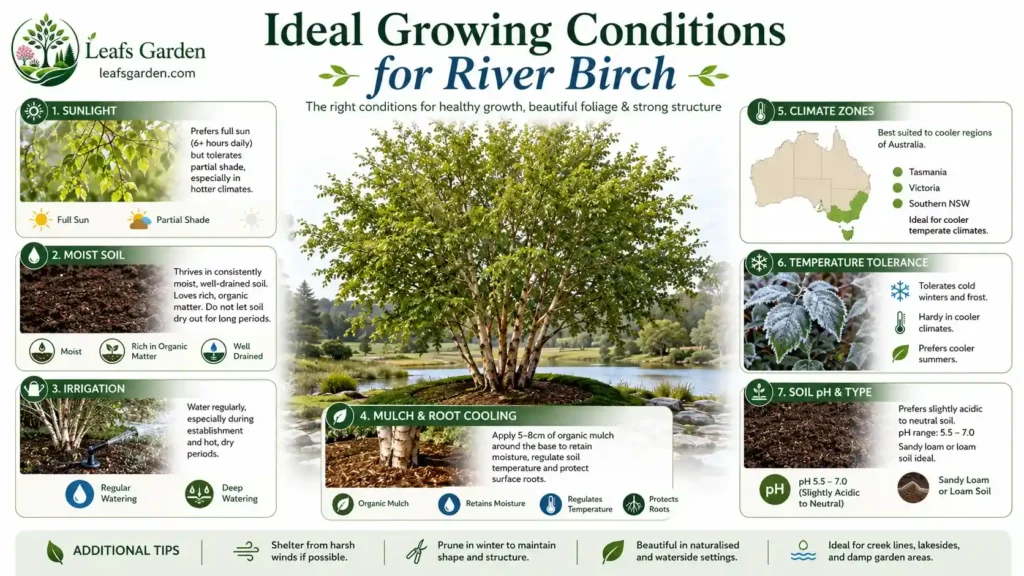
River birch performs best in USDA zones 4–9, where winters are cool and summers remain moderately humid. The species naturally adapts to riverbanks and floodplain environments with regular soil moisture and seasonal rainfall.
Ideal climate conditions include:
Compared to silver birch, river birch handles humidity and summer heat more effectively. This improved tolerance has increased interest in river birch Australia planting, especially in cooler southern regions.
However, river birch tree Australia cultivation still has limitations because prolonged dry heat and harsh summer conditions can stress the tree.
Major Australian climate challenges include:
The species generally performs better in temperate and cooler subtropical areas than in tropical inland climates.
River birch can grow in Australia when planted in cooler and moisture-rich regions. Success depends heavily on climate moderation, irrigation, and soil moisture management.
The tree is most suitable for:
Tasmania and southern Victoria often provide the most reliable conditions because of:
Cooler NSW regions may also support healthy growth when trees receive adequate watering and afternoon shade protection.
Queensland presents greater challenges due to:
In hotter Australian climates, river birch may experience slower growth, yellowing foliage, bark stress, and shortened lifespan if irrigation is inconsistent.
Tropical birch Brisbane discussions often refer to river birch because it tolerates humidity better than silver birch. However, true river birch still prefers cooler root conditions and regular moisture.
A tropical birch tree Brisbane planting may survive in protected garden environments when:
River birch handles humidity relatively well, but prolonged extreme heat can still damage the canopy.
Common warm-climate stress symptoms include:
In Brisbane and similar climates, river birch performs best near:
Deep mulching becomes especially important in warm climates because surface roots dry out quickly during heatwaves.
River birch grows best in full sun but can tolerate partial shade in hotter climates. The tree typically develops stronger branching, fuller canopy growth, and healthier bark color when it receives several hours of direct sunlight daily.
Ideal sunlight conditions include:
In cooler climates, full sun promotes:
In warmer Australian regions, partial afternoon shade may help protect:
Excessive shade can reduce bark coloration and weaken canopy structure over time.
River birch prefers moist, fertile, and slightly acidic soil with reliable drainage. The species naturally grows in rich floodplain soils that hold moisture without becoming permanently stagnant.
Best soil characteristics include:
The tree adapts well to:
Although river birch tolerates damp ground, poor drainage combined with compacted soil may eventually damage roots.
Avoid:
Adding compost and mulch improves both moisture retention and root protection.
River birch has relatively high water needs compared with drought-tolerant ornamental trees. Consistent moisture is one of the most important factors for healthy growth.
The species is sensitive to:
Young trees require:
In Australia, irrigation becomes especially important during:
Signs of underwatering include:
Deep watering combined with heavy mulching helps stabilize soil moisture around shallow roots.
River birch benefits from balanced feeding during active growth periods. Fertilizer supports canopy development, bark health, and overall vigor, especially in nutrient-poor soils.
The best fertilizer timing is usually:
Slow-release feeding is preferred because it:
Suitable fertilizer types include:
Avoid excessive nitrogen because overly rapid growth may weaken branches and increase stress during hot weather.
Mulch and organic matter often improve soil health more effectively than heavy fertilizer applications alone.
River birch establishes fastest when planted during cool seasons in moisture-retaining soil with good organic content. Proper planting helps the tree develop a stronger root system, healthier canopy growth, and improved heat tolerance during summer.
The best planting time for river birch depends on regional climate conditions. Cooler temperatures allow roots to establish before extreme seasonal stress arrives.
In Australia, the ideal planting periods are:
These cooler seasons reduce:
For river birch in warmer Australian climates, autumn planting is usually preferred because roots establish more effectively before summer heat arrives.
In the USA, the best planting times are:
Cool-season planting supports:
Avoid planting during:
A river birch sapling establishes best when planted in rich, moist soil with enough space for canopy and root expansion.
Follow these planting steps:
A river birch tree spacing guide generally recommends:
Proper spacing improves:
Mulching is extremely important for river birch because the tree develops shallow moisture-sensitive roots.
Benefits of mulching include:
Apply:
Suitable mulch materials include:
In hot Australian climates, mulch helps protect roots from overheating and reduces drought stress during extended dry periods.
Avoid:
Young river birch trees may require temporary staking in windy or exposed areas. Proper staking helps stabilize the trunk while roots establish.
Staking is most useful when:
Use:
Overstaking can weaken trunk development, so the tree should still move slightly in the wind.
Early establishment care should include:
During the first 1–2 years, consistent moisture is critical for healthy root development. Newly planted river birch trees struggle quickly if soil becomes excessively dry.
Consistent watering, mulching, and seasonal pruning help river birch trees remain healthy, vigorous, and visually attractive. Although river birch is more adaptable than many birch species, regular maintenance is still important for bark quality, canopy density, and long-term stress reduction.
River birch benefits from different maintenance tasks throughout the year. Seasonal care helps protect the tree from drought stress, pests, and structural problems.
| Season | Care Tasks |
| Spring | Fertilize, inspect pests |
| Summer | Deep watering |
| Autumn | Mulch renewal |
| Winter | Structural pruning |
Spring is the main active growth period. This is the best time to:
Summer care focuses heavily on moisture management. Deep watering becomes critical during:
Autumn is ideal for:
Winter maintenance mainly involves pruning and structural inspection because the bare canopy makes branch structure easier to evaluate.
River birch trees require light structural pruning rather than aggressive cutting. Proper pruning improves airflow, branch balance, and canopy appearance.
The best pruning time is usually:
Avoid heavy pruning during active spring growth because birch trees can experience excessive sap bleeding. This sap leakage does not usually kill the tree, but it may weaken branches and create unnecessary stress.
Pruning should focus on:
Multi-stem river birch trees may occasionally require selective thinning to maintain balanced structure and improve bark visibility.
Avoid:
Clean pruning cuts help reduce disease risk and improve healing.
River birch is considered a fast-growing shade tree under favorable growing conditions. Healthy trees can establish quickly and develop a broad canopy within several years.
Average annual growth rate:
Fast growth makes river birch useful for:
Compared with slower ornamental trees, river birch creates visual impact relatively quickly. Young trees often develop noticeable bark texture and canopy spread within only a few growing seasons.
Growth speed depends heavily on:
In Australia, growth may slow during prolonged heat or drought unless supplemental watering is provided.
River birch requires ongoing maintenance to preserve canopy health and ornamental bark quality over time.
Most healthy trees live:
Long-term maintenance priorities include:
Bark maintenance mainly involves protecting the trunk from:
The peeling bark naturally renews itself and usually does not require manual cleaning or treatment.
Root monitoring becomes increasingly important as the tree matures because river birch develops a wide shallow root system. Surface roots may compete with lawns and nearby plants for moisture during dry periods.
Inspect mature trees periodically for:
Consistent long-term care helps river birch maintain its graceful form, decorative bark, and strong landscape value for decades.
Most river birch problems develop from drought stress, excessive heat, poor soil conditions, or pest pressure. Although river birch is more resilient than many other birch species, it still requires stable moisture and climate protection to remain healthy.
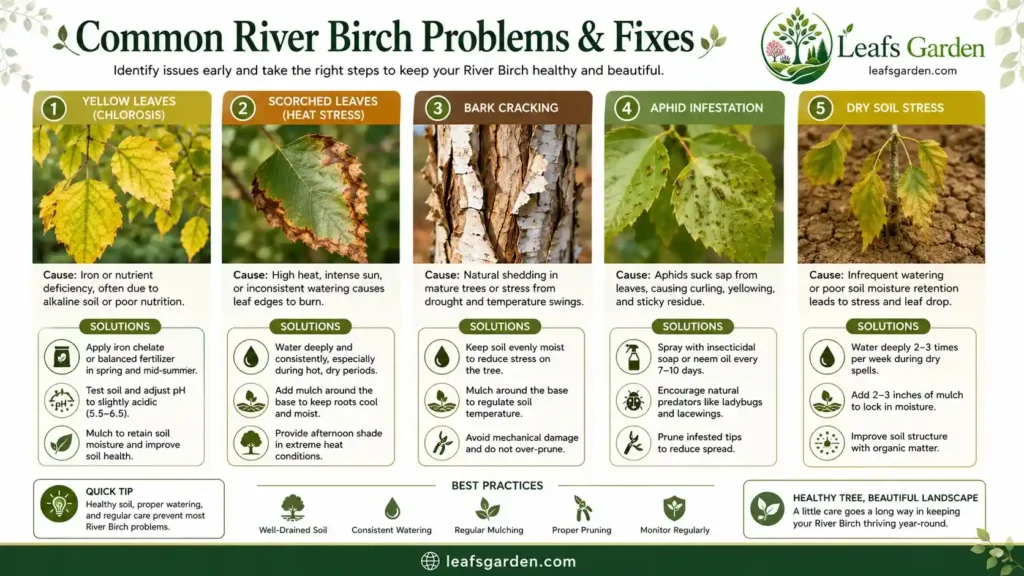
River birch leaves usually turn yellow because of heat stress, chlorosis, nutrient deficiencies, or inconsistent watering.
One of the most common causes is drought stress. When shallow roots become too dry, the canopy may respond with:
Heat stress becomes more severe during:
Chlorosis is another common issue, especially in alkaline soils. This condition prevents the tree from absorbing iron properly.
Symptoms include:
Nutrient deficiencies may also affect foliage color when soil lacks:
Solutions include:
River birch may occasionally experience pest and fungal problems, especially when trees become stressed by heat or poor watering conditions.
Common pests include:
| Pest | Common Symptoms |
| Aphids | Sticky residue, curled leaves |
| Borers | Branch dieback, trunk damage |
| Leaf miners | Damaged foliage patterns |
Aphids commonly appear on young foliage and may attract ants due to honeydew production.
Borers are more dangerous because they attack weakened trees. Heat-stressed river birch trees are more vulnerable to borer infestation.
Common disease problems include:
Leaf spot diseases may cause:
Fungal problems usually increase when:
Healthy growing conditions are the best prevention strategy. Proper spacing, mulching, and moisture management significantly reduce disease pressure.
River birch can struggle in hotter Australian climates because the species naturally prefers cooler and moisture-rich environments.
Common heat-related problems include:
Leaf scorch appears as:
Dry winds increase moisture loss rapidly, especially during summer heatwaves.
Bark cracking may develop when:
In warm Australian regions, river birch benefits from:
Trees planted near lawns, ponds, or moisture-retentive gardens generally perform better than those in exposed dry landscapes.
River birch roots are shallow and moisture-seeking rather than aggressively invasive. However, mature trees can still create problems when planted too close to structures.
Potential root concerns include:
Compared with highly invasive tree species, river birch roots are usually considered moderate in aggressiveness. Problems mainly occur when roots search for moisture near:
Safe planting distances help reduce structural risks.
General recommendations include:
Mulching and deep watering reduce excessive surface root competition by encouraging more stable moisture conditions.
Poor river birch growth usually results from environmental stress rather than genetic weakness.
The most common causes include:
Watering mistakes are especially common during establishment. Dry soil quickly weakens canopy growth, while permanently saturated soil may damage roots.
Compacted soil restricts:
Signs of poor growth may include:
Nutrient imbalance may also reduce growth performance, especially in alkaline or depleted soils.
Solutions often include:
Correcting environmental stress early usually restores healthy canopy development and improves long-term tree vigor.
River birch trees are widely used in landscape design because they combine ornamental bark, graceful structure, and fast canopy growth. Their adaptability to moist soil makes them especially valuable near water features, while their textured trunks create strong visual interest throughout the year.
For a complete guide to deciduous and evergreen landscape trees suited to Australian temperate and cooler climates, see our Evergreen, Shade & Landscape Trees guide.
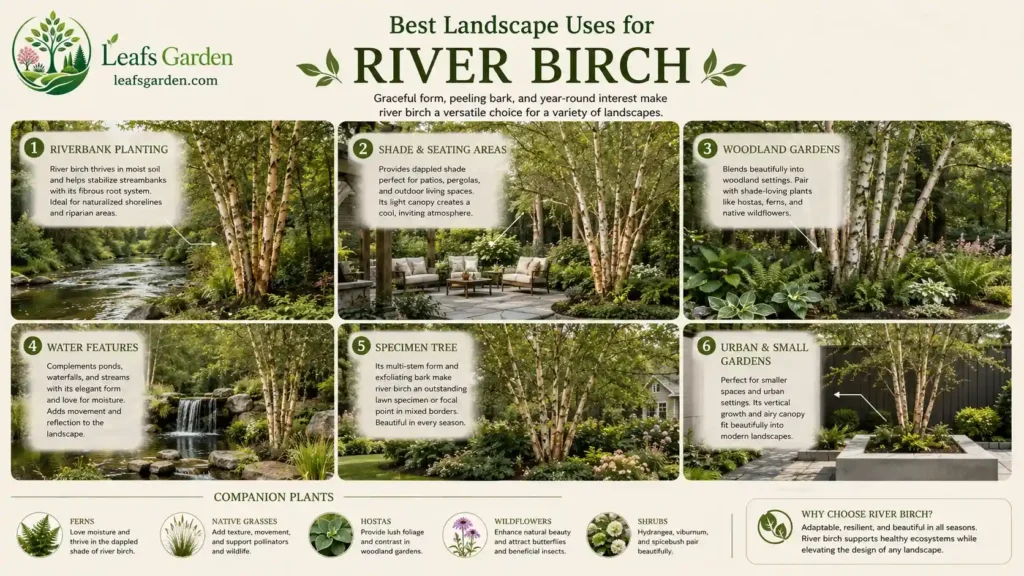
River birch works well in both residential and public landscapes due to its natural form and broad environmental adaptability.
Popular landscape uses include:
| Landscape Use | Benefits |
| Specimen Tree | Decorative bark and graceful structure |
| Riverbank Planting | Erosion control and moisture tolerance |
| Shade Tree | Fast canopy growth and cooling effect |
As a specimen tree, river birch becomes a focal point because of its peeling cinnamon-colored bark and multi-layered canopy. Multi-stem forms are especially attractive in open lawns and naturalistic gardens.
Riverbank planting is one of the species’ strongest landscape applications. The tree naturally adapts to:
Its moisture-seeking root system helps stabilize soil in areas vulnerable to erosion.
River birch is also valued as a fast-growing shade tree. The spreading canopy creates filtered shade that softens heat around:
River birch can work in smaller gardens when carefully managed through pruning and thoughtful placement. Although mature trees can become large, selective pruning helps maintain a more compact structure.
Useful management strategies include:
Multi-stem river birch forms are often preferred in compact landscapes because they create:
In urban settings, river birch may suit:
For small trees for small gardens Brisbane discussions, river birch is usually considered only for cooler or moisture-rich sites. The species requires careful irrigation management in subtropical climates to prevent heat stress.
Compact landscape success depends on:
River birch pairs well with moisture-loving companion plants that tolerate partial shade and organically rich soil.
Suitable companion plants include:
Ferns complement river birch particularly well because their soft foliage matches the tree’s natural woodland appearance.
Popular combinations include:
Native grasses add movement and texture beneath the canopy while improving naturalistic garden design.
For another fast-growing deciduous shade tree that pairs beautifully with river birch in temperate Australian landscapes, the Liquid Amber Tree delivers spectacular multi-colour autumn foliage alongside similar moist soil adaptability.
Other moisture-loving plants suitable near river birch include:
Organic mulch and layered planting help retain soil moisture around both the tree and companion plants.
River birch is increasingly used in modern Australian landscapes because of its ornamental bark and soft natural form. Landscape designers often select the species for projects focused on texture, seasonal interest, and naturalistic planting design.
Current ornamental bark trends favor trees with:
River birch fits well within:
Its lighter canopy structure also works effectively in modern landscapes that emphasize:
In sustainable landscapes, river birch may contribute to:
Australian designers often use river birch near:
The combination of textured bark, fast growth, and graceful structure gives river birch strong visual value in both traditional and modern landscape settings.
River birch handles heat and moisture better than silver birch, while silver birch performs more successfully in colder climates with lower summer stress. Both trees are valued for ornamental bark and elegant branching, but their climate adaptability differs significantly.
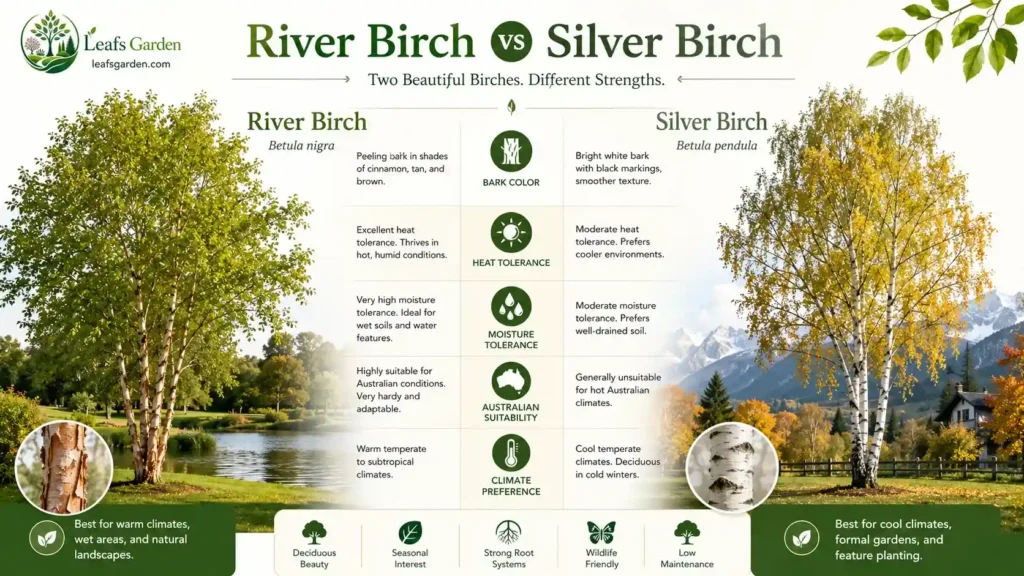
River birch and silver birch belong to the same birch family, but they differ in bark texture, moisture tolerance, and environmental adaptability.
| Feature | River Birch | Silver Birch |
| Bark | Peeling cinnamon | White bark |
| Heat Tolerance | Higher | Lower |
| Moisture Tolerance | Excellent | Moderate |
| Australian Suitability | Better | Cooler regions only |
River birch develops textured peeling bark in shades of cinnamon, salmon, cream, and brown. Silver birch produces the classic smooth white bark commonly associated with traditional European birch landscapes.
Heat tolerance is one of the biggest differences between the two species. River birch handles:
Silver birch prefers:
Moisture tolerance also differs significantly. River birch naturally grows near waterways and adapts well to wet ground, while silver birch performs better in moderately moist but not permanently damp soils.
The best birch tree for Australia depends largely on regional climate conditions. Both river birch and silver birch Australia plantings can succeed, but each species performs differently across the country.
River birch is generally better suited for:
Silver birch tree Australia cultivation works best in:
Silver birch struggles more in warm coastal and subtropical environments because:
Some silver birch varieties are slightly more adaptable than others, but most still prefer cool-climate conditions.
Among birch trees Australia gardeners commonly grow:
For gardeners seeking an alternative long-lived deciduous ornamental tree with excellent pollution tolerance and golden autumn colour in similar Australian temperate climates, the Ginkgo Maidenhair Tree is another highly popular choice.
River birch is often considered the more practical option for Australian landscapes where summers are warmer and moisture levels can be maintained through irrigation.
River birch and tropical birch are frequently confused in Australia because the term “tropical birch” is not always botanically precise.
In some cases, tropical birch may refer to:
This naming confusion creates uncertainty for gardeners researching climate suitability and long-term performance.
Key differences between river birch and local tropical birch references may include:
| Characteristic | River Birch | Tropical Birch References |
| Botanical Identity | Betula nigra | May vary |
| Leaf Habit | Deciduous | Sometimes semi-evergreen |
| Bark Texture | Peeling cinnamon bark | Variable |
| Preferred Climate | Temperate to subtropical | Often warmer climates |
River birch remains a true deciduous birch species native to the USA. It still requires:
Some trees sold as tropical birch may tolerate:
Visually, true river birch usually displays:
Local tropical birch references may differ substantially in bark color, canopy shape, and seasonal behavior.
River birch supports biodiversity, erosion control, and urban cooling while also providing strong ornamental landscape value. Its rapid growth, moisture tolerance, and spreading canopy make it useful in both ecological restoration projects and residential landscapes.
River birch helps support wildlife by providing shelter, seasonal food sources, and habitat structure for birds and beneficial insects.
The tree contributes ecological value through:
Small birds often use river birch for:
The flowers and catkins attract insects during pollination periods, helping support local biodiversity within garden ecosystems.
River birch also contributes to native habitat support by creating:
When combined with companion planting such as ferns and native grasses, river birch can strengthen habitat diversity in naturalistic landscapes.
River birch is highly valued for erosion control because of its natural adaptation to riverbanks and floodplain environments.
The tree’s root system helps:
Riverbank stabilization is one of the species’ most important environmental functions. In natural settings, river birch commonly grows near:
Its moisture-seeking roots perform well in wetland landscapes where many ornamental trees struggle.
River birch is often planted in:
The combination of root spread and fast canopy establishment helps protect vulnerable soils from long-term erosion damage.
River birch provides effective shade and contributes to urban cooling through its broad canopy and fast growth rate.
The tree helps reduce urban heat by:
Fast canopy growth allows river birch to create usable shade relatively quickly compared with slower ornamental trees.
This cooling effect benefits:
In urban environments, river birch can help moderate temperatures around:
Its lighter canopy structure also creates filtered shade instead of extremely dense darkness, making outdoor spaces feel cooler while still allowing moderate light penetration.
Combined with its ornamental bark and graceful branching, river birch offers both environmental and aesthetic value in sustainable landscape design.
River birch is generally considered non-toxic and safe for residential landscapes, but its shallow roots and moisture requirements should still be considered before planting near homes, paving, and underground infrastructure.
River birch is not commonly classified as a toxic tree for pets or children. The leaves, bark, and branches are generally considered low risk in normal landscape settings.
This makes river birch suitable for:
The tree does not typically produce:
However, basic garden safety still matters because:
Pets may occasionally chew bark or leaves, but serious toxicity problems are not commonly associated with river birch.
Maintaining tree health through pruning and branch inspection also improves overall garden safety.
River birch roots are not considered aggressively invasive compared with many large urban tree species. However, the tree develops a wide shallow root system that actively searches for moisture near the soil surface.
Root characteristics include:
The roots may compete with:
In some landscapes, mature roots can gradually affect:
Safe planting distances help minimize these issues.
General spacing recommendations include:
Mulching and deep watering help reduce excessive surface-root competition by encouraging more stable soil moisture conditions.
River birch should not be planted directly beside buildings because mature roots and canopy spread require adequate space.
Proper planting distance protects:
Recommended distances usually include:
| Structure | Recommended Distance |
| House Foundations | 5–8 meters |
| Underground Pipes | 3–5 meters |
| Paving & Paths | Several meters clearance |
Although river birch roots are less aggressive than some urban trees, moisture-seeking roots may still move toward:
The canopy should also be considered because mature trees can develop:
In smaller gardens, multi-stem forms combined with long-term pruning management may help reduce space pressure near structures.
Careful placement improves both tree health and long-term property protection.
River birch is one of the most adaptable ornamental birch trees, valued for its peeling bark, fast growth, graceful canopy, and strong moisture tolerance. Compared with many traditional birch species, Betula nigra handles humidity and wetter soil conditions more successfully, making it a practical option for temperate and moisture-rich landscapes.
Its biggest advantages include:
River birch performs best in:
In Australia, the species is generally most suitable for:
Hot and dry climates may still create challenges, especially where summer heat, dry winds, and poor soil moisture place stress on shallow roots.
River birch works especially well as:
For the best long-term results, climate compatibility should always guide tree selection. Gardeners in cooler regions may successfully grow both river birch and silver birch, while warmer climates often favor the improved heat tolerance of river birch.
Choosing the right birch species for local environmental conditions helps ensure healthier growth, stronger bark development, reduced stress problems, and longer landscape lifespan.
Yes, river birch can grow in Australia when planted in cooler and moisture-rich regions. The tree performs best in Tasmania, Victoria, and cooler parts of New South Wales where summers are milder and soil moisture is more reliable. In hotter regions, successful growth usually requires deep watering, mulching, and protection from intense afternoon heat.
River birch is considered a fast-growing ornamental shade tree. Under favorable conditions, it commonly grows around 60–90 cm per year. Growth is usually fastest in moist fertile soil with regular irrigation and full sun exposure.
River birch is generally better for warmer and more humid climates because it tolerates heat and wet soil more effectively than silver birch. Silver birch performs better in cooler climates with lower summer temperatures. In many Australian landscapes, river birch is often the more adaptable choice.
Yes, river birch is a deciduous tree that loses its leaves during winter. Before leaf drop, the foliage usually changes from green to yellow or golden-yellow shades. The peeling bark then becomes the tree’s main ornamental feature throughout winter.
River birch roots are not considered aggressively invasive, but they do spread widely near the soil surface in search of moisture. Mature roots may compete with lawns and nearby plants if planted too close. Proper spacing from houses, paving, and underground pipes helps prevent long-term issues.
River birch tolerates heat better than many other birch species, but extreme hot and dry climates can still cause stress. Prolonged heat may lead to leaf scorch, bark cracking, and canopy thinning. Deep watering, mulching, and afternoon shade protection improve performance in warmer regions.
The term “tropical birch” in Australia can sometimes refer to river birch or other ornamental trees with birch-like bark. This creates naming confusion because not all tropical birch references are true Betula nigra trees. True river birch remains a deciduous birch species native to the USA.
River birch trees typically reach 12–21 meters tall at maturity, depending on climate, soil quality, and growing conditions. Multi-stem forms often appear wider and more spreading, while single-trunk trees usually develop a taller upright canopy.