Grow Better Gardens with Smarter Plant Choices
Discover helpful guides on trees, hedges, fruit plants, edible plants, and beautiful landscape greenery.

Spartan juniper is a fast-growing evergreen conifer valued for its narrow upright shape, low maintenance care, and year-round green foliage.
Known botanically as Juniperus chinensis ‘Spartan’, Spartan juniper is widely used for privacy screens, formal hedges, driveway borders, and vertical landscape structure. Its dense green foliage and naturally upright growth make it one of the most practical evergreen conifers for residential and commercial landscapes.
Spartan juniper is especially popular in Australia, the USA, and other temperate regions because it adapts well to different climates and soil conditions. Gardeners value it for its drought tolerance, strong wind resistance, and reliable evergreen appearance throughout the year.
One of the biggest reasons people choose Spartan juniper is its balance between beauty and low maintenance. It grows relatively quickly compared to many upright conifers while still keeping a tidy pyramidal shape without constant pruning.
Many homeowners searching for natural privacy solutions often ask:
The answer is usually yes. Spartan juniper performs very well as a dense screening conifer in sunny locations with well-drained soil. Its narrow footprint also makes it suitable for smaller gardens, urban landscapes, fence lines, and modern outdoor designs.
Many gardeners also compare Spartan juniper with Blue Arrow Juniper and Seneca Juniper when choosing upright evergreen conifers. While Blue Arrow juniper is slimmer and more columnar, Spartan juniper is fuller and often preferred for thick privacy hedging and screening.
Because of its fast growth rate, upright evergreen habit, and easy-care nature, Spartan juniper continues to be one of the most reliable conifers for Australian gardens and landscapes worldwide.
Spartan juniper is a narrow upright Chinese juniper cultivar with dense evergreen foliage and a naturally columnar shape.
Known for its strong vertical growth and low-maintenance care, Spartan juniper is widely planted as a privacy screen, hedge, and architectural landscape conifer. Its rich green foliage stays attractive throughout the year, making it a reliable evergreen option for both residential and commercial landscapes.
Spartan juniper has a naturally upright pyramidal form with dense compact branching and scale-like evergreen foliage. It is commonly used where gardeners want height without excessive width.
Key identifying features include:
Its vertical shape makes it ideal for:
Spartan juniper belongs to the cypress family and is a cultivated form of Chinese juniper.
| Classification | Details |
| Scientific name | Juniperus chinensis Spartan |
| Botanical variation | Juniperus chinensis Spartan juniper |
| Alternative botanical reference | Juniperus Spartan |
| Plant family | Cupressaceae |
Common names include:
As part of the Cupressaceae family, Spartan juniper is closely related to other ornamental conifers commonly used in landscaping and screening applications.
Spartan juniper originates from Chinese juniper species native to parts of East Asia. Over time, this cultivar became popular worldwide because of its adaptability, drought tolerance, and strong upright structure.
Today, Spartan juniper performs successfully across:
Its ability to tolerate heat, dry conditions, and varying soil types makes it especially valuable in Australian landscapes where water-wise gardening is increasingly important.
In the USA, Spartan juniper is commonly planted in suburban landscapes, commercial properties, and formal evergreen hedges because it combines fast vertical growth with a relatively narrow footprint.
Spartan juniper is not a true pine tree even though some gardeners refer to it as a pine juniper, juniper pine, or juniper pine tree. The confusion usually comes from its evergreen appearance and conifer-like shape.
However, junipers and pine trees belong to different plant groups and have distinct foliage characteristics.
| Feature | Spartan Juniper | Pine Tree |
| Plant type | Juniper conifer | Pine conifer |
| Foliage | Scale-like | Needle-like |
| Growth habit | Narrow upright | Varies widely |
| Maintenance | Low | Moderate |
Unlike many pine species, Spartan juniper keeps a dense compact structure with softer scale-like foliage rather than long needles. It also typically requires less pruning and maintenance than many traditional pine landscape trees.
This low-maintenance nature is one reason Spartan juniper remains popular for modern privacy screens and structured evergreen landscaping.
Spartan juniper trees typically grow tall and narrow, making them ideal for screening and vertical landscaping.
This upright evergreen conifer is valued for its ability to create height without taking up excessive horizontal space. Its naturally columnar form works especially well in modern gardens, narrow side yards, driveway borders, and privacy hedge plantings.
Spartan juniper size can vary depending on climate, sunlight exposure, soil quality, and long-term maintenance.
In most Australian gardens, mature Spartan juniper trees commonly reach:
In ideal USA growing conditions, especially in cooler temperate regions with consistent moisture and full sun, some plants may grow even taller over time.
Typical growth expectations include:
| Region | Mature Height | Mature Width |
| Australia | 4–6 m | 1–1.8 m |
| USA | 5–7 m | 1–2 m |
| Mild temperate climates | Up to 7 m | Narrow upright spread |
Climate strongly influences overall size and density. In warmer dry climates, Spartan juniper may remain slightly narrower and more compact. In cooler temperate environments with richer soil, growth may become fuller and taller.
One of the biggest advantages of Spartan juniper is its narrow footprint. Unlike broad spreading evergreen trees, it provides vertical screening while preserving usable garden space.
This makes Spartan juniper especially useful for:
Spartan juniper has a moderate-to-fast growth rate under full sun and well-drained soil conditions.
The average Spartan juniper growth rate is typically:
Many gardeners searching for:
are usually looking for a fast privacy solution. Compared with many evergreen conifers, Spartan juniper establishes relatively quickly while still maintaining a dense structured form.
Several factors improve growth speed:
Growth can slow significantly in:
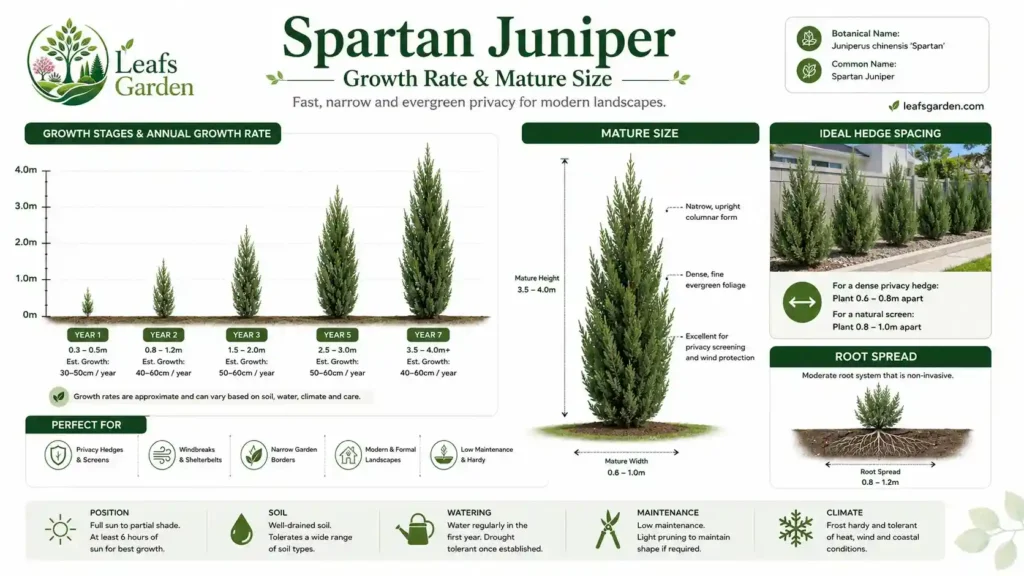
Spartan juniper is known for its dense evergreen foliage and strong upright structure.
Its foliage stays rich green throughout the year, providing consistent color in all seasons. Unlike some conifers that become sparse with age, Spartan juniper typically maintains compact branching and dense coverage when grown in suitable conditions.
Key appearance features include:
The foliage consists of soft scale-like growth rather than long pine needles. This creates a smoother, more refined appearance that works well in formal landscapes and modern garden designs.
Its upright pyramidal form also helps it resist wind damage better than some broader evergreen species. The compact branching structure reduces breakage and improves year-round durability in exposed landscapes.
Spartan juniper has a relatively non-invasive root system compared with many large landscape trees.
Its roots are generally considered suitable near:
While roots are not typically aggressive, proper drainage remains extremely important. Poorly drained soil can lead to root stress, fungal issues, and reduced long-term health.
Healthy root development depends on:
Because of its manageable roots and narrow growth habit, Spartan juniper is often chosen for structured residential landscapes where space efficiency matters.
Spartan juniper grows best in sunny climates with good drainage and moderate airflow.
This evergreen conifer performs exceptionally well in regions with full sun, relatively dry conditions, and soils that do not remain constantly wet. Its adaptability is one reason Juniperus chinensis ‘Spartan’ has become popular in Australian landscapes, American gardens, and many temperate regions worldwide.
Good airflow around the foliage is especially important because it helps reduce fungal stress and keeps the dense evergreen growth healthy.
Spartan juniper adapts very well to many Australian climate zones, especially areas with warm sunshine and moderate drainage.
In coastal regions, Spartan juniper generally performs well when planted in:
It can tolerate moderate coastal exposure and occasional dry winds once established. However, extremely humid coastal conditions may slightly reduce foliage density over time if airflow is poor.
Dry inland climates are often ideal for Spartan juniper because the plant naturally handles heat and lower rainfall levels well.
Benefits in inland regions include:
This makes Spartan juniper highly suitable for water-wise Australian landscaping.
Temperate regions provide some of the best overall growing conditions for Spartan juniper. Mild winters combined with sunny summers help maintain dense upright growth and healthy foliage color throughout the year.
In these climates, the plant often develops:
Spartan juniper has good frost tolerance once established.
Light to moderate frosts are usually not a major problem in most temperate Australian gardens. Young plants may require slight protection during severe cold events, but mature specimens are generally resilient.
Spartan juniper grows successfully across a wide range of American climate zones.
| USDA Zone | Suitability |
| Zone 4–9 | Excellent |
| Extreme humidity | Moderate |
| Heavy tropical climates | Less ideal |
In USDA Zones 4–9, Spartan juniper usually maintains strong evergreen performance with proper sunlight and drainage.
However, extremely humid regions can increase the risk of:
Heavy tropical climates are generally less suitable because constant humidity and excessive moisture may weaken long-term plant health.
Spartan juniper is widely valued for its drought-resistant qualities and heat tolerance.
Once established, it can handle:
This makes Spartan juniper highly effective for:
Its drought tolerance is one reason it is commonly used in xeriscaping projects where reducing water usage is a priority.
Key xeriscaping advantages include:
Although Spartan juniper tolerates dry conditions very well, occasional deep watering during extreme heat can help maintain richer foliage color and stronger overall growth.
Spartan juniper needs full sun and well-drained soil for healthy upright growth.
Choosing the correct planting location is one of the most important factors for long-term success. Proper sunlight, airflow, and drainage help Spartan juniper maintain dense evergreen foliage, faster growth, and strong disease resistance.
Spartan juniper performs best in full sun conditions.
For optimal growth, the plant should receive:
Full sun helps Spartan juniper develop:
Plants grown in bright sunlight are usually fuller and healthier compared with those planted in shaded areas.
Although Spartan juniper can tolerate light partial shade, growth may become thinner and less compact if sunlight is limited for long periods.
Minimum acceptable conditions generally include:
Too much shade can create several problems, including:
For the best screening results, Spartan juniper trees should always be planted in the sunniest practical position available.
Spartan juniper adapts to several soil types as long as drainage remains good.
Suitable soil conditions include:
Sandy soil works very well because it allows excess water to drain away from the roots quickly. This helps reduce root rot risks and improves drought tolerance.
Loamy soil is often considered ideal because it balances:
Good drainage is essential for healthy Spartan juniper growth.
Poorly drained soil can cause:
If drainage is poor, improve the planting area by:
Spartan juniper generally prefers:
The plant is relatively adaptable as long as the soil does not remain excessively wet.
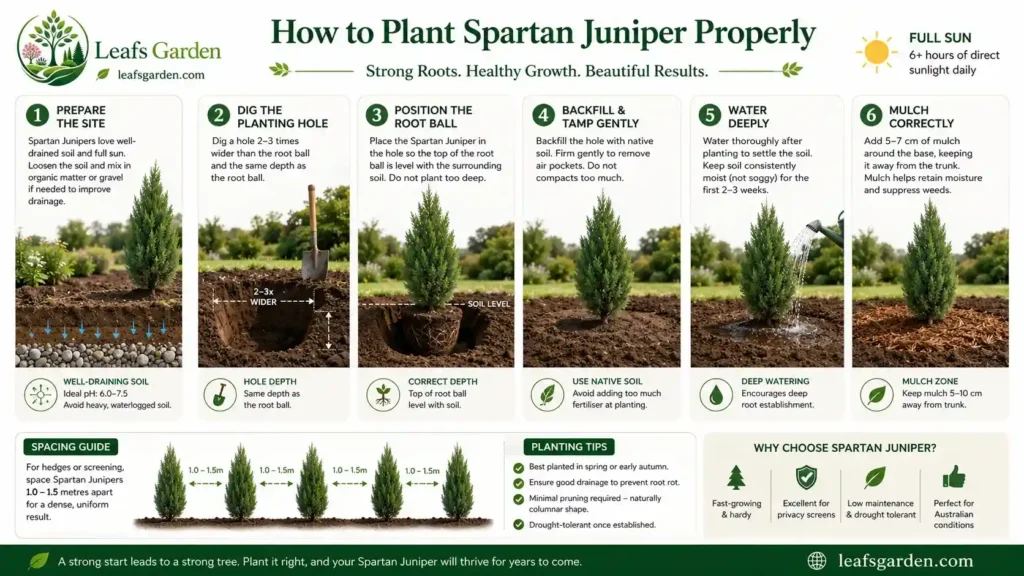
Correct spacing prevents overcrowding and improves airflow.
Proper spacing also helps maintain healthy foliage density and reduces future maintenance problems for a Spartan juniper hedge.
| Use | Recommended Spacing |
| Hedge planting | Moderate spacing |
| Privacy screen | Wider spacing |
| Feature planting | Single specimen |
For hedge planting, moderate spacing encourages connected foliage coverage while still allowing airflow between plants.
For privacy screens, slightly wider spacing allows mature growth without excessive crowding. This helps spartan juniper trees maintain healthier branching over time.
When using juniper Spartan trees as feature specimens, individual planting creates stronger visual impact and allows the natural pyramidal form to stand out clearly.
Before planting, check that water drains freely from the site. Avoid locations where water pools after rainfall.
If needed:
Dig a hole:
A wider hole helps roots establish more easily in surrounding soil.
Place the root ball carefully into the hole with the top sitting level slightly above surrounding soil height.
Avoid planting too deeply because buried stems can increase disease risks.
Refill the hole gently using the original soil or improved well-draining soil mix.
Lightly firm the soil:
After planting, water deeply to settle the soil around the roots.
During establishment:
Apply mulch around the base to help:
Keep mulch slightly away from the trunk to prevent moisture buildup around the stem.
Spartan juniper is considered a low-maintenance evergreen once established.
Once the root system becomes established, this upright conifer typically requires only basic watering, occasional feeding, and light seasonal maintenance. Proper care helps maintain dense foliage, healthy green color, and strong upright growth for many years.
Correct watering is one of the most important parts of Spartan juniper care.
Although Spartan juniper is drought tolerant after establishment, newly planted trees still require consistent moisture while developing roots.
Young Spartan juniper plants need deeper and more regular watering during their first growing season.
General watering guidelines include:
Deep watering encourages roots to grow downward, improving drought resistance later.
Mature Spartan juniper trees usually require far less irrigation.
Established plants often perform well with:
In dry Australian summers or extended drought periods, occasional deep soaking helps maintain healthier foliage color and stronger growth.
Overwatering is one of the most common causes of Spartan juniper problems.
Excess moisture can lead to:
Signs of excessive watering may include:
Well-drained soil remains essential for long-term plant health.
Spartan juniper generally does not require heavy feeding, but occasional fertilization can improve growth and foliage density.
The best time to fertilize Spartan juniper is usually:
Avoid heavy late-season fertilizing because soft new growth may become vulnerable to winter damage in colder regions.
Slow-release conifer fertilizers are commonly recommended because they provide steady nutrients without forcing overly rapid growth.
Balanced slow-release fertilizers can help:
Always follow label recommendations to avoid overfertilization.
Organic feeding options may include:
Organic materials improve soil structure gradually while supporting beneficial soil activity.
Mulching helps Spartan juniper maintain healthier roots and more stable soil conditions.
A mulch layer helps reduce rapid moisture evaporation during hot weather. This is especially useful in dry Australian climates and sunny landscape positions.
Mulch suppresses weeds that compete for:
Reducing weed competition helps young Spartan juniper plants establish faster.
Mulch also protects roots by:
For best results:
Spartan juniper maintenance changes slightly throughout the year depending on climate and weather conditions.
| Season | Care Tasks |
| Spring | Fertilizing & pruning |
| Summer | Deep watering |
| Autumn | Mulching |
| Winter | Minimal maintenance |
Spring is the main active growth period.
Recommended tasks include:
During summer:
Autumn is a good time for:
Moderate watering may still be necessary in dry climates.
Winter maintenance is usually minimal.
Most established Spartan juniper plants simply require:
Because of its hardy evergreen nature, Spartan juniper remains relatively easy to maintain throughout the year.
Spartan juniper naturally keeps its upright shape but light pruning improves density and appearance.
One of the biggest advantages of Juniperus chinensis ‘Spartan’ is that it usually maintains a neat pyramidal form without constant trimming. Unlike many hedge plants that require heavy shaping several times a year, Spartan juniper typically needs only occasional maintenance.
Light pruning can help:
The best time to prune Spartan juniper is usually during active spring growth.
Spring pruning allows the plant to recover quickly and produce fresh healthy growth.
Light spring trimming is useful for:
Small corrective cuts are generally safer than aggressive heavy pruning.
Heavy winter pruning is not recommended.
Cutting too aggressively during cold conditions may:
In colder climates, damaged or dead branches can still be removed lightly if necessary, but major shaping is better saved for spring.
Spartan juniper responds best to light shaping rather than severe cutting.
For a Spartan juniper hedge, regular light trimming helps maintain:
Avoid waiting too long between pruning sessions because large overgrown cuts can create visible gaps.
Spartan juniper works well in both:
Formal shaping creates:
Natural shaping preserves:
Many gardeners prefer minimal shaping because the plant naturally develops an attractive upright habit on its own.
Avoid cutting deeply into old bare wood whenever possible.
Older interior branches may not regenerate dense foliage effectively after severe pruning. Instead:
This approach helps maintain a fuller appearance and reduces long-term thinning.
Spartan juniper is considered a very low-maintenance evergreen conifer.
Its naturally upright growth and drought tolerance reduce the need for:
Low-maintenance advantages include:
Once established, Spartan juniper often requires only occasional monitoring and seasonal light trimming.
With proper drainage and suitable growing conditions, Spartan juniper can remain healthy for many years.
Long lifespan benefits include:
Healthy plants grown in full sun with proper airflow and well-drained soil often maintain strong growth and dense foliage for decades.
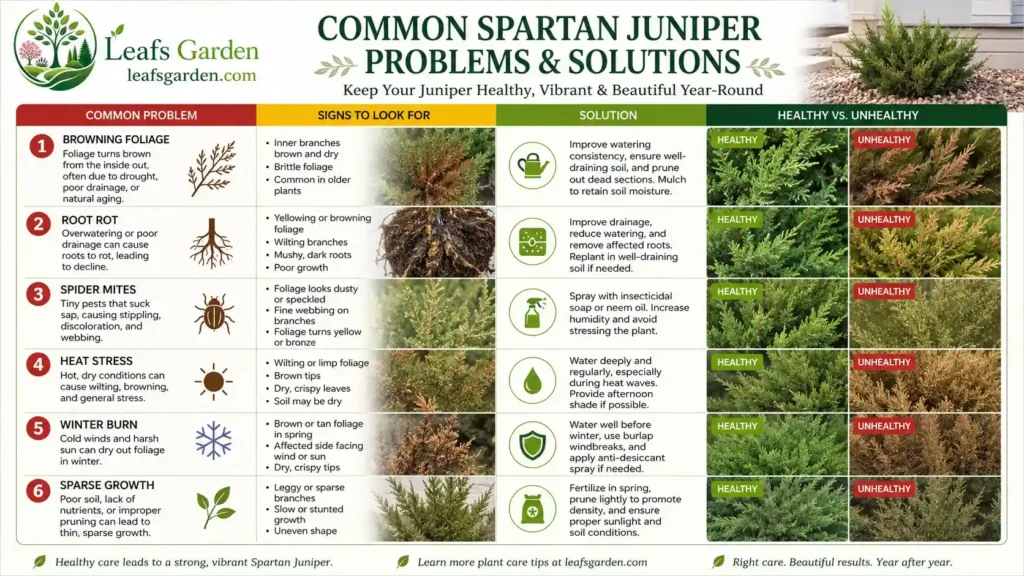
Most Spartan juniper problems are caused by poor drainage, overwatering, or fungal stress.
Although Juniperus chinensis ‘Spartan’ is considered a hardy low-maintenance evergreen, unhealthy growing conditions can still lead to foliage discoloration, thinning growth, or branch decline.
Many gardeners searching for spartan juniper problems are usually dealing with browning foliage, yellow branches, or sparse growth caused by environmental stress rather than severe disease.
Browning foliage is one of the most common Spartan juniper issues.
Possible causes include:
Occasional inner needle drop may be normal as older foliage ages, but widespread browning usually indicates environmental stress.
Root rot is commonly linked to constantly wet soil.
Signs may include:
Heavy clay soil and poor drainage significantly increase the risk of root disease.
Spider mites can become active during hot dry weather.
Symptoms may include:
Regular inspection during warm periods helps catch infestations early.
Bagworms occasionally affect junipers and other evergreen conifers.
These pests create hanging protective cases attached to branches and may cause:
Removing bagworms early usually helps reduce long-term damage.
Winter burn can occur in colder climates when foliage loses moisture faster than roots can replace it.
Common symptoms include:
Exposed winter winds and frozen soil conditions increase the risk.
Extreme heat combined with dry soil may also stress Spartan juniper.
Heat stress can cause:
Deep occasional watering during severe heat helps reduce stress.
| Problem | Cause | Solution |
| Brown patches | Water stress | Adjust watering |
| Yellow foliage | Drainage issues | Improve soil |
| Sparse growth | Lack of sunlight | Increase exposure |
Most Spartan juniper problems can be prevented by improving overall growing conditions.
Good airflow helps reduce:
Avoid overcrowding plants in narrow spaces without ventilation.
Correct spacing improves:
Overcrowded junipers often become more vulnerable to disease and thinning interior growth.
Healthy drainage remains one of the most important disease prevention factors.
Improve drainage by:
Well-drained soil helps Spartan juniper maintain stronger roots, healthier foliage, and better long-term resistance to stress problems.
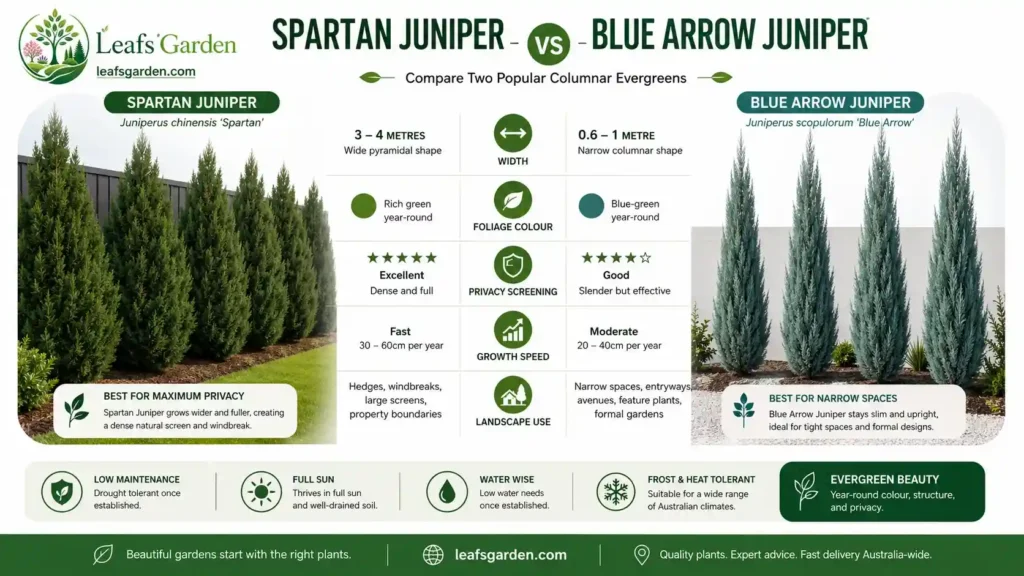
Spartan juniper is fuller and wider, while Blue Arrow juniper is thinner and more columnar.
Both are popular upright evergreen conifers used for screening, structure, and vertical landscaping. However, the better choice depends on available space, desired appearance, and landscaping goals.
Juniperus chinensis ‘Spartan’ is typically preferred for dense privacy hedging, while Blue Arrow Juniper is often selected for narrow accent planting and modern architectural landscapes.
| Feature | Spartan Juniper | Blue Arrow Juniper |
| Width | Fuller | Narrow |
| Color | Green | Blue-green |
| Privacy screening | Excellent | Moderate |
| Growth speed | Moderate-fast | Moderate |
Spartan juniper develops a broader upright pyramidal shape with denser branching. This fuller structure creates better visual coverage for screening applications.
Blue Arrow juniper remains much narrower and more columnar. Its slim profile works especially well where planting space is limited.
Because of its tight vertical growth, Blue Arrow is often used in:
Spartan juniper produces rich green evergreen foliage throughout the year.
In comparison, Blue Arrow juniper has a more distinctive blue-green or silvery blue tone. This cooler foliage color creates stronger contrast in modern garden designs and contemporary landscapes.
Many gardeners choose between them based on desired color style:
Spartan juniper is generally considered the stronger privacy screening option.
Its fuller branching and wider growth habit create:
Blue Arrow juniper can still provide screening, but its narrower structure often leaves more visible gaps between plants unless spacing is reduced significantly.
For large evergreen privacy hedges, Spartan juniper is usually the more practical choice.
Spartan juniper typically grows slightly faster than Blue Arrow juniper under similar conditions.
Average Spartan juniper growth characteristics:
Blue Arrow juniper generally develops at a steadier moderate pace while maintaining a tighter columnar shape.
Several related names are commonly associated with Blue Arrow juniper, including:
Many gardeners researching Juniperus blue arrow height are specifically looking for a narrow evergreen that stays compact while still adding vertical impact.
Compared with Spartan juniper, Blue Arrow usually:
Both conifers perform well in structured landscapes, but their ideal uses differ slightly.
Spartan juniper works especially well for:
Its fuller shape makes it highly effective where privacy and visual coverage are priorities.
Blue Arrow juniper is often preferred for:
Its slim upright form creates strong vertical lines without occupying much ground space.
Choose Spartan juniper if you want:
Choose Blue Arrow juniper if you prefer:
Both upright conifers are durable, low-maintenance, and highly valuable in Australian and international landscape design.
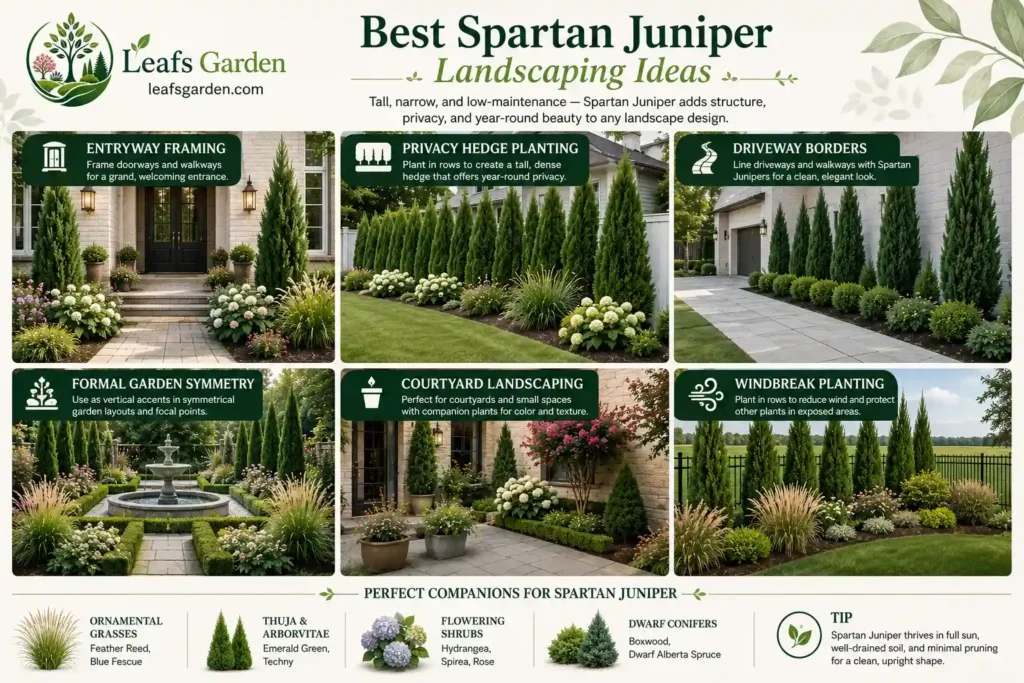
Spartan juniper works well as a hedge, privacy screen, vertical accent, or formal evergreen border.
Its upright evergreen shape, dense foliage, and narrow footprint make Juniperus chinensis ‘Spartan’ one of the most versatile conifers for both traditional and modern landscape design.
Because it naturally grows tall without spreading excessively wide, Spartan juniper fits well into:
For a complete guide to evergreen screening trees and landscape tree selection across Australian climates, see our Evergreen, Shade & Landscape Trees guide.
Spartan juniper creates strong vertical structure beside gates, entrances, and pathways.
Using matching plants on both sides of an entryway helps create:
Its upright shape naturally draws the eye upward and gives entrances a more refined appearance.
Fence screening is one of the most common uses for Spartan juniper.
Dense evergreen foliage helps:
A properly spaced Spartan juniper hedge can create a living green wall with relatively low maintenance requirements.
For larger privacy hedges requiring faster and denser screening coverage, Leighton Green Cypress is one of the most widely planted fast-growing evergreen alternatives used alongside Spartan juniper in Australian residential and rural landscapes.
Spartan juniper trees work especially well along driveways because of their narrow footprint and non-invasive root system.
Benefits include:
The upright form also helps maintain cleaner sightlines compared with wider evergreen trees.
Spartan juniper is commonly used in formal landscapes because its naturally symmetrical growth requires very little shaping.
It pairs well with:
Repeated vertical planting can create strong rhythm and visual consistency throughout the landscape.
Dense evergreen branching helps Spartan juniper function as an effective small-scale windbreak.
Planted in rows, it can help:
This is especially useful in exposed inland Australian landscapes.
For even stronger windbreak and screening performance in larger Australian properties, Leighton Green Conifer is another popular evergreen conifer commonly planted alongside Spartan juniper for layered boundary protection.
Spartan juniper is highly effective in smaller landscapes where vertical growth is preferred over wide spreading plants.
Its upright habit makes it ideal for:
Even mature plants usually maintain a manageable width relative to their height.
In courtyard settings, Spartan juniper adds:
Its clean vertical lines work particularly well in contemporary courtyard designs.
Urban landscapes often require plants that remain tidy, durable, and space-efficient.
Spartan juniper suits urban conditions because it offers:
It is frequently used near:
Spartan juniper combines well with many evergreen and ornamental landscape plants.
Popular companion choices include:
Bunnings often stocks thuja bunnings varieties that pair well with Spartan juniper in mixed evergreen screens.
Thuja adds:
Ornamental grasses help soften the strong vertical structure of Spartan juniper.
They create:
Low-growing evergreen conifers work well around the base of Spartan juniper plantings.
Gardeners commonly search for:
to combine compact evergreen textures with taller vertical screening plants.
Dwarf conifers help create:
Flowering shrubs provide seasonal color contrast against Spartan juniper’s rich green foliage.
Good combinations may include:
This combination helps create balanced landscapes that remain attractive across multiple seasons.
Spartan juniper is commonly available at Australian nurseries and specialty conifer suppliers.
Because Juniperus chinensis ‘Spartan’ is widely used for hedging and evergreen screening, it is usually easy to find in garden centres across Australia. Availability is often strongest during the main planting seasons in spring and autumn.
Many Australian gardeners purchase Spartan juniper for:
Plants are commonly sold in:
Bunnings is one of the most common places where gardeners search for:
Availability may vary depending on:
Bunnings and independent nurseries often stock Spartan juniper alongside:
For larger privacy projects, specialty conifer nurseries may offer:
Choosing healthy plants is important for long-term growth success.
Look for foliage that is:
Avoid plants with:
A healthy Spartan juniper should usually have:
A strong central leader helps maintain the plant’s natural pyramidal shape as it matures.
Healthy roots are essential for successful establishment.
When possible, check for:
Avoid plants sitting in constantly wet nursery containers because excessive moisture may increase root stress risks.
Inspect plants carefully for pests or disease symptoms before purchasing.
Check for:
Healthy pest-free Spartan juniper plants usually establish faster and adapt more successfully after planting.
Spartan juniper is generally considered low-risk in landscapes but should not be consumed by pets or children.
Juniperus chinensis ‘Spartan’ is widely used in residential landscapes because of its manageable root system, durable evergreen growth, and relatively low-maintenance nature. While it is considered practical and safe for most outdoor settings, there are still a few important considerations regarding pets, roots, and environmental performance.
Spartan juniper is not typically considered highly dangerous, but mild irritation or digestive discomfort may occur if plant material is consumed.
Like many ornamental conifers, Spartan juniper should not be eaten by:
Ingestion of foliage or berries from some juniper species may potentially cause:
Most household pets naturally avoid consuming large amounts of evergreen foliage, but supervision is still recommended.
The foliage is softer than many pine trees, but prolonged contact may still occasionally cause:
This is usually minimal and not considered a major landscaping concern.
Spartan juniper has a relatively non-aggressive root system compared with many larger landscape trees.
Its roots are generally:
Unlike some large shade trees, Spartan juniper usually does not produce aggressive surface roots that lift pathways or invade drainage systems.
Because of its narrow growth habit and controlled root spread, Spartan juniper is commonly planted near:
Adequate drainage should still be maintained around structures to prevent root stress and excess soil moisture buildup.
Spartan juniper has moderate drought resilience and reasonable environmental durability once established.
Established plants can tolerate:
This makes Spartan juniper useful for:
Dense evergreen branching helps Spartan juniper function as a useful wind-filtering plant.
Its upright structure provides:
The compact branching structure also improves wind resistance compared with some broader evergreen species that are more vulnerable to branch breakage.
Because of its durability, narrow form, and manageable maintenance needs, Spartan juniper remains a practical evergreen choice for many residential landscapes in Australia and similar climates worldwide.
Spartan juniper is one of the best upright evergreen conifers for privacy, structure, and low-maintenance landscaping in Australia and similar climates worldwide.
Juniperus chinensis ‘Spartan’ combines fast upright growth, dense evergreen foliage, and strong adaptability in a way that suits both modern and traditional landscapes. Its naturally narrow pyramidal shape makes it especially valuable for privacy screening, formal hedges, driveway borders, and space-efficient garden design.
Key benefits of Spartan juniper include:
Unlike many larger evergreen trees, Spartan juniper provides vertical height without excessive spreading width. This makes it highly practical for urban gardens, narrow spaces, and structured residential landscapes.
Its drought-resistant nature also makes it a strong choice for Australian gardens and water-wise landscaping projects where long-term sustainability matters.
For the best long-term results:
With correct placement and drainage, Spartan juniper can remain dense, healthy, and visually attractive for decades while requiring relatively little maintenance compared with many other screening conifers.
Juniperus chinensis 'Spartan' typically grows around 30–60 cm per year under full sun and well-drained soil conditions. Growth is usually faster in warm temperate climates with regular airflow and moderate watering during establishment.
A mature Spartan juniper tree commonly reaches: 4–6 metres tall in Australia Up to 7 metres in ideal climates Most plants stay relatively narrow, usually around 1–2 metres wide, making them suitable for vertical screening and narrow landscape spaces.
Yes, Spartan juniper is considered one of the best evergreen conifers for privacy screens. Its dense foliage, upright growth habit, and relatively fast growth rate make it highly effective for: Fence screening Boundary hedges Wind protection Year-round privacy A properly spaced Spartan juniper hedge can create a thick evergreen barrier with relatively low maintenance.
Yes, Spartan juniper grows very well in many Australian climates. It performs especially well in: Temperate regions Dry inland areas Sunny coastal gardens with good airflow Its drought tolerance and adaptability make it a popular evergreen screening plant throughout Australia.
The most common causes of browning include: Overwatering Poor drainage Root stress Heat stress Fungal disease Winter burn Improving soil drainage, adjusting watering habits, and maintaining proper airflow usually help reduce browning problems.
Spartan juniper is fuller, wider, and better suited for dense privacy hedges. Blue Arrow Juniper is narrower and more columnar with blue-green foliage, making it more suitable for tight spaces and architectural accent planting.
Yes, Spartan juniper grows best in full sun. For healthy dense growth, it usually needs: At least 6–8 hours of direct sunlight daily Good airflow Open growing conditions Too much shade can cause sparse growth, weaker branching, and reduced foliage density.
Yes, Spartan juniper can grow in pots temporarily, especially while young. Container growing works best when using: Large pots with drainage holes Well-drained soil Full sun positioning However, because Spartan juniper eventually becomes a tall evergreen conifer, long-term growth is usually better in the ground where roots have more space to develop.