Grow Better Gardens with Smarter Plant Choices
Discover helpful guides on trees, hedges, fruit plants, edible plants, and beautiful landscape greenery.


Pyrus Capital Pear is a narrow ornamental pear tree widely planted in Australian landscapes because of its upright growth, attractive spring flowers, and vibrant autumn foliage. This fast-growing flowering pear tree is especially popular for driveways, screening, and modern suburban gardens where space is limited but vertical structure is needed.
Pyrus calleryana ‘Capital’ has become a preferred ornamental pear tree in cities across Australia due to its compact columnar shape and clean architectural appearance. Homeowners often choose this pyrus tree because it grows tall without spreading too wide, making it ideal for narrow garden beds, boundary planting, and formal avenue landscaping.
One of the main attractions of this blossoming pear tree is its seasonal display. During spring, the tree produces masses of white pear blossom tree flowers that cover the canopy before the full foliage appears. In summer, glossy green leaves create dense vertical screening, while autumn brings strong red, orange, and burgundy foliage colour that enhances modern landscapes.
Unlike fruiting pear trees grown for edible harvests, ornamental pears are mainly planted for decorative value. Trees like Capital Pear focus more on flowering performance, foliage colour, canopy shape, and urban landscaping suitability rather than producing large edible fruit. Small ornamental fruits may still appear, but they are not typically consumed.
In Australia, Capital Pear is commonly used for driveway planting, council streetscapes, commercial developments, and contemporary home gardens. Its narrow growth habit allows multiple trees to be planted in symmetrical rows without taking excessive space. The tree is also valued for its relatively low-maintenance nature and adaptability to cool and temperate climates.
In the United States, Pyrus calleryana ‘Capital’ is often compared with Bradford Pear and Cleveland Pear varieties. While Bradford ornamental pear trees are known for their broad canopy and structural weaknesses, Capital Pear offers a more upright form better suited to tighter urban spaces. Cleveland Pear is another similar flowering pear cultivar, though it generally develops a wider canopy than Capital Pear over time.
Because of its strong vertical structure, decorative flowering display, and seasonal beauty, Capital Pear remains one of the most widely recognised ornamental flowering pear varieties used in Australian residential and urban landscaping.
Pyrus Capital Pear is an upright ornamental cultivar of Callery Pear grown mainly for landscaping rather than edible fruit production. It is widely planted as a flowering pear tree in Australian residential developments, modern gardens, and council streetscapes because of its narrow shape, seasonal colour, and decorative spring flowering.
This ornamental flowering pear is valued more for appearance and structure than fruit. The tree develops a tall columnar canopy that fits well into narrow landscapes where wider shade trees may become difficult to manage.
| Feature | Details |
| Botanical Name | Pyrus calleryana ‘Capital’ |
| Common Name | Capital Pear |
| Plant Type | Ornamental flowering pear |
| Family | Rosaceae |
| Origin | Asia-derived ornamental cultivar |
| USDA Zones | Approx. 5–9 |
| Australian Climate Suitability | Cool to temperate regions |
Pyrus calleryana ‘Capital’ is recognised for its clean vertical structure and strong seasonal appearance. The tree combines ornamental beauty with practical urban landscaping benefits.
Key features include:
The upright structure makes this pyrus tree particularly useful in areas where horizontal space is limited. Many homeowners use it as a driveway ornamental pear tree because it creates height and symmetry without excessive canopy spread.
Capital Pear has become one of the most widely planted ornamental pear tree varieties in Australia due to its adaptability and modern landscape appeal. Its vertical growth habit works especially well in suburban developments where block sizes are smaller and gardens require structured planting solutions.
The tree is commonly selected for:
It is especially popular in cities and cooler regions including:
Local councils also frequently plant Capital Pear trees along streets and public spaces because they provide seasonal interest, controlled growth, and an attractive flowering display with relatively low maintenance requirements.
Compared with broader ornamental pear varieties, Capital Pear offers a more compact and upright form, making it highly suitable for modern Australian streetscapes and compact residential landscapes.
Capital ornamental pear trees typically grow between 8–11 metres tall with a narrow canopy spread of around 3–4 metres at maturity. This tall but compact structure is one of the main reasons the tree is widely used in Australian suburban landscaping and driveway planting.
Compared with broader ornamental pear varieties, Pyrus calleryana ‘Capital’ maintains a much narrower profile as it matures. The tree grows vertically rather than outward, making it suitable for tight garden spaces, narrow property borders, and formal avenue planting.
Typical mature dimensions include:
| Feature | Average Size |
| Mature Height | 8–11 metres |
| Mature Width | 3–4 metres |
| Growth Habit | Upright columnar |
| Canopy Density | Dense and vertical |
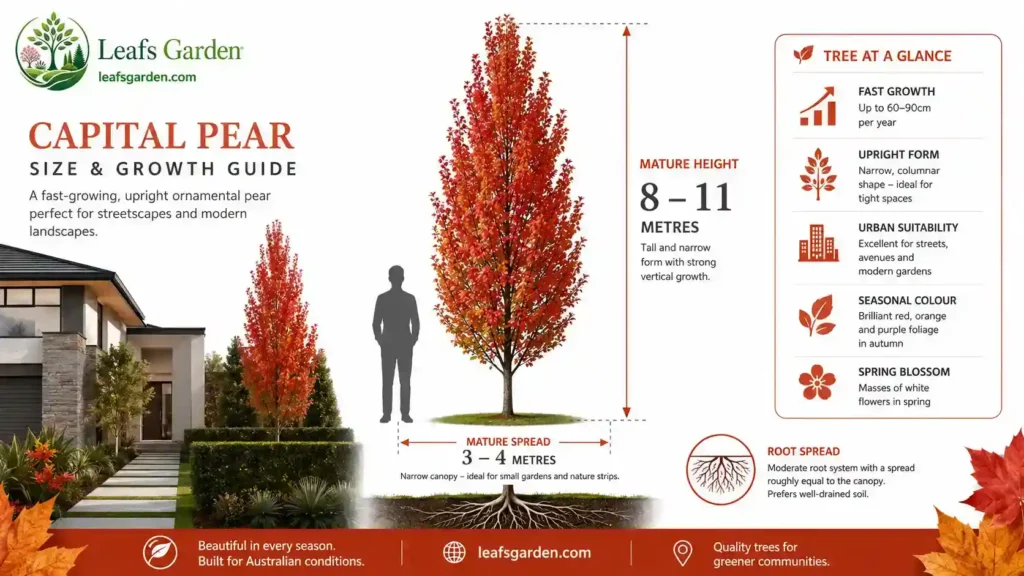
Capital Pear is considered a moderate to fast-growing ornamental tree under suitable growing conditions. Young trees establish relatively quickly and can produce noticeable annual growth once roots become established.
Growth performance is usually strongest when the tree receives:
In warmer sunny climates, growth can accelerate further, especially during spring and early summer. Cooler temperate regions still support healthy development, although overall growth may be slightly slower.
Most newly planted flowering pear trees establish within the first few years and gradually develop their characteristic upright structure.
Pyrus Capital Pear develops a strong upright columnar form with dense vertical branching. The canopy remains relatively narrow even at maturity, which makes it highly practical for urban landscapes where space efficiency matters.
Key structural traits include:
This shape allows the tree to fit comfortably into:
Because the canopy grows upward rather than outward, Capital Pear is commonly used where larger shade trees would become too wide or obstructive.
The root system of Capital Pear is generally considered less invasive than some larger ornamental pear cultivars, but proper planting distance is still important. Like most ornamental flowering pear trees, roots naturally spread outward in search of moisture and oxygen.
Although the roots are not usually aggressive enough to cause severe structural damage under normal conditions, poor placement can still create problems near hard surfaces or underground infrastructure.
General spacing recommendations include:
| Area | Recommended Distance |
| Driveways & paving | 2–3 metres |
| House foundations | 3–5 metres |
| Swimming pools | 4–5 metres |
| Underground pipes | Avoid direct planting nearby |
Root spread often extends beyond the canopy drip line as the tree matures. In compact urban gardens, allowing enough underground space helps reduce future stress, improves stability, and supports healthier long-term growth.
Proper soil preparation and drainage also play a major role in root performance. Waterlogged or heavily compacted soils may increase root stress and reduce overall tree health over time.
Capital Pear produces masses of bright white pear blossoms during spring before the canopy fully leafs out. The flowering display is one of the most visually striking features of this ornamental pear tree and is a major reason it is widely planted in residential and commercial landscapes.
During peak bloom, the tree becomes densely covered in clusters of small white flowers that create a soft cloud-like appearance across the upright canopy. These flower of pear displays often appear in early to mid-spring depending on climate conditions.
Common flowering characteristics include:
Many homeowners choose this blooming pear tree specifically for its decorative spring appearance. Rows of flowering pear trees planted along driveways or streets can create a highly formal and symmetrical landscape effect during flowering season.
The pear tree flowers are relatively small individually, but the large quantity of blooms creates a dramatic visual display from a distance. This is why Capital Pear is frequently selected as a feature flower pear tree in modern Australian landscape design.
After flowering finishes, Capital Pear develops dense glossy green foliage that remains attractive throughout summer. The leaves are smooth, slightly rounded, and densely arranged along the upright branches, helping the tree maintain a full vertical appearance.
Summer foliage benefits include:
The dense canopy makes this ornamental pear useful for screening neighbouring properties, softening fences, and adding vertical greenery to compact urban gardens.
Because the canopy remains relatively narrow while still producing thick foliage, the tree works especially well in:
Capital Pear is highly valued for its strong autumn foliage colour. As temperatures cool, the green summer leaves gradually shift into vibrant shades of red, orange, burgundy, and sometimes purple tones.
The autumn transformation creates one of the most decorative seasonal displays among ornamental pear varieties commonly grown in Australia.
Compared with other ornamental pears:
| Variety | Autumn Colour Performance |
| Capital Pear | Strong red-orange tones |
| Winter Glow Pear | Bright red and burgundy |
| Chanticleer Pear | Orange-red foliage |
| Manchurian Pear | Deep red-purple colours |
Capital Pear is particularly appreciated for producing reliable autumn colour even in cooler urban environments. The narrow upright shape combined with fiery seasonal foliage makes the tree highly attractive in avenue planting and formal landscapes.
Yes, small ornamental fruits may appear on Capital Pear trees after flowering, although the tree is not grown for edible pear production. The fruits are typically small, hard, and decorative rather than suitable for eating.
Pyrus calleryana fruit characteristics usually include:
Like many Callery Pear cultivars, Capital Pear may produce clusters of tiny fruits following successful pollination. These fruits are far smaller than commercial eating pears and are primarily considered ornamental.
The small callery pear fruit can attract wildlife including:
Although ornamental fruits are generally not problematic, fallen fruit may occasionally contribute to minor seasonal cleanup beneath mature trees. However, fruit production is usually much lighter compared with traditional fruiting pear varieties.
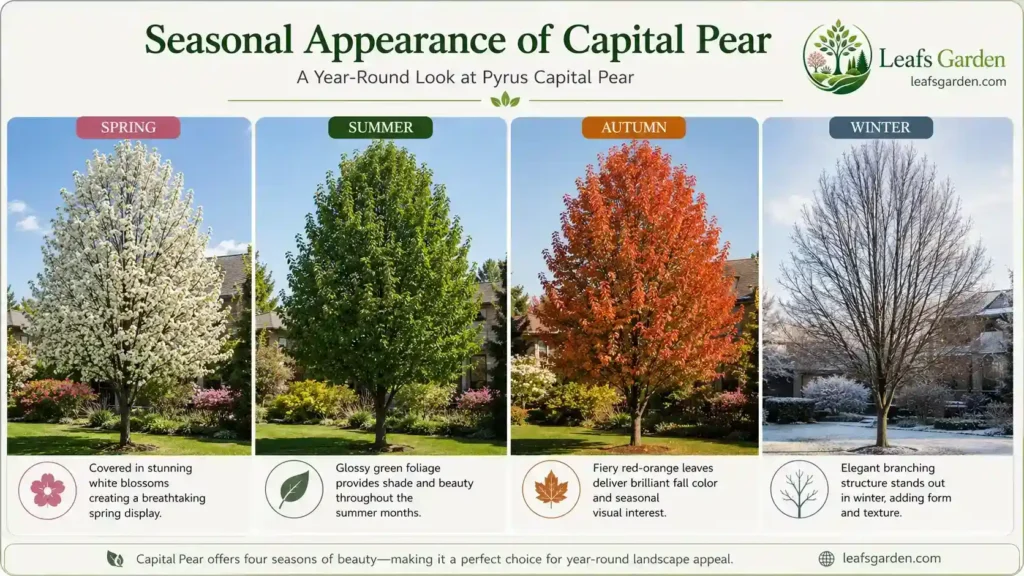
Capital Pear performs best in full sun where it can develop dense foliage, stronger flowering, and healthier overall growth. A minimum of six hours of direct sunlight daily is usually recommended for the best ornamental performance.
Trees grown in sunny positions generally produce:
Shaded planting areas may reduce flowering intensity and create thinner canopy growth over time. For driveway planting and formal landscape use, open sunny positions help maintain the tree’s symmetrical upright appearance.
Capital ornamental pear trees prefer well-draining soil but are adaptable to several common Australian soil types. They can grow successfully in clay, loam, and moderately sandy soils provided drainage remains adequate.
Ideal soil conditions include:
The tree adapts relatively well to urban soils, which is one reason ornamental pear tree Australia plantings are common in residential developments and council landscapes.
However, consistently waterlogged conditions should be avoided because excess moisture can lead to:
Improving drainage before planting can significantly improve long-term tree performance in heavier soils.
Capital Pear trees require moderate watering during the establishment phase, especially throughout the first one to three years after planting. Deep watering encourages stronger root development and improves drought resilience later in life.
Young trees benefit from:
Once mature, Capital Pear develops moderate drought tolerance compared with many other ornamental flowering trees. Established trees can usually tolerate short dry periods, particularly in temperate climates.
Even drought-tolerant mature trees may still require supplemental watering during prolonged heatwaves or unusually dry seasons.
Capital Pear performs best in cool to temperate Australian climates where seasonal temperature changes help support flowering and autumn colour development. The tree is widely planted across southern and southeastern Australia due to its adaptability and strong landscape performance.
Best Australian growing regions include:
In Australian pear tree landscaping, Capital Pear is commonly used for:
The tree is especially popular in ornamental pear tree Australia plantings because it combines seasonal beauty with practical urban growth habits. Many pear trees Australia varieties struggle in extremely humid tropical climates, but Capital Pear performs reliably in cooler regions with distinct seasonal changes.
Pyrus calleryana ‘Capital’ generally grows well in USDA Zones 5–9, making it suitable for a wide range of international climates outside Australia as well.
International adaptability includes:
| Region | Suitability |
| Southern Australia | Excellent |
| Temperate USA regions | Very good |
| Cooler European climates | Suitable |
| Urban commercial landscapes | Highly suitable |
| Mild temperate climates worldwide | Reliable |
In the United States, Capital Pear is often planted in regions where other ornamental pears such as Bradford Pear or Cleveland Pear are commonly grown. Its narrow upright structure makes it particularly useful for dense suburban developments and modern urban landscapes.
The tree also adapts well to cooler European climates where ornamental flowering trees are widely used in formal landscape design. Because of its manageable canopy size and strong seasonal appearance, Capital Pear remains a practical ornamental tree for urban landscaping projects worldwide.
Choose an open sunny area with enough vertical space for mature growth. Capital Pear develops a tall upright canopy, so selecting the correct planting position helps maintain healthy structure, strong flowering, and balanced root development.
The ideal planting location should provide:
Although the canopy remains relatively narrow, the tree still requires room for root expansion and long-term stability. Avoid planting too close to buildings, retaining walls, pipes, or paved areas where root growth may become restricted over time.
A driveway ornamental pear tree should also be positioned carefully to allow canopy symmetry and even spacing along the planting line.
Proper spacing is important for airflow, root development, and long-term canopy shape. Capital ornamental pear spacing varies depending on the intended landscape use.
| Planting Type | Recommended Spacing |
| Driveways | 3–4 m apart |
| Screening | 2.5–3 m apart |
| Narrow rows | 2–2.5 m apart |
Wider spacing allows fuller canopy development, while tighter spacing creates stronger screening and formal avenue effects. In modern landscapes, rows of evenly spaced Capital Pear trees are commonly used to create symmetrical driveway planting and structured urban landscaping.
When planting near driveways or paths, leave enough distance from paving to reduce future root pressure and improve soil access around the base of the tree.
Planting Capital Pear correctly during establishment greatly improves long-term health and growth performance.
Start by loosening compacted soil and removing weeds or grass from the planting area. Improving drainage before planting can help reduce future root stress, especially in heavier clay soils.
Dig a hole approximately twice as wide as the root ball but no deeper than the root system itself. Wide planting holes encourage outward root expansion into surrounding soil.
Place the tree upright in the centre of the hole. The top of the root ball should sit level with or slightly above surrounding soil level to avoid water pooling around the trunk.
Refill the hole gradually using the original soil. Lightly firm the soil during backfilling to remove major air pockets without excessively compacting the ground.
After planting, water the tree thoroughly to help settle the soil around the roots. Deep watering encourages early root establishment and reduces transplant stress.
Apply mulch around the base of the tree while keeping it away from direct contact with the trunk. Proper mulching helps retain moisture, regulate soil temperature, and reduce weed competition.
Organic mulch provides several important benefits for newly planted ornamental pear trees. A healthy mulch layer helps improve moisture retention while supporting more stable soil conditions during establishment.
Benefits of organic mulch include:
Suitable mulch materials include:
Maintain a mulch layer approximately 5–8 cm deep around the base of the tree while leaving a small gap around the trunk to prevent excess moisture buildup.
For fertilizing, slow-release fertilizer is usually best applied during spring when active growth begins. Balanced fertilizers designed for ornamental trees can help support:
Overfertilizing should be avoided because excessive nitrogen can encourage overly soft growth and reduce structural strength. Young Capital Pear trees generally respond best to moderate feeding combined with proper watering and healthy soil conditions.
Capital Pear is considered a relatively low-maintenance ornamental pear tree and usually requires only minimal pruning once established. Most pruning focuses on maintaining the tree’s upright structure, improving airflow, and removing weak or damaged growth.
The best pruning season is typically during winter while the tree is dormant. Winter pruning allows the branch structure to be seen more clearly and reduces stress during active growth periods.
Main pruning tasks include:
Because Pyrus calleryana ‘Capital’ naturally develops a narrow columnar form, excessive pruning is generally unnecessary. Over-pruning can reduce flowering performance and disrupt the formal architectural appearance that makes the tree attractive in modern landscapes.
Young trees benefit most from early structural shaping to encourage stronger branch spacing and long-term stability.
Regular seasonal maintenance helps keep Capital Pear healthy, attractive, and structurally balanced throughout the year.
| Season | Care Tasks |
| Spring | Fertilize, inspect flowering |
| Summer | Deep watering |
| Autumn | Leaf cleanup |
| Winter | Structural pruning |
Spring is the main active growth and flowering period. This is the best time to:
During warmer months, deep watering helps maintain healthy foliage and supports root development, especially during dry periods or heatwaves.
Key summer tasks include:
Autumn brings strong foliage colour followed by seasonal leaf drop. Basic cleanup helps maintain garden appearance and improves airflow around the tree base.
Autumn care usually involves:
Winter is the preferred season for structural pruning and canopy correction because the tree is dormant and branch visibility improves significantly.
Capital Pear is widely regarded as a low-maintenance ornamental tree suitable for both experienced landscapers and beginner gardeners. Its naturally upright growth habit reduces the need for constant shaping compared with many broader ornamental trees.
Reasons the tree is considered easy to maintain include:
Once established, most maintenance involves occasional pruning, seasonal watering during dry periods, and basic health monitoring.
Because of its manageable structure and predictable growth habit, Capital Pear is frequently recommended for homeowners seeking a formal ornamental tree without intensive long-term maintenance.
Underplanting ornamental pears helps soften the base of the tree while improving overall landscape appearance. Since Capital Pear develops a relatively upright canopy, there is often enough light beneath the tree for compatible companion plants.
Popular underplanting ornamental pears combinations include:
These companion plants work well because they tolerate similar growing conditions and help create layered landscape texture without competing heavily with surface roots.
Benefits of underplanting include:
Low-growing drought-tolerant plants are usually the best choice beneath ornamental pear trees because they require less maintenance and integrate well into modern Australian landscape designs.
Most Capital Pear problems in Australia involve fungal disease, structural weakness, environmental stress, or poor growing conditions. Although this ornamental pear tree is generally considered hardy and low maintenance, problems can still develop when drainage, airflow, or pruning are neglected.
Common ornamental pear tree problems Australia gardeners may encounter include:
Early identification and proper maintenance usually help reduce long-term damage and improve overall tree health.
Leaf spot is one of the more common fungal issues affecting ornamental flowering pear trees in humid or poorly ventilated environments. Symptoms often appear as:
Improving airflow through light pruning and avoiding excessive overhead watering can help reduce fungal spread.
Fire blight is a bacterial disease that can occasionally affect members of the Rosaceae family, including ornamental pears. Although severe outbreaks are less common in many Australian regions compared with some overseas climates, the risk still exists under favourable conditions.
Typical symptoms include:
Prompt pruning of infected branches and disinfecting pruning tools may help limit spread.
Root stress often develops when Capital Pear is planted in compacted or poorly draining soil. Excess moisture around roots can reduce oxygen availability and weaken the tree over time.
Root-related stress may cause:
Proper drainage and suitable planting distance from hard surfaces help minimise root problems.
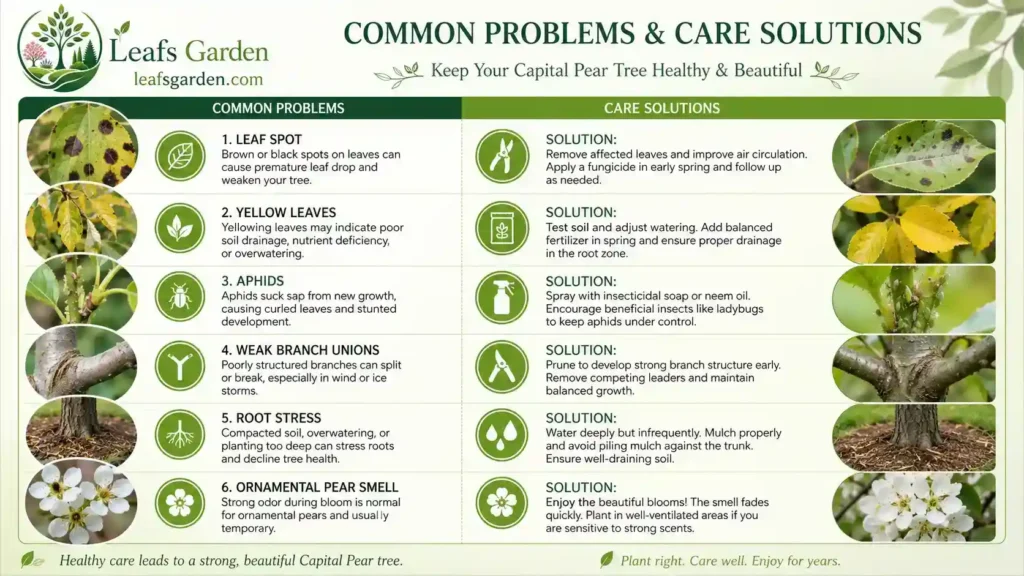
Some flowering pear trees naturally produce a noticeable scent during bloom season. This ornamental pear tree smell is commonly associated with Callery Pear cultivars, including Capital Pear and Bradford Pear.
The scent is usually strongest during peak flowering in spring and may vary depending on:
While many people enjoy the visual beauty of the white blossoms, others may find the fragrance unpleasant or overly strong at close range. The smell is temporary and generally fades once flowering finishes.
Capital Pear trees can occasionally attract common sap-feeding insects, especially during active spring and summer growth periods.
Common pests include:
Aphids feed on young foliage and shoots by extracting plant sap. Heavy infestations may cause:
Psyllids are small insects that may damage leaves and create distorted growth. Some species also produce sticky honeydew that encourages sooty mould development.
Scale insects attach themselves to stems and branches where they feed on plant sap. Severe infestations can weaken overall tree vigour and reduce canopy health over time.
Healthy trees with good airflow and balanced watering are generally more resistant to serious pest outbreaks.
Yellow leaves on Capital Pear trees are commonly linked to environmental stress or nutrient imbalance. Identifying the underlying cause early helps prevent further decline.
Common causes include:
Excess watering can reduce oxygen around roots and contribute to root decline. Yellowing leaves combined with soggy soil often indicate excessive moisture problems.
Heavy compacted soil or waterlogged planting areas may prevent healthy root function. Poor drainage commonly leads to weak growth and foliage discolouration.
Insufficient nutrients such as nitrogen or iron may cause pale or yellow foliage. Balanced fertilizing during spring usually helps improve canopy health.
Although Capital Pear has a relatively manageable root system compared with some larger ornamental trees, structural weaknesses can still develop as the tree matures.
Potential concerns include:
Narrow branch angles may become structurally weaker over time, especially if rapid growth creates crowded branching patterns. During strong winds or storms, poorly structured branches can split more easily under pressure.
Early pruning and structural training during the tree’s younger years help reduce future breakage risks and improve long-term canopy stability.
Capital Pear and Manchurian Pear are both popular ornamental pear varieties used in Australian landscaping, but they differ significantly in canopy shape, growth habit, and space requirements.
Capital Pear is generally preferred for narrow urban spaces and formal driveway planting, while Manchurian Pear is more suitable for broader gardens and feature tree applications.
| Feature | Capital Pear | Manchurian Pear |
| Shape | Upright | Broad |
| Autumn Colour | Strong | Excellent |
| Growth Speed | Faster | Moderate |
| Space Needed | Compact | Larger |
Capital Pear develops a narrow vertical structure that works well in compact suburban landscapes. Manchurian Pear, by comparison, forms a wider rounded canopy that provides stronger shade coverage but requires more horizontal space.
Both trees produce attractive spring flowering and seasonal foliage colour, although Manchurian Pear is often recognised for particularly vibrant autumn tones.
Pyrus calleryana Chanticleer Pear is another widely planted ornamental pear tree commonly compared with Capital Pear. Both varieties share upright growth habits and strong seasonal appearance, but Chanticleer Pear usually develops a slightly broader canopy over time.
Key differences include:
Both trees are commonly used for:
Pyrus calleryana Chanticleer Pear is often selected when a balance between vertical growth and moderate canopy spread is desired, while Capital Pear remains the better choice for narrow access areas and compact properties.
Cleveland Pear is another upright ornamental flowering pear frequently planted in the United States and increasingly recognised internationally. Compared with Capital Pear, Cleveland ornamental pear trees generally develop a wider and fuller shape as they mature.
Main differences include:
| Feature | Capital Pear | Cleveland Pear |
| Growth Habit | Narrow upright | Upright-rounded |
| Mature Width | Narrower | Broader |
| Urban Space Suitability | Excellent | Good |
| Screening Ability | Strong vertical screening | Fuller canopy screening |
The Cleveland pear tree is appreciated for its symmetrical appearance and seasonal flowering display. Cleveland Select Pear fruit, like most ornamental pear cultivars, is small and decorative rather than suitable for eating.
Capital Pear is often preferred where strict vertical form and reduced canopy spread are priorities.
Bradford ornamental pear trees became extremely popular in North America because of their fast growth and heavy spring flowering, but they are now often criticised for structural weaknesses and invasive tendencies in some regions.
Compared with Bradford Pear:
Tree Bradford Pear varieties commonly develop weak branch unions due to dense canopy structure and narrow branch angles. This can increase storm damage risks as trees mature.
In bradford pear Australia discussions, Capital Pear is often considered more practical for modern urban landscapes because its upright shape fits smaller residential blocks more effectively.
Both varieties produce decorative white spring flowers and colourful autumn foliage, but Capital Pear usually offers better space efficiency and a cleaner architectural form for formal planting.
For a detailed comparison of Bradford Pear’s structural weaknesses, flowering characteristics, and Australian growing performance, see our complete Bradford Pear Tree guide.
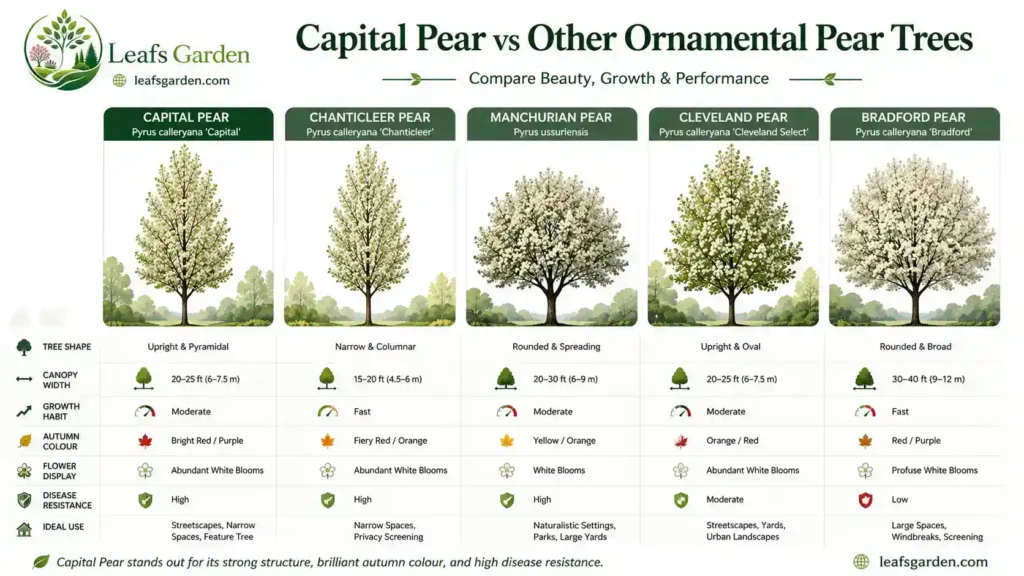
Several other ornamental pear varieties are commonly used in Australian and international landscaping projects. Each offers slightly different growth habits, flowering performance, and seasonal foliage colour.
Popular varieties include:
Known for strong red autumn foliage and dense canopy structure. Frequently used in feature planting and residential streetscapes.
A smaller ornamental pear valued for silvery foliage tones and drought tolerance. Often used in Mediterranean-style gardens.
Produces attractive white blossoms and rounded canopy growth with strong autumn colour performance.
A very narrow upright ornamental pear similar to Capital Pear but often with even tighter vertical growth.
Unlike deciduous ornamental pears, evergreen ornamental pear varieties maintain foliage year-round in suitable climates and are commonly used for screening and privacy planting.
These ornamental pear varieties allow homeowners and landscapers to select trees based on available space, climate conditions, canopy shape, and desired seasonal appearance.
Capital Pear trees are ideal for vertical accents, screening, and formal driveway planting. Their narrow upright growth habit allows landscapers to introduce height, structure, and seasonal colour without using excessive horizontal space.
Because of their clean architectural form, these ornamental pear trees work especially well in contemporary Australian landscapes where compact garden layouts and organised planting designs are increasingly popular.
Common modern landscaping uses include:
The combination of spring flowering, glossy foliage, and strong autumn colour allows Capital Pear to provide visual interest across multiple seasons.
r a complete guide to ornamental and deciduous landscape trees suited to Australian urban and temperate climates, see our Evergreen, Shade & Landscape Trees guide.
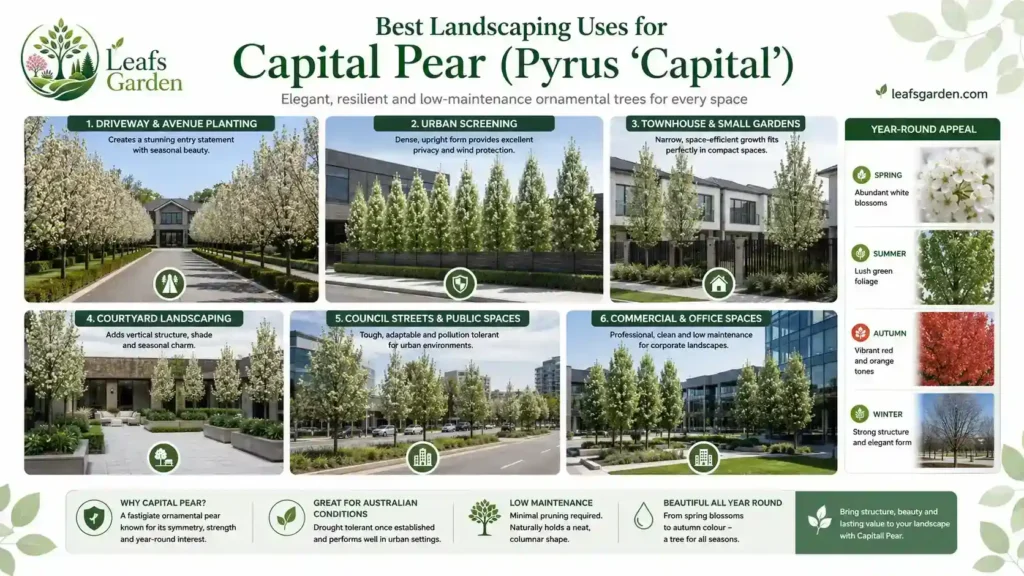
Capital Pear is one of the most popular driveway ornamental pear tree varieties because of its tall narrow canopy and uniform growth pattern. When planted in evenly spaced rows, the trees create a structured avenue effect that adds strong visual impact to residential and commercial entrances.
Popular driveway landscaping styles include:
Rows of evenly spaced Capital Pear trees create a classic avenue appearance with strong vertical symmetry. This style works particularly well on long driveways and larger residential properties.
Planting matching trees on both sides of entry points helps frame driveways and create a balanced formal landscape design.
The upright canopy allows trees to be planted along narrow boundaries without excessive overhang onto driveways or neighbouring properties.
Capital Pear is especially useful where wider ornamental trees would overcrowd access areas or reduce vehicle clearance.
For a lighter filtered-shade alternative in driveway and streetscape planting, the Gleditsia Sunburst Tree is another popular ornamental tree widely used alongside Capital Pear in Australian formal landscape designs.
The dense upright canopy provides effective vertical screening while maintaining a relatively compact footprint. This makes Capital Pear highly suitable for urban privacy planting where garden space is limited.
Screening advantages include:
Unlike broad shade trees that require large setbacks, Capital Pear can create privacy barriers along fences, side boundaries, and urban property edges without overwhelming smaller gardens.
These qualities make the tree highly effective for:
Capital Pear performs exceptionally well in small garden environments because it provides height and seasonal beauty without consuming large amounts of space.
Ideal small-space applications include:
The columnar growth habit helps maintain open ground space while still adding strong vertical structure to the landscape.
In courtyard settings, a single flowering pear tree can become a focal point during spring flowering and autumn colour change. In townhouse developments, rows of Capital Pear trees are often used to create greenery without interfering with pathways, parking access, or nearby buildings.
Capital Pear is widely used in commercial landscaping because of its tidy growth habit, predictable structure, and relatively low maintenance requirements.
Common commercial applications include:
Rows of ornamental pear trees create structured formal planting around entrances, pathways, and parking areas.
Many councils plant Capital Pear along urban streets because the narrow canopy suits pedestrian areas and modern streetscape design.
The upright growth habit allows trees to provide greenery and seasonal colour without excessively shading parking spaces or obstructing visibility.
Commercial landscapers often choose Capital Pear because it combines:
Its ability to fit into structured planting schemes makes it one of the most widely used ornamental flowering trees for modern urban developments in Australia.
Some Callery Pear cultivars can spread aggressively in certain countries, but the level of risk varies depending on climate, pollination conditions, and local environmental management. Capital Pear belongs to the Pyrus calleryana group, which has raised environmental concerns in parts of the United States due to invasive spread from ornamental plantings.
Many callery pear tree concerns are linked to:
In the USA, invasive issues involving Callery Pear trees have become more widely recognised over recent years. Some ornamental pear varieties, especially Bradford Pear, have escaped cultivation and spread into roadsides, grasslands, and natural ecosystems in certain regions.
Common invasive issues in USA landscapes include:
However, invasive behaviour varies significantly between cultivars and climates. In many Australian areas, concerns are generally lower due to different environmental conditions and more controlled urban planting practices.
Capital Pear is still widely used in Australian landscaping because of its narrow growth habit, ornamental value, and suitability for urban environments. Local risk levels can differ between councils and regions, so checking local planting recommendations remains important before large-scale planting.
Environmental impact discussions around ornamental pears mainly focus on pollination and seed spread potential.
Key environmental considerations include:
When multiple Callery Pear cultivars are planted close together, cross-pollination can increase fruit and seed production. This may raise the chance of unwanted seed dispersal in some environments.
Birds and wildlife may feed on small ornamental fruits and spread seeds into nearby open land or unmanaged areas. This process contributes to natural spread in some overseas regions.
Some councils and regional authorities may provide guidance on suitable ornamental pear varieties for urban planting. Recommendations can vary depending on:
Before planting large numbers of ornamental pears, homeowners and landscapers should review local council advice and select varieties appropriate for their specific region and landscape goals.
Capital Pear trees are widely available through Australian garden centres, wholesale nurseries, and landscape suppliers. Availability is usually strongest during cooler planting seasons when ornamental trees are in high demand for residential and commercial landscaping projects.
Many homeowners search for:
Availability can vary between states and seasons, especially for larger advanced-grade trees. Some nurseries also stock related ornamental pear varieties including Chanticleer, Manchurian Pear, and Winter Glow Pear.
When purchasing from nurseries, buyers often have options ranging from small tube stock to mature advanced trees ready for immediate landscape impact.
Choosing a healthy tree is important for long-term performance and structural stability. Before purchasing a Capital Pear, inspect the tree carefully for signs of healthy growth and good nursery management.
Important things to check include:
Look for:
Most ornamental pears are grafted trees. The graft union should appear healthy and stable without cracking, swelling, or weak attachment points.
Healthy roots are critical for successful establishment. Avoid trees with:
Inspect leaves for signs of:
Healthy foliage usually indicates better overall nursery care and stronger establishment potential after planting.
Capital Pear trees are sold in several size grades depending on budget, planting goals, and desired landscape impact.
Common size options include:
| Tree Type | Typical Use |
| Tube stock | Budget-friendly young planting |
| Medium container trees | Residential gardens |
| Advanced trees | Instant landscape impact |
| Mini capital ornamental pear | Compact gardens |
| Miniature ornamental pear tree | Courtyards and small spaces |
Tube stock trees are smaller and more affordable but require additional time to establish and reach mature height.
Advanced-grade trees provide faster visual impact and are commonly used in commercial landscaping and established residential projects.
Mini capital ornamental pear selections are useful for tighter urban gardens or decorative compact landscapes where full-sized trees may become too tall.
Miniature ornamental pear tree varieties are also suitable for courtyards, townhouse gardens, and small feature planting areas where space is extremely limited.
Pyrus Capital Pear is widely regarded as one of the most practical ornamental pear trees for modern Australian landscapes because of its upright structure, seasonal beauty, and urban adaptability. However, like most ornamental trees, it also has some limitations that homeowners should consider before planting.
| Pros | Cons |
| Narrow upright shape | Flowers may smell |
| Great autumn colour | Can develop weak branching |
| Fast-growing | Not edible fruit |
| Ideal for driveways | Leaf drop in autumn |
| Attractive spring blossoms | Some invasive concerns overseas |
The compact columnar canopy makes Capital Pear highly suitable for narrow gardens, urban properties, and driveway planting where wider trees may become overcrowded.
The tree produces strong seasonal foliage colour with shades of red, orange, and burgundy that enhance modern landscapes during autumn.
Capital Pear establishes relatively quickly and develops useful screening height faster than many slower-growing ornamental trees.
Its symmetrical vertical structure makes it one of the most popular driveway ornamental pear tree varieties in Australia.
Masses of white spring flowers create a highly decorative flowering display that adds strong seasonal interest to residential and commercial landscapes.
Some people notice a strong scent during flowering season, which is common among several Callery Pear cultivars.
Narrow branch angles and dense vertical growth may occasionally create structural weakness if pruning and canopy management are neglected.
Although small ornamental fruits may develop, they are not grown for eating like traditional fruiting pear trees.
As a deciduous ornamental pear tree, Capital Pear sheds leaves during autumn and early winter, requiring seasonal cleanup.
Certain Callery Pear varieties have raised invasive concerns in parts of the United States, although risks are generally lower in many Australian regions.
Pyrus Capital Pear remains one of the best ornamental pear trees for Australian urban landscapes because of its narrow growth habit, strong seasonal colour, and relatively low-maintenance nature. Its upright columnar structure makes it especially valuable in modern residential developments where garden space is more limited but structured landscaping is still important.
This flowering ornamental pear tree performs particularly well for:
The combination of white spring blossoms, glossy summer foliage, and vibrant autumn colour allows Capital Pear to deliver year-round visual appeal without requiring excessive maintenance. Its compact canopy also makes it far more practical for smaller suburban properties compared with broader shade trees.
One of the biggest advantages of Pyrus calleryana ‘Capital’ is its adaptability across different temperate climates. While it is especially popular in Australian landscaping, the tree also performs well in many parts of the United States and cooler European regions where ornamental flowering trees are widely used in urban design.
In USA comparisons, Capital Pear is often viewed as a narrower and more space-efficient alternative to Bradford Pear, while also maintaining a more compact profile than some Cleveland Pear varieties. These differences make Capital Pear particularly attractive for tighter urban planting environments and formal avenue landscapes.
Like all ornamental pears, choosing the right variety should depend on:
For homeowners seeking a tall, elegant ornamental tree with strong seasonal interest and excellent urban suitability, Capital Pear continues to be one of the most reliable and visually appealing choices for modern landscapes.
Capital Pear trees are considered moderate to fast-growing ornamental trees and can establish quickly in sunny conditions. With proper watering, full sun, and well-draining soil, young trees often develop noticeable height growth within the first few years after planting.
Yes, Capital Pear trees are deciduous ornamental pear trees that lose their leaves during autumn or early winter. Before leaf drop occurs, the foliage usually changes into vibrant red, orange, and burgundy autumn colours.
Capital Pear roots are generally considered manageable compared with larger aggressive tree species, but they still require proper spacing from paving, foundations, and underground pipes. Allowing enough planting distance helps reduce future root stress and structural problems.
The main difference is canopy shape. Capital Pear develops a narrower upright columnar form, while Chanticleer Pear grows with a slightly broader and fuller canopy. Both are popular ornamental flowering pear trees used in urban landscaping and driveway planting.
Yes, upright ornamental pear trees like Pyrus Capital are widely used for driveway planting because of their symmetrical shape, narrow canopy spread, and strong seasonal appearance. Their vertical growth habit allows formal avenue planting without excessive horizontal crowding.
Capital Pear trees may produce small ornamental fruits after flowering, but they are not grown for edible pear production. The fruit is typically small, hard, and decorative rather than suitable for eating.
Some Callery Pear cultivars naturally produce a noticeable scent during flowering season. The smell is most noticeable during peak spring blooming when large numbers of white flowers open across the canopy.