Grow Better Gardens with Smarter Plant Choices
Discover helpful guides on trees, hedges, fruit plants, edible plants, and beautiful landscape greenery.

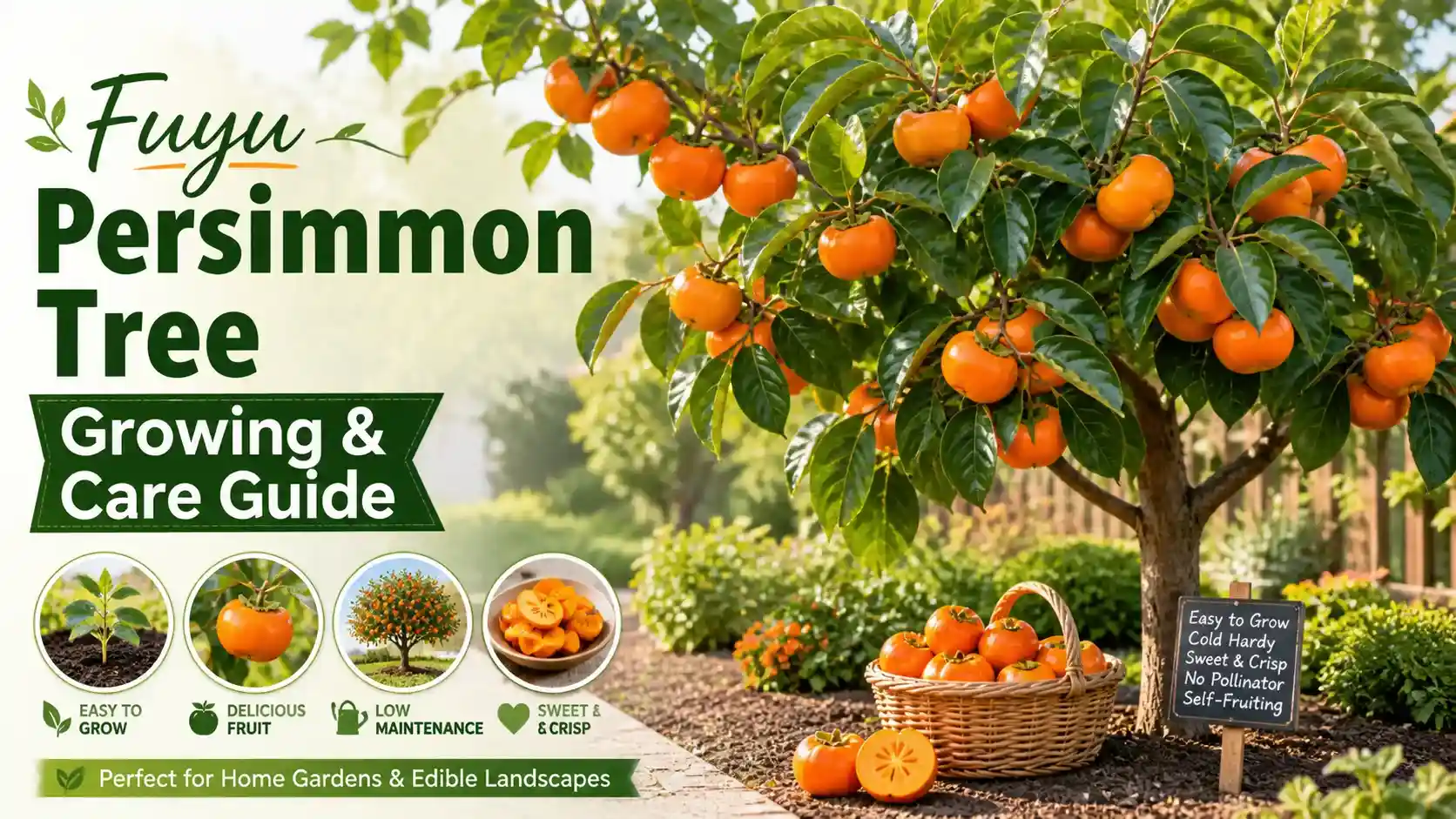
The fuyu persimmon tree is a popular Japanese persimmon fruit tree valued for its sweet, non-astringent fruit that can be eaten while still firm. Unlike some other types of persimmon fruit that must become very soft before eating, Fuyu persimmons have a crisp, mild, honey-like flavor when mature. This guide explains how to identify the tree, understand its fruit features, and grow it successfully in the right climate and soil. You will also learn about Fuyu persimmon care, root system behavior, pruning, harvesting, common problems, and how it compares with other persimmon varieties.
A Fuyu persimmon is a cultivated variety of Asian persimmon known for producing sweet, non-astringent fruit. The terms fuyu persimmon, persimmon Fuyu, and Fuyu persimmons all refer to the same general fruit type or tree variety. It is especially popular because the fruit does not need to become fully soft before eating.
Fuyu is one of the most widely grown non-astringent persimmon varieties. This means the fruit can be enjoyed while firm, as long as it is mature and fully colored. Its mild sweetness, firm texture, and easy fresh-eating quality make it a favorite choice for home gardens, orchards, and edible landscapes.
The Fuyu persimmon belongs to the Asian persimmon group and is commonly grown as a productive fruit tree. It is often described as a Japanese persimmon because many popular cultivated forms of Diospyros kaki are closely associated with Japan and East Asian fruit-growing traditions.
|
Classification |
Details |
|
Scientific name |
Diospyros kaki ‘Fuyu’ |
|
Common names |
Fuyu persimmon, Japanese persimmon, Japanese kaki, sweet persimmon |
| Plant type |
Deciduous fruit tree |
| Fruit type |
Edible persimmon fruit |
The Japanese kaki is valued for its attractive orange fruit, glossy seasonal foliage, and reliable garden performance in suitable climates. As a Japanese persimmon fruit, Fuyu is best known for being a sweet persimmon that can be sliced and eaten fresh when firm.
Fuyu and Fuji are different fruits, even though the names sound similar. Fuyu fruit refers to a persimmon variety, while Fuji fruit usually refers to Fuji apple, a popular apple cultivar. In simple terms, Fuyu belongs to the persimmon family, and Fuji belongs to the apple group.
The confusion often comes from the similar spelling, but Fuji fruit vs persimmon is an important distinction. A Fuyu persimmon is usually orange, squat, and tomato-shaped, with sweet non-astringent flesh. A Fuji apple is round, crisp, and usually red, pink, or yellowish with apple-type flesh. So, Fuyu is a persimmon, not a Fuji apple.
The Fuyu persimmon tree is a compact, productive, and attractive persimmon fruit tree grown for its sweet, firm, orange fruit. As a persimmon plant, it works well in home gardens, edible landscapes, and small orchards where full sun and well-drained soil are available. Like many persimmon trees, the Fuyu variety also adds seasonal beauty with glossy foliage, autumn color, and bright fruit.
|
Feature |
Fuyu Persimmon Tree Details |
|
Botanical name |
Diospyros kaki ‘Fuyu’ |
|
Common names |
Fuyu persimmon, Japanese persimmon, Japanese kaki |
| Fruit type |
Non-astringent persimmon |
| Taste |
Sweet, mild, honey-like |
|
Fruit texture |
Firm when edible |
| Fruit color |
Orange to deep orange |
| Tree type |
Deciduous fruit tree |
|
Mature height |
Usually 12–20 feet, depending on climate and pruning |
| Sunlight |
Full sun |
|
Soil |
Well-drained, fertile soil |
| Watering |
Moderate, consistent moisture |
|
Harvest season |
Usually autumn to early winter |
| Best use |
Home gardens, orchards, landscaping, edible gardens |
A Fuyu persimmon plant is especially useful for gardeners who want a manageable fruiting tree with ornamental value. Compared with some larger persimmon fruit trees, Fuyu can often be kept smaller with careful pruning, making it suitable for many residential spaces.
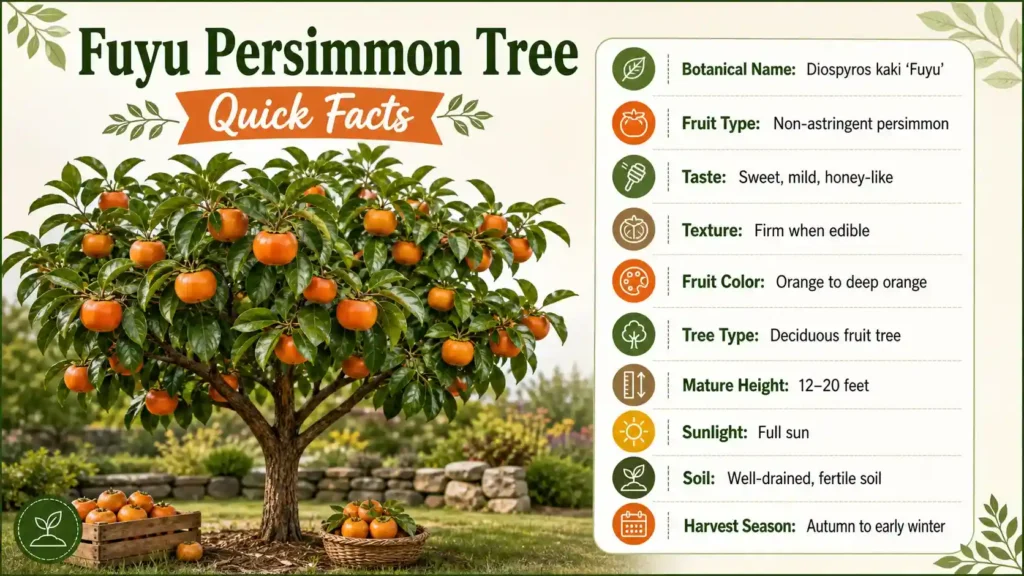
Fuyu persimmon fruit is easy to recognize because of its squat, round, tomato-shaped form. Unlike longer or acorn-shaped persimmon varieties, Fuyu usually has a flattened base and a smooth, rounded body. The skin is glossy and firm, giving the fruit a clean, attractive look when mature.
The typical persimmon colour ranges from bright orange to deep orange, depending on ripeness, sunlight, and growing conditions. Gardeners may also describe the colour persimmon fruit as warm orange with a rich autumn tone. A mature persimmon fruit Fuyu should look evenly colored, full-sized, and firm. The persimmon Fuyu fruit often stands out on the tree because its orange skin contrasts beautifully with the green or autumn-colored leaves.
Fuyu persimmon has a sweet, mild, and pleasantly honey-like flavor. Its texture is one of its most important features because it can be eaten while crisp-firm, similar to an apple, once the fruit is mature. The flesh is smooth, refreshing, and easy to slice for fresh eating, salads, snacks, or simple desserts.
This makes Fuyu different from many soft persimmon varieties that must fully soften before they taste pleasant. Some soft persimmons are astringent when firm and need to become jelly-like before eating. Fuyu, however, is non-astringent, so the fruit does not need to be extremely soft. If a persimmon soft texture is preferred, Fuyu can also be left to soften slightly, but it is most commonly enjoyed firm. Among common persimmons fruit types, Fuyu is especially valued for this easy-eating quality.
Fuyu persimmon fruit usually ripens in autumn to early winter, depending on the local climate, tree health, and growing season. In warmer regions, fruit may mature earlier, while cooler areas may see a later harvest window. The best time to harvest is when the fruit has reached full size, developed a deep orange color, and tastes sweet.
A ripe persimmon on tree should look fully colored and mature rather than pale or greenish. When several persimmons on tree develop rich orange skin, it usually means harvest time is near. Other signs of maturity include a sweet flavor, firm but developed flesh, and easier separation from the stem when cut or gently handled. For best quality, harvest persimmon fruit carefully to avoid bruising the skin or damaging nearby branches.
A standard Fuyu persimmon tree usually grows about 12–20 feet tall, depending on climate, soil quality, rootstock, and pruning style. In ideal conditions, the canopy can become broad and rounded, often spreading nearly as wide as the tree is tall. This makes it a manageable fruit tree for many home gardens, especially when planted with enough space for air movement and sunlight.
Pruning can help keep the tree smaller, easier to harvest, and better shaped. Light annual pruning removes dead, crossing, or crowded branches while maintaining a strong structure. Heavy pruning is usually not needed unless the tree has become too tall, dense, or unbalanced. With regular care, Fuyu persimmon can remain compact enough for backyard growing while still producing a healthy crop.
A dwarf persimmon tree is a smaller-growing form of persimmon, usually created by grafting the desired fruiting variety onto a rootstock that limits overall tree size. This is useful for small gardens, courtyards, edible landscapes, and larger containers where a full-sized tree may take too much space.
A dwarf Fuyu persimmon plant can be easier to prune, spray, protect, and harvest. It may also fit better near patios or in compact backyard layouts. However, the final size depends strongly on the rootstock, growing conditions, container size, and pruning routine. When choosing a persimmon Fuyu tree, rootstock matters because it can influence tree vigor, mature height, disease tolerance, soil adaptation, and long-term performance.
Fuyu persimmon trees generally have a moderate growth rate. They may grow slowly during the first year while roots establish, then become more vigorous once settled into well-drained soil with steady moisture and full sun. Grafted trees usually fruit earlier than seed-grown plants because they are propagated from mature fruiting wood. Seed-grown persimmons can take much longer and may not produce fruit identical to the parent tree.
A general fruiting timeline may look like this:
With good care, a Fuyu persimmon tree can remain productive for many years, offering both edible fruit and seasonal ornamental value.
Fuyu persimmon grows best in mild to warm temperate regions where the tree receives enough winter chill and a long growing season for fruit to develop properly. It performs well in areas with warm summers, cool winters, and autumn conditions that allow the fruit to color and sweeten before harvest.
In regions where gardeners search for persimmon tree Australia growing advice, Fuyu is often suitable for many temperate and subtropical areas, provided the location has good drainage, full sun, and protection from extreme weather. Like many persimmon trees Australia gardeners grow, Fuyu benefits from stable seasonal conditions and does not perform well in constantly wet or poorly drained soil.
A Fuyu persimmon tree should be planted in full sun for the best growth and fruit quality. Full sun supports stronger flowering, better fruit set, deeper fruit color, and improved sweetness. Trees grown in too much shade may produce fewer flowers, weaker branches, and less flavorful fruit.
These requirements are similar to many fruit trees & edible plants that need full sunlight and proper care for healthy growth.
Good sunlight also helps keep the canopy healthier by improving airflow and reducing damp conditions around the leaves. For best results, choose a planting spot that receives at least 6–8 hours of direct sunlight each day. More sun usually means better fruit color, stronger ripening, and a more productive tree.
A Fuyu persimmon plant grows best in fertile, well-drained soil that holds some moisture without becoming waterlogged. The ideal soil is slightly acidic to neutral, rich in organic matter, and loose enough for roots to spread easily. Heavy clay soil can be improved with compost and careful drainage planning, but constantly soggy soil should be avoided.
The soil should stay evenly moist during establishment, especially for young trees. However, excess water around the roots can increase the risk of root stress and root rot. A balanced soil environment helps the tree develop strong roots, healthy foliage, and better fruit production over time.
Plant a persimmon fruit tree in an open, sunny location where the canopy has enough space to grow naturally. Avoid cramped areas where the tree will compete heavily with larger trees, buildings, or dense shrubs. Good spacing supports airflow, sunlight exposure, easier pruning, and safer harvesting.
For a standard Fuyu persimmon tree, allow enough room for a mature canopy that may spread several feet in each direction. Keep the tree away from walls, fences, buildings, and underground services so the roots and branches have space to develop. As a general guide, avoid planting too close to foundations, paved areas, water lines, or other fruit trees. A well-spaced tree is easier to manage and usually stays healthier over the long term.
Yes, Fuyu persimmon can be grown in containers, especially when using a dwarf tree or a young tree that will be managed with careful pruning. Container growing is useful for small gardens, patios, and spaces where planting directly in the ground is not possible. However, the container must be large enough to support root growth and stable enough to hold the tree as it matures.
Choose a pot with strong drainage holes and use a quality, well-draining potting mix. A larger container gives the roots more space, reduces drying stress, and supports better fruiting potential. Container-grown persimmons need regular watering because pots dry out faster than garden soil. They may also need more careful feeding, seasonal pruning, and root management to stay productive and healthy.
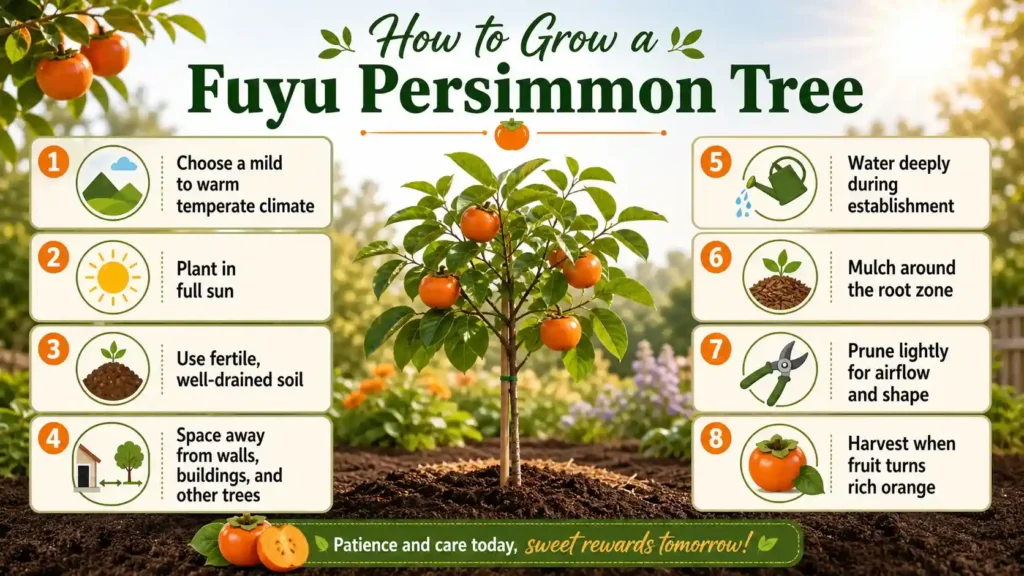
Fuyu persimmon trees need steady moisture, especially during the first few years after planting. Newly planted trees should be watered deeply and regularly so the root system can establish properly. Deep watering encourages roots to grow downward instead of staying shallow near the soil surface.
Established trees are usually more drought-tolerant, but they still benefit from consistent moisture during hot weather, flowering, and fruit development. Avoid shallow daily watering because it can create weak surface roots. At the same time, do not allow the soil to stay soggy, as poorly drained conditions can stress the roots and increase the risk of root rot.
Fuyu persimmon tree care should include balanced feeding rather than heavy fertilizing. Compost, aged organic matter, or a mild balanced fertilizer can support healthy growth when the soil is low in nutrients. The goal is to encourage steady tree development, strong flowering, and good fruit production.
Avoid applying too much nitrogen, especially once the tree is established. Excess nitrogen may produce lush leafy growth but reduce flowering and fruiting. If the tree is growing well, producing healthy leaves, and fruiting normally, it may only need light seasonal feeding. A soil test can help identify whether extra nutrients are truly needed.
Mulch is useful for protecting the root zone and keeping soil moisture more stable. A layer of organic mulch around the base of the tree helps reduce weed competition, slow evaporation, and support better soil structure as it breaks down. This is especially helpful for young Fuyu persimmon trees with developing roots.
Apply mulch around the root area, but keep it a few inches away from the trunk. Mulch piled directly against the bark can trap moisture and increase the risk of rot or pest problems. A proper mulch layer keeps the soil cooler in summer, protects feeder roots, and supports long-term soil health.
Pruning helps maintain tree shape, improve airflow, and support fruit production. A young Fuyu persimmon tree should be trained to develop a strong framework of well-spaced branches. As the tree matures, pruning should focus on removing dead, broken, crossing, or crowded branches.
Good airflow reduces disease pressure and allows sunlight to reach more of the canopy. This can improve flowering, fruit color, and overall tree health. Avoid excessive pruning, as heavy cuts may reduce fruiting wood and encourage unnecessary leafy growth. Light, regular pruning is usually better than severe pruning after years of neglect.
A simple seasonal routine makes persimmon fruit tree care easier and more consistent throughout the year.
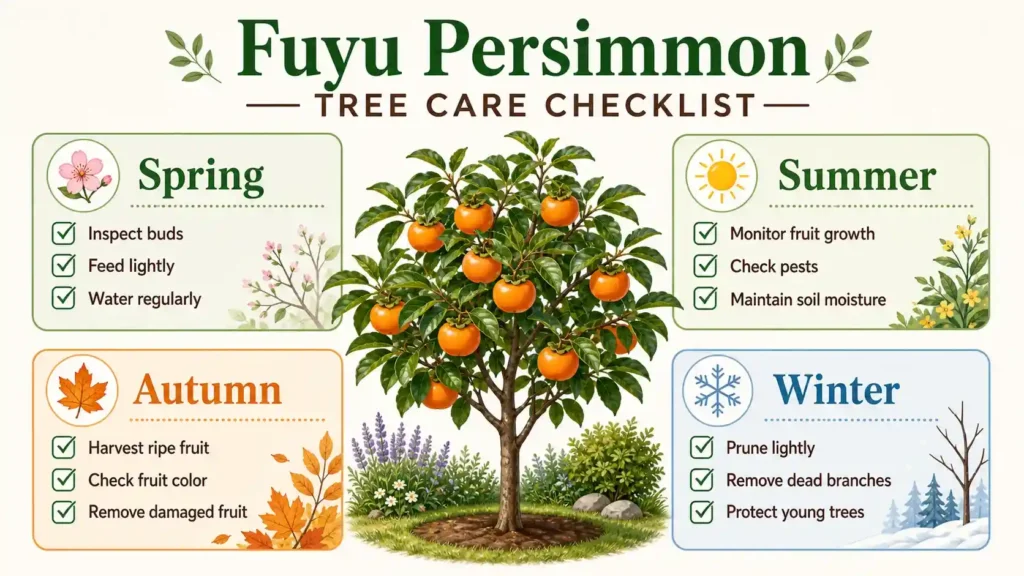
A persimmon flower is usually small, pale, and modest compared with many ornamental flowers. The blooms may appear cream, pale yellow, or light greenish-white, depending on the tree and growing conditions. A flower persimmon is not typically grown for large, showy blossoms, but the flowers are important because they support fruit development later in the season.
On a Fuyu persimmon tree, the flowers can be easy to overlook because they are often tucked near the leaves and branches. Even though they are not highly decorative, healthy flowering is an important sign that the tree is mature enough and growing in suitable conditions.
Fuyu persimmon leaves are usually glossy green during the active growing season. They help support fruit production by capturing sunlight and feeding the tree through photosynthesis. Healthy leaves are an important sign of good watering, balanced nutrients, proper sunlight, and general tree health.
As the season changes, the leaves may turn attractive autumn shades before falling. Depending on the climate, they can show tones of yellow, orange, red, or bronze. This seasonal color gives the Fuyu persimmon tree ornamental value in addition to its edible fruit.
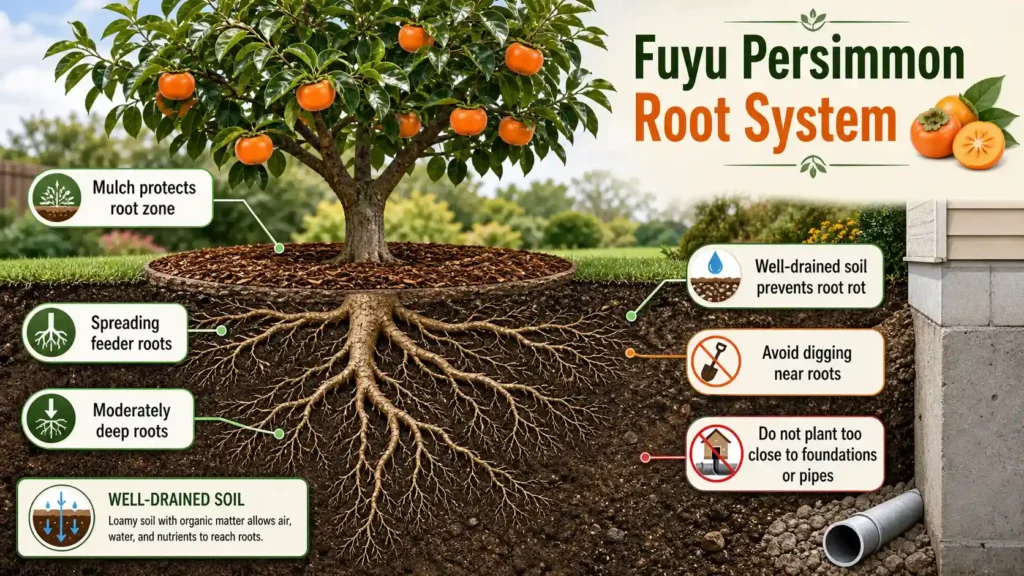
The Fuyu persimmon root system is moderately deep and spreading, which helps the tree anchor itself and access moisture from the surrounding soil. Because the roots spread outward as well as downward, the tree should be planted with enough space around it for healthy root development.
Young trees need consistent moisture while their roots establish. Deep watering is especially important during dry weather because it encourages stronger root growth. However, the soil should never stay waterlogged. Well-drained soil helps prevent root rot and keeps the root system healthier over time.
Gardeners should avoid digging too close to the tree because persimmon roots, especially smaller feeder roots, can be damaged by tools. These feeder roots help absorb water and nutrients, so protecting them supports stronger growth and better fruiting. A layer of organic mulch can help protect the root zone, reduce moisture loss, and keep soil conditions more stable.
Fuyu persimmon trees should not be planted too close to foundations, underground pipes, paved areas, or tight structural spaces. Proper spacing gives the root system room to spread naturally and reduces the risk of future planting conflicts.
Many Fuyu persimmon trees can produce fruit without another persimmon tree nearby. This means Fuyu is often considered self-fertile or able to set fruit on its own in suitable growing conditions. For many home gardeners, one healthy tree may be enough to produce a useful crop once the tree is mature.
However, fruiting can still vary depending on climate, tree age, sunlight, soil condition, water availability, and seasonal weather. A young tree may flower lightly or drop fruit before maturity, while an older, well-established tree in full sun usually has better fruiting potential. Even with a self-fertile variety, strong overall tree health is important for reliable harvests.
A Fuyu persimmon tree may fail to fruit for several reasons. In many cases, the issue is related to age, stress, or growing conditions rather than the variety itself.
Common reasons include:
Improving sunlight, watering, pruning, and soil health often helps support better flowering and fruiting over time.
Fruit drop in Fuyu persimmon can be natural or stress-related. Some early fruit drop is normal because the tree may shed extra young fruit that it cannot fully support. This natural thinning helps the tree balance its energy and protect overall growth.
Stress-related fruit drop can happen when the tree experiences heat stress, drought, inconsistent watering, poor drainage, nutrient imbalance, root disturbance, pest pressure, or sudden weather changes. Young trees may also drop fruit more often because their root systems and branch structure are still developing.
To reduce unnecessary fruit drop, keep soil moisture consistent, avoid excessive nitrogen, protect the root zone with mulch, and make sure the tree receives full sun. A healthy, established Fuyu persimmon tree is more likely to hold fruit successfully until harvest.
Fuyu persimmons are usually harvested in autumn to early winter, depending on the local climate and growing conditions. The fruit is ready when it reaches full size, develops a rich orange to deep orange color, and has a sweet, mild flavor. Since Fuyu is a non-astringent type, it does not need to become extremely soft before harvesting.
A ripe persimmon fruit Fuyu should feel firm but mature, with smooth skin and strong color. If the fruit is still pale, hard, and flavorless, it may need more time on the tree. Harvest carefully by cutting the fruit from the stem instead of pulling it, as pulling can damage the branch or bruise the fruit.
Fuyu persimmon is one of the easiest fruit persimmon types to eat because it can be enjoyed firm when mature.
If you enjoy fresh, bite-sized fruits, you can also explore our kiwiberry guide for another easy-to-eat option.
The fruit can be washed, sliced, and eaten fresh like an apple. Its crisp-firm texture and sweet flavor make it suitable for snacks, fruit bowls, and simple fresh dishes.
Fuyu persimmons can also be:
Among common persimmons, Fuyu is especially valued because it is pleasant to eat before becoming fully soft. This makes Fuyu persimmons practical for fresh eating, storage, and everyday kitchen use.
Fresh Fuyu persimmon fruit can be stored at room temperature for short-term use, especially if the fruit is firm and not overripe. Keep it on the countertop away from direct sunlight and check it regularly for soft spots. If the fruit is already mature and you want it to last longer, refrigeration is a better option.
Refrigerated persimmon fruit Fuyu can stay usable longer than fruit left at room temperature, especially when stored unwashed in a breathable container or produce drawer. Avoid stacking heavy fruit on top of it because persimmons can bruise.
For longer storage, Fuyu persimmons can be dried. Drying concentrates the sweetness and creates a chewy fruit snack that can be stored much longer than fresh fruit. Before drying, slice the fruit evenly and remove any damaged areas.
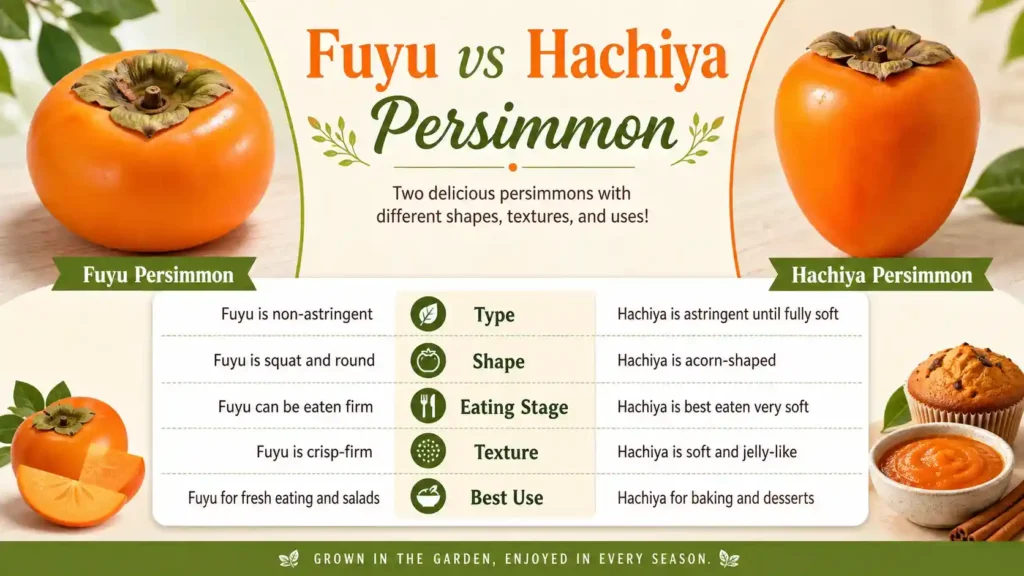
Fuyu and Hachiya are two of the best-known types of persimmon fruit, but they are eaten at different stages. Fuyu is non-astringent, so it can be eaten while firm. Hachiya persimmon is astringent when firm and should be eaten only when fully soft and ripe.
| Feature | Fuyu Persimmon | Hachiya Persimmon |
|
Type |
Non-astringent | Astringent until fully soft |
|
Shape |
Squat and round | Acorn-shaped |
|
Eating stage |
Can be eaten firm | Best eaten very soft |
| Taste | Sweet and mild |
Rich and very sweet when ripe |
| Texture | Crisp-firm to tender |
Soft, jelly-like when ripe |
| Best use | Fresh eating, salads, drying |
Baking, pulp, desserts |
The main difference between persimmon Hachiya and Fuyu is astringency. Fuyu is easier for fresh eating because it stays pleasant while firm, while persimmons Hachiya need to soften fully before they lose their dry, puckering taste. The Hachiya variety is excellent for recipes that use soft persimmon pulp, while Fuyu is often preferred for slicing, salads, and eating fresh.
Fuyu persimmon fruit is valued for its natural sweetness, attractive color, and fresh-eating quality. The fruit contains dietary fiber, vitamins, minerals, and plant-based antioxidants that make it a nutritious seasonal food. Its sweet, mild flavor also makes it easy to include in everyday meals without needing added sugar.
For another sweet and versatile fruit, you can also explore our starfruit tree guide.
Because Fuyu persimmon can be eaten firm, it is practical for slicing, packing, and serving fresh. It works well in fruit salads, green salads, breakfast bowls, dried fruit snacks, and simple desserts. While persimmon fruit is a healthy food choice for many people, it should be understood as part of a balanced diet rather than a cure or medical treatment.
A Fuyu persimmon tree is useful not only for fruit production but also for garden design. Its manageable size, seasonal foliage, and bright orange fruit make it suitable for many home landscapes.
It can be used as a:
When planted in full sun with enough spacing, the tree can become both functional and attractive. It provides fruit, structure, and seasonal value without needing the space required by many larger fruit trees.
The Fuyu persimmon tree has strong ornamental value throughout the growing season. In spring and summer, its glossy green leaves create a clean, healthy appearance. As the fruit develops, the orange color becomes more noticeable and adds visual interest to the tree.
In autumn, the tree may display warm leaf colors before the leaves fall. The bright fruit can remain highly visible on the branches, giving the tree a decorative seasonal look. Its rounded canopy, attractive branching, glossy foliage, and rich fruit color make it a valuable choice for edible landscaping and ornamental garden design.
A Fuyu persimmon tree is generally manageable, but poor growing conditions can lead to several problems. Most issues are connected to drainage, sunlight, watering, pruning, or seasonal stress.
Common growing problems include:
Healthy soil, full sun, balanced watering, light pruning, and regular inspection can prevent many common problems before they become serious.
Persimmons are generally eaten as fruit and are safe for many people when consumed in normal food amounts. Fuyu persimmon is sweet, firm, and commonly enjoyed fresh, dried, or added to simple dishes. However, people with dietary restrictions, digestive sensitivity, blood sugar concerns, or medical conditions should eat persimmons sensibly and consider their overall diet.
Because persimmons contain natural sugars and fiber, portion size may matter for some individuals. Anyone following a specific medical diet or managing a health condition should seek professional guidance before making major dietary changes. Persimmon fruit should be treated as a nutritious food, not as a medical treatment.
Persimmons are nutritious fruits that may provide fiber, vitamins, minerals, and antioxidants as part of a balanced diet. However, this article is for informational purposes only and should not be used as medical advice, diagnosis, or treatment guidance.
Overeating high-fiber fruits, including persimmons, may cause digestive discomfort in some people, such as bloating, gas, or stomach upset. For best results, enjoy Fuyu persimmon in reasonable portions and combine it with a varied, balanced diet.
Fuyu and Fuji are often confused because the names look similar, but they refer to different fruits. Fuyu is a persimmon variety, while Fuji usually refers to a Fuji apple. The correct spelling for this fruit tree is persimmon, not permission.
Many users search with misspelled terms such as permission fruit, persimon fruit, or permisson tree, but these usually point to the same topic: persimmon fruit or persimmon trees. Other common spelling variations include persimon tree, persimone tree, persimen, permissom fruit, fruit permission, parsimon, and percimmon tree.
For clarity, the accurate name is Fuyu persimmon, and the tree is correctly called a Fuyu persimmon tree. Using the correct spelling helps readers find reliable growing, care, and fruit information more easily.
Choosing a healthy Fuyu persimmon tree starts with checking the plant carefully before planting. This section is informational only, but it can help gardeners understand what a strong, well-prepared young tree should look like.
Look for these signs of a healthy tree:
Search terms such as fuyu persimmon tree Bunnings, persimmon tree Bunnings, or persimmon tree for sale Australia are usually buying-related. For an informational article, they are best treated only as availability context rather than core content keywords.
A standard Fuyu persimmon tree is suitable when there is enough garden space for a wider canopy and deeper root development. It can work well in home orchards, larger backyards, and edible landscapes where the tree has room to mature naturally.
A dwarf persimmon tree is often better for small spaces, compact gardens, courtyards, and container growing. Because dwarf trees stay smaller, they are usually easier to prune, harvest, protect, and manage. They can also be a better choice near patios or in gardens where a full-sized tree would become too large.
The best option depends on available space, rootstock, climate, pruning goals, and whether the tree will be grown in the ground or in a large container.
A healthy fuyu persimmon tree grows best when it has full sun, well-drained soil, steady moisture, and light seasonal care. Use this quick summary as a simple care checklist for better growth, fruiting, and long-term tree health.
Quick Care Summary
A Fuyu persimmon tree usually grows about 12–20 feet tall, depending on climate, soil, rootstock, and pruning. Its spread can also become broad and rounded as the tree matures. Regular light pruning can keep the tree smaller, improve airflow, and make harvesting easier. For compact gardens or containers, a dwarf Fuyu persimmon tree may be a better option because it stays more manageable.
A grafted Fuyu persimmon tree may begin producing fruit in about 3–4 years, although timing can vary by tree age, care, and growing conditions. Seed-grown persimmon trees usually take much longer and may not produce fruit identical to the parent plant. In general, the first few years focus on root establishment and branch growth, while stronger fruiting usually develops as the tree matures.
Fuyu is a variety of Japanese persimmon, also known as Japanese kaki. Its scientific name is Diospyros kaki ‘Fuyu’. While “Japanese persimmon” can refer to the broader species group, Fuyu is one specific cultivated variety known for sweet, non-astringent fruit that can be eaten while firm.
Yes, Fuyu persimmon fruit can be eaten while firm when it is mature. Fuyu is a non-astringent persimmon, which means it does not need to become extremely soft before eating. Once the fruit turns rich orange and tastes sweet, it can be sliced and eaten fresh like an apple.
Fuyu persimmon is non-astringent, squat, round, and can be eaten firm. Hachiya persimmon is astringent when firm, acorn-shaped, and should be eaten only when fully soft and jelly-like. Fuyu is often used for fresh eating, salads, and drying, while Hachiya is commonly used for pulp, baking, and desserts.
Many Fuyu persimmon trees can produce fruit without another tree nearby, so they are often considered self-fertile. However, fruiting can still vary based on tree age, sunlight, climate, watering, pruning, and overall growing conditions. A healthy mature tree in full sun usually has better fruiting potential than a young or stressed tree.
Yes, Fuyu persimmon can grow in a pot, especially if it is a dwarf tree or a young tree managed with pruning. The container should be large, stable, and deep enough to support root growth. Good drainage is essential because soggy soil can damage roots. Container-grown trees also need full sun, regular watering, and careful feeding because pots dry out faster than garden soil.
A Fuyu persimmon tree may drop fruit because of natural thinning, especially when it sets more young fruit than it can support. Stress-related fruit drop can also happen because of inconsistent watering, heat, drought, poor pollination, young tree age, nutrient imbalance, or root stress. Keeping soil moisture consistent, avoiding excess nitrogen, protecting the root zone, and giving the tree full sun can help reduce unnecessary fruit drop.