Grow Better Gardens with Smarter Plant Choices
Discover helpful guides on trees, hedges, fruit plants, edible plants, and beautiful landscape greenery.


The silver birch tree is one of the most recognizable ornamental trees in temperate landscapes, valued for its elegant white bark, airy canopy, and graceful appearance throughout the year. Scientifically known as Betula pendula, this popular birch tree species is widely planted in parks, woodland gardens, and residential landscapes because of its fast growth and decorative appeal. Often referred to as the white birch tree or simply silverbirch, it adapts well to a variety of climates and soil conditions, including cooler regions suitable for silver birch trees Australia cultivation. With shimmering foliage, striking bark texture, and seasonal beauty, silver birches remain a favorite choice for gardeners seeking a low-maintenance yet visually impressive tree.
The silver birch tree is a deciduous ornamental tree known for its elegant white bark, delicate branches, and light canopy. It is one of the most widely recognized species among Betula trees and birches, commonly planted in gardens, parks, and woodland landscapes. This graceful birch tree is appreciated for its fast growth, adaptability, and year-round ornamental appeal.
The scientific name of the silver birch is Betula pendula. It belongs to the tree birch family, known botanically as the Betulaceae family, which includes alders, hazels, and hornbeams. Among the many species of birch, Betula pendula is one of the most popular ornamental varieties because of its attractive bark and naturally drooping branches.
Key botanical details include:
The genus Betula contains numerous species distributed across Europe, Asia, and North America. These Betula trees and birches are typically recognized by their peeling bark, lightweight foliage, and adaptability to colder environments.
The silver birch has a strong European origin and naturally grows across northern and central Europe, parts of western Asia, and cooler temperate regions. In the wild, it commonly appears in woodland edges, open forests, heathlands, and mountainous areas.
The species thrives in the forest birch ecosystem, where it often acts as a pioneer tree. Pioneer trees are among the first species to establish themselves in disturbed or open ground, helping improve soil conditions for future plant growth.
Natural habitat conditions include:
One reason the silver birch remains highly popular is its excellent adaptability to cooler climates. It tolerates frost, wind, and poor soils better than many ornamental trees, making it suitable for a wide geographic range.
Several distinctive features make the silver birch instantly recognizable among ornamental trees. These classic birch tree characteristics contribute to its popularity in landscaping and garden design.
The most iconic feature is the bright white bark, which develops as the tree matures. Young trunks begin brownish in color before gradually turning white with black fissures and markings. This silvery-white appearance gives the tree its common name.
Several ornamental tree species are similarly valued for their pale bark tones and strong visual contrast within garden landscapes.
Notable bark features include:
The delicate birch tree foliage creates a light, airy canopy that moves gracefully in the wind. Leaves are relatively small and allow filtered sunlight to pass through, making the tree suitable for layered planting schemes.
Foliage characteristics include:
Silver birch trees provide visual interest throughout the year because of their changing seasonal appearance.
The silver birch produces catkins during spring. Male catkins are long and yellow-brown, while female catkins are smaller and upright. Budding begins early in the growing season as temperatures rise.
Typical seasonal cycle:
Birch tree leaves are one of the easiest ways to identify a silver birch. The leaves are small, triangular to diamond-shaped, with finely serrated edges and pointed tips. The glossy green appearance gives the tree a soft and elegant texture during the growing season.
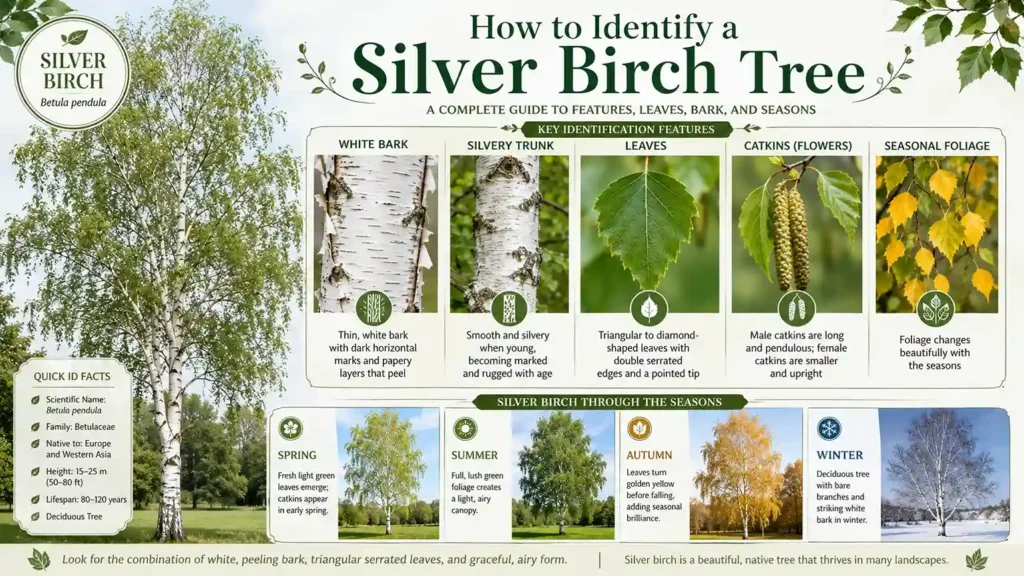
Characteristics of silver birch leaves include:
The silver birch tree leaves grow alternately along thin branches, creating a delicate and airy canopy. Compared to broader deciduous leaves, the leaves on a birch tree are lightweight and flutter easily in the breeze.
|
Feature |
Silver Birch Leaves |
|
Leaf Shape |
Triangular to diamond-shaped |
| Leaf Edge |
Finely serrated |
|
Spring Color |
Fresh light green |
| Summer Color |
Medium glossy green |
|
Autumn Color |
Golden yellow |
| Seasonal Appearance |
Light and airy throughout growing season |
|
Texture |
Thin and delicate |
| Arrangement |
Alternate along branches |
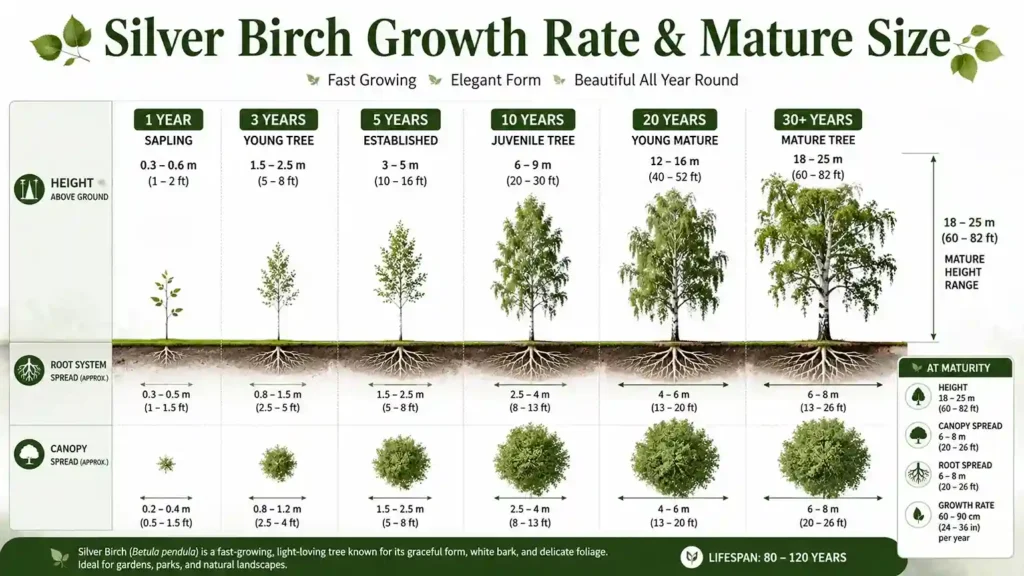
The silver birch tree is widely appreciated for its fast development, elegant height, and relatively manageable mature size. Its upright form and airy canopy make it suitable for ornamental landscapes, woodland gardens, and avenue planting. Understanding the mature dimensions and growth habits of silver birch trees helps gardeners choose the right planting location and maintain healthy long-term growth.
One of the most common questions among gardeners is, how tall do silver birch trees grow? Mature silver birch trees can reach impressive heights under suitable growing conditions, especially in cooler climates with adequate moisture.
Typical silver birch height ranges include:
The exact height of silver birch trees depends on several factors:
When asking how tall is a birch tree, it is important to note that silver birch generally grows taller in open environments with full sunlight. Multi-stem ornamental forms may remain shorter but develop a broader canopy structure.
Beyond height, gardeners often want to know how big do birch trees get overall. Silver birch trees develop a moderately spreading canopy with graceful, pendulous branches that create an elegant silhouette.
Typical mature dimensions include:
The full birch tree mature size depends heavily on spacing and growing conditions. Trees planted in open areas tend to develop wider crowns, while woodland-grown specimens often grow taller and narrower due to light competition.
Characteristics of mature tall birch trees include:
For landscape planning, gardeners should allow adequate spacing from buildings, pathways, and neighboring trees to accommodate mature growth.
The silver birch growth rate is considered fast compared to many ornamental hardwood trees. Young trees establish quickly and can produce noticeable annual height increases during their early years.
Average annual growth rate:
This rapid development explains why silver birch is often considered among the fastest growing birch tree varieties for ornamental use.
Several factors influence how fast birch trees grow:
When asking how fast does a birch tree grow, young saplings usually experience their fastest growth during the first 10–20 years. Growth gradually slows as the tree matures.
Growth performance can decline if trees experience:
Providing consistent moisture and protecting shallow roots are essential for maintaining healthy growth rates.
The average birch tree lifespan is shorter than many larger hardwood species. While silver birch trees grow quickly, they are generally considered moderately short-lived ornamental trees.
Typical lifespan ranges:
Several factors affect longevity:
Silver birch trees perform best in cool temperate regions. Excessive heat and drought can shorten lifespan significantly.
Consistent moisture supports healthy root systems and reduces environmental stress.
Healthy trees with proper airflow and maintenance are less vulnerable to fungal diseases and insect infestations.
Compacted soil and root disturbance can weaken tree stability and reduce overall lifespan.
Correct pruning, mulching, and watering practices help extend the health and structural integrity of mature birch trees.
|
Tree Age |
Average Height |
Growth Stage |
|
1–2 Years |
3–6 feet | Young sapling establishment |
| 3–5 Years | 8–15 feet |
Rapid juvenile growth |
|
6–10 Years |
15–30 feet | Developing canopy structure |
| 10–20 Years | 30–50 feet |
Mature growth acceleration |
|
20–40 Years |
50–70 feet | Fully mature ornamental tree |
| 40+ Years | Stable mature height |
Slower growth and aging stage |
Understanding the silver birch root system is important before planting this fast-growing ornamental tree near homes, pathways, or other landscape features. Silver birch trees develop a broad, shallow root network designed to absorb moisture efficiently from the upper soil layers. While this root structure supports rapid growth, it also influences planting location, soil management, and nearby plant competition.
The root system of birch trees is generally shallow, fibrous, and spreading rather than deeply anchored. Most feeder roots remain close to the soil surface where oxygen and moisture are more available.
Key features of the birch tree root structure include:
The silver birch root system often extends significantly beyond the canopy width. In mature trees, roots may spread two to three times wider than the visible crown.
Important root characteristics:
Because of their shallow nature, silver birch trees benefit greatly from mulching, which helps maintain root-zone moisture and temperature stability.
A common concern among homeowners is whether birch trees develop invasive roots. In most cases, silver birch roots are not aggressively destructive like some large urban tree species, but they can still create issues if planted too close to structures.
Silver birch roots naturally spread outward in search of water and nutrients. Since the root system stays relatively close to the surface, roots may compete heavily with lawns, flowers, and nearby shrubs.
Potential root-related issues include:
Silver birch roots are generally less damaging than trees with large deep anchoring roots. However, roots may exploit existing weaknesses in underground systems if moisture is present.
Important considerations:
To reduce future problems, proper spacing is essential.
Recommended minimum distances:
|
Structure |
Recommended Distance |
|
House foundations |
20–30 feet (6–9 meters) |
| Underground pipes |
15–20 feet (4.5–6 meters) |
|
Patios and paving |
10–15 feet (3–4.5 meters) |
| Other large trees |
15–25 feet (4.5–7.5 meters) |
Allowing sufficient spacing helps maintain healthy root development while reducing moisture competition and structural risks.
A birch tree root system diagram is often helpful for understanding how roots spread beneath the soil surface. Since silver birch trees develop shallow lateral roots rather than deep taproots, visual diagrams can assist gardeners when planning planting distances and landscape layouts.
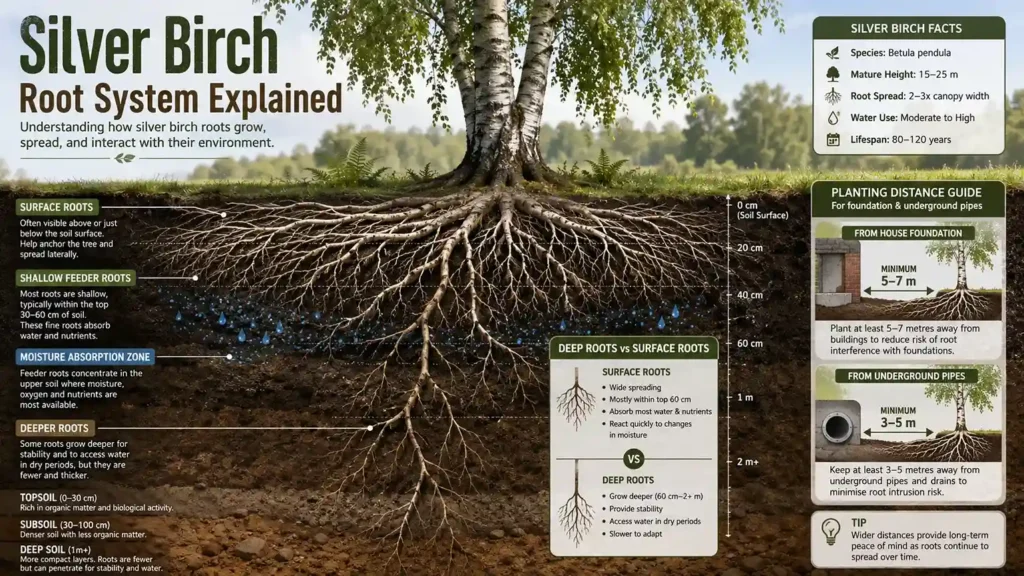
A typical diagram would illustrate:
|
Root Type |
Characteristics |
|
Surface Roots |
Shallow, wide-spreading, moisture-seeking |
| Deep Roots |
Limited depth compared to many hardwood trees |
|
Feeder Roots |
Fine roots responsible for nutrient uptake |
| Structural Roots |
Larger stabilizing roots near trunk base |
The majority of the active silver birch root system remains close to the soil surface, which explains the tree’s sensitivity to drought and heat stress.
Selecting the right planting location is critical for healthy growth and long-term root management.
Silver birch trees compete strongly for water because of their dense feeder roots. Avoid planting them too close to:
Instead, pair birch trees with plants that tolerate partial shade and moderate root competition.
Silver birch trees grow best in:
Avoid:
Applying organic mulch around the root zone helps preserve moisture, suppress weeds, and protect the shallow roots from temperature extremes.
Birch trees are valued for their decorative bark, graceful form, and adaptability to different landscape styles. There are many types of birch trees grown around the world, ranging from tall woodland species to compact ornamental forms suitable for smaller gardens. These elegant deciduous trees belong to the Betula genus and include numerous attractive cultivars used in residential and commercial landscaping.
There are several well-known birch tree varieties commonly used in ornamental planting. Each species differs in bark texture, mature size, climate tolerance, and canopy shape.
Popular birch types include:
These Betula varieties are widely planted for ornamental purposes because of their distinctive bark and seasonal foliage color.
Key characteristics shared among many birch varieties:
Among all ornamental birches, the silver birch remains one of the most widely planted due to its elegant white trunk and adaptable growth habit.
Several cultivated forms of silver birch are available for different landscape purposes. Some are selected for bark brightness, while others are valued for weeping habits, compact size, or unusual foliage texture.
The weeping silver birch is one of the most elegant ornamental tree forms available. Its long pendulous branches create a soft cascading effect, making it popular in parks and decorative landscapes.
Also known as the European weeping birch, this variety develops a graceful umbrella-shaped canopy as it matures.
Features of birch weeping forms include:
The weeping birch works especially well as a specimen tree in open lawns and ornamental gardens.
Betula pendula alba is prized for its exceptionally bright white bark appearance. This cultivar enhances winter interest and creates strong visual contrast in landscape designs.
Key features include:
Because of its striking trunk coloration, this variety is commonly planted in minimalist and modern garden designs.
Betula pendula moss white is another ornamental selection valued for its clean bark coloration and refined appearance.
Characteristics of silver birch moss white include:
The moss white silver birch is frequently used in avenue planting and contemporary landscape schemes where bark texture becomes a major visual feature.
The cut leaf birch is known for its finely dissected foliage that gives the canopy a soft feathery appearance.
Features of the cut leaf birch tree include:
This variety adds texture and movement to mixed ornamental plantings.
The dwarf silver birch is ideal for compact landscapes and smaller residential gardens where full-sized birch trees may become too large.
Advantages include:
Because of its restrained growth habit, the dwarf form works well in urban landscapes and modern garden layouts.
The river birch tree and silver birch are both popular ornamental species, but they differ significantly in bark texture, moisture tolerance, and growth habits. River birch is especially valued for wet soils, while silver birch performs best in cooler, well-drained conditions.
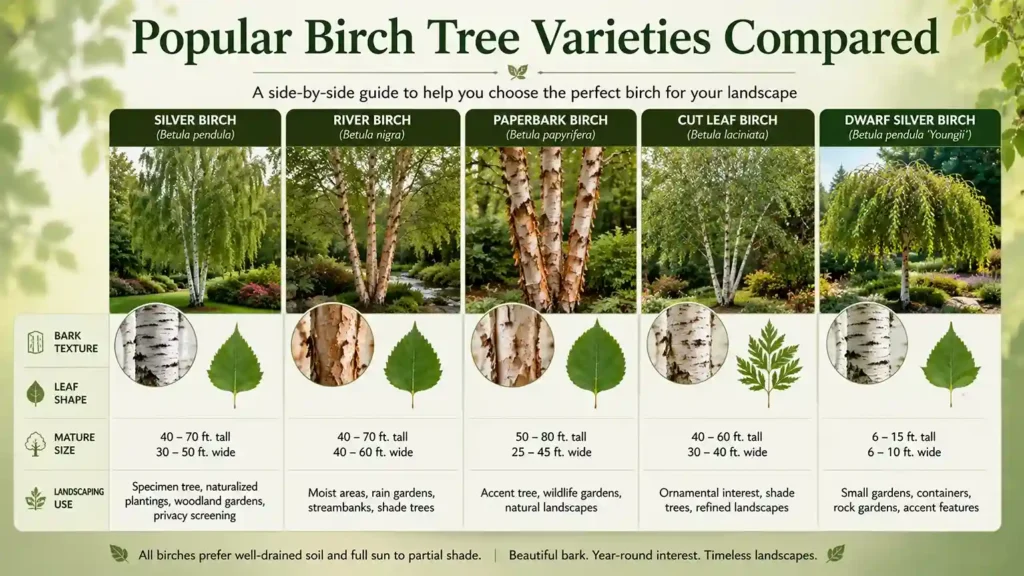
Some paperbark birch trees are also compared with silver birch because of their decorative peeling bark.
|
Feature |
River Birch Tree | Silver Birch |
| Bark | Peeling cinnamon-brown bark |
Bright white bark with black markings |
|
Growth Rate |
Fast | Fast |
| Water Tolerance | High tolerance for wet soils |
Prefers moist but well-drained soil |
|
Heat Tolerance |
Better in warm climates | Prefers cooler climates |
| Landscaping Use | Wet areas, shade trees, riverbanks |
Ornamental gardens, woodland planting |
|
Canopy Appearance |
Dense spreading canopy | Light airy canopy |
| Ornamental Value | Textured bark and strong form |
Elegant white trunk and seasonal foliage |
Proper birch tree care is essential for maintaining healthy growth, vibrant foliage, and the distinctive white bark that makes silver birch trees so attractive in ornamental landscapes. Although silver birch is considered relatively low maintenance, it performs best when provided with consistent moisture, suitable soil conditions, and protection from environmental stress.
Successful birch care begins with understanding the tree’s natural growing preferences. Silver birch trees thrive in cool temperate environments where roots remain moist and protected from excessive heat.
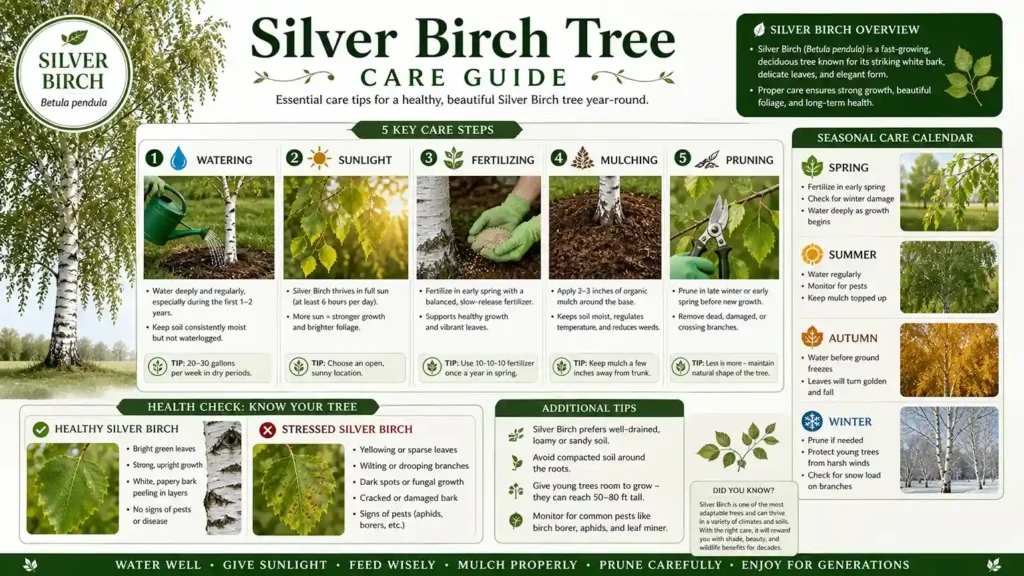
Silver birch trees grow best in:
In warmer climates, especially in regions growing silver birch trees Australia, some afternoon shade can help reduce heat stress and protect shallow roots.
Consistent watering is one of the most important aspects of healthy birch tree growth. Silver birch trees naturally prefer moist soil conditions and can decline if exposed to prolonged drought.
Watering recommendations:
Signs of underwatering include:
Silver birch trees adapt to several soil types but grow best in:
Avoid:
Healthy soil conditions support stronger root development and better resistance to environmental stress.
Using the right fertilizer for birch trees can improve foliage color, encourage steady growth, and maintain overall tree health. However, silver birch trees generally do not require excessive feeding if planted in fertile soil.
The ideal fertilizing periods are:
Avoid fertilizing late in the growing season, as this may encourage soft new growth vulnerable to winter damage.
Silver birch trees benefit most from balanced nutrients that support foliage and root health.
Important nutrients include:
A slow-release balanced fertilizer is usually sufficient for ornamental birch trees.
|
Fertilizer Type |
Benefits | Considerations |
| Organic Fertilizer | Improves soil health and moisture retention |
Slower nutrient release |
|
Synthetic Fertilizer |
Fast nutrient availability | Overuse may stress roots |
| Compost & Mulch | Natural nutrient improvement |
Requires regular application |
Organic options are often preferred because they improve soil structure while reducing the risk of root burn.
Mulching plays a major role in protecting the shallow root system of silver birch trees. Proper mulch application helps regulate soil temperature and reduce moisture loss during hot weather.
Benefits of mulching include:
Silver birch trees are sensitive to environmental stress, especially during prolonged heat or drought conditions.
To reduce stress:
During summer, shallow roots can overheat quickly, particularly in exposed planting areas.
Summer care tips:
Proper moisture management greatly improves tree vigor and foliage quality.
Silver birch trees provide year-round ornamental value with noticeable seasonal changes in foliage, bark appearance, and canopy texture.
During spring:
This season represents the start of the tree’s rapid annual growth cycle.
In summer, silver birch trees display:
Consistent watering becomes especially important during this season.
Autumn is one of the most visually attractive seasons for silver birch trees.
Seasonal features include:
Fallen leaves also contribute organic matter back into the soil.
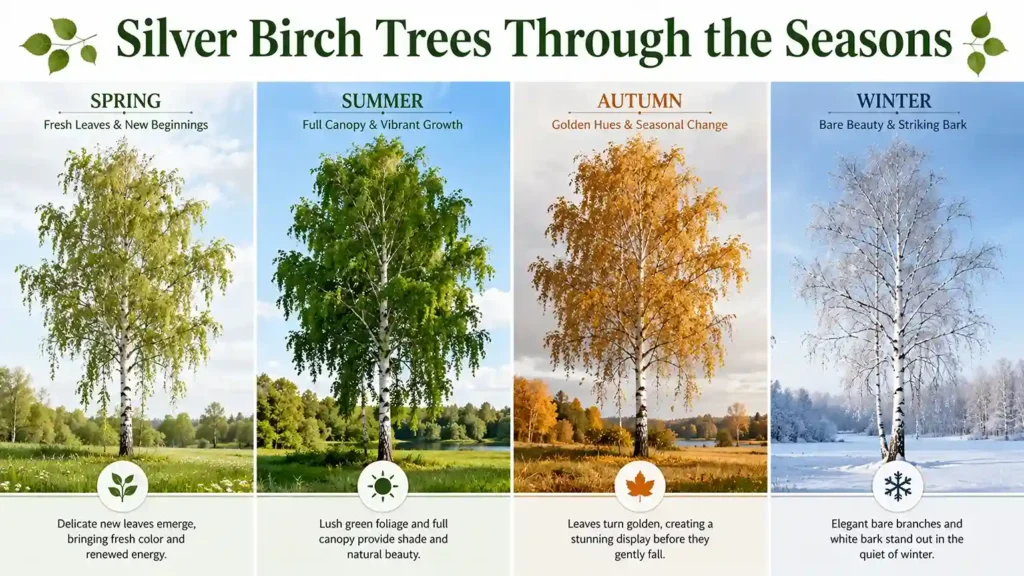
The elegant branch structure of the weeping birch winter silhouette becomes highly visible after leaf fall.
Winter ornamental features include:
Even during dormancy, silver birch trees remain visually striking in ornamental gardens and woodland landscapes.
Proper pruning and maintenance are essential for preserving the health, structure, and ornamental appearance of silver birch trees. Correct pruning improves airflow, removes weak growth, and helps maintain the graceful canopy that makes silver birch so popular in landscaping. However, birch trees are sensitive to improper cutting practices, so timing and technique are extremely important.
Knowing when to prune birch trees is critical because birch species are prone to heavy sap bleeding if pruned at the wrong time of year.
The best time for pruning is:
Avoid pruning during:
A proper seasonal pruning guide helps reduce stress and lowers the risk of disease or pest attraction.
|
Season |
Pruning Suitability |
Notes |
|
Spring |
Not recommended | High sap bleeding risk |
| Summer | Best period |
Ideal for shaping and maintenance |
|
Autumn |
Suitable | Light structural pruning |
| Winter | Limited pruning only |
Avoid heavy cuts |
Late summer pruning is generally safest because the tree’s energy reserves are more stable and sap pressure is lower.
Effective silver birch pruning focuses on maintaining natural form rather than aggressive reshaping. Birch trees naturally develop elegant branching patterns that should be preserved whenever possible.
Important tips for trimming birch trees include:
Topping a silver birch tree is generally not recommended. Topping removes large sections of the crown and can severely weaken the tree.
Problems caused by topping include:
Instead of topping, selective crown thinning and branch reduction provide safer and healthier long-term results.
Understanding how to prune birch trees correctly helps maintain tree health while preserving ornamental value.
Removing dead, damaged, or diseased wood is one of the most important maintenance tasks.
Focus on:
Dead branch removal improves:
Birch trees naturally develop a graceful upright form, so pruning should support this structure rather than force unnatural shapes.
Shape management goals include:
Light thinning is usually more beneficial than heavy cutting.
Many ornamental silver birches are grown as multi-stem specimens for decorative effect.
Important multi stem birch tree care practices include:
Multi-stem forms are especially popular in modern landscape design because they create strong winter architectural interest.
Improper pruning can reduce the lifespan and ornamental quality of silver birch trees. Avoiding common mistakes helps prevent long-term structural and health problems.
Removing excessive foliage weakens the tree and reduces its ability to produce energy through photosynthesis.
Problems caused by over-pruning include:
As a general rule, avoid removing more than 20–25% of the canopy in a single season.
One of the most well-known birch tree problems is excessive sap bleeding after improper seasonal pruning.
Sap bleeding occurs when:
Although sap bleeding alone may not always kill the tree, it can:
Pruning during late summer significantly reduces this issue and supports healthier recovery after maintenance work.
Proper planting and propagation techniques are essential for establishing healthy silver birch trees with strong root systems and long-term ornamental value. Whether growing from young saplings, bare-root specimens, or seeds, silver birch trees benefit from careful site preparation, consistent moisture, and suitable soil conditions during the early stages of growth.
Learning how to properly plant a silver birch tree improves establishment success and reduces future stress problems. Since silver birch trees develop shallow spreading roots, selecting the right planting location is especially important.
Before planting:
Silver birch trees grow best where roots can spread freely without excessive competition from nearby large trees.
Recommended spacing:
Silver birch trees prefer:
Avoid:
Adding organic matter before planting can improve drainage and moisture retention.
Consistent watering is critical during establishment.
Watering guidelines:
Mulching around the base helps preserve moisture and protect shallow roots from heat stress.
Young birch saplings establish quickly when planted in favorable conditions. Many gardeners prefer starting with nursery-grown trees because they adapt faster and require less time to mature.
A healthy silver birch sapling typically features:
Young saplings generally establish best during cooler planting seasons such as autumn or early spring.
Silver birch seedlings are commonly grown from seed and can adapt well when transplanted early.
Important care practices include:
A developing Betula pendula seedling grows rapidly under favorable conditions and may establish noticeable height growth within a few seasons.
Bare root birch trees are sold without soil around their roots during dormancy. They are often more affordable and establish effectively when planted correctly.
Advantages include:
Important planting tips:
Although silver birch trees naturally grow best in open ground, certain compact varieties can successfully grow as a birch tree in a pot or decorative container planting.
Growing a birch tree in container conditions requires careful attention to watering and root management.
Container requirements:
Because silver birch trees grow quickly, containers should provide sufficient room for root development.
A healthy potted birch tree requires:
Compact or dwarf varieties are generally better suited for long-term container growth than full-sized trees.
Gardeners interested in expanding ornamental plantings often choose to propagate birch tree varieties through seeds or young cuttings. The most common and reliable method involves seed propagation.
Propagating birch trees from seed requires patience but can produce healthy young trees adapted to local growing conditions.
Basic propagation steps:
Silver birch seeds are small and lightweight, often naturally dispersed by wind.
For successful germination:
Seedlings usually emerge within several weeks under suitable temperatures.
A developing Betula pendula seedling grows rapidly when given:
Young seedlings can later be transplanted into garden beds, woodland areas, or larger containers once root systems become established.
Silver birch trees are widely admired for their white bark, elegant structure, and seasonal foliage, but growing them successfully in Australia requires careful climate and site selection. While these ornamental trees naturally prefer cooler temperate regions, many gardeners still grow silver birch trees Australia wide in suitable environments with proper watering and root protection.
Yes, silver birch Australia cultivation is possible in many cooler parts of the country. Although silver birch trees are native to Europe and cooler northern climates, they can adapt successfully to selected Australian regions with moderate temperatures and reliable moisture.
Many gardeners choose birch trees Australia wide because of their:
Cool-climate ornamental trees are often combined with drought-tolerant Australian species to create layered landscape designs with contrasting textures and foliage forms.
However, growing birch trees in Australia can be more challenging in hot or dry regions because silver birch trees are sensitive to prolonged heat and drought stress.
Silver birch performs best when:
In suitable climates, silver birch trees remain highly popular ornamental specimens for residential and commercial landscapes.
Choosing the right climate is one of the most important factors for successful silver birch growth in Australia.
Silver birch trees grow best in cool temperate areas with mild summers and regular rainfall.
Suitable Australian regions often include:
These environments better replicate the natural growing conditions of European birch forests.
Silver birch trees are highly sensitive to excessive heat, especially during long dry summers.
Heat-related problems may include:
In warmer regions, planting locations with afternoon shade can help reduce environmental stress.
Consistent moisture is essential for healthy silver birch growth in Australian conditions.
Effective water management practices include:
Shallow birch roots dry out quickly in Australian summer conditions, making irrigation especially important.
Silver birch trees are highly valued in ornamental landscape design because of their elegant appearance and year-round visual interest.
Popular uses for ornamental birch trees include:
Many designers use birch trees in landscaping because their light canopy allows filtered sunlight to reach lower planting layers.
Benefits include:
Silver birch trees pair well with:
Popular birch tree landscape ideas include:
|
Landscape Style |
Birch Tree Use |
| Woodland Gardens |
Natural clustered planting |
|
Contemporary Gardens |
Multi-stem feature trees |
| Cottage Gardens |
Soft ornamental backdrop |
|
Urban Courtyards |
Compact dwarf varieties |
| Avenue Planting |
Formal tree-lined pathways |
The bright bark becomes especially striking during winter when surrounding vegetation is dormant.
Although silver birch trees can grow successfully in suitable climates, Australian conditions may create several environmental challenges.
Intense Australian sunlight can damage the thin bark of silver birch trees.
Symptoms include:
Providing partial afternoon shade can help reduce bark stress in warmer regions.
Drought is one of the biggest threats to healthy silver birch growth in Australia.
Signs of drought stress:
Preventive measures include:
Silver birch trees prefer cool, moisture-retentive soils, which may differ from naturally dry or alkaline Australian soils.
To improve adaptation:
With proper site preparation and ongoing care, silver birch trees can become highly attractive ornamental features in suitable Australian landscapes.
Although silver birch trees are valued for their beauty and relatively fast growth, they can still experience health issues caused by environmental stress, pests, and diseases. Understanding common silver birch trees problems helps gardeners identify symptoms early and maintain healthier, longer-living ornamental trees.
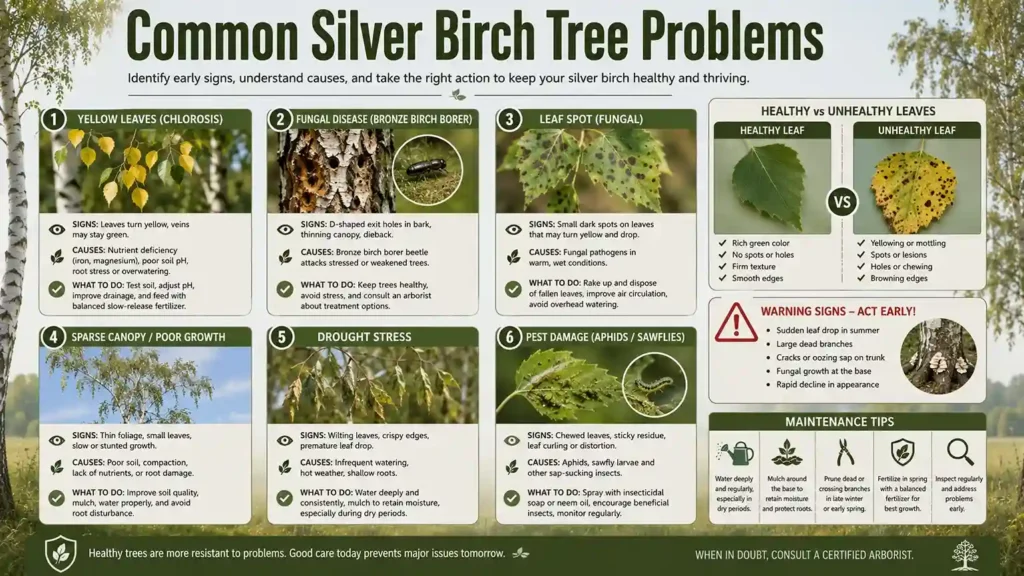
Several common silver birch problems are linked to unsuitable growing conditions, drought stress, root disturbance, or poor airflow around the canopy. Because silver birch trees naturally prefer cool, moist environments, stress often appears quickly during hot or dry conditions.
Common issues include:
Environmental stress is often the main trigger behind declining tree health. Trees planted in compacted soil or exposed to prolonged summer heat are usually more vulnerable to pests and disease.
Warning signs to monitor:
|
Problem |
Possible Cause |
| Early leaf drop |
Drought stress |
|
Leaf scorch |
Excessive heat or dry soil |
| Thin canopy |
Root competition or poor nutrition |
|
Branch dieback |
Disease or root stress |
| Bark cracking |
Sunburn or environmental stress |
Regular monitoring allows early intervention before problems become severe.
Several fungal and environmental diseases can affect silver birch trees, particularly when trees are weakened by drought or poor growing conditions.
Fungal diseases are among the most common diseases of silver birch trees. Excess moisture combined with poor airflow can encourage fungal growth on leaves, bark, or branches.
Common fungal issues include:
Symptoms may include:
Proper airflow and avoiding waterlogged conditions help reduce fungal disease risk.
Leaf spot diseases create dark or brown spotting across foliage surfaces and are often caused by fungal pathogens during humid conditions.
Symptoms include:
Most cases are cosmetic but repeated severe infections may weaken tree vigor over time.
Preventive measures:
Dieback is one of the more serious silver birch health problems and often develops gradually.
Common dieback symptoms include:
Potential causes:
Early pruning of affected branches can help slow disease progression in some cases.
The graceful form of weeping birch varieties makes them especially attractive, but these ornamental trees can develop several health issues under stressful conditions.
Yellow foliage is one of the most common weeping birch tree problems.
Possible causes include:
Maintaining consistent soil moisture is essential for preventing foliage discoloration.
A thinning or sparse canopy may indicate:
Trees growing in compacted or dry soils are especially prone to reduced canopy density.
Silver birch trees can occasionally attract pests that weaken foliage and branches.
Common pests include:
Signs of pest activity may include:
Healthy trees with proper watering and minimal stress are generally more resistant to pest infestations.
Consistent maintenance is the best way to reduce disease risk and maintain strong ornamental growth.
Routine inspection allows problems to be identified before severe decline occurs.
Proper watering and canopy ventilation are especially important for silver birch health.
Watering recommendations:
Airflow improvements:
Healthy airflow reduces humidity buildup around foliage and helps prevent fungal disease development.
Silver birch trees are among the most versatile ornamental trees used in modern landscape design. Their bright white bark, graceful canopy, and light foliage make them suitable for both naturalistic and structured garden styles. Whether planted as feature specimens or grouped in woodland settings, silver birch trees create year-round visual interest with relatively low maintenance requirements.
Silver birch trees are widely used in ornamental landscapes because of their elegant form and seasonal beauty. Their airy canopy also allows filtered light to reach surrounding plants, making them highly adaptable in mixed planting schemes.
Many ornamental tree species with decorative bark and seasonal foliage are commonly used together in landscape designs focused on year-round visual structure.
Silver birch trees work exceptionally well as standalone feature trees in lawns and open garden spaces.
Benefits of feature planting include:
Multi-stem forms are especially popular as architectural landscape features.
Because of their upright growth habit and uniform appearance, silver birch trees are commonly used for avenue planting along:
The repeating white trunks create a highly structured and elegant landscape effect.
Advantages of avenue planting:
Silver birch naturally complements woodland-style landscapes because of its open canopy and natural forest appearance.
Woodland garden benefits include:
Groups of silver birch trees help recreate the appearance of natural birch forest ecosystems.
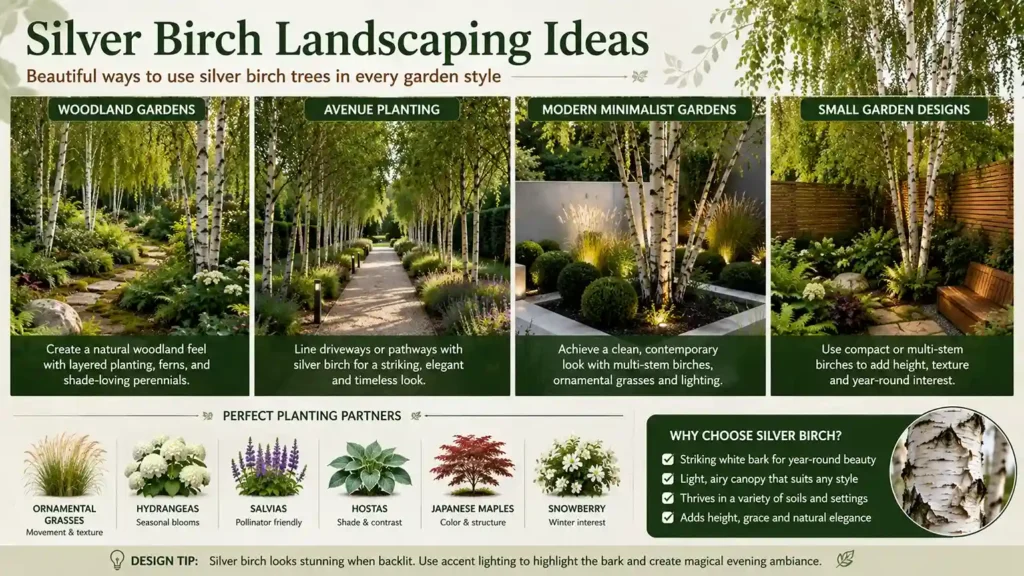
Although some birch species become quite large, several silver birch varieties are suitable for compact landscapes and urban gardens.
Smaller ornamental selections provide the same decorative bark and foliage benefits while remaining manageable in limited spaces.
Advantages of compact varieties:
Dwarf and narrow-growing cultivars are especially useful where planting space is restricted.
Multi-stem silver birch forms are highly popular in contemporary landscape design.
Benefits include:
These designs work particularly well in:
The layered trunks create strong architectural interest throughout the year.
Selecting suitable companion plants helps enhance the ornamental value of silver birch landscapes while supporting healthy planting combinations.
Because birch trees create light filtered shade, they pair well with many woodland and shade-tolerant plants.
Popular companion plants include:
These plants tolerate moderate root competition while complementing the delicate birch canopy.
Combining silver birch trees with contrasting foliage and flowering plants creates stronger visual impact throughout the year.
Effective seasonal contrast combinations include:
|
Season |
Companion Plant Ideas |
|
Spring |
Bulbs, bluebells, hellebores |
| Summer |
Ferns, ornamental grasses, hostas |
|
Autumn |
Red foliage shrubs, Japanese maples |
| Winter |
Evergreens and textured bark plants |
Using layered planting designs helps maintain visual interest across all seasons.
One reason silver birch remains such a popular ornamental tree is its strong year-round landscape appeal.
The bright white bark becomes the dominant visual feature during winter after leaf drop.
Winter benefits include:
Multi-stem forms are especially striking during the dormant season.
Silver birch trees develop vibrant yellow foliage during autumn, adding seasonal warmth to landscapes.
Autumn ornamental features:
In spring, fresh foliage and delicate catkins create soft texture and movement throughout the canopy.
Spring features include:
The combination of bark, foliage, and graceful structure allows silver birch trees to remain visually attractive in every season of the year.
Silver birch trees are among the most widely planted ornamental trees because of their elegant white bark, graceful canopy, and fast growth. They are commonly used in residential gardens, woodland landscapes, avenue planting, and decorative outdoor spaces. The species adapts well to cool temperate climates and provides strong ornamental value throughout every season.
|
Feature |
Details |
|
Scientific Name |
Betula pendula |
| Common Name |
Silver Birch |
|
Growth Rate |
Fast |
| Mature Height |
Variable by variety |
|
Lifespan |
Moderate |
| Root Type |
Shallow spreading |
|
Best Climate |
Cool temperate |
| Ideal Use |
Ornamental landscaping |
Silver birch trees are considered fast-growing ornamental trees. Under suitable conditions, they can grow around 1.5–3 feet (45–90 cm) per year. Growth is usually fastest during the first 10–20 years when the tree is actively establishing its canopy and root system.
Silver birch trees have shallow spreading roots rather than aggressively invasive deep roots. However, the roots can spread widely near the soil surface and may compete with nearby plants for moisture. Planting at a safe distance from foundations, pipes, and paved areas helps prevent future problems.
The best time to prune a silver birch tree is during late summer or early autumn. Pruning during spring should be avoided because birch trees produce heavy sap flow at that time, which can lead to sap bleeding and increased stress.
Yes, silver birch trees can grow successfully in cooler Australian climates. Regions with mild summers and reliable moisture are best suited for healthy growth. In hotter areas, regular watering and protection from excessive afternoon heat are important.
Most mature silver birch trees grow between 40–70 feet (12–21 meters) tall depending on climate, soil quality, and variety. Some compact ornamental cultivars remain much smaller and are suitable for residential gardens.
Common silver birch tree problems include: Drought stress Yellowing leaves Sparse canopy growth Fungal infections Leaf spot diseases Branch dieback Pest infestations such as aphids or borers Most issues are linked to heat stress, poor watering, or unsuitable soil conditions.
Yes, some compact and dwarf birch varieties can grow successfully in containers. A large pot with excellent drainage, regular watering, and seasonal feeding is important for maintaining healthy root growth. Dwarf silver birch varieties are generally best suited for container growing.
The average lifespan of a silver birch tree ranges from 40–80 years, although some trees can live longer in ideal growing conditions. Proper watering, pruning, and disease prevention help improve longevity.
Several compact varieties work well in smaller spaces, including: Dwarf silver birch Multi-stem silver birch forms Cut leaf birch cultivars Narrow upright ornamental varieties These trees provide decorative bark and foliage without becoming excessively large.
Silver birch tree leaves are small, triangular to diamond-shaped, and have finely serrated edges. The leaves are bright green during spring and summer before turning golden yellow in autumn. Their delicate texture and pointed tips make them easy to recognize.
The white bark develops naturally as the tree matures and helps reflect sunlight while protecting the trunk from temperature extremes. The bark also gives silver birch its strong ornamental appeal during winter.
Yes, silver birch trees are excellent for woodland-style planting schemes. Their light canopy allows filtered sunlight to reach understory plants such as ferns, hostas, and ornamental grasses.
Yes, silver birch trees are deciduous, meaning they shed their leaves during autumn before entering winter dormancy. After leaf fall, the white bark and graceful branch structure become the main ornamental features.
Silver birch trees grow best in full sun or partial shade. Ideally, they should receive at least 6 hours of sunlight daily for healthy growth and strong foliage development.
Silver birch trees prefer moist, well-drained soil with slightly acidic to neutral pH levels. Loamy or sandy soils with good drainage are ideal for maintaining healthy root systems.
Silver birch trees have limited drought tolerance because of their shallow root systems. Extended dry periods can cause leaf scorch, yellowing foliage, and canopy thinning. Regular watering during hot weather is important.