Grow Better Gardens with Smarter Plant Choices
Discover helpful guides on trees, hedges, fruit plants, edible plants, and beautiful landscape greenery.

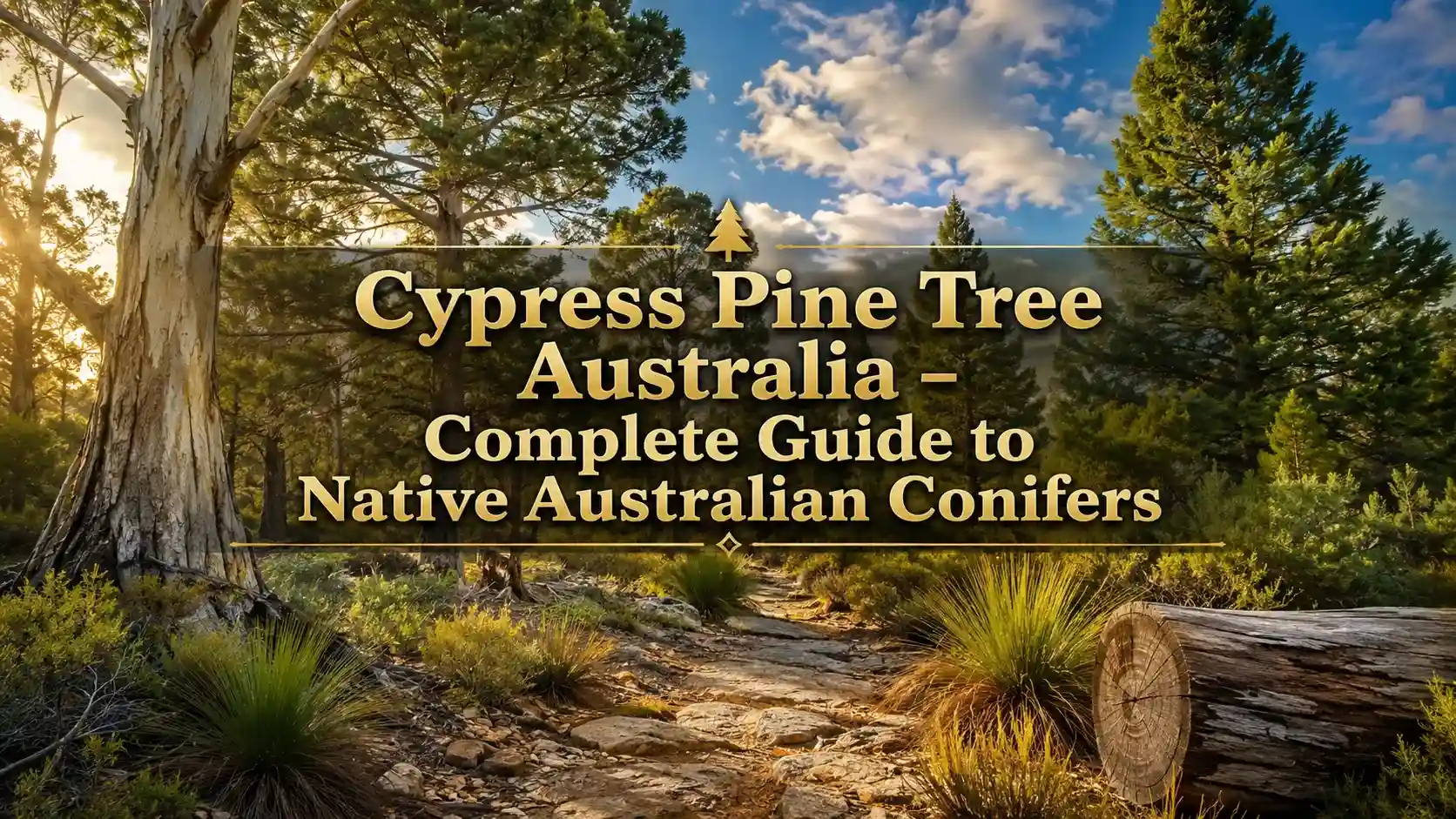
The cypress pine tree Australia is one of the most important groups of native conifers found across the country’s inland, coastal, and semi-arid landscapes. Known for their resilience, attractive timber, and adaptability to harsh Australian climates, Australian cypress pine trees play a major role in landscaping, forestry, conservation, and rural shelterbelt planting. These evergreen native trees are valued for their natural termite resistance, drought tolerance, and distinctive honey-gold timber used in flooring, furniture, and structural wood applications.
Unlike true pine trees that belong to the Pinus genus and were mostly introduced to Australia from overseas, Australian native pine species belong primarily to the Callitris genus. These native conifers have evolved specifically for Australian conditions, making them more suitable for dry soils, heat, and unpredictable rainfall patterns. Species such as white cypress pine, black cypress pine, and Rottnest Island pine are widely recognized for both ecological and commercial value.
The Callitris genus includes several native Australian cypress pine species that vary in size, habitat, and growth habit. These trees are commonly planted in native gardens, windbreaks, and restoration projects while also supporting biodiversity and soil stability across Australian ecosystems.
A cypress pine is a group of evergreen conifer trees native to Australia and commonly associated with the Callitris genus. Despite the name “pine,” these trees are not true pine trees in the botanical sense. Australian cypress pine species are adapted to dry climates, nutrient-poor soils, and harsh environmental conditions, making them highly important native conifers across many Australian landscapes.
Cypress pine trees are classified as Australian native conifers because they produce cones and needle-like or scale-like foliage similar to other conifer species. However, unlike traditional pine species from the Pinus genus, Australian cypress pines evolved naturally within Australia and are better suited to local ecosystems and climate conditions.
There are several major differences between cypress pine and traditional pine species:
Australian cypress pine species are widely used in timber production, native landscaping, conservation planting, and shelterbelt establishment because of their resilience and low maintenance requirements.
Australian cypress pines belong primarily to the Callitris genus, a group of native conifers distributed throughout mainland Australia and Tasmania. These trees are part of the Cupressaceae family, which also includes cypress and juniper species found worldwide.
The Callitris genus contains multiple species adapted to different Australian environments, including inland woodlands, coastal dunes, rocky hillsides, and semi-arid regions. Many species are recognized for their ecological importance and valuable timber.
Important Australian cypress pine species include:
These native Australian conifers vary in growth rate, appearance, and habitat, but they share similar characteristics such as cone production, aromatic timber, and drought resistance.
Some pine-like trees are native to Australia, but many commonly planted pine trees are introduced species. Native pine trees Australia mainly refers to species within the Callitris genus and several related native conifers that naturally occur across Australian ecosystems.
Introduced pine species, such as Radiata pine (Pinus radiata), were brought to Australia for commercial forestry and timber plantations. These trees grow quickly and are widely used in construction and paper production. However, they are not naturally part of Australia’s native flora.
Native Australian pines differ from introduced pine trees in several important ways:
|
Feature |
Native Australian Pines | Introduced Pine Species |
| Main Genus | Callitris |
Pinus |
|
Origin |
Australia | Overseas |
| Climate Adaptation | High drought tolerance |
Often require higher rainfall |
|
Timber Properties |
Naturally termite resistant | Softer commercial timber |
| Ecological Role | Supports native biodiversity |
Plantation-focused forestry |
Because native Australian cypress pines evolved under Australian environmental conditions, they are often preferred for sustainable landscaping, habitat restoration, and conservation-focused planting projects.
The white cypress pine tree is one of the most widespread and commercially important native conifers in Australia. It is commonly found across inland New South Wales and Queensland, especially in dry woodland regions and semi-arid environments.
This species is recognized by its:
White cypress pine generally grows between 10 and 20 meters tall, although mature specimens can become larger under favorable conditions. The tree grows at a slow to moderate rate and is highly valued for its long lifespan and strong drought tolerance.
The timber of Callitris glaucophylla is particularly important in the Australian forestry industry because of its:
White cypress pine timber is commonly used for flooring, wall linings, furniture, fencing, and structural applications.
Black cypress pine refers to several darker-barked Callitris species commonly found in rocky inland and elevated regions of eastern Australia. These trees typically have denser foliage and a darker trunk appearance compared to white cypress pine.
Key characteristics include:
Black cypress pine naturally occurs in parts of New South Wales, Victoria, and inland Queensland. It often grows in open woodland ecosystems where rainfall is limited and temperatures can be extreme.
These trees are valued for both environmental restoration and native shelterbelt planting because they tolerate poor soils and dry conditions exceptionally well.
Southern cypress pine is a smaller native conifer species adapted to southern Australian climates and semi-arid regions. It commonly occurs in dry inland woodlands and low-rainfall environments.
Main characteristics include:
Southern cypress pine is highly adapted to dry climate conditions and can survive extended periods of low rainfall once established. Its hardy nature makes it suitable for conservation planting and low-maintenance native landscaping.
Callitris preissii, commonly known as Rottnest Island pine, is a coastal native conifer found mainly in Western Australia. It naturally grows in sandy coastal soils and areas exposed to salt-laden winds.
This species performs well under:
Rottnest Island pine is widely appreciated for its ornamental value in coastal landscaping. Its dense foliage and symmetrical shape make it popular in parks, gardens, and coastal shelterbelts.
The species is also useful for stabilizing sandy soils and supporting coastal biodiversity.
Oyster Bay pine is closely associated with Tasmania and southeastern Australian coastal regions. It is often linked with Callitris rhomboidea, a native conifer species adapted to cooler climates and well-drained soils.
This species typically grows in:
Oyster Bay pine is known for its slender form, aromatic timber, and ecological importance in native vegetation communities. The tree contributes to habitat diversity and soil protection in sensitive environments.
The Murray pine tree is commonly associated with inland Australian cypress pine populations and is closely related to white cypress pine species. In many regions, the term is used interchangeably with inland forms of Callitris glaucophylla.
Murray pine commonly occurs in:
This native species is valued for its ability to tolerate heat, drought, and low-fertility soils. Its timber also shares many characteristics with white cypress pine, including termite resistance and durability.
Bribie Island pine refers to localized coastal native pine populations found in eastern Australian coastal environments. These regional varieties are adapted to sandy soils, salt exposure, and humid coastal conditions.
Coastal and localized native pine species often provide:
Many regional cypress pine varieties are important in protecting fragile coastal ecosystems while also serving as attractive native garden trees.
|
Species |
Scientific Name | Height | Native Region | Timber Use | Growth Rate |
| White Cypress Pine | Callitris glaucophylla | 10–20 m | Inland NSW & Queensland | Flooring, structural timber |
Moderate |
|
Black Cypress Pine |
Callitris endlicheri | 8–15 m | Eastern inland Australia | Durable timber, shelterbelts | Slow–Moderate |
| Southern Cypress Pine | Callitris gracilis | 5–12 m | Southern Australia | Conservation planting |
Slow |
|
Rottnest Island Pine |
Callitris preissii | 5–15 m | Western Australian coast | Ornamental, coastal planting | Moderate |
| Oyster Bay Pine | Callitris rhomboidea | 6–15 m | Tasmania & southeast Australia | Specialty timber |
Slow |
|
Murray Pine Tree |
Related to Callitris glaucophylla | 10–18 m | Inland southeastern Australia | Timber and fencing | Moderate |
| Bribie Island Pine | Regional coastal varieties | 5–12 m | Eastern coastal Australia | Landscaping and erosion control |
Moderate |
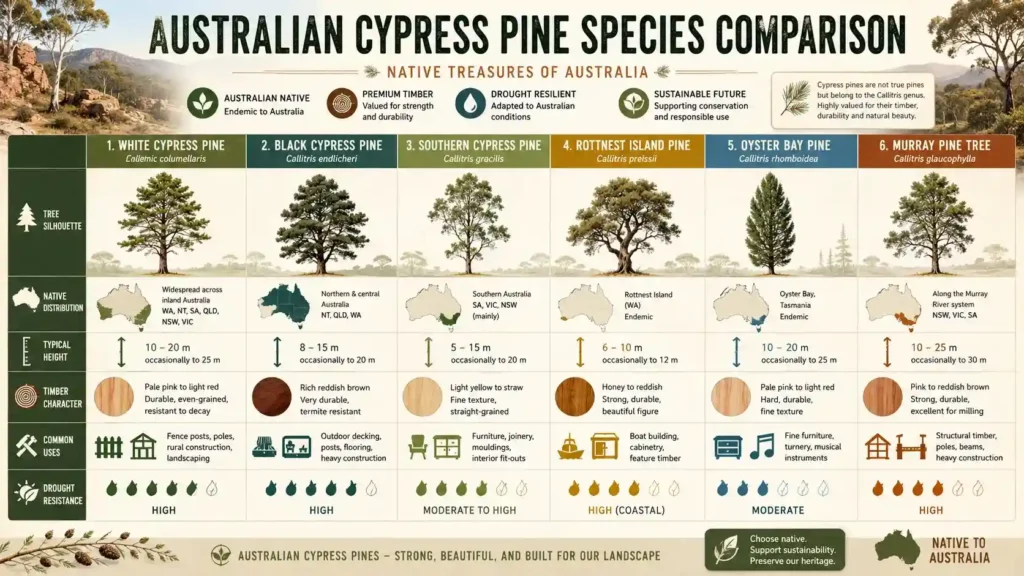
Australian cypress pine trees vary in size depending on the species, climate conditions, and soil quality. Most native cypress pine species reach a mature height between 5 and 20 meters, although some well-established trees in favorable environments can grow even taller.
Typical mature size ranges include:
These native conifers are generally long-lived trees. Many Australian cypress pines can survive for several decades, while some mature specimens may live well over 100 years under stable environmental conditions.
Growth rates are usually classified as slow to moderate:
|
Growth Type |
Characteristics |
| Slow Growth |
Common in dry inland climates and poor soils |
|
Moderate Growth |
Occurs in well-drained soils with regular rainfall |
| Early Establishment |
Young trees focus heavily on root development |
Compared to introduced pine plantation species such as Radiata pine, Australian cypress pine trees grow more slowly. However, they compensate with superior drought tolerance, stronger timber durability, and lower maintenance requirements.
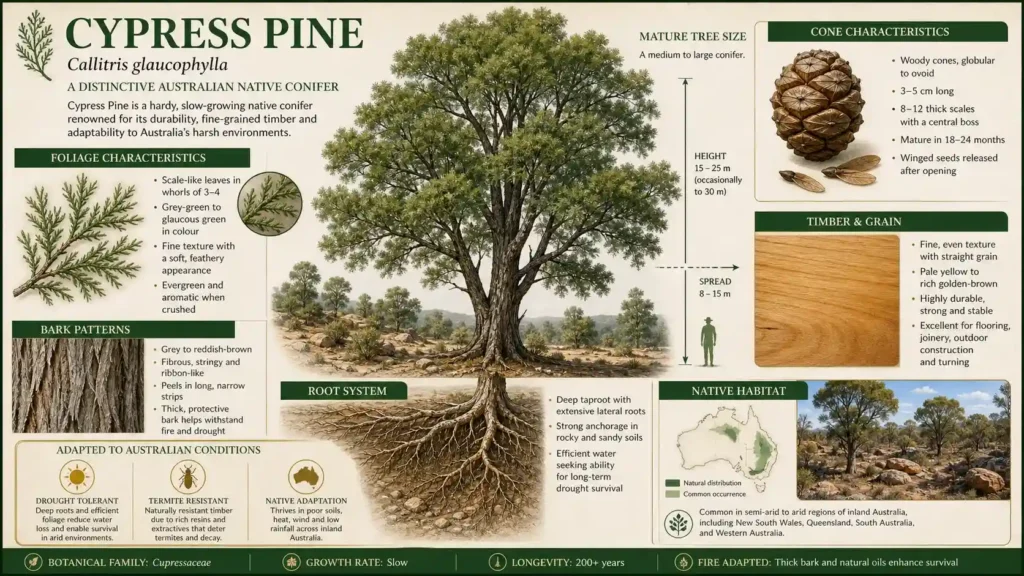
Australian cypress pine trees have distinctive foliage, bark, and cone structures that make them easy to identify among native conifers.
The foliage typically consists of fine scale-like leaves rather than long needles found on traditional pine trees. The leaf texture is soft, compact, and aromatic, helping reduce water loss in dry Australian climates.
Common foliage features include:
Cypress pine cones are small, woody, and rounded. They usually contain multiple seeds protected by thick cone scales. Many species retain cones on the tree for extended periods, especially in dry environments.
Cone characteristics include:
The bark patterns vary between species but are generally rough, fibrous, and deeply furrowed.
Bark texture and trunk appearance are also important ornamental features in several landscape tree species commonly grown for visual contrast.
Bark coloration ranges from grey-brown to almost black in some inland species.
Bark benefits include:
Australian cypress pine timber is highly valued for its attractive natural appearance and warm colour variations. The wood commonly displays honey-gold, pale yellow, and light brown tones that become richer over time.
Natural timber tones may include:
Freshly cut cypress pine often shows a soft cypress green colour within parts of the grain before aging into warmer golden hues. This natural variation contributes to the popularity of cypress pine flooring and interior timber applications.
The timber also features:
Because of its appearance and durability, cypress pine wood is commonly used in flooring, ceilings, furniture, wall linings, and exposed timber beams.
Cypress pine trees develop strong and adaptable root systems designed for Australian environmental conditions. Their roots spread efficiently through dry and sandy soils to locate moisture and improve long-term survival.
Key root system characteristics include:
These root systems help native cypress pines survive in semi-arid landscapes where rainfall can be inconsistent for long periods.
The root structure also provides important environmental benefits:
|
Benefit |
Importance |
|
Soil Stabilization |
Helps reduce erosion in dry landscapes |
| Drought Survival |
Accesses deeper soil moisture |
|
Wind Resistance |
Improves tree stability |
| Land Rehabilitation |
Supports degraded soil recovery |
Because of their stabilizing root systems, Australian cypress pine trees are frequently planted in shelterbelts, erosion-control projects, and conservation programs across rural Australia.
Australian cypress pine trees naturally grow across a wide range of environments throughout the country. Different species within the Callitris genus have adapted to inland woodlands, coastal dunes, rocky slopes, and semi-arid regions, making them some of the most versatile native conifers in Australia.
Inland Australia contains some of the largest natural populations of cypress pine trees, especially white cypress pine species. These trees commonly occur in:
Inland cypress pine forests are often found in open woodland ecosystems where rainfall is limited and temperatures can fluctuate significantly throughout the year.
Coastal regions also support several native cypress pine species, particularly in sandy and wind-exposed environments. Coastal species such as Rottnest Island pine and regional coastal varieties grow well near shorelines because of their salt tolerance and ability to handle sandy soils.
Coastal habitats may include:
Many Australian cypress pine species are especially well adapted to semi-arid landscapes where water availability is unpredictable. Their drought-resistant foliage and deep root systems allow them to survive in environments that are too harsh for many other tree species.
These native trees are commonly seen in:
|
Habitat Type |
Common Cypress Pine Presence |
|
Inland Woodlands |
Very common |
|
Semi-Arid Plains |
Highly adapted |
| Coastal Areas |
Moderate to common |
|
Rocky Hillsides |
Common |
| Dry Open Forests |
Widespread |
Australian cypress pine trees are highly resilient and can tolerate a broad range of climate conditions. Their natural adaptation to harsh Australian environments makes them suitable for both rural and urban landscaping projects.
One of their strongest characteristics is heat tolerance. Most cypress pine species can withstand prolonged hot weather and intense summer temperatures without significant stress once established.
Several Australian tree species commonly used in dry-climate landscapes are also valued for their ability to tolerate heat, drought, and challenging growing conditions.
Climate adaptations include:
Drought resistance is another major advantage of Australian cypress pine trees. Many species evolved in low-rainfall regions and can survive with minimal supplemental watering after establishment.
Important drought-resistant features include:
Several species also demonstrate moderate frost tolerance, especially inland varieties growing in elevated or cooler regions. Mature trees generally tolerate light to moderate frosts better than young saplings.
Typical climate tolerance levels:
|
Climate Factor |
Cypress Pine Adaptation |
| Heat |
Excellent tolerance |
|
Drought |
Very high resistance |
| Frost |
Moderate tolerance |
|
Coastal Wind |
Good adaptability |
| Low Rainfall |
Highly suitable |
Australian cypress pine trees are well known for their ability to grow in difficult soil conditions where many other tree species struggle. Their adaptability makes them valuable for conservation planting and low-maintenance landscaping.
Sandy soils are particularly suitable for many cypress pine species because these soils provide good drainage and allow root systems to expand efficiently. Coastal species especially thrive in sandy environments exposed to wind and salt.
Preferred soil conditions include:
Well-drained conditions are essential for healthy growth. Although cypress pine trees are highly drought tolerant, many species are sensitive to prolonged waterlogging and poorly drained soils.
Good drainage helps prevent:
One of the major strengths of Australian cypress pine trees is their ability to adapt to poor soils with low fertility. These native conifers can establish successfully in nutrient-deficient environments where introduced tree species often fail.
Their soil adaptability makes them useful for:
Because of this resilience, cypress pine trees are commonly planted in challenging Australian landscapes where long-term durability and environmental tolerance are essential.
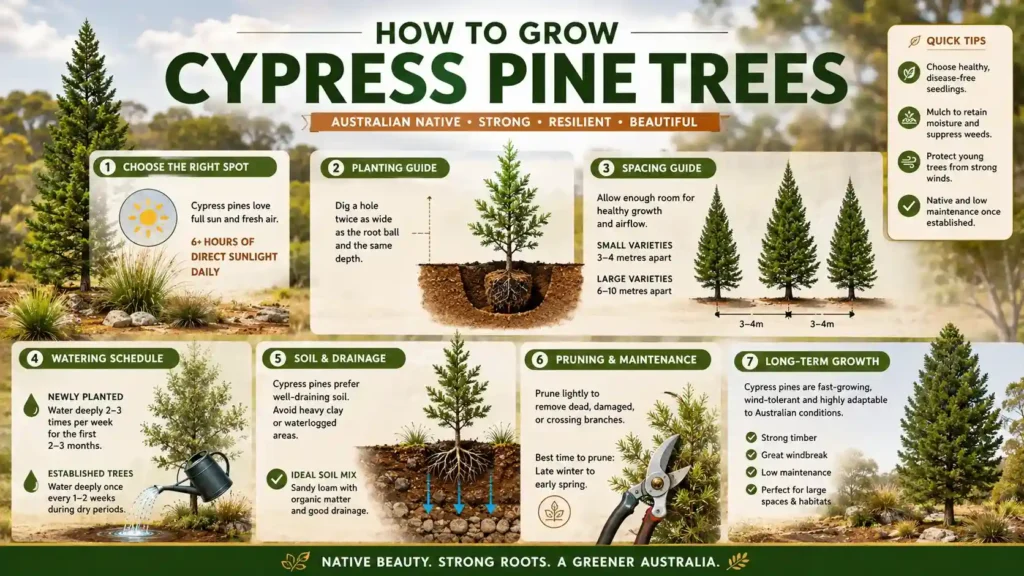
Choosing the right planting location is essential for healthy cypress pine growth. Most Australian cypress pine species perform best in open areas with full sunlight and well-drained soil conditions.
These native conifers generally require:
Full sun exposure encourages stronger growth, denser foliage, and improved drought tolerance. Trees planted in shaded areas may develop thinner canopies and slower growth rates.
Wind protection is especially important for young cypress pine trees during the establishment phase. Although mature trees tolerate wind well, newly planted saplings can suffer from leaning or moisture loss in highly exposed locations.
Helpful wind protection strategies include:
Coastal species such as Rottnest Island pine generally tolerate salt-laden winds better than inland species.
Proper planting improves long-term tree health and root establishment. Australian cypress pine trees are relatively low-maintenance once established, but careful early planting is important for success.
Avoid excessive soil amendments unless the soil is extremely poor. Most native cypress pine species adapt naturally to low-fertility Australian soils.
Correct spacing allows healthy canopy development and improves airflow between trees.
|
Planting Purpose |
Recommended Spacing |
|
Ornamental planting |
3–5 meters |
| Shelterbelts |
2–4 meters |
|
Timber plantations |
4–6 meters |
| Coastal stabilization |
2–3 meters |
Proper spacing also helps reduce fungal issues and root competition as trees mature.
Young cypress pine trees require more regular watering during their establishment period. Consistent moisture encourages strong root development during the first one to two years after planting.
Newly planted trees benefit from:
Once established, Australian cypress pine trees become highly drought tolerant and usually require minimal supplemental watering.
Mature cypress pines generally survive on natural rainfall in most Australian climates. Additional watering may only be needed during extreme drought conditions or prolonged heatwaves.
Fertilizing requirements are usually low because these native trees evolved in nutrient-poor soils. Excessive fertilization can sometimes encourage weak or overly rapid growth.
If needed, use:
Overfeeding should be avoided, especially in dry inland environments.
Australian cypress pine trees require relatively little pruning compared to many ornamental trees. Their naturally symmetrical growth habit often develops well without heavy shaping.
Light pruning may be used to:
Pruning is best performed during dry weather to reduce disease risk.
Regular removal of dead, damaged, or diseased branches helps maintain tree health and improves airflow through the canopy.
Benefits of maintenance pruning include:
Avoid excessive pruning into older wood because some cypress pine species regenerate slowly from heavily cut branches.
Australian cypress pine trees are generally hardy and resistant to many common tree problems. However, poor growing conditions can still create health issues.
Root rot is one of the most serious problems affecting cypress pine trees, especially in poorly drained soils.
Common causes include:
Symptoms may include yellowing foliage, branch dieback, and reduced growth.
Prevention methods include:
One of the major advantages of cypress pine trees is their strong natural pest resistance. The aromatic oils within the timber and foliage help deter many insects and termites.
Most mature trees experience minimal pest problems, although occasional issues may include:
Healthy trees growing in suitable conditions are usually highly resilient.
Fungal diseases are uncommon in healthy cypress pine trees but may occur under overly damp conditions or poor airflow.
Potential fungal concerns include:
|
Fungal Issue |
Common Cause |
|
Root diseases |
Waterlogged soil |
| Needle browning |
Excess humidity |
|
Branch dieback |
Poor airflow |
| Stem cankers |
Physical damage or stress |
Good spacing, proper drainage, and moderate pruning greatly reduce the likelihood of fungal problems in Australian cypress pine plantings.
Cypress pine Australia species are widely planted as windbreaks and shelterbelts across rural and semi-arid regions. Their dense evergreen foliage, drought tolerance, and adaptability to poor soils make them highly effective for protecting farmland, livestock areas, and rural infrastructure from harsh environmental conditions.
These native conifers are commonly used on rural properties because they provide:
White cypress pine and other inland species are especially valuable in dry farming regions where strong seasonal winds can damage exposed land. Their root systems help stabilize soil while the dense canopy reduces wind velocity across open landscapes.
For rural property planting, cypress pine trees are often arranged in rows to create effective shelterbelts. Benefits include:
|
Shelterbelt Benefit |
Impact |
|
Wind Reduction |
Protects crops and pastures |
| Moisture Retention |
Reduces soil drying |
|
Livestock Protection |
Provides shade and shelter |
| Soil Stability |
Helps prevent erosion |
Erosion control is another important landscaping use. Cypress pine roots bind loose soil together, helping prevent land degradation in sandy or semi-arid areas. Coastal species also assist with dune stabilization and protection of fragile landscapes exposed to wind and water movement.
Australian cypress pine trees are popular ornamental plants in both residential and commercial landscapes because of their attractive form, evergreen foliage, and low water requirements.
These trees work especially well in:
Their fine-textured foliage and naturally symmetrical growth habit create a clean architectural appearance suitable for modern native landscaping designs.
Many Australian native trees used in ornamental landscapes are selected for their seasonal structure, evergreen foliage, and adaptability to residential garden settings
In native gardens, cypress pine trees combine well with:
Because many species tolerate dry conditions, they are commonly included in water-wise and low-maintenance garden designs.
Coastal landscaping applications are particularly important for species adapted to salty air and sandy soils. Trees such as Rottnest Island pine are suitable for:
Their tolerance to wind exposure and poor coastal soils makes them reliable long-term ornamental trees in challenging environments.
Australian cypress pine trees provide valuable ecological benefits across native landscapes. Their dense foliage, cones, and branching structures create habitat opportunities for birds, insects, and small native animals.
These native conifers support wildlife by providing:
Bird species commonly use mature cypress pine trees for roosting and nesting because of the dense evergreen canopy. The trees also contribute to ecological stability in woodland and semi-arid ecosystems.
Additional biodiversity benefits include:
|
Ecological Benefit |
Importance |
|
Habitat Creation |
Supports native wildlife |
| Soil Protection |
Reduces erosion and degradation |
|
Native Vegetation Support |
Enhances ecosystem resilience |
| Carbon Storage |
Assists long-term environmental sustainability |
Cypress pine plantings are often included in conservation and revegetation projects because they integrate well with other native species and improve landscape diversity. Their adaptability to harsh conditions makes them especially valuable in restoring degraded land and supporting sustainable Australian ecosystems.
A common question in the timber industry is: is cypress hardwood? Despite its strength and durability, cypress pine is technically classified as a softwood because it comes from a conifer species rather than a broadleaf hardwood tree.
Australian cypress pine belongs to the Callitris genus, which is part of the conifer family. In botanical classification, all conifers are grouped as softwoods regardless of how hard or dense the timber may feel.
However, cypress pine timber is often harder and more durable than many commercial softwoods. This creates confusion because its performance characteristics can resemble some hardwood timbers.
Key differences include:
|
Classification Factor |
Cypress Pine |
| Botanical Type |
Softwood |
|
Tree Group |
Conifer |
| Timber Density |
Moderate to high |
|
Durability |
Excellent |
| Termite Resistance |
Naturally high |
Although classified as a softwood, Australian cypress pine is widely respected for its structural strength, stability, and long service life.
Cypress pine timber is highly valued in Australia because of its combination of durability, natural resistance properties, and attractive appearance. These qualities make it suitable for both interior and exterior applications.
One of its most important features is durability. Cypress pine performs well in demanding environments and can last for decades when properly maintained.
Major timber properties include:
Natural termite resistance is another major advantage of cypress pine timber. The wood contains natural oils and resins that help repel termites and other timber pests without requiring heavy chemical treatment.
Benefits of termite resistance include:
Cypress pine also contains aromatic oils that produce its characteristic scent. These oils contribute to the timber’s durability and pest resistance while giving freshly cut wood a distinctive natural aroma.
Cypress flooring is one of the most popular uses for Australian cypress pine timber. Its warm honey-gold colour, natural knots, and strong grain patterns create a distinctive appearance suited to both traditional and modern interiors.
Cypress pine flooring is commonly used in:
Many homeowners choose cypress pine floors because they combine durability with natural visual character. The timber develops a rich patina over time while maintaining structural strength.
Popular flooring styles include:
Tongue-and-groove flooring applications are especially common because they provide stable installation and a seamless finished surface. Cypress pine’s natural movement properties make it suitable for properly installed timber floor systems.
In addition to flooring, cypress pine timber is used for:
Proper finishing helps protect cypress pine floors while enhancing the timber’s natural colour and grain.
Oiling penetrates the timber surface and enhances the warm honey-gold appearance of cypress pine flooring. Oil finishes help maintain a more natural timber look while allowing the wood grain to remain visible.
Benefits of oiling include:
Sealing creates a protective layer over the timber surface, helping resist moisture, scratches, and everyday wear. Polyurethane and matte sealers are commonly used for cypress pine floors.
Advantages of sealing include:
To maintain cypress pine flooring:
Proper care helps preserve both the appearance and lifespan of cypress pine floors.
Cypress wood is widely used throughout Australia because of its strength, workability, and natural resistance to insects and decay.
Common furniture applications include:
Its attractive grain and warm colouring make it popular for handcrafted timber furniture and exposed timber features.
As a structural timber, cypress pine is frequently used for:
Outdoor projects also benefit from the timber’s natural durability and resistance properties.
Exterior uses include:
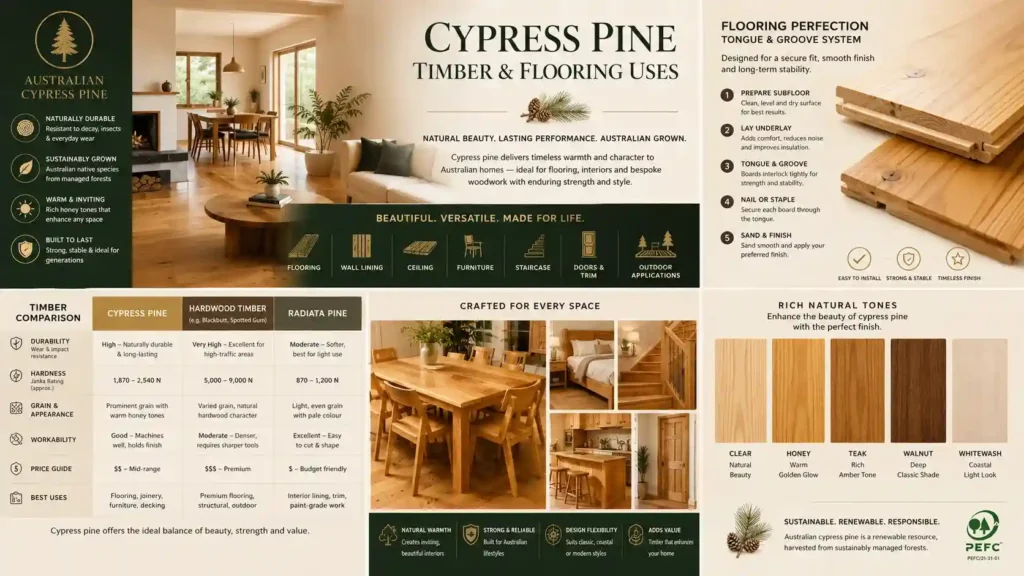
Because of its resilience in harsh Australian conditions, cypress pine remains one of the country’s most respected native timbers.
|
Feature |
Cypress Pine | Hardwood Timber |
Radiata Pine |
|
Timber Type |
Native softwood | Hardwood | Plantation softwood |
| Durability | High | Very high |
Moderate |
|
Termite Resistance |
Natural resistance | Varies by species | Low without treatment |
| Growth Rate | Slow–moderate | Slow |
Fast |
|
Appearance |
Honey-gold with knots | Dense varied grain | Pale uniform colour |
| Flooring Suitability | Excellent | Excellent |
Moderate |
|
Outdoor Performance |
Very good | Excellent | Requires treatment |
| Aroma | Distinct aromatic oils | Usually mild |
Minimal aroma |
Cypress pine occupies a unique position between traditional softwoods and hardwoods because it combines the workability of softwood with durability characteristics often associated with hardwood timber species.
Australian cypress pine trees offer several advantages that make them valuable for landscaping, conservation, forestry, and rural planting projects. Their ability to survive under harsh Australian conditions is one of the main reasons they are widely used across inland and coastal regions.
One of the most important benefits is native drought tolerance. Cypress pine species evolved in environments with low and irregular rainfall, allowing them to survive extended dry periods once established.
Drought-tolerant characteristics include:
These features make cypress pine trees ideal for water-wise landscaping and low-rainfall environments.
Natural pest resistance is another major advantage. Cypress pine timber and foliage contain aromatic oils and natural compounds that help deter termites and many common wood-damaging insects.
Benefits of pest resistance include:
Because of this natural resistance, cypress pine timber is widely valued in Australian construction and flooring applications.
Low maintenance requirements also contribute to the popularity of Australian cypress pine trees. Once established, most species require minimal watering, fertilizing, or pruning.
Low-maintenance advantages include:
|
Benefit |
Impact |
| Minimal watering needs |
Suitable for drought-prone regions |
| Limited pruning requirements |
Lower long-term maintenance |
|
Strong environmental adaptability |
Reliable growth in difficult conditions |
| Good longevity |
Long-lasting landscape value |
These characteristics make cypress pine species suitable for large rural properties, native gardens, shelterbelts, and restoration projects.
Despite their many benefits, Australian cypress pine trees also have some limitations that should be considered before planting.
Slow growth is one of the most common disadvantages. Compared to fast-growing plantation species such as Radiata pine, native cypress pine trees usually establish and mature more gradually.
Slow growth may result in:
However, the slower growth rate often contributes to improved timber density and durability.
Limited shade production can also be a drawback for some landscaping applications. Many cypress pine species develop relatively narrow or open canopies rather than broad dense crowns.
This means they may provide:
For this reason, cypress pine trees are often combined with other native species in larger landscape designs.
Sensitivity in wet soils is another important limitation. Although highly drought tolerant, many cypress pine species struggle in poorly drained or waterlogged environments.
Excess moisture can lead to:
Planting in well-drained soil is essential for long-term success.
Bushfire considerations are important when planting cypress pine trees in fire-prone regions. Like many conifers, cypress pine species contain natural oils and resins that can increase flammability under extremely dry conditions.
Bushfire-related considerations include:
However, some mature cypress pine species can survive lower-intensity fires because of their thick bark and resilient growth habits.
Proper landscape planning may help reduce fire risks by:
Sustainable forestry is another important environmental consideration. Australian cypress pine timber is highly valued because of its natural durability and long service life, making responsible forest management essential.
The importance of sustainable forestry includes:
| Environmental Factor |
Importance |
|
Native ecosystem protection |
Preserves biodiversity |
| Controlled timber harvesting |
Supports long-term resource availability |
|
Land rehabilitation |
Assists degraded landscape recovery |
| Carbon storage |
Supports environmental sustainability |
Using responsibly sourced cypress pine timber helps balance commercial use with conservation goals while protecting native Australian forest ecosystems for future generations.
Cypress pine and Radiata pine are both widely used in Australia, but they differ significantly in origin, growth rate, durability, and timber performance.
Radiata pine (Pinus radiata) is an introduced plantation species originally from California. It is widely grown in commercial forestry because of its rapid growth and high timber yield. In contrast, Australian cypress pine belongs to the native Callitris genus and grows more slowly under natural Australian conditions.
Key differences include:
| Feature | Cypress Pine |
Radiata Pine |
|
Origin |
Native Australian conifer | Introduced species |
| Growth Rate | Slow to moderate |
Fast |
|
Durability |
High natural durability | Moderate |
| Termite Resistance | Naturally resistant |
Usually requires treatment |
|
Timber Appearance |
Honey-gold with knots | Pale and uniform |
| Drought Tolerance | Excellent |
Moderate |
Cypress pine is often preferred for premium flooring, outdoor structures, and rural construction because of its natural termite resistance and durability. Radiata pine is more commonly used in framing, packaging, and mass-produced timber products due to its affordability and rapid plantation growth.
Macrocarpa pine, also known as Monterey cypress (Cupressus macrocarpa), differs from Australian cypress pine in both appearance and growing conditions.
Macrocarpa pine is typically planted in cooler temperate regions and coastal environments. It grows faster than many native cypress pine species and develops a broad, dense canopy.
Main differences include:
|
Feature |
Cypress Pine |
Macrocarpa Pine |
|
Botanical Group |
Callitris genus | Cupressus genus |
| Native Status | Native to Australia |
Introduced species |
|
Canopy Shape |
Narrow to medium | Broad and dense |
| Drought Tolerance | Very high |
Moderate |
|
Timber Aroma |
Strong aromatic oils | Mild aroma |
| Soil Adaptability | Excellent in poor soils |
Prefers better drainage |
Cypress pine generally performs better in dry inland climates, while Macrocarpa pine is more commonly used in temperate coastal regions and ornamental shelterbelt plantings.
The term white pine Australia can refer to several different timber species depending on the region and industry context. This often creates confusion when comparing white pine with white cypress pine.
White cypress pine is a native Australian conifer known for:
Some white pine species used commercially may refer to softer imported or plantation-grown timbers that do not offer the same durability characteristics.
Comparison highlights include:
| Feature | White Cypress Pine |
White Pine Varieties |
|
Native Status |
Native Australian species |
Often imported or plantation grown |
|
Durability |
High | Moderate to low |
| Termite Resistance | Naturally resistant |
Usually lower |
|
Flooring Suitability |
Excellent | Variable |
| Timber Strength | Strong and stable |
Generally softer |
Because of its strength and resilience, white cypress pine is often preferred for structural timber, flooring, and long-term outdoor use.
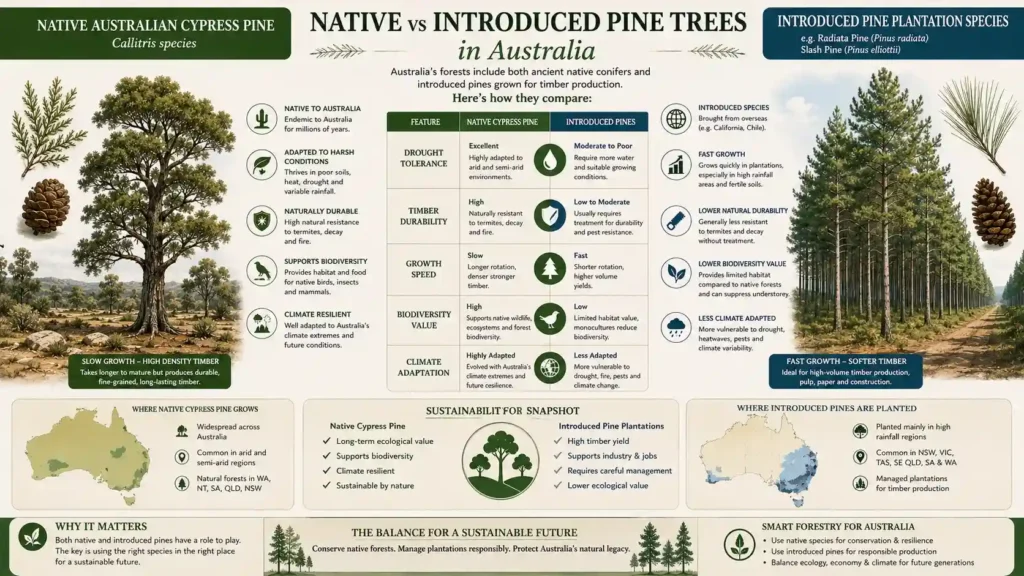
Australia contains both native pine-like conifers and introduced pine plantation species. Understanding the difference is important for landscaping, forestry, and environmental planning.
Native Australian pine trees mainly belong to the Callitris genus and evolved specifically for Australian environmental conditions. These species are naturally adapted to:
Introduced pine trees were brought to Australia primarily for commercial forestry and timber production. Common introduced species include:
Native and introduced pines differ in several important ways:
|
Feature |
Native Pines |
Introduced Pines |
|
Environmental Adaptation |
Suited to Australian climates |
Often require managed conditions |
|
Biodiversity Support |
Strong ecological integration | Lower native habitat value |
| Timber Growth Speed | Slower growth |
Faster plantation growth |
|
Maintenance Needs |
Generally low | Often higher in dry climates |
| Conservation Importance | High |
Mainly commercial use |
Native cypress pine species are increasingly valued in sustainable landscaping and conservation projects because they support local ecosystems while providing durable timber and long-term environmental resilience.
Australian cypress pine trees have long been important to Indigenous Australians across many inland and semi-arid regions. Native communities traditionally used different parts of cypress pine trees for practical, cultural, and environmental purposes.
The durable timber was commonly valued for:
The aromatic wood and foliage were also recognized for their natural properties. In some regions, cypress pine smoke and plant materials were associated with traditional practices connected to cleansing and insect deterrence.
Because cypress pine species naturally survived in harsh inland environments, they also became part of traditional ecological knowledge regarding drought-resistant native vegetation and land management.
Cypress pine has played an important role in Australian forestry for many decades, especially in inland New South Wales and Queensland where large native cypress forests occur naturally.
White cypress pine forests became commercially significant because of the timber’s:
Unlike fast-growing plantation species, many Australian cypress pine forests are managed under selective and sustainable harvesting systems. This approach helps maintain biodiversity while supporting long-term timber production.
Cypress pine forestry is commonly associated with:
| Forestry Use |
Importance |
|
Structural timber production |
Widely used in rural construction |
| Flooring timber supply |
Popular for interior applications |
|
Sustainable native forestry |
Supports long-term ecosystem management |
| Regional timber industries |
Important for inland communities |
Because native cypress pine grows more slowly than plantation softwoods, responsible forest management is essential to maintain healthy regeneration and protect native habitats.
Cypress pine timber is highly valued in Australia because it combines durability, visual appeal, and natural resistance properties rarely found together in one softwood species.
One of the biggest reasons for its popularity is its natural termite resistance. The timber contains preservative oils and resins that help protect it from insect attack without requiring heavy chemical treatment.
Additional qualities that make cypress pine timber valuable include:
Cypress pine is also appreciated for its versatility. It is widely used in:
The timber’s warm appearance and natural character make it especially popular in Australian homes, rural buildings, and architectural timber designs.
Another reason for its high value is its performance in harsh Australian climates. Cypress pine handles dry conditions, heat, and insect exposure better than many commercial plantation softwoods, making it a trusted long-term building material across Australia.
Australian cypress pine tree species are among the most valuable native conifers found across the country’s inland, coastal, and semi-arid landscapes. Their ability to tolerate drought, poor soils, heat, and challenging environmental conditions makes them highly important for both natural ecosystems and practical human use. Species within the Callitris genus provide long-lasting timber, reliable wind protection, erosion control, and strong ecological benefits throughout Australia.
Native Australian conifers such as white cypress pine and related species play a major role in sustainable forestry, biodiversity support, and land rehabilitation. Unlike many introduced pine species, Australian cypress pines evolved specifically for local conditions, allowing them to thrive with lower maintenance and reduced water requirements.
These trees are widely valued for landscaping and timber applications because of their:
Cypress pine timber continues to be highly respected in Australian construction, flooring, furniture making, and outdoor projects because of its strength, longevity, and distinctive appearance.
Using native trees such as Australian cypress pine in sustainable landscapes helps support local biodiversity, conserve water, stabilize soil, and protect native ecosystems for future generations. Their resilience and long-term environmental value make them an excellent choice for modern Australian landscaping and forestry practices.
Yes, cypress pine is native to Australia. Most Australian cypress pine species belong to the Callitris genus, a group of native conifers naturally found across inland, coastal, and semi-arid regions. These trees evolved under Australian climate conditions and are well adapted to drought, poor soils, and heat.
White cypress pine generally has lighter bark, lighter timber colouring, and wider distribution across inland New South Wales and Queensland. Black cypress pine usually features darker bark, denser foliage, and occurs more commonly in rocky or elevated inland regions. Both species are drought tolerant and valued for durable timber.
Cypress pine is classified as a softwood because it comes from a conifer species. However, its timber is harder and more durable than many commercial softwoods. This is why cypress pine is widely used in flooring, structural timber, and outdoor construction applications.
Australian cypress pine trees generally grow at a slow to moderate rate depending on the species, soil quality, and climate conditions. Young trees establish gradually because much of their early growth focuses on root development. In suitable conditions, some species may reach 10–20 meters at maturity over several decades.
Cypress pine trees are used for many purposes across Australia, including: Flooring and interior timber Furniture production Structural construction Windbreaks and shelterbelts Native landscaping Soil stabilization and erosion control Habitat restoration projects Their natural termite resistance makes them especially valuable in timber applications.
Yes, Australian cypress pine species are highly drought tolerant. Their deep root systems and moisture-conserving foliage allow them to survive in low-rainfall and semi-arid environments. Once established, many species require very little supplemental watering.
White cypress pine is considered an excellent flooring timber because of its durability, attractive honey-gold colour, and natural resistance to termites. Cypress pine flooring is commonly used in Australian homes, rural buildings, and commercial interiors.
Cypress trees naturally grow across many parts of Australia, including inland woodlands, semi-arid plains, coastal regions, and dry forests. Large populations are found in New South Wales, Queensland, South Australia, Western Australia, and Tasmania depending on the species.
Some species, especially Rottnest Island pine and regional coastal varieties, grow very well in coastal environments. These trees tolerate sandy soils, salt-laden winds, and dry coastal conditions, making them suitable for coastal landscaping and dune stabilization.
Yes, Australian cypress pine trees support local biodiversity by providing shelter, nesting sites, and habitat for birds and small native animals. Mature trees are especially valuable in conservation plantings and native woodland restoration projects.
Cypress pine timber contains natural oils and resins that help repel termites and wood-boring insects. This natural resistance reduces the need for chemical treatments and contributes to the timber’s long lifespan.
Yes, cypress pine trees are highly adaptable to poor and low-fertility soils. Many species naturally grow in sandy, rocky, or nutrient-deficient environments where other tree species may struggle to survive.
Australian cypress pine is an excellent choice for low-maintenance gardens because it requires minimal watering, limited pruning, and adapts well to harsh climates once established. It is commonly used in native and drought-tolerant landscape designs.