Grow Better Gardens with Smarter Plant Choices
Discover helpful guides on trees, hedges, fruit plants, edible plants, and beautiful landscape greenery.

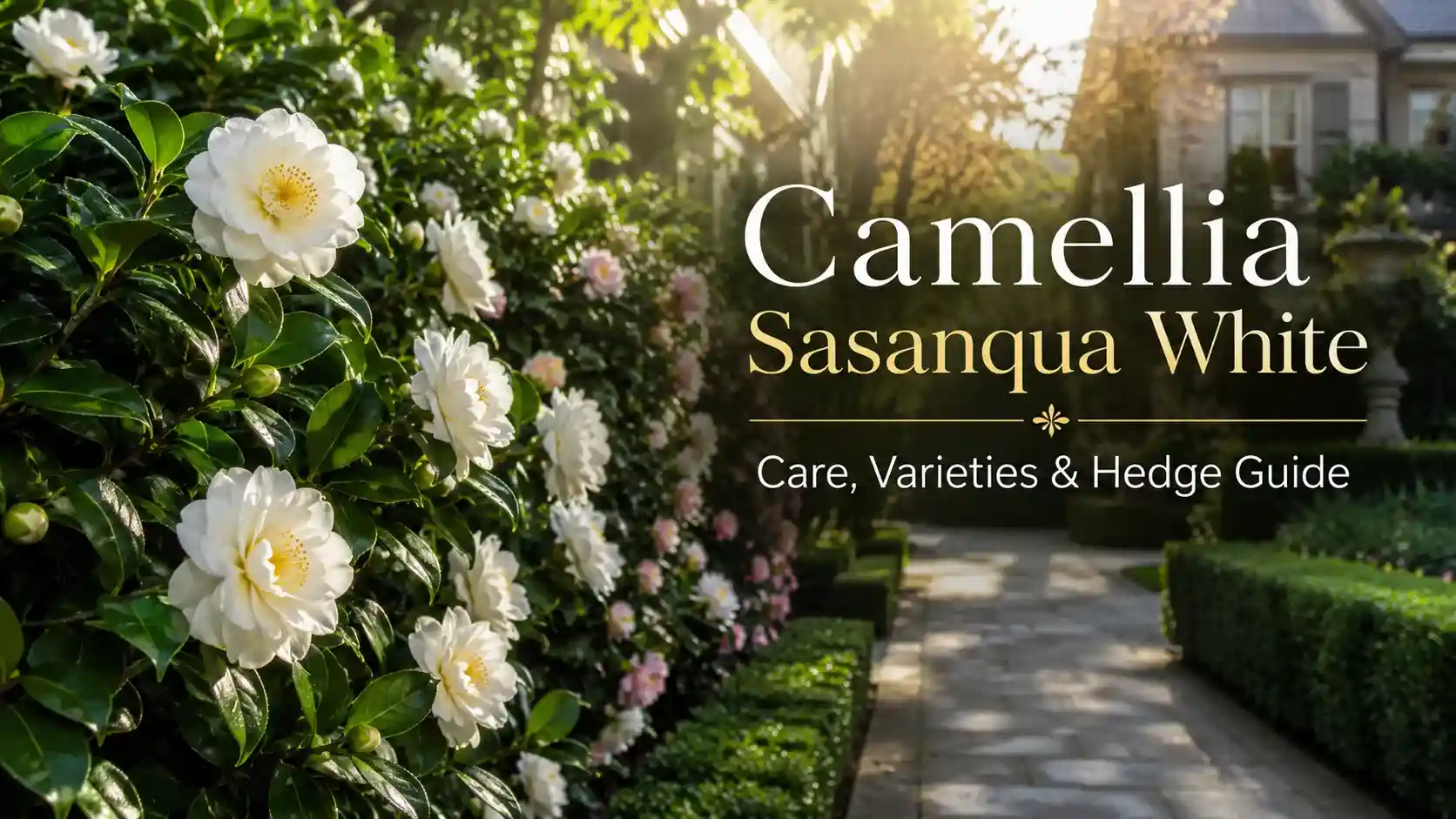
Camellia sasanqua white is a popular evergreen flowering shrub valued for its elegant blooms, glossy foliage, and versatile landscape use. Known for producing beautiful white camellia flowers during the cooler months, this plant is widely used in hedges, privacy screens, foundation plantings, and ornamental garden designs. Many gardeners prefer white camellias because they combine year-round greenery with long-lasting seasonal flowers while requiring relatively low maintenance. Compared to japonica camellias, sasanqua camellias generally grow faster, tolerate more sun, and perform exceptionally well as dense hedging plants. Whether grown as a compact shrub, hedge, or small tree, a camellia with white flowers adds structure, texture, and timeless appeal to residential landscapes and formal gardens alike.
Camellia sasanqua is an evergreen flowering shrub native to Japan and parts of East Asia. It belongs to the Theaceae family and is closely related to other camellia species, especially Camellia japonica. However, sasanqua camellias are generally more adaptable to sun exposure, faster growing, and better suited for hedging and screening purposes.
Unlike larger japonica varieties, camellia sasanqua plants typically develop a lighter, more open branching structure with smaller leaves and flowers. These characteristics make them highly popular in residential landscapes where controlled growth and manageable maintenance are important. Many gardeners choose a white camellia plant because it combines ornamental flowers with dense evergreen foliage that remains attractive throughout the year.
As evergreen shrubs, sasanqua camellias maintain glossy foliage in every season. Their blooming period usually begins in autumn and can continue into early winter depending on climate conditions. During flowering season, the plants produce elegant camellia flowers white in color, often with soft fragrance and delicate petal formations. The blooms range from single to semi-double and double flower forms, adding texture and visual contrast to gardens.
A camellia bush white in color works exceptionally well in both formal and natural-style landscapes because of its refined flower appearance and reliable year-round greenery.
One of the defining features of white sasanqua camellias is their glossy dark green foliage. The leaves are small, leathery, and densely arranged, helping the shrub maintain a full and polished appearance even outside the blooming season. This evergreen structure makes the plant valuable for privacy hedges, borders, and foundation planting.
The white camellia flowers are admired for their clean, elegant appearance and soft fragrance. Depending on the cultivar, blooms may feature golden stamens, ruffled petals, or semi-double flower forms that create a layered ornamental effect. A mature camellia flower white variety can produce abundant blooms across an extended flowering season.
Compared to japonica camellias, sasanqua types tolerate more direct sunlight and warmer growing conditions. This increased sun tolerance allows them to thrive in locations where other camellia species may struggle with heat stress. Because of their adaptability and dense branching habit, they are widely used as fast-growing evergreen screening plants.
Most white camellia plants develop into upright or spreading shrubs with moderate to rapid growth rates. Their natural growth habit responds well to pruning, making them ideal for shaping into formal hedges, privacy screens, or compact ornamental forms. In landscaping, white camellia flowers create a strong visual contrast against deep green foliage, delivering a refined and timeless garden aesthetic.
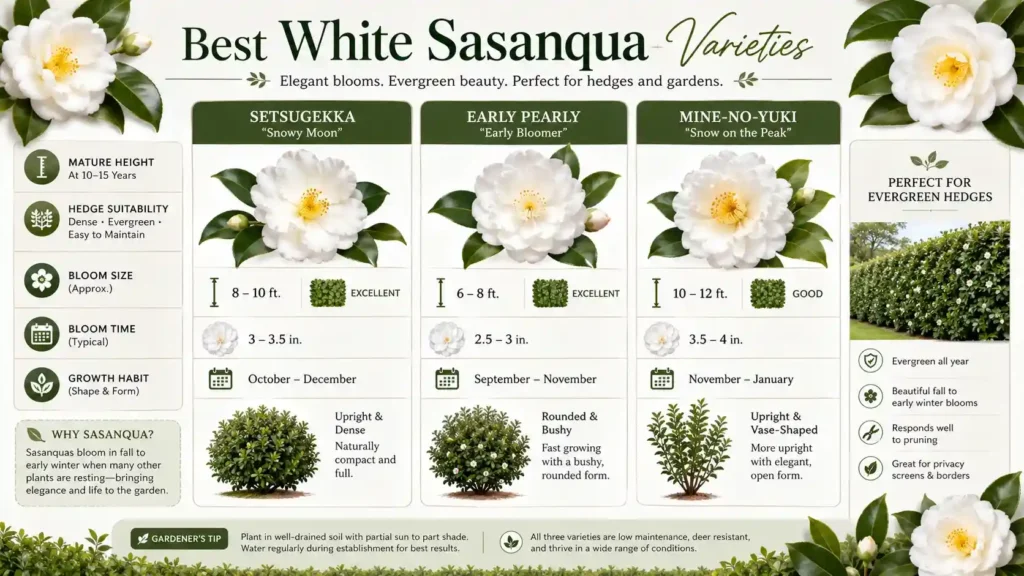
Early Pearly is one of the most widely grown white sasanqua camellia varieties for hedging and ornamental landscaping. Known botanically as camellia sasanqua Early Pearly, this cultivar is valued for its vigorous growth, dense evergreen foliage, and abundant white blooms that appear from autumn into early winter.
The flowers of camellia Early Pearly are medium-sized, semi-double to double in form, and bright white in color with soft golden centers. The layered petals create a refined appearance that stands out beautifully against the shrub’s glossy green leaves. Because of its heavy flowering habit, this variety is often chosen by gardeners looking for a reliable camellia with long-lasting seasonal interest.
One of the main reasons the Early Pearly camellia hedge is so popular is its naturally dense growth pattern. The shrub responds extremely well to shaping and regular pruning, allowing it to form compact privacy screens and formal evergreen hedges. Many landscapers use sasanqua Early Pearly in boundary plantings because it creates year-round coverage while maintaining a neat structure.
In suitable growing conditions, camellia sasanqua Early Pearly grows at a moderate to fast rate. Mature plants commonly reach around 2.5 to 4 meters in height depending on pruning style and environmental conditions. When planted closely together, they develop into thick screening hedges with excellent privacy performance.
This variety performs best in mild temperate climates with well-drained acidic soil and regular moisture. It tolerates more direct sun than many japonica camellias, making it highly adaptable in residential gardens. Early Pearly camellia NZ plantings are especially common because the climate conditions in many parts of New Zealand support healthy flowering and evergreen growth throughout the year.
Because of its combination of elegant white flowers, hedge performance, and relatively low maintenance requirements, Early Pearly remains one of the top choices among white camellia sasanqua varieties for modern gardens and landscape design.
Setsugekka is considered one of the most famous and widely planted white sasanqua camellias in residential landscaping. Known for its vigorous growth, elegant flowers, and excellent hedge performance, camellia Setsugekka is frequently used in privacy screens, boundary hedges, and feature plantings.
The standout feature of camellia sasanqua Setsugekka is its large semi-double white flowers. The blooms have gently ruffled petals surrounding prominent golden stamens, creating a soft yet highly decorative appearance. Flowering typically begins in autumn and can continue into early winter, providing strong seasonal color when many other shrubs are dormant.
A major reason for the popularity of the Setsugekka camellia hedge is its dense evergreen growth and rapid screening ability. The shrub develops upright branching with thick foliage coverage, making it highly effective for privacy planting. Compared to slower-growing camellia types, sasanqua camellia Setsugekka establishes relatively quickly and responds very well to shaping and pruning.
A mature camellia Setsugekka hedge commonly reaches around 3 to 4 meters in height if left unpruned, although many gardeners maintain it at lower heights for formal hedge designs. Its adaptability to sun exposure also makes it easier to grow along fences, driveways, and open garden borders where other camellia species may struggle.
Because of its combination of large flowers, evergreen foliage, and reliable hedge structure, camellia sasanqua Setsugekka remains one of the top-performing white flowering shrubs for both ornamental and functional landscape use.
Many white camellia varieties are available for different landscape styles, hedge applications, and garden sizes. Some cultivars are compact and slow growing, while others develop into tall evergreen screening shrubs suitable for large-scale privacy planting.
Among the most recognized white camellias varieties are:
These camellia cultivars vary significantly in flower form, bloom size, growth habit, and mature height. Some produce single flowers with visible golden stamens, while others display dense double blooms with layered petals.
The main differences between white camellia sasanqua varieties often include:
Compact white sasanqua camellia varieties such as Mine-No-Yuki are ideal for smaller gardens, pathways, and foundation planting. These shrubs maintain a tidy shape with moderate pruning and generally stay below 2 meters in height.
In contrast, taller camellia sasanqua white varieties like Setsugekka and Early Pearly are preferred for large hedges and privacy screens because of their vigorous upright growth. These cultivars can form dense evergreen barriers while producing abundant seasonal flowers.
Different names of camellias are also associated with unique bloom characteristics. Some white flowering cultivars produce highly fragrant blooms, while others are selected primarily for hedge structure and foliage density. This diversity allows gardeners to choose white camellia varieties that best match their climate conditions, maintenance preferences, and landscape goals.
Hiryu is a highly popular deep pink flowering camellia valued for its compact growth and strong hedge performance. Commonly known as camellia Hiryu or Hiryu camellia, this variety belongs to the sasanqua and hiemalis camellia groups, combining vigorous flowering with manageable plant size.
Camellia sasanqua Hiryu produces rich pink to reddish-pink semi-double blooms that create strong visual contrast against dark green evergreen foliage. The flowers are smaller than some larger white cultivars, but they appear abundantly across the plant during the blooming season, making the shrub highly decorative in autumn and early winter gardens.
One of the key advantages of Hiryu camellia sasanqua is its naturally compact and upright growth habit. This makes it suitable for low hedges, foundation borders, screening, and smaller residential landscapes where oversized shrubs may become difficult to manage.
Camellia hiemalis Hiryu responds well to regular pruning and shaping. Light pruning after flowering helps maintain dense foliage and encourages more controlled branching. Without maintenance, the plant can become slightly open or uneven over time, especially in shaded conditions.
Because of its colorful blooms, evergreen structure, and reliable flowering performance, Hiryu remains one of the most commonly planted pink sasanqua camellias for decorative hedges and ornamental garden use.
Plantation Pink is a soft flowering ornamental camellia widely admired for its elegant blooms and graceful landscape appearance. Often referred to as plantation pink camellia or camellia Plantation Pink, this variety is especially popular in decorative gardens where long seasonal flowering and evergreen structure are desired.
Camellia sasanqua Plantation Pink produces soft pink semi-double flowers with delicate petal formations and golden stamens. The blooms appear abundantly across the shrub during autumn, creating a refined and colorful display that complements both modern and traditional garden styles.
A major feature of pink camellia sasanqua varieties like Plantation Pink is their versatility in ornamental landscaping. These shrubs work exceptionally well as:
The upright yet slightly spreading growth habit of plantation camellia makes it visually softer than some dense formal hedge varieties. Many gardeners use it to add texture and seasonal flower color while maintaining year-round evergreen coverage.
Because of its attractive flowers and elegant foliage, camellia Plantation Pink is often selected for residential gardens focused on aesthetics rather than dense privacy screening.
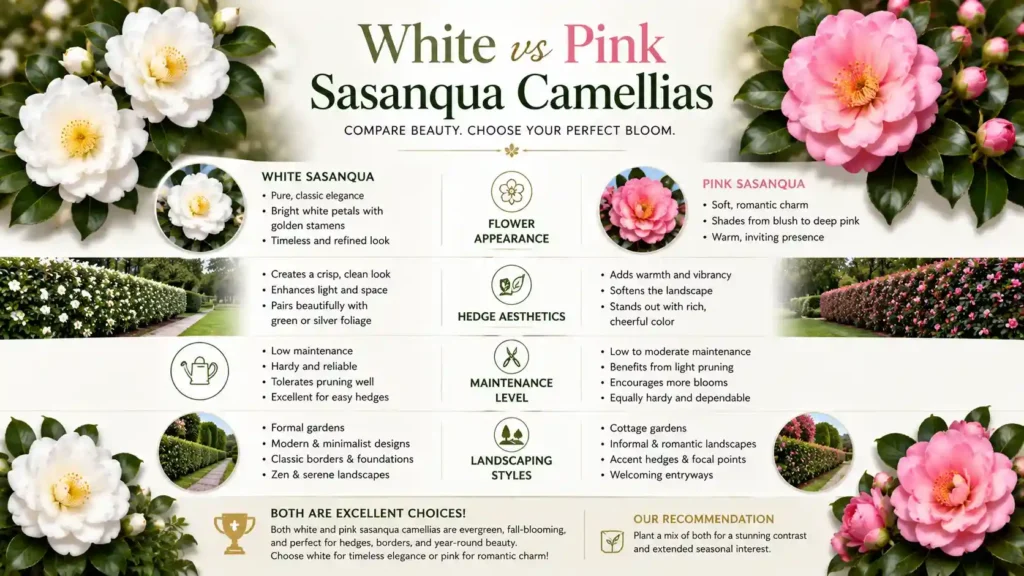
Both white and pink sasanqua camellias offer excellent landscape value, but they differ slightly in visual impact, hedge style, and ornamental appeal.
|
Feature |
White Sasanqua |
Pink Sasanqua |
|
Flower appearance |
Clean, elegant white blooms with formal appearance | Soft to deep pink blooms with warmer visual impact |
| Hedge appeal | Ideal for formal hedges and structured privacy screens |
Better suited for ornamental and softer landscape designs |
|
Sun tolerance |
Excellent tolerance to partial and full sun conditions | Similar sun tolerance with strong flowering performance |
| Maintenance | Low-maintenance with easy shaping and pruning |
Requires similar pruning and seasonal care |
A white camellia tree often creates a more classic and refined garden appearance, especially in formal landscapes and minimalist designs. In contrast, a pink camellia tree introduces stronger seasonal color and softer visual texture.
Both camellia pink and white flowering forms belong to highly adaptable evergreen shrubs that perform well in hedges, borders, and feature plantings. Whether selecting a camellia flower pink variety or a white flowering cultivar, sasanqua camellias remain among the most versatile ornamental shrubs for modern landscaping.
A camellia sasanqua hedge is one of the most attractive evergreen hedge options for residential landscapes and ornamental gardens. These shrubs are widely valued for their dense foliage, seasonal flowering, and reliable screening performance throughout the year.
One of the biggest advantages of a sasanqua hedge is its naturally thick evergreen growth. The shrubs develop dense branching covered with glossy green leaves, creating strong visual privacy even outside the flowering season. This makes sasanqua camellias highly effective for boundary planting, noise reduction, and garden screening.
Compared to many traditional evergreen hedge plants, a sasanqua camellia hedge offers the added benefit of decorative flowers during autumn and early winter. The long flowering season provides months of visual interest while most other hedge plants remain purely green.
Key reasons why camellias as hedges are so popular include:
A hedge camellia also creates a softer and more ornamental appearance than many formal hedge species. White flowering varieties especially provide a refined landscape effect while still functioning as practical privacy barriers.
Because of their adaptability and elegant structure, camellia hedge plantings are commonly used around fences, driveways, patios, entryways, and property borders.
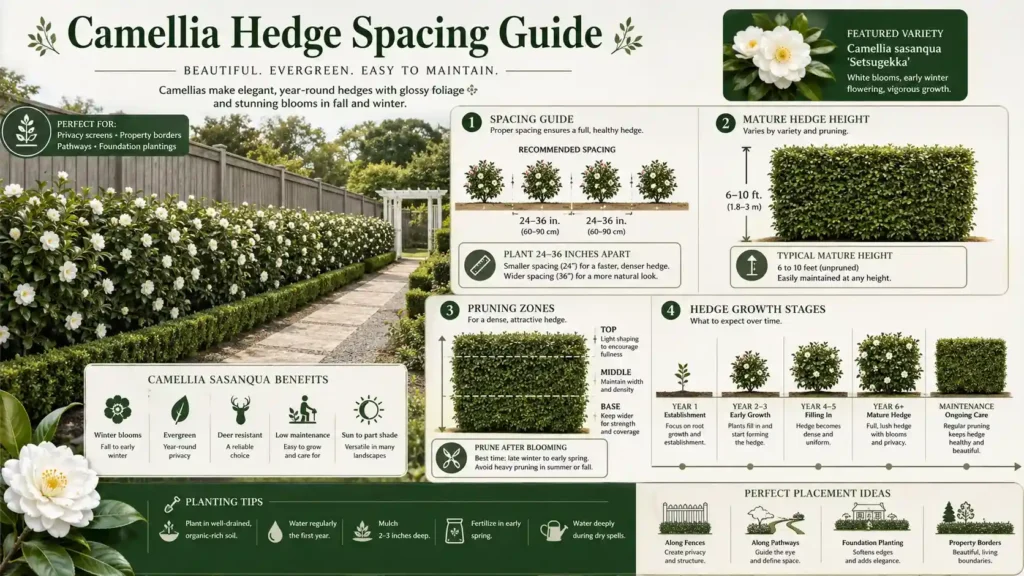
The ideal camellia hedge height depends on the selected variety, pruning style, and intended landscape use. Most sasanqua hedge varieties mature between 2.5 and 4 meters tall if left untrimmed, although regular pruning can easily maintain lower formal hedge heights.
For dense screening, spacing is extremely important. Most gardeners plant camellia for hedge applications approximately:
Proper spacing allows the shrubs to develop thick foliage without excessive competition for water and nutrients. When planted correctly, hedging camellias quickly form continuous evergreen coverage.
A white camellia hedge is especially effective in formal landscape designs because the clean flower color contrasts beautifully with dark evergreen foliage.
Flowering evergreen plants are often layered with ornamental native trees to create year-round structure and seasonal garden color.
Many gardeners also prefer sasanqua camellias hedge plantings because they remain visually attractive throughout all seasons.
Regular pruning is recommended after flowering finishes in late winter or early spring. Light trimming encourages branching density and helps maintain a uniform hedge shape. Heavy pruning should generally be avoided during flowering periods because it may reduce bloom production for the following season.
Several white sasanqua camellias perform exceptionally well as evergreen hedges due to their growth habit, foliage density, and flowering reliability.
Setsugekka is one of the best large hedge varieties because of its vigorous upright growth and dense evergreen structure. It produces large semi-double white flowers and creates excellent privacy screening in medium to tall hedge applications.
Early Pearly is another highly recommended hedge cultivar with compact branching and abundant white blooms. It responds very well to shaping and develops into a dense formal hedge with regular pruning.
For smaller gardens and lower hedge designs, compact white sasanqua varieties such as Mine-No-Yuki are often preferred. These cultivars maintain manageable growth while still delivering evergreen coverage and seasonal flowering performance.
Choosing the right camellia variety depends on:
With proper spacing, pruning, and soil preparation, white sasanqua camellias can develop into long-lasting evergreen hedges that combine privacy, structure, and ornamental beauty.
Camellia sasanqua is widely considered a camellia fast growing variety compared to many other camellia species, especially japonica types. Under suitable growing conditions, these evergreen shrubs establish relatively quickly and develop into dense screening plants within a few years.
The typical annual growth rate of a fast growing camellia ranges between 30 and 60 centimeters per year, depending on the cultivar, climate, soil quality, and maintenance practices. Vigorous hedge varieties such as Setsugekka and Early Pearly often grow faster than compact ornamental cultivars.
Climate plays a major role in determining growth speed. Camellia sasanqua performs best in mild temperate regions with moderate humidity, consistent rainfall, and protection from extreme frost. In warmer climates, growth tends to be stronger and more continuous, while colder conditions may slow seasonal development.
Several environmental factors directly influence the growth rate of sasanqua camellias:
Unlike many traditional camellias, sasanqua varieties tolerate more direct sunlight, which contributes to their faster establishment and dense hedge performance. Plants grown in brighter conditions often develop fuller branching and stronger flowering displays compared to heavily shaded specimens.
When properly maintained, a fast growing camellia can mature into a large evergreen shrub or privacy hedge within several growing seasons. Regular pruning after flowering also helps improve branch density and promotes a more compact, structured appearance over time.
Yes, sasanqua camellias can be successfully trained into small ornamental trees through selective pruning and structural shaping. A camellia sasanqua tree is a popular landscape feature in formal gardens, entryways, patios, and decorative courtyard designs because it combines evergreen foliage with seasonal flowering.
To create a sasanqua tree form, growers typically select one strong central stem and gradually remove lower side branches over several growing seasons. This standard training method encourages the plant to develop a defined trunk with a rounded flowering canopy above. Regular maintenance pruning is important to preserve the tree shape and maintain balanced growth.
A mature sasanqua camellia tree offers several landscaping advantages:
Many gardeners choose a camellia tree white variety for formal garden layouts because the white flowers create a clean and sophisticated appearance against dark green foliage. White flowering tree forms are especially effective near entrances, pathways, patios, and outdoor seating areas.
A camelia tree or carmellia tree, as commonly misspelled in plant searches, can also perform well in decorative containers when given proper care. Container-grown camellias are widely used for:
For successful container growth, the plant requires:
Most camellia sasanqua tree forms remain manageable in size and respond well to shaping, making them highly adaptable for both residential gardens and ornamental landscape projects. With proper pruning and care, a sasanqua tree can become a long-lasting evergreen feature plant with reliable seasonal flowering.
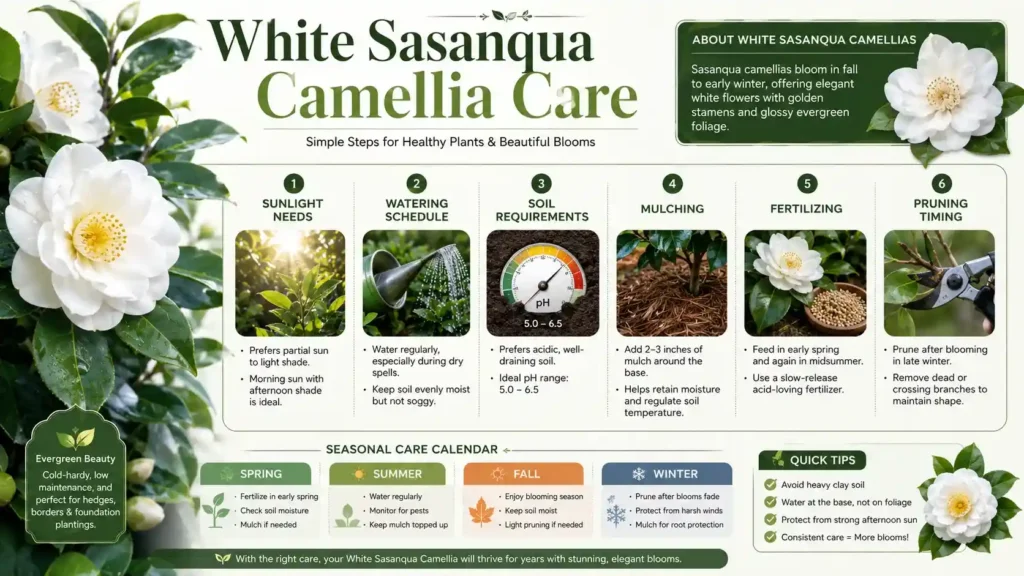
White sasanqua camellias grow best in slightly acidic, well-drained soil rich in organic matter. The ideal soil pH generally falls between 5.5 and 6.5. Acidic conditions allow the roots to absorb essential nutrients efficiently, supporting healthy foliage growth and strong flowering performance.
Poorly drained or alkaline soil can lead to nutrient deficiencies, weak growth, and yellowing leaves. Improving soil with compost, pine bark, or organic matter helps increase drainage while maintaining proper acidity levels.
Compared to many japonica camellias, sasanqua varieties tolerate more sunlight and warmer conditions. Most plants perform best with:
In cooler climates, white sasanqua camellias can often handle full sun with adequate soil moisture. Increased sunlight exposure usually improves flowering density and hedge growth.
Consistent watering is especially important during establishment and flowering periods. Newly planted camellias should receive deep watering one to two times per week depending on weather conditions and soil drainage. Mature plants become more drought tolerant but still benefit from regular moisture during dry seasons.
Proper watering practices include:
Overwatering should be avoided because constantly wet soil may damage the root system and increase the risk of fungal diseases.
White sasanqua camellias benefit from regular feeding during active growth periods. The best fertilizer timing is usually:
A fertilizer formulated for acid-loving plants is generally recommended because it supports healthy foliage, root development, and flower production. Excessive fertilization should be avoided, as too much nitrogen may encourage leafy growth while reducing flowering performance.
Organic mulch plays an important role in long-term camellia health. Common mulch materials include:
Applying mulch around the base of the plant provides several benefits:
Mulch should be spread evenly around the root zone while keeping it slightly away from the main stem to prevent excess moisture buildup near the trunk.
Root protection becomes especially important during hot summers and dry weather conditions. Because camellias have relatively shallow root systems, mulching and consistent watering help reduce environmental stress and maintain stable growth.
The best time to prune white sasanqua camellias is immediately after flowering finishes. Pruning too late in the season may remove developing flower buds and reduce blooming for the following year.
Light annual pruning helps:
For hedge shaping, regular trimming of outer growth encourages thicker foliage coverage and stronger privacy screening. Formal hedges generally require more frequent shaping than natural informal plantings.
To prevent leggy growth, camellias should receive adequate sunlight and periodic structural pruning. Plants growing in excessive shade may develop sparse branching and uneven growth patterns over time.
Important maintenance practices include:
With proper care, pruning, and growing conditions, white sasanqua camellias can remain healthy, dense, and highly ornamental for decades in residential landscapes and evergreen hedge plantings.
Yellow leaves and reduced flowering are among the most common issues affecting white sasanqua camellias. In many cases, these problems are linked to poor soil conditions, nutrient imbalance, or improper watering practices.
One of the main causes is incorrect soil pH. Camellias prefer acidic soil, and when planted in alkaline conditions, the roots struggle to absorb important nutrients such as iron and magnesium. This often leads to yellowing leaves, weak growth, and fewer flower buds.
Common symptoms of soil-related stress include:
Nutrient deficiencies can also affect flowering performance. A lack of potassium and phosphorus may reduce bloom production, while iron deficiency commonly causes yellow leaves with green veins. Using a fertilizer designed for acid-loving plants can help restore nutrient balance.
Overwatering is another major problem for camellia roots. Constantly wet soil reduces oxygen availability around the root system and may lead to root damage or fungal infections. Signs of excessive watering include:
Proper drainage and controlled watering are essential for maintaining healthy white sasanqua camellias.
Although sasanqua camellias are generally resilient plants, they can still experience pest and disease problems under stressful growing conditions.
Scale insects are one of the most common pests affecting camellias. These small sap-feeding insects attach themselves to stems and leaves, gradually weakening the plant.
Typical signs include:
Early treatment with horticultural oil or insecticidal soap can help control infestations before they spread.
Petal blight is a fungal disease that mainly affects camellia flowers during cool, damp weather. Infected blooms develop brown spots that quickly spread across the petals, causing flowers to collapse prematurely.
To reduce petal blight risk:
Root rot is one of the most serious camellia diseases and is usually caused by poorly drained soil or excessive watering. Once roots begin rotting, plants may rapidly decline.
Preventing root rot involves:
Healthy drainage is critical for long-term camellia survival.
Camellias naturally evolved in forest environments with acidic organic soil. Because of this, they perform poorly in alkaline conditions where nutrient absorption becomes restricted. High soil pH interferes with iron uptake, which directly affects leaf color and flowering quality.
Overwatering presents another major biological risk. Camellia roots require oxygen for healthy function, and saturated soil limits air movement around the root zone. Prolonged waterlogging weakens roots and creates ideal conditions for fungal pathogens that cause root rot.
Mulch plays a scientifically important role in camellia care, especially in hot climates. Organic mulch helps:
In warm regions, mulching can significantly reduce heat stress and improve moisture retention during dry periods. Proper soil management, balanced watering, and root protection remain the most important factors for maintaining healthy white sasanqua camellias.
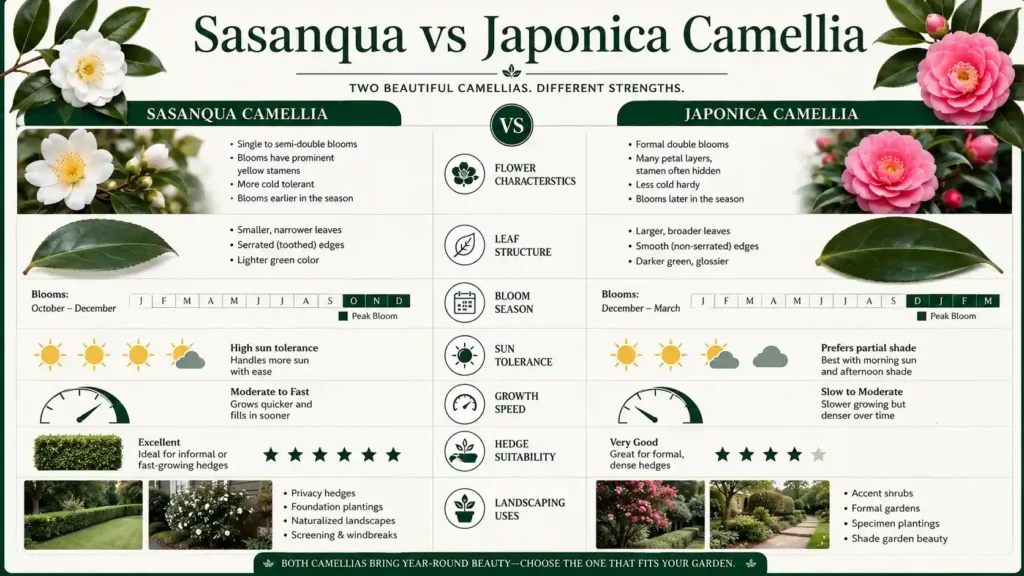
Sasanqua and japonica are two of the most widely cultivated camellia species used in ornamental gardening and landscaping. Although both belong to the same plant family and share evergreen characteristics, they differ significantly in growth habit, flowering season, sun tolerance, and landscape use.
Sasanqua camellias are generally faster growing, more sun tolerant, and better suited for hedges and screening. In contrast, japonica camellia varieties are often grown for their larger formal blooms and perform best in partially shaded garden settings.
Many gardeners choose camellia japonica white cultivars for decorative feature planting because of their large flowers and refined appearance. White camellia japonica types are especially popular in traditional gardens where ornamental flowering is prioritized over hedge performance.
The following table highlights the major differences between these camellia species:
|
Feature |
Sasanqua Camellia |
Japonica Camellia |
|
Bloom season |
Autumn to early winter | Winter to spring |
| Sun tolerance | Handles more direct sun |
Prefers partial shade |
|
Growth speed |
Moderate to fast growing | Slower growing |
| Hedge suitability | Excellent for hedges and screening |
Better for specimen planting |
Sasanqua camellias usually have:
Japonica camellias typically produce:
Many japonica camellia varieties are grown primarily for ornamental display rather than functional hedging. Their flowers often appear larger and more dramatic than sasanqua blooms, making them highly valued in collector gardens and decorative landscapes.
Choosing between these camellia species depends largely on garden goals. Sasanqua types are ideal for evergreen privacy hedges and sun-exposed areas, while japonica camellias are better suited for shaded ornamental gardens focused on large floral displays.
White sasanqua camellias are highly versatile landscape plants that combine evergreen foliage with elegant seasonal flowers. Their dense growth habit and refined appearance make them suitable for both formal and natural garden styles.
Many evergreen flowering plants commonly used in ornamental landscapes are selected for their year-round structure, seasonal blooms, and adaptability to residential garden settings.
One of the most common uses for white camellias is evergreen privacy hedging. Dense foliage and upright branching create effective screening along fences, property lines, and outdoor living areas. Varieties such as Setsugekka and Early Pearly develop into thick flowering hedges that provide year-round coverage while adding seasonal visual interest.
Benefits of white camellia privacy hedges include:
White camellias are widely used around entrances, gates, and pathways because their flowers create a clean and elegant focal point. A pair of camellias positioned near entryways can add symmetry and structure while maintaining evergreen foliage across all seasons.
Trees and shrubs with decorative bark or contrasting foliage are often combined in landscape designs to create stronger seasonal texture and visual depth.
Tree-form sasanqua camellias are especially effective for:
The controlled growth habit of many sasanqua varieties makes them suitable for foundation planting around homes and buildings. Their glossy foliage softens walls and structures while providing seasonal flower color without excessive maintenance.
For foundation landscapes, compact and medium-sized cultivars are often preferred because they:
White camellias also perform exceptionally well in mixed evergreen garden borders. Their dark green leaves and bright flowers contrast effectively with textured foliage plants and flowering shrubs.
In layered landscape designs, camellias can be combined with:
This combination creates depth, color variation, and continuous visual interest throughout the year.
Choosing suitable companion plants helps improve both the health and appearance of white sasanqua camellias. Since camellias prefer acidic, moisture-retentive soil, they pair best with plants that thrive under similar growing conditions.
Azaleas are among the most compatible companion plants for camellias. Both shrubs prefer acidic soil, filtered sunlight, and consistent moisture. Azaleas also extend seasonal flower color because many bloom during spring after camellias finish flowering.
Benefits of pairing azaleas with camellias include:
Gardenias complement white camellias beautifully because of their glossy foliage and fragrant white blooms. Both plants create a refined evergreen garden appearance and perform well in sheltered landscapes with acidic soil conditions.
Gardenias work especially well in:
Ferns provide soft texture beneath camellias and help create a woodland-style landscape effect. Their fine foliage contrasts effectively with the larger glossy camellia leaves while thriving in shaded, moisture-rich environments.
Ferns are useful for:
Hydrangeas pair well with camellias because they provide large summer blooms after camellia flowering season ends. This creates extended seasonal color within the landscape.
Hydrangeas and camellias share several growing preferences:
Combining white sasanqua camellias with complementary evergreen shrubs and flowering plants creates balanced, visually layered landscapes that remain attractive throughout the year.
White sasanqua camellias grow best in mild temperate climates with moderate rainfall, well-drained acidic soil, and protection from extreme environmental conditions. Their adaptability to both partial shade and increased sunlight makes them more versatile than many other camellia species.
These evergreen shrubs perform particularly well in regions with:
Because sasanqua camellias flower during autumn and early winter, climates with stable seasonal transitions generally support stronger blooming performance and healthier foliage growth.
Camellia sasanqua Australia plantings are extremely common due to the plant’s strong adaptability to many Australian climate zones. Sasanqua varieties tolerate heat and sunlight better than japonica camellias, making them highly suitable for coastal and temperate regions.
In Australia, white sasanqua camellias are frequently used for:
Camellia plants Sydney gardeners commonly grow include Setsugekka, Early Pearly, and Plantation Pink because these cultivars perform well in Sydney’s mild climate and seasonal rainfall patterns.
In warmer Australian regions, afternoon shade and mulching are important for protecting shallow roots from excessive summer heat. Proper irrigation during dry periods also helps maintain healthy flowering and foliage density.
New Zealand offers highly favorable growing conditions for white sasanqua camellias due to its temperate climate and relatively high humidity levels. Many camellia varieties establish quickly in New Zealand gardens because the cool winters and mild summers reduce environmental stress.
Popular landscape uses in New Zealand include:
The long flowering season and reliable evergreen growth make sasanqua camellias especially valuable in residential landscapes throughout both the North and South Islands.
Outside Australia and New Zealand, white sasanqua camellias also thrive in many mild temperate regions around the world. Areas with moderate seasonal temperature variation and acidic soil conditions generally support healthy growth.
Ideal growing environments typically include:
Although sasanqua camellias tolerate light frost once established, severe freezing temperatures may damage flower buds and young growth. In colder climates, planting near walls, fences, or sheltered garden areas can help reduce frost exposure.
With proper soil preparation, mulching, and watering practices, white sasanqua camellias remain highly adaptable evergreen shrubs suitable for a wide range of temperate garden environments.
Selecting a healthy white sasanqua camellia is important for long-term growth, flowering performance, and overall plant structure. Whether examining nursery stock or researching common retail varieties, understanding plant quality indicators helps gardeners identify strong and well-established specimens.
Healthy roots are one of the most important signs of a vigorous camellia plant. A quality plant should have:
Severely root-bound plants may struggle to establish properly after transplanting. In some cases, tightly circling roots can reduce long-term growth and water absorption.
Healthy camellia foliage should appear:
Sparse growth, curling leaves, or visible spotting may indicate stress, nutrient imbalance, or pest problems. Strong foliage density is especially important when selecting plants intended for hedging or screening applications.
Flower buds provide a useful indication of plant health and flowering potential. Healthy buds should appear:
Plants with abundant buds generally indicate stable growing conditions and good seasonal development. However, excessively heavy budding on small plants may sometimes place stress on immature root systems.
White sasanqua camellias are widely available in garden centers, specialty nurseries, and retail plant departments across many temperate regions. Availability often varies depending on climate, seasonal demand, and local landscaping trends.
Many gardeners researching camellia plant Bunnings selections or camellia plants Bunnings availability often encounter popular hedge and flowering varieties such as Setsugekka, Early Pearly, and Avalanche. Terms like Bunnings camellias, camellia sasanqua Bunnings, and sasanqua camellias Bunnings are commonly associated with standard nursery-grade evergreen hedge plants and ornamental flowering cultivars.
Sasanqua camellias are typically sold in a range of container sizes depending on plant maturity and intended landscape use.
Common nursery sizes include:
Larger plants generally provide faster visual impact in landscaping, while smaller plants may establish more gradually over time.
White sasanqua camellias are commonly grown in two primary forms:
|
Plant Type |
Characteristics |
|
Hedge Forms |
Dense branching, upright growth, ideal for screening |
| Standard Forms |
Single trunk with elevated canopy for ornamental use |
Standard camellia Bunnings selections and similar nursery forms are often used as decorative feature plants in entryways, patios, and formal gardens. Hedge-form camellias are more commonly selected for privacy screens and evergreen boundaries.
The best availability of flowering camellias usually occurs during autumn and early winter when plants begin blooming. During this period, gardeners can more easily evaluate:
Searches related to camellia Avalanche Bunnings and sasanqua camellia for sale often increase during flowering season because visible blooms make cultivar identification easier for home gardeners.
Regardless of retail source, selecting healthy plants with strong roots, dense foliage, and balanced branching remains more important than choosing plants solely based on flower display.
Camellia sasanqua white remains one of the most reliable and attractive evergreen flowering shrubs for modern landscapes and residential gardens. Its combination of glossy evergreen foliage, elegant seasonal blooms, fast growth, and hedge performance makes it highly versatile for both ornamental and practical garden use.
White flowering varieties such as Setsugekka and Early Pearly are especially valued for privacy hedges, foundation planting, entryway landscaping, and evergreen screening. Their dense branching structure and extended flowering season provide year-round visual appeal while maintaining relatively low maintenance requirements.
Proper growing conditions play an important role in long-term plant health. Well-drained acidic soil, balanced watering, mulching, and regular pruning help maintain dense foliage, strong flowering, and healthy root development. Light pruning after flowering also improves hedge shape and encourages compact evergreen growth.
For homeowners and gardeners seeking a durable evergreen shrub with decorative flowers and strong landscape adaptability, camellia sasanqua white continues to be one of the best choices for hedges, garden borders, and ornamental planting designs.
Setsugekka and Early Pearly are considered two of the best white camellia sasanqua varieties for hedges. Both develop dense evergreen foliage, respond well to pruning, and produce abundant white flowers during the blooming season. Setsugekka is often preferred for taller privacy screens, while Early Pearly is highly valued for compact formal hedging.
Camellia sasanqua white is generally considered a moderate to fast-growing evergreen shrub. Most varieties grow approximately 30 to 60 centimeters per year under suitable conditions. Growth speed depends on sunlight exposure, soil quality, watering, and climate.
Yes, white sasanqua camellias tolerate full sun better than many japonica camellias. In mild climates, they often perform very well in sunny positions if the soil remains consistently moist and well-drained. In hotter regions, some afternoon shade may help protect foliage and flowers from heat stress.
Sasanqua camellias typically grow faster, tolerate more sunlight, and are better suited for hedges and screening. Japonica camellias generally produce larger flowers and prefer partially shaded conditions. Sasanqua varieties also bloom earlier, usually during autumn and early winter.
A mature camellia sasanqua hedge commonly reaches between 2.5 and 4 meters in height depending on the cultivar and pruning style. Regular trimming can maintain lower formal hedge heights for smaller residential landscapes.
White sasanqua camellias should usually be pruned immediately after flowering finishes. Pruning too late in the season may remove developing flower buds and reduce flowering for the following year.
Yes, white sasanqua camellias are evergreen shrubs. They retain their glossy green foliage throughout the year while producing seasonal flowers during autumn and early winter.
Yes, many white sasanqua camellias grow successfully in large containers when planted in acidic, well-drained potting mix. Container-grown plants require regular watering, seasonal feeding, and proper drainage to maintain healthy growth.
Yellow leaves are often caused by alkaline soil, nutrient deficiencies, poor drainage, or overwatering. Camellias prefer acidic soil conditions, and improper pH levels can reduce nutrient absorption, especially iron uptake.
Yes, flowering sasanqua camellias can attract bees and other pollinators during cooler flowering months. Single and semi-double flower varieties are generally more accessible to pollinators than heavily double-flowered cultivars.
White sasanqua camellias grow best in acidic, organic-rich, well-drained soil with a pH between 5.5 and 6.5. Heavy clay or waterlogged soil may increase the risk of root problems and poor plant performance.
Yes, sasanqua camellias can be trained into tree form through selective pruning. Tree-form camellias are commonly used in entryways, patios, and formal garden designs because of their evergreen canopy and seasonal flowering display.