Grow Better Gardens with Smarter Plant Choices
Discover helpful guides on trees, hedges, fruit plants, edible plants, and beautiful landscape greenery.


A pittosporum hedge is a popular evergreen landscaping plant used for privacy screens, boundary borders, wind protection, and decorative garden structure. Known for its dense foliage, fast growth, and clean appearance, hedging pittosporum is widely used in residential and commercial landscapes because it creates a neat, attractive hedge with relatively low maintenance. Many homeowners prefer pittosporum hedges for their ability to provide year-round greenery while also responding well to trimming and compact shaping.
Gardeners often consult detailed guides on hedging and screening plants to determine which species provide optimal coverage, growth habit, and long-term low-maintenance performance.
One of the main reasons hedge pittosporum varieties are so widely planted is their versatility. Some cultivars grow into tall screening hedges for privacy, while others stay compact and work well in formal gardens or small outdoor spaces. Most pittosporum shrubs are evergreen, drought-tolerant once established, and adaptable to coastal, urban, and suburban conditions.
Popular hedge varieties include pittosporum tenuifolium, which is valued for its rapid growth and dense screening ability, pittosporum tobira for structured hedges and fragrant flowers, silver sheen pittosporum for elegant privacy screens, and variegated pittosporum cultivars that add decorative contrast with multi-toned foliage. These plants are commonly used for modern landscaping designs because they combine fast coverage, easy shaping, and long-lasting visual appeal.
A pittosporum plant is an evergreen ornamental shrub or small tree belonging to the Pittosporaceae family. These plants are widely grown for their dense foliage, fast-growing nature, and ability to form attractive privacy hedges. Native to regions including Australia, New Zealand, Asia, and parts of the Pacific Islands, pittosporum species are highly valued in landscaping because they adapt well to different climates and garden styles.
The pittosporum family includes many evergreen species with varying growth habits, leaf textures, and foliage colors. Some varieties develop into compact shrubs suitable for decorative borders, while others grow into tall screening hedges or small ornamental trees. Their naturally dense branching structure makes them ideal for shaping and formal hedge designs.
Common foliage colors range from glossy dark green to silver-green, lime green, and variegated cream-and-green patterns. Certain varieties, such as silver sheen pittosporum, feature soft shimmering leaves that create a lighter, elegant appearance in landscapes. Leaf textures can vary from smooth and rounded to slightly wavy or narrow depending on the species. Many pittosporum plants also produce small fragrant flowers during the growing season, adding additional ornamental value.
Pittosporum plants can grow in several forms depending on the species and pruning style. A pittosporum shrub is typically maintained as a dense, compact plant with multiple stems and rounded growth. These shrubs are commonly used in foundation planting, low hedges, and decorative garden borders.
The term pittosporum bush is often used interchangeably with shrub, especially for naturally rounded or informal landscape forms. Bush varieties usually require less structured pruning and blend well into relaxed garden designs.
A pittosporum tree develops when taller varieties are trained with a central trunk and elevated canopy. Tree-form pittosporums are often used as ornamental screening plants, patio accents, or small shade trees in modern landscapes.
Compact hedge varieties are ideal for smaller gardens and formal edging, while taller cultivars are preferred for privacy screens and windbreaks. Dwarf forms remain dense and low-growing, whereas tall hedge types can quickly create thick evergreen barriers for boundary planting.
Pittosporum grows best in mild to warm climates with good sunlight and well-drained soil. Many varieties thrive in coastal, Mediterranean, and temperate regions where winters are not excessively harsh. Their adaptability has made them highly popular in residential landscaping, especially in pittosporum Australia gardening projects where the plants are widely used for hedges, screening, and low-maintenance outdoor design.
Most pittosporum varieties perform best in full sun to partial shade. Full sunlight generally encourages denser growth and stronger foliage color, while some species also show good pittosporum shade tolerance in lightly shaded areas. However, deep shade may reduce hedge density and slow overall growth.
Another major advantage of pittosporum plants is their tolerance to coastal and urban conditions. Many varieties handle salty air, wind exposure, pollution, and compact city gardens extremely well. Their durability and easy maintenance make them suitable for roadside planting, modern landscapes, courtyard gardens, and coastal privacy hedges.
Pittosporum tenuifolium is one of the most widely used evergreen hedge plants for privacy screening and landscape borders. Native to New Zealand, this fast-growing species is known for its dense branching, small glossy leaves, and strong adaptability to pruning. It creates a thick, attractive hedge that works well in both formal and informal garden designs.
One of the most recognizable forms is kohuhu pittosporum tenuifolium, commonly planted for large screening hedges and wind protection. Many gardeners also choose black stem pittosporum varieties because of their distinctive dark stems that contrast beautifully with bright green foliage.
A pittosporum tenuifolium hedge is valued for several reasons:
This variety is commonly used for tall privacy hedges because it can quickly develop into a full green screen with regular maintenance.
Pittosporum silver sheen is considered one of the best choices for modern privacy hedging due to its elegant foliage and vigorous growth habit. This cultivar features soft silver-green leaves that create a lighter, refined appearance compared to darker hedge plants. Its upright growth pattern makes it highly effective for fast screening.
A silver sheen hedge is especially popular in contemporary landscaping because it combines visual softness with dense evergreen coverage. Homeowners often use it as a silver sheen privacy screen along fences, property lines, and outdoor entertaining spaces.
Key benefits of silver sheen pittosporum include:
Silver sheen kohuhu pittosporum is closely related to New Zealand hedge varieties and performs particularly well in warm coastal climates. Many landscapers also refer to it as silver sheen pittosporum tenuifolium because of its connection to the tenuifolium group.
This variety is ideal for homeowners seeking a tall, elegant hedge with rapid coverage and minimal visual heaviness.
Pittosporum tobira is a compact evergreen species commonly used for formal hedges, foundation planting, and decorative landscape borders. Native to East Asia, this plant is widely recognized for its thick glossy foliage and fragrant spring flowers.
Often called japanese pittosporum, this species is also known by the names japanese mock orange and japanese cheesewood. The nickname “mock orange” comes from the plant’s sweet citrus-like flower fragrance during blooming season.
Compared to taller screening varieties, pittosporum tobira has a more rounded and structured growth habit, making it ideal for shaped hedges and low-maintenance garden designs.
A japanese pittosporum hedge works particularly well for:
A pittosporum tobira hedge is also highly valued for its drought tolerance, salt resistance, and ability to maintain a dense shape with regular trimming.
Variegated pittosporum varieties are grown primarily for their decorative foliage and ornamental landscape value. These plants feature leaves with contrasting cream, white, silver, or pale green edges that add brightness and texture to garden spaces.
Popular cultivars include pittosporum variegata and pittosporum variegatum, both commonly used in decorative hedging, foundation planting, and mixed shrub borders. Their lighter foliage tones create visual contrast against darker evergreen plants and modern architectural landscapes.
One of the most popular decorative forms is variegated japanese pittosporum, especially the cultivar pittosporum tobira variegata. This variety combines the dense structure of Japanese pittosporum with striking cream-edged foliage.
Variegated hedge types are commonly used for:
These varieties generally grow slightly slower than solid green cultivars but offer significantly higher ornamental appeal in landscape compositions.
Dwarf pittosporum varieties are ideal for compact gardens, small landscapes, pathways, and decorative borders where controlled growth and dense foliage are important. These smaller cultivars maintain a neat appearance with minimal pruning and are commonly used in formal landscaping designs.
One popular compact variety is pittosporum emerald dome, known for its naturally rounded shape and dense green foliage.
Similar to Lilly Pilly varieties, this compact pittosporum’s rounded shape and dense foliage make it ideal for low hedges, foundation planting, or small garden screens.
It works well as a low hedge, foundation plant, or accent shrub in structured gardens.
Pittosporum golf ball is another highly compact cultivar recognized for its globe-shaped growth habit. Its naturally symmetrical form makes it suitable for modern gardens, container planting, and geometric landscape designs.
Pittosporum tom thumb is widely used for decorative edging because of its small leaves and rich purple-bronze foliage tones. This variety provides strong color contrast in mixed shrub plantings and formal garden layouts.
Other compact landscaping options include:
Benefits of dwarf pittosporum varieties include:
These compact shrubs are especially useful for homeowners who want evergreen structure without the height of large privacy hedges.
Tall pittosporum varieties are commonly planted for privacy screening, wind protection, and large boundary hedges.
Other Australian native trees, such as Tuckeroo Trees, are often used alongside tall pittosporum hedges to create multi-layered privacy screens and windbreaks for larger properties.
Their rapid vertical growth and dense evergreen foliage make them effective natural screens for residential and commercial landscapes.
Pittosporum green pillar is a narrow upright variety designed for tight spaces where vertical screening is needed without excessive width. Its columnar growth habit makes it useful for side boundaries, driveways, and narrow garden beds.
Pittosporum screenmaster is specifically developed for fast hedge establishment and dense coverage. It forms a thick evergreen wall that works exceptionally well for blocking neighboring views and reducing wind exposure.
Wonder screen pittosporum is another popular screening cultivar valued for its vigorous growth and lush foliage density. It creates a tall privacy hedge relatively quickly and responds well to regular shaping.
Features commonly found in tall pittosporum screening varieties include:
The tallest pittosporum cultivars can reach significant mature heights when left untrimmed, making them ideal for full privacy barriers. Many tall pittosporum varieties are capable of forming large hedges that provide year-round screening while maintaining an elegant landscaped appearance.
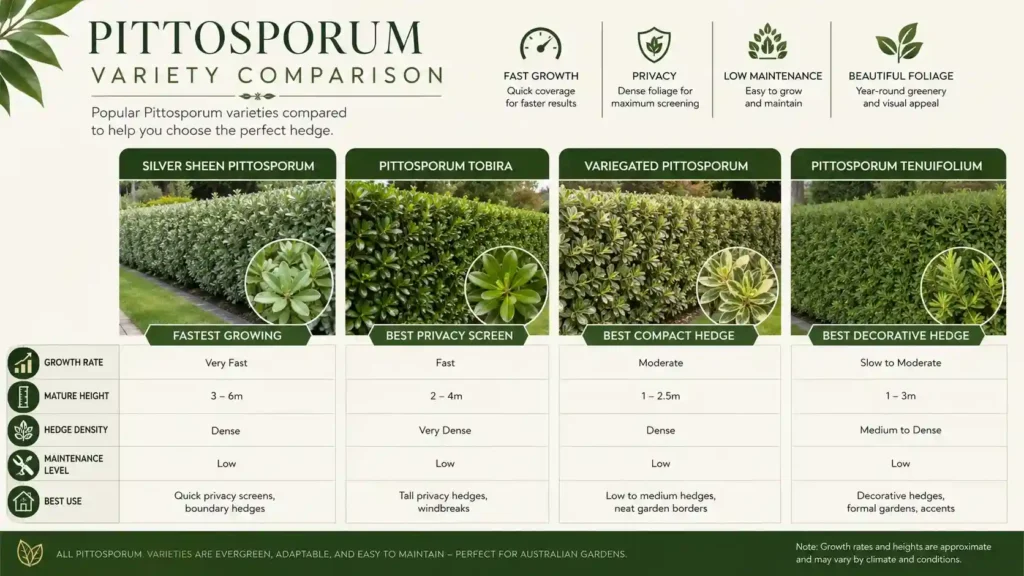
The pittosporum silver sheen growth rate is one of the main reasons this variety is widely used for privacy hedging and screening. It is considered a fast-growing evergreen hedge that can quickly establish dense coverage in residential and commercial landscapes.
Under favorable growing conditions, the silver sheen pittosporum growth rate typically ranges between 2 to 3 feet of growth per year. Warm temperatures, full sun exposure, regular watering during establishment, and well-drained soil can further improve growth performance.
Silver sheen hedges are especially valued because they combine rapid vertical growth with relatively narrow width expansion, making them suitable for:
Regular pruning encourages thicker branching and denser foliage, helping the hedge develop a fuller appearance more quickly.
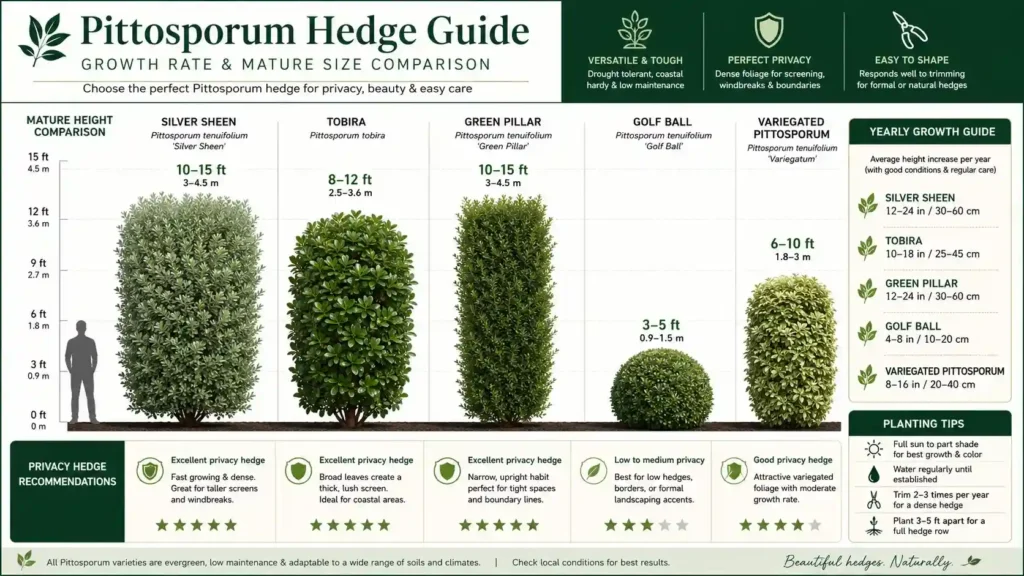
The mature size of a pittosporum hedge depends on the variety, pruning style, climate, and growing conditions. Some dwarf cultivars remain compact, while tall screening forms can grow into substantial evergreen barriers.
A mature pittosporum silver sheen height commonly reaches:
When maintained as a formal hedge, many homeowners keep silver sheen hedges between 8 and 15 feet tall for manageable screening and easier maintenance.
General pittosporum size ranges vary by cultivar:
|
Pittosporum Type |
Average Height | Average Width |
| Dwarf varieties | 2–4 feet |
2–4 feet |
|
Medium hedge varieties |
6–10 feet | 4–6 feet |
| Tall screening varieties | 15–25 feet |
6–10 feet |
Compact forms are ideal for decorative borders and small gardens, while taller varieties are preferred for large-scale privacy hedging.
Some pittosporum cultivars grow significantly faster than others, especially those selected for screening and privacy hedge applications.
The pittosporum tenuifolium growth rate is considered fast, with many plants growing approximately 2 to 3 feet annually under optimal conditions. This makes it one of the most reliable choices for rapid hedge establishment.
Variegated pittosporum growth rate is generally slower compared to solid green varieties because the lighter foliage contains less chlorophyll. Most variegated cultivars develop at a moderate pace and are often chosen more for decorative value than speed.
Pittosporum mountain green growth rate is moderate to fast depending on climate and maintenance. This cultivar forms a dense upright hedge and performs well in formal landscape designs.
Pittosporum stephens island growth rate is relatively vigorous once established. It is valued for strong branching structure and effective evergreen screening in coastal and windy environments.
The fastest-growing varieties are typically those used for large privacy screens and windbreak hedges because they establish dense coverage more quickly than compact ornamental forms.
The pittosporum silver sheen root system is generally considered non-invasive compared to many large hedge trees. Most roots spread moderately outward rather than aggressively downward, making pittosporum suitable for residential gardens when planted correctly.
However, mature hedges still require adequate spacing from structures such as:
For healthy development and airflow, hedge spacing recommendations vary based on desired density and plant size.
|
Hedge Type |
Recommended Spacing |
| Dense privacy hedge |
3–5 feet apart |
|
Medium screening hedge |
5–7 feet apart |
| Large tall hedge |
6–8 feet apart |
Closer spacing creates a fuller hedge more quickly, while wider spacing allows better airflow and reduces long-term crowding.
Although pittosporum roots are usually manageable, overcrowded planting can increase competition for moisture and nutrients. Proper spacing also helps reduce disease risk and improves long-term hedge structure.
|
Variety |
Growth Rate | Mature Height |
Best Use |
|
Silver Sheen Pittosporum |
Fast | 15–25 ft | Privacy screens |
| Pittosporum tenuifolium | Fast | 12–20 ft |
Tall hedging |
|
Pittosporum tobira |
Moderate | 6–12 ft | Formal hedges |
| Variegated Pittosporum | Moderate | 6–10 ft |
Decorative landscaping |
|
Pittosporum golf ball |
Slow | 2–3 ft | Compact borders |
| Pittosporum green pillar | Fast | 12–18 ft |
Narrow screening |
Selecting the correct planting location is essential for establishing a healthy and dense pittosporum hedge. Most pittosporum varieties grow best in areas with good airflow, adequate sunlight, and well-drained soil.
Pittosporum plants prefer fertile, moderately moist soil with good organic content. Although they can adapt to various soil types, growth is usually strongest in loamy soil that retains moisture without becoming waterlogged.
Ideal soil conditions include:
Heavy clay soil may slow root development unless improved with compost or organic material.
Proper drainage is one of the most important factors for long-term hedge health. Pittosporum roots dislike constantly wet conditions, which can lead to root stress and fungal problems.
To improve drainage:
Good drainage encourages stronger root growth and healthier foliage density.
Most pittosporum hedge varieties perform best in full sun to partial shade. Full sunlight usually produces thicker foliage, faster growth, and improved hedge density.
General sunlight recommendations:
|
Sun Condition |
Plant Performance |
| Full sun |
Best growth and dense foliage |
|
Partial shade |
Good growth with moderate density |
| Deep shade |
Slower growth and thinner hedging |
Silver sheen and tenuifolium varieties generally achieve their best screening performance in bright sunny locations.
Correct spacing is important for creating a balanced hedge with proper airflow and healthy root development. Planting too closely can cause overcrowding, while excessive spacing may leave gaps in the hedge.
For a dense silver sheen hedge, spacing plants approximately 3 to 5 feet apart usually provides effective privacy coverage while allowing room for mature growth.
Recommended spacing depends on the desired hedge style:
|
Hedge Style |
Recommended Spacing |
| Dense privacy hedge |
3–4 ft apart |
|
Standard screening hedge |
4–5 ft apart |
| Informal large hedge |
5–6 ft apart |
Closer planting creates faster screening but may require more frequent pruning over time.
Karo hedge spacing recommendations are generally similar for compact screening layouts. Moderate spacing allows the hedge to fill naturally without excessive competition between roots.
For smaller or medium hedge forms:
Proper spacing improves sunlight penetration and reduces long-term disease risk.
For maximum privacy and fast hedge establishment:
Dense screening hedges usually develop faster when plants receive balanced airflow and consistent sunlight.
Pittosporum can be grown successfully both in garden soil and in containers, depending on the variety and available space.
Pittosporum silver sheen in pots is suitable for patios, courtyards, balconies, and compact urban gardens. Young plants adapt well to containers when provided with adequate drainage and regular watering.
Container-grown plants require:
While container planting offers flexibility, silver sheen varieties eventually become large plants and may outgrow smaller pots over time.
Growing pittosporum in containers has several limitations compared to ground planting:
Tall screening varieties generally perform better when planted directly in the ground, where roots have enough space for long-term development.
Proper soil preparation helps pittosporum hedges establish faster and maintain healthy evergreen growth.
A balanced slow-release pittosporum fertilizer supports foliage density, root development, and overall hedge vigor. Fertilizing is especially beneficial during active spring and summer growth periods.
Recommended fertilizer characteristics:
Avoid excessive nitrogen because overly rapid growth can weaken hedge structure.
Before planting:
Healthy soil preparation improves root establishment and reduces transplant stress.
Mulching helps maintain moisture, regulate soil temperature, and suppress weeds around newly planted hedges.
Best mulching practices include:
Consistent mulching also improves soil structure over time and supports healthier root systems.
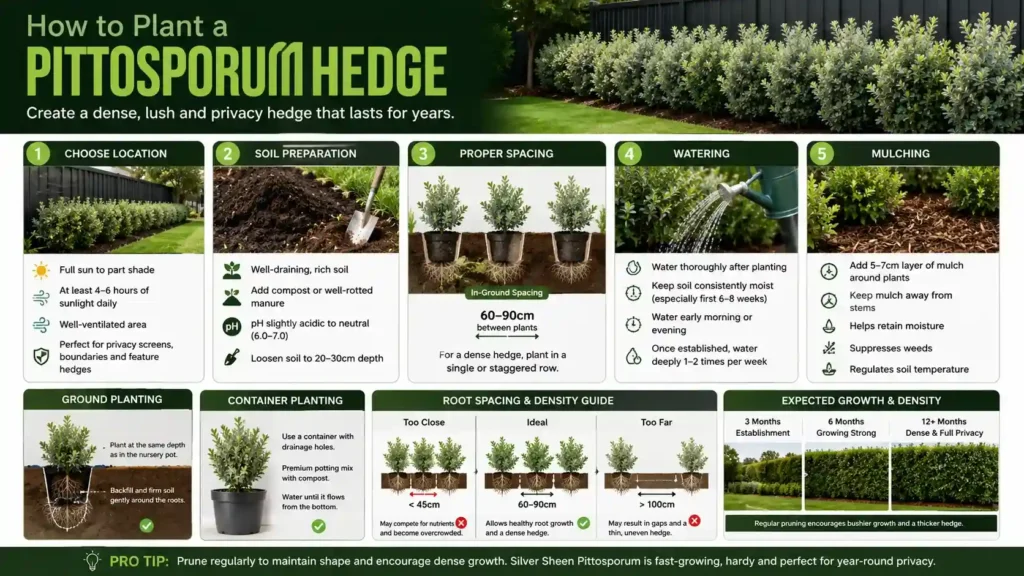
Proper watering is essential for establishing healthy pittosporum hedges and maintaining dense evergreen growth. Water needs vary depending on plant age, climate conditions, soil type, and seasonal temperatures.
Newly planted pittosporum hedges require regular watering during their establishment period. Young plants need consistent soil moisture to support root development and reduce transplant stress.
During the first growing season:
Deep watering encourages roots to grow downward, creating stronger and more drought-resistant plants over time.
Once established, mature pittosporum hedges become significantly more tolerant of dry conditions. Most mature varieties only require occasional deep watering during extended drought periods.
Signs of underwatering may include:
Overwatering should also be avoided because excessive moisture can contribute to root problems and fungal disease.
Many pittosporum varieties are considered moderately to highly drought tolerant once established. Species such as pittosporum tenuifolium and pittosporum tobira perform particularly well in dry climates and coastal regions.
Factors that improve drought tolerance include:
Although mature hedges tolerate dry conditions well, occasional deep irrigation helps maintain fuller foliage and healthier long-term growth.
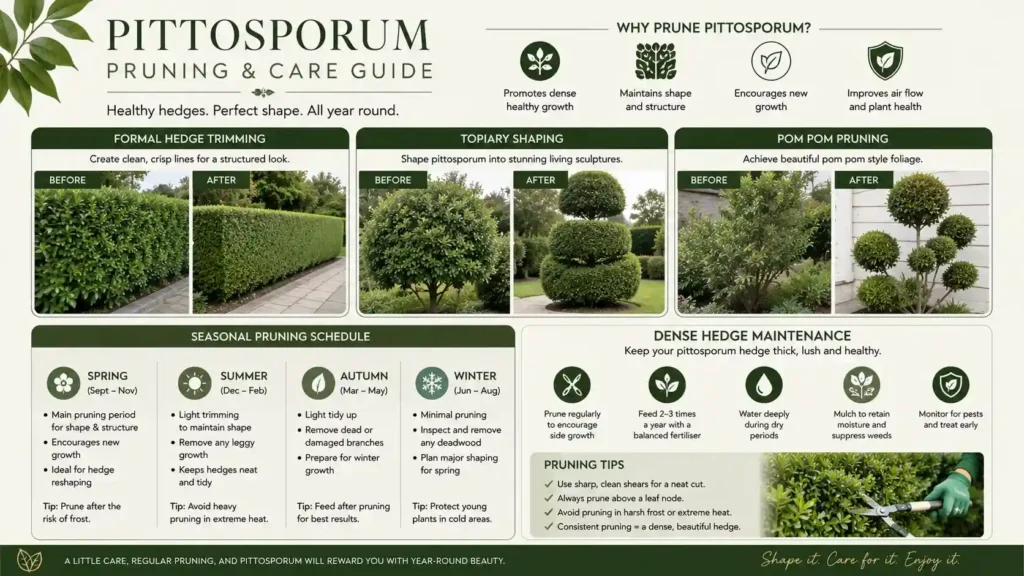
Regular pittosporum trimming helps maintain hedge density, improve plant structure, and preserve the desired shape. Most pittosporum varieties respond extremely well to pruning, making them ideal for formal hedges and decorative landscaping.
Routine pruning pittosporum encourages:
Light but consistent trimming usually produces better hedge structure than severe cutting performed infrequently.
Cutting back pittosporum may be necessary when hedges become overgrown, uneven, or sparse. Most healthy plants recover well from moderate pruning because they naturally produce vigorous new growth.
General trimming guidelines include:
For tall privacy hedges, regular shaping helps maintain a compact appearance while preventing excessive thinning in lower sections.
Understanding when to prune pittosporum is important for maintaining healthy growth and avoiding seasonal stress.
The best pruning periods are usually:
|
Season |
Recommended Pruning Activity |
|
Early spring |
Major shaping and structural pruning |
| Late spring to summer |
Light trimming and maintenance |
|
Early autumn |
Minor shaping if needed |
| Winter |
Avoid heavy pruning in cold climates |
Most varieties respond best to pruning during active growing periods when recovery is faster.
Knowing how to prune pittosporum correctly helps maintain dense evergreen coverage and long-term plant health.
Basic pruning steps include:
Frequent light trimming generally produces a thicker and more attractive hedge compared to occasional heavy pruning.
Pittosporum plants are widely used for decorative shaping because of their dense foliage and excellent response to pruning. Their compact branching structure allows landscapers to create clean geometric forms and ornamental garden features.
Pittosporum topiary designs are commonly used in:
Popular topiary forms include:
Compact varieties such as dwarf pittosporum cultivars are especially suitable for detailed shaping work.
Pittosporum pom pom pruning involves shaping foliage into rounded clustered forms along exposed stems or trunks. This decorative style is often used in modern landscape design because it creates a sculptural appearance while maintaining evergreen structure.
Pom pom shaping works best with:
Consistent trimming helps preserve the clean ornamental appearance of topiary and pom pom forms throughout the year.
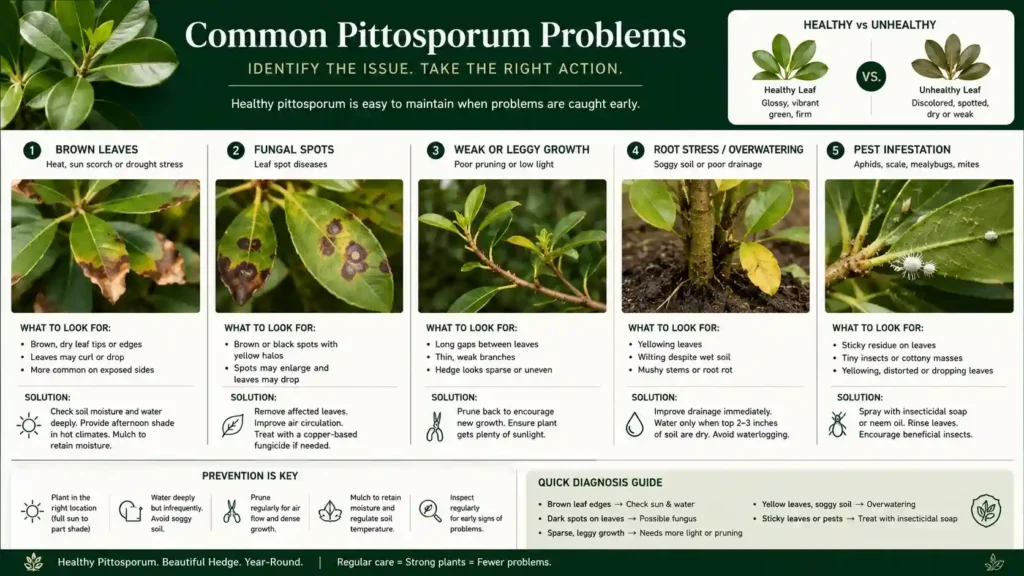
One of the most common hedge concerns is pittosporum leaves turning brown. Browning foliage can result from several environmental, watering, soil, or disease-related issues. Identifying the cause early helps prevent long-term damage and improves hedge recovery.
|
Problem |
Possible Cause |
| Dry brown leaf edges |
Underwatering or heat stress |
|
Yellowing followed by browning |
Poor drainage or root stress |
| Random brown patches |
Wind burn or sun scorch |
|
Browning after planting |
Transplant shock |
| Brown spots on pittosporum leaves |
Fungal infection or leaf spot disease |
Brown spots on pittosporum leaves are often associated with moisture-related fungal conditions, especially in overcrowded hedges with poor airflow.
To restore healthy growth:
Consistent maintenance usually helps healthy pittosporum hedges recover from temporary environmental stress.
Like many evergreen shrubs, pittosporum plants can occasionally experience fungal diseases and general plant health issues, especially in humid or poorly ventilated conditions.
Pittosporum fungus issues often develop when excess moisture remains on foliage or soil for extended periods. Common fungal conditions include:
Symptoms may include:
Gardeners frequently search for pittosporum diseases pictures to identify visual symptoms before treatment.
Most pittosporum problems can be minimized with proper care practices:
Healthy hedges with good airflow are significantly less likely to develop severe disease outbreaks.
Although silver sheen is one of the most popular hedge varieties, several common pittosporum silver sheen problems may appear as the hedge matures.
Silver sheen varieties sometimes develop long, flexible branches due to their rapid growth habit. Without regular shaping, branches may become leggy or uneven.
Solutions include:
Because of their lighter foliage and upright growth, silver sheen hedges can experience wind stress in exposed locations. Strong winds may cause:
Wind exposure can be reduced by:
Root stress is another common issue in mature silver sheen hedges, especially when planted in compacted soil or areas with poor drainage.
Potential causes include:
Healthy soil preparation and consistent irrigation management are essential for preventing root-related decline.
Pittosporum hedges are generally considered relatively low-maintenance, but occasional pest activity and allergy concerns may occur.
Several insects may occasionally affect hedge health, including:
A pittosporum bug infestation may cause:
Minor infestations are often manageable with strong water sprays, pruning, or horticultural oils.
Some individuals may experience mild pittosporum allergy symptoms from pollen, plant oils, or prolonged skin contact during pruning.
Possible symptoms include:
Wearing gloves and limiting direct exposure during trimming can help reduce irritation for sensitive individuals.
Many gardeners ask, can you grow pittosporum from cuttings, and the answer is yes. Pittosporum propagation from cuttings is one of the most reliable and commonly used methods for producing new hedge plants because it preserves the characteristics of the parent variety.
Semi-hardwood cuttings taken during the active growing season generally provide the best success rates. Healthy stems with firm but flexible growth are ideal for rooting.
Most cuttings root successfully when placed in warm conditions with indirect light and stable moisture.
Pittosporum propagation through cuttings offers several advantages:
Many commercial nurseries use cuttings rather than seeds to maintain consistent hedge quality and growth habits.
Growing pittosporum from seed is possible, although it usually requires more time and patience compared to propagation from cuttings.
Pittosporum seeds are typically collected from mature seed capsules after flowering. Once cleaned and prepared, the seeds can be sown in moist seed-starting mix under warm growing conditions.
For successful germination:
Germination times may vary depending on species and environmental conditions.
Young pittosporum seedlings are usually slower-growing during their early stages. They require protection from extreme temperatures, drying winds, and excessive direct sunlight until stronger root systems develop.
Seed-grown plants may occasionally show slight variations in:
Because of this variability, named hedge cultivars are more commonly propagated from cuttings for landscaping consistency.
Gardeners frequently ask how long do pittosporum live when planning long-term privacy hedges or landscape structures. With proper care, many pittosporum varieties can remain healthy and attractive for several decades.
The average lifespan depends on factors such as:
|
Variety |
Average Lifespan |
| Pittosporum tenuifolium |
30–50 years |
|
Silver Sheen Pittosporum |
20–40 years |
| Pittosporum tobira |
40–60 years |
|
Dwarf pittosporum varieties |
20–40 years |
| Variegated pittosporum |
20–35 years |
Well-maintained hedges often live significantly longer when grown in suitable conditions with regular pruning and proper soil drainage.
Long-lasting pittosporum hedges generally benefit from:
Healthy maintenance practices help preserve dense evergreen foliage and strong branch structure throughout the plant’s lifespan.
Pittosporum hedges are widely used for creating dense privacy screens and clearly defined property boundaries. Their evergreen foliage, rapid growth, and strong response to pruning make them highly effective for both residential and commercial landscaping.
Tall-growing varieties are especially useful for blocking neighboring views, reducing wind exposure, and adding year-round greenery. One of the most popular choices is the silver sheen privacy screen, valued for its elegant silver-green foliage and fast vertical growth.
Best screening varieties include:
Benefits of pittosporum hedging for privacy applications include:
These hedges work particularly well along fences, driveways, pool areas, and outdoor living spaces where year-round screening is desired.
Pittosporum plants are highly suitable for formal gardens because they tolerate precise trimming and maintain dense structured growth. Their naturally compact branching allows landscapers to create clean geometric hedge lines and symmetrical garden layouts.
Structured hedge ideas using pittosporum include:
Compact dwarf cultivars are especially popular in formal landscape design because they remain neat with minimal maintenance.
Common dwarf varieties used in formal gardens include:
|
Compact Variety |
Best Landscape Use |
| Pittosporum golf ball |
Rounded feature planting |
|
Pittosporum emerald dome |
Low structured hedges |
| Pittosporum tom thumb |
Decorative edging |
|
Wheelers dwarf |
Compact evergreen borders |
| Pittosporum miss muffet |
Small formal gardens |
These smaller cultivars are ideal for modern minimalist gardens and carefully shaped landscape compositions.
Many pittosporum varieties perform exceptionally well in coastal and contemporary landscape designs due to their tolerance for wind, salt exposure, and dry conditions.
Wind-tolerant varieties such as silver sheen, pittosporum tobira, and tenuifolium cultivars are commonly used in coastal gardens where durable evergreen structure is required.
Advantages for coastal landscaping include:
In modern landscaping, pittosporum hedges are often used to create clean architectural lines and soft natural screening around outdoor spaces.
Popular contemporary styling ideas include:
The soft foliage textures and manageable growth habits of pittosporum plants work especially well with modern hardscaping materials such as concrete, stone, timber, and steel.
|
Feature |
Silver Sheen Pittosporum | Pittosporum Tobira | Variegated Pittosporum |
| Growth Speed | Fast | Moderate |
Moderate |
|
Mature Height |
Tall | Medium | Medium |
| Best Use | Privacy screens | Formal hedges |
Decorative borders |
|
Foliage Style |
Silver-green narrow leaves | Thick glossy green leaves | Cream and green variegated foliage |
| Maintenance Level | Moderate | Low |
Moderate |
|
Wind Tolerance |
High | High | Moderate |
| Best Garden Style | Modern landscapes | Structured gardens |
Decorative landscapes |
|
Category |
Recommended Varieties |
|
Best compact varieties |
Pittosporum golf ball, tom thumb, emerald dome |
| Best tall screening varieties |
Silver sheen, screenmaster, green pillar |
|
Best formal hedge varieties |
Pittosporum tobira, wheelers dwarf |
| Best low-maintenance options |
Pittosporum tobira, silver sheen |
This range of growth habits and foliage styles allows pittosporum hedges to fit both compact decorative gardens and large-scale privacy landscapes.
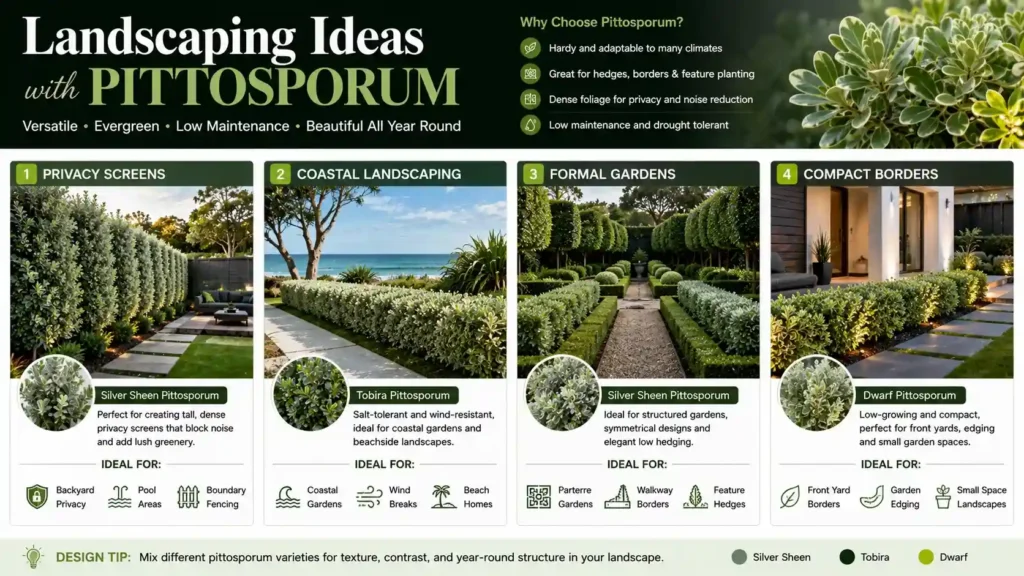
Pittosporum hedge plants remain one of the most versatile and reliable choices for modern landscaping because they combine evergreen beauty, dense growth, and relatively low maintenance requirements. Whether used for privacy screening, decorative borders, wind protection, or formal garden structure, pittosporum varieties offer flexible solutions for both small residential gardens and large landscape projects.
Fast-growing types such as silver sheen and pittosporum tenuifolium are especially effective for creating tall privacy hedges and windbreaks, while compact cultivars like tom thumb, emerald dome, and wheelers dwarf work well for decorative edging and structured garden layouts. Their adaptability to coastal conditions, urban environments, and various pruning styles makes pittosporum hedges suitable for a wide range of climates and landscape designs.
When selecting the right variety, it is important to consider:
Choosing the correct pittosporum cultivar helps ensure healthier growth, better hedge performance, and a landscape design that remains attractive and functional for many years.
The growth rate of a pittosporum hedge depends on the variety, climate, and growing conditions. Fast-growing types such as silver sheen pittosporum and pittosporum tenuifolium can grow approximately 2 to 3 feet per year under ideal conditions. Regular watering, sunlight, and occasional fertilization help improve hedge density and growth speed.
Silver sheen pittosporum is one of the best varieties for privacy screening because of its rapid growth and dense evergreen foliage. Pittosporum tenuifolium and screenmaster cultivars are also excellent choices for tall boundary hedges and windbreaks.
The best time to prune pittosporum hedges is during spring and early summer when the plants are actively growing. Light maintenance trimming can also be done during late summer or early autumn. Heavy winter pruning is generally avoided in colder climates.
Most pittosporum varieties grow best in full sun to partial shade. While they can tolerate some shade, dense foliage and faster growth usually develop in brighter locations with several hours of sunlight daily.
Pittosporum leaves turning brown may result from underwatering, poor drainage, fungal disease, transplant shock, or environmental stress such as strong wind and heat exposure. Improving watering practices and increasing airflow through pruning often helps resolve the issue.
Silver sheen pittosporum can reach approximately 15 to 25 feet tall when left untrimmed. As a maintained hedge, it is commonly kept between 8 and 15 feet for practical privacy screening and easier maintenance.
Yes, pittosporum is highly suitable for coastal gardens because many varieties tolerate salty air, strong winds, and dry conditions. Silver sheen, pittosporum tobira, and tenuifolium cultivars are commonly used in coastal landscaping.
Yes, pittosporum can be successfully propagated from cuttings. Semi-hardwood cuttings taken during active growth periods usually root well when planted in moist, well-draining propagation mix.
Compact varieties such as pittosporum golf ball, tom thumb, emerald dome, and wheelers dwarf are ideal for small gardens, borders, and container planting because they maintain dense foliage without excessive height.
Pittosporum hedges are generally considered low-maintenance plants. Once established, they require moderate watering, occasional fertilization, and regular trimming to maintain shape and density.
Most pittosporum hedges are planted approximately 3 to 5 feet apart depending on the variety and desired hedge density. Closer spacing creates faster privacy coverage, while wider spacing allows better airflow.
Pittosporum root systems are generally non-invasive compared to many large hedge trees. However, large mature hedges should still be planted with reasonable distance from foundations, paving, and underground utilities.
Yes, many compact and medium-sized varieties can grow successfully in containers. However, tall hedge types such as silver sheen may eventually outgrow smaller pots and perform better when planted in the ground.
A balanced slow-release fertilizer designed for evergreen shrubs works best for pittosporum hedges. Fertilizing during spring and summer supports healthy foliage growth and stronger hedge density.
Silver sheen pittosporum and pittosporum tenuifolium are among the fastest-growing varieties commonly used for tall privacy hedges and screening applications.