Grow Better Gardens with Smarter Plant Choices
Discover helpful guides on trees, hedges, fruit plants, edible plants, and beautiful landscape greenery.

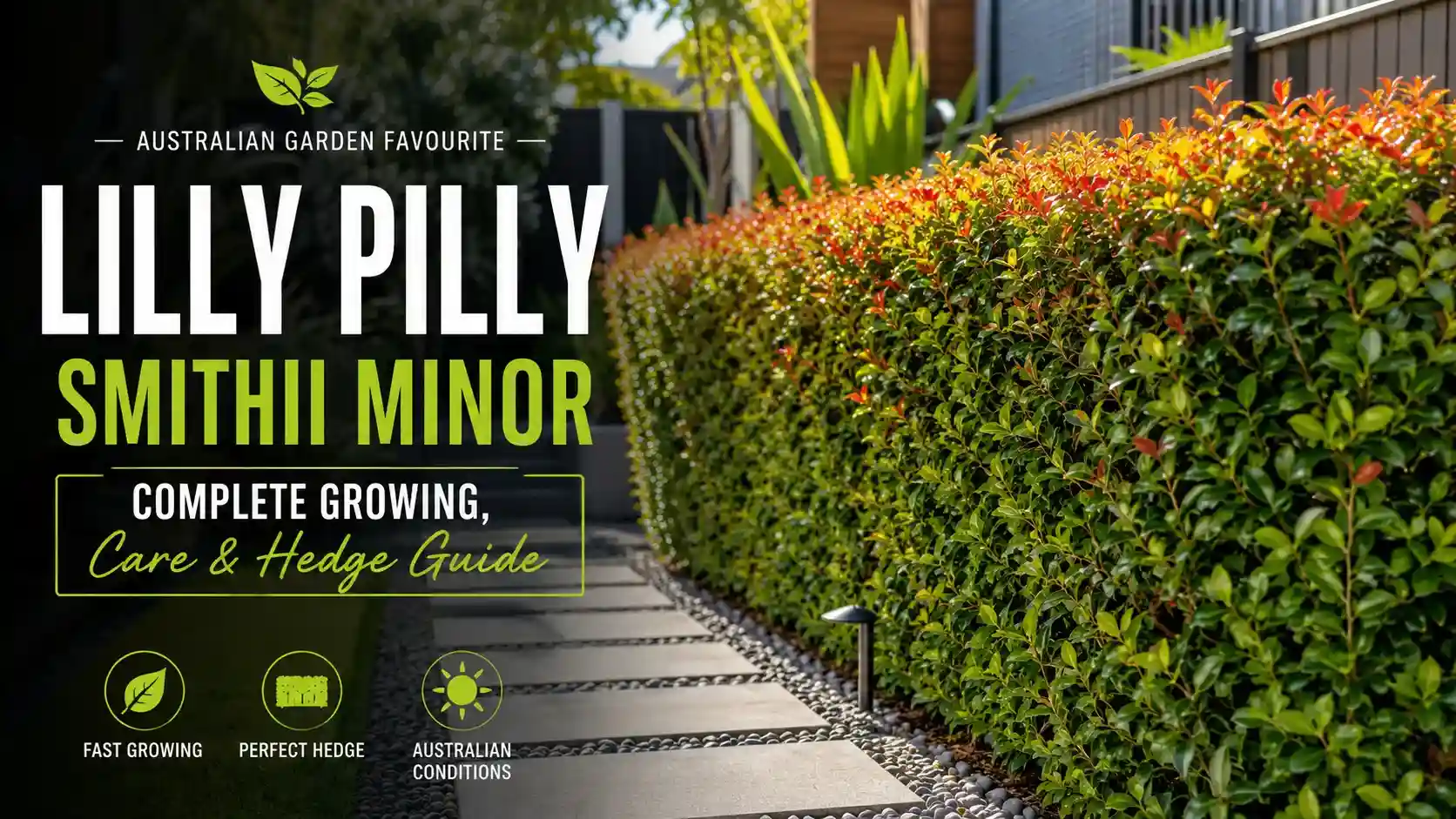
Lilly pilly smithii minor is a compact Australian native shrub widely valued for its dense evergreen foliage, neat growth habit, and excellent hedging performance. Commonly known as a dwarf lilly pilly or miniature lilly pilly, this popular plant belongs to the Acmena and Syzygium groups and is often referred to by botanical names such as acmena smithii minor and syzygium smithii minor. It is one of the most reliable choices for compact hedges, privacy screens, landscaping borders, and small gardens due to its manageable size and attractive appearance. As an australian lilly pilly and a well-known common lilly pilly variety, it is highly favored in residential landscapes for creating structured greenery with minimal maintenance.
Lilly pilly smithii minor is a compact evergreen plant that belongs to the Myrtaceae family, a large botanical group that includes many Australian native species. Its scientific classification is commonly listed as Acmena smithii minor, although it is also closely associated with Syzygium smithii due to botanical reclassification within the lilly pilly group.
The naming differences between acmena, syzygium, and lilly pilly often create confusion among gardeners. In simple terms:
Because of this, gardeners may see names such as:
All referring to closely related forms of the same popular hedging plant.
Native to the rainforests and coastal regions of eastern Australia, this plant has become one of the most widely used compact hedge varieties in Australian landscaping due to its adaptability and dense growth habit.
Lilly pilly smithii minor is known by several common and regional names throughout Australia. These names are often used interchangeably in nurseries and landscaping projects.
Common names include:
Although the spelling may vary, these names generally refer to compact forms of Acmena smithii or closely related Syzygium varieties used for hedging and ornamental planting.
Lilly pilly smithii minor is highly valued for its attractive foliage, compact size, and reliable performance in residential gardens and urban landscapes.
Key characteristics include:
Its compact form makes it one of the most practical hedge plants for modern gardens where space efficiency and low maintenance are important. Compared to larger lilly pilly varieties, this dwarf selection maintains a neater appearance while still creating excellent privacy coverage.
The combination of ornamental foliage, manageable growth, and strong adaptability has made syzygium smithii lilly pilly varieties extremely popular for hedges, screening, driveways, and compact landscaping designs across Australia.
One of the main reasons gardeners choose this variety is its manageable size and predictable growth habit. The average acmena smithii minor height typically ranges between 2 to 5 meters when planted in the ground, depending on climate, soil quality, and pruning frequency.
Typical mature dimensions include:
In ideal growing conditions with regular watering and fertilizing, lilly pilly smithii minor develops relatively quickly. Young plants establish steadily during the first year, followed by stronger vertical and lateral growth over the next several seasons.
General growth timeline:
| Plant Age |
Average Growth |
|
1 Year |
Early root establishment and compact foliage |
| 2–3 Years |
Noticeable hedge formation and dense branching |
|
4–5 Years |
Mature screening height begins developing |
| 5+ Years |
Fully established compact hedge or screening plant |
Gardeners commonly ask how tall do lilly pillies grow, but the answer varies greatly depending on the cultivar. Compact varieties like smithii minor remain significantly smaller than large screening forms used for tall privacy hedges.
Lilly pilly plants range from compact dwarf shrubs to large screening trees. Understanding how big do lilly pillys grow helps when selecting the right variety for a specific landscape design.
Compact varieties such as lilly pilly smithii minor are ideal for:
Similar to Lilly Pilly varieties, smithii minor is perfect for compact gardens, narrow courtyards, and low-maintenance screening.
Larger varieties are more suitable for:
Compared with taller cultivars, smithii minor offers:
Most lilly pilly varieties are considered relatively fast-growing when provided with:
Growth speed generally increases in warm Australian climates where moisture and nutrients remain consistent throughout the year.
Lilly pilly varieties differ significantly in mature size, making proper selection important for long-term landscape planning.
The smallest lilly pilly cultivars are commonly used for:
Examples include:
These compact selections usually remain under 3–5 meters with pruning.
The tallest lilly pilly varieties can grow into substantial screening trees reaching well above standard hedge height.
Popular lilly pilly tall varieties include:
Some larger cultivars may exceed:
These taller forms are commonly used for:
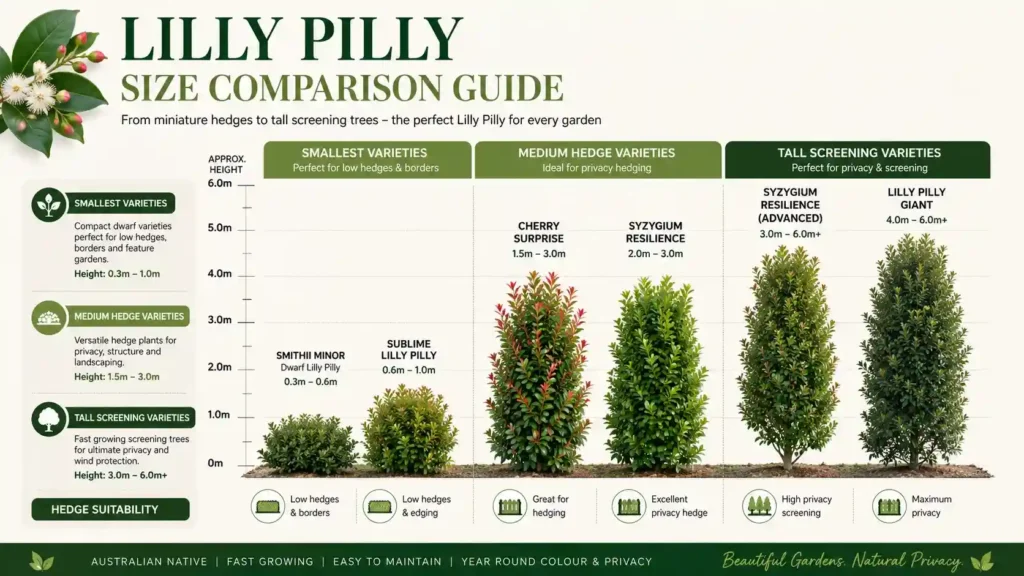
Acmena smithii height depends heavily on how the plant is maintained. In natural conditions without pruning, plants may reach the upper end of their mature height range. However, regular trimming keeps the structure compact and dense.
Typical hedge height expectations include:
|
Use Type |
Average Maintained Height |
| Low Border Hedge |
1–1.5 meters |
|
Medium Privacy Hedge |
2–3 meters |
| Tall Compact Screen |
4–5 meters |
Container-grown plants usually remain smaller due to restricted root space. In pots, acmena smithii minor height commonly stays between:
Pruning plays a major role in size control. Frequent trimming encourages:
Without pruning, plants become taller and looser in appearance. With regular maintenance, lilly pilly smithii minor remains one of the most practical compact hedging plants for modern Australian gardens.
Lilly pilly smithii minor is widely regarded as one of the best compact hedge plants for Australian gardens. Its naturally dense foliage, upright growth habit, and reliable response to pruning make it highly effective for creating neat and long-lasting green screens.
A well-maintained lilly pilly hedge provides several practical landscaping benefits:
Compared to larger hedge species, this compact lilly pilly remains easier to control while still delivering excellent coverage. The foliage grows tightly along the stems, helping create a fuller hedge with fewer gaps.
Many homeowners choose a syzygium smithii hedge because it offers:
Gardeners often consult detailed guides on hedging and screening plants to identify species that provide effective coverage and low-maintenance greenery for residential landscapes.
An acmena smithii hedge is also popular because it tolerates regular trimming exceptionally well, allowing gardeners to maintain clean and structured hedge lines with minimal effort.
Correct hedge lilly pilly spacing is essential for developing a dense and healthy screen. Proper spacing encourages even growth while allowing sufficient airflow around each plant.
Recommended spacing generally depends on the desired hedge density and mature height.
|
Hedge Density |
Recommended Spacing |
| Very Dense Hedge |
70–90 cm apart |
|
Standard Privacy Hedge |
1–1.5 meters apart |
| Informal Screen |
1.5–2 meters apart |
For faster hedge establishment:
An acmena smithii minor hedge usually fills out relatively quickly because of its naturally bushy structure. Most hedges begin forming noticeable screening coverage within 2–3 years under suitable growing conditions.
Maintenance spacing is also important. Plants positioned too closely may:
Balanced spacing helps maintain healthier long-term hedge performance.
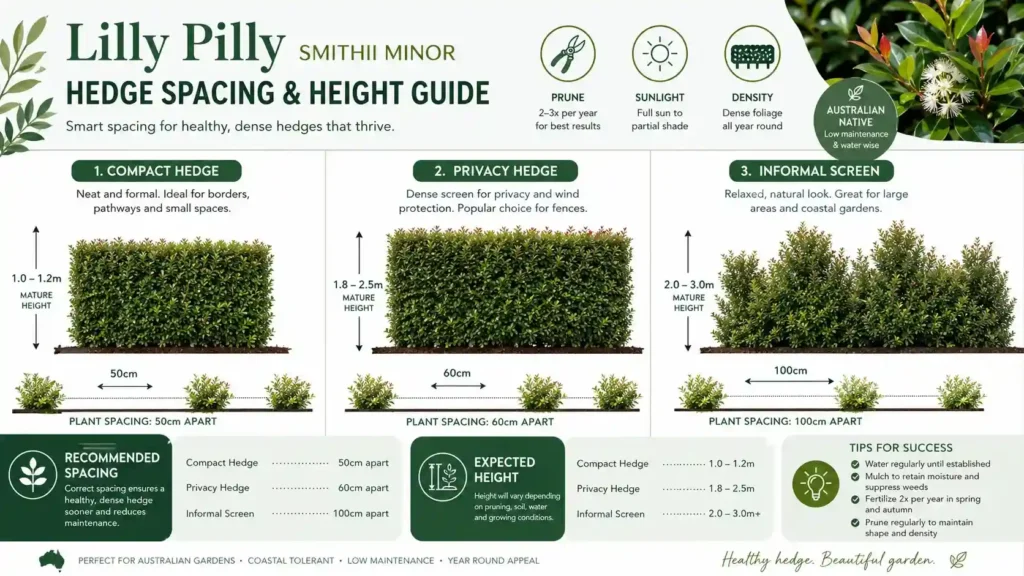
One of the biggest advantages of this lilly pilly compact variety is its flexibility in hedge design. It can be shaped into both formal and informal landscape styles depending on pruning frequency.
A formal lilly pilly hedge is created through regular trimming and structured shaping.
Features include:
Formal hedges are commonly used for:
Informal hedges maintain a softer and more natural appearance.
Characteristics include:
This style works well in:
Typical lilly pilly hedge height varies according to use:
|
Hedge Style |
Typical Height |
| Low Border Hedge |
1–1.5 meters |
|
Medium Privacy Hedge |
2–3 meters |
| Tall Screening Hedge |
4–5 meters |
Regular trimming helps maintain a dense and compact hedge shape while preventing excessive vertical growth.
Lilly pilly smithii minor is highly versatile and adapts well to many landscape applications. Its compact structure and evergreen foliage make it suitable for both decorative and functional planting.
Common landscaping uses include:
Its adaptability, compact growth habit, and dense foliage structure continue to make the acmena smithii hedge one of the most dependable hedge plants used throughout Australian residential landscaping.
Other native options, such as Tuckeroo Trees, can complement smithii minor hedges to provide layered screening and additional privacy in larger or multi-level landscapes.
|
Hedge Type |
Recommended Spacing | Expected Height |
Maintenance Level |
|
Low Border Hedge |
70–90 cm | 1–1.5 m | Low |
| Formal Privacy Hedge | 1–1.2 m | 2–3 m |
Moderate |
|
Informal Screen Hedge |
1.5–2 m | 3–5 m | Low to Moderate |
| Compact Urban Hedge | 80 cm–1 m | 1.5–2.5 m |
Moderate |
Lilly pilly smithii minor grows exceptionally well across many Australian regions due to its adaptability and strong tolerance to varying environmental conditions. As an australian lilly pilly, it performs best in temperate, subtropical, and coastal climates where moisture levels remain relatively consistent throughout the year.
Ideal growing conditions include:
This compact lilly pilly variety thrives in:
For the densest hedge growth and strongest foliage color, planting in full sun is generally recommended. However, partial shade is still suitable, particularly in hotter inland climates where afternoon sun can become intense.
Sunlight requirements:
Lilly pilly smithii minor also shows moderate frost tolerance once established. Young plants may experience light foliage damage during severe frosts, but mature plants usually recover well in spring.
Cold climate protection tips:
Because of its resilience and versatility, this variety remains one of the most dependable choices for residential hedging and compact landscape planting throughout Australia.
Healthy soil conditions play a major role in long-term plant performance. Like most lilly pilly varieties, this plant prefers rich, well-draining soil that retains moisture without becoming excessively wet.
Ideal soil conditions include:
Recommended soil pH:
Heavy clay soils may restrict root development and increase the risk of root stress. Sandy soils, on the other hand, may dry too quickly without additional organic matter.
To improve soil quality:
A healthy root environment helps the lilly pilly tree maintain dense foliage, stronger growth, and improved resistance to environmental stress.
Consistent watering is especially important during the establishment phase. Newly planted lilly pillies require regular moisture while roots develop and spread into surrounding soil.
For newly planted hedges and shrubs:
Signs of underwatering may include:
Once established, lilly pilly smithii minor becomes moderately drought tolerant. Mature plants can handle short dry periods better than young plants, especially when mulched properly.
However, prolonged drought may lead to:
Deep occasional watering is generally more beneficial than shallow frequent watering because it encourages stronger root growth.
Regular feeding helps maintain vigorous growth, dense foliage, and healthy hedge development. Proper fertilizing is an important part of caring for syzygium smithii, especially when plants are regularly pruned.
Best fertilizer types include:
Avoid excessive phosphorus-heavy products, particularly for young native plants.
|
Season |
Fertilizing Recommendation |
| Early Spring |
Apply balanced slow-release fertilizer |
|
Late Spring |
Light feeding for active growth |
| Summer |
Optional feeding if growth slows |
|
Autumn |
Mild feeding before cooler weather |
| Winter |
Usually not required |
Consistent feeding encourages:
Mulching is one of the most effective ways to support healthy root systems and maintain consistent soil conditions around the plant.
Benefits of mulching include:
Recommended mulch materials:
Apply mulch:
Healthy roots are essential for maintaining vigorous hedge growth and dense evergreen foliage. A properly mulched lily pily plant generally requires less watering, experiences less environmental stress, and establishes more successfully in both garden beds and hedge plantings.
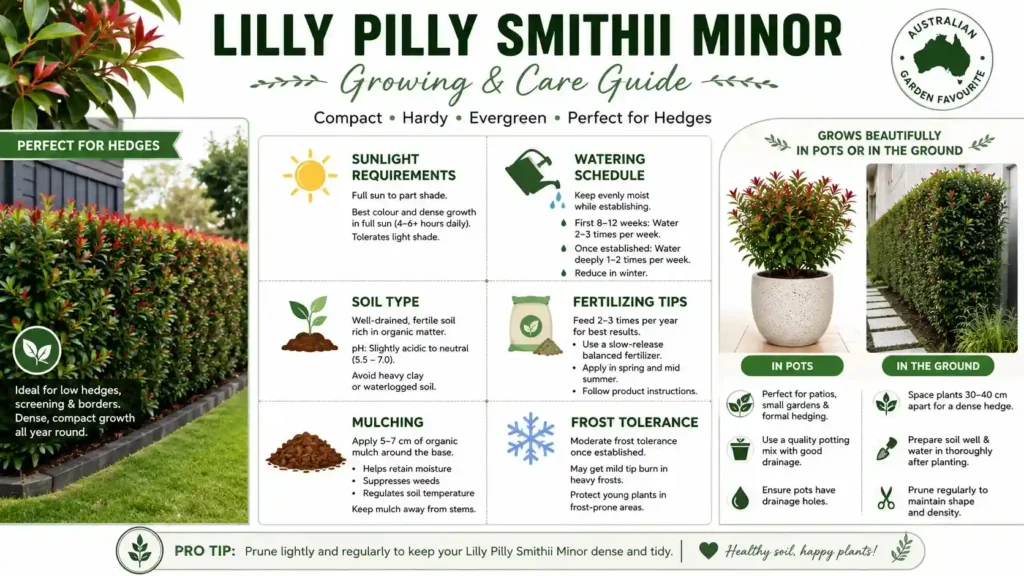
Regular pruning is essential for maintaining a dense, healthy, and attractive lilly pilly hedge. Lilly pilly smithii minor responds exceptionally well to trimming, making it one of the easiest compact hedge plants to shape and control.
The best seasons for pruning are:
These periods encourage active regrowth while helping maintain a fuller hedge structure.
Benefits of regular pruning include:
Young plants benefit from light formative pruning during early growth stages. Frequent light trimming usually produces a denser hedge than occasional heavy cutting.
For formal hedges:
For informal hedges:
Avoid heavy pruning during:
One of the major advantages of lilly pilly smithii minor is its natural compact structure. With proper maintenance, it can maintain a neat hedge shape for many years without excessive growth problems.
Effective hedge trimming techniques include:
A slightly narrower top and wider base:
Compact shaping methods work particularly well for:
When pruning:
Consistent maintenance helps preserve the naturally tidy appearance that makes this variety so popular for compact residential landscaping.
Although lilly pilly smithii minor is relatively hardy, some common issues can still affect plant health under unsuitable growing conditions.
Psyllids are small sap-sucking insects that commonly affect some lilly pilly varieties.
Symptoms may include:
Smithii minor is often chosen because it shows better psyllid resistance than many other lilly pilly types.
Management strategies:
Yellow foliage may result from:
Solutions include:
Compacted or waterlogged soil can place stress on the root system.
Signs include:
Prevent root stress by:
Poor drainage is one of the most common causes of long-term plant decline.
Excess moisture may lead to:
To improve drainage:
Lilly pilly smithii minor is highly regarded for its strong disease resilience and relatively low-maintenance nature. This reliability is one reason why it remains one of the most widely planted compact hedge varieties in Australia.
Key resistance benefits include:
Healthy plants grown under suitable conditions generally experience fewer pest and disease problems.
Disease prevention tips:
Its dense foliage, manageable growth habit, and dependable resilience continue to make smithii minor one of the most practical choices for low-maintenance hedges, privacy screens, and structured landscape planting.
Lilly pilly smithii minor is generally considered to have a relatively non-invasive root system compared to many larger hedge trees and fast-growing screening plants. Its roots are typically compact, fibrous, and less aggressive, making it a safer option for residential gardens and urban landscapes.
In most situations, the root system grows:
Because of its controlled growth habit, this variety is commonly planted near:
However, like all plants, root behavior can vary depending on:
Roots naturally seek moisture and nutrients. If pipes are leaking or soil remains consistently damp near structures, roots may grow toward those areas.
Healthy modern pipes are rarely affected by lilly pilly smithii minor roots. Problems usually occur only when:
Compared to large invasive tree roots, this compact variety poses a much lower risk near residential infrastructure.
Potential concerns may include:
Maintaining healthy soil conditions and proper planting distance greatly reduces future root-related problems.
Correct planting distance helps support healthy root growth while protecting nearby structures and allowing adequate airflow around the plant.
Recommended planting distances include:
|
Structure |
Recommended Distance |
|
Fences |
50 cm–1 meter |
| House Foundations |
2–3 meters |
|
Pools |
2–4 meters |
| Pathways & Paving |
1–1.5 meters |
Lilly pilly smithii minor is commonly used along fence lines because of its dense screening ability and manageable root spread.
Benefits of fence planting include:
Allowing some space between the hedge and fence:
Although the roots are not considered highly invasive, maintaining distance from building foundations is still recommended.
Proper spacing helps:
This variety is often considered safer near pools than many large hedging trees due to its compact root structure.
Still, planting too close may increase:
Adequate spacing improves long-term landscape management around pool areas.
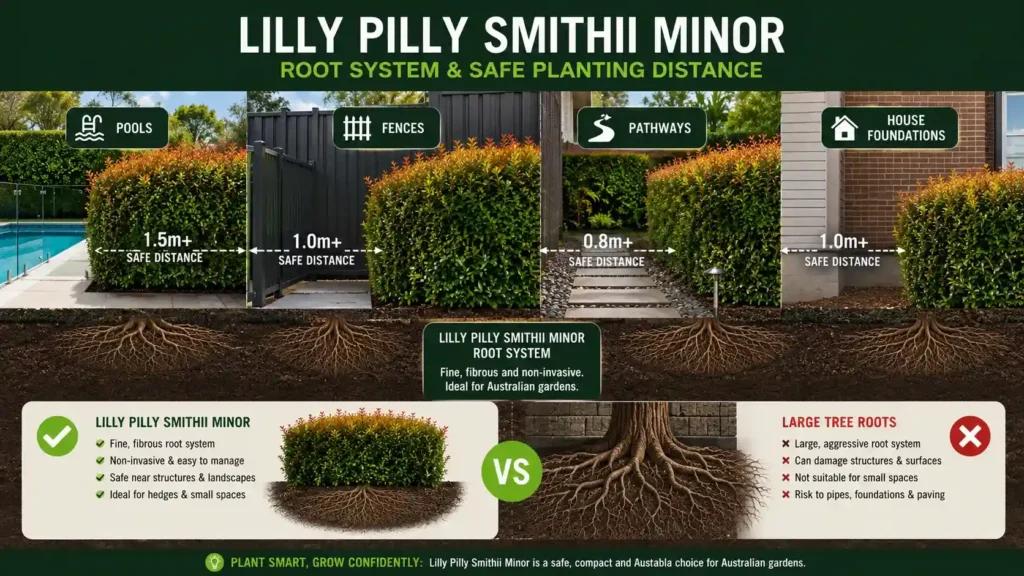
Compared with taller lilly pilly varieties and large screening cultivars, smithii minor develops a much more compact and controlled root system.
Key differences include:
|
Variety Type |
Root Spread | Growth Strength | Suitability Near Structures |
| Smithii Minor | Compact | Moderate |
Excellent |
|
Large Syzygium Varieties |
Wider | Strong | Moderate |
| Tall Screening Lilly Pillies | Extensive | Vigorous |
Requires More Space |
The compact root spread of smithii minor makes it highly suitable for:
Because the root system remains relatively manageable, it is widely used for hedge planting where controlled growth and lower infrastructure risk are important priorities.
Regular pruning, proper watering, and suitable planting distances help maintain balanced root development and long-term plant health.
Australia offers a wide range of lilly pilly cultivars suited to different hedge styles, garden sizes, and landscaping goals. While lilly pilly smithii minor is highly valued for compact hedging, other varieties may offer faster growth, brighter foliage, or increased screening height.
Understanding the differences between popular acmena smithii varieties helps gardeners choose the most suitable plant for their landscape needs.
Lilly pilly smithii minor and Cherry Surprise are both popular hedging plants, but they differ in appearance, growth habit, and overall landscape use.
Smithii minor typically produces:
Cherry surprise lilly pilly is known for:
The decorative foliage color of acmena cherry surprise often makes it more visually striking in feature landscaping.
Smithii minor develops:
Lilly pilly cherry surprise generally grows:
Smithii minor is often preferred for:
Cherry surprise lilly pilly works well for:
Sublime lilly pilly is another highly popular hedge cultivar used throughout Australia for dense screening and psyllid resistance.
Smithii minor:
Acmena smithii sublime:
Both varieties show good resistance compared to older lilly pilly cultivars. However, sublime lilly pilly is particularly well known for its improved psyllid tolerance in humid regions.
Benefits include:
Smithii minor:
Acmena smithii sublime:
Allyn magic lilly pilly is a decorative dwarf variety often selected for ornamental planting and compact landscapes.
Both cultivars remain relatively compact compared to large screening forms.
Smithii minor:
Allyn magic lilly pilly:
Allyn magic is especially valued for:
Smithii minor focuses more on:
Smithii minor is ideal for:
Allyn magic performs best in:
Several other lilly pilly varieties australia gardeners commonly use offer different sizes, colors, and growth habits.
Purple rain lilly pilly is known for:
Best suited for:
Red head lilly pilly produces:
Popular uses include:
Cascade lilly pilly has a softer growth habit with slightly weeping branches.
Common applications:
Syzygium resilience is widely planted because of its:
It is commonly used for:
|
Variety |
Mature Height | Hedge Suitability | Growth Rate |
Best Use |
|
Smithii Minor |
2–5 m | Excellent | Moderate | Compact hedges & small gardens |
| Cherry Surprise | 4–6 m | Excellent | Fast |
Colorful privacy screens |
|
Sublime Lilly Pilly |
5–8 m | Excellent | Fast | Medium to tall hedges |
| Allyn Magic Lilly Pilly | 1–2 m | Moderate | Moderate |
Decorative borders & pots |
|
Purple Rain Lilly Pilly |
4–6 m | Very Good | Fast | Ornamental hedging |
| Red Head Lilly Pilly | 5–8 m | Excellent | Fast |
Tall dense screening |
|
Cascade Lilly Pilly |
3–5 m | Good | Moderate | Informal landscaping |
| Syzygium Resilience | 6–8 m | Excellent | Fast |
Large privacy hedges |
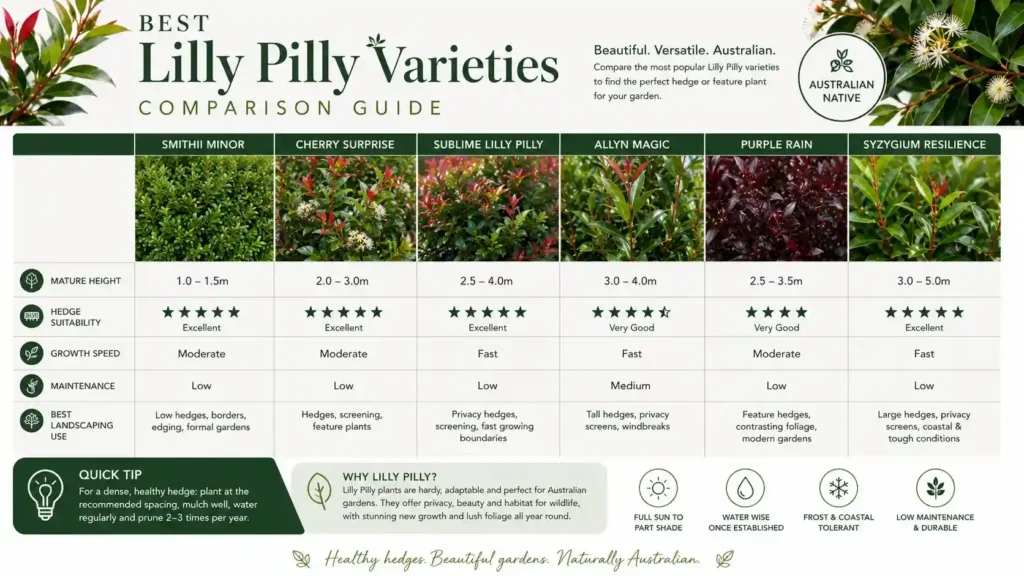
Lilly pilly smithii minor grows very successfully in containers, making it an excellent choice for patios, balconies, courtyards, and compact urban gardens. Its naturally dense foliage and controlled growth habit allow it to maintain an attractive appearance in pots with relatively simple maintenance.
Container growing is especially useful for:
With proper care, potted plants can remain healthy and dense for many years.
Choosing the correct pot size is important for root development, moisture balance, and long-term plant health.
General pot recommendations include:
|
Plant Size |
Recommended Pot Diameter |
| Young Plant |
30–40 cm |
|
Medium Hedge Plant |
45–60 cm |
| Mature Feature Plant |
70 cm+ |
A larger container provides:
Pots should always include:
Oversized containers are usually preferable to undersized pots because restricted roots can reduce foliage density and overall hedge performance.
A high-quality potting mix is essential for healthy container growth. Lilly pilly smithii minor prefers moisture-retentive but well-draining soil that supports strong root development without becoming waterlogged.
An ideal potting mix should contain:
Recommended features:
Avoid:
Refreshing the top layer of potting mix annually helps maintain soil quality and nutrient availability.
Container-grown lilly pillies generally require more frequent watering than garden-planted specimens because pots dry out faster, especially during hot weather.
Young container plants:
Mature potted plants:
General watering tips:
Signs of underwatering:
Signs of overwatering:
Nutrients in containers deplete faster than in garden soil, making regular feeding important.
Best fertilizer options:
Recommended feeding schedule:
Consistent feeding supports:
Lilly pilly smithii minor is one of the most practical evergreen plants for small-space landscaping because of its upright compact structure and reliable hedge performance.
Popular uses include:
Container-grown lilly pillies also pair well with:
Their manageable size, dense foliage, and adaptability continue to make them one of the best compact evergreen screening plants for balconies, patios, and urban garden design.
Growing lilly pilly seedlings is one of the easiest and most reliable ways to establish healthy hedges and ornamental garden plants. Young seedlings adapt well to Australian growing conditions and typically establish quickly when planted in suitable soil with regular moisture.
Most nursery-grown seedlings are already partially established and can be planted directly into:
When planting seedlings:
Early care is important because strong root development supports faster foliage growth and improved hedge density later.
Benefits of growing from seedlings include:
Young lilly pilly trees generally develop dense branching relatively early, especially when lightly tip-pruned during active growth periods.
Propagation from cuttings is a common method used to produce genetically identical plants with consistent growth characteristics.
Semi-hardwood cuttings are typically taken from healthy stems during active growing seasons.
Basic propagation steps include:
Suitable propagation media may include:
Cuttings usually root more successfully when:
Root development commonly occurs within several weeks depending on environmental conditions and plant health.
Propagation from cuttings is often preferred for maintaining the exact characteristics of compact hedge cultivars and ornamental lilly pilly trees.
Lilly pilly plants generally establish steadily during their early years, especially when grown in fertile soil with regular watering and seasonal feeding.
Typical early growth stages include:
|
Growth Stage |
Development |
| First 3 Months |
Root establishment and early foliage growth |
|
6–12 Months |
Increased branching and stronger leaf density |
| 1–2 Years |
Noticeable hedge shaping and vertical growth |
|
2–3 Years |
Developing privacy screen or compact hedge |
| 4+ Years |
Mature structured growth begins forming |
Growth speed depends on:
Young lily pilly trees often grow faster in warmer Australian climates where growing conditions remain stable throughout the year.
Tip pruning during early stages helps:
The best time to plant lilly pilly seedlings is usually during:
These periods allow roots to establish before extreme summer heat or winter cold arrives.
Avoid planting during:
Proper timing improves:
With correct planting practices and consistent early care, lilly pilly trees develop into dense, evergreen hedges and compact landscape plants suitable for a wide range of Australian garden styles.
Lilly pilly smithii minor is considered a moderately fast-growing hedge plant under suitable growing conditions. While it is not as aggressively fast as some larger screening varieties, it develops steadily and forms dense foliage relatively quickly.
Growth speed depends on factors such as:
In ideal conditions, young plants can establish noticeable hedge coverage within:
Its balanced growth habit is one reason many gardeners prefer it over larger varieties. The plant grows quickly enough to create effective screening while remaining easier to manage and maintain.
Regular pruning also encourages:
Yes, lilly pilly smithii minor produces small edible berries after flowering. The berries are typically:
The fruit is commonly used in:
Although edible, berry flavor can vary between different lilly pilly varieties. Some produce sweeter fruit, while others are more ornamental than culinary.
The plant also develops:
For many gardeners, the berries provide additional decorative value alongside the plant’s screening performance.
Lilly pilly smithii minor can tolerate partial shade reasonably well, although growth performance is usually strongest in full sun or bright filtered light.
Shade tolerance includes:
In shaded locations, the plant may experience:
For best hedge performance:
In hotter Australian regions, partial afternoon shade may actually help reduce moisture stress during summer.
Because of its adaptability, this variety performs successfully in many residential environments where sunlight conditions vary throughout the day.
Lilly pilly smithii minor is generally considered one of the safer hedge plants for planting near pools, pathways, and paved areas because of its relatively compact root system.
Compared with large invasive tree species, its roots are:
This makes it suitable for:
However, proper planting distance is still important to reduce:
Poolside considerations include:
With correct spacing and regular pruning, the plant performs very well around modern landscape structures.
Yes, lilly pilly smithii minor is one of the best hedge plants for small gardens due to its compact growth habit and strong response to pruning.
Its manageable size makes it ideal for:
Benefits for smaller spaces include:
Unlike larger screening trees, this variety can maintain effective privacy without overwhelming limited garden areas.
It also works extremely well in:
Its combination of dense growth, manageable size, and low-maintenance performance continues to make lilly pilly smithii minor one of the most practical compact hedge plants for Australian residential gardens.
Lilly pilly smithii minor remains one of the best compact Australian hedging plants for residential landscapes due to its dense evergreen foliage, manageable growth habit, and reliable adaptability across different climates. Its naturally compact structure makes it highly suitable for modern gardens where space efficiency, privacy, and low-maintenance landscaping are important priorities.
This variety performs exceptionally well for:
Its strong hedge performance, moderate growth rate, and good psyllid resistance continue to make it one of the most dependable lilly pilly varieties for Australian homes.
Lilly pilly smithii minor is especially valuable because it offers:
When selecting a lilly pilly variety, it is important to consider:
Compact varieties like smithii minor are ideal for smaller residential spaces, while taller lilly pilly cultivars may suit larger boundary hedges and expansive landscapes better.
With proper planting, watering, pruning, and spacing, lilly pilly smithii minor can provide long-lasting greenery, effective privacy, and attractive structure for a wide range of Australian landscaping styles.
Lilly pilly smithii minor typically grows between 2–5 meters tall depending on soil quality, climate, pruning frequency, and planting conditions. When regularly trimmed as a hedge, it is commonly maintained between 1.5–3 meters for compact privacy screening.
Yes, it is considered one of the best compact hedge varieties in Australia. Its dense evergreen foliage, compact growth habit, and strong response to pruning make it ideal for: Privacy hedges Border planting Urban screening Small garden landscapes It also forms thick foliage coverage relatively quickly compared to many traditional hedge plants.
Acmena smithii and Syzygium smithii are closely related botanical classifications used for the same general lilly pilly group. Many plants previously classified under Acmena were later reclassified into the Syzygium genus through updated botanical systems. In gardening and landscaping, both names are still commonly used interchangeably for lilly pilly varieties.
Lilly pilly smithii minor generally has a compact and less aggressive root system compared to large screening trees. The roots are usually safe for residential gardens when planted at appropriate distances from: Foundations Pools Pipes Pathways Problems are uncommon unless roots encounter damaged pipes or consistently wet soil areas.
Recommended spacing depends on the desired hedge density. General spacing guidelines: Dense formal hedge: 70–90 cm apart Standard privacy hedge: 1–1.5 meters apart Informal screen: 1.5–2 meters apart Closer spacing produces faster hedge coverage, while wider spacing improves airflow and long-term maintenance access.
Yes, smithii minor is widely valued for its improved psyllid resistance compared to many older lilly pilly varieties. While no plant is completely immune, this variety generally experiences fewer leaf damage issues and maintains healthier foliage under normal growing conditions.
Several dwarf and miniature lilly pilly cultivars are available in Australia. Some of the smallest varieties include: Allyn Magic Tiny Trev Backyard Bliss Lilly Pilly Smithii Minor These compact varieties are commonly used for: Small gardens Decorative borders Pot planting Low hedges
Yes, this variety grows very successfully in containers and pots. Its compact root system and manageable growth habit make it ideal for: Balconies Courtyards Patios Small-space landscaping Large pots with quality drainage and regular feeding help maintain healthy long-term growth.
Lilly pilly smithii minor is considered a moderately fast-growing hedge plant. Under suitable conditions with regular watering and fertilizing, it can establish a noticeable privacy hedge within 2–3 years. Growth speed improves with: Full sun exposure Rich well-draining soil Seasonal feeding Consistent moisture
This variety grows best in full sun to partial shade. Full sun encourages: Denser foliage Faster hedge growth Stronger leaf color However, it can still perform well in partially shaded areas, especially in warmer Australian climates.
Yes, mature plants produce small edible berries after flowering. The berries are usually pink to purple and can attract birds and pollinators to the garden. Some gardeners also use the fruit for jams and native food recipes.
Yes, it is one of the most suitable evergreen hedging plants for compact residential gardens. Its naturally controlled growth and easy pruning make it ideal for: Narrow garden beds Courtyards Urban landscapes Small privacy screens It provides dense greenery without becoming excessively large or difficult to maintain.
Most lilly pilly hedges benefit from light pruning several times during the active growing season. Regular trimming: Encourages dense growth Maintains compact shape Prevents uneven branching Improves overall hedge appearance Formal hedges usually require more frequent trimming than informal screens.