Grow Better Gardens with Smarter Plant Choices
Discover helpful guides on trees, hedges, fruit plants, edible plants, and beautiful landscape greenery.

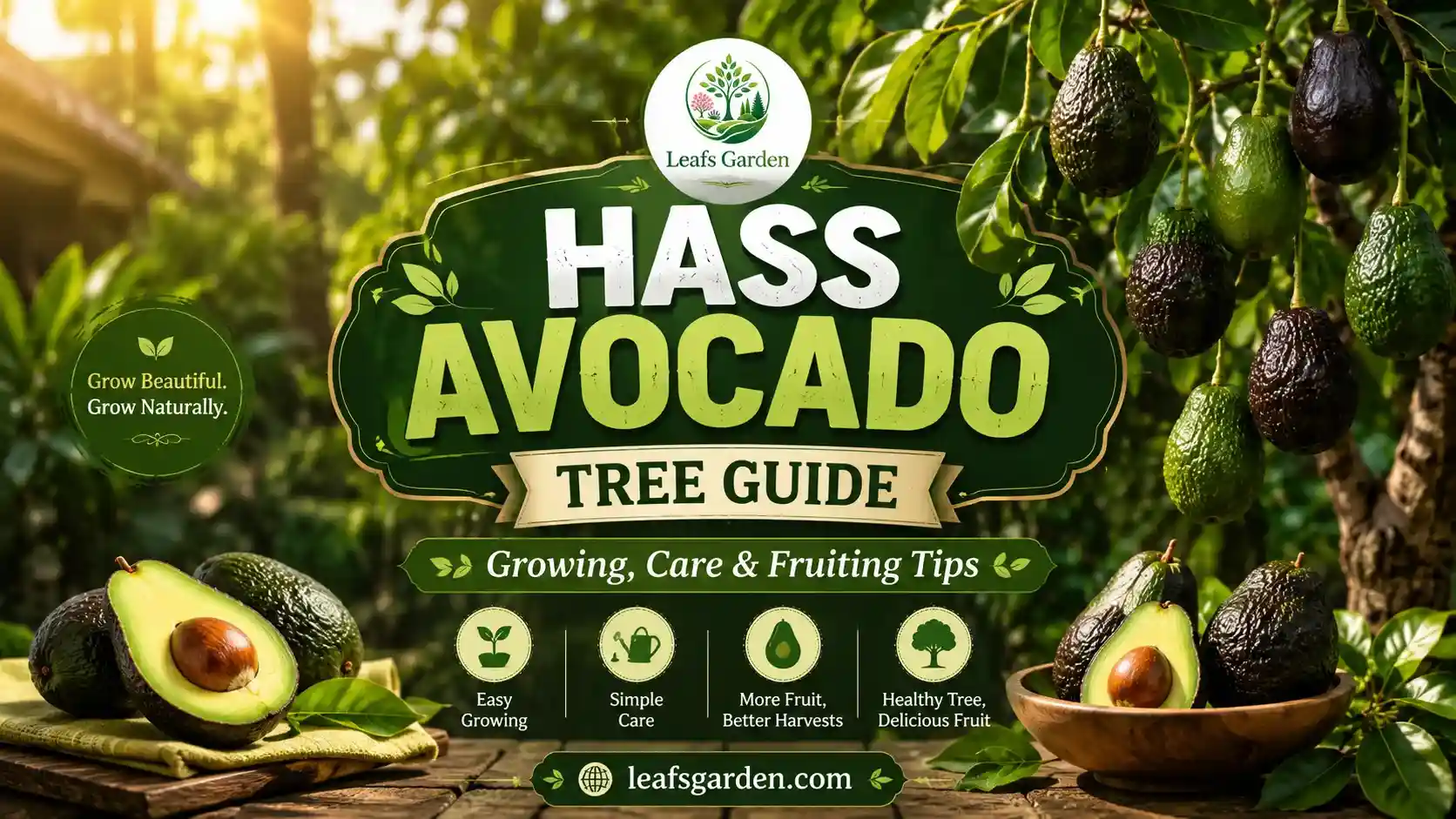
The Hass avocado tree is the most popular avocado variety worldwide because of its creamy avocado fruit, reliable harvests, and strong adaptability to warm climates like Australia, California, Florida, and many subtropical regions. Gardeners prefer the hass avocado for its rich flavor, productive growth habit, and long harvesting season.
A hass avocado tree is commonly grown in home gardens, backyard orchards, and commercial farms because it produces consistent fruit and adapts well to different growing conditions. Many homeowners choose avocado trees for fresh fruit production, tropical landscaping, and container growing.
In Australia, the avocado tree hass variety grows especially well in Queensland, New South Wales, Western Australia, and other mild coastal regions. The avocado hass tree also performs successfully in warm parts of the USA and similar climates worldwide where frost is limited and sunlight is abundant.
From compact potted plants to full-sized outdoor avocado trees, the hass avocado tree remains one of the most rewarding fruit trees for long-term home growing and productive harvests.
The Hass avocado tree is a grafted variety of Persea americana known for dark pebbly skin, creamy texture, and rich buttery flesh. It is the most widely grown avocado species for home gardens and commercial production because of its dependable fruit quality and strong productivity.
Those looking to expand their backyard harvest will find the Hass avocado a standout addition among productive fruit trees and edible plants suited to warm Australian climates.
| Classification | Details |
| Scientific Name | Persea americana |
| Common Name | Hass avocado tree |
| Plant Type | Evergreen fruit tree |
| Family | Lauraceae |
| Avocado Species | Persea americana avocado |
| Origin | California, USA |
The americana avocado tree has a dense evergreen canopy with glossy green foliage and spreading branches. Young trees usually grow upright before developing a broader rounded shape as they mature.
Leaves are oval to lance-shaped with a leathery texture and deep green surface. Mature leaves can grow 10–30 cm long depending on climate and growing conditions. Healthy foliage gives the tree a lush tropical appearance throughout the year.
The bark texture is slightly rough and grey-brown on mature trunks. Younger stems remain smoother and greener before thickening over time. Most avocado species develop branching canopies that respond well to pruning and shaping.
A flowering avocado tree produces clusters of small yellow-green blossoms during the blooming season. The flowers are not highly decorative, but heavy flowering is an important sign of healthy fruit production potential.
The Hass variety is usually propagated through grafting instead of seed because grafted trees maintain reliable fruit quality, predictable growth habits, and faster production.
A mature Hass avocado tree develops a broad, rounded canopy with dense evergreen foliage and strong branching structure. In warm climates, a full grown avocado tree creates a tropical appearance that works well in backyard orchards and edible landscapes.
The average avocado tree height for Hass varieties ranges from 5 to 12 meters outdoors depending on pruning, soil quality, and climate conditions. Some unpruned trees may grow even taller in ideal subtropical environments.
| Feature | Average Size |
| Mature Height | 5–12 m |
| Canopy Spread | 4–8 m |
| Leaf Length | 10–30 cm |
| Growth Habit | Rounded and spreading |
An avocado tree with fruits becomes highly attractive during the harvest season because the dark-skinned avocados hang beneath the dense foliage. Mature fruit gradually changes from green to deep purplish-black as it ripens.
During flowering season, the avocado tree bloom appears as clusters of tiny yellow-green flowers spread across branch tips. Although avocado tree flowers are small, mature healthy trees can produce thousands of blooms during peak flowering periods.
Different avocado tree varieties vary in fruit size, flavor, cold tolerance, and tree growth habit. In Australia and the USA, Hass remains the dominant commercial and home-growing variety because of its creamy texture and reliable production.
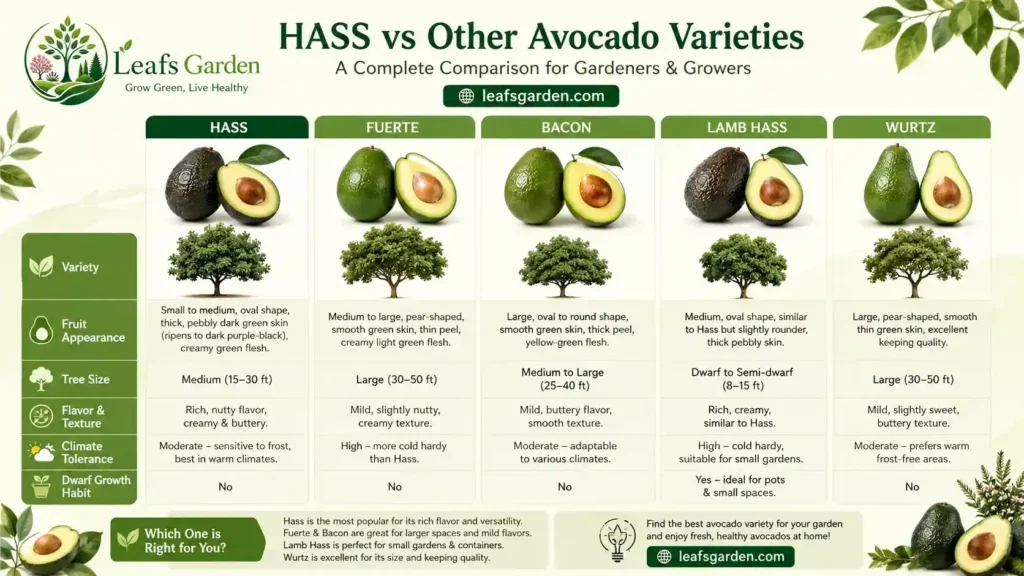
| Variety | Fruit Characteristics | Tree Size | Climate Tolerance | Best Feature |
| Hass | Dark pebbly skin, creamy flesh | Medium-large | Warm subtropical | Best flavor and commercial variety |
| Fuerte avocado | Smooth green skin, mild flavor | Large | Better cold tolerance | Excellent pollinator |
| Bacon avocado | Thin green skin, lighter flavor | Medium-large | Cool tolerant | Suitable for cooler regions |
| Lamb Hass | Similar to Hass but larger fruit | Medium | Warm climates | Late-season production |
| Wurtz avocado | Small compact fruit tree | Dwarf avocado tree | Container friendly | Best for pots and small gardens |
The fuerte avocado tree is commonly grown as a companion pollinator for Hass trees because it improves fruit set during flowering season. Bacon avocado tree varieties are also popular in cooler growing areas due to better frost tolerance.
In Australia, growers often choose Hass as the primary type of avocado in Australia because of strong market demand and high-quality fruit. However, dwarf avocado tree varieties like Wurtz are increasingly popular for patios, courtyards, and container gardening.
Hass avocado trees grow best in warm subtropical and Mediterranean climates with mild winters, low frost exposure, and long sunny growing seasons. Healthy trees perform best where temperatures remain stable and drainage is excellent.
Many gardeners choose the hass avocado tree because it adapts well to coastal and warm inland regions across Australia, the USA, and other subtropical parts of the world. Consistent warmth and sunlight help improve flowering, fruit production, and overall tree health.
Hass avocado trees thrive in regions with:
The avocado tree Australia climate is highly suitable in many regions, especially along warmer coastal areas. Australia avocado production is strongest in subtropical zones where temperatures remain relatively mild year-round.
Popular Australian growing regions include:
Gardeners growing tropical fruit trees in these warm Australian regions may also enjoy cultivating the Kensington Pride mango, another highly productive backyard fruit tree that thrives in similar subtropical conditions.
In the USA, Hass avocado trees grow successfully in:
California remains the largest commercial growing region because Mediterranean weather conditions closely match the tree’s natural preferences.
Gardeners worldwide grow Hass avocado trees in:
People searching where can you grow avocado trees should focus mainly on frost protection, sunlight, and drainage quality. Cold winters are usually the biggest limitation for healthy avocado growth.
Hass avocado trees grow best in USDA Zones 9–11 where winter temperatures remain relatively mild. Trees can survive brief cold periods, but extended frost often damages leaves, flowers, and young fruit.
| Australian Region | Growing Suitability |
| Queensland | Excellent |
| Northern NSW | Excellent |
| Coastal WA | Very Good |
| Warm Victoria Zones | Moderate to Good |
| Tropical North | Good with management |
Queensland is one of the strongest avocado-producing areas because of its warm subtropical climate and long growing season. Northern NSW also supports strong backyard and commercial production.
In Western Australia, coastal regions with mild winters perform best. Victoria can successfully grow avocado trees in warmer protected zones, especially near coastal environments.
An avocado tree Melbourne location may require additional frost protection during winter because cooler southern temperatures can slow growth and damage young trees.
| USA Region | USDA Zones |
| Southern California | 9–11 |
| Florida | 9–11 |
| Southern Texas | 9–10 |
| Hawaii | 10–11 |
The best time to plant avocado trees Australia wide is usually during:
Warmer soil temperatures help young roots establish faster and reduce transplant stress.
Hass avocado trees grow best outdoors in warm climates, but smaller trees can also survive indoors with enough sunlight and careful care management.
An indoor avocado tree usually grows more slowly than outdoor trees because indoor conditions often provide less sunlight, lower humidity, and restricted root space.
To grow avocado trees indoors successfully, provide:
Many gardeners start an avocado plant indoor from seed before moving it outdoors later. Young seedlings adapt more easily to indoor environments during early growth stages.
| Growing Method | Suitability |
| Outdoor ground planting | Best long-term growth |
| Large outdoor containers | Very good |
| Indoor containers | Moderate |
| Small indoor pots | Temporary only |
An avocado tree in pot conditions needs regular pruning and careful watering because roots become restricted over time. Dwarf varieties generally adapt better to containers than full-sized Hass trees.
People interested in growing avocado plant indoors should understand that fruit production indoors is less common unless trees receive strong light and proper pollination conditions. Outdoor planting usually provides better flowering and heavier fruit yields.
A full-grown Hass avocado tree can reach 5–12 meters outdoors depending on climate, soil quality, growing conditions, and pruning practices. Trees grown in warm subtropical regions with ideal care usually become larger and develop broader canopies over time.
Many gardeners ask how big do avocado trees get because mature trees require significant vertical and horizontal growing space. Without pruning, a mature avocado tree can become dense, tall, and wide-spreading.
| Tree Feature | Average Size |
| Mature Height | 5–12 m |
| Canopy Width | 4–8 m |
| Trunk Thickness | Moderate to thick |
| Growth Rate | Medium to fast |
The size of Hass avocado tree growth depends heavily on:
People searching how tall does avocado tree grow should know that container-grown trees usually remain much smaller than ground-planted trees. Outdoor trees in frost-free regions often reach their maximum size faster.
An avocado tree mature enough for consistent fruit production typically develops a rounded evergreen canopy with strong branching structure. Mature trees also produce heavier flowering and larger seasonal harvests.
| Growth Stage | Approximate Height |
| Young Tree | 1–2 m |
| Developing Tree | 2–5 m |
| Mature Fruit-Producing Tree | 5–12 m |
Regular pruning helps control height, improves airflow, and makes harvesting easier. Many home gardeners intentionally maintain smaller trees for easier maintenance and better backyard management.
A dwarf Hass avocado tree is a compact avocado variety designed for smaller gardens, patios, balconies, and container growing. These smaller trees are easier to maintain while still producing quality fruit under suitable conditions.
Dwarf avocado trees are becoming increasingly popular in urban gardens across Australia because many homeowners have limited outdoor space.
| Dwarf Type | Approximate Height |
| Miniature avocado tree | 1.5–3 m |
| Standard dwarf avocado tree | 2–4 m |
| Full outdoor Hass tree | 5–12 m |
A dwarf avocado tree Australia growers commonly select is the Wurtz variety, sometimes called “Little Cado.” It is one of the most reliable dwarf avocado tree varieties for container gardening and small backyard spaces.
People searching for the smallest avocado tree often prefer compact grafted varieties because they remain manageable while still producing fruit relatively early.
Even compact trees still require strong sunlight, proper drainage, and regular feeding for healthy growth and fruiting.
Hass avocado trees develop shallow but wide-spreading root systems that require space, oxygen, and excellent drainage. Most roots remain close to the soil surface rather than growing deeply downward.
Because of the spreading root system, proper spacing is important for healthy long-term growth.
| Planting Type | Recommended Spacing |
| Backyard planting | 4–6 m apart |
| Commercial orchards | 5–8 m apart |
| Dwarf varieties | 2–4 m apart |
Trees planted too closely often compete for sunlight, nutrients, and airflow, increasing disease risk and reducing fruit production.
An avocado tree grown in containers remains smaller because roots become restricted over time. Container-grown trees require:
Small containers can slow growth, reduce fruiting, and create root stress in mature trees.
For best results, plant Hass avocado trees in locations with:
Avoid low-lying garden areas where water collects after heavy rain because avocado roots are highly sensitive to excess moisture and root rot conditions.
Grafted Hass avocado trees fruit faster and produce reliable fruit quality compared to seed-grown trees. Most commercial growers and experienced gardeners prefer grafted trees because they provide predictable growth, earlier harvests, and consistent avocado production.
An avocado tree from seed can still grow successfully, but fruit quality and production time are often unpredictable. Some seed-grown trees may never produce fruit identical to the parent Hass avocado.
| Feature | Seed-Grown Tree | Grafted Avocado Tree |
| Fruiting Time | 7–15 years | 2–4 years |
| Fruit Quality | Unpredictable | Consistent |
| Tree Size | Often larger | Easier to manage |
| Reliability | Variable | Highly reliable |
| Commercial Use | Rare | Standard method |
Growing avocado from seed is popular for educational projects and indoor gardening because the germination process is simple and visually rewarding. However, gardeners wanting dependable fruit production usually choose an avocado grafted tree from a nursery.
Seed-grown trees still have value for experimentation, decorative growing, and learning about avocado development stages.
Learning how to grow avocado from seed is one of the most common ways beginners start avocado gardening. Healthy seeds germinate relatively easily when warmth, moisture, and light conditions remain stable.
Start with a fresh ripe avocado and carefully remove the seed without damaging it.
Before avocado seed growing begins:
The flat end is the root side, while the pointed end produces the stem.
One of the most popular methods is to grow avocado seed in water using toothpicks.
This process is commonly called planting avocado seeds in water because roots develop before soil planting begins.
| Stage | Approximate Time |
| Seed cracking | 2–6 weeks |
| Root emergence | 3–8 weeks |
| Stem growth | 4–10 weeks |
| Early leaf development | 6–12 weeks |
During germination, the avocado pit sprout slowly opens as roots grow downward and stems emerge upward.
Once roots become strong and stems develop leaves, transplant the seed into soil.
Use:
Keep the top half of the seed slightly exposed above the soil surface.
Young avocado seedlings need:
Avoid overwatering because young roots are sensitive to excess moisture.
As roots expand, move the tree into a larger container or outdoor location. Transplanting is best done during warm weather when growth remains active.
Hass avocado trees grow best in loose, fertile, and well-draining soil with moderate organic matter. Healthy root systems require constant oxygen flow and cannot tolerate waterlogged conditions.
Good avocado growing conditions focus heavily on drainage because avocado roots are highly sensitive to standing water.
| Soil Factor | Recommended Range |
| Soil Type | Sandy loam or loose loam |
| Drainage | Excellent |
| Soil pH | 5.5–7 |
| Organic Matter | Moderate |
For container growing, use a soil mix containing:
This combination improves drainage requirements while maintaining enough moisture for healthy growth.
Raised beds are often useful in areas with dense or poorly draining soil because they reduce root rot risk and improve aeration.
Hass avocado trees require full sunlight, warm temperatures, and protection from severe frost to grow successfully. Mature trees thrive in stable subtropical climates with long sunny growing seasons.
Healthy avocado trees need:
Insufficient sunlight often causes:
| Condition | Preferred Range |
| Ideal growing temperature | 16–29°C |
| Mild frost tolerance | Brief exposure only |
| Extreme heat tolerance | Moderate with watering |
Young trees are especially vulnerable to frost sensitivity. Cold temperatures can damage leaves, flowers, and developing fruit.
Although Hass avocado trees tolerate warm weather well, extreme dry heat and strong winds may stress the tree.
Strong winds can:
Wind protection barriers, sheltered planting positions, and regular deep watering help reduce environmental stress during hot conditions.
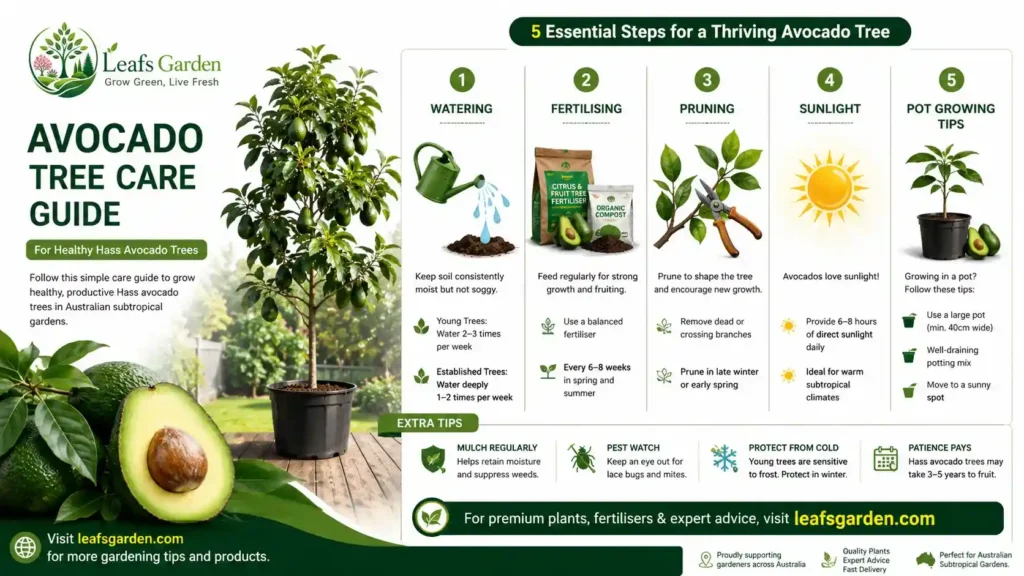
Hass avocado trees prefer deep but infrequent watering with excellent drainage. Consistent moisture helps support healthy roots, flowering, and fruit production, but excessive watering can quickly damage the tree.
Avocado roots are shallow and sensitive to waterlogged soil, so balanced watering is essential for long-term growth.
| Tree Age | Recommended Watering |
| Young trees | 2–3 times weekly during warm weather |
| Established trees | Deep watering every 5–10 days |
| Container trees | More frequent monitoring required |
Hot weather, sandy soil, and strong winds usually increase watering needs. Cooler months reduce moisture demand and watering frequency.
A lack of water can slow growth and reduce fruit production.
Common drought stress signs include:
Too much water is one of the most common avocado tree problems.
Watch for:
Healthy Hass avocado trees grow best when soil dries slightly between deep watering sessions. Good drainage is more important than frequent watering.
The best fertiliser for avocado trees provides balanced nutrients that support leafy growth, root development, flowering, and fruit production. Hass avocado trees benefit from regular feeding during active growing seasons.
| Nutrient | Main Benefit |
| Nitrogen | Leaf and branch growth |
| Potassium | Fruit development |
| Phosphorus | Root growth |
| Magnesium | Leaf health |
| Zinc | Flower and fruit production |
Many gardeners use a slow-release fertilizer for avocado trees formulated specifically for citrus and fruit trees.
In Australia, avocado fertiliser products often contain:
Avocado trees growing in sandy soils may require more regular nutrient applications because nutrients leach faster after watering and rainfall.
| Season | Feeding Recommendation |
| Spring | Main growth feeding |
| Summer | Light maintenance feeding |
| Autumn | Reduced feeding |
| Winter | Minimal feeding in cool regions |
Young trees usually require lighter but more frequent applications compared to mature fruiting trees.
An avocado plant fertilizer should support steady healthy growth without causing excessive soft foliage that weakens the tree.
Regular pruning improves airflow, controls tree size, strengthens branch structure, and makes harvesting easier. Proper maintenance also reduces disease pressure and supports healthier fruit production.
The best time to prune avocado trees in Australia is usually:
Avoid heavy pruning during frost-prone months because exposed branches may suffer cold damage.
When learning how to cut an avocado tree, focus on removing:
Use clean sharp pruning tools to reduce disease spread and improve healing.
| Technique | Purpose |
| Height reduction | Easier harvesting |
| Canopy thinning | Better airflow |
| Side shaping | Balanced structure |
| Deadwood removal | Health improvement |
Many gardeners maintain smaller trees intentionally because compact canopies are easier to manage and protect during extreme weather.
| Maintenance Task | Frequency |
| Watering checks | Weekly |
| Fertilising | Every few months |
| Light pruning | Annually |
| Pest inspection | Regularly |
| Mulching | Seasonal |
Mulch helps regulate soil temperature and moisture while reducing weed competition around the root zone.
Yes, you can grow avocado in a pot successfully if the container is large enough and drainage remains excellent. Pot growing is popular for patios, courtyards, balconies, and smaller gardens.
An avocado pot plant usually stays smaller than ground-grown trees because root growth becomes naturally restricted.
| Requirement | Recommendation |
| Pot Size | Large deep container |
| Drainage | Essential |
| Sunlight | Full sun |
| Soil | Well-draining mix |
| Watering | Regular but controlled |
An avocado tree in a pot requires more monitoring because containers dry faster than garden soil.
Yes, especially with:
Large containers provide better stability and support healthier root systems over time.
Container-grown Hass avocado trees can still produce fruit successfully when environmental conditions remain warm and stable.
Grafted Hass avocado trees usually produce fruit within 2–4 years, while seed-grown trees often take 7–15 years to mature and fruit successfully. Tree age, climate, sunlight, pollination, and care quality all influence avocado production speed.
Many gardeners ask how long does avocado tree take to fruit because avocado trees require patience before reaching reliable harvest stages.
| Tree Type | Estimated Fruiting Time |
| Grafted Hass avocado tree | 2–4 years |
| Seed-grown avocado tree | 7–15 years |
| Dwarf grafted varieties | 2–3 years |
A grafted tree develops faster because it comes from mature fruit-producing parent material. Seed-grown trees must pass through a long juvenile growth stage before flowering begins.
People searching how long for avocado to fruit should understand that healthy growing conditions greatly improve flowering and fruit development.
Most Hass avocado trees flower during spring and develop fruit gradually over several months. In Australia and many subtropical regions, harvesting commonly occurs from autumn through spring depending on climate and region.
Young trees may flower before they are strong enough to support fruit production. Early flowers sometimes drop naturally during the first few growing seasons.
Some avocado trees fail to fruit because of pollination problems, environmental stress, poor nutrition, or tree immaturity. Healthy foliage alone does not always guarantee avocado production.
| Problem | Effect on Tree |
| Poor pollination | Reduced fruit set |
| Immature tree | No flowering yet |
| Climate stress | Flower and fruit drop |
| Nutrient imbalance | Weak flowering |
| Frost damage | Flower destruction |
| Excess shade | Reduced production |
Avocado flowers have unique opening cycles that can sometimes limit successful pollination. Low bee activity, poor weather, or lack of nearby pollinator varieties may reduce fruit development.
Young avocado trees often need several years before reaching reproductive maturity. Seed-grown trees especially require long development periods before flowering begins.
Temperature extremes can interfere with flowering and fruit set.
Common climate-related problems include:
Environmental stress frequently causes flowers and small fruit to drop prematurely.
Too much nitrogen may encourage leafy growth while reducing flowering potential. Deficiencies in potassium, zinc, and other nutrients can also weaken fruit production.
Balanced fertilising supports stronger flowering, healthier fruit development, and improved long-term yields.
Proper care and ideal growing conditions can help an avocado tree reach fruiting maturity faster. While genetics still influence production timing, healthy management improves flowering success and overall productivity.
Grafting remains the fastest and most reliable method for early fruit production.
Benefits include:
Pollination activity strongly affects avocado fruit set.
Helpful pollination practices include:
Balanced nutrients help trees build enough energy for flowering and fruit development.
Focus on:
Avocado trees produce best in full sun conditions.
Trees growing in shaded locations often develop:
At least 6–8 hours of direct sunlight daily supports stronger flowering and healthier fruit production.
Healthy fruiting trees benefit from:
Stable growing conditions help Hass avocado trees transition into productive long-term fruit producers more successfully.
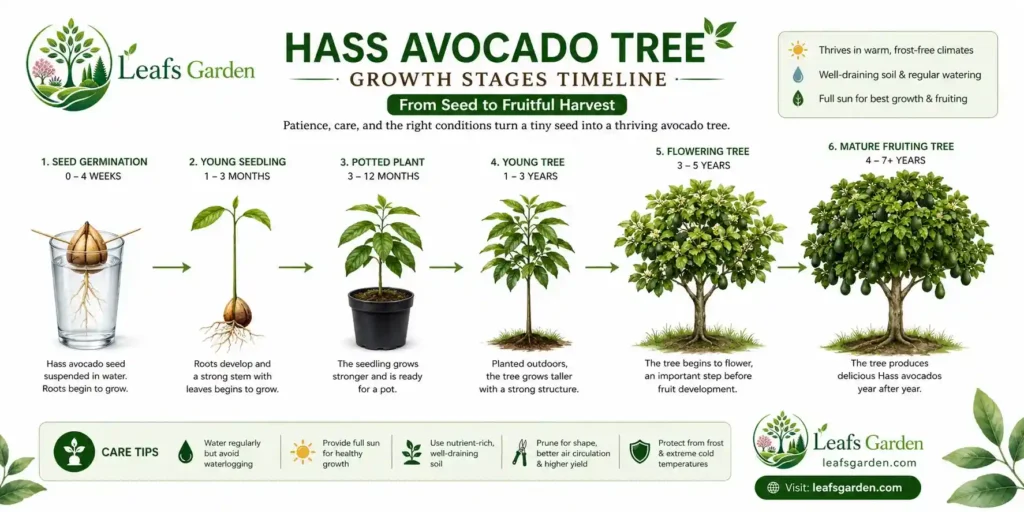
A flowering avocado tree produces thousands of small yellow-green flowers during the blooming season, but only a small percentage typically develop into mature fruit. Healthy flowering is one of the most important stages for successful avocado production.
An avocado tree flower is small, delicate, and grouped in clusters across branch tips and outer canopy growth. Although the flowers are not highly ornamental, heavy blooming usually indicates strong tree health and good fruiting potential.
| Flower Feature | Description |
| Color | Yellow-green |
| Size | Small |
| Flower Arrangement | Large clustered blooms |
| Blooming Season | Usually spring |
| Pollination Type | Insect-assisted |
An avocado tree bloom can contain hundreds or even thousands of flowers at one time. However, natural fruit drop remains common because not every flower becomes a mature avocado.
Healthy flowering depends on:
Cold weather, heavy rain, or strong winds during flowering may reduce pollination success and fruit development.
Avocado trees use a unique flowering system called Type A and Type B pollination. Flowers open twice over two days, changing between female and male stages during different times of the day.
This flowering behavior improves cross-pollination opportunities between compatible avocado varieties.
| Pollination Type | Female Opening | Male Opening |
| Type A | Morning Day 1 | Afternoon Day 2 |
| Type B | Afternoon Day 1 | Morning Day 2 |
The Hass avocado tree belongs to the Type A flowering group.
Several avocado varieties improve pollination efficiency when planted near Hass trees.
| Companion Variety | Pollination Type | Benefit |
| Bacon avocado | Type B | Improves fruit set |
| Fuerte avocado | Type B | Excellent companion pollinator |
| Lamb Hass | Type A | Extended flowering support |
A Bacon avocado or fuerte avocado planted nearby may help increase production because overlapping flowering schedules improve pollen transfer.
Pollination is mainly assisted by:
Warm mild weather during blooming usually improves pollination activity and fruit development.
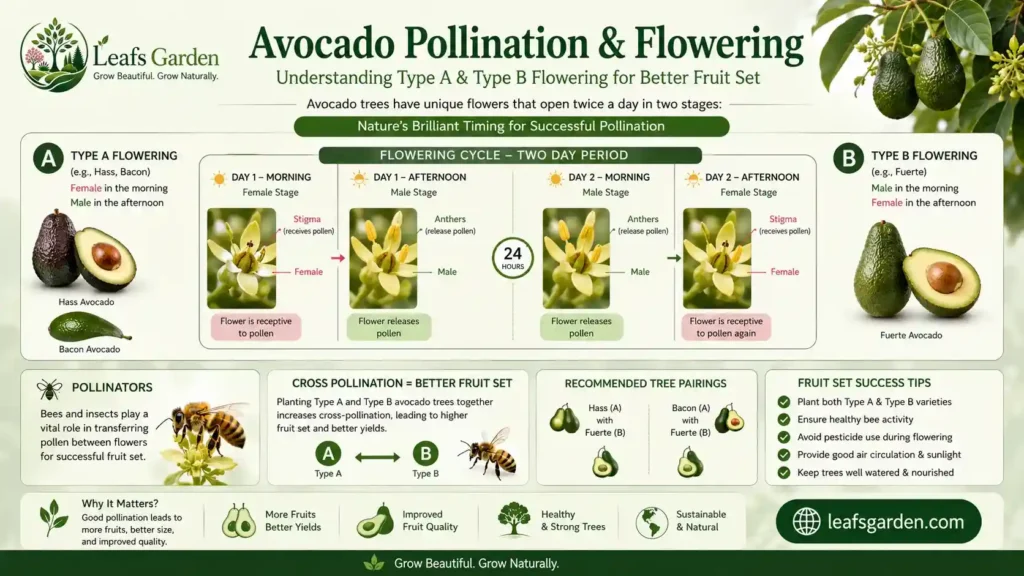
No, a Hass avocado tree can produce fruit on its own, but planting two compatible avocado varieties often improves pollination and increases total yields.
This is one of the most misunderstood avocado pollination myths. A single healthy Hass tree is capable of flowering and fruiting without another tree nearby.
A single tree may still produce well if:
Many backyard growers successfully harvest fruit from only one Hass avocado tree.
Planting a Type A and Type B combination may improve:
| Main Tree | Recommended Companion |
| Hass avocado | Fuerte avocado |
| Hass avocado | Bacon avocado |
| Hass avocado | Other Type B varieties |
Even though two trees are not mandatory, cross-pollination often becomes more beneficial in larger gardens and commercial orchards where maximizing fruit production is important.
For smaller gardens, proper care, sunlight, and healthy flowering conditions are usually more important than simply adding another tree.
Hass avocado season in Australia typically peaks from autumn through spring depending on region, climate, and local harvesting schedules. Different growing areas mature fruit at slightly different times, which helps extend avocado availability throughout much of the year.
Many people searching when are Hass avocados in season want to know the best period for harvesting fresh, high-quality fruit. In Australia, commercial and backyard harvest periods vary between warmer northern regions and cooler southern areas.
| Region | Main Harvest Period |
| Queensland | March–August |
| NSW | April–September |
| Western Australia | August–January |
| Victoria warmer regions | Later seasonal harvests |
The Australia avocado season is longer than many people expect because regional climate differences stagger fruit maturity across the country.
Gardeners interested in extending their tropical harvest calendar may also consider adding a lychee fruit tree, which produces seasonal fruit in similarly warm Queensland and NSW growing regions.
Globally, avocado season changes by climate and hemisphere.
| Country/Region | Peak Hass Season |
| Australia | Autumn–Spring |
| California USA | Spring–Summer |
| Mexico | Year-round major supply |
| New Zealand | Late winter–summer |
Warm subtropical climates allow Hass avocados to mature gradually while remaining on the tree for extended periods before harvesting.
Hass avocados dominate global markets because:
This extended international avocado season helps maintain year-round supermarket availability in many countries.
Knowing when to pick avocados is important because avocados do not fully soften while still attached to the tree. Instead, they mature on the tree and ripen after harvesting.
Many beginners mistakenly leave fruit hanging too long while waiting for softness. A mature avocado should be picked firm and allowed to ripen indoors.
In Australia, harvesting usually begins once fruit reaches maturity and oil content develops properly. Harvest timing depends on:
| Sign | Meaning |
| Full fruit size | Approaching maturity |
| Darkening skin | Near harvest readiness |
| Mature harvest season | Increased oil content |
People asking when to pick an avocado off the tree should understand that mature fruit often remains firm even when ready for harvest.
A common method is:
If the fruit ripens properly with good flavor and texture, the remaining avocados are usually ready for harvesting.
Several visual and internal signs help determine when a Hass avocado is mature enough for picking. Harvesting too early may result in poor flavor and watery texture.
One of the easiest indicators is skin color development.
| Fruit Stage | Skin Appearance |
| Immature | Bright green |
| Mature | Dark green to purplish-black |
| Fully ripened | Deep dark textured skin |
Hass avocados develop darker pebbly skin as maturity increases, although color alone should not be the only indicator.
As fruit matures, oil content rises inside the flesh. Higher oil levels create the creamy buttery texture that makes Hass avocados popular worldwide.
Immature fruit often tastes:
Properly matured fruit becomes richer, smoother, and creamier after ripening.
A harvest-ready avocado usually feels:
Soft fruit still attached to the tree may become overripe quickly after picking.
After harvesting:
| Texture | Ripeness |
| Very firm | Not ripe |
| Slightly soft | Ready to eat |
| Very soft | Overripe |
Proper harvesting and ripening timing greatly improve flavor, texture, and overall eating quality for Hass avocados.
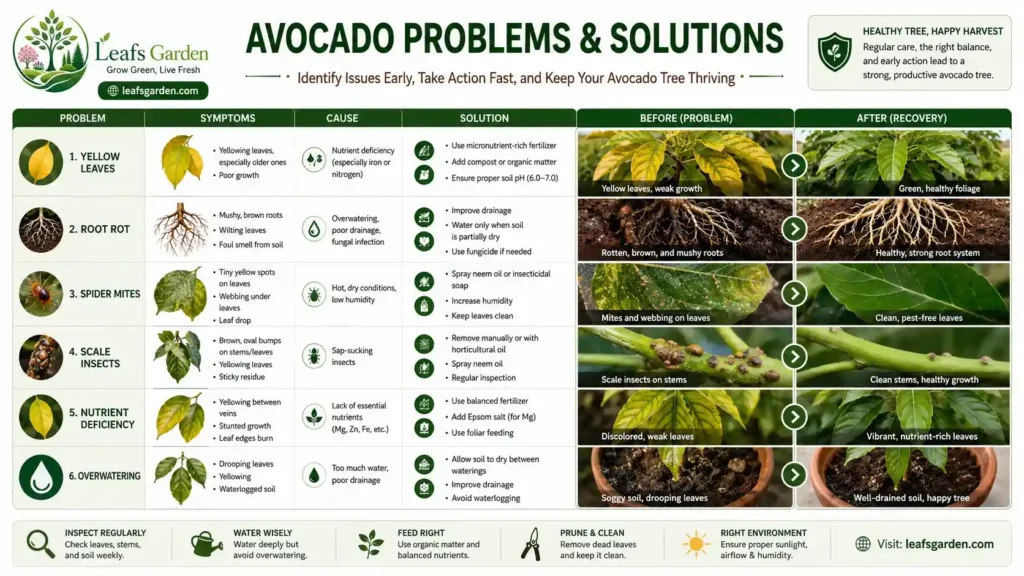
Yellow leaves and leaf drop are common warning signs that a Hass avocado tree is experiencing stress from watering issues, nutrient imbalance, or root damage. Early diagnosis helps prevent long-term growth problems and reduced fruit production.
Nutrient shortages often cause pale or yellowing foliage, especially in older leaves.
| Nutrient Problem | Visible Symptoms |
| Nitrogen deficiency | Pale yellow leaves |
| Iron deficiency | Yellow leaves with green veins |
| Magnesium deficiency | Yellowing around leaf edges |
| Zinc deficiency | Small distorted leaves |
Balanced fertilising improves foliage color, canopy density, and overall tree health.
Incorrect watering is one of the most common causes of avocado leaf problems.
Deep watering with proper drainage usually helps maintain healthy root conditions.
Root rot is one of the most serious avocado tree problems because avocado roots are highly sensitive to excessive moisture.
| Symptom | Description |
| Yellow leaves | Persistent discoloration |
| Leaf drop | Sudden canopy thinning |
| Weak growth | Reduced new shoots |
| Dark roots | Root damage and decay |
Poor drainage, compacted soil, and overwatering greatly increase root rot risk in Hass avocado trees.
Hass avocado trees can experience several pests and fungal diseases that affect foliage, roots, flowers, and fruit quality. Healthy growing conditions help reduce severe infestations and disease outbreaks.
Root rot remains one of the most destructive avocado diseases worldwide.
It is commonly caused by:
Severely affected trees may decline rapidly if conditions are not corrected early.
Anthracnose is a fungal disease that affects fruit, leaves, and stems, especially during humid conditions.
Improved airflow and careful watering help reduce fungal spread.
Mites are tiny sap-feeding pests that damage leaves and reduce tree vigor.
| Symptom | Appearance |
| Speckled leaves | Tiny yellow spots |
| Leaf bronzing | Discolored foliage |
| Webbing | Severe infestations |
Dry hot weather often increases mite activity.
Scale insects attach themselves to branches and leaves while feeding on plant sap.
Natural predators, pruning, and horticultural oils are commonly used for control.
Slow growth in Hass avocado trees usually results from poor soil conditions, restricted roots, environmental stress, or nutrient imbalance. Identifying the main cause helps restore healthy development more quickly.
Heavy compacted soil limits oxygen flow and root expansion.
Healthy avocado trees grow best in loose, well-draining soil with balanced fertility.
Container-grown trees may slow down once roots become crowded.
| Problem | Visible Effect |
| Root-bound containers | Slow canopy growth |
| Small containers | Reduced vigor |
| Poor drainage pots | Root stress |
Repotting into larger containers often improves growth rates.
Extreme cold or excessive heat can slow avocado development significantly.
Young trees are especially sensitive to frost and rapid temperature changes.
Too much or too little fertiliser may interfere with healthy growth.
| Issue | Result |
| Excess nitrogen | Weak soft growth |
| Nutrient deficiency | Pale slow growth |
| Salt buildup | Root damage |
Balanced feeding schedules combined with proper watering help maintain steady healthy development throughout the growing season.
Hass avocados are valued worldwide for their creamy texture, healthy fats, and nutrient-rich flesh. The fruit provides a combination of vitamins, minerals, fiber, and antioxidants that support overall health and balanced nutrition.
According to Eat for Health, avocados are recognized as a nutrient-dense whole food providing healthy fats, dietary fiber, and essential vitamins as part of a balanced Australian diet.
| Nutrient | Benefit |
| Healthy fats | Supports heart health |
| Fiber | Aids digestion |
| Potassium | Supports muscle and nerve function |
| Vitamin E | Antioxidant protection |
| Vitamin C | Immune support |
| Folate | Cell development support |
Hass avocados contain mostly monounsaturated fats, which are commonly considered beneficial fats for a balanced diet. These fats help create the rich buttery texture that makes Hass avocados popular worldwide.
Healthy fats may support:
Avocados are naturally rich in dietary fiber, which supports digestive health and helps maintain stable digestion.
Fiber benefits include:
Hass avocados provide several important vitamins and minerals in a natural whole-food form.
The fruit is often included in salads, sandwiches, smoothies, and healthy meal plans because of its nutrient density and versatile flavor.
Avocados also contain antioxidants that help protect plant cells and support overall nutritional value.
Common avocado antioxidants include:
These compounds are especially valued in fresh whole-food diets focused on balanced nutrition.
Hass avocado trees are popular in home gardens because they combine edible fruit production with attractive evergreen foliage. The trees work well in backyard orchards, tropical-style gardens, and container-growing setups.
Many homeowners grow Hass avocado trees for:
A mature avocado tree adds both practical food value and visual appeal to residential landscapes.
Compact and dwarf avocado varieties are suitable for:
Container gardening allows growers to move trees during cold weather and manage tree size more easily.
| Landscaping Feature | Benefit |
| Evergreen canopy | Year-round greenery |
| Dense foliage | Tropical appearance |
| Fruit production | Functional edible landscaping |
| Broad canopy | Shade and privacy |
The lush foliage and rounded structure make avocado trees highly suitable for tropical and subtropical landscape designs.
Commercial avocado farming has expanded rapidly worldwide because of growing global demand for Hass avocados. Large-scale production now occurs across Australia, the USA, Mexico, New Zealand, South America, and many subtropical regions.
Commercial orchards focus on:
Modern avocado farming relies heavily on climate management and efficient orchard planning to maintain strong fruit yields.
| Farming Requirement | Importance |
| Warm climate | Essential |
| Well-draining soil | Critical |
| Reliable irrigation | High importance |
| Pollination activity | Improves yield |
| Frost protection | Important in cooler regions |
Growing avocados commercially involves long-term orchard investment because trees may remain productive for decades under proper management.
Commercial growers often focus on:
Hass avocado remains the dominant commercial variety because of its excellent storage ability, rich flavor, durable skin, and strong international market demand.
| Feature | Details |
| Scientific Name | Persea americana |
| Common Name | Hass avocado tree |
| Mature Height | 5–12 m |
| Sunlight | Full sun |
| Soil Type | Well-draining |
| Fruiting Time | 2–4 years grafted |
| Best Climate | Subtropical |
| Pot Friendly | Yes, dwarf varieties |
Hass avocado trees are productive, rewarding fruit trees ideal for warm Australian gardens, many USA regions, and subtropical climates worldwide. Their creamy fruit, evergreen foliage, and reliable production make the hass avocado tree one of the most popular choices for home gardeners and commercial growers alike.
Successful growing avocado trees requires the right climate, well-draining soil, full sunlight, and consistent maintenance. Proper planting techniques and balanced avocado tree care greatly improve long-term tree health, flowering, and fruit production.
Patience is also important because avocado trees need time to establish strong roots before producing reliable harvests. Grafted trees usually fruit much faster, while seed-grown trees may require several additional years before maturity.
With regular watering, seasonal feeding, pruning, and protection from frost or poor drainage, a healthy Hass avocado tree can remain productive for decades while adding tropical beauty and fresh homegrown fruit to the garden.
A grafted Hass avocado tree usually takes around 2–4 years to bear fruit under good growing conditions. Seed-grown trees often take much longer and may require 7–15 years before producing avocados.
Yes, you can grow a Hass avocado tree in a pot, especially dwarf varieties and younger grafted trees. Large containers with excellent drainage, full sunlight, and regular feeding help container-grown avocado trees grow successfully.
A mature Hass avocado tree can grow approximately 5–12 meters tall outdoors depending on climate, soil quality, and pruning practices. Dwarf avocado varieties remain much smaller and are better suited for patios and small gardens.
The best fertiliser for avocado trees in Australia is usually a balanced slow-release fertiliser designed for citrus or fruit trees. Healthy avocado growth benefits from nitrogen, potassium, magnesium, zinc, and trace minerals applied during active growing seasons.
No, Hass avocado trees can produce fruit without another tree nearby. However, planting a compatible Type B avocado variety like Bacon or Fuerte may improve pollination and increase fruit yields.
Hass avocado season in Australia generally runs from autumn through spring depending on region and climate. Queensland and NSW often harvest earlier, while cooler southern regions may produce later seasonal fruit.
Yes, you can grow a Hass avocado tree from seed using water germination or direct soil planting methods. However, seed-grown trees may not produce fruit identical to the parent tree and usually take much longer to mature.
An avocado tree may fail to fruit because of immature age, poor pollination, insufficient sunlight, nutrient imbalance, temperature stress, or watering problems. Healthy flowering conditions and proper avocado tree care usually improve fruit production over time.