Grow Better Gardens with Smarter Plant Choices
Discover helpful guides on trees, hedges, fruit plants, edible plants, and beautiful landscape greenery.
The Gleditsia Sunburst tree is a fast-growing ornamental shade tree known for its glowing golden foliage, thornless branches, and light filtered canopy. Botanically identified as Gleditsia triacanthos ‘Sunburst,’ this deciduous honey locust cultivar is widely planted in residential landscapes, urban streetscapes, public parks, and modern garden designs because it combines attractive seasonal color with low-maintenance growth habits.
Unlike dense shade trees that create dark lawns and heavy leaf buildup, the Sunburst Honey Locust produces an airy canopy that allows filtered sunlight to pass through. This filtered shade helps grass grow underneath the tree while still cooling patios, sidewalks, and outdoor living areas. Its bright yellow spring foliage gradually changes to soft lime green in summer before turning golden again in autumn, giving the landscape seasonal visual interest for most of the year.
Homeowners and landscape designers also prefer the Gleditsia Sunburst tree because it is thornless, relatively drought tolerant once established, and fast growing compared to many traditional ornamental shade trees. The delicate leaf texture and open branching structure create a softer appearance that works well in both formal and naturalistic landscapes.
Several honey locust cultivars are commonly compared in landscaping. The Sunburst Honey Locust is mainly valued for its golden foliage and ornamental appearance. The Shademaster Honey Locust develops greener leaves and a denser shade canopy suited for larger cooling areas. Traditional Green Honey Locust trees usually refer to standard green cultivars or wild-type honey locusts, which may produce thorns and seed pods more aggressively than modern thornless landscape varieties.
| Feature | Details |
| Botanical Name | Gleditsia triacanthos ‘Sunburst’ |
| Common Name | Sunburst Honey Locust |
| Tree Type | Deciduous Shade Tree |
| Mature Height | 30–40 feet |
| Growth Rate | Fast |
| Sunlight | Full Sun |
| USDA Zones | 4–9 |
| Main Feature | Golden-yellow foliage |
The Sunburst Honey Locust is a thornless ornamental shade tree known for its bright golden foliage, airy branching structure, and fast growth rate. It is one of the most popular honey locust cultivars used in modern landscaping because it provides filtered shade without creating a dense, dark canopy.
Its open branching habit allows sunlight to pass through the tree, making it highly suitable for lawns, patios, sidewalks, and residential yards. The tree is especially valued for its vivid yellow spring leaves that gradually turn soft green during summer before developing warm golden tones in autumn.
The Gleditsia Sunburst tree belongs to the Fabaceae plant family, which is commonly known as the legume or pea family. This family includes many nitrogen-fixing trees and shrubs valued in ornamental and ecological landscaping.
The scientific name of the tree is Gleditsia triacanthos ‘Sunburst.’ In botanical naming, Gleditsia triacanthos refers to the species commonly called honey locust, while ‘Sunburst’ identifies the specific cultivated variety, or cultivar.
A species is a naturally occurring plant type found in nature. A cultivar is a selectively developed form bred for desirable traits such as thornless growth, foliage color, improved canopy structure, or reduced seed pod production.
The Sunburst cultivar was specifically developed to improve ornamental appeal by combining:
The tree is commonly sold and identified under several related names in nurseries and landscaping guides. These names usually refer to the same ornamental cultivar.
Common names include:
Although the names vary slightly, they generally describe the same thornless golden-leaved honey locust cultivar used in residential and urban landscapes.
The original honey locust species is native to central and eastern parts of North America. Wild honey locust trees naturally grew in open woodlands, floodplains, and river valleys where they adapted to heat, drought, and varying soil conditions.
Early wild honey locust trees often developed large thorns and heavy seed pods, making them less suitable for urban landscaping. Over time, horticulturists developed improved ornamental cultivars with thornless branches and cleaner growth habits.
The Sunburst Honey Locust became especially popular during the rise of suburban and urban landscape design because it solved several common problems associated with traditional shade trees. Its filtered canopy reduced heavy shade issues while its smaller leaflets created easier seasonal cleanup compared to larger-leaved deciduous trees.
Today, the Gleditsia Sunburst tree is widely planted in:
The Sunburst Honey Locust became popular because it combines ornamental beauty with practical landscape performance. It offers many of the cooling benefits of a shade tree without the dense canopy problems associated with species like maple or sycamore.
One major advantage is its filtered shade. The fine-textured leaves allow grass and smaller plants to grow beneath the canopy more easily. This creates healthier lawns and brighter outdoor spaces.
The tree is also appreciated for its drought tolerance once established. In many climates, mature trees require less supplemental watering than other fast-growing ornamental shade trees.
Homeowners and landscape designers also value:
Its lawn-friendly canopy and manageable maintenance requirements make it one of the most widely recommended ornamental honey locust cultivars for modern residential landscapes.
The Gleditsia Sunburst tree is easily identified by its glowing golden foliage, soft leaf texture, and open canopy structure. Unlike dense shade trees, this ornamental honey locust creates a light and airy appearance that adds color without overwhelming the landscape.
Its delicate branching habit and seasonal foliage transitions make it highly recognizable in residential gardens, parks, and streetscapes.
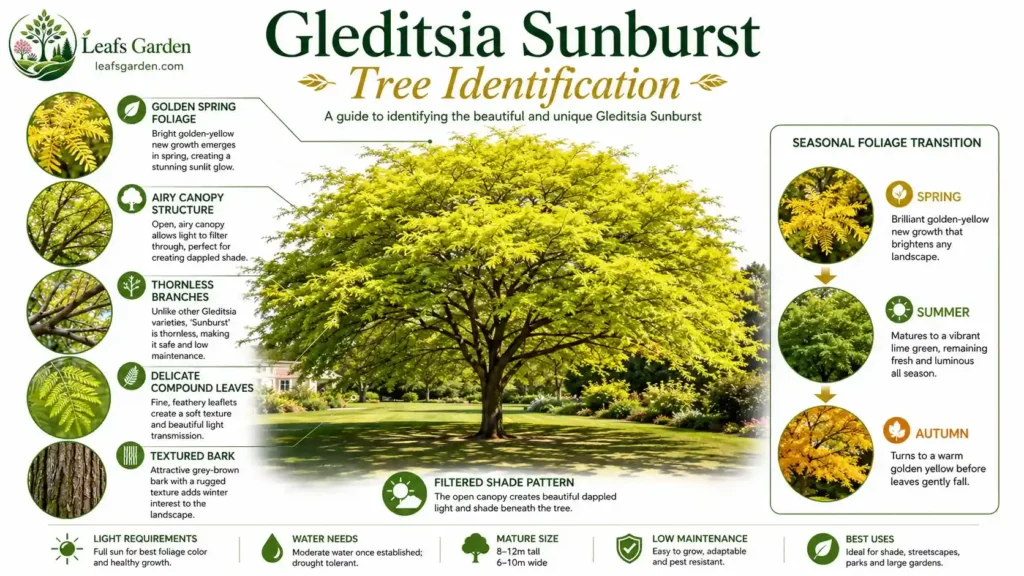
The most distinctive feature of the Sunburst Honey Locust is its changing foliage color throughout the growing season. The tree delivers multiple color stages that keep landscapes visually attractive from spring through autumn.
In spring, new leaves emerge with a vivid golden-yellow color that appears almost luminous in full sunlight. This bright flush of foliage is one of the primary reasons the cultivar is used as an ornamental focal tree.
As temperatures rise, the foliage gradually softens into a lighter lime green shade during summer. The airy leaf structure allows sunlight to filter through the canopy while still providing cooling shade.
During autumn, the leaves transition again into warm golden tones before dropping for winter dormancy. Because the leaflets are small and delicate, seasonal cleanup is usually easier compared to larger deciduous shade trees.
Seasonal foliage progression typically includes:
The Gleditsia Sunburst tree is considered a medium-sized ornamental shade tree with relatively fast growth during its early years.
Most mature trees reach:
The canopy develops into a broad, rounded form with graceful branching that allows filtered sunlight to pass through.
Growth size may vary depending on climate, soil quality, irrigation, and available root space. Trees planted in open landscapes generally develop wider crowns and fuller branching patterns than those growing in compact urban streetscapes.
In tighter urban conditions, the canopy may remain narrower due to restricted root zones and surrounding infrastructure.
The bark of the Sunburst Honey Locust is typically gray-brown with shallow ridges that become more textured as the tree matures. Younger trees often have smoother bark and lighter branch coloration.
One of the biggest advantages of this cultivar is its thornless branching structure. Unlike wild honey locust trees that can develop large sharp thorns, the Sunburst cultivar was specifically bred for safer ornamental landscape use.
The canopy has a fine-textured appearance because the leaves are made up of many small leaflets. This creates a softer visual effect compared to trees with larger, heavier foliage.
The open branching habit produces an airy shade pattern that allows:
This filtered shade effect is one of the defining features that separates honey locust cultivars from denser shade trees.
The Sunburst Honey Locust produces small, inconspicuous flowers during spring. These flowers are usually pale green to yellowish and are not considered a major ornamental feature.
Most Sunburst cultivars are seedless or produce very few seed pods compared to wild honey locust trees. This low-pod characteristic helps reduce landscape litter and maintenance.
Wild honey locust species often develop:
Modern ornamental cultivars like Sunburst were selected specifically to minimize these less desirable characteristics.
As a result, the tree is considered cleaner and more suitable for residential lawns, sidewalks, patios, and public landscapes.
The Gleditsia Sunburst tree typically develops a strong root system that includes both deeper anchoring roots and spreading lateral roots near the soil surface.
Compared to some aggressive shade trees, the root system is generally considered more lawn-friendly and adaptable to urban environments. The filtered canopy also reduces competition for turfgrass below the tree.
However, root behavior can still vary depending on soil conditions, irrigation, and planting location.
Potential root considerations include:
When planted with adequate spacing, the Sunburst Honey Locust is usually considered safer for sidewalks and residential landscapes than many large-rooted urban shade trees.
The Gleditsia Sunburst tree is considered a fast-growing ornamental shade tree that establishes relatively quickly in residential and urban landscapes. Under favorable growing conditions, it can develop a noticeable canopy within only a few years, making it popular for homeowners who want faster shade and landscape impact.
Its rapid juvenile growth, combined with drought tolerance and filtered shade, makes the Sunburst Honey Locust one of the more efficient medium-sized shade trees for modern landscapes.
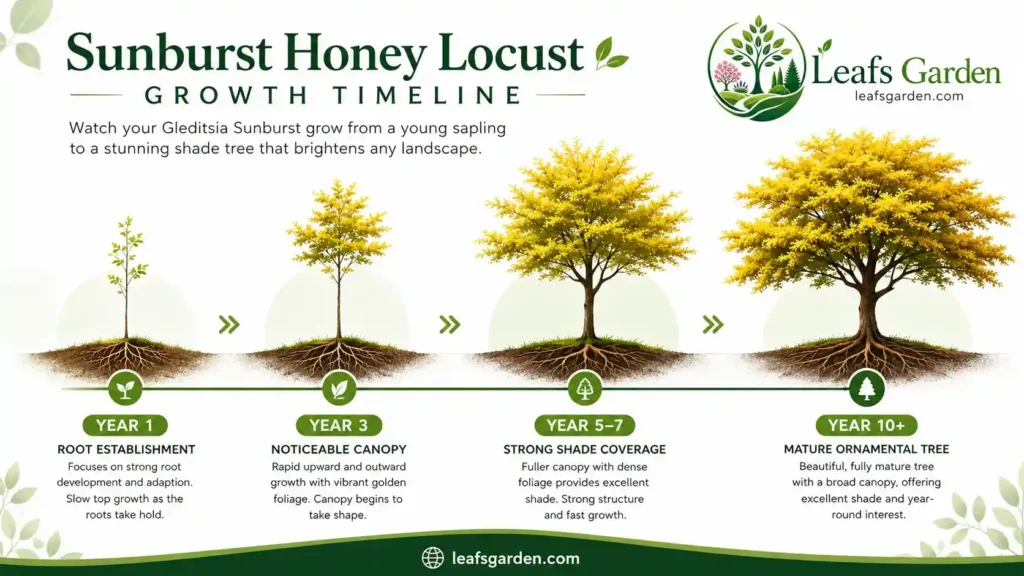
The Sunburst Honey Locust typically grows around 1.5 to 3 feet per year during its active growth stages. Young trees often grow fastest during the first several years after establishment.
In ideal conditions, growth can be especially vigorous when the tree receives:
Faster growth is usually seen in warmer climates with longer growing seasons. Mature growth speed may gradually slow as the tree reaches its full canopy size and structural maturity.
Typical annual growth includes:
| Tree Stage | Average Growth Rate |
| Young Establishing Tree | 2–3 feet per year |
| Mid-Maturity Growth | 1.5–2 feet per year |
| Mature Tree | Slower structural growth |
Compared to many ornamental shade trees, the Gleditsia Sunburst develops usable landscape shade relatively quickly without becoming excessively dense or oversized.
Several environmental and maintenance factors influence how quickly a Sunburst Honey Locust grows. Healthy growing conditions usually result in stronger canopy development, brighter foliage color, and faster root establishment.
Full sun is one of the most important requirements for strong growth. The tree performs best with at least 6–8 hours of direct sunlight daily.
Insufficient sunlight may cause:
Well-draining soil supports healthier root expansion and faster establishment. Although the tree tolerates various soil types, constantly waterlogged soil can reduce growth and increase disease risk.
The tree adapts relatively well to:
Poor drainage is usually more harmful than soil texture itself.
Young Sunburst Honey Locust trees require regular watering during their establishment phase. Deep watering encourages stronger root development and better drought tolerance later.
Overwatering may slow growth by reducing oxygen around the roots, while prolonged drought stress can limit canopy expansion and leaf production.
Warm growing seasons generally increase growth speed. The tree performs well across a broad climate range within USDA Zones 4–9.
Growth may slow temporarily in:
Once established, the tree becomes relatively adaptable to heat, urban pollution, and moderate drought conditions.
The Sunburst Honey Locust develops relatively quickly compared to many ornamental landscape trees. Early canopy formation is one of the reasons it is frequently selected for residential yards and public landscapes.
| Age | Expected Growth |
| 1 Year | Establishing roots |
| 3 Years | Noticeable canopy |
| 5–7 Years | Strong shade coverage |
| 10+ Years | Mature ornamental tree |
During the first year, most energy is directed toward root establishment rather than heavy top growth. By the third year, many trees begin forming a visible ornamental canopy with stronger branching patterns.
Between five and seven years, the tree often provides meaningful filtered shade and a fuller landscape presence. After ten years, the Gleditsia Sunburst usually reaches a mature ornamental structure with broad canopy spread and consistent seasonal foliage color.
The Gleditsia Sunburst tree grows best in full sun, well-draining soil, and moderate moisture conditions. Its adaptability is one of the main reasons it performs well in residential landscapes, streetscapes, parks, and drought-tolerant gardens.
Once established, the Sunburst Honey Locust becomes relatively resilient to heat, dry conditions, and urban stress while still maintaining its ornamental foliage color and airy canopy structure.
Full sun is essential for healthy growth and strong foliage color development in the Gleditsia Sunburst tree. The tree performs best when planted in areas that receive at least 6–8 hours of direct sunlight daily.
Insufficient sunlight can reduce both growth speed and ornamental quality. Trees planted in heavy shade may develop weaker branching and less vibrant foliage.
Strong sunlight helps improve:
Although the tree can tolerate light partial shade, its brightest foliage color and healthiest structure usually appear in open sunny locations.
The Sunburst Honey Locust is adaptable to a wide range of soil conditions, which makes it highly useful in urban and residential landscaping.
It grows best in well-draining loamy soil but can also tolerate less ideal soil types better than many ornamental shade trees.
The tree can tolerate moderately heavy clay soils if drainage is adequate. Compacted clay with standing water may increase the risk of root stress and fungal problems.
Adding organic matter can help improve:
The Gleditsia Sunburst also adapts well to sandy soils because of its relatively drought-tolerant nature. Sandy conditions may require more frequent watering during the establishment period since moisture drains faster.
The tree is tolerant of varying soil pH levels and performs well in:
This flexibility contributes to its popularity in diverse climate regions and urban landscapes where soil quality can vary significantly.
The watering needs of the Sunburst Honey Locust change as the tree matures. Young trees require more consistent moisture to establish healthy roots, while mature trees become increasingly drought tolerant.
During the first one to two growing seasons, deep watering is important for proper root development.
General watering recommendations include:
Mulching around the base can help retain soil moisture and stabilize root temperatures.
Once established, the Gleditsia Sunburst becomes relatively drought tolerant compared to many traditional shade trees.
Mature trees usually tolerate:
However, prolonged drought can still lead to:
Occasional deep watering during extended dry periods helps maintain healthier growth and canopy appearance.
The Sunburst Honey Locust is highly adaptable across a broad climate range and performs well in USDA Zones 4–9.
Its strong environmental tolerance makes it suitable for both colder winters and hot summer climates.
The tree tolerates winter cold relatively well and can survive freezing temperatures common in northern landscapes. Dormant winter conditions generally do not harm established trees within the recommended growing zones.
Heat tolerance is one of the major strengths of the Gleditsia Sunburst tree. It handles hot summers better than many ornamental shade trees and performs well in urban heat conditions where reflected pavement temperatures may stress other species.
The tree is commonly planted in:
The Sunburst Honey Locust can also grow successfully in suitable Australian climates, especially in temperate and semi-dry regions with adequate sunlight and moderate irrigation during establishment.
Parts of southern and southeastern Australia may support healthy growth where winters are mild to cool and summers remain sunny.
The Gleditsia Sunburst tree usually does not require heavy fertilization when planted in reasonably healthy soil. Overfertilizing may encourage overly rapid branch growth that becomes structurally weaker.
Most established trees perform well with natural soil nutrients and organic mulch decomposition.
Fertilizer may be helpful when trees show signs of:
The best time to fertilize is typically:
Balanced slow-release fertilizers are generally preferred for ornamental landscape trees. Excess nitrogen should be avoided because it may stimulate weak, overly soft growth.
Proper planting helps the Sunburst Honey Locust establish faster, develop a stronger root system, and form a healthier canopy. Choosing the right planting location and following correct planting techniques can significantly improve long-term growth, drought tolerance, and structural stability.
Because the Gleditsia Sunburst tree grows relatively quickly, early root establishment is especially important during the first few growing seasons.
The best time to plant a Sunburst Honey Locust is usually during spring or early autumn when temperatures are milder and soil moisture is more stable.
Spring planting is often preferred in colder climates because it gives the tree a full growing season to establish roots before winter dormancy begins.
Benefits of spring planting include:
Autumn planting also works well in regions with mild winters. Cooler temperatures and seasonal rainfall can help reduce transplant stress while encouraging root development beneath the soil surface.
Autumn planting advantages include:
In extremely hot climates, planting during cooler seasonal periods helps reduce moisture loss and transplant shock.
Selecting the correct planting location is important because the Gleditsia Sunburst develops a moderately broad canopy and spreading root system as it matures.
The tree performs best in open sunny areas with enough space for both canopy expansion and healthy root development.
Planting too close to buildings may eventually restrict canopy shape and root spread. Most landscape professionals recommend allowing at least:
This spacing helps maintain airflow and reduces long-term pruning needs.
Although the Sunburst Honey Locust is generally considered more urban-friendly than many shade trees, proper spacing from sidewalks and driveways is still important.
Recommended spacing often includes:
Restricted root spaces can increase the chance of surface root development over time.
One of the biggest advantages of the Gleditsia Sunburst tree is its lawn-friendly canopy. The filtered shade allows more sunlight to reach grass beneath the tree compared to dense shade species.
This makes the tree highly suitable for:
Correct planting techniques help reduce transplant stress and improve long-term tree health.
Dig a planting hole approximately:
A wider planting hole encourages easier root expansion into surrounding soil.
Avoid digging excessively deep holes because settling soil may cause the tree to sink too low after planting.
Position the tree so the root flare remains slightly above surrounding soil level. The root flare is the area where the trunk begins widening into the root system.
Proper positioning helps:
Straighten the trunk before backfilling soil to maintain proper vertical growth.
Backfill the hole using the original soil unless severe soil problems exist. Break apart large compacted clumps while filling around the roots.
Avoid heavily compacting the soil during backfilling because roots require oxygen movement through the soil structure.
Light watering during backfilling can help settle air pockets naturally.
After planting, water deeply to help stabilize the soil around the roots.
Initial watering should:
During the establishment phase, deep watering is usually more effective than frequent shallow irrigation.
Apply mulch around the base of the tree to help conserve moisture and moderate soil temperature.
Good mulching practices include:
Proper mulch placement also helps suppress weeds and reduce moisture competition.
Several planting mistakes can slow establishment and increase stress on newly planted Sunburst Honey Locust trees.
Planting too deep is one of the most common causes of decline in ornamental landscape trees.
Deep planting may lead to:
The root flare should always remain visible above soil level.
Although young trees require regular moisture, excessive watering can damage roots by reducing soil oxygen.
Common signs of overwatering include:
Deep but controlled watering is usually the safest approach.
Poorly drained planting sites can create long-term health problems for the Gleditsia Sunburst tree.
Constantly saturated soil may increase the risk of:
If drainage is poor, soil improvement or raised planting areas may help create healthier growing conditions.
The Gleditsia Sunburst tree is considered a relatively low-maintenance ornamental shade tree once established. Its drought tolerance, filtered canopy, and adaptable nature make it easier to manage than many traditional landscape trees.
Basic care mainly involves proper pruning, seasonal monitoring, mulching, and occasional deep watering during stressful weather conditions.
Proper pruning helps maintain a healthier canopy structure, improves airflow, and reduces the risk of weak branch development. Because the Sunburst Honey Locust grows relatively quickly, occasional structural pruning is beneficial during the early years.
The best time to prune the Gleditsia Sunburst tree is usually during late winter or very early spring before active new growth begins.
Dormant-season pruning helps:
Light corrective pruning may also be performed during summer if damaged branches appear.
Crossing or rubbing branches should be removed early before they create bark wounds or structural weakness.
Removing crowded interior growth can help improve:
Healthy branch spacing becomes especially important as the canopy expands with age.
Young Sunburst Honey Locust trees benefit from structural shaping to develop strong branching patterns.
Canopy shaping usually focuses on:
Overpruning should be avoided because excessive branch removal may stress the tree and reduce foliage density.
Mulching helps support healthy root development and improves overall soil conditions around the tree.
Organic mulch gradually improves soil structure while helping maintain more stable moisture and temperature conditions.
A mulch layer helps reduce evaporation during hot weather and keeps soil moisture more consistent around the roots.
Benefits of mulch include:
Applying mulch is especially beneficial during the establishment phase.
Mulch also suppresses weeds and grass competition around the base of the tree.
Reducing weed competition helps improve:
For best results, mulch should remain several inches away from direct trunk contact to prevent excess moisture buildup around the bark.
The care needs of the Gleditsia Sunburst tree change slightly throughout the year. Seasonal monitoring helps maintain stronger foliage color, healthier growth, and improved stress resistance.
Spring is the tree’s main active growth period and one of the most important times for inspection and maintenance.
Recommended spring tasks include:
This is also when the tree displays its brightest golden-yellow foliage.
Most established Sunburst Honey Locust trees require minimal fertilization, but weak or nutrient-deficient trees may benefit from balanced slow-release fertilizer applications during early spring.
Fertilizing should remain moderate because excessive nitrogen may encourage weak, overly rapid growth.
New spring growth can help reveal overall tree health. Healthy trees usually produce vibrant foliage with steady branch extension and balanced canopy development.
Signs of possible stress include:
Summer care mainly focuses on moisture management and heat stress prevention.
Deep watering during extended dry periods helps maintain:
During intense summer heat, younger trees may experience temporary stress if moisture becomes limited.
Common heat stress symptoms include:
Deep watering and mulch coverage help reduce heat-related stress.
Autumn is generally a lower-maintenance season for the Gleditsia Sunburst tree.
As temperatures cool, the foliage develops warm golden tones before leaf drop begins.
Because the tree has small leaflets and relatively low pod production, autumn cleanup is usually easier than with many larger deciduous shade trees.
Seasonal cleanup may include:
Autumn is also a suitable time for planting in mild climates.
The tree enters dormancy during winter and generally requires minimal maintenance once established.
Young trees may still benefit from basic winter protection in colder regions.
Winter protection measures may include:
Established Gleditsia Sunburst trees are generally cold hardy within USDA Zones 4–9 and recover well when healthy entering dormancy.
Most Gleditsia Sunburst tree problems are linked to environmental stress, watering issues, pests, or fungal diseases. Although the Sunburst Honey Locust is considered relatively durable and low maintenance, improper growing conditions can still affect foliage color, canopy density, and branch health.
Early identification of symptoms usually helps prevent more serious long-term damage.
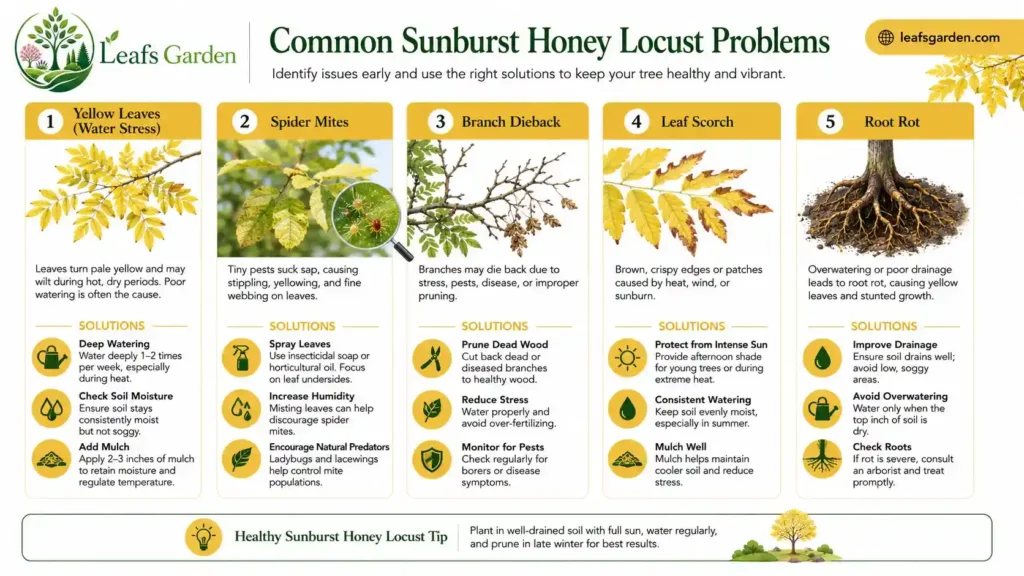
Yellowing or browning leaves are among the most common issues seen on Sunburst Honey Locust trees. In many cases, foliage discoloration is caused by environmental stress rather than severe disease.
Excessive watering can reduce oxygen levels around the roots and stress the tree. Saturated soil conditions may eventually contribute to root rot and canopy decline.
Common signs of overwatering include:
Improving drainage and reducing watering frequency usually helps stabilize the tree.
Extreme summer heat and prolonged drought can cause leaf scorch or browning around the edges of leaflets.
Heat stress symptoms may include:
Deep watering during extended dry periods and maintaining mulch around the root zone can help reduce moisture loss.
Poor soil nutrition may also affect foliage color and growth performance.
Possible deficiency symptoms include:
Nitrogen deficiency is one of the more common nutrient issues affecting ornamental shade trees, although soil testing is the best way to confirm specific deficiencies before fertilizing.
Several insects may occasionally affect the Gleditsia Sunburst tree, especially during periods of stress or drought.
Webworms create silk-like webbing around leaves and branches while feeding on foliage.
Mild infestations usually cause limited long-term damage, but severe outbreaks may lead to:
Pruning affected branches early can help reduce infestation spread.
Wood-boring insects may target stressed or weakened trees. Borers tunnel beneath the bark and can interfere with water and nutrient movement.
Possible signs include:
Keeping the tree healthy and minimizing stress is one of the best preventive measures against borers.
Spider mites are tiny sap-feeding pests that often become more active during hot, dry weather.
Common symptoms include:
Increasing humidity around the tree and reducing drought stress may help limit mite activity.
Although relatively resilient, the Sunburst Honey Locust can still develop fungal or disease-related problems under stressful growing conditions.
Cankers are localized dead areas that develop on branches or trunks, often caused by fungal infections entering through wounds or stressed tissue.
Symptoms may include:
Pruning infected limbs and improving overall tree health can help reduce progression.
Root rot is commonly associated with poorly drained soil and chronic overwatering.
Typical symptoms include:
Improving soil drainage is critical for prevention.
Leaf spot fungi may occasionally appear during humid or wet weather conditions.
Affected foliage may develop:
Most minor leaf spot infections are manageable and rarely threaten mature healthy trees.
Because the Gleditsia Sunburst tree grows relatively quickly, some branches may develop weaker attachment angles if pruning and structural training are neglected.
Rapid growth can occasionally create:
Early structural pruning helps improve branch strength and canopy stability.
Strong winds and storms may damage larger branches, especially in exposed landscapes.
Wind protection strategies include:
Healthy trees with proper pruning generally tolerate storms better over time.
| Problem | Possible Cause | Solution |
| Yellow leaves | Water stress | Adjust watering |
| Sparse canopy | Low sunlight | Relocate or prune |
| Branch dieback | Disease/stress | Prune affected limbs |
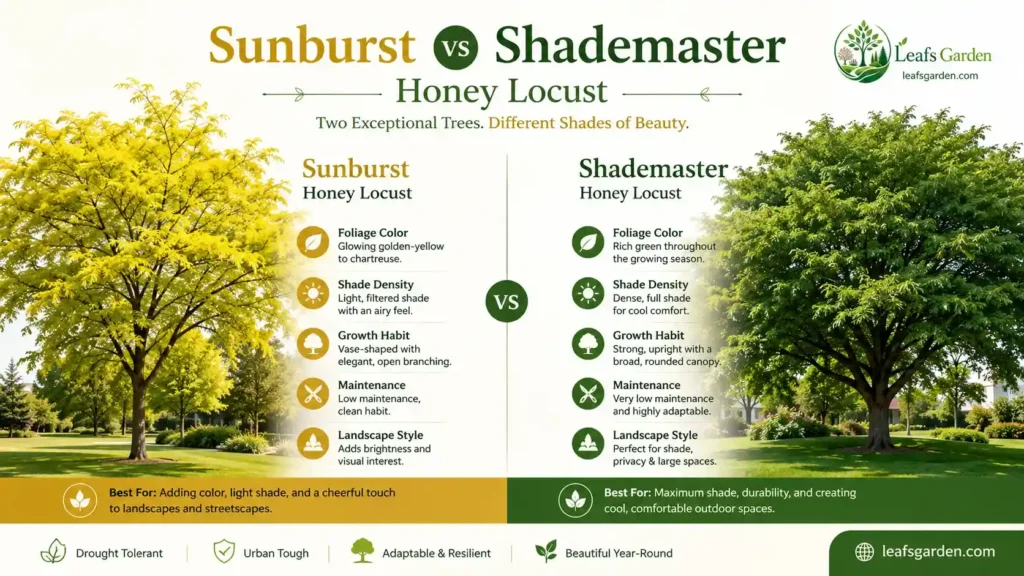
Sunburst and Shademaster are two of the most popular honey locust cultivars used in modern landscaping. Although both belong to the species Gleditsia triacanthos, they differ in foliage color, canopy density, and overall landscape function.
The Sunburst Honey Locust is mainly valued for its ornamental golden foliage and airy appearance, while the Shademaster Honey Locust is typically chosen for stronger traditional shade coverage and larger canopy performance.
| Feature | Sunburst | Shademaster |
| Foliage Color | Golden-yellow | Green |
| Shade Density | Filtered | Denser |
| Growth Habit | Ornamental | Traditional shade |
| Maintenance | Low | Low |
| Landscape Style | Accent tree | Shade tree |
The biggest visual difference between the two cultivars is foliage color. The Gleditsia Sunburst tree produces bright golden spring growth that gradually softens into lime green during summer, while Shademaster maintains a more consistent medium-green canopy.
Shade density also differs significantly. Sunburst creates lighter filtered shade that allows more sunlight to reach lawns and garden beds beneath the tree. Shademaster develops a fuller canopy that provides stronger cooling shade in larger open areas.
The better honey locust variety depends largely on the landscape goal, available space, and desired visual effect.
The Sunburst Honey Locust is often preferred for residential yards because of its ornamental appearance and lighter canopy structure.
Homeowners frequently choose Sunburst for:
Its filtered shade also supports healthier grass growth beneath the canopy compared to denser shade trees.
Shademaster may be more suitable for homeowners wanting:
Both cultivars perform well in urban streetscapes because of their adaptability to pollution, heat, and varying soil conditions.
Sunburst is commonly selected where visual impact and ornamental color are priorities, while Shademaster is often planted along wider streets and medians requiring stronger shade coverage.
Urban planners may favor Shademaster for:
Commercial landscapes frequently use both cultivars depending on design goals.
Sunburst works well for:
Shademaster is more commonly used where practical shade performance is the primary objective.
The term “Green Honey Locust” is often used broadly to describe standard green-leaved honey locust trees, including traditional cultivars and sometimes wild-type species.
Compared to green honey locust varieties, the Gleditsia Sunburst tree offers stronger ornamental appeal because of its vivid foliage transitions and brighter visual presence.
Sunburst is primarily valued as an ornamental landscape tree due to:
Green honey locust trees generally provide a more natural or traditional shade-tree appearance without the dramatic seasonal color contrast.
Wild or standard green honey locust trees may also differ structurally from improved ornamental cultivars.
Traditional or native honey locust trees can sometimes produce:
Modern cultivars like Sunburst were selectively developed to reduce many of these less desirable characteristics while improving landscape performance and visual quality.
The Gleditsia Sunburst tree is widely used in landscaping because it combines ornamental beauty with practical shade performance. Its golden foliage, airy canopy, and filtered sunlight make it highly adaptable for residential gardens, urban plantings, and public landscapes.
For a broader guide to shade and ornamental landscape trees suited to Australian and temperate climates, see our complete Evergreen, Shade & Landscape Trees guide.
Unlike dense shade trees that can darken outdoor spaces, the Sunburst Honey Locust creates a lighter, more open landscape effect while still providing cooling benefits.
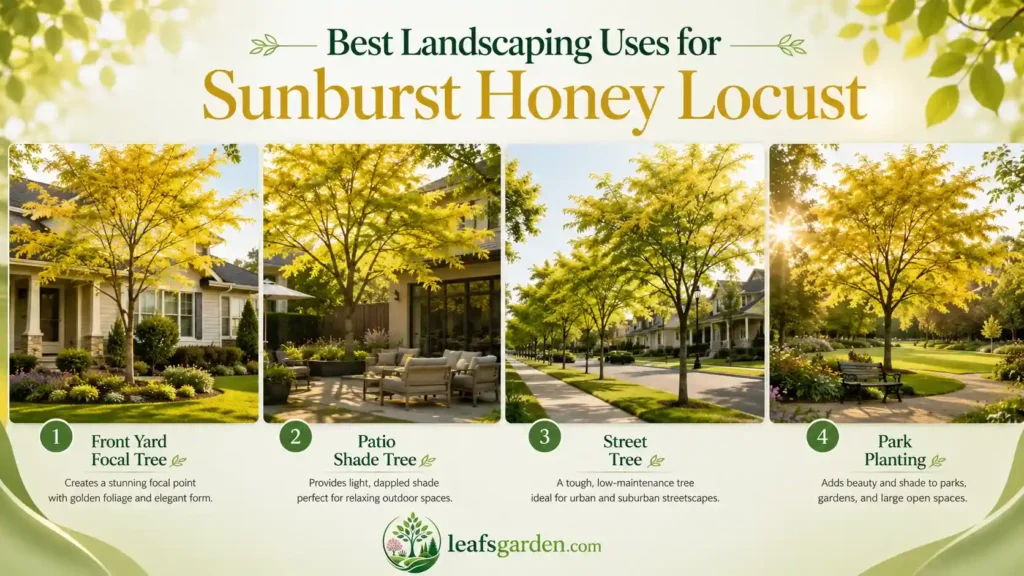
The Sunburst Honey Locust works well in many landscape styles because of its moderate size, fast growth, and decorative seasonal color.
The bright golden spring foliage makes the Gleditsia Sunburst tree an effective focal point in front yard landscapes.
It is often used to:
Its fine-textured canopy also softens hard architectural lines around buildings and driveways.
The filtered shade created by the tree is especially valuable around patios and outdoor seating areas.
Unlike dense shade trees, the airy canopy allows enough sunlight to pass through to maintain a brighter outdoor environment while still reducing heat exposure.
Patio benefits include:
The Sunburst Honey Locust is commonly planted as a street tree because it tolerates many urban growing conditions.
Its adaptability to:
makes it suitable for sidewalks, medians, and residential streetscapes.
For larger boulevard and avenue plantings requiring a bigger shade canopy in similar urban conditions, the London Plane Tree is one of the most widely planted street trees alongside Gleditsia Sunburst in Australian and international streetscapes.
The lighter canopy also improves visibility and creates a more open streetscape appearance compared to dense shade species.
Public parks often use the Sunburst Honey Locust for ornamental shade and seasonal color.
The tree performs well in:
Its relatively low maintenance requirements and lawn-friendly shade pattern make it practical for larger landscape installations.
One of the biggest advantages of the Gleditsia Sunburst tree is its filtered shade canopy. The fine leaf texture allows dappled sunlight to reach the ground beneath the tree instead of creating dense dark shade.
This filtered light provides several landscape benefits.
Many dense shade trees make it difficult for turfgrass to survive beneath the canopy. The Sunburst Honey Locust allows more sunlight penetration, which supports healthier lawn growth.
This makes it useful for:
Although the canopy is airy, it still helps reduce surface heat and creates more comfortable outdoor conditions during summer.
Filtered shade can help:
Dense shade sometimes creates problems such as:
The Sunburst Honey Locust helps minimize these issues because its canopy remains more open and breathable.
The golden foliage of the Gleditsia Sunburst tree pairs well with many ornamental plants, especially species that contrast with its bright canopy color and drought-tolerant nature.
Ornamental grasses complement the airy structure of the tree and create movement beneath the canopy.
Popular combinations include:
Their texture blends naturally with the fine foliage of the honey locust.
Purple or dark burgundy shrubs create strong visual contrast against the tree’s golden-yellow foliage.
Common companion shrubs include:
This contrast is especially striking during spring growth.
Because mature Sunburst Honey Locust trees tolerate relatively dry conditions, drought-resistant perennials often perform well beneath and around the canopy.
Suitable companion plants may include:
These plants also benefit from the filtered sunlight conditions created by the tree’s open canopy structure.
The Gleditsia Sunburst tree is generally considered less invasive and easier to manage than wild honey locust trees. Modern ornamental cultivars like Sunburst were specifically developed to reduce common problems such as aggressive thorn growth, excessive seed pod production, and heavy landscape litter.
While the tree is relatively landscape-friendly, some root, cleanup, and maintenance considerations may still occur depending on planting conditions and long-term care.
The root system of the Sunburst Honey Locust is usually considered more manageable than many aggressive urban shade trees, but proper planting distance is still important for long-term landscape safety.
When planted with adequate spacing, the Gleditsia Sunburst tree is generally considered reasonably safe near residential foundations.
Most landscape professionals recommend planting at least:
The tree’s root system is less aggressive than some large moisture-seeking species, but roots may still spread widely in search of water and oxygen.
Roots are not typically known for aggressively invading healthy underground pipes. However, older damaged pipes or leaking irrigation systems may attract root growth over time.
Risk factors increase when:
Proper installation distance and healthy underground infrastructure help reduce potential issues.
In compacted or shallow soils, some surface roots may eventually appear near the ground surface.
Surface root development is more likely when:
Compared to many large shade trees, the Sunburst Honey Locust is still generally viewed as relatively lawn compatible.
One reason the Gleditsia Sunburst tree became popular in landscaping is its cleaner growth habit compared to wild honey locust trees.
Most Sunburst cultivars produce very few seed pods or remain nearly seedless under normal growing conditions.
This is a major advantage because wild honey locust trees can generate:
Reduced pod production makes the ornamental cultivar more suitable for patios, lawns, sidewalks, and public spaces.
Although cleaner than wild honey locust species, the tree still drops foliage seasonally because it is deciduous.
Fortunately, the small leaflets usually decompose quickly and are easier to clean compared to larger leaves from maples, sycamores, or oaks.
Typical seasonal debris may include:
Overall, the Sunburst Honey Locust is commonly considered a relatively low-litter ornamental shade tree.
The Gleditsia Sunburst tree is not generally considered highly toxic in normal landscape conditions, but some caution is still recommended around seeds, pods, and plant material.
Most ornamental honey locust cultivars are considered to have low toxicity risk compared to many ornamental landscape plants.
However, ingestion of large quantities of pods or seeds may occasionally cause mild digestive upset in animals or humans.
Potential symptoms may include:
Severe toxicity is uncommon in properly maintained landscape settings.
The thornless nature of the Sunburst cultivar makes it safer for pets and people compared to wild honey locust trees with large sharp thorns.
For pet-friendly landscapes, homeowners often appreciate:
As with most ornamental trees, preventing pets from chewing excessive plant material is still recommended for overall safety.
The Gleditsia Sunburst tree can grow successfully in suitable Australian climates when provided with full sunlight, well-draining soil, and moderate watering during establishment. Its drought tolerance and adaptability make it a practical ornamental shade tree for many temperate and semi-dry regions across Australia.
The Sunburst Honey Locust is especially valued for its filtered shade, golden foliage, and ability to tolerate urban conditions better than many traditional deciduous trees.
The Sunburst Honey Locust performs best in regions with warm summers, moderate rainfall, and seasonal temperature variation.
The tree adapts well to climates that provide:
Because it is deciduous, the Gleditsia Sunburst tree also benefits from seasonal dormancy in cooler months.
Its broad environmental adaptability allows it to grow in:
Heat tolerance is one of the major strengths of the Sunburst Honey Locust. Mature trees generally perform well in hot summer conditions once roots are established.
The tree can tolerate:
However, younger trees may still require supplemental watering during prolonged heatwaves while establishing their root systems.
The Gleditsia Sunburst tree is usually most successful in temperate Australian regions where summers are sunny and winters are not excessively tropical.
Suitable growing areas may include parts of:
These climates often provide enough seasonal cooling and moderate moisture balance for healthy ornamental growth.
Because of its filtered canopy and moderate drought tolerance, the Sunburst Honey Locust also fits well into water-conscious landscape designs.
It is commonly suitable for:
Its lighter canopy also supports healthier grass growth underneath compared to dense shade trees commonly used in Australian landscapes.
Another highly adaptable ornamental shade tree that performs well alongside Gleditsia Sunburst in Australian urban and suburban landscapes is the Chinese Elm Tree, valued for its graceful canopy and strong heat tolerance.
Although relatively heat tolerant, the Gleditsia Sunburst tree may still experience stress in extremely hot or dry climates without proper moisture management.
Leaf scorch is one of the most common issues during periods of intense summer heat or drought stress.
Symptoms may include:
Young trees are usually more vulnerable than mature established specimens.
Providing mulch and occasional deep watering during heatwaves can help reduce scorch severity.
Proper watering becomes especially important in hotter Australian regions where evaporation rates remain high during summer.
Helpful water management practices include:
Once established, the Sunburst Honey Locust generally becomes more resilient to periodic dry conditions while still maintaining healthy ornamental growth.
The Gleditsia Sunburst tree is widely appreciated for its fast growth, bright ornamental foliage, and adaptable landscape performance. Its filtered canopy and thornless structure make it one of the most popular honey locust cultivars for residential and urban planting.
However, like most ornamental shade trees, it also has a few maintenance considerations that homeowners should understand before planting.
The Sunburst Honey Locust offers several benefits that make it highly attractive for modern landscapes.
One of the biggest advantages of the Gleditsia Sunburst tree is its relatively fast growth rate.
Under favorable conditions, the tree can:
This makes it especially useful for newer landscapes needing quicker visual coverage.
The tree is highly valued for its changing foliage color throughout the growing season.
Seasonal color highlights include:
Its vivid spring appearance is one of the main reasons it is planted as an ornamental focal tree.
Unlike dense shade trees, the Sunburst Honey Locust creates filtered sunlight beneath the canopy.
This lighter shade pattern helps:
Filtered shade is especially useful around patios, lawns, and open residential gardens.
Once established, the tree becomes relatively drought tolerant and can handle moderate dry periods better than many traditional shade trees.
Its adaptability makes it suitable for:
Deep root development helps mature trees tolerate occasional moisture stress.
The Sunburst cultivar was specifically developed to eliminate the large dangerous thorns found on wild honey locust trees.
Thornless growth improves:
This feature makes it far more practical for residential planting.
Although generally low maintenance, the Sunburst Honey Locust still has some limitations and potential concerns.
Because the tree grows relatively quickly, some branches may develop weaker attachment angles if structural pruning is neglected.
Strong storms or high winds may occasionally cause:
Early pruning and canopy training help reduce this risk.
The Gleditsia Sunburst tree may occasionally attract pests, especially during drought stress or poor growing conditions.
Possible pest problems include:
Healthy trees with proper watering and airflow are generally less vulnerable to serious infestations.
As a deciduous tree, the Sunburst Honey Locust loses its leaves during autumn.
Although the small leaflets usually decompose quickly, homeowners should still expect:
Compared to many larger deciduous trees, however, cleanup demands are generally considered relatively low.
The Gleditsia Sunburst tree remains one of the most versatile ornamental shade trees for homeowners who want bright seasonal color, filtered shade, and relatively low-maintenance landscape performance. Its golden spring foliage, airy canopy, and thornless growth habit make it highly attractive for both residential and urban planting.
One of the tree’s biggest advantages is its ability to provide shade without creating dense dark conditions beneath the canopy. The filtered sunlight supports healthier lawn growth, brighter outdoor spaces, and more balanced landscape designs compared to many traditional heavy shade trees.
The Sunburst Honey Locust is especially well suited for:
Homeowners looking for a fast-growing ornamental tree with seasonal interest often find the Gleditsia Sunburst tree an excellent choice. It is particularly useful for people who want:
Over the long term, the tree adds both visual and functional landscape value through its adaptable growth habit and moderate maintenance needs. Its combination of ornamental beauty and practical shade performance helps explain why it remains one of the most widely planted honey locust cultivars.
Before planting, it is still important to choose the right cultivar and planting location based on climate, available space, and landscape goals. Proper spacing, sunlight exposure, and soil drainage help ensure healthier growth and stronger long-term canopy development.
The Gleditsia Sunburst tree typically reaches around 30–40 feet in height with a canopy spread of approximately 30–35 feet at maturity. Trees planted in open landscapes often develop broader crowns than those growing in tighter urban spaces.
The Sunburst Honey Locust is generally considered a relatively low-mess shade tree compared to many deciduous species. Its small leaflets decompose quickly, and most cultivars produce very few seed pods. Seasonal leaf drop still occurs during autumn, but cleanup is usually lighter than with larger-leaved trees.
The Sunburst Honey Locust is a fast-growing ornamental shade tree that commonly grows around 1.5–3 feet per year under favorable conditions. Full sun, proper drainage, and regular watering during establishment help maximize growth speed.
Most Gleditsia Sunburst tree problems are related to environmental stress, pests, or drainage issues. Common concerns may include: Yellowing leaves from overwatering or drought Spider mites or webworms Occasional branch weakness during storms Leaf scorch during extreme heat Root rot in poorly drained soil Proper planting and maintenance usually reduce most long-term problems.
Yes, the Sunburst Honey Locust is a deciduous tree, meaning it loses its leaves during autumn before entering winter dormancy. New golden foliage emerges again during spring growth.
The main difference is foliage color and canopy density. The Sunburst Honey Locust produces bright golden-yellow new growth and lighter filtered shade, while Shademaster develops greener foliage and a denser traditional shade canopy. Sunburst is often chosen for ornamental landscapes, while Shademaster is more commonly used for larger shade coverage.
Yes, honey locust trees, including the Gleditsia Sunburst cultivar, can grow successfully in suitable Australian climates with full sun, good drainage, and moderate watering during establishment. Temperate and semi-dry regions generally provide the best growing conditions.
Honey locust roots are generally considered less invasive than many large urban shade trees, especially in ornamental cultivars like Sunburst. However, roots may still spread widely in search of moisture and can occasionally affect sidewalks or shallow infrastructure if planted too close. Proper spacing helps minimize potential root issues.