Grow Better Gardens with Smarter Plant Choices
Discover helpful guides on trees, hedges, fruit plants, edible plants, and beautiful landscape greenery.

The dwarf Wurtz avocado is a compact avocado tree variety known for its smaller mature size, container-friendly growth, and reliable fruit production in home gardens across Australia, the USA, and warm subtropical climates worldwide.
Also commonly called the Wurtz avocado, little avocado tree, dwarf avocado tree, or small avo tree, this variety is one of the most popular choices for gardeners who want fresh avocados without needing a large backyard. Its naturally dwarfing growth habit makes it far easier to manage than a standard avocado tree.
Unlike full-sized avocado trees that can become very tall and difficult to maintain, a dwarf Wurtz avocado tree stays more compact while still producing full-sized creamy fruit. This makes it highly suitable for modern urban gardening and smaller residential spaces.
Homeowners often choose the Wurtz avocado tree because it offers:
The dwarf avocado is especially popular in Melbourne backyards, patio gardens, sunny balconies, and small-space edible landscapes where large fruit trees are not practical. It can also adapt well to container growing, making it useful for renters and gardeners with limited outdoor space.
In Australia, the Wurtz avocado performs particularly well in warm temperate and subtropical regions. However, its adaptability also makes it a strong option for gardeners in parts of the USA and other frost-free climates worldwide.
For beginners, the Wurtz avocado tree is often considered one of the easiest avocado varieties to grow successfully at home. Its manageable size, earlier fruiting potential, and container-friendly growth make it an excellent entry point into avocado cultivation.
A Wurtz avocado tree is a naturally dwarfing avocado variety that stays much smaller than standard avocado trees while still producing full-sized creamy avocados.
The dwarf Wurtz avocado is widely grown in home gardens because it combines compact growth with reliable fruit production. Unlike many large avocado varieties, this small avocado tree fits well in patios, raised beds, courtyard gardens, and large containers.
The Wurtz avocado tree is especially valued by gardeners looking for a manageable avocado plant that does not dominate small outdoor spaces.
The Wurtz avocado belongs to the species Persea americana, which is part of the Lauraceae family. This plant family also includes cinnamon, camphor, and bay laurel trees.
Avocado trees are evergreen fruit trees known for their dense foliage, creamy fruit texture, and subtropical growing preferences. The Wurtz avocado maintains the same botanical characteristics as larger avocado trees but grows in a more compact form.
A grafted avocado plant and a seed-grown avocado tree behave very differently.
| Feature | Grafted Avocado Plant | Seed-Grown Avocado Tree |
| Fruiting Speed | Earlier | Much slower |
| Fruit Quality | Predictable | Unpredictable |
| Tree Size | Controlled | Often larger |
| Reliability | High | Variable |
| True-to-Type Fruit | Yes | Not always |
Most dwarf Wurtz avocado trees sold in Australia and the USA are grafted trees because they provide faster and more reliable fruit production.
The Wurtz avocado follows the avocado Type A flowering pattern. Avocado flowers open twice, functioning as female during one phase and male during another. This flowering behavior improves cross-pollination opportunities between avocado varieties.
Although Wurtz avocado trees are considered partially self-pollinating, nearby avocado trees can often improve fruit set and overall productivity.
The Wurtz avocado is often called the smallest avocado tree because of its naturally compact growth habit and controlled canopy structure.
Unlike many avocado trees that grow very tall and wide, the dwarf avocado tree develops a denser and more manageable shape. This makes pruning easier and helps maintain a smaller avocado tree height over time.
Compared with a Hass avocado tree or Reed avocado tree, the Wurtz avocado usually stays significantly smaller.
This controlled growth habit is one reason why the little avocado tree is highly popular in urban gardening.
It works especially well for:
The compact size also makes harvesting, watering, fertilising, and seasonal pruning far simpler for beginner gardeners.
The main difference between a dwarf Wurtz avocado and a standard avocado tree is overall size, maintenance level, and container suitability.
| Feature | Wurtz Avocado | Full-Sized Avocado Tree |
| Mature Height | Smaller | Much taller |
| Pot Friendly | Yes | Limited |
| Fruiting Speed | Faster | Slower |
| Maintenance | Easier | Higher |
| Indoor Potential | Partial | Rare |
For home gardeners with limited space, the dwarfing avocado tree is often the more practical choice because it delivers productive growth without requiring a large orchard-sized area.
Those exploring compact and productive options will find the dwarf Wurtz avocado a rewarding addition to the broader world of fruit trees and edible plants suited to modern Australian gardens.
A dwarf Wurtz avocado tree usually grows much smaller than standard avocado trees, making it ideal for containers, patios, and compact gardens.
Unlike large avocado trees that can dominate a backyard, the dwarf Wurtz avocado maintains a more controlled size while still producing quality fruit. Its compact structure is one of the main reasons it is popular in Australia, especially for suburban gardens and container growing.
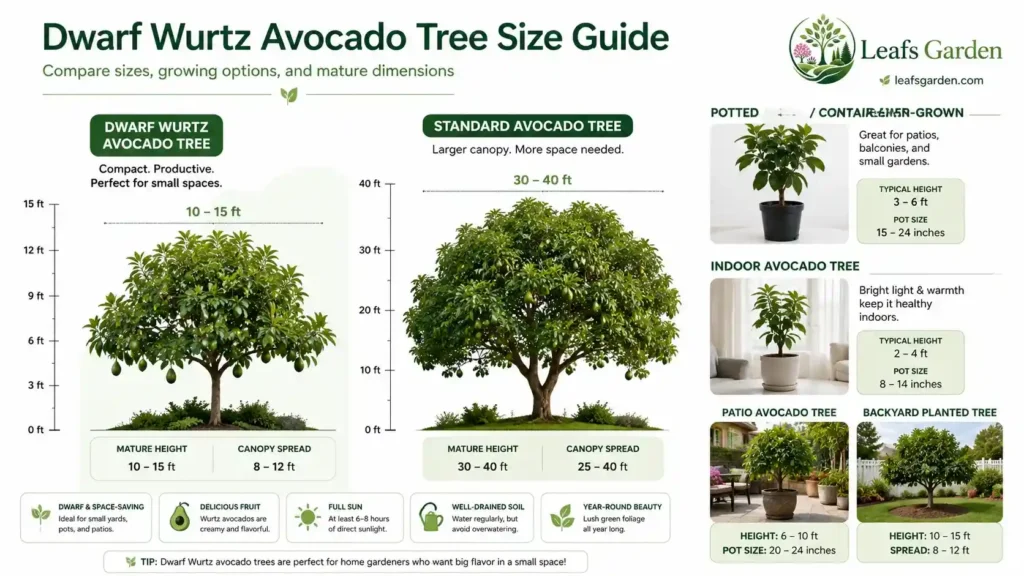
A dwarf Wurtz avocado tree typically reaches a much smaller mature size than traditional avocado varieties like Hass or Reed.
In most home garden conditions, a full grown avocado tree of the Wurtz variety develops a compact canopy with moderate spread and manageable height. Actual avocado plant size depends on climate, soil quality, pruning, sunlight, and whether the tree is grown in a pot or directly in the ground.
Typical mature size expectations include:
Under natural outdoor conditions, standard avocado trees can grow very tall over time. Some large avocado varieties may exceed several metres in height if left unpruned.
The dwarf Wurtz avocado stays significantly smaller because of its naturally dwarfing growth habit.
Indoor vs outdoor growth size can also vary considerably:
| Growing Environment | Expected Growth |
| Indoor sunny area | Smaller and slower |
| Patio container | Compact moderate growth |
| Raised garden bed | Medium compact growth |
| In-ground outdoor planting | Largest potential size |
Indoor avocado plants generally remain smaller because of reduced root space, lower light intensity, and controlled environmental conditions.
A pot-grown avocado tree usually stays smaller than a garden-planted avocado tree.
Container growing naturally restricts root expansion, which slows overall tree growth and helps maintain a compact structure. This is one reason the Wurtz avocado is considered one of the best avocado trees for pots.
When planted directly into the ground, the tree can access more moisture, nutrients, and root space. This usually results in faster development and a slightly larger mature canopy.
Several factors influence final avocado tree height:
Root restriction plays a major role in controlling avocado plant size. Smaller containers limit vigorous root expansion, helping the tree remain manageable for balconies and patios.
Pruning also affects growth structure.
Regular pruning can help:
Without pruning, even dwarf avocado trees can become denser and taller over time.
The dwarf Wurtz avocado tree is considered moderately fast-growing under warm conditions with proper care.
Its growth speed depends heavily on temperature, sunlight, watering consistency, and soil drainage.
| Growth Stage | Expected Development |
| Year 1–2 | Root establishment and early branch growth |
| Year 3–4 | Strong canopy development and possible early fruiting |
| Mature Fruiting Stage | Reliable seasonal fruit production begins |
| Long-Term Growth | Stable compact mature tree structure |
During the first two years, most energy goes into root development and structural branching. Young avocado plants may appear slow initially while establishing themselves.
By years three and four, a healthy grafted Wurtz avocado tree often becomes fuller and may begin flowering and setting fruit under suitable growing conditions.
At the mature fruiting stage, the tree develops a balanced canopy capable of supporting regular avocado production.
Long-term tree size expectations remain relatively manageable compared with full-sized avocado trees, especially when the plant is grown in containers or pruned regularly.
Wurtz avocado trees grow best in warm frost-free climates with full sun, well-drained soil, and moderate watering.
The dwarf Wurtz avocado is highly adaptable for home gardens, but strong growth and reliable fruit production depend on the right environment. Proper sunlight, soil drainage, temperature balance, and climate protection all play major roles in long-term avocado tree health.
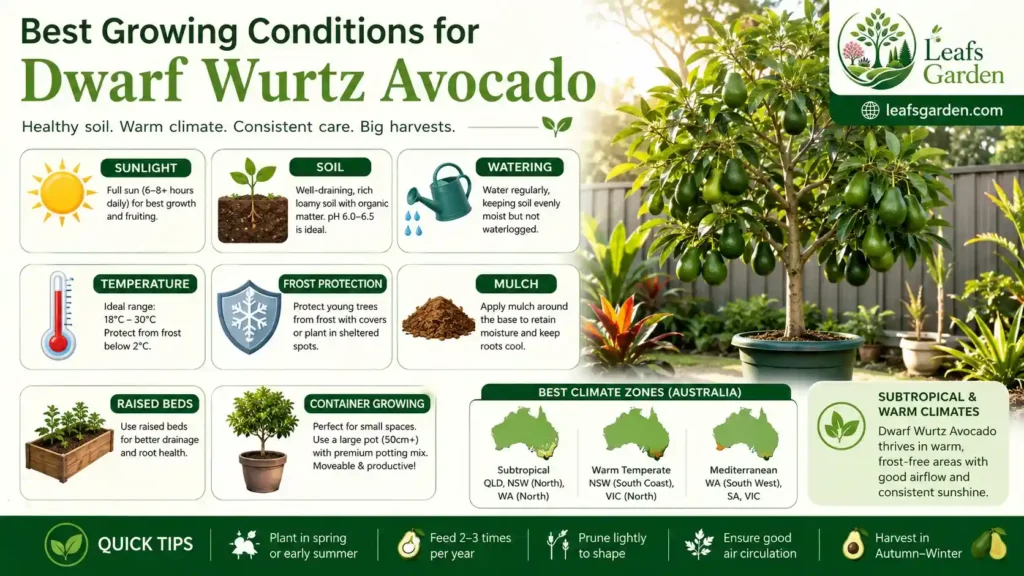
The dwarf Wurtz avocado performs best in warm temperate, subtropical, and mild tropical climates.
In Australia, avocado growing is especially successful in regions with moderate winters and warm summers. Many gardeners grow avocado trees successfully in coastal and frost-protected areas.
Popular Australia avocado growing regions include:
Avocado tree Melbourne growing conditions can be suitable when the tree receives maximum sunlight and protection from cold winter winds and frost. In cooler Melbourne areas, container growing is often preferred because pots can be moved to warmer protected locations during cold periods.
In the USA, Wurtz avocado trees generally grow best in USDA zones 9–11 where freezing temperatures are less common.
Tropical vs subtropical climates also affect growth performance:
| Climate Type | Wurtz Avocado Performance |
| Tropical | Fast vigorous growth |
| Subtropical | Excellent fruit production |
| Mild temperate | Possible with protection |
| Cold frost-prone climates | Higher risk of damage |
Subtropical climates are often ideal because they provide warmth without excessive humidity stress.
Dwarf Wurtz avocado trees need full sun for healthy growth and strong fruit production.
Most avocado trees perform best with at least 6–8 hours of direct sunlight daily. Insufficient light can reduce flowering, slow growth, and weaken fruit development.
Outdoor avocado trees should be planted in the sunniest part of the garden whenever possible.
Indoor avocado plant light requirements are much higher than many beginners expect. Indoor trees need:
Low-light indoor conditions commonly lead to:
Balcony and patio positioning also matters greatly.
For container-grown avocado trees:
Warm reflective surfaces near patios can also improve heat retention during cooler seasons.
The best soil mix for avocado cultivation is loose, airy, and extremely well-draining.
Avocado roots are highly sensitive to excess moisture. Poor drainage is one of the most common causes of avocado tree decline and root rot.
Healthy avocado soil should allow water to move through quickly while still retaining moderate moisture.
A quality avocado soil mix often includes:
Drainage importance cannot be overstated for dwarf avocado trees. Waterlogged roots can rapidly develop fungal disease and oxygen stress.
Soil pH recommendations for avocado trees generally fall within a slightly acidic to neutral range.
| Soil Factor | Recommended Condition |
| Drainage | Excellent |
| Soil Texture | Loose and airy |
| Soil pH | Slightly acidic to neutral |
| Organic Matter | Moderate |
Raised beds vs pots can both work well depending on climate and available space.
Raised beds provide:
Pots provide:
Dwarf Wurtz avocado trees prefer warm stable temperatures and moderate humidity.
Although mature trees tolerate some environmental variation, sudden cold exposure can damage leaves, flowers, and developing fruit.
Frost sensitivity is one of the biggest concerns for avocado cultivation.
Young avocado plants are especially vulnerable to:
Protective measures may include:
The Wurtz avocado also has reasonable heat tolerance when watered correctly. However, extreme dry heat combined with strong sun can sometimes stress young trees.
During hot weather:
Wind protection is another important factor.
Strong winds can:
Protected garden positions with stable airflow usually provide the best growing environment for healthy dwarf avocado trees.
The best way to grow a Wurtz avocado tree is by planting a grafted avocado plant in free-draining soil with consistent warmth and sunlight.
The dwarf Wurtz avocado grows best when established in a stable environment with strong sunlight, good airflow, and controlled watering. Because this variety naturally stays smaller than standard avocado trees, it is highly suitable for backyard gardens, raised beds, and large containers.
Proper planting and early care greatly improve long-term fruit production and tree health.
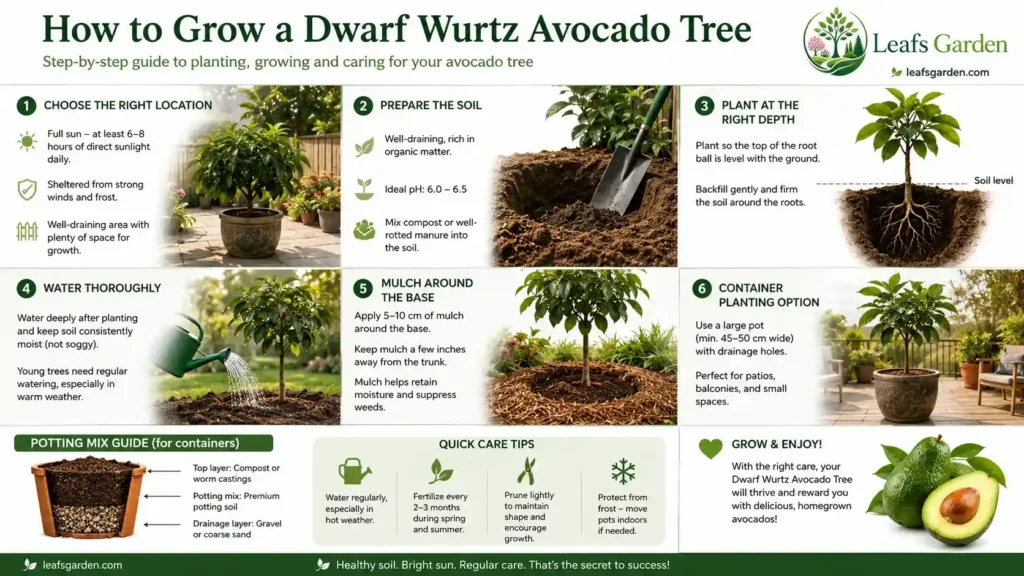
Planting a dwarf avocado tree correctly helps establish stronger roots and healthier long-term growth.
A young Wurtz avocado tree should always be planted in a warm sunny position with excellent drainage.
Select a location with:
Avoid low wet areas where water collects after rain.
Prepare loose nutrient-rich soil before planting.
Good avocado soil should contain:
If soil drains poorly, raised beds are often recommended.
Place the avocado plant at the same depth it was growing in its nursery container.
Do not bury the trunk deeply because excessive soil contact around the stem can increase rot risk.
The root crown should remain slightly above surrounding soil level.
Water thoroughly immediately after planting to help settle the soil around the roots.
Early watering should:
Young avocado trees need consistent moisture during the establishment phase.
Apply mulch around the base of the tree to improve soil stability and moisture retention.
Good mulch options include:
Keep mulch slightly away from the trunk to reduce fungal risk.
The dwarf Wurtz avocado is one of the best avocado varieties for container growing.
Its compact growth habit makes it highly suitable for patios, balconies, courtyards, and movable garden setups.
Choosing the best avocado planter pot size is important for healthy root development.
Young trees usually start well in medium containers before gradually moving into larger pots as the root system expands.
A quality avocado container should provide:
Potting avocado trees correctly helps reduce root stress and waterlogging problems.
A good container soil mix may include:
Container drainage setup is critical because avocado roots dislike stagnant moisture.
For better drainage:
A regular re-potting schedule also supports healthy growth.
Signs a dwarf avocado tree may need re-potting include:
Most container-grown avocado trees benefit from occasional pot upgrades as they mature.
Indoor avocado tree care requires strong sunlight, warmth, and careful moisture management.
Although avocado trees naturally prefer outdoor conditions, dwarf Wurtz avocado trees can adapt better to indoor growing than many larger avocado varieties.
To grow avocado trees indoors successfully:
Window placement is one of the most important factors for indoor avocado health.
In Australia, north-facing windows usually provide the strongest sunlight exposure for indoor avocado plants.
Poor lighting often causes:
Indoor humidity tips can also improve plant performance.
Dry indoor air may stress avocado foliage, especially during winter heating periods.
Helpful humidity strategies include:
Indoor avocado trees generally remain smaller and slower-growing compared with outdoor garden trees.
Growing avocado trees from seed is possible, but grafted avocado trees are usually far more reliable for fruit production.
Most commercial dwarf Wurtz avocado plants are grafted because they maintain predictable growth habits and earlier fruiting performance.
| Seed Grown | Grafted Wurtz |
| Slower fruiting | Faster fruiting |
| Unpredictable fruit | Reliable fruit |
| Larger size | Dwarf habit |
Seed-grown avocado trees may take many years to fruit and often do not produce fruit identical to the parent tree.
Grafted Wurtz avocado trees provide:
For beginner gardeners, grafted avocado plants are usually the easiest and most practical option for successful home avocado cultivation.
Proper avocado tree care includes balanced watering, pruning, fertilising, mulching, and seasonal maintenance.
The dwarf Wurtz avocado is relatively easy to maintain compared with larger avocado varieties, but consistent care is still essential for healthy growth and reliable fruit production. Good maintenance habits help prevent root stress, improve flowering, and support long-term tree health.
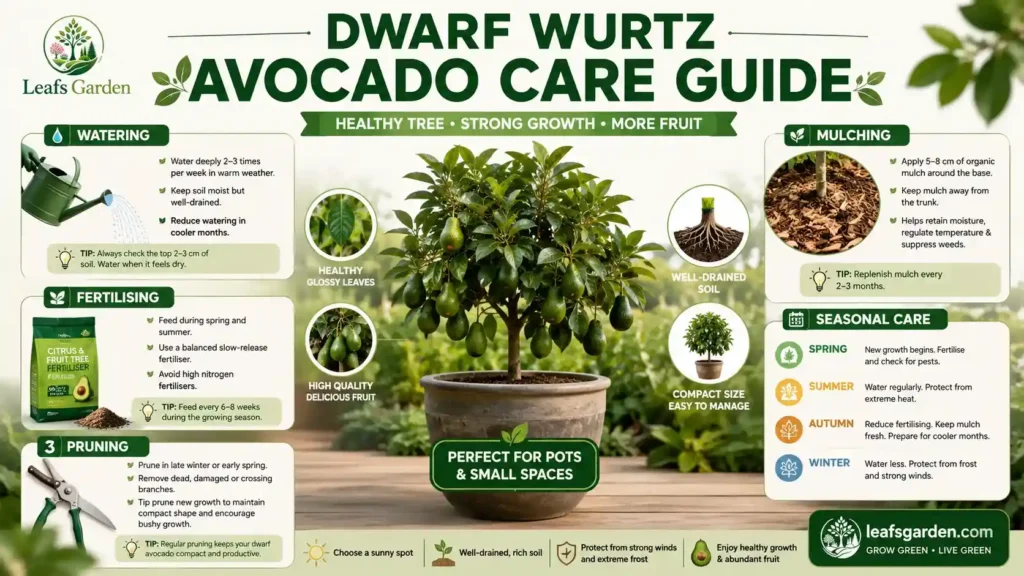
Dwarf avocado trees need steady moisture without constantly wet soil.
How often to water avocado trees depends on:
Young avocado plants generally require more regular watering while establishing roots. Mature trees become more drought tolerant but still perform best with consistent moisture.
A healthy watering routine usually focuses on deep watering rather than shallow daily watering.
General watering principles include:
Overwatering risks are one of the biggest problems for avocado cultivation.
Excess moisture can lead to:
Container-grown avocado trees are especially sensitive to waterlogged conditions because drainage problems develop more quickly in pots.
Dry soil symptoms may also appear if watering becomes too limited.
Common signs include:
The goal is balanced moisture rather than constantly wet or completely dry soil.
The best fertiliser for avocado trees supports steady leafy growth, root development, flowering, and fruit production.
Dwarf Wurtz avocado trees benefit from balanced feeding throughout the growing season, especially during active spring and summer growth.
Many avocado fertiliser Australia products are formulated with nutrients suited for subtropical fruit trees.
Important avocado nutrients include:
| Nutrient | Main Function |
| Nitrogen | Leaf and branch growth |
| Potassium | Fruit development |
| Phosphorus | Root support |
| Magnesium | Leaf health |
Nitrogen and potassium are particularly important for healthy avocado tree performance.
Nitrogen encourages:
Potassium supports:
Organic vs synthetic fertilizers both have advantages depending on gardening style.
Organic fertilisers may include:
Synthetic fertilisers usually provide:
Fertilising avocado trees seasonally helps avoid nutrient stress.
A common seasonal approach includes:
Over-fertilising should be avoided because excessive nutrients may damage sensitive avocado roots.
Regular pruning helps maintain the compact shape of a dwarf Wurtz avocado tree.
Because this variety naturally stays smaller, pruning is usually focused on shaping, airflow improvement, and branch maintenance rather than aggressive size reduction.
When to trim avocado trees depends on climate and growth activity.
Light pruning is often performed after fruit harvest or during active growing periods when recovery is faster.
When to prune avocado trees in Australia commonly depends on regional climate conditions, but many gardeners avoid heavy pruning during cold winter periods.
Pruning goals may include:
Shaping compact growth is especially useful for:
Removing dead branches also improves plant health and reduces disease risk.
Branches showing:
should be removed carefully using clean pruning tools.
Mulching plays a major role in avocado root health and moisture stability.
Avocado roots prefer cool protected soil conditions with steady moisture and good airflow.
The best mulch types for avocado trees include:
Mulch helps with:
Root temperature control is especially important during Australian summer heat and cooler winter conditions.
Mulch acts as a protective layer that reduces sudden soil temperature changes around sensitive avocado roots.
For best results:
Moisture retention tips for dwarf avocado trees include:
Healthy roots are one of the most important foundations for long-term avocado tree growth and productive fruiting.
A grafted dwarf Wurtz avocado tree can start producing fruit earlier than seed-grown avocado trees under proper care conditions.
The exact fruiting timeline depends on climate, sunlight, watering consistency, tree maturity, and overall plant health. Grafted Wurtz avocado trees are specifically grown for earlier and more reliable fruit production, making them a preferred option for home gardeners.
Compared with seed-grown avocado trees, the dwarf Wurtz avocado usually reaches productive maturity much faster.
A Wurtz avocado tree develops fruit gradually through several maturity stages.
Young avocado trees first focus on root growth and canopy development before directing energy toward flowering and fruit production.
| Growth Stage | Development |
| Early Establishment | Root and branch growth |
| Juvenile Stage | Canopy thickening and leaf production |
| Flowering Stage | Blossom development begins |
| Fruiting Stage | Fruit set and avocado growth |
| Mature Production | Regular seasonal harvests |
During the first years, most energy is directed toward structural growth rather than fruit production.
As the tree matures, flowering avocado tree development becomes more consistent. Healthy mature trees usually develop stronger flowering cycles and improved fruit-setting capacity each season.
The fruit-setting process begins after successful pollination.
Once pollinated:
Environmental stability strongly affects fruit retention during this stage.
The avocado flowering cycle is unique compared with many other fruit trees.
Avocado tree flowers open in two stages, functioning as female during one opening period and male during another. This flowering system helps encourage cross-pollination between avocado varieties.
The Wurtz avocado is generally classified as a Type A flowering avocado.
Avocado tree flowers explained simply:
Although Wurtz avocado trees can partially self-pollinate, nearby avocado trees may improve pollination success and fruit production.
Pollination behavior is influenced by:
Flower drop causes are also common during avocado blooming seasons.
Some flower loss is natural because avocado trees produce far more flowers than they can fully support into mature fruit.
However, excessive flower drop may result from:
Healthy growing conditions improve both flower retention and fruit development.
An avocado tree may fail to fruit if growing conditions are unstable or if the tree has not reached proper maturity.
Young trees commonly require time before becoming productive, especially seed-grown avocado plants.
Several common causes can reduce or prevent fruit production.
Avocado trees require strong sunlight for flowering and fruit development.
Insufficient sunlight may lead to:
Most avocado trees perform best with full sun exposure daily.
Cold weather and frost can damage:
Even temporary frost exposure during flowering season may significantly reduce avocado production.
Excess or insufficient nutrients may interfere with flowering and fruit growth.
Common nutrient-related problems include:
Balanced fertilising improves productive growth.
Poor pollination can limit fruit formation even when flowering appears healthy.
Low pollination activity may occur because of:
Adding compatible avocado varieties nearby may sometimes improve fruit set.
Both overwatering and underwatering can stress avocado trees and reduce fruit production.
Incorrect watering often causes:
Stable moisture levels with well-drained soil usually provide the best conditions for reliable avocado fruiting.
Avocado season in Australia varies by region and variety, but Wurtz avocado trees typically fruit during warmer growing seasons.
Climate, temperature, and local growing conditions all influence when avocados mature and become ready for harvest. In many Australian regions, homegrown Wurtz avocados develop gradually over several months before reaching picking maturity.
Because avocado fruit ripens after harvesting rather than on the tree, correct harvest timing is important for flavour and texture quality.
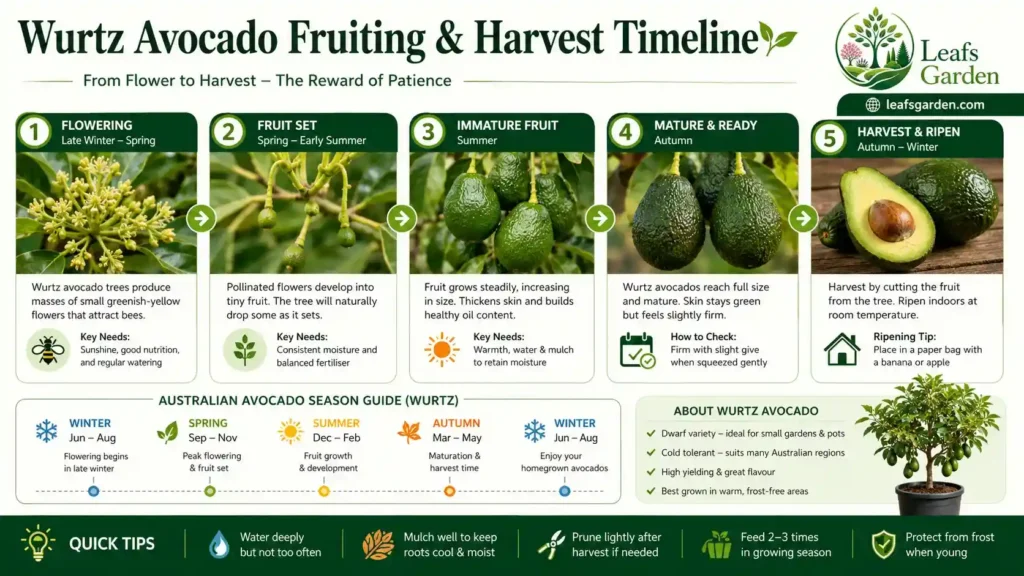
Avocado season in Australia changes between states and climate zones.
Warmer subtropical regions generally experience earlier avocado production, while cooler southern areas may harvest later in the season.
| Region | General Avocado Season |
| Queensland | Earlier warm-season harvest |
| Northern NSW | Extended subtropical season |
| Victoria | Later seasonal harvest |
| Western Australia | Region-dependent timing |
| Coastal Australia | Longer growing periods |
The Australia avocado season overview also varies by avocado variety.
Some avocado trees mature fruit earlier, while others hold fruit on the tree longer before harvest readiness.
Regional differences are mainly influenced by:
In Melbourne and cooler southern regions, avocado development may progress more slowly because of lower seasonal temperatures.
Subtropical climates usually support:
Avocados should only be picked once they reach mature development on the tree.
Unlike many fruits, avocados usually soften after harvest rather than while hanging on the tree.
Signs avocados are ready often include:
A mature avocado generally feels firm but fully developed when harvested.
Harvest maturity indicators can vary slightly between avocado varieties, but common signs include:
| Indicator | Meaning |
| Full fruit shape | Mature internal development |
| Healthy skin colour | Normal ripening stage |
| Easy stem separation | Fruit nearing readiness |
| Seasonal timing | Likely mature fruit |
Many gardeners test maturity by harvesting one avocado first and allowing it to ripen indoors.
If the fruit softens properly and develops creamy texture, additional avocados are usually ready for harvest.
Ripening after harvest typically occurs at room temperature over several days.
Warmer indoor temperatures often speed up the ripening process.
Proper storage helps preserve avocado texture, flavour, and freshness after harvest.
Freshly picked avocados are usually stored at room temperature first until they begin softening.
Ripening indoors works best when avocados are placed in:
Some gardeners place avocados near bananas or apples because these fruits release natural ethylene gas that can speed ripening.
Once avocados become soft and ready to eat, refrigeration helps slow further softening.
Refrigeration tips include:
To reduce browning on cut avocado surfaces:
Preventing spoilage mainly depends on avoiding excessive moisture and over-ripening.
Spoilage signs may include:
Proper harvest timing and storage conditions greatly improve avocado quality and shelf life.
The most common avocado tree problems include yellow leaves, root rot, poor fruiting, pests, and cold damage.
Although the dwarf Wurtz avocado is easier to manage than many larger avocado varieties, it can still develop health problems if growing conditions become unstable. Most issues are linked to watering mistakes, poor drainage, nutrient imbalance, or environmental stress.
Early identification usually makes avocado tree problems much easier to correct.
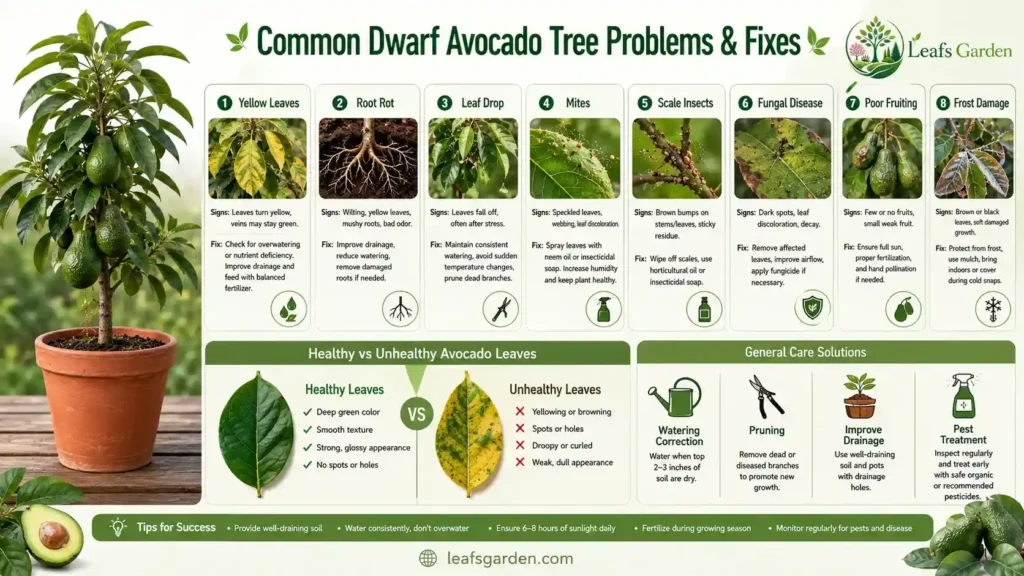
Yellow leaves are one of the most common warning signs in avocado trees.
Leaf discoloration often indicates stress affecting the roots, nutrients, or moisture balance. In some cases, older leaves naturally yellow and drop as part of normal canopy renewal, but widespread yellowing usually signals a deeper issue.
Nutrient deficiencies can weaken avocado foliage and reduce healthy green growth.
Common nutrient-related symptoms include:
Nitrogen deficiency is one of the most common causes of yellow avocado leaves because nitrogen supports healthy foliage production.
Magnesium and iron deficiencies may also affect leaf colour, especially in poor-quality soils.
Water stress can result from both underwatering and overwatering.
Dry conditions may cause:
Excess moisture may cause:
Balanced watering is important for stable avocado tree health.
Salt buildup sometimes develops in pots or poorly flushed soils.
Excess salts from fertilisers or mineral-heavy irrigation water may damage sensitive avocado roots.
Common salt stress symptoms include:
Occasional deep watering can help flush excess salts from the soil.
Root rot is one of the most serious problems affecting dwarf avocado trees.
Avocado roots require oxygen-rich soil conditions. Constantly wet soil can quickly encourage fungal root disease and root decay.
Overwatering symptoms commonly include:
Many beginners mistakenly add more water when wilted foliage appears, which can worsen root damage if drainage is already poor.
Poor drainage is a major cause of avocado root failure.
Heavy clay soils and containers without proper drainage can trap excessive moisture around the root system.
This increases the risk of:
Container-grown avocado trees are especially vulnerable if pots remain waterlogged after watering.
Preventing root rot is far easier than treating severe root damage.
Agriculture Victoria provides detailed horticultural guidance on avocado root disease management and soil drainage practices for Australian home growers.
Helpful prevention methods include:
Healthy root systems are essential for productive avocado growth and fruiting.
Dwarf Wurtz avocado trees may occasionally develop pest or fungal disease problems, especially during humid or stressed growing conditions.
Most infestations become more severe when airflow is poor or trees are weakened by environmental stress.
Mites are tiny sap-feeding pests that may damage avocado leaves.
Common symptoms include:
Hot dry weather can increase mite activity.
Scale insects attach themselves to stems and leaves while feeding on plant sap.
Signs of scale infestation may include:
Heavy infestations can weaken overall tree health over time.
Fungal diseases commonly develop during wet humid conditions or poor airflow.
Possible fungal problems include:
Excess moisture and overcrowded canopies often increase fungal risk.
Many gardeners prefer natural treatment options before using stronger chemical controls.
Common natural management methods include:
Healthy growing conditions usually reduce long-term pest and disease pressure naturally.
Some avocado problems become more noticeable when multiple stress factors occur together.
Poor soil, unstable watering, frost exposure, and nutrient imbalance can collectively weaken the tree over time.
| Problem | Cause | Solution |
| Yellow Leaves | Nutrient stress or watering imbalance | Correct feeding and moisture levels |
| Root Rot | Overwatering and poor drainage | Improve drainage and reduce watering |
| Leaf Drop | Temperature or moisture stress | Stabilise growing conditions |
| Poor Fruiting | Low sunlight or poor pollination | Increase sun exposure and improve pollination |
| Brown Leaf Tips | Salt buildup or dry stress | Flush soil and adjust watering |
| Pest Damage | Mites or scale insects | Apply natural pest treatments |
| Frost Damage | Cold exposure | Protect tree during winter |
Regular observation and early correction are the best ways to maintain a healthy and productive dwarf Wurtz avocado tree.
Wurtz avocado trees are smaller and easier to manage than standard Hass avocado trees, making them better for containers and compact gardens.
Both avocado varieties are popular for home growing, but they suit different gardening situations. The Hass avocado is widely known for commercial production and rich flavour, while the dwarf Wurtz avocado is preferred for limited-space home gardens and patio growing.
Choosing between the two often depends on available space, maintenance expectations, and growing conditions.
The biggest difference between a Wurtz avocado and a Hass avocado is overall tree size.
The dwarf Wurtz avocado is a naturally compact avocado tree designed for smaller growing areas. Its controlled growth habit makes it much easier to manage in suburban gardens and containers.
Hass avocado trees grow significantly larger over time and usually require more outdoor space.
| Feature | Dwarf Wurtz Avocado | Hass Avocado |
| Mature Size | Compact | Much larger |
| Pot Suitability | Excellent | Limited |
| Pruning Needs | Moderate | Higher |
| Patio Growing | Very suitable | Less practical |
| Urban Garden Use | Excellent | Requires more space |
The compact canopy structure of the Wurtz avocado also makes harvesting and maintenance easier for beginner gardeners.
Both Wurtz and Hass avocados produce creamy fruit with rich texture, but slight flavour differences may occur depending on climate and growing conditions.
Wurtz avocados are known for:
Hass avocados are often recognised for:
Fruit quality from both varieties improves when grown under warm sunny conditions with balanced watering and healthy soil.
Climate and harvest timing can also influence flavour intensity and oil content.
The dwarf Wurtz avocado is valued for reliable fruiting in compact spaces.
Because grafted Wurtz avocado trees often fruit earlier than seed-grown trees, many home gardeners choose them for faster backyard production.
Productivity differences may include:
| Productivity Factor | Wurtz Avocado | Hass Avocado |
| Fruiting Speed | Earlier | Moderate |
| Space Efficiency | High | Lower |
| Container Productivity | Good | Limited |
| Commercial Yield | Lower | Higher |
| Home Garden Suitability | Excellent | Good with space |
Hass avocado trees generally produce larger long-term harvests in large open growing areas, which is why they dominate commercial avocado farming.
The Wurtz avocado, however, performs exceptionally well for home-scale fruit production where space is limited.
The dwarf Wurtz avocado is usually the better choice for small gardens, patios, balconies, and compact edible landscapes.
Its naturally smaller size makes it easier to:
For Melbourne backyards, courtyard gardens, and patio growing, the Wurtz avocado is often more practical than a standard Hass avocado tree.
The Hass avocado may still be suitable for gardeners with:
For most urban home gardeners, the little avocado tree habit of the dwarf Wurtz avocado provides the best balance between manageable growth and productive fruiting.
Gardeners interested in full-sized backyard production can explore our complete guide to the Hass avocado tree, which covers everything from fruiting timelines to care requirements for larger growing spaces.
Wurtz avocado trees grow best in warm sunny areas with protection from frost and strong winds.
The dwarf Wurtz avocado adapts well to many climates when given proper sunlight, drainage, and temperature protection. Its compact size also makes it easier to grow in locations where larger avocado trees may struggle due to space limitations or colder seasonal conditions.
Because it can be grown both in the ground and in containers, the Wurtz avocado is one of the most flexible avocado varieties for home gardeners.
Growing avocado trees in Melbourne is possible when the tree receives maximum sunlight and winter protection.
Melbourne’s cooler winters can slow avocado growth compared with subtropical regions, but the dwarf Wurtz avocado performs better than many larger avocado varieties because it is easier to manage and protect.
Successful Melbourne avocado growing usually depends on:
North-facing garden positions in Australia often provide the best warmth and sunlight exposure.
Many Melbourne gardeners grow dwarf avocado trees successfully in:
Container growing is especially useful because pots can be relocated during cold weather periods.
Coastal Australia provides some of the best conditions for Wurtz avocado trees.
Warm temperatures, moderate humidity, and reduced frost exposure help support healthy avocado growth and reliable fruit production.
Popular coastal growing regions include:
Subtropical coastal climates often allow:
Gardeners in these warm coastal regions may also enjoy growing the Kensington Pride mango, another productive subtropical fruit tree that thrives in similar Queensland and northern NSW growing conditions.
However, strong coastal winds may sometimes stress avocado trees.
Wind protection can help reduce:
Planting near fences, walls, or sheltered garden zones often improves tree performance.
The dwarf Wurtz avocado grows well in many warm regions of the USA.
It is especially popular in areas where outdoor avocado cultivation is already common because its smaller size makes backyard management easier.
The best USA growing areas generally include USDA zones 9–11.
Suitable regions often include:
In colder American climates, container growing is commonly used so trees can receive winter protection.
The compact size of the Wurtz avocado also makes it practical for:
Consistent warmth and strong sunlight remain essential for reliable flowering and fruit production.
One of the biggest advantages of the dwarf Wurtz avocado is its suitability for container growing worldwide.
Because the tree remains naturally smaller, gardeners in cooler or space-limited regions can still grow avocado plants successfully using large pots and controlled positioning.
Container growing works particularly well for:
Worldwide container growers often benefit from:
To grow Wurtz avocado trees successfully in containers worldwide:
This adaptability is one reason the dwarf Wurtz avocado is considered one of the best compact avocado trees for modern home gardening globally.
Dwarf avocado trees provide homegrown fruit, compact growth, ornamental beauty, and easier maintenance for backyard gardeners.
The dwarf Wurtz avocado is one of the most practical avocado varieties for modern home gardening. Its smaller size, container-friendly growth, and productive fruiting habit make it highly suitable for urban spaces, suburban gardens, and compact outdoor areas.
Unlike large avocado trees that require significant space and maintenance, the Wurtz avocado offers a more manageable approach to growing fresh avocados at home.
The dwarf Wurtz avocado is ideal for small gardens because it stays naturally compact while still producing full-sized fruit.
Its manageable growth habit allows gardeners to enjoy avocado cultivation without needing a large backyard or orchard space.
Small garden benefits include:
The smaller avocado tree height also reduces shading problems in compact residential gardens.
Many homeowners prefer the little avocado tree structure because it integrates more easily into modern backyard layouts.
The Wurtz avocado is one of the best avocado trees for patios and balconies.
Its compact root system and container-friendly growth make it highly suitable for urban gardening environments where planting directly into the ground may not be possible.
Patio and balcony gardening advantages include:
Container-grown avocado trees can also be repositioned seasonally to improve sunlight exposure or reduce cold weather stress.
For apartment gardeners and renters, the dwarf avocado tree provides an accessible way to grow edible fruit plants in limited outdoor areas.
Dwarf Wurtz avocado trees work well as edible landscape plants because they combine ornamental foliage with productive fruiting.
The evergreen canopy adds year-round greenery while also functioning as a practical food-producing tree.
Edible landscaping benefits include:
The tree pairs well with:
Because the Wurtz avocado remains smaller than standard avocado trees, it is easier to include in mixed ornamental and edible garden designs.
The dwarf Wurtz avocado is often recommended for beginner gardeners because it is easier to manage than many larger avocado varieties.
Its naturally controlled size simplifies routine care tasks such as:
Beginner-friendly growing features include:
| Feature | Benefit |
| Compact Growth | Easier space management |
| Earlier Fruiting | Faster results |
| Pot Compatibility | Flexible placement |
| Smaller Canopy | Simpler pruning |
| Easier Harvesting | Reduced maintenance difficulty |
Grafted Wurtz avocado trees also tend to produce fruit earlier than seed-grown avocado plants, giving beginners a better chance of seeing successful harvests sooner.
For home gardeners wanting a productive, attractive, and manageable fruit tree, the dwarf Wurtz avocado offers one of the best combinations of convenience and long-term usability.
The dwarf Wurtz avocado tree is one of the best compact avocado varieties for Australian home gardeners because it combines manageable size, reliable fruit production, and container-friendly growth.
Its naturally smaller growth habit makes it far easier to maintain than many full-sized avocado trees while still producing creamy homegrown fruit. Whether grown in Melbourne backyards, sunny patios, raised beds, or large containers, the Wurtz avocado adapts well to modern small-space gardening.
For gardeners wanting a productive avocado plant without needing a large orchard-sized area, the dwarf Wurtz avocado offers an excellent long-term solution.
With proper sunlight, free-draining soil, balanced watering, and seasonal care, a dwarf Wurtz avocado tree can provide years of healthy growth and reliable avocado harvests in both outdoor gardens and container-growing setups.
Yes, the Wurtz avocado is widely considered one of the smallest avocado tree varieties available for home gardeners. Its naturally dwarfing growth habit keeps the tree far more compact than standard avocado trees like Hass or Reed. This smaller mature size makes it ideal for patios, containers, balconies, and small backyard gardens.
Yes, dwarf Wurtz avocado trees grow very well in large pots and containers. Their compact root system and controlled growth habit make them one of the best avocado varieties for container gardening. Good drainage, full sun, and regular watering are important for healthy pot-grown avocado trees.
A dwarf Wurtz avocado tree usually stays much smaller than a full-sized avocado tree. Its final size depends on climate, pruning, soil quality, and whether it is grown in a pot or in the ground. Container-grown trees generally remain more compact because root growth is naturally restricted.
A grafted Wurtz avocado tree can begin producing fruit earlier than seed-grown avocado trees under proper growing conditions. Healthy trees with strong sunlight, balanced watering, and good soil drainage usually establish faster and develop fruit more reliably over time.
Yes, dwarf avocado trees can grow indoors if they receive enough sunlight and warmth. Indoor avocado plants perform best near bright sunny windows with several hours of direct light daily. Proper airflow, moderate humidity, and well-draining soil are also important for healthy indoor growth.
The best fertiliser for avocado trees contains balanced nutrients that support leaf growth, root health, flowering, and fruit development. Nitrogen and potassium are especially important for healthy avocado growth. Many gardeners use either organic compost-based fertilisers or balanced slow-release avocado fertilisers.
Avocado trees in Australia are commonly pruned after harvest or during active growing periods. Many gardeners avoid heavy pruning during cold winter weather because recovery can slow in cooler conditions. Light seasonal pruning helps maintain compact shape and healthy airflow.
Wurtz avocado trees are considered partially self-pollinating. They can produce fruit on their own, but nearby avocado trees may improve pollination success and overall fruit set. Flowering conditions, insect activity, and temperature also affect pollination performance.
No, Wurtz avocados and Hass avocados are different avocado varieties. The Wurtz avocado tree is naturally dwarfing and better suited for compact gardens and containers. Hass avocado trees grow much larger and are more commonly used for commercial avocado production.
Yes, Wurtz avocado trees can grow in Melbourne when planted in warm sunny protected locations. Container growing is especially popular in Melbourne because pots can be moved during colder weather. Frost protection, full sun exposure, and good drainage all help improve avocado tree success in cooler Victorian climates.