Grow Better Gardens with Smarter Plant Choices
Discover helpful guides on trees, hedges, fruit plants, edible plants, and beautiful landscape greenery.

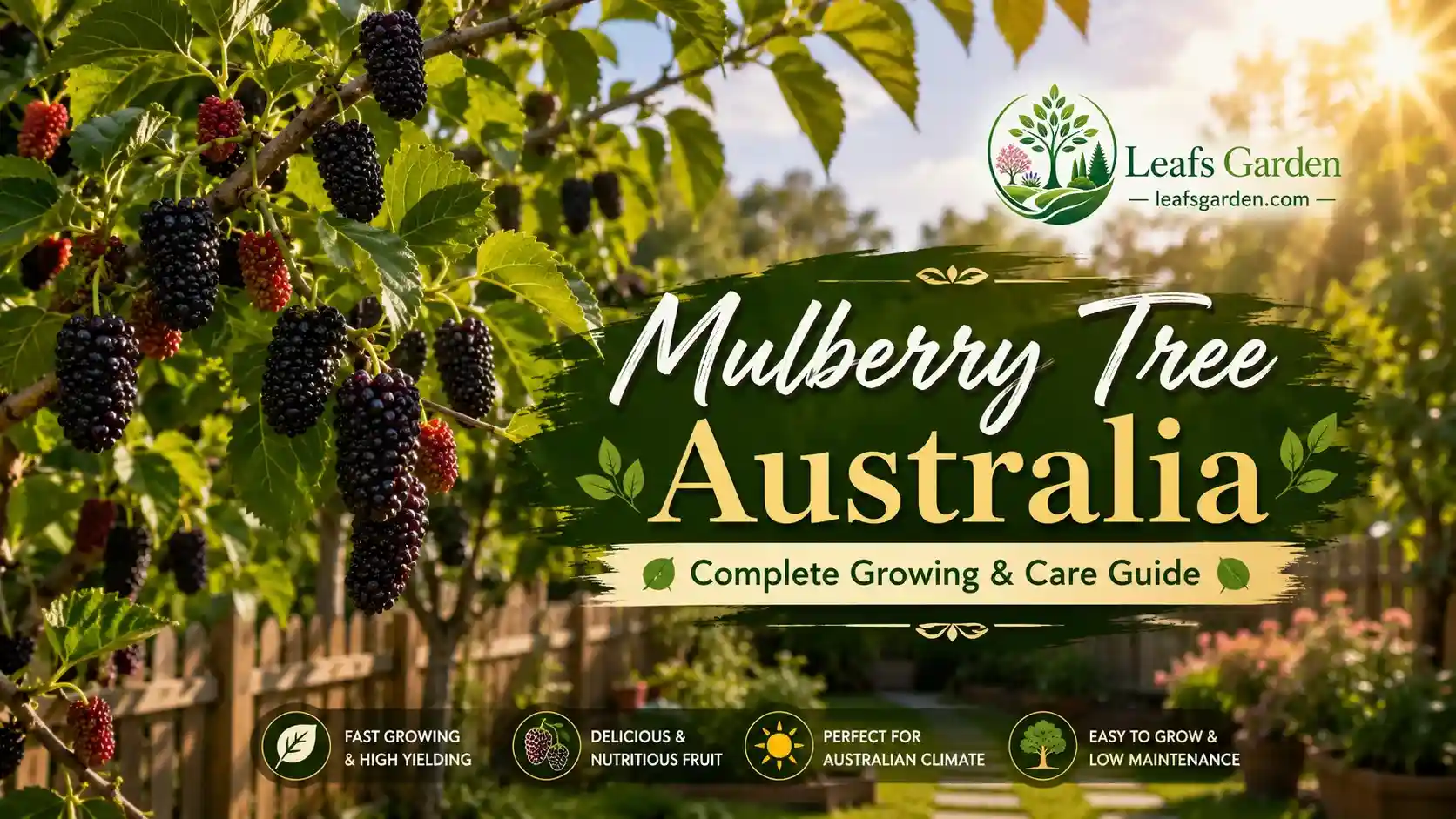
Mulberry trees are fast-growing deciduous fruit trees that produce sweet, juicy berries and adapt extremely well to Australian growing conditions. A healthy mulberry tree australia gardeners grow can provide seasonal fruit, dense summer shade, and low-maintenance backyard beauty for decades.
Across mulberries australia wide, these trees are popular because they tolerate heat, grow quickly, and fruit heavily with minimal care. Many home gardeners plant an australian mulberry tree for fresh fruit production, while others use mulberry tree and fruit varieties as ornamental shade trees in family gardens and small orchards.
Mulberry trees are highly versatile and suitable for:
Several mulberry varieties grow successfully in Australia. Black mulberry trees are valued for their rich sweet flavor, while white mulberry trees are known for vigorous growth and adaptability. Weeping mulberry forms are popular ornamental feature trees, and compact dwarf mulberry tree varieties work well in pots and smaller urban gardens.
Most mulberry trees fruit from late spring through summer depending on climate and variety. These trees are deciduous, meaning they naturally lose their leaves during winter dormancy before producing fresh spring growth again. Once established, mulberries are considered one of the easiest fruit trees to maintain, making them ideal for both beginner and experienced gardeners.
A mulberry tree is a deciduous fruit tree from the Moraceae family grown for its sweet edible berries, rapid growth, and dense shade canopy. Mulberry trees are widely cultivated in Australia because they adapt well to different climates and produce reliable seasonal fruit with relatively low maintenance.
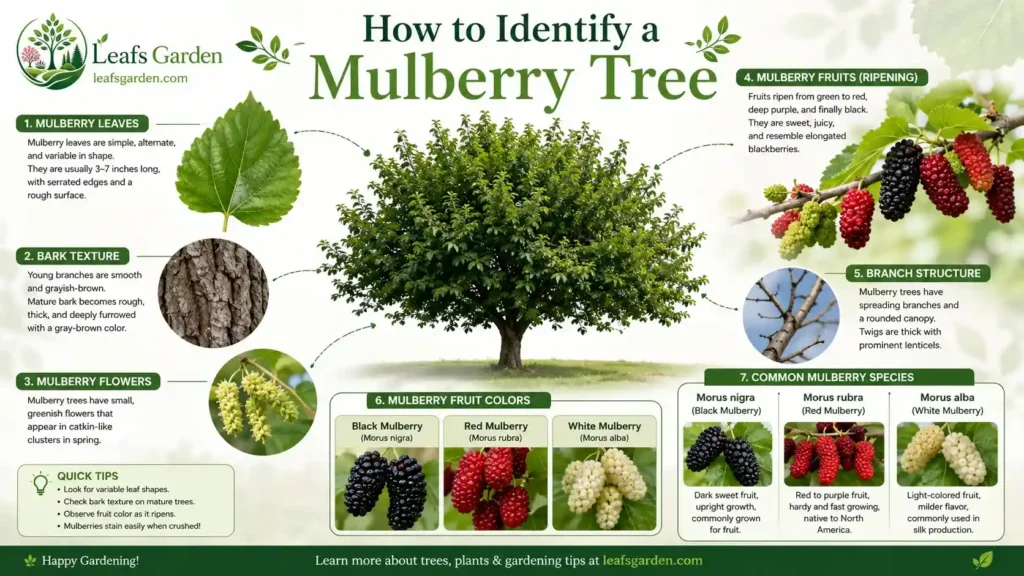
Mulberry trees belong to the Morus tree group, with the most common species being Morus nigra and Morus alba. These trees are recognized by their broad leaves, spreading canopy, and clusters of soft berry-like fruit.
Common scientific names include:
Mulberry plant leaves are usually broad, green, and slightly rough in texture. Some leaves may appear lobed on younger growth while mature leaves become more heart-shaped. Leaf size can vary depending on the mulberry tree species and growing conditions.
The bark of mature mulberry trees becomes thick, textured, and brownish-grey with age. Younger branches are smoother and lighter in color.
Mulberry flower clusters are small and often unnoticed because they are greenish and compact. After pollination, the flowers develop into elongated mulberry berries that resemble blackberries.
Mulberry fruit changes color as it ripens. Depending on the variety, ripe fruit may appear:
Most mulberry trees develop a broad spreading growth habit with dense seasonal foliage.
Home gardeners exploring productive backyard options will find the mulberry a rewarding addition among the many versatile fruit trees and edible plants suited to Australian climates.
Some ornamental forms, such as weeping mulberries, grow with cascading branches, while dwarf varieties remain compact for pots and smaller gardens.
Yes, most mulberry trees are deciduous and naturally lose their leaves during winter in Australia. This seasonal dormancy helps the tree conserve energy before producing fresh spring growth.
If gardeners ask, “are mulberry trees deciduous,” the answer is yes for nearly all common Australian varieties. During autumn and winter, leaves gradually yellow and drop as temperatures cool.
Many people also wonder, “do mulberry trees lose their leaves?” Leaf drop is completely normal and is part of the annual growth cycle of healthy mulberry trees.
Winter behavior of mulberry trees typically includes:
New leaves and flower growth usually begin again in late winter or early spring depending on the local climate.
Australia grows several mulberry varieties suitable for home gardens, orchards, pots, and ornamental landscaping. Different mulberry varieties australia gardeners choose depend on fruit flavor, mature size, and climate suitability.
| Variety | Fruit Color | Size | Best Climate |
| Black mulberry tree | Dark purple-black | Large | Cool to warm temperate |
| White mulberry tree | White to pink | Large | Warm and subtropical |
| English mulberry tree | Black-red | Medium to large | Temperate regions |
| Weeping mulberry tree | Black-purple | Compact | Small gardens |
| Dwarf mulberry tree | Black-red | Small | Pots and courtyards |
The Morus nigra black mulberry tree is one of the most popular fruiting varieties because of its rich sweet flavor and heavy crops. White mulberry trees are more vigorous and tolerate heat extremely well.
Weeping mulberry trees are commonly used as ornamental feature trees because of their graceful cascading branches. Dwarf mulberry tree varieties are ideal for container growing and compact backyard spaces.
Among the many types of mulberry trees grown in Australia, gardeners usually select varieties based on available space, climate, and desired fruit quality.
Mulberry trees grow successfully across a wide range of Australian climates and are considered one of the most adaptable fruit trees for home gardens. With proper sunlight, soil drainage, and seasonal care, mulberries can produce heavy crops and vigorous growth for many years.
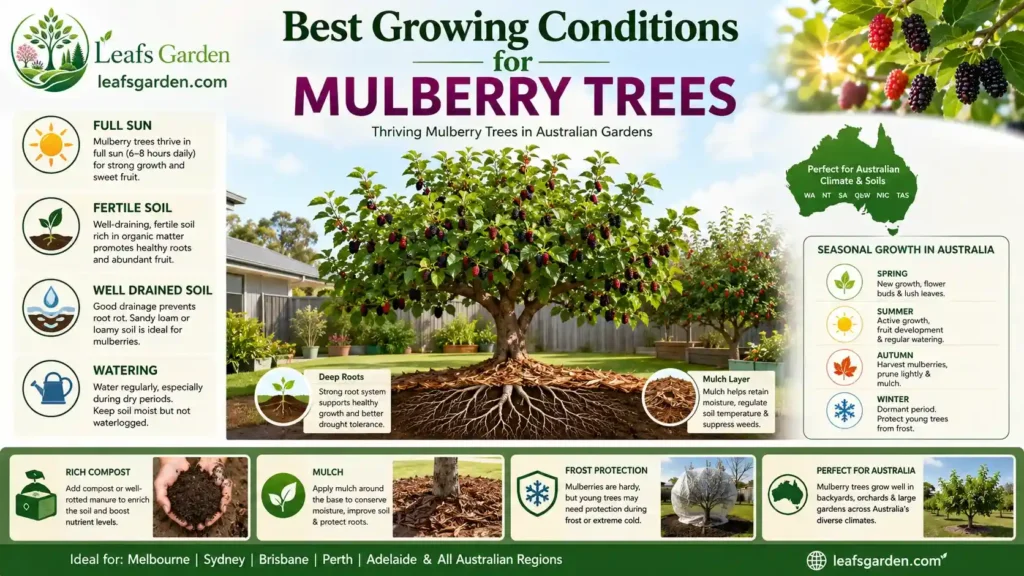
Mulberries grow well across most Australian states including Queensland, New South Wales, Victoria, Western Australia, and South Australia. Their adaptability makes them suitable for both warm subtropical regions and cooler temperate climates.
Mulberry melbourne growers typically succeed with black mulberry and English mulberry varieties because they tolerate cooler winters and seasonal changes well.
In warmer regions, mulberry perth and mulberry sydney gardeners benefit from long growing seasons, strong summer heat, and reliable fruit production.
Mulberries brisbane gardens often produce vigorous growth due to Queensland’s warm subtropical climate. In many northern regions, the mulberry season qld gardeners experience can begin earlier than southern states because of warmer spring temperatures.
Mulberries generally perform best in:
Once established, mulberry trees tolerate drought, summer heat, and varying humidity levels better than many other fruit trees.
Mulberry trees need full sun for strong growth, healthy foliage, and heavy fruit production. Trees grown in shaded areas often develop weaker branches and produce fewer berries.
Most mulberry varieties require at least:
Mulberry trees handle Australian summer heat extremely well once mature. Established trees tolerate high temperatures and continue producing dense foliage during hot weather.
Strong sunlight also improves:
In cooler climates, planting mulberries in the sunniest part of the garden helps maximize fruit production during the growing season.
Well-draining fertile soil helps mulberry trees grow faster, establish stronger roots, and produce better fruit crops. Although mulberries are adaptable, soil quality strongly affects long-term performance.
Ideal soil conditions include:
Mulberry trees generally prefer a soil pH between 6.0 and 7.0, though many varieties tolerate slightly alkaline conditions.
Adding compost before planting improves:
Sandy soil drains quickly and may require extra compost and watering during summer. Heavy clay soil can hold excessive moisture, increasing the risk of root stress and poor growth.
If planting in clay-heavy areas, gardeners should improve drainage by adding:
Healthy drainage is especially important during wet Australian winters and heavy rainfall periods.
Most mulberry trees tolerate Australian heat very well and continue growing strongly during hot summers. Mature trees are highly resilient and can survive extended warm conditions once established.
Young mulberry trees, however, are more sensitive to frost and cold winter winds. Newly planted trees may require temporary protection during their first few winters.
Mulberry trees generally tolerate:
In colder regions, frost protection methods may include:
Winter dormancy naturally improves cold tolerance in established deciduous mulberry trees. Once spring temperatures rise, new leaf and fruit growth usually resumes quickly.
Mulberry trees can grow from compact dwarf forms to very large shade trees depending on the variety, climate, and pruning method. Growth size varies significantly between standard, dwarf, and ornamental weeping mulberry trees.
A full grown mulberry tree can become extremely large if left unpruned for many years. Standard varieties often develop broad spreading canopies with strong root systems and thick trunks.
Average mulberry tree size for mature standard trees is commonly:
Many gardeners ask, “how big do mulberry trees grow?” In ideal Australian conditions, vigorous trees can grow surprisingly fast during spring and summer.
Black mulberry and white mulberry trees often become large landscape trees when planted in open ground with full sun and fertile soil.
Mulberry size is influenced by:
People also ask, “how big does a mulberry bush get?” Compact bush-style mulberries usually remain much smaller through regular pruning and container restriction.
Without seasonal pruning, mature mulberry trees may eventually become too large for smaller suburban gardens. Regular canopy management helps maintain a safer and more productive tree size.
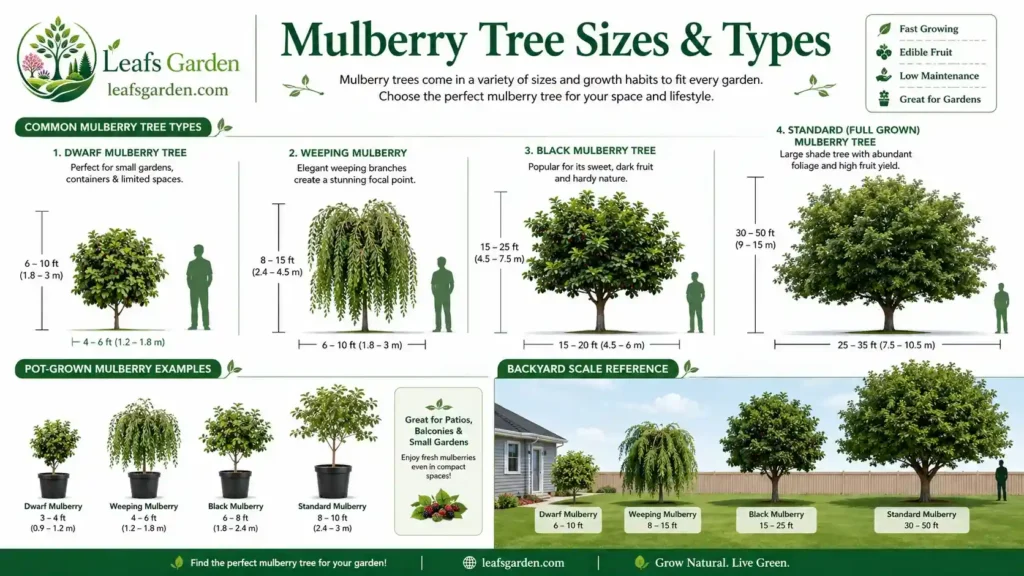
Dwarf mulberry varieties are ideal for smaller gardens, patios, and pots, while standard mulberry trees are better suited for orchards and large backyard spaces.
| Feature | Dwarf Mulberry | Standard Mulberry |
| Mature Size | Small and compact | Large spreading tree |
| Best For | Pots and small gardens | Orchards and shade |
| Pruning Needs | Minimal | Regular pruning needed |
| Fruit Production | Moderate to high | Heavy fruit crops |
| Growth Speed | Moderate | Fast-growing |
| Root Spread | Compact | Extensive root system |
A dwarf mulberry is easier to manage in urban gardens where space is limited. Many dwarf mulberry tree australia growers prefer compact varieties because they still produce quality fruit without excessive height.
Dwarf black mulberry varieties are especially popular for:
Standard mulberry trees, however, generally provide heavier shade and much larger fruit harvests over time.
Weeping mulberry trees are compact ornamental forms with cascading branches that create an umbrella-like canopy shape. These trees are highly popular in decorative Australian gardens because they combine fruit production with attractive landscaping value.
A mature weeping mulberry usually remains much smaller than standard mulberry varieties. Its naturally drooping branch structure makes it suitable for:
Many gardeners searching for a mulberry tree weeping form choose grafted ornamental varieties because they are easier to maintain and visually compact.
The mulberry weeping tree growth habit typically includes:
Regular pruning helps maintain shape and improves airflow through the canopy while encouraging healthy fruit production.
Mulberry trees are easy to establish in Australian gardens when planted in the right season and location. Proper planting improves root development, growth speed, and long-term fruit production.
The best time for when to plant mulberry tree australia gardeners grow is late winter to early spring. Planting during this period allows roots to establish before strong summer heat arrives.
Early-season planting offers several benefits:
In warmer regions of Australia, mulberry trees can also be planted during autumn if frost risk is low. Avoid planting during extreme summer heat because young roots may dry out quickly.
Bare-root mulberry trees are usually planted during winter dormancy, while potted nursery trees can be planted almost year-round with proper watering.
Planting mulberry tree varieties correctly helps young trees establish faster and produce healthier long-term growth. Whether planting a standard or dwarf variety, the process remains simple and beginner-friendly.
Select a planting site with at least 6–8 hours of direct sunlight daily. Full sun improves fruit production, canopy growth, and berry sweetness.
Avoid areas with:
Before planting a mulberry tree, improve the soil using compost or aged organic matter. Well-draining fertile soil supports stronger root growth and healthier foliage.
Good mulberry soil should be:
Dig a hole approximately twice as wide as the root ball and slightly deeper than the nursery container.
A wider planting hole helps roots spread more easily into surrounding soil.
Place the tree carefully into the hole so the root crown sits at natural soil level. Avoid planting too deeply because excessive soil around the trunk can encourage rot.
When learning how to plant mulberry tree varieties properly, correct root positioning is one of the most important steps.
After backfilling the soil, water thoroughly to remove air pockets and settle the roots into place.
Deep watering helps:
Apply mulch around the base of the tree while keeping it away from direct trunk contact.
Mulching helps:
For successful mulberry tree planting, regular watering during the first growing season is essential until the tree becomes established.
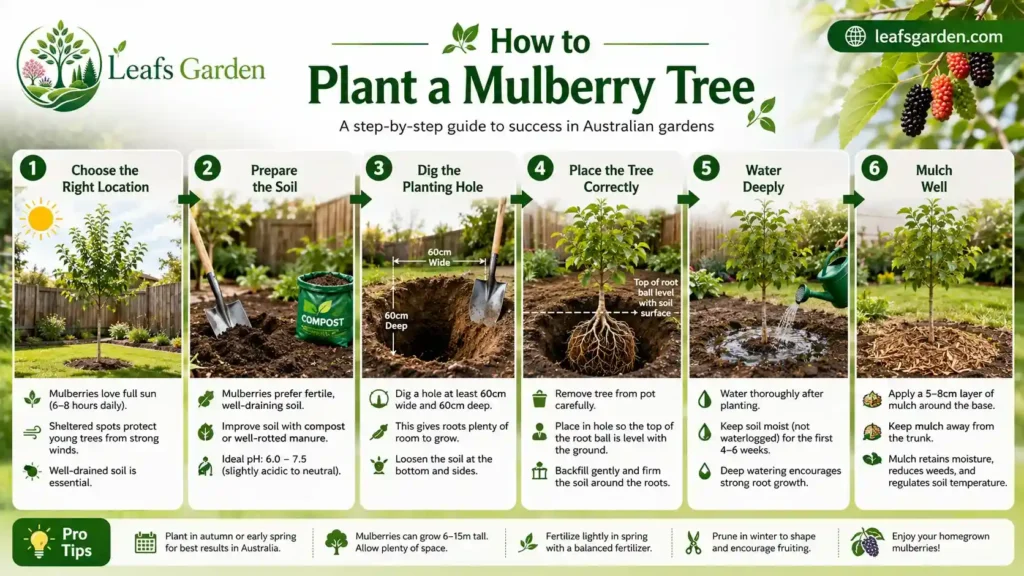
A mulberry tree in pot culture works very well when compact varieties are selected. Dwarf and weeping mulberries are especially suitable for container growing in patios, balconies, and small urban gardens.
A healthy mulberry tree pot setup should include:
Many gardeners successfully grow mulberry in pot systems because containers naturally help limit tree size and make pruning easier.
When growing a mulberry tree in a pot, choose containers that are:
Container-grown mulberry trees usually require:
Dwarf mulberries and weeping forms are generally the easiest choices for long-term container growing in Australian climates.
Mulberry trees are low-maintenance fruit trees once established, but proper watering, feeding, mulching, and seasonal care greatly improve growth, fruit quality, and long-term tree health.
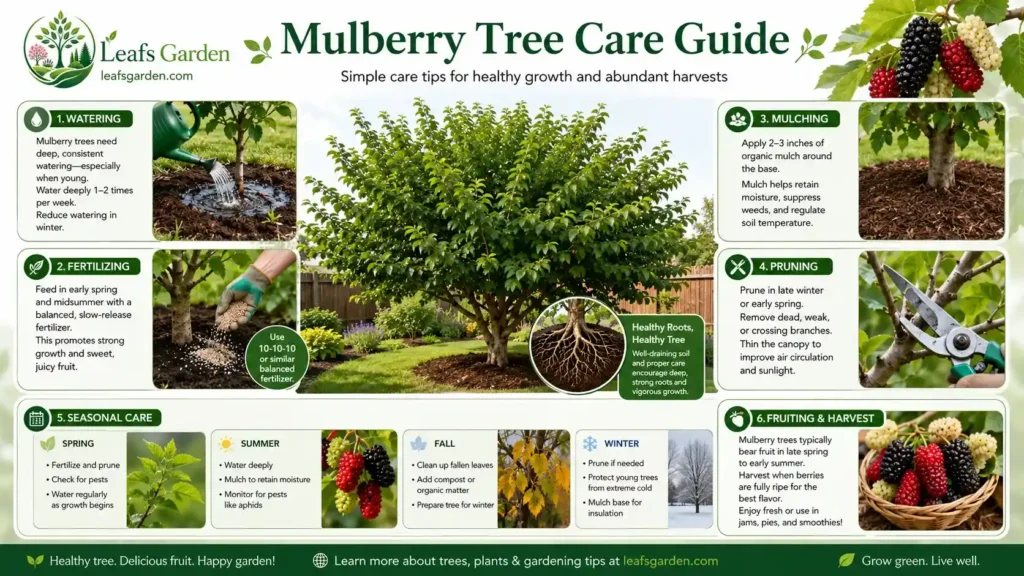
Mulberry trees need regular watering during their establishment phase, especially during the first one to two years after planting. Deep watering helps develop stronger root systems and improves drought resistance later.
Young mulberry trees generally need:
Once mature, most mulberry trees become relatively drought tolerant and can handle Australian summer conditions well.
Watering frequency depends on:
Sandy soils dry faster and require more frequent watering, while heavier soils retain moisture longer.
Overwatering should be avoided because constantly wet soil may lead to:
Container-grown mulberry trees usually require more frequent watering than in-ground trees due to faster soil drying.
Balanced slow-release fertilizer improves mulberry growth, canopy development, and fruit production. Feeding mulberry trees correctly encourages healthier leaves and sweeter fruit during the growing season.
A quality mulberry fertilizer should contain balanced nutrients including:
Organic compost and aged manure can also improve soil fertility naturally.
Most gardeners apply mulberry tree fertilizer during:
Avoid excessive nitrogen because overly vigorous leafy growth may reduce fruit production.
Healthy fertilizing practices help support:
Container-grown mulberry trees may require more frequent light feeding because nutrients leach faster from potting mix.
Mulching is one of the most important parts of mulberry tree care because it protects roots and improves soil moisture stability during hot Australian summers.
A healthy mulch layer helps with:
Good mulch materials include:
Apply mulch around the root zone while keeping it several centimetres away from direct trunk contact to prevent moisture-related disease problems.
Mulberry roots benefit from:
Shallow root competition from weeds should also be minimized to help young trees establish more efficiently.
Regular seasonal care improves mulberry tree maintenance and supports stronger fruit production throughout the year. Mulberry plant care becomes easier when tasks are divided by season.
| Season | Maintenance Tasks |
| Spring care | Fertilize, apply mulch, monitor new growth, water regularly |
| Summer fruiting | Harvest fruit, deep water during heat, protect ripening berries from birds |
| Autumn cleanup | Remove fallen fruit and leaves, inspect tree health, reduce watering gradually |
| Winter pruning | Prune dormant branches, shape canopy, remove dead wood |
Routine mulberry bush care should also include:
Consistent seasonal maintenance keeps mulberry trees productive, healthy, and easier to manage in both backyard gardens and container-growing setups.
Mulberry trees usually begin fruiting from spring through summer, although exact timing varies depending on climate, temperature, and mulberry variety. Warm Australian regions often experience earlier fruit production than cooler southern areas.
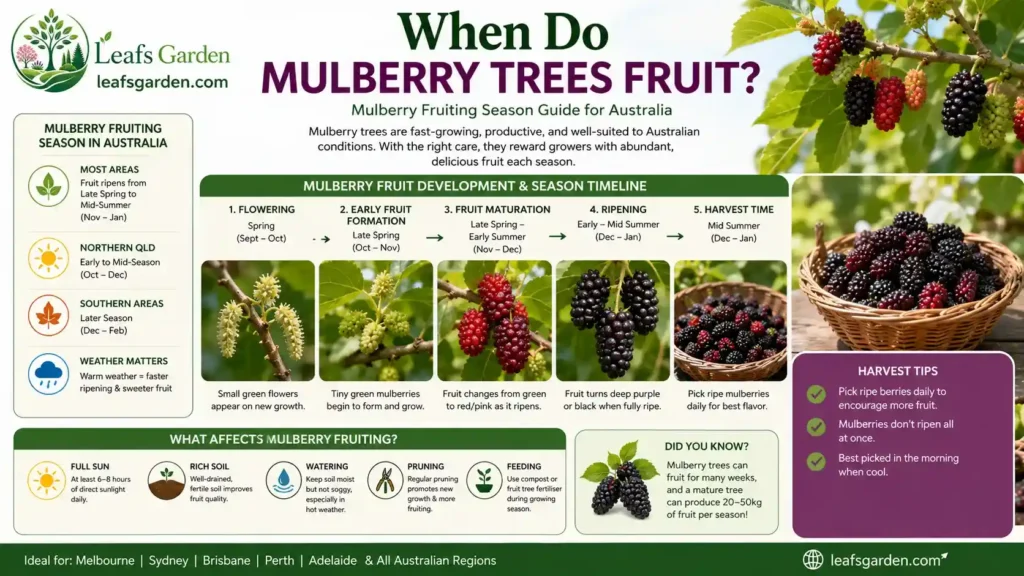
The mulberry season australia gardeners experience generally starts in late spring and continues into summer. In warmer climates, some trees may begin producing fruit earlier and continue harvesting for several weeks.
Many people ask, “when do mulberries fruit?” Most Australian mulberry trees produce berries between:
The mulberry season qld growers experience often begins sooner because Queensland’s warmer temperatures encourage earlier flowering and fruit development.
If gardeners ask, “when does mulberry fruit,” the answer depends on several factors including:
The mulberry tree fruiting season may also vary between black mulberry, white mulberry, and weeping mulberry varieties.
For gardeners wondering “when are mulberries in season in australia,” peak harvest commonly occurs during warm spring and summer weather when berries fully ripen and soften.
Healthy fruiting trees usually show:
Mulberry trees can fruit relatively quickly compared to many other fruit trees, especially when propagated from cuttings or grafted nursery stock.
Average fruiting timelines include:
| Propagation Type | Average Time to Fruit |
| Trees from cuttings | 1–3 years |
| Grafted trees | 1–2 years |
| Seed-grown trees | 5–10 years |
Trees from cuttings are one of the fastest ways to establish productive mulberry trees because they grow as clones of mature fruiting plants.
Grafted mulberry trees also produce fruit quickly since the upper grafted section already comes from mature fruiting wood.
Seed-grown mulberry trees usually take much longer to mature and may vary in fruit quality, size, and growth habit.
Faster fruit production is encouraged by:
A mulberry tree may fail to fruit due to environmental stress, immature age, or incorrect maintenance practices. Most fruiting problems can be corrected once the underlying cause is identified.
Mulberry trees need full sun for strong flowering and fruit development. Trees growing in excessive shade often produce fewer berries or no fruit at all.
Poor sunlight may cause:
Young mulberry trees may simply need more time to mature before producing fruit consistently. Seed-grown trees especially can take several years before fruiting begins.
Recently planted trees often focus first on:
Excessive pruning may remove developing fruiting wood and reduce seasonal berry production.
Heavy pruning can lead to:
Mulberry trees generally fruit better when pruning is moderate and timed during winter dormancy.
Too much nitrogen fertilizer may encourage rapid leaf growth while reducing flower and fruit production.
Nutrient imbalance symptoms may include:
Balanced fertilizing and proper seasonal care usually improve long-term fruit production in healthy mulberry trees.
Pruning helps mulberry trees maintain a manageable size, improve airflow, encourage healthy fruit production, and reduce branch overcrowding. Proper seasonal pruning also keeps trees safer and easier to harvest.
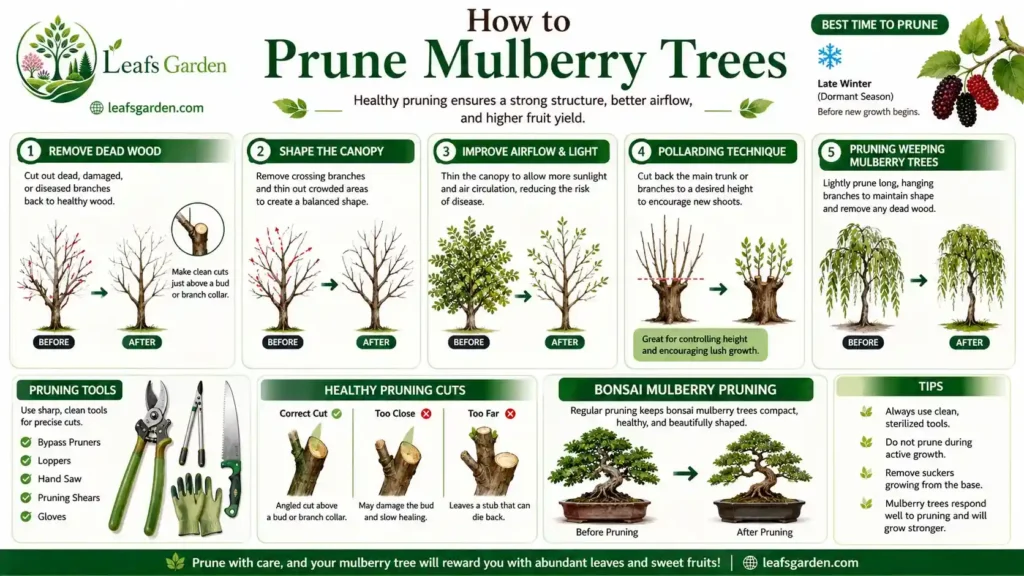
Mulberry trees are best pruned during winter dormancy when the tree has lost its leaves and active growth has slowed. Winter pruning reduces stress and allows the tree to recover before spring growth begins.
Many gardeners ask:
In most Australian regions, pruning is usually done from late winter to early spring before new buds open.
Gardeners who enjoy seasonal winter pruning routines may also appreciate growing a Nijisseiki pear, another popular deciduous fruit tree that follows a similar dormancy and pruning schedule in temperate Australian home orchards.
If people ask, “when do you prune mulberry trees in australia,” the ideal timing depends slightly on local climate, but dormant winter pruning remains the safest and most effective option.
Winter pruning benefits include:
Avoid heavy pruning during active summer growth because excessive cutting may reduce fruit production and stress the tree during hot weather.
Pruning mulberry trees australia gardeners grow should focus on tree health, balanced structure, and long-term size control. Regular pruning also helps maintain easier harvesting access.
Start by removing:
Removing unhealthy wood improves overall tree vigor and reduces potential pest or fungal issues.
Thin crowded internal branches to improve airflow through the canopy.
Better airflow helps:
Proper mulberry tree pruning australia practices often focus heavily on canopy ventilation.
A mature mulberry tree can become extremely large if left unmanaged. Reduce excessive height and spread by selectively shortening vigorous branches.
When gardeners prune mulberry tree varieties regularly, trees become:
Avoid removing too much growth in a single season because aggressive pruning may stimulate excessive leafy regrowth.
Shape the tree into an open balanced framework with evenly spaced branches.
Good canopy structure supports:
Pruning mulberry should always aim to maintain both productivity and structural stability.
Mulberry trees respond very well to pollarding and bonsai training because of their vigorous growth and flexible branching habit.
A pollarded mulberry tree is regularly cut back to major framework branches to control size and encourage dense new seasonal growth.
Pollarding is commonly used for:
This pruning method requires ongoing maintenance because mulberry trees regrow rapidly after cutting.
Mulberry bonsai tree cultivation is also popular among bonsai enthusiasts due to the tree’s:
A well-maintained mulberry bonsai can produce miniature fruit while developing an aged ornamental appearance over time.
Successful mulberry bonsai care usually includes:
Both pollarded and bonsai-trained mulberry trees require consistent maintenance to preserve their compact form and healthy growth structure.
Mulberry trees can be propagated from cuttings or seeds, but cuttings are generally the fastest and most reliable method for producing fruiting trees. Propagation allows gardeners to grow new mulberry plants at low cost while preserving desirable fruit qualities.
Mulberry cuttings are one of the easiest ways to grow new mulberry trees because they root relatively well and develop quickly under suitable conditions.
Many gardeners prefer mulberry tree cuttings because the new plant remains genetically identical to the parent tree, helping preserve fruit quality and growth characteristics.
Growing mulberry from cuttings is commonly done during late winter or early spring using dormant hardwood branches.
People searching how to propagate mulberry trees often find that hardwood cuttings root faster when humidity and moisture remain stable.
Successful rooting usually depends on:
Rooted mulberry cuttings can later be transplanted into pots or garden beds once strong new growth appears.
Growing mulberry from seed is slower than propagation from cuttings, but it can still produce vigorous and healthy trees.
Mulberry tree from seed cultivation is often used for experimentation, breeding, or growing large numbers of seedlings.
Fresh mulberry tree seeds generally germinate more successfully than old dried seeds.
Mulberry seeds may germinate slowly and unevenly, sometimes taking several weeks or months depending on temperature and seed quality.
Seed-grown trees can vary in:
Unlike propagated cuttings, seedlings may not always match the characteristics of the parent mulberry tree.
Young mulberry seedlings require careful early maintenance to establish healthy roots and strong branch growth.
Mulberry tree seedlings grow best when protected from harsh heat, drying winds, and excessive moisture stress during their early stages.
Healthy seedling care includes:
Young mulberry seedlings should not remain waterlogged because excess moisture may damage delicate developing roots.
As seedlings mature, they gradually become more tolerant of:
Once mulberry tree seedlings develop strong root systems and several sets of leaves, they can be transplanted into larger containers or permanent garden positions.
Mulberry trees are generally hardy and easy to grow, but they can still develop problems caused by poor growing conditions, pests, or environmental stress. Early identification helps prevent long-term damage and improves fruit production.
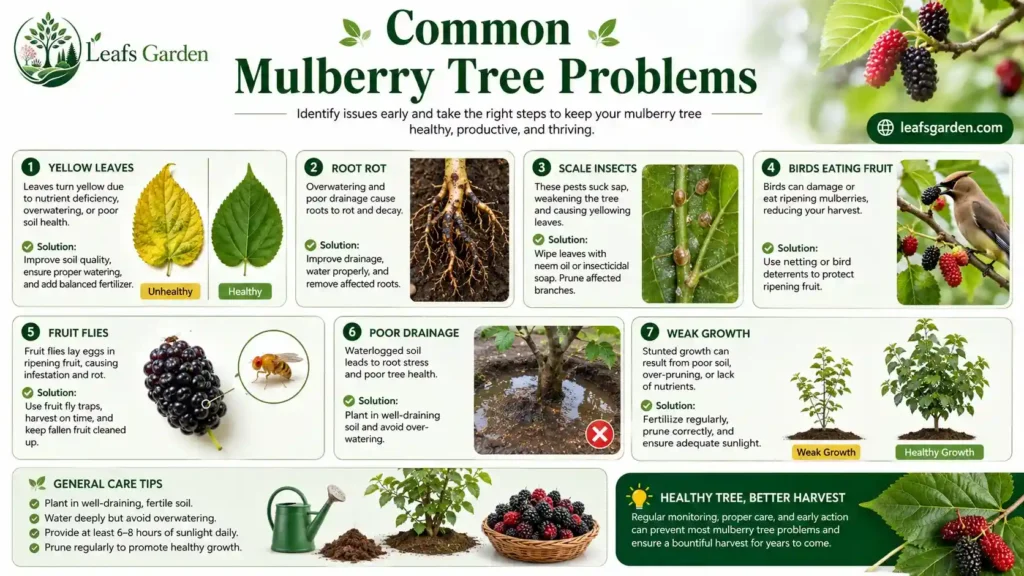
Yellow leaves and weak growth are usually signs of stress affecting root health, nutrient uptake, or watering balance.
Lack of essential nutrients can cause pale leaves, poor vigor, and reduced fruit production.
Common nutrient deficiency symptoms include:
Nitrogen deficiency is one of the most common causes of pale mulberry leaves. Applying balanced fertilizer and compost usually improves recovery.
Both underwatering and overwatering can stress mulberry trees and affect overall health.
Underwatering may cause:
Overwatering may lead to:
Deep but infrequent watering is generally healthier for established mulberry trees.
Poor drainage is a major cause of root decline in mulberry trees. Waterlogged soil prevents oxygen from reaching roots and may encourage fungal disease.
Heavy compacted soil often increases the risk of:
Improving drainage with compost and organic matter usually helps restore healthier root conditions.
Mulberry trees may occasionally experience pest or disease issues, especially during warm humid conditions or periods of heavy fruiting.
Fruit flies are attracted to ripening mulberries and may damage soft mature fruit.
Common signs include:
Harvesting fruit quickly and maintaining garden hygiene helps reduce fruit fly problems.
For detailed fruit fly identification and management advice, NSW Department of Primary Industries provides reliable guidance for Australian home gardeners and backyard orchard growers.
Scale insects attach themselves to stems and branches where they feed on plant sap.
Symptoms may include:
Horticultural oils and regular monitoring usually help manage infestations.
Birds are one of the most common mulberry fruit problems in Australia because they are highly attracted to ripe berries.
Bird damage may result in:
Protective netting is often the most effective solution during peak fruiting season.
Root rot develops when soil remains excessively wet for long periods.
Common symptoms include:
Improving soil drainage and reducing overwatering are critical for prevention.
Some mulberry varieties are restricted or discouraged in certain regions because of invasive growth habits or pollen-related concerns.
Many people ask, “why are mulberry trees illegal?” Restrictions usually apply to specific non-fruiting or highly invasive varieties rather than all mulberry trees.
Potential concerns include:
In some countries and regions, male white mulberry trees are restricted because airborne pollen may contribute to allergies.
If gardeners ask, “are mulberry trees illegal in australia,” the answer is generally no for most backyard fruiting varieties. However, local regulations may vary depending on council restrictions, biosecurity concerns, or environmental weed classifications in certain areas.
Before planting large-scale mulberry trees, it is always best to check:
Most commonly sold fruiting mulberry trees in Australian nurseries are considered safe and suitable for home gardens.
Mulberry trees are valued for both their edible fruit and practical landscape benefits. They provide sweet seasonal harvests, dense shade, fast growth, and strong adaptability in Australian gardens.
Mulberry fruit is highly versatile and can be eaten fresh or used in a wide variety of homemade foods and desserts. Ripe mulberries are sweet, juicy, and rich in color, making them popular for both fresh consumption and preserving.
Fresh mulberries are commonly eaten directly from the tree during harvest season. Fully ripe berries become soft, sweet, and flavorful.
Fresh fruit is often used for:
Mulberries are widely used for homemade jam because of their natural sweetness and rich berry flavor.
Mulberry jam is popular for:
Mulberry ice cream is a popular seasonal dessert made using fresh or frozen berries. The fruit provides natural sweetness and deep purple coloring.
Mulberries are also blended into:
Mulberry fruit works well in many baked and chilled desserts because of its soft texture and sweet-tart flavor.
Popular dessert uses include:
Mulberries can be dried for long-term storage and healthy snacking. Dried mulberries develop a concentrated sweetness and chewy texture.
Dried fruit is often used in:
Mulberry trees are excellent landscape trees because they combine ornamental beauty, shade, and edible fruit production in one plant.
Large mulberry trees develop broad spreading canopies that provide excellent summer shade for gardens and outdoor areas.
Shade benefits include:
Mulberries are known for their rapid growth, especially during warm Australian growing seasons.
Fast growth makes them useful for:
Mulberry trees attract many forms of wildlife including birds, bees, and beneficial insects.
Wildlife benefits include:
Mulberries are highly popular in backyard orchards because they produce reliable fruit crops with relatively low maintenance.
They pair well with other fruit trees such as:
Gardeners pairing mulberries with figs in their backyard orchard may find our guide to the Brown Turkey fig helpful, as it shares a similar deciduous growth cycle and low-maintenance care routine in warm Australian conditions.
Compact mulberry varieties allow gardeners to grow fruit trees even in limited spaces. Dwarf and ornamental forms are especially suitable for urban gardens and container growing.
Dwarf mulberry trees remain smaller and easier to manage than standard full-sized varieties.
Dwarf trees are ideal for:
They also require less aggressive pruning and are easier to harvest.
Weeping mulberry trees provide both ornamental beauty and compact growth. Their cascading branch structure makes them attractive feature trees for decorative landscaping.
Weeping forms work well in:
Many mulberry varieties can be grown successfully in large containers with proper care.
Pot-grown mulberries benefit from:
Dwarf and weeping mulberry varieties are generally the best choices for long-term container growing in Australian conditions.
Australia grows several productive mulberry varieties suited to different climates, garden sizes, and landscaping needs. Some varieties are grown mainly for sweet fruit production, while others are preferred for ornamental use or compact growth.
| Variety | Fruit Taste | Growth Size | Best Use |
| Black English mulberry | Rich, sweet, intense flavor | Large | Home orchards and fruit production |
| White mulberry | Mildly sweet | Large fast-growing tree | Shade and hardy landscape planting |
| Morus nigra mulberry | Deep sweet-tart flavor | Medium to large | Premium fruit quality |
| Weeping mulberry | Sweet black fruit | Compact ornamental form | Small gardens and feature planting |
| Dwarf mulberry tree | Sweet compact fruiting variety | Small | Pots, patios, and courtyards |
Black English mulberry trees are among the most popular fruiting mulberries in Australia because of their excellent berry flavor and reliable production.
Key features include:
These trees are commonly planted in backyard orchards and larger gardens where space allows full canopy growth.
White mulberry trees are vigorous fast-growing trees that tolerate a wide range of Australian conditions. Fruit color may range from white to pink or light purple depending on the cultivar.
White mulberries are valued for:
They are often used as hardy landscape trees in warmer climates.
Morus nigra mulberry varieties are highly prized for superior fruit quality and rich berry flavor. These trees usually grow slower than white mulberries but produce sweeter fruit.
Benefits include:
Many Australian gardeners consider Morus nigra one of the best mulberry varieties for fresh eating and homemade desserts.
Weeping mulberry trees are compact ornamental forms with cascading branches and umbrella-shaped canopies.
They are commonly used for:
Weeping varieties combine ornamental appearance with seasonal fruit production while remaining easier to manage than large standard mulberries.
A dwarf mulberry tree is ideal for gardeners with limited space or container-growing needs. These compact varieties produce good fruit crops while maintaining a smaller mature size.
Dwarf mulberries are especially suitable for:
Regular pruning and seasonal feeding help dwarf mulberry trees remain productive and compact for many years.
Mulberry trees are widely available across Australia through local nurseries, online plant stores, garden centers, and seasonal retail suppliers. Choosing the right variety and purchasing healthy nursery stock improves long-term growth and fruit production success.
Gardeners can buy mulberry tree varieties from both local nurseries and online plant suppliers depending on availability and preferred tree size.
Many people purchase mulberry tree stock online because specialist nurseries often provide:
Local garden nurseries are also useful because buyers can inspect plant health before purchasing.
Common purchasing options include:
People searching for mulberry tree for sale listings will often find:
Some nurseries also offer mulberry seedlings for sale for gardeners wanting lower-cost young plants.
Before purchasing, consider:
Mulberry tree bunnings stock may vary depending on season, region, and nursery supplier availability. Many Australian gardeners purchase mulberry trees through major garden retailers because they are widely accessible and beginner-friendly.
Mulberry trees bunnings stores commonly carry include:
A bunnings mulberry tree is often sold during fruit tree planting seasons, especially in late winter and spring.
Some larger stores may occasionally stock:
Availability changes throughout the year, so checking local stock before visiting is often helpful.
Selecting healthy nursery stock is extremely important for successful establishment and long-term productivity. Strong young trees adapt faster and usually develop better fruit production over time.
Inspect the root system carefully when possible.
Healthy roots should be:
Healthy roots are one of the strongest indicators of good plant quality.
For grafted mulberry trees, check that the graft union appears:
Poor graft quality may affect long-term growth and structural strength.
Leaves should appear healthy, green, and free from visible damage.
Avoid trees with:
Healthy foliage usually indicates better nursery care and lower transplant stress.
Always confirm the exact mulberry variety before purchasing. Different types vary greatly in:
Choosing the correct variety helps ensure the tree matches available space and intended garden use.
Mulberry trees are among the easiest and most rewarding fruit trees to grow in Australia. They adapt well to many climates, grow quickly, and produce generous crops of sweet berries with relatively low maintenance.
Whether growing a large backyard shade tree, a compact dwarf mulberry, or a weeping ornamental variety, mulberries suit a wide range of Australian gardens and growing conditions. Their strong climate adaptability allows them to perform well in temperate, subtropical, and warm regions across the country.
Mulberry trees are also highly suitable for:
With proper pruning, watering, fertilizing, and seasonal care, mulberry trees remain healthy, productive, and easier to manage over the long term.
Because of their beginner-friendly nature, fast growth, and reliable fruit production, mulberries continue to be one of the best fruit tree choices for Australian home gardeners.
Mulberry trees usually fruit from late spring through summer depending on the climate and variety. In warmer regions like Queensland, fruiting may begin earlier than in cooler southern areas.
Yes, most mulberry trees are deciduous. They naturally lose their leaves during winter dormancy and produce fresh new growth again in spring.
Mulberry trees are considered fast-growing fruit trees. Under good conditions, some varieties can grow more than 1 metre per year during active growing seasons.
Yes, mulberry trees can grow successfully in pots, especially dwarf and weeping varieties. Large containers with good drainage and regular watering are important for healthy growth.
Mulberry trees are best pruned during winter dormancy, usually from late winter to early spring before new growth begins.
Black English mulberry and Morus nigra varieties are among the most popular for Australian gardens because of their sweet fruit and reliable production. Dwarf and weeping forms are ideal for smaller spaces.
Most common fruiting mulberry trees are not considered invasive in Australian home gardens. However, some non-fruiting or highly vigorous varieties may face restrictions in certain regions.
Grafted mulberry trees and trees grown from cuttings may fruit within 1–3 years. Seed-grown trees usually take much longer and may need several years before producing fruit.
Yes, mulberry trees are commonly propagated from cuttings. Hardwood cuttings are one of the easiest and fastest ways to grow new mulberry trees.
Yes, mulberry trees grow best in full sun. At least 6–8 hours of direct sunlight daily helps improve fruit production, canopy growth, and berry sweetness.