Grow Better Gardens with Smarter Plant Choices
Discover helpful guides on trees, hedges, fruit plants, edible plants, and beautiful landscape greenery.

Purple fountain grass australia is one of the most popular ornamental grasses for adding bold color, soft movement, and modern texture to outdoor spaces. Its rich burgundy-purple foliage and fluffy flower plumes create a dramatic focal point in both small and large Australian gardens.
Known botanically as Pennisetum setaceum rubrum, Pennisetum advena rubrum, and Cenchrus setaceus, this ornamental grass is widely used for borders, feature planting, pots, pathways, and contemporary landscape designs. Australian gardeners value it for its fast growth, low-maintenance nature, and year-round visual impact in warm climates.
Purple fountain grass performs especially well in coastal gardens, drought-tolerant landscapes, and tropical or subtropical regions where heat and sunlight enhance its deep purple color. Its fountain-shaped form also adds movement and softness to modern outdoor spaces without requiring intensive care.
Another reason for its growing popularity in Australia is its beginner-friendly nature. Even new gardeners can successfully grow purple fountain grass with basic sunlight, drainage, and watering care. Whether planted in garden beds, decorative containers, or mixed ornamental borders, it provides strong ornamental value with minimal maintenance.
Purple fountain grass is an ornamental clumping grass known for its arching purple foliage, soft feathery plumes, and elegant fountain-like shape. It is widely grown in Australian landscapes for decorative texture, seasonal color, and low-maintenance garden design.
Purple fountain grass belongs to the Poaceae grass family, which includes many ornamental and lawn grasses used in landscaping. Its scientific classification is commonly associated with Pennisetum rubrum, Pennisetum setaceum rubrum purple fountain grass, and Pennisetum advena rubrum.
In modern botanical classification, some references also place the plant under the genus Cenchrus. This is why gardeners may sometimes see different plant labels at nurseries or garden centers.
Although the names are closely related, there are slight usage differences:
These names generally describe ornamental fountain grasses with colorful foliage and plume flowers, but purple fountain grass is specifically known for its rich purple-red appearance.
Purple fountain grass is sold under several common names across Australia. Different nurseries and landscapers may use slightly different terms depending on plant variety and regional preference.
Common names include:
Despite the different names, these terms usually refer to the same or closely related ornamental grass varieties with purple foliage and soft flowering plumes.
Purple fountain grass is highly valued for its dramatic ornamental appearance and flowing growth habit. The plant forms dense clumps of narrow arching leaves that create a soft fountain-shaped silhouette in the landscape.
Key plant characteristics include:
The flower plumes emerge above the foliage during warmer months and move gently in the wind, adding motion and texture to outdoor spaces.
Most mature plants reach:
| Feature | Average Size |
| Height | 60 cm to 150 cm |
| Spread | 60 cm to 100 cm |
| Growth Habit | Upright arching clump |
Seasonal color intensity can vary depending on climate and sunlight exposure. In warm Australian regions with full sun, foliage usually develops deeper burgundy and purple tones. Cooler weather may slightly fade the color or slow growth during winter.
Purple fountain grass behaves as a perennial in many warm Australian climates where frost is minimal. In tropical and subtropical regions, the plant can continue growing for multiple years with regular maintenance.
In cooler Australian states, it is often treated as a seasonal ornamental grass because frost can damage foliage and reduce winter survival rates.
Its lifespan usually depends on:
In warm conditions, healthy plants can survive for several growing seasons and continue producing fresh foliage and flower plumes each year.
Purple fountain grass grows best in warm Australian climates with full sun, free-draining soil, and moderate watering. When planted in the right conditions, it develops richer purple foliage, stronger plume production, and faster seasonal growth.
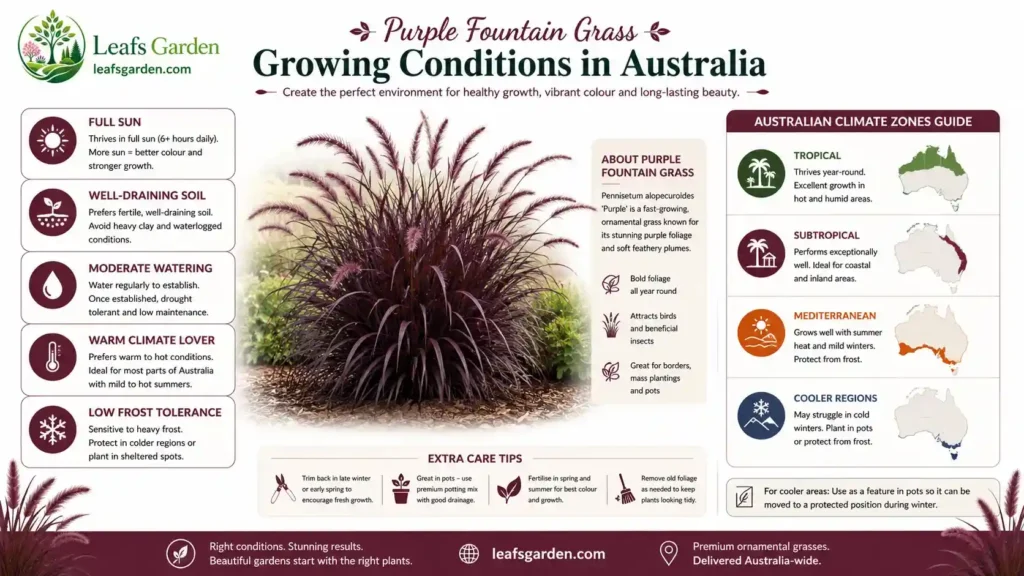
Purple fountain grass performs exceptionally well in many Australian climate regions, especially areas with long warm seasons and mild winters.
Tropical regions provide ideal growing conditions for purple fountain grass because the plant thrives in heat, humidity, and extended sunlight exposure. Growth remains active for much of the year in frost-free areas.
These conditions are common in parts of:
Subtropical climates are among the most reliable environments for maintaining strong foliage color and continuous ornamental growth.
The plant grows particularly well in:
Subtropical conditions support healthy plume production and long seasonal performance.
Purple fountain grass also adapts well to Mediterranean-style climates with dry summers and mild winters.
It is commonly used in:
Its drought-tolerant nature makes it suitable for low-water garden planning.
In cooler Australian regions, purple fountain grass may slow down significantly during winter. Frost exposure can damage foliage and reduce plant vigor.
In colder climates:
Gardeners in cooler states often treat it as a warm-season ornamental grass rather than a permanent evergreen feature.
Purple fountain grass needs full sun for the strongest color development and healthiest growth.
Plants grown in direct sunlight typically produce:
A minimum of 6–8 hours of direct sunlight daily is ideal.
Too much shade can reduce ornamental quality and cause:
Partial shade may still support growth, but the dramatic purple color usually becomes less intense.
Purple fountain grass grows best in well-draining soil that prevents excessive moisture around the roots.
Ideal soil conditions include:
Drainage is more important than soil richness for long-term plant health. Waterlogged conditions increase the risk of root rot and fungal problems.
Raised beds and improved garden drainage help maintain healthy root systems.
Purple fountain grass adapts very well to sandy soils commonly found in coastal Australian gardens.
Sandy soil benefits include:
Adding organic matter can improve moisture retention without making the soil heavy.
Heavy clay soils may hold excessive moisture and restrict root growth.
If planting in clay soil:
Good drainage remains essential in all Australian climates.
Purple fountain grass becomes relatively drought tolerant once established, making it suitable for low-maintenance landscapes.
Mature plants can handle dry conditions better than many ornamental grasses. Deep root systems help the plant tolerate periods of reduced watering.
This makes it popular in:
Young plants require more regular watering while roots establish.
During extreme summer heat:
Morning watering is generally best during hot weather.
Overwatering is one of the most common problems affecting purple fountain grass.
Common symptoms include:
Consistently wet soil reduces oxygen around the roots and weakens the plant over time.
Purple fountain grass handles heat extremely well but has limited frost tolerance in colder regions.
This ornamental grass thrives in hot Australian summers and performs best in warm temperatures.
Strong heat tolerance allows it to maintain:
Frost can burn foliage and damage exposed growth, especially in young plants.
Severe frost may cause:
In colder climates, plants may temporarily die back during winter.
Winter protection improves long-term survival in cooler areas.
Helpful strategies include:
Pruning dead winter growth in early spring encourages fresh new foliage.
| Requirement | Ideal Condition |
| Sunlight | Full sun |
| Soil | Well-draining |
| Water | Moderate |
| Climate | Warm regions |
| Frost Tolerance | Low |
Purple fountain grass is easy to grow from nursery plants or divisions and establishes quickly in warm Australian conditions. With proper sunlight, drainage, and spacing, it develops into a dense ornamental grass with rich purple foliage and soft flowering plumes.
Proper planting helps purple fountain grass establish faster and maintain strong seasonal growth.
Spacing depends on the desired landscaping effect and plant variety size.
General spacing guidelines include:
| Planting Style | Recommended Spacing |
| Mass planting | 60–80 cm apart |
| Feature planting | 80–120 cm apart |
| Container planting | One plant per pot |
Adequate spacing improves:
Crowded planting can reduce airflow and create uneven growth.
Purple fountain grass should be planted at the same depth as its nursery container.
Important planting tips:
Planting too deep can increase moisture problems around the roots.
The best planting season in Australia is usually during spring or early summer when temperatures begin warming consistently.
Warm-season planting allows:
In tropical and subtropical regions, planting can often continue for much of the warmer year.
Purple fountain grass performs exceptionally well in open garden beds where its shape and foliage color become major visual features.
Mass planting creates strong movement and dramatic color contrast across landscapes.
This technique works well for:
Repeated planting also creates a softer flowing appearance when the plumes move in the wind.
Purple fountain grass is widely used along pathways, fences, driveways, and garden edges.
Border planting benefits include:
Its arching growth habit helps soften hard landscape lines.
As a feature grass, purple fountain grass creates a bold focal point in modern Australian landscaping.
Popular feature uses include:
The burgundy-purple foliage pairs especially well with stone, timber, and minimalist outdoor designs.
Purple fountain grass adapts very well to pots and containers, making it suitable for patios, balconies, and compact outdoor spaces.
A medium to large container provides enough space for healthy root development.
Recommended features include:
Larger containers also help reduce moisture stress during hot Australian summers.
Good drainage is essential when growing ornamental grasses in containers.
Poor drainage can quickly lead to:
Using premium free-draining potting mix improves root health and overall plant performance.
Purple fountain grass is highly popular in decorative outdoor containers because it adds movement, texture, and strong foliage color without requiring excessive maintenance.
It works especially well for:
Container-grown plants may require slightly more frequent watering than garden-grown specimens.
Purple fountain grass can survive indoors temporarily, but it is generally not considered an ideal long-term indoor plant.
Indoor environments usually lack the intense sunlight needed for healthy ornamental growth.
Common indoor problems include:
Growth often becomes less compact indoors.
Purple fountain grass requires several hours of direct sunlight daily to maintain its rich burgundy foliage.
Indoor placement should ideally include:
Without sufficient light, foliage may gradually turn greener and lose its ornamental appeal.
Purple fountain grass is considered a fast-growing ornamental grass in warm climates.
Under ideal conditions, plants establish quickly and develop dense foliage within a single growing season.
Rapid growth makes it useful for:
Young plants can fill out rapidly during spring and summer.
Growth is strongest during warm months when sunlight and temperatures remain high.
Typical seasonal behavior includes:
| Season | Growth Activity |
| Spring | Rapid new growth |
| Summer | Peak foliage and plume production |
| Autumn | Slower growth with continued color |
| Winter | Dormancy or reduced growth in cooler areas |
In warm Australian regions, purple fountain grass may continue growing for most of the year with only minor seasonal slowdown.
Regular pruning, balanced watering, and seasonal maintenance help purple fountain grass remain healthy, vibrant, and visually attractive throughout the year. Although it is considered a low-maintenance ornamental grass, proper care improves foliage color, plume production, and long-term growth performance in Australian gardens.
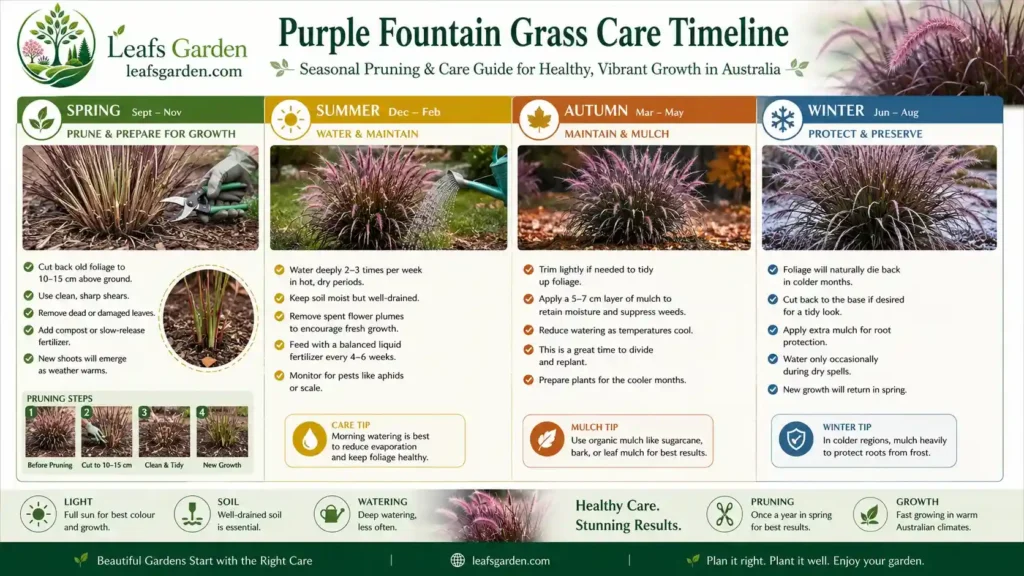
Purple fountain grass requires only light feeding to maintain healthy growth and strong foliage color.
This ornamental grass usually performs well without heavy fertilization, especially when planted in reasonably healthy soil.
Overfeeding can cause:
In many Australian gardens, occasional seasonal feeding is sufficient.
A balanced slow-release fertilizer is generally the best option for ornamental grasses.
Recommended fertilizer types include:
Apply fertilizer mainly during:
Avoid excessive nitrogen because it can reduce the rich burgundy-purple appearance.
Mulching helps stabilize soil moisture and supports healthier root development around purple fountain grass.
A light mulch layer helps the soil retain moisture during hot Australian summers.
Suitable mulch materials include:
Mulch also helps reduce rapid soil temperature fluctuations.
Mulching suppresses weeds that compete for nutrients and moisture around the plant base.
Additional benefits include:
Keep mulch slightly away from the crown to prevent excessive moisture buildup near the stems.
Seasonal maintenance keeps purple fountain grass attractive and encourages stronger regrowth throughout the year.
Summer is the plant’s main active growing period.
Important summer care practices include:
Healthy summer growth usually produces the strongest foliage color and plume development.
Growth slows significantly during cooler months, especially in frost-prone areas.
Winter maintenance may include:
Frost-damaged leaves can remain until spring pruning.
Spring is the most important recovery period for ornamental grasses.
Spring maintenance encourages:
This is also the ideal time for major pruning and dividing mature clumps if needed.
Purple fountain grass is usually cut back in late winter or early spring before fresh new growth begins.
The ideal pruning season depends slightly on regional climate, but most Australian gardeners prune before active spring growth starts.
This timing helps:
Avoid heavy pruning during cold frost periods.
Cutting back old foliage allows the plant to redirect energy into fresh new shoots.
Benefits of seasonal pruning include:
Regular pruning also prevents excessive dead foliage buildup inside mature clumps.
Proper pruning timing keeps ornamental grasses healthy without causing unnecessary stress.
A simple pruning process usually works best:
Most gardeners leave several centimeters of foliage above the base to protect emerging shoots.
Dead foliage should be removed regularly to improve appearance and reduce pest or fungal issues.
Signs foliage should be removed include:
Clean removal improves overall plant presentation in landscaped areas.
Light trimming during summer is possible, but heavy pruning is generally not recommended during extreme heat.
Light trimming may include:
Hard pruning during active summer heat can stress the plant and reduce ornamental quality.
Severe summer pruning may expose sensitive growth to heat stress.
Potential risks include:
If trimming during summer, avoid removing excessive foliage at one time.
Safe pruning practices help ornamental grasses recover faster and maintain a healthier structure.
Best pruning practices include:
Clean cuts reduce damage and improve regrowth quality.
Several common mistakes can weaken ornamental grasses over time.
Avoid:
Balanced seasonal maintenance keeps purple fountain grass dense, colorful, and visually attractive throughout Australian growing conditions.
Purple fountain grass adds texture, movement, and dramatic contrast to Australian landscapes. Its flowing burgundy foliage and soft plume flowers work well in both modern and natural-style gardens, making it one of the most versatile ornamental grasses for outdoor design.
For a complete guide to evergreen, shade, and ornamental landscape trees that pair beautifully with ornamental grasses in Australian garden designs, see our Evergreen, Shade & Landscape Trees guide.
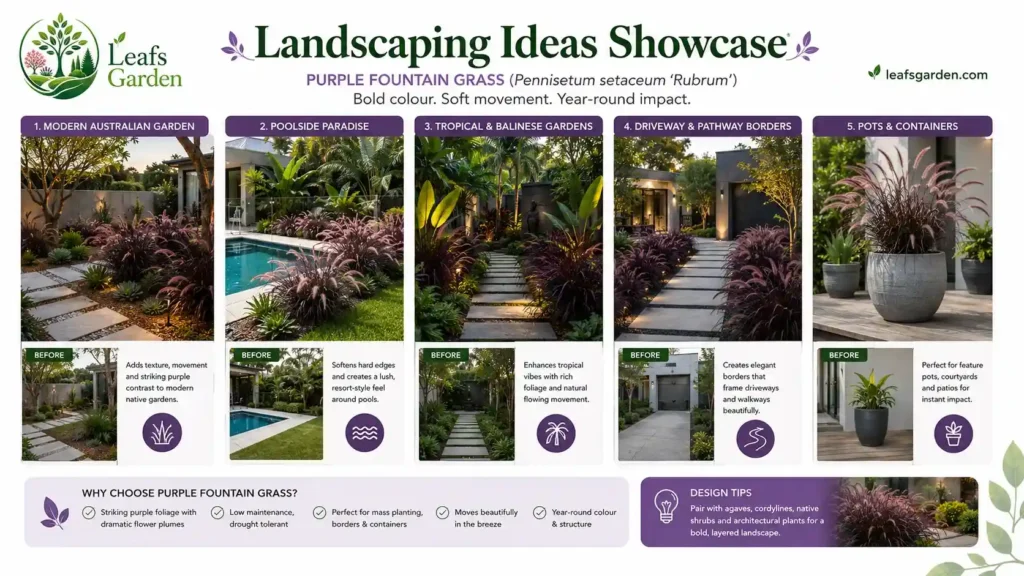
Purple fountain grass can be used in multiple landscape styles because of its bold color, fountain-shaped growth, and low-maintenance nature.
In modern landscapes, purple fountain grass is often used to soften hard surfaces and create strong visual contrast.
It pairs particularly well with:
Its architectural shape adds movement without making the design look overcrowded.
Purple fountain grass blends naturally into tropical-style gardens because of its rich foliage color and flowing texture.
It works well alongside:
The soft plumes also add a relaxed resort-style appearance to outdoor spaces.
Many Australian gardeners use purple fountain grass around pools because it tolerates heat well and creates soft movement in sunny conditions.
Poolside benefits include:
Its flowing foliage helps soften tiled or paved pool areas.
Purple fountain grass is widely used in contemporary borders to create depth and layered texture.
Popular border applications include:
The purple-red foliage contrasts especially well against green shrubs and lighter flowering plants.
Purple fountain grass combines effectively with many Australian ornamental plants and landscape styles.
Native grasses help create a softer natural landscape appearance while maintaining drought tolerance.
Good combinations include:
These pairings suit water-wise and native-inspired gardens.
For a taller native Australian evergreen tree that pairs naturally with purple fountain grass in wildlife-friendly and coastal garden designs, Coast Banksia is a popular companion species that thrives in similar warm, well-drained Australian conditions.
Flowering perennials add seasonal color contrast around the darker foliage of purple fountain grass.
Suitable companion flowers include:
Bright flowers stand out strongly against the burgundy foliage.
Green shrubs help highlight the dramatic purple color and fountain shape.
Effective shrub pairings include:
The contrast between dark ornamental grass and green foliage creates a balanced landscape design.
For a taller canopy companion with golden filtered shade and light airy foliage, the Gleditsia Sunburst Tree pairs exceptionally well with purple fountain grass in modern Australian suburban and commercial landscapes.
Purple fountain grass is highly effective as a standalone feature plant because of its strong color and graceful movement.
Single clumps can act as visual accents in minimalist gardens or decorative planting areas.
Accent planting works well:
Its flowing shape naturally attracts visual attention.
Purple fountain grass is commonly planted along driveways to soften edges and create a more modern entrance appearance.
Benefits for driveway landscaping include:
Repeated planting also creates rhythm and movement along long driveways.
Large ornamental grass clumps help frame entrances and create a welcoming landscape design.
Common entryway uses include:
The plume flowers add softness and movement near architectural features.
Mass planting creates one of the most visually dramatic effects with purple fountain grass.
Layered landscaping improves texture and visual depth in larger gardens.
A common layering approach includes:
This creates a balanced and professional-looking landscape design.
Although not a dense hedge plant, purple fountain grass can still provide soft visual screening when planted in groups.
Mass planting helps:
The moving foliage also creates a softer, more natural privacy effect compared to rigid hedges.
| Plant Type | Best Use |
| Purple fountain grass | Feature contrast |
| Dwarf fountain grass | Small gardens |
| Native grasses | Natural landscapes |
| Chinese fountain grass | Softer texture |
Several ornamental fountain grass varieties offer different colors, heights, textures, and landscaping effects. Some varieties are grown for dramatic burgundy foliage, while others are valued for compact growth, soft texture, or decorative striped leaves.
Purple Fountain Grass Rubrum is the most widely recognized ornamental fountain grass variety used in Australian landscapes.
This variety is commonly sold under names such as:
It is popular because of its:
The plant performs especially well in modern gardens, tropical designs, and decorative container planting.
The defining feature of Rubrum is its rich burgundy-purple foliage that intensifies in full sun.
Its ornamental appeal includes:
Warm Australian climates usually produce the deepest foliage coloration.
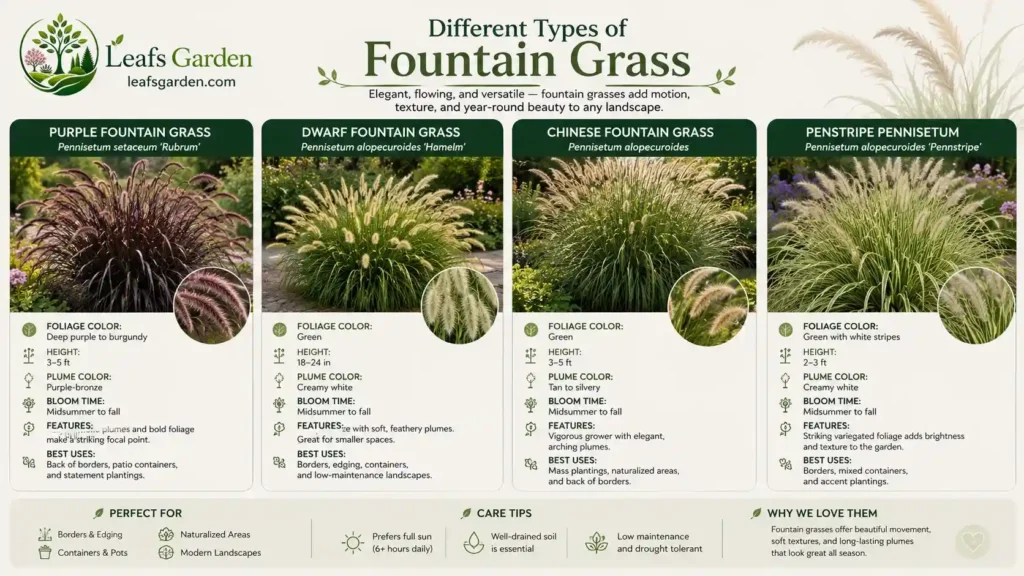
Dwarf fountain grass varieties are smaller ornamental grasses designed for compact spaces and decorative planting.
Dwarf forms are ideal for areas where full-sized purple fountain grass may become too large.
They work particularly well for:
Compact growth also makes maintenance easier in confined spaces.
Dwarf fountain grass adapts exceptionally well to containers and decorative pots.
Advantages include:
Its compact root system also makes container management more practical.
Chinese fountain grass offers a softer and often greener ornamental appearance compared to darker purple varieties.
This type typically has:
Its movement in the wind creates a softer visual effect in landscaped spaces.
Compared with purple fountain grass, Chinese fountain grass usually provides:
| Feature | Chinese Fountain Grass | Purple Fountain Grass |
| Foliage Color | Green to light bronze | Burgundy-purple |
| Texture | Softer and finer | Bold and dramatic |
| Landscape Style | Naturalistic gardens | Modern contrast gardens |
| Visual Impact | Subtle | Strong focal effect |
Chinese fountain grass is often preferred for softer natural-style planting schemes.
Pennstripe Pennisetum is a decorative ornamental grass known for its striped variegated foliage.
Unlike solid-colored fountain grasses, Pennstripe varieties feature mixed leaf coloration that creates additional visual texture.
Common foliage tones include:
The variegation gives the plant a brighter ornamental appearance.
The striped leaf pattern makes Pennstripe Pennisetum highly decorative in:
It is often used where foliage detail is more important than dramatic height.
Purple foxtail grass and purple fountain grass are often confused because both produce colorful foliage and plume-like flower heads.
Although visually similar, they differ in several ways:
| Feature | Purple Foxtail Grass | Purple Fountain Grass |
| Growth Habit | More upright | Fountain-shaped arching form |
| Plume Shape | Foxtail-like spikes | Soft flowing plumes |
| Texture | Slightly firmer | Softer appearance |
| Landscape Style | Accent texture | Dramatic ornamental focal point |
Purple fountain grass generally produces a fuller cascading shape.
Purple foxtail grass often suits:
Purple fountain grass is usually preferred for:
Both grasses provide strong ornamental value, but purple fountain grass is typically chosen for its dramatic color contrast and flowing form.
Purple fountain grass is generally low-maintenance, but poor drainage, frost exposure, nutrient imbalance, or pest activity can sometimes affect its appearance and growth. Most problems are easy to correct when identified early.
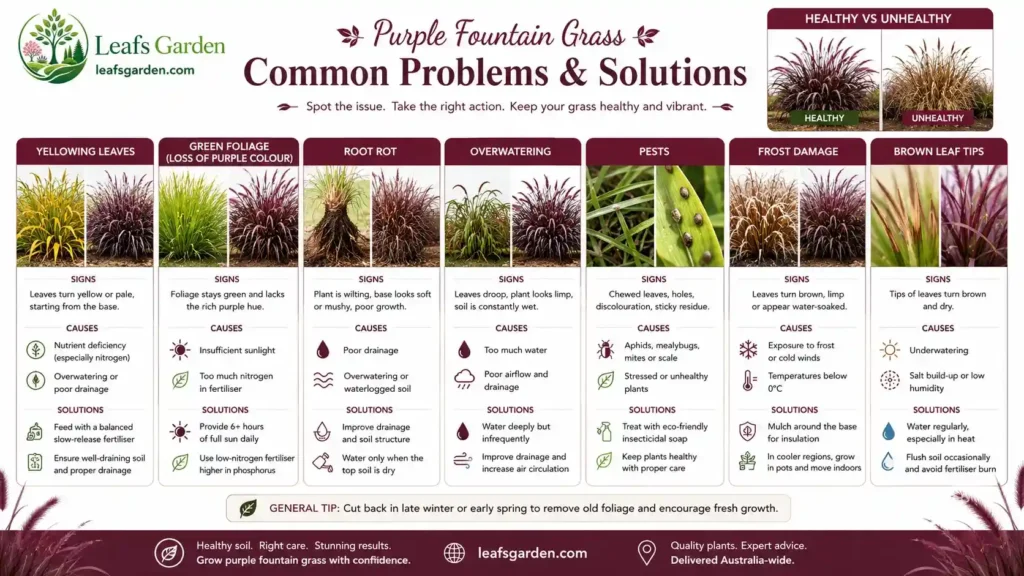
Purple fountain grass usually turns greener when growing conditions reduce pigment development in the foliage.
Insufficient sunlight is one of the most common reasons foliage loses its deep burgundy-purple color.
Too much shade can cause:
For the richest foliage color, purple fountain grass should receive at least 6–8 hours of direct sunlight daily.
Overfertilizing with high-nitrogen products can also encourage greener foliage instead of darker purple tones.
Excess nitrogen may lead to:
Using balanced slow-release fertilizer helps maintain healthier ornamental growth without excessive greening.
Brown leaves and dry foliage tips are commonly linked to moisture stress or natural seasonal aging.
Both underwatering and inconsistent watering can cause foliage damage.
Signs of water stress include:
Deep watering during prolonged hot Australian weather usually improves recovery.
Container-grown plants may dry out faster than garden-planted specimens.
In cooler Australian regions, brown foliage may simply indicate winter dormancy rather than serious plant decline.
Dormancy symptoms often include:
Pruning old growth in late winter or early spring encourages fresh new shoots.
Root rot is one of the most serious problems affecting purple fountain grass and is usually caused by excessive soil moisture.
Early signs of root rot may include:
Waterlogged roots lose oxygen and gradually weaken the entire plant.
Improving drainage is the most effective solution for preventing root rot.
Helpful drainage improvements include:
Healthy drainage is especially important during wet seasons or humid conditions.
Purple fountain grass is relatively resistant to major pests and diseases, but occasional problems can still appear under poor growing conditions.
Aphids may cluster on young stems or soft foliage growth.
Common aphid symptoms include:
Light infestations are often manageable with water sprays or insecticidal soap treatments.
Excess moisture and poor airflow can encourage fungal problems.
Possible fungal symptoms include:
Reducing overhead watering and improving airflow usually lowers fungal risk.
Young plants can occasionally attract snails and slugs, especially in damp garden conditions.
Damage may include:
Removing garden debris and reducing excessive moisture helps control infestations.
Purple fountain grass may raise invasive concerns in some regions depending on climate and seed production.
Certain ornamental fountain grasses related to Cenchrus setaceus have been monitored in parts of Australia because of their ability to spread under favorable conditions.
Regional regulations or recommendations can vary depending on:
Gardeners should always check local plant guidelines if unsure.
Some varieties can self-seed in warm climates if flower heads are left unmanaged.
Potential spread factors include:
Many cultivated ornamental forms produce limited viable seed compared to wild invasive types.
Responsible maintenance helps reduce unwanted spread.
Recommended practices include:
With proper management, purple fountain grass can remain a controlled and highly decorative ornamental feature in Australian gardens.
Purple fountain grass stands out for its dramatic burgundy foliage, soft plume flowers, and flowing fountain-shaped form compared to many standard ornamental grasses. Different grass varieties offer unique textures, sizes, and maintenance levels depending on Australian climate conditions and landscape goals.
Purple fountain grass and native Australian grasses are both widely used in landscaping, but they create very different visual effects.
Purple fountain grass is known for:
Native Australian grasses usually provide:
Purple fountain grass creates a more dramatic ornamental statement, while native grasses often blend naturally into Australian landscapes.
Both options are relatively low-maintenance, but their care requirements differ slightly.
| Feature | Purple Fountain Grass | Native Australian Grasses |
| Water Needs | Moderate once established | Usually very drought tolerant |
| Pruning | Seasonal cutback recommended | Often minimal pruning |
| Foliage Color | Burgundy-purple | Green, silver, or bronze |
| Landscape Style | Modern and tropical | Natural and native gardens |
Native grasses are often preferred for ecological landscaping, while purple fountain grass is chosen for ornamental contrast and decorative texture.
Purple fountain grass and red fountain grass are closely related ornamental grasses and are sometimes sold under similar names.
Purple fountain grass generally develops:
Red fountain grass may appear:
Sunlight exposure and climate can influence the final foliage color in both varieties.
Some red fountain grass varieties grow slightly taller or more upright depending on cultivar selection.
Typical differences include:
| Feature | Purple Fountain Grass | Red Fountain Grass |
| Average Height | 60–150 cm | 80–180 cm |
| Growth Habit | Softer arching shape | Slightly more upright |
| Foliage Tone | Purple-burgundy | Red-bronze |
Both grasses are commonly used for ornamental borders and feature planting.
Fountain grass and pampas grass are both ornamental grasses, but they differ greatly in size, texture, and landscape impact.
Pampas grass is significantly larger and more aggressive in appearance.
| Feature | Fountain Grass | Pampas Grass |
| Height | 60–150 cm | 2–4 meters |
| Growth Style | Compact fountain shape | Large dense clumps |
| Plume Texture | Soft and delicate | Large feathery plumes |
| Garden Suitability | Small to medium spaces | Large open landscapes |
Purple fountain grass is usually easier to manage in residential gardens.
Purple fountain grass generally requires:
Pampas grass often requires:
Many gardeners prefer purple fountain grass for smaller modern landscapes because of its manageable size and softer appearance.
The best ornamental grass for Australian gardens depends mainly on climate conditions, available space, and landscaping style.
Different ornamental grasses suit different Australian environments.
| Climate Type | Recommended Ornamental Grass |
| Tropical and subtropical | Purple fountain grass |
| Dry Mediterranean regions | Native drought-tolerant grasses |
| Coastal gardens | Fountain grass and lomandra |
| Large open spaces | Pampas grass |
| Small modern gardens | Dwarf fountain grass |
Purple fountain grass remains one of the most versatile ornamental grasses for Australian gardens because it combines:
Its ability to thrive in warm climates while providing year-round ornamental value makes it a popular choice for both beginner and experienced gardeners.
Purple fountain grass is commonly available from nurseries, garden centers, and large retailers across Australia. Availability usually increases during spring and summer when ornamental grasses are in peak growing season.
Bunnings is one of the most common places where Australian gardeners look for ornamental grasses, including purple fountain grass.
Purple fountain grass availability at Bunnings can vary depending on:
During warmer months, many stores stock ornamental grasses suitable for landscaping, pots, and feature planting.
Gardeners may also find related varieties labeled as:
Purple fountain grass is commonly sold in several nursery pot sizes depending on plant maturity.
Typical sizes include:
| Pot Size | Best For |
| Small starter pots | New garden planting |
| Medium nursery pots | Decorative containers |
| Large advanced pots | Instant landscape impact |
Larger plants generally provide quicker visual results in landscaping projects.
Many Australian garden retailers stock a wide range of ornamental grasses suited for different landscaping styles.
Garden centers often carry ornamental grasses for:
Common options may include:
Native grasses are popular for drought-tolerant and Australian native gardens.
These grasses are commonly selected for:
Native grasses also pair well with purple fountain grass in layered landscape designs.
Grass plants sold at large retailers are often grouped by:
Checking plant labels carefully helps identify the correct fountain grass variety before purchase.
Purple fountain grass is available from several types of plant suppliers throughout Australia.
Local nurseries are often the best source for healthy ornamental grass plants adapted to regional growing conditions.
Benefits of buying locally include:
Nursery staff can also recommend suitable ornamental grasses for specific landscapes and climates.
Online plant stores offer convenient access to ornamental grasses, especially for gardeners in regional areas.
Online purchasing advantages include:
When ordering online, checking shipping conditions and plant health guarantees is important.
Purple fountain grass is usually easiest to find during active growing seasons.
Peak availability often occurs in:
Stock may become more limited during colder months in some Australian regions.
Inspecting plant health before purchase helps ensure stronger establishment and long-term growth.
Healthy purple fountain grass should display:
Avoid plants with excessive browning, yellowing, or collapsed stems.
Healthy roots are essential for fast establishment after planting.
Check for:
Healthy root systems usually recover faster after transplanting.
Carefully inspect plants for signs of pests or disease before purchase.
Look for:
Selecting healthy pest-free plants reduces future maintenance problems and improves long-term ornamental performance.
Purple fountain grass is valued for its low maintenance, drought tolerance, and strong visual impact in Australian landscapes. Its dramatic foliage color, soft plume flowers, and adaptable growth habit make it one of the most versatile ornamental grasses for modern outdoor spaces.
Purple fountain grass provides year-round ornamental interest and helps create more dynamic landscape designs.
The flowing arching foliage and soft plume flowers create natural movement in the garden, especially during windy conditions.
This movement adds:
Its fountain-shaped growth habit also helps soften hard edges around paving, walls, and pathways.
One of the biggest advantages of purple fountain grass is its bold burgundy-purple foliage color.
The deep foliage tones create strong contrast against:
This contrast makes it highly effective for feature planting and contemporary garden design.
Although mainly grown for ornamental use, purple fountain grass can still provide environmental and habitat benefits in garden spaces.
Dense clumping foliage may provide shelter for small beneficial garden insects and wildlife.
The plant structure can help support:
Layered ornamental planting also contributes to more diverse garden ecosystems.
The soft flowering plumes can attract certain pollinating insects during active blooming periods.
Pollinator activity may include:
Combining purple fountain grass with flowering perennials can further improve pollinator-friendly landscaping.
Purple fountain grass is especially popular among gardeners looking for attractive plants that require minimal ongoing care.
Once established, purple fountain grass handles dry conditions relatively well.
Its drought-tolerant qualities make it suitable for:
Deep root systems help the plant remain resilient during short dry periods.
Purple fountain grass performs strongly in hot conditions and maintains good ornamental quality during Australian summers.
Heat tolerance benefits include:
This makes it highly suitable for exposed sunny garden positions.
Purple fountain grass adapts very well to container growing, making it suitable for compact outdoor spaces.
Although the foliage becomes full and dramatic, the root system remains relatively manageable in appropriately sized containers.
This allows successful planting in:
Container growth also helps control plant size more easily.
Purple fountain grass is widely used as a decorative container plant because of its strong foliage color and elegant shape.
Container gardening advantages include:
The soft flowing plumes and burgundy foliage create a striking focal point even in smaller outdoor areas.
Purple fountain grass is generally considered safe for home landscapes, but gardeners should still be aware of sharp foliage edges, seasonal maintenance precautions, and possible self-seeding behavior in some Australian regions.
Purple fountain grass is commonly grown in residential gardens where pets and children are present.
Although the plant is not typically considered highly dangerous, the leaves may occasionally cause mild irritation because of their narrow edges and rough texture.
Possible minor issues include:
Sensitive pets may react differently depending on contact or ingestion levels.
Purple fountain grass is generally not classified as severely toxic to dogs or cats in most ornamental gardening references.
However, it is still recommended to:
Maintaining supervised garden access is always the safest approach for pets.
Basic gardening precautions help make pruning and maintenance safer and more comfortable.
Wearing gloves is recommended when handling mature ornamental grasses.
Protective gloves help prevent:
Long sleeves may also help when trimming large mature clumps.
The narrow leaves can develop surprisingly sharp edges, especially when dry.
Care should be taken during:
Using sharp clean garden tools also improves safety and reduces unnecessary plant damage.
Some fountain grass varieties may produce seeds capable of spreading under favorable growing conditions.
In warm climates, mature flower plumes can occasionally release seeds into nearby garden areas.
Potential self-seeding factors include:
Seed spread levels vary depending on the specific ornamental variety.
Responsible maintenance helps reduce unwanted spread and keeps ornamental grasses controlled in the landscape.
Good management practices include:
Regular maintenance allows gardeners to enjoy the ornamental benefits of purple fountain grass while minimizing environmental concerns.
Purple fountain grass is one of the most attractive ornamental grasses for Australian gardens because of its bold burgundy foliage, soft flowing plumes, and low-maintenance growing habit. Its dramatic color and fountain-shaped form make it a standout feature in modern landscapes, tropical gardens, decorative borders, and container planting.
For the best results, purple fountain grass should be grown in full sun with well-draining soil and moderate watering. Warm Australian climates help the plant maintain stronger purple coloration, faster growth, and healthier plume production throughout the growing season.
Its versatility is one of its biggest landscaping advantages. Purple fountain grass works beautifully as:
The plant also suits drought-tolerant and contemporary outdoor designs where movement, texture, and color contrast are important.
Another major benefit is its simple maintenance routine. Occasional pruning, balanced watering, and seasonal cleanup are usually enough to keep the plant healthy and visually attractive year after year.
For long-term success, gardeners should always consider local climate conditions before planting, especially in frost-prone regions where winter protection may be needed. Choosing healthy nursery-grown plants and maintaining responsible garden care practices will help ensure strong ornamental performance.
From an expert gardening perspective, purple fountain grass remains one of the most reliable ornamental grasses for adding year-round visual impact to Australian landscapes with minimal maintenance effort.
Purple fountain grass is best cut back in late winter or early spring before new growth begins. This timing helps remove old foliage, improve airflow, and encourage fresh healthy shoots for the new growing season. In warmer Australian climates, light maintenance trimming may also be done throughout the year if needed.
Purple fountain grass survives winters well in warm tropical and subtropical regions of Australia. In cooler climates, frost may damage the foliage and slow growth during winter. Severe frost can cause temporary dieback, but healthy plants may regrow in spring if the roots remain protected.
Some fountain grass species related to Cenchrus setaceus may raise invasive concerns in certain Australian regions. However, many ornamental purple fountain grass varieties are grown mainly for decorative use and produce limited seed spread. Responsible maintenance, including removing seed heads when necessary, helps reduce unwanted spreading.
Purple fountain grass is considered a fast-growing ornamental grass in warm conditions. Young plants can establish quickly during spring and summer, often reaching mature size within a single growing season when provided with full sun, well-draining soil, and moderate watering.
Yes, purple fountain grass grows very well in pots and containers. Its compact root system and decorative foliage make it ideal for balconies, patios, courtyards, and modern container gardens. Large pots with good drainage provide the best long-term growth and stability.
Purple fountain grass commonly turns greener when it does not receive enough direct sunlight. Excess nitrogen fertilizer can also reduce the deep burgundy-purple foliage color. Growing the plant in full sun usually helps restore stronger purple tones.
Purple fountain grass is widely available from local nurseries, garden centers, online plant stores, and large retailers across Australia. Availability is usually highest during spring and summer when ornamental grasses are actively growing.
In warm Australian climates, purple fountain grass often behaves like a perennial and returns each year with proper care. In colder frost-prone areas, it may die back during winter and regrow in spring, although severe cold can shorten plant lifespan.
Light trimming during summer is generally safe for removing damaged leaves or tidying the plant shape. However, heavy pruning during extreme heat is not recommended because it may stress the plant and reduce foliage quality.
Purple fountain grass usually has deeper burgundy-purple foliage and a softer fountain-shaped growth habit. Red fountain grass varieties may appear more bronze-red and sometimes grow slightly taller or more upright depending on the cultivar. Both are popular ornamental grasses used in Australian landscaping.