Grow Better Gardens with Smarter Plant Choices
Discover helpful guides on trees, hedges, fruit plants, edible plants, and beautiful landscape greenery.

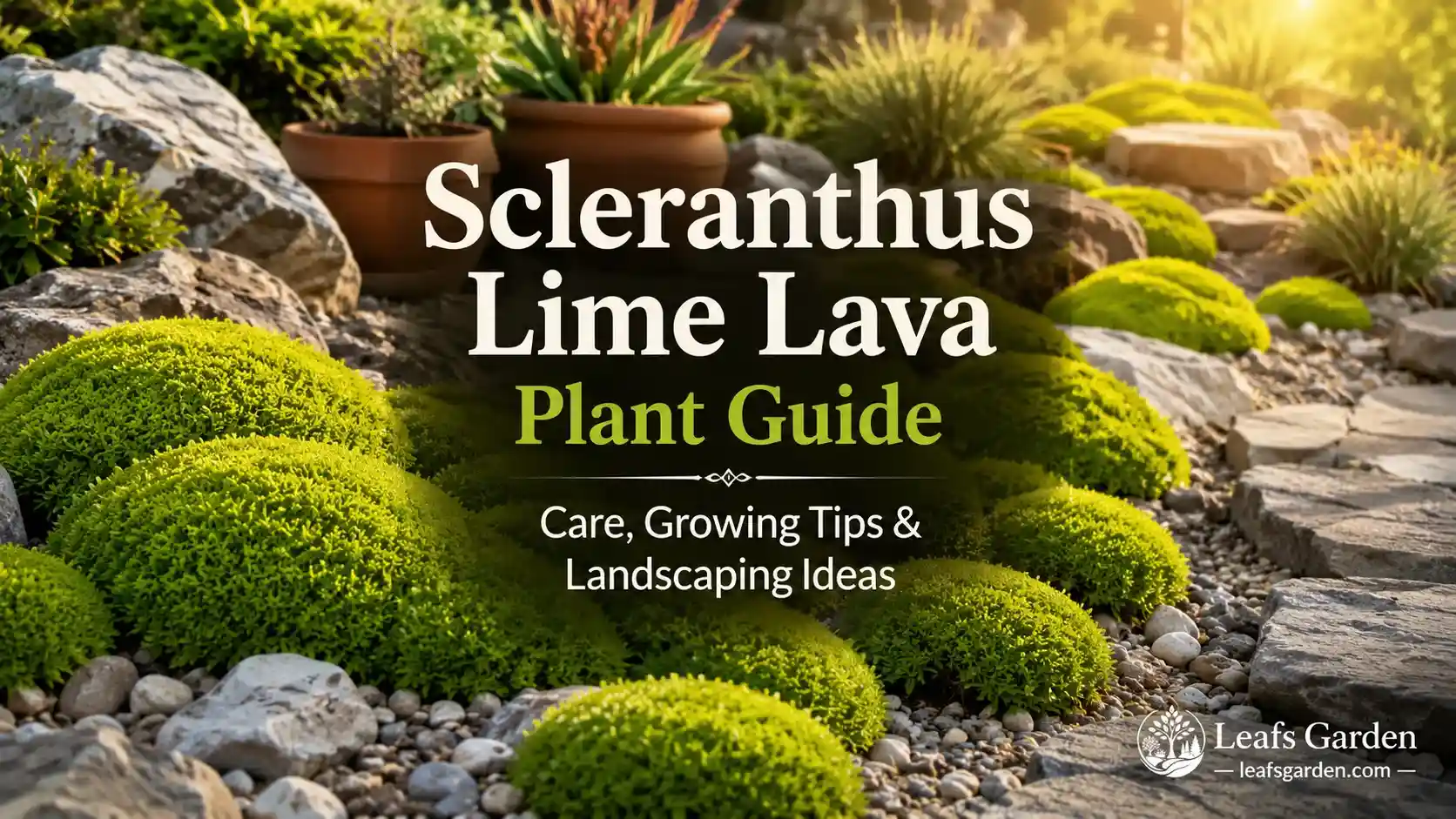
Scleranthus Lime Lava is a compact cushion-forming ornamental plant known for its bright lime-green foliage, moss-like texture, and low-maintenance growth habit.
Also known as the Lime Lava plant, Lava grass, or Lime Lava cushion grass, this unique evergreen ground cover is valued for its soft textured appearance and dense mounding growth. The plant belongs to the cushion plants category and is commonly used to create smooth flowing shapes in modern outdoor spaces. Its vivid chartreuse foliage adds strong visual contrast to stone, gravel, timber, and darker green plants.
Scleranthus biflorus Lime Lava has become increasingly popular in rock gardens, minimalist landscaping, decorative pots, and ground cover designs because of its clean structure and compact spreading habit. Unlike traditional ornamental grasses, it forms a tight moss-like cushion that works especially well in alpine gardens, rockery plants arrangements, and contemporary landscape styling.
Many gardeners in Australia and Perth prefer Lime Lava for its adaptability to mild warm climates and free-draining soils. It performs particularly well in raised beds, pathway edging, and container displays where airflow and drainage remain consistent. Its low-growing form also makes it useful for filling gaps between stones and softening hard landscaping features naturally.
Among evergreen ground cover plants, Scleranthus Lime Lava stands out for its sculptural texture, low maintenance requirements, and year-round ornamental appeal.
Scleranthus Lime Lava is a low-growing evergreen cushion plant with dense lime-green foliage that creates a soft moss-like mound.
This ornamental ground cover is widely used in modern landscaping because of its compact structure, vibrant chartreuse color, and smooth textured appearance.
Gardeners looking to compare different ground cover and ornamental plant options will find helpful context in our ornamental plant growth and care guides covering a wide range of low-maintenance garden plants.
The plant forms rounded cushions that spread gently across the soil surface, making it highly suitable for rock gardens, alpine landscapes, decorative containers, and pathway edging.
Its moss-like texture gives gardens a softer and more natural look while still maintaining the structure of a compact evergreen plant. Unlike many spreading ground covers, Lime Lava stays neat, controlled, and visually dense throughout most of the year.
The botanical name of Lime Lava is Scleranthus biflorus. It belongs to the Caryophyllaceae family, which includes several low-growing ornamental and alpine plant species.
| Category | Details |
| Botanical Name | Scleranthus biflorus |
| Family | Caryophyllaceae |
| Plant Type | Evergreen Cushion Plant |
| Origin | New Zealand |
| Growth Style | Compact Ground Cover |
Scleranthus biflorus naturally grows in rocky alpine environments where drainage is excellent and moisture levels remain balanced. Its natural habitat explains why the plant performs best in free-draining soil and open sunny locations.
Although these two species are closely related, there are noticeable differences in appearance and growth habit.
| Feature | Scleranthus biflorus | Scleranthus uniflorus |
| Growth Form | Dense compact cushion | Softer looser mound |
| Texture | Firm and structured | More relaxed texture |
| Landscape Use | Modern landscaping | Natural alpine gardens |
| Foliage Density | Very dense | Slightly open |
Most Lime Lava cultivars used in landscaping are selected forms of Scleranthus biflorus because of their stronger cushion shape and brighter lime-green foliage.
Scleranthus Lime Lava is commonly known by several ornamental gardening names based on its texture and appearance.
Common names include:
These names are commonly used in landscaping, nursery catalogs, and rock garden design discussions.
Scleranthus Lime Lava is valued for its compact cushion growth, evergreen structure, and bright ornamental foliage.
Its rounded form creates a sculptural effect in gardens, especially when planted among stones, gravel pathways, alpine plants, or minimalist landscape designs.
| Feature | Details |
| Botanical Name | Scleranthus biflorus |
| Common Name | Lime Lava Plant |
| Plant Type | Cushion Ground Cover |
| Foliage Color | Lime Green |
| Growth Habit | Compact Mounding |
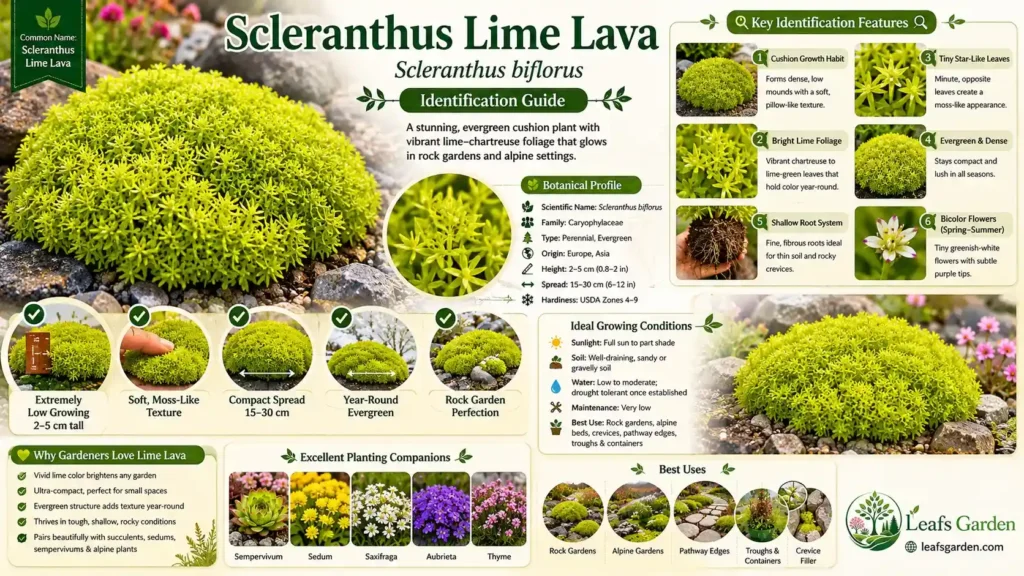
Lime Lava stays compact and low-growing, making it ideal for edging, pots, and small-space landscaping.
Its dense cushion shape spreads outward more than upward, creating a soft carpet-like effect across the soil surface. This compact growth habit makes Scleranthus Lime Lava highly suitable for modern gardens, rockeries, alpine plant displays, and decorative ground cover designs where neat structure is important.
Scleranthus Lime Lava typically remains very short while gradually expanding into rounded mounds.
| Growth Feature | Average Size |
| Mature Height | 5–10 cm |
| Mature Spread | 30–60 cm |
| Growth Habit | Compact Spreading Cushion |
| Growth Rate | Slow to Moderate |
The plant naturally develops into low dome-shaped cushions that gently spread across surrounding soil or gravel surfaces. In ideal conditions, multiple plants can merge together to create a seamless moss-like carpet.
Because of its tidy appearance, Lime Lava works especially well along pathways, garden borders, retaining walls, and decorative stone features.
Scleranthus Lime Lava develops a dense shallow root system that supports its compact soil-hugging growth pattern.
Its shallow root structure allows the plant to thrive in rock gardens, raised beds, gravel landscapes, and alpine-style environments where deep soil is limited.
The foliage grows tightly against the soil surface, helping create its signature cushion appearance. This compact structure also helps reduce visible soil gaps and provides a clean finished look in landscaping designs.
Lime Lava naturally performs well in:
Its cushion-forming habit softens hard stone surfaces while adding vibrant lime-green contrast to rocks and gravel.
Scleranthus Lime Lava is a long-lasting evergreen ornamental plant with very low maintenance requirements.
In mild climates, especially across many Australian growing regions, the plant maintains its bright foliage year-round. Proper drainage and airflow significantly improve its lifespan and long-term appearance.
Lime Lava requires very little ongoing care once established.
Typical maintenance includes:
The plant rarely requires heavy pruning or constant attention, making it popular in low-maintenance landscape designs.
Scleranthus Lime Lava grows steadily rather than aggressively. This controlled growth habit helps maintain neat garden structure without frequent containment or reshaping.
Scleranthus Lime Lava grows best in well-draining soil, bright sunlight, and moderate watering conditions.
This compact cushion plant performs best when growing conditions closely match its natural alpine-style habitat. Proper drainage, balanced moisture, and good airflow are the most important factors for maintaining healthy dense lime-green foliage.
Scleranthus Lime Lava requires free-draining soil to prevent excess moisture buildup around the roots.
Heavy compacted soil can quickly lead to root problems and unhealthy foliage. The plant performs best in loose airy growing mediums that allow water to drain rapidly.
Adding coarse sand, small gravel, pumice, or perlite can improve soil structure and airflow significantly.
Wet soil is one of the biggest causes of Lime Lava decline.
To improve drainage:
Good drainage helps maintain compact healthy cushion growth and reduces the risk of root rot.
Scleranthus Lime Lava grows best in bright sunlight with good airflow.
The plant develops its strongest lime-green color when exposed to sufficient direct light throughout the day.
| Light Condition | Plant Response |
| Full Sun | Best color and dense growth |
| Partial Shade | Softer color and looser growth |
| Heavy Shade | Weak thinning foliage |
Full sun is usually preferred in cooler or mild climates. In hotter Australian regions, light afternoon shade can help reduce heat stress during extreme summer conditions.
Bright sunlight encourages:
Low light conditions may cause dull coloring and uneven spreading.
Scleranthus Lime Lava prefers moderate watering with periods of slight drying between watering sessions.
Once established, the plant becomes reasonably drought tolerant and does not require constantly moist soil.
Watering frequency depends on climate, soil type, and container size.
General watering guidelines:
Container-grown plants may dry faster than garden-planted specimens.
Established Lime Lava plants tolerate short dry periods better than overly wet conditions. Their compact root system allows them to survive moderate drought once fully rooted.
To reduce root rot risk:
Healthy roots are essential for maintaining dense evergreen cushion growth.
Scleranthus Lime Lava performs best in mild to warm climates with consistent airflow and well-drained conditions.
The plant adapts particularly well to many Australian garden environments because of its tolerance for dry conditions and sunny locations.
It grows successfully in:
Perth gardens are often suitable for Lime Lava because of:
Proper drainage remains especially important during wetter seasonal periods.
Scleranthus Lime Lava handles moderate heat well when soil drainage remains balanced. In extremely hot climates, some afternoon shade may help prevent foliage stress.
Light frost is usually tolerated briefly, but prolonged freezing conditions may damage foliage and slow growth. Protection is beneficial in colder regions.
Scleranthus Lime Lava requires only light feeding to maintain healthy growth and vibrant foliage color.
Overfertilizing can cause weak loose growth and reduce the plant’s dense cushion structure.
Feed lightly during the active growing season using balanced low-strength fertilizer applications.
Recommended schedule:
A gentle slow-release fertilizer designed for ornamental plants or alpine plants works well for maintaining balanced growth.
Too much fertilizer may cause:
Moderate nutrition supports healthier long-term structure.
| Requirement | Ideal Condition |
| Sunlight | Full Sun |
| Soil | Well-Draining |
| Watering | Moderate |
| Climate | Mild to Warm |
| Maintenance | Low |
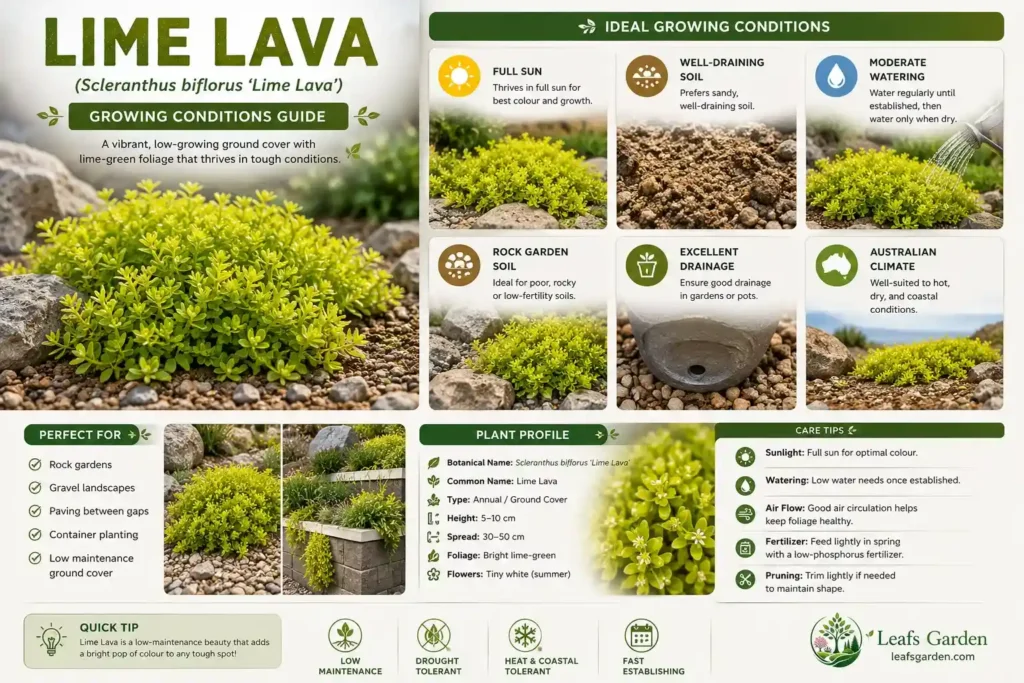
Lime Lava requires minimal care but benefits from occasional trimming, proper drainage, and seasonal maintenance.
Once established, Scleranthus Lime Lava is considered a relatively easy-care ornamental ground cover plant. Regular monitoring of moisture levels, airflow, and foliage condition helps maintain its dense cushion form and bright lime-green appearance throughout the year.
Scleranthus Lime Lava benefits from light pruning to maintain its compact rounded cushion shape.
Heavy pruning is usually unnecessary because the plant naturally grows in a dense controlled mound. Small adjustments help improve appearance and encourage even growth.
Light trimming helps preserve the plant’s soft dome-like structure.
Best practices include:
Regular light shaping keeps the plant neat in rock gardens, borders, and decorative containers.
Dry or damaged sections should be removed when noticed.
Removing dead growth helps:
Dead foliage is more likely to appear after excessive rain, poor drainage, or seasonal stress.
If one side begins growing more aggressively, lightly trim the outer edges to maintain balance. Good sunlight exposure from all directions also helps encourage symmetrical cushion growth.
Scleranthus Lime Lava adapts well to seasonal changes when drainage and airflow remain stable.
During warmer months:
Container-grown plants may require more frequent watering in hot weather.
In cooler conditions:
The evergreen foliage generally remains attractive in mild climates, although growth may slow during colder months.
Extended wet periods can create excess moisture around the roots.
To reduce problems during rainy seasons:
Preventing prolonged moisture buildup is one of the most important parts of Lime Lava care.
Mulching helps regulate soil conditions while improving the appearance of surrounding landscaping.
However, mulch should be used carefully around cushion plants to avoid trapping too much moisture.
Suitable mulch options include:
Mineral-based mulches are usually better than heavy organic mulch for alpine plants and rockery plants.
To avoid excessive moisture retention:
Good moisture balance helps preserve the plant’s dense evergreen texture.
Scleranthus Lime Lava grows very well in containers because of its compact size and ornamental cushion form.
Its rounded lime-green foliage creates strong visual contrast in decorative planters, modern outdoor containers, and minimalist garden arrangements.
Choose containers that allow moderate horizontal spreading while maintaining proper drainage.
Ideal container features include:
Terracotta pots are especially useful because they improve airflow and reduce excess moisture retention.
Good drainage is essential for container-grown Lime Lava plants.
To improve drainage:
Poor drainage is one of the most common causes of decline in potted cushion plants.
Lime Lava works beautifully in:
Its bright chartreuse foliage pairs especially well with darker stones, ornamental grasses, succulents, and architectural landscape elements.
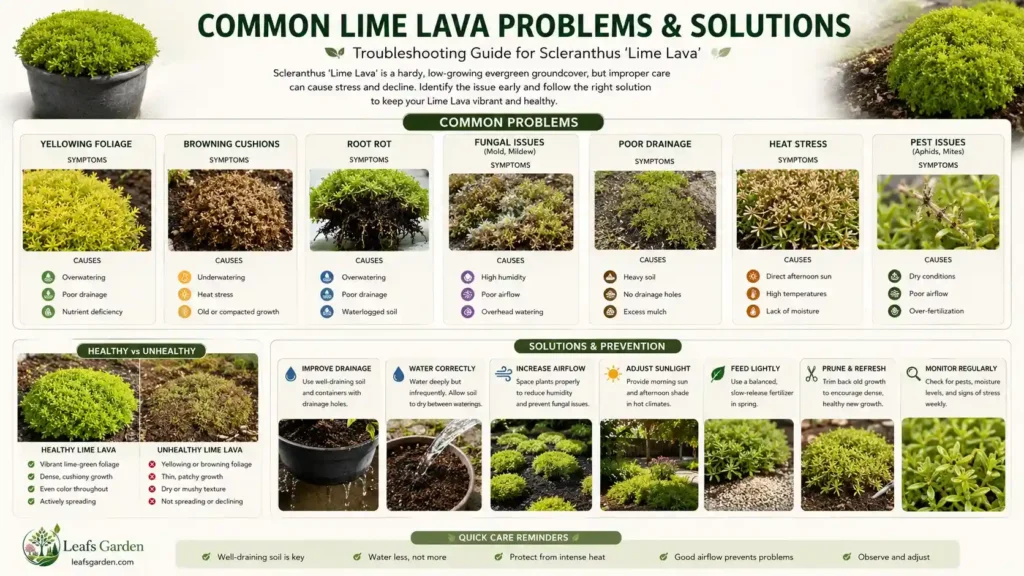
Most Lime Lava plant problems are caused by excess moisture, poor drainage, or insufficient airflow.
Scleranthus Lime Lava is generally a hardy low-maintenance cushion plant, but unhealthy growing conditions can quickly affect its dense evergreen foliage. Most issues develop when the roots remain too wet for extended periods or when the plant receives inadequate sunlight and ventilation.
Yellow or brown foliage is one of the most common signs that environmental conditions are stressing the plant.
Excess watering can weaken the roots and reduce oxygen flow within the soil.
Common symptoms include:
Allowing the soil to dry slightly between watering sessions usually helps prevent these problems.
Extreme heat combined with dry reflected surfaces may occasionally stress the foliage.
Signs of heat stress include:
In hotter climates, light afternoon shade and balanced moisture levels can help reduce stress.
Poor drainage is one of the leading causes of decline in Scleranthus Lime Lava plants.
Heavy compacted soil often traps excess moisture around the shallow roots, increasing the risk of root damage and fungal problems. Improving soil structure with sand, gravel, or raised planting areas can significantly improve plant health.
Root rot develops when the soil remains consistently wet and oxygen circulation around the roots becomes limited.
Common root rot symptoms include:
The plant may gradually lose its compact shape as damaged roots fail to support healthy foliage.
Preventing root rot mainly depends on proper drainage management.
Best prevention practices include:
Good drainage remains the most important factor for long-term success.
If drainage problems already exist:
Fast-draining alpine-style soil conditions are ideal for Lime Lava plants.
Scleranthus Lime Lava is generally resistant to major insect infestations, especially when grown in healthy conditions.
Fungal problems are more likely to appear in humid poorly ventilated environments.
Possible fungal symptoms include:
Reducing excess moisture and improving airflow usually helps control fungal issues naturally.
Lime Lava rarely experiences severe insect attacks compared to many ornamental ground cover plants. Occasional pests may appear, but healthy plants typically recover quickly.
Routine monitoring helps identify problems early.
Check regularly for:
Early corrections often prevent more serious plant decline.
Scleranthus Lime Lava usually declines because of environmental stress rather than severe disease problems.
The most common growing mistakes include:
These conditions often weaken the roots and reduce the plant’s compact evergreen growth.
To help stressed plants recover:
Healthy new growth often returns once soil moisture and lighting conditions stabilize.
| Problem | Cause | Solution |
| Yellow foliage | Overwatering | Improve drainage |
| Patchy growth | Poor sunlight | Move to brighter area |
| Root rot | Wet soil | Reduce watering |
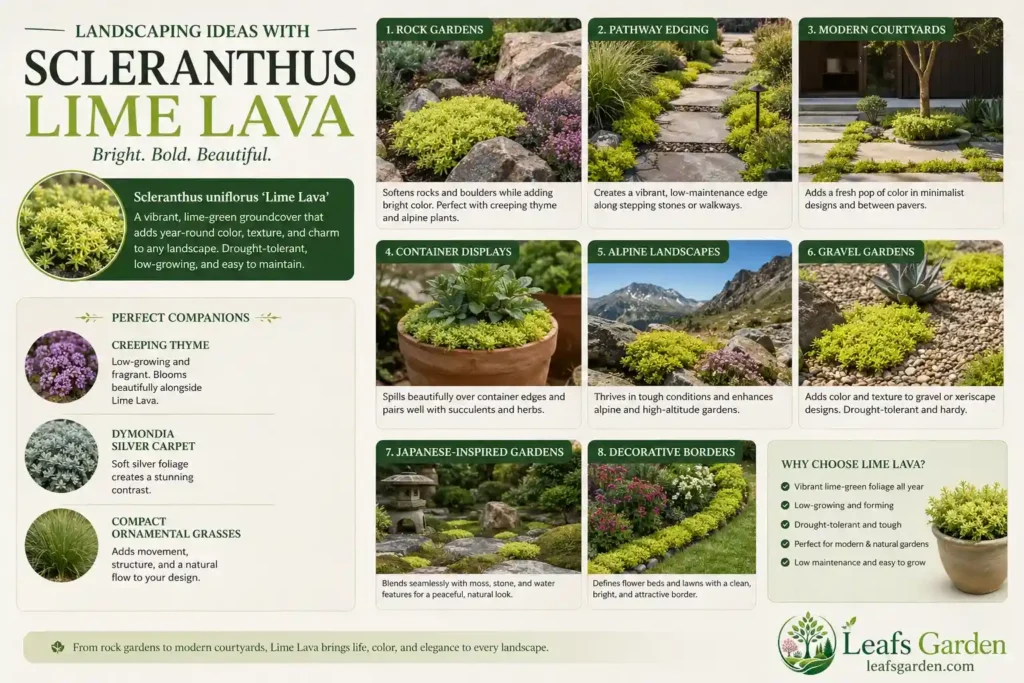
Lime Lava is commonly used as a decorative ground cover in modern gardens, rockeries, pathways, and container displays.
Its compact cushion shape, bright lime-green foliage, and soft moss-like texture make it highly effective for adding contrast, structure, and visual softness to outdoor spaces. Scleranthus Lime Lava works especially well in contemporary landscapes where clean lines, stone textures, and low-maintenance planting designs are important.
Scleranthus Lime Lava is one of the most effective cushion plants for rock garden landscapes.
Its dense mounding habit naturally softens the appearance of stone surfaces while adding vibrant evergreen color between rocks and gravel.
Lime Lava pairs beautifully with:
The bright chartreuse foliage creates strong contrast against darker stone materials and modern hardscaping elements.
Because of its alpine-style growth habit, Lime Lava blends naturally into alpine garden designs.
It works especially well alongside:
Its low profile helps maintain open layered garden structure without overcrowding nearby plants.
Scleranthus Lime Lava is widely used as a low-maintenance ornamental ground cover plant.
Its compact spreading habit allows it to cover exposed soil while maintaining a neat controlled appearance.
Lime Lava creates soft textured edging along:
The rounded cushion growth helps soften sharp hardscape lines while keeping borders visually organized.
In smaller garden sections, Lime Lava can be used as a decorative alternative to traditional lawn areas.
Although not suitable for heavy foot traffic, it performs well in:
Its evergreen foliage provides year-round visual appeal with minimal mowing or trimming requirements.
The plant is highly useful for filling:
Its dense cushion structure helps create a fuller more finished landscape appearance.
Scleranthus Lime Lava combines well with other low-growing ornamental plants that prefer similar drainage and sunlight conditions.
Popular companion plants include:
Creeping thyme adds flowering contrast and fragrance, while Dymondia silver carpet introduces silver-toned foliage that complements Lime Lava’s bright green color.
Compact ornamental grasses can add height variation and movement to rock garden designs without overpowering the cushion growth habit of Lime Lava.
Native Australian ground covers are also commonly paired with Scleranthus Lime Lava in drought-tolerant landscape designs because they often share similar growing requirements.
If you are looking to expand your low-growing garden palette, exploring small Australian native plants for shaded garden spaces can help you find ideal companion options that thrive in similar conditions.
Scleranthus Lime Lava is highly valued in modern landscaping because of its sculptural appearance and minimalist texture.
In minimalist outdoor designs, Lime Lava is often used to create:
Its uniform compact growth supports simple uncluttered garden aesthetics.
The soft moss-like texture of Lime Lava works beautifully in Japanese-inspired landscapes where balance, texture, and natural flow are important.
It is commonly used near:
Its rounded cushion form helps create calm natural visual movement throughout the landscape.
For gardeners wanting to add vertical interest alongside low-growing cushion plants, discovering suitable Australian native climbing plants can help create a more layered and dynamic garden structure.
Modern outdoor spaces frequently use Lime Lava in:
Its vibrant evergreen foliage adds brightness and texture while maintaining a highly organized professional appearance.
Scleranthus Lime Lava performs well in Perth when grown in free-draining soil with adequate sunlight and airflow.
Its compact evergreen growth, drought tolerance, and preference for sunny conditions make it well suited to many Perth garden environments. The plant adapts especially well to modern Australian landscaping styles that use gravel, stone, raised beds, and low-maintenance ground cover plants.
Scleranthus Lime Lava adapts well to Perth’s dry climate when soil drainage remains consistent.
The warm sunny conditions common across Perth often help maintain the plant’s dense compact cushion form and bright lime-green foliage.
Lime Lava performs particularly well in:
Once established, the plant can tolerate moderate dry conditions better than constantly wet soil environments.
Although the plant tolerates warm weather, extreme heat can occasionally stress the foliage.
Helpful heat management practices include:
Balanced moisture and airflow help preserve healthy evergreen foliage during hotter seasons.
Scleranthus Lime Lava can grow successfully in both coastal and inland Australian gardens when planted in suitable soil conditions.
The plant’s low compact growth habit helps protect it from moderate wind exposure.
It generally performs well in:
However, extremely strong drying winds may occasionally cause minor foliage stress during hot weather.
Lime Lava adapts best to:
Heavy clay soil should be improved with coarse sand, gravel, or organic soil conditioners to prevent excessive moisture retention.
The best planting periods for Scleranthus Lime Lava are usually during mild seasonal conditions when temperatures are not excessively hot or cold.
Ideal planting seasons include:
These seasons allow the roots to establish gradually before intense summer heat arrives.
Newly planted Lime Lava benefits from:
Allowing the plant to establish strong roots early helps improve long-term drought tolerance and overall landscape performance in Australian gardens.
Direct Answer: Lime Lava differs from traditional ornamental grasses and moss-like plants because of its dense cushion form and bright lime foliage.
| Plant | Texture | Water Needs | Best Use |
| Lime Lava | Cushion | Moderate | Rock Gardens |
| Creeping Thyme | Spreading | Low | Pathways |
| Baby Tears | Soft Moss | Higher | Shade Areas |
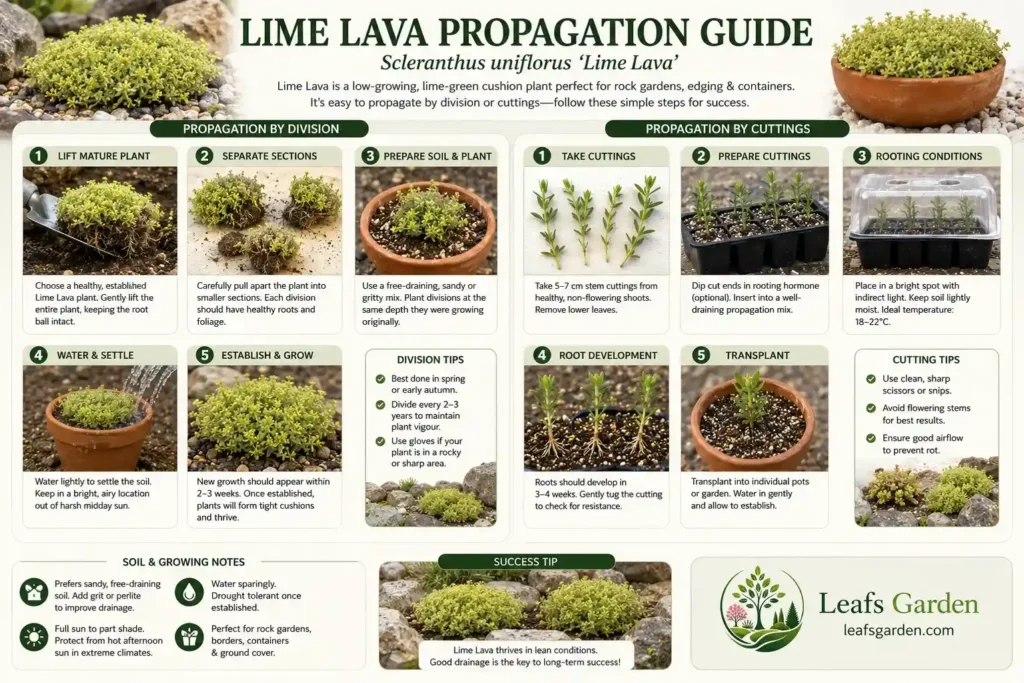
Scleranthus Lime Lava is usually propagated through division or small stem sections.
Propagation is generally simple when the plant is healthy and actively growing. Because of its dense cushion-forming habit, division is the most reliable method for producing new plants while maintaining strong root development and compact growth.
Division is the easiest and most successful way to propagate Scleranthus Lime Lava.
This method allows gardeners to separate healthy sections from an established plant and replant them directly into suitable growing conditions.
Avoid excessively large divisions because smaller healthy sections often establish more evenly.
The best time for division propagation is usually during mild growing periods.
Ideal seasons include:
Avoid propagating during extreme summer heat or cold winter periods because environmental stress may slow root establishment.
Scleranthus Lime Lava can also be propagated from small stem sections or cuttings, although this method may take longer than division.
Successful rooting depends on stable environmental conditions.
Best rooting conditions include:
A sandy alpine-style mix with coarse drainage material usually works best.
Cuttings require balanced moisture without becoming waterlogged.
Helpful moisture practices include:
Overwatering is one of the most common reasons propagation cuttings fail.
Proper transplanting techniques help newly propagated Lime Lava plants establish faster with less stress.
To reduce transplant stress:
Stable growing conditions improve recovery significantly.
Newly transplanted Lime Lava plants benefit from:
Once established, the plants gradually develop their compact evergreen cushion form and become easier to maintain long term.
Lime Lava works best outdoors but can also be used in decorative containers and modern plant displays.
Its compact cushion shape, evergreen foliage, and bright lime-green color make it highly versatile in both landscape design and container gardening. Scleranthus Lime Lava is especially effective in modern outdoor spaces where texture, structure, and low-maintenance planting are priorities.
Scleranthus Lime Lava performs best in outdoor environments with good sunlight, airflow, and free-draining soil.
Its dense compact growth allows it to function as both a decorative ground cover and a textural accent plant in contemporary landscapes.
Lime Lava is commonly used in courtyards because its low-growing structure helps soften hard paving surfaces and modern architectural lines.
It works particularly well alongside:
Its bright chartreuse foliage adds contrast and visual brightness to compact outdoor spaces.
Rockeries are one of the most popular uses for Scleranthus Lime Lava.
The plant naturally complements:
Its cushion-forming habit creates a soft natural transition between rocks and surrounding landscape elements.
Lime Lava works effectively as a border plant because of its neat compact growth.
It is commonly used for:
The low mound shape keeps borders visually clean without becoming invasive or overgrown.
Scleranthus Lime Lava grows very well in containers where its sculptural cushion form becomes a strong visual feature.
Its evergreen lime-green foliage contrasts beautifully with natural stone, terracotta, and minimalist modern planter materials.
Terracotta containers are highly suitable because they improve airflow and help excess moisture evaporate more efficiently.
Terracotta pots also complement the plant’s alpine-style appearance and natural texture.
Modern minimalist planters work especially well with Lime Lava because of its clean rounded form.
Popular planter styles include:
The plant’s bright foliage helps soften rigid architectural shapes.
Lime Lava combines well with other compact ornamental plants in mixed container arrangements.
Suitable companion plants include:
Its dense cushion texture helps create layered contrast within decorative displays.
Scleranthus Lime Lava can grow indoors temporarily, but outdoor growing conditions are generally more suitable long term.
The plant performs best when it receives strong natural light, good ventilation, and balanced moisture conditions.
Indoor environments often provide less sunlight than the plant naturally prefers.
Insufficient light may cause:
Bright sunny windows or high-light indoor areas are usually necessary for acceptable indoor performance.
Good airflow is important for maintaining healthy dense foliage indoors.
Poor ventilation may increase the risk of:
For best results, indoor plants should be placed in bright airy locations with consistent airflow and well-draining soil conditions.
Scleranthus Lime Lava is an attractive low-maintenance cushion plant ideal for modern gardens, rock landscapes, and decorative containers.
Its dense compact growth, bright lime-green foliage, and soft moss-like texture make it one of the most visually distinctive ground cover plants for contemporary landscaping. Whether used in rockeries, alpine gardens, pathway edging, courtyard designs, or minimalist planter arrangements, Lime Lava adds year-round structure and vibrant color with very little maintenance.
Scleranthus biflorus Lime Lava performs especially well in free-draining soil with bright sunlight and moderate watering. Its adaptability to Australian growing conditions, including many Perth garden environments, makes it a reliable choice for low-water and modern outdoor designs. The plant’s compact cushion form also helps soften stone surfaces, gravel landscapes, and architectural hardscaping naturally.
Because of its versatility, Lime Lava combines beautifully with creeping thyme, ornamental grasses, Dymondia silver carpet, succulents, and other alpine or rockery plants. Its evergreen appearance and controlled growth habit make it useful for both small decorative spaces and larger landscape compositions.
Experimenting with different ground cover combinations can help create more layered and visually balanced garden designs. Exploring additional rock garden plants and alpine-style companions can also enhance the texture, color contrast, and long-term visual appeal of modern outdoor landscapes.
Scleranthus Lime Lava is mainly used as an ornamental ground cover plant in rock gardens, pathways, modern landscapes, decorative containers, and alpine garden designs. Its dense cushion shape and bright lime-green foliage help soften stone surfaces and create strong visual texture in outdoor spaces.
Yes, Lime Lava is moderately drought tolerant once fully established. The plant handles short dry periods better than constantly wet soil conditions. However, prolonged extreme dryness may still stress the foliage, especially in containers or intense summer heat.
Scleranthus Lime Lava prefers moderate watering with slight drying between watering sessions. Water more frequently during hot dry weather and reduce watering during cooler or rainy periods. Avoid keeping the soil constantly wet because excessive moisture can lead to root rot.
Yes, Lime Lava grows very well in pots and decorative containers. Wide shallow planters with excellent drainage are ideal for maintaining healthy compact cushion growth. Terracotta pots and minimalist planters are especially popular for displaying the plant in modern outdoor spaces.
Scleranthus Lime Lava is neither a true grass nor a moss. It is an evergreen cushion-forming ornamental plant known for its moss-like texture and compact mounding growth habit. Its appearance resembles soft moss or ornamental grass, but it belongs to the Caryophyllaceae plant family.
Yes, Scleranthus Lime Lava performs well in many Perth gardens when planted in free-draining soil with good sunlight and airflow. Perth’s warm dry climate often suits the plant well, especially in rock gardens, gravel landscapes, and raised beds.
Scleranthus biflorus is most commonly propagated through division. Healthy sections of an established cushion plant are carefully separated and replanted into well-draining soil. Small stem cuttings can also be rooted under stable moisture and bright indirect light conditions.
Brown foliage is usually caused by overwatering, poor drainage, excessive moisture retention, or environmental stress. Root rot, heat stress, and inadequate airflow can also damage the dense cushion growth. Improving drainage and adjusting watering practices often helps the plant recover.