Grow Better Gardens with Smarter Plant Choices
Discover helpful guides on trees, hedges, fruit plants, edible plants, and beautiful landscape greenery.

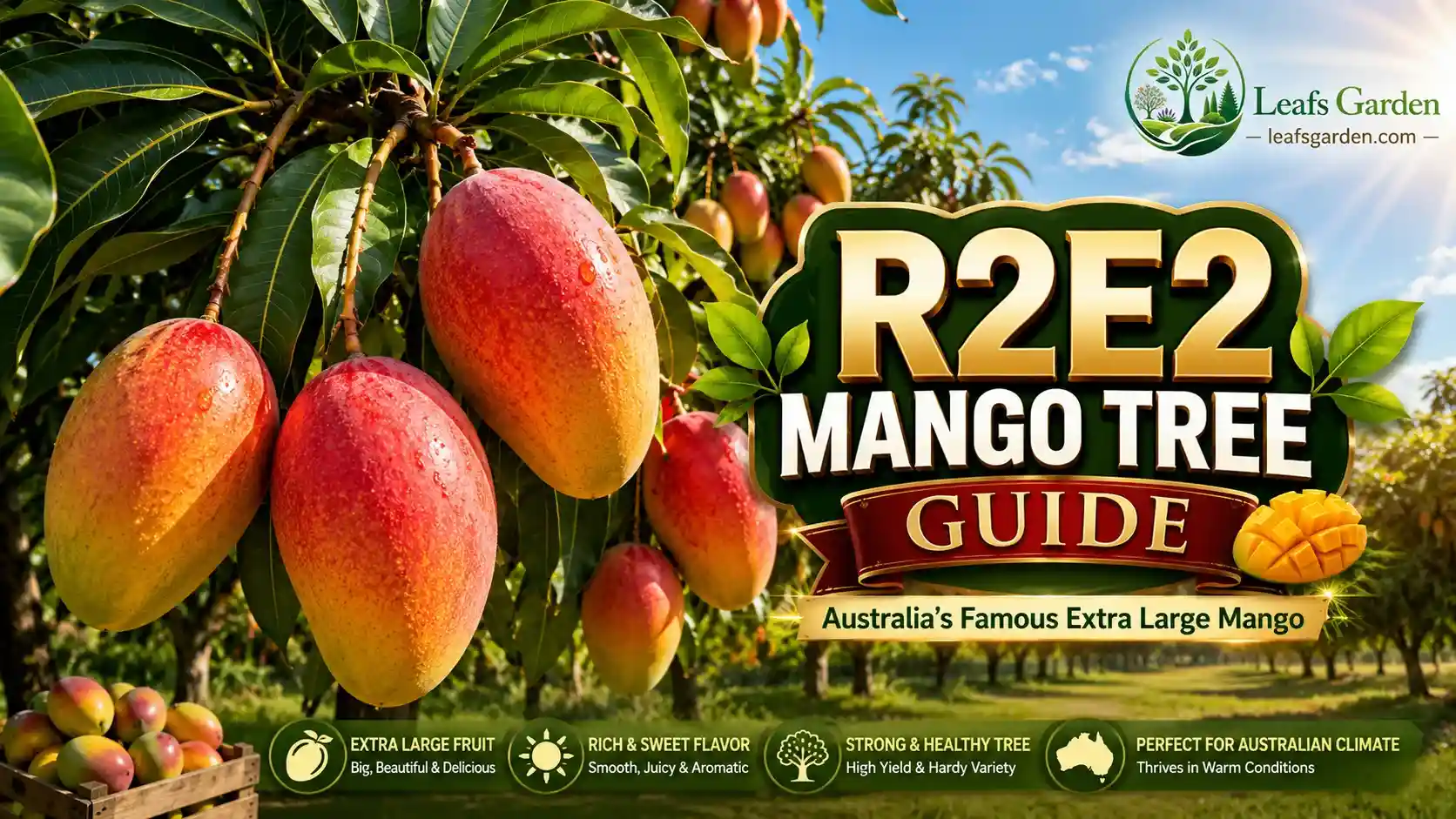
The R2E2 mango tree is one of Australia’s most famous commercial mango varieties, known for its extra-large fruit size, vibrant red-orange skin, mild sweet flavor, and strong market appeal. It performs especially well in warm Australian climates but can also grow in suitable subtropical and tropical regions worldwide, including parts of the USA.
The R2E2 mango became popular because of its impressive appearance, reliable production, and excellent transport durability. Its large fruit size immediately stands out in supermarkets and export markets, making it one of the most recognizable Australian mango varieties. Commercial growers in Queensland and other warm mango-producing regions value the variety for its strong shelf presence and consistent fruit quality.
Compared to the rich tropical flavor of the Kensington Pride mango, the R2E2 has a milder and more balanced sweetness. Many consumers describe it as less aromatic but visually more striking because of its giant oval shape and colorful skin. The famous Bowen mango, which is closely connected to Kensington Pride, is also known for stronger aroma and deeper mango flavor.
Other premium mangoes continue gaining popularity across Australia and international markets. The Honey Gold mango is often preferred for its creamy texture and very sweet taste, while the Calypso mango is valued for lower fiber and better shelf stability. Imported and specialty varieties like the Maha Chanok mango and Alphonso mango are also attracting attention from mango enthusiasts looking for floral sweetness and premium dessert-quality fruit.
Global interest in Australian mangoes has increased significantly because consumers are searching for larger, visually attractive, and export-quality tropical fruits. Australian mango varieties are now widely discussed by home gardeners, tropical fruit collectors, and commercial growers in countries including the United States, Thailand, and parts of South America. The R2E2 mango tree remains one of the leading examples of Australia’s modern commercial mango breeding success.
The R2E2 mango originated in Australia through selective breeding and became famous for producing exceptionally large mangoes with attractive coloration.
The R2E2 mango origin traces back to Queensland, Australia, where commercial mango breeding programs focused on developing export-quality fruit with strong shelf appeal. Australian growers wanted a mango that could handle transport well while still producing large, colorful fruit suitable for supermarkets and international markets.
The variety was developed through controlled breeding rather than genetic modification. Breeders selected parent mango trees with desirable traits such as fruit size, skin color, productivity, and storage performance. Over time, the R2E2 became one of the best-known commercial mangoes in Australia because of its oversized fruit and bright red-orange blush.
Many people wonder why the unusual name “R2E2” exists. The name comes from the breeding row and selection code used during the mango development process. It was never intended as a marketing-style fruit name, but the label remained attached to the variety after commercial release.
Online searches often create confusion between:
These terms are usually typing mistakes, nickname variations, or internet misunderstandings connected to the actual R2E2 mango tree. The official commercial variety is properly called the R2E2 mango.
Today, the R2E2 is recognized as one of the most famous Australian mango varieties and is widely associated with large premium mango displays during the Australian mango season.
The R2E2 belongs to the species Mangifera indica, the same species as most edible mango varieties worldwide.
Mangoes belong to the plant family Anacardiaceae, which also includes cashew and pistachio trees. The R2E2 mango tree is classified as a tropical evergreen fruit tree grown mainly for its edible stone fruit.
Here is the scientific classification of the R2E2 mango:
| Classification Level | Information |
| Kingdom | Plantae |
| Family | Anacardiaceae |
| Genus | Mangifera |
| Species | Mangifera indica |
| Fruit Type | Tropical stone fruit |
The mango species grown in Australia are mostly selections or cultivars of Mangifera indica.
Gardeners keen on exploring productive tropical varieties will find the R2E2 mango a standout addition among the many rewarding fruit trees and edible plants suited to warm Australian climates.
This includes commercial varieties such as:
Although these mangoes belong to the same species, each variety differs in sweetness, fiber content, fruit size, aroma, and skin color.
The R2E2 mango fruit type is considered a drupe, also known as a stone fruit. It contains soft edible flesh surrounding a single large seed. Like many tropical fruit trees, the R2E2 grows best in hot climates with long warm seasons and minimal frost exposure.
R2E2 mangoes became popular because of their huge size, visual appeal, transport durability, and strong commercial value.
One major reason behind the big mango Australia trend was the R2E2’s impressive appearance. These mangoes are much larger than many traditional varieties, often weighing over one kilogram under ideal growing conditions. Their bright red, orange, and golden skin also makes them highly attractive in retail displays.
Australian supermarkets favored the R2E2 because the fruit handled shipping and storage better than softer mango varieties. The firm flesh and thicker skin reduced damage during transport, helping growers supply fruit across long distances more successfully.
Consumer appeal also played a major role in the variety’s success. Many buyers were drawn to:
The R2E2 became especially important for commercial mango production in Queensland and other warm mango-growing regions. Export markets also appreciated its presentation quality because visually attractive mangoes often perform better in premium fruit sales.
Although some consumers prefer sweeter mangoes like Honey Gold or Kensington Pride, the R2E2 remains one of the most recognizable mangoes in Australia due to its strong market presence and distinctive oversized fruit.
R2E2 mangoes are extremely large, oval-shaped mangoes with bright red, orange, and yellow skin.
One of the easiest ways to identify an R2E2 mango is by its unusually large fruit size. It is considered one of the biggest commercial mango varieties in Australia and often looks much larger than standard supermarket mangoes.
The fruit usually has:
The long mango appearance and oversized body make the variety stand out immediately in fruit markets and commercial displays.
The skin color changes as the fruit matures. Most R2E2 mangoes develop:
This colorful mango description is one of the reasons the variety became commercially successful in Australia. The vibrant skin gives the fruit a premium tropical appearance that attracts buyers quickly.
Here is a general average fruit weight comparison between popular mango varieties:
| Mango Variety | Average Fruit Size |
| R2E2 | Very Large (800g–1.5kg+) |
| Kensington Pride | Medium |
| Honey Gold | Medium |
| Calypso | Medium |
| Maha Chanok | Medium to Long |
| Alphonso | Small to Medium |
Under excellent growing conditions, some R2E2 mangoes can grow even larger than the typical commercial size, making them one of the most recognizable big mango characteristics in Australia.
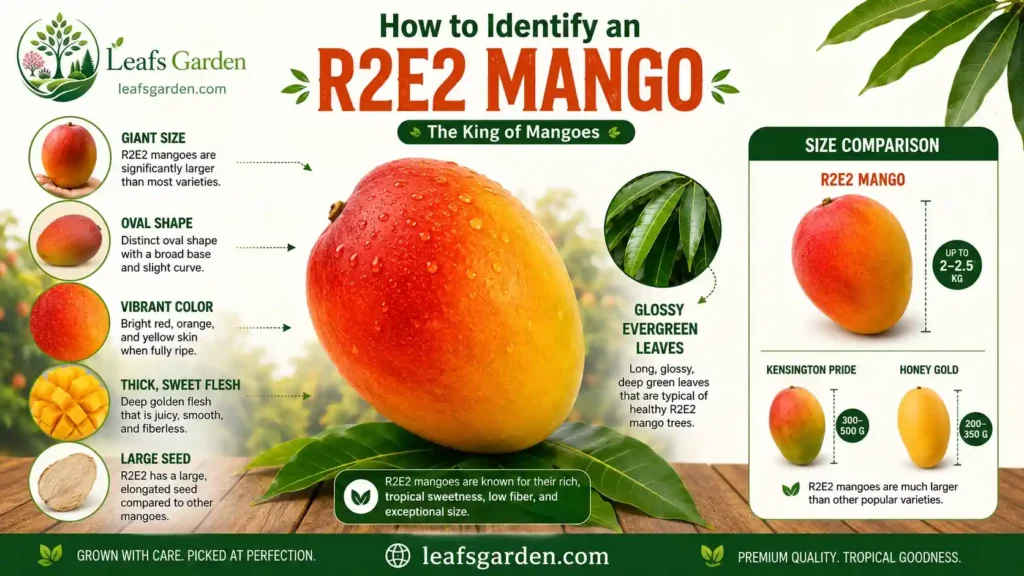
R2E2 mangoes have firm flesh with moderate fiber compared to smoother varieties like Honey Gold or Maha Chanok.
Inside the fruit, the flesh is usually deep yellow to golden orange with a dense texture that holds its shape well when sliced. The fruit is not considered extremely fibrous, but it contains more fiber than ultra-smooth dessert mangoes.
Compared with other varieties:
This fibrous mango comparison helps explain why some consumers prefer R2E2 for slicing and presentation rather than purely for soft buttery texture.
The seed size inside the fruit is relatively large because the mango itself grows very big. Even with the larger seed, the fruit still provides a high amount of edible flesh because of its oversized body.
The juice content is moderate rather than excessively watery. The flesh stays reasonably firm after cutting, which helps the fruit perform well in:
Its stronger flesh structure also improves transport durability, which became an important advantage for Australian mango exporters.
R2E2 mangoes have a mild sweet flavor with balanced acidity rather than an intensely rich tropical taste.
The R2E2 mango taste is often described as clean, refreshing, and lightly sweet. It does not usually have the strong aromatic richness found in some premium dessert mangoes. Instead, the flavor remains balanced and approachable for a wide range of consumers.
Many people searching for a sweet mango in Australia compare R2E2 with other famous varieties because sweetness levels vary significantly between mango cultivars.
Here is a general sweetness comparison:
| Mango Variety | Flavor Style | Sweetness Level |
| R2E2 | Mild sweet, balanced | Medium |
| Kensington Pride | Rich tropical flavor | High |
| Honey Gold | Very sweet, creamy | Very High |
| Alphonso | Rich, aromatic, intense | Very High |
| Calypso | Balanced sweet, smooth | Medium-High |
Consumers asking “which mangoes are sweetest” in Australia often rank:
The R2E2 still remains popular because many buyers value:
Unlike intensely rich mangoes, the R2E2 appeals to consumers who prefer a lighter tropical sweetness with less overpowering aroma.
An R2E2 mango tree can grow into a large evergreen tree reaching 20–40 feet or more in suitable climates.
Like many tropical mango tree varieties, the R2E2 develops a broad canopy, strong trunk structure, and dense evergreen foliage when planted in warm frost-free regions. In commercial orchards and home gardens with enough space, mature trees can become very large over time.
Average R2E2 mango tree height depends on:
Under ideal tropical conditions, mature trees may reach:
The canopy spread can also become very wide. Mature trees often develop rounded crowns extending 20 feet or more across. This is why proper spacing is important when planting multiple mango trees.
Among different types of mango trees, the R2E2 is considered a vigorous grower with strong branching and heavy foliage production. The tree naturally forms a dense shade canopy if left unmanaged.
The root system is extensive and deep. Mango roots spread widely in search of water and nutrients, making well-draining soil extremely important. Poor drainage can damage roots and increase the risk of fungal disease or root rot.
Home gardeners often control the tree’s final size through:
Proper management helps improve airflow, fruit production, and harvesting access.
R2E2 mango trees are moderately fast growers that can live for decades with proper care.
Young trees establish quickly in warm climates with strong sunlight and good soil conditions. During the early years, the tree focuses heavily on root development, branch formation, and canopy growth.
Typical mango tree growth stages include:
The mango tree fruiting age depends largely on how the tree was propagated:
R2E2 mango trees become more productive as they mature. Healthy trees can continue producing fruit for several decades under suitable tropical or subtropical conditions.
Long-term productivity improves when growers maintain:
Older mature mango trees may produce very heavy seasonal crops, especially in warm Australian growing regions such as Queensland and the Northern Territory.
Environmental stress can slow growth significantly. Frost, poor soil drainage, nutrient deficiencies, and extended cold weather may reduce flowering and fruit development.
Grafted R2E2 mango trees fruit faster, stay more predictable, and are preferred for home gardens and orchards.
A grafted mango tree is created by attaching a cutting from a known R2E2 parent tree onto strong rootstock. This process allows growers to reproduce the exact characteristics of the original variety.
Most commercial nurseries sell grafted mango trees because they provide:
Seed-grown trees behave very differently. Mango seeds do not always grow true to type, meaning the resulting fruit may differ from the original R2E2 mango in:
This seed-grown variability is one reason commercial orchards rarely rely on seed propagation for premium mango production.
Grafted mango tree height is often easier to manage because growers can prune and shape the canopy from an early age. These trees are also more suitable for:
Many homeowners searching for grafted mango trees for sale prefer R2E2 because the variety combines attractive fruit appearance with strong commercial genetics.
Before purchasing a tree, buyers should check:
Choosing a healthy grafted tree greatly improves the chances of successful long-term mango production.
R2E2 mango trees grow best in tropical and subtropical climates with warm temperatures and minimal frost.
Like most mango trees Australia is known for, the R2E2 performs best in regions with long hot summers, mild winters, and low frost risk. Commercial production is strongest in warm Australian growing areas such as Queensland, the Northern Territory, and parts of Western Australia.
Mangoes in Australia thrive because these regions provide:
Outside Australia, R2E2 mango trees can also grow successfully in suitable subtropical and tropical areas worldwide.
Gardeners building a productive tropical backyard orchard in warm Australian conditions may also consider adding a Hass avocado tree, another large evergreen fruit tree that thrives in similar Queensland and subtropical coastal growing environments.
In the United States, the variety performs best in:
The tree is generally most suitable for USDA growing zones:
Cold temperatures remain one of the biggest limitations for mango production. Young trees are especially vulnerable to frost damage, while mature trees can only tolerate brief periods of light cold stress.
Worldwide tropical regions suitable for R2E2 mango growing include:
Growers in cooler climates often use greenhouses, protected courtyards, or container growing to improve survival during winter.
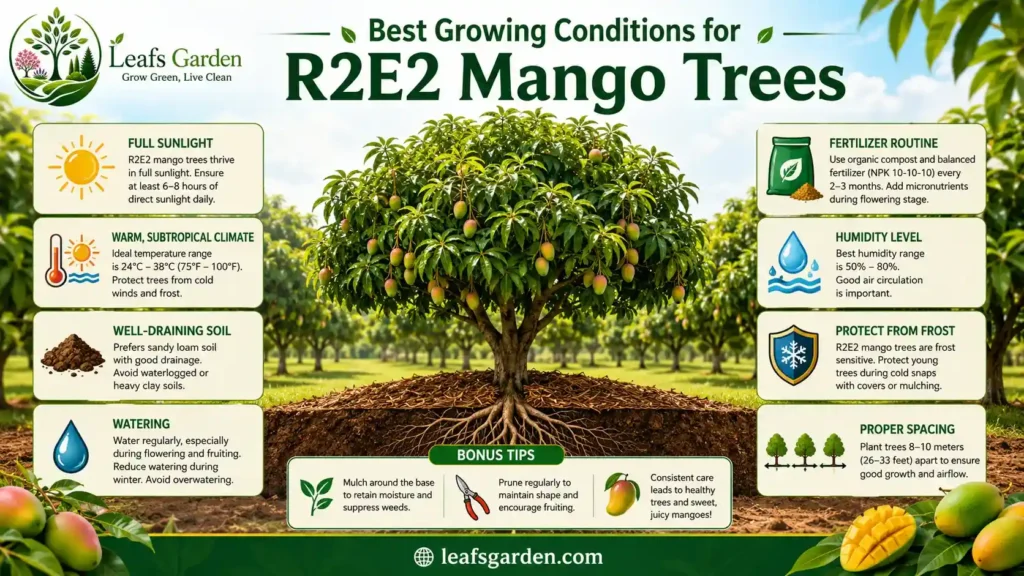
Full sunlight and warm temperatures are essential for strong flowering and fruit production.
R2E2 mango trees require direct sunlight for most of the day to maintain healthy growth and reliable fruiting. A minimum of 6–8 hours of strong sun exposure is recommended, although all-day sunlight produces the best results.
Strong sunlight supports:
The tree has excellent heat tolerance and performs very well in hot summer conditions. Mature mango trees can handle temperatures above 90°F (32°C) when watered properly.
Ideal temperature ranges include:
Frost sensitivity remains a major concern. Temperatures below freezing can damage leaves, flowers, young branches, and developing fruit.
Young trees are especially vulnerable to:
Summer growth conditions strongly influence fruit production. Long hot summers help the R2E2 mango develop:
Poor sunlight or extended cool weather may reduce flowering and slow overall tree development.
R2E2 mango trees prefer well-draining sandy or loamy soil with slightly acidic to neutral pH.
Good soil drainage is one of the most important factors for successful mango growing. Mango roots dislike constantly wet conditions, and waterlogged soil can quickly lead to root disease.
The ideal soil texture includes:
Heavy clay soils can create serious problems because they hold too much moisture around the root system.
Recommended soil conditions include:
Drainage importance cannot be overstated for mango trees. Poor drainage increases the risk of:
Root rot prevention starts with proper site selection. Gardeners should avoid:
Raised planting mounds or elevated beds can help improve drainage in difficult soils.
Mulching around the tree also helps maintain:
However, mulch should not touch the trunk directly because trapped moisture may encourage disease.
Young mango trees need regular watering, while mature trees prefer moderate watering with dry periods before flowering.
Water needs change significantly as the R2E2 mango tree matures. Newly planted trees require more consistent moisture to establish strong roots and healthy early growth.
Basic irrigation guidelines for young trees include:
Mature mango trees become more drought tolerant once fully established. Overwatering older trees can reduce flowering and increase disease problems.
Many growers intentionally allow mild dry periods before flowering because this can encourage stronger bloom development.
Humidity levels also influence tree performance. Mango trees generally prefer:
Excessive humidity combined with poor airflow may increase fungal disease pressure, especially during flowering season.
A simple seasonal watering schedule often looks like this:
| Season | Watering Approach |
| Spring | Moderate watering during active growth |
| Summer | Deep watering during heat and fruit development |
| Autumn | Gradually reduce watering |
| Winter | Minimal watering during cooler dormancy-like period |
Container-grown mango trees usually need more frequent watering because pots dry out faster than ground soil.
Proper watering management helps improve:
Plant the tree in a sunny location with well-draining soil and enough space for canopy growth.
Proper planting gives an R2E2 mango tree the best chance for strong root development, healthy canopy formation, and long-term fruit production. Mango trees dislike poor drainage and crowded planting conditions, so site preparation is very important.
Follow these planting steps carefully:
Proper spacing recommendations are important because R2E2 mango trees become very large over time.
General spacing guidelines:
Adequate spacing improves:
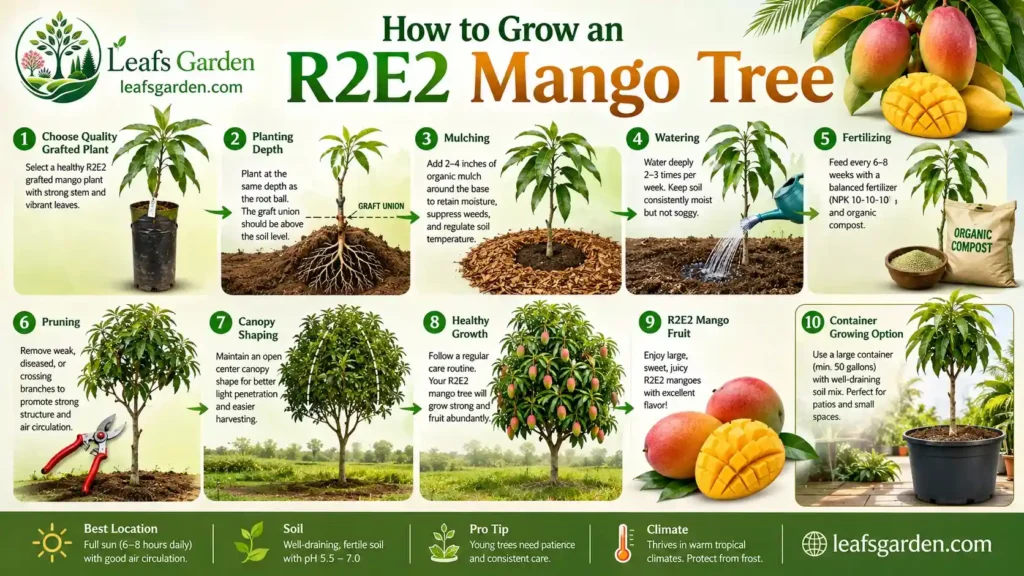
Balanced fertilizers with micronutrients help R2E2 mango trees develop healthy foliage and fruit.
Mango trees need regular nutrition to support leaf growth, flowering, root development, and fruit production. Young trees especially benefit from consistent feeding during active growth periods.
The most important nutrients include:
Micronutrients are also extremely important for mango trees, especially:
Nutrient deficiencies may cause:
A simple seasonal fertilizing approach works well for most growers:
| Tree Stage | Fertilizer Focus |
| Young Trees | Balanced fertilizer with moderate nitrogen |
| Pre-Flowering | Reduced nitrogen, higher potassium |
| Fruiting Season | Potassium and micronutrient support |
| Post-Harvest | Recovery feeding for canopy growth |
Organic feeding is also popular among home gardeners. Common organic materials include:
Overfertilizing should be avoided because excessive nitrogen may produce heavy leaf growth with reduced flowering.
Young trees usually benefit from smaller, more frequent fertilizer applications, while mature trees can handle larger seasonal feedings.
Regular pruning improves airflow, controls size, and encourages better fruiting.
Without management, R2E2 mango trees can become extremely large and difficult to harvest. Pruning helps maintain a healthier structure while improving sunlight penetration throughout the canopy.
Important pruning goals include:
The best time to prune is usually after harvest or during periods of active growth.
Basic pruning practices include:
Dead branch removal improves overall tree health and reduces pest or disease problems.
Height control is especially important in backyard gardens. Many growers keep mango trees smaller through annual trimming rather than allowing full natural height.
Proper shape management creates:
Excessive pruning should be avoided because overly aggressive cuts may temporarily reduce flowering and fruit yield.
Commercial orchards often use controlled canopy systems to improve:
Young or grafted R2E2 mango trees can grow in large containers, though mature trees perform better in the ground.
Container growing is useful for gardeners with:
Young grafted trees adapt much better to pots than large seed-grown trees. However, because the R2E2 naturally becomes very large, long-term container growing requires regular pruning and careful root management.
Recommended container size:
The best potting mix should provide:
A common mango potting mix may include:
Container-grown trees dry out faster than in-ground trees, so watering must be monitored more carefully during hot weather.
Compared with dwarf mango varieties, the R2E2 is less naturally suited to permanent pot culture because of its vigorous growth habit and large canopy potential.
Still, container growing can work successfully when growers:
Many gardeners in cooler regions use containers so trees can be moved indoors or protected during winter cold periods.
R2E2 mangoes are usually harvested during the Australian mango season from late spring through summer.
For people asking “when are mangoes in season Australia,” the answer depends on regional climate and harvest timing. Because Australia has multiple tropical growing regions, mango harvests begin earlier in warmer northern areas and gradually move southward.
The R2E2 mango season commonly starts in:
Northern Territory and Queensland are among the most important commercial mango-producing regions for R2E2 fruit. These warm climates provide the heat and long growing season needed for proper flowering, fruit sizing, and ripening.
General regional harvest timing in Australia:
| Region | Typical Mango Season |
| Northern Territory | September–November |
| Queensland | November–January |
| Western Australia | November–February |
| Northern New South Wales | Late summer |
Season timing may vary slightly each year depending on:
The R2E2 is especially popular during the peak Australian mango season because its bright skin color and oversized fruit attract strong supermarket demand.
Commercial orchards carefully monitor fruit maturity before harvest to ensure:
In international markets, Australian mangoes are often viewed as premium tropical fruit because of their quality standards and seasonal freshness.
Grafted R2E2 mango trees may fruit within 3–5 years, while seed-grown trees take much longer.
The fruiting age of an R2E2 mango tree depends mainly on propagation method, climate quality, and overall tree care.
Grafted trees produce fruit faster because they come from mature parent material already selected for reliable flowering and fruiting performance.
Typical productivity timeline:
Seed-grown trees usually require much more patience. In many cases, they may take:
Seed-grown trees also vary significantly in fruit quality because mango seeds do not always grow true to the parent variety.
Commercial orchard expectations are very different from home garden growing. Orchard growers focus heavily on:
To encourage faster fruiting, growers typically provide:
Cool temperatures or poor growing conditions may delay flowering and reduce early productivity.
Healthy mature R2E2 mango trees can continue producing fruit for decades under suitable tropical or subtropical conditions.
Mature R2E2 mangoes develop stronger skin color, aroma, and slight softness near ripening.
Harvest timing is extremely important because mangoes picked too early may lack sweetness and proper texture, while overripe fruit can bruise or spoil quickly.
Common harvest indicators include:
R2E2 mangoes are often harvested while still firm so they can continue ripening safely during storage and transport.
Commercial growers also monitor:
After harvest, mangoes usually ripen indoors over several days at room temperature.
Basic storage tips include:
Ripening indoors naturally improves:
Many growers place mangoes in paper bags to speed up ripening slightly through trapped natural ethylene gas.
A fully ripe R2E2 mango should feel slightly soft when gently pressed while still maintaining enough firmness for slicing and serving.
Yellow mango leaves are commonly caused by overwatering, nutrient deficiencies, or poor drainage.
Leaf yellowing is one of the most common warning signs in mango trees. In many cases, the problem begins below the soil surface where excess moisture damages the roots and reduces nutrient absorption.
Common causes of yellow mango leaves include:
Overwatering is especially dangerous for R2E2 mango trees because mango roots require oxygen-rich, fast-draining soil. Constantly wet roots may become weak or diseased.
Nutrient deficiencies can also affect leaf color:
Poor drainage problems are more common in:
To improve tree health:
Young leaves sometimes appear light green naturally before darkening as they mature, so mild temporary discoloration is not always a serious problem.
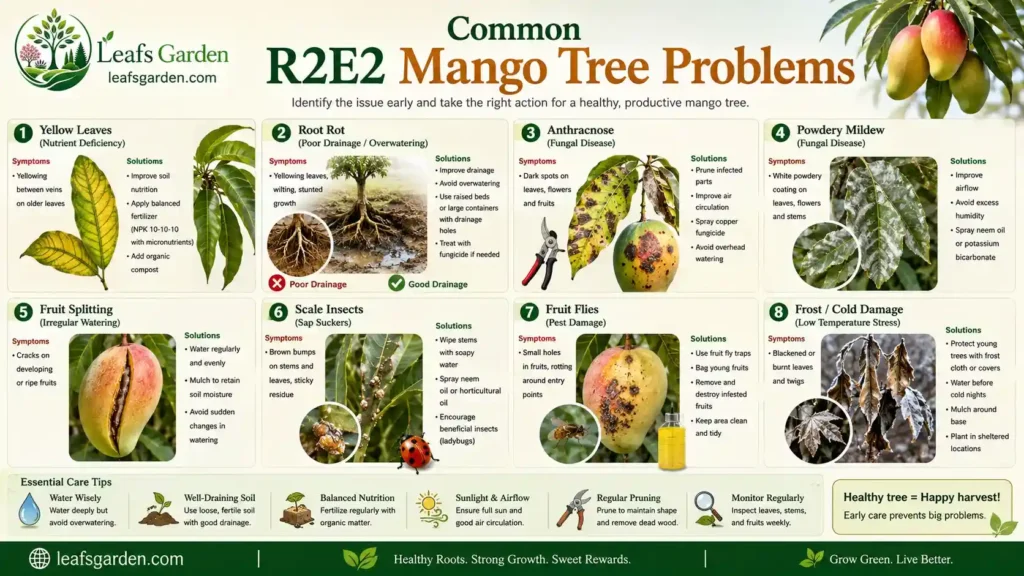
Anthracnose, powdery mildew, fruit flies, and scale insects are among the most common mango tree problems.
Warm humid conditions can increase disease pressure in mango orchards and backyard gardens. Proper airflow and seasonal maintenance help reduce many fungal and pest-related issues.
Common mango diseases include:
| Disease | Common Symptoms |
| Anthracnose | Black leaf spots, fruit rot, flower damage |
| Powdery Mildew | White powdery coating on flowers and leaves |
| Root Rot | Weak growth, yellow leaves, root decline |
| Bacterial Black Spot | Dark lesions on fruit and foliage |
Anthracnose is one of the most serious mango fungal diseases, especially during humid flowering seasons. It can damage flowers, reduce fruit production, and spoil developing mangoes.
For detailed mango disease identification and integrated pest management advice, Agriculture Victoria provides reliable horticultural guidance for Australian mango growers and backyard orchardists.
Powdery mildew commonly affects:
Poor airflow and excessive moisture around the canopy often increase fungal disease risk.
Common mango pests include:
Fruit flies are especially problematic because they damage ripening mangoes and reduce market quality.
Scale insects and sap-feeding pests may cause:
Preventive tree management is extremely important. Good practices include:
Healthy vigorous mango trees are usually more resistant to serious pest and disease outbreaks.
Inconsistent watering and environmental stress can reduce fruit quality and cause splitting.
Fruit splitting is a common mango problem that usually appears when trees experience sudden moisture changes during fruit development.
The problem often occurs when:
The mango skin may crack because internal fruit growth happens faster than the outer skin can stretch.
Poor fruiting problems can also result from:
Environmental stress strongly affects mango production. Sudden temperature swings, strong winds, excessive humidity, or prolonged cool weather may reduce flowering and fruit retention.
Common signs of poor fruiting include:
To improve fruit quality:
Mature healthy trees with stable growing conditions generally produce more reliable harvests.
Young R2E2 mango trees are highly sensitive to frost and cold winds.
Cold weather is one of the biggest threats to tropical mango production. Even brief frost exposure can damage young leaves, flowers, shoots, and developing fruit.
Young trees are especially vulnerable because their tender growth lacks cold resistance.
Common frost damage symptoms include:
Cold winds can also dry out foliage and increase stress even when temperatures remain slightly above freezing.
Mature trees tolerate mild cold better than young trees, but extended freezing temperatures may still cause severe canopy damage or tree decline.
Protective measures include:
Growers in cooler climates often plant mango trees in:
After frost injury, damaged branches should not be pruned immediately. Waiting until warmer weather helps growers identify which parts of the tree remain alive before trimming dead growth.
| Mango Variety | Sweetness | Fiber Level | Fruit Size | Popular Region |
| R2E2 | Mild Sweet | Medium | Very Large | Australia |
| Kensington Pride | Rich Sweet | Medium | Medium | Australia |
| Honey Gold | Very Sweet | Low | Medium | Australia |
| Calypso | Balanced Sweet | Low | Medium | Australia |
| Maha Chanok | Floral Sweet | Very Low | Medium | Thailand/Australia |
Kensington Pride is often considered sweeter and more aromatic, while R2E2 is larger and visually striking.
The discussion around R2E2 mango vs Kensington Pride is one of the biggest comparisons in Australian mango culture. Both are famous Australian mango varieties, but they appeal to consumers for different reasons.
The Kensington Pride mango, also widely connected with the Bowen mango name, is known for:
The R2E2 mango focuses more on:
Many consumers searching for the best mango flavor in Australia often choose Kensington Pride because of its deeper sweetness and stronger aroma.
Gardeners interested in growing the classic Australian mango alongside their R2E2 can explore our dedicated guide to the Kensington Pride mango, covering everything from tree care to harvest tips for this iconic Australian variety.
Meanwhile, R2E2 attracts buyers who prefer oversized fruit with premium visual appeal.
Here is a simple comparison:
| Feature | R2E2 | Kensington Pride |
| Fruit Size | Very Large | Medium |
| Sweetness | Mild Sweet | Rich Sweet |
| Aroma | Moderate | Strong |
| Flesh Texture | Firm | Softer |
| Market Appeal | High visual impact | Traditional favorite |
The Kensington mango discussion often centers around flavor quality, while the R2E2 discussion usually focuses on fruit size and export presentation.
Calypso mangoes are less fibrous and more shelf-stable compared to Kensington Pride.
The Calypso mango vs Kensington Pride comparison is common among consumers looking for smoother flesh and longer storage life.
Calypso mangoes are popular because they typically offer:
Kensington Pride remains highly respected for:
One major difference in the Calypso vs Kensington mango comparison is texture. Kensington Pride often contains more noticeable fiber, while Calypso usually provides smoother flesh better suited for neat slicing and commercial fruit trays.
Here is a quick comparison:
| Feature | Calypso | Kensington Pride |
| Fiber Level | Low | Medium |
| Sweetness | Balanced Sweet | Rich Sweet |
| Shelf Life | Longer | Shorter |
| Aroma | Moderate | Strong |
| Flesh Texture | Smooth | Juicy and softer |
Because of its storage performance, Calypso became increasingly important in Australian supermarkets and export-focused mango production.
Honey Gold and Maha Chanok are often preferred for sweetness, while R2E2 stands out for size and appearance.
The Honeygold mango is widely considered one of the sweetest premium mangoes in Australia. It is especially known for:
Many consumers also recognize the Pinata Honey Gold mango branding associated with premium Australian mango marketing.
Compared with R2E2:
Maha Chanok mangoes are another highly respected premium variety. Originally from Thailand, they became increasingly popular in Australia because of their:
The Maha Chanok is often considered one of the best mangoes for fresh dessert eating.
The Alphonso mango Australia market also continues growing because of consumer interest in imported and specialty mango varieties. Alphonso mangoes are famous for:
Here is a broader premium mango comparison:
| Mango Variety | Main Strength |
| R2E2 | Giant size and appearance |
| Honey Gold | Very sweet creamy flavor |
| Maha Chanok | Floral sweetness and low fiber |
| Alphonso | Rich aromatic dessert flavor |
| Kensington Pride | Classic Australian mango taste |
Although sweeter varieties often receive higher flavor rankings, the R2E2 remains highly valuable commercially because of its:
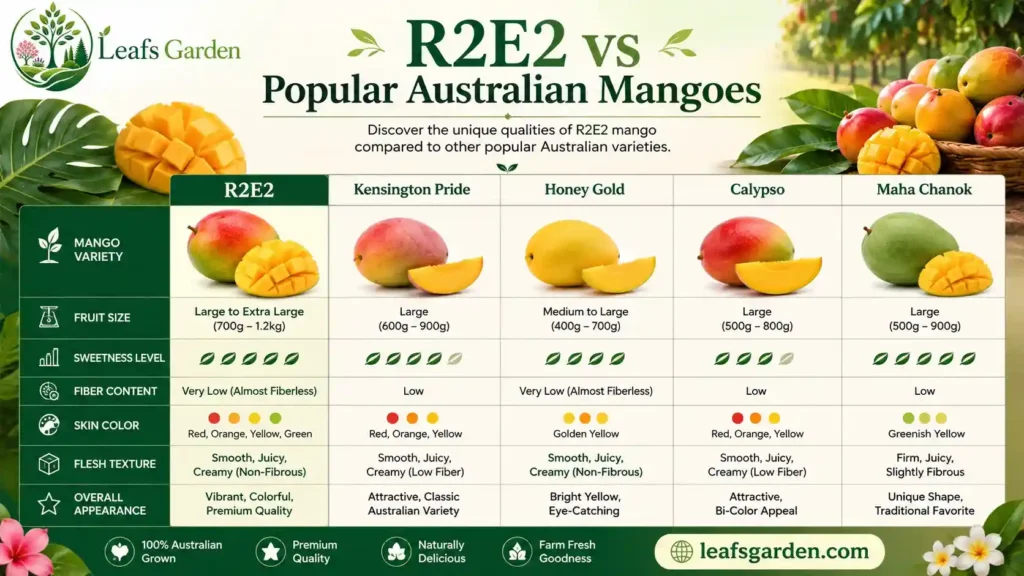
Honey Gold, Kensington Pride, and Maha Chanok are usually ranked among the sweetest Australian mangoes.
When people search for the sweetest mango in Australia, several premium mango varieties are consistently mentioned because of their rich flavor, low fiber, and strong tropical sweetness.
The most commonly praised sweet mangoes include:
The Honey Gold mango is often considered one of the best mangoes in Australia for dessert-style sweetness. Its creamy texture and low fiber content make it especially popular for fresh eating.
Kensington Pride remains one of the most iconic Australian mango varieties because of its:
Maha Chanok mangoes are also highly respected for:
The idea of the best mango Australia consumers prefer often depends on personal taste. Some buyers prioritize:
Here is a simple sweetness comparison:
| Mango Variety | Sweetness Level | Flavor Style |
| Honey Gold | Very High | Creamy and rich |
| Kensington Pride | High | Tropical and aromatic |
| Maha Chanok | High | Floral and smooth |
| Alphonso | Very High | Rich dessert flavor |
| R2E2 | Medium | Mild balanced sweetness |
There is no single best Australian mango for everyone because different varieties excel in different areas.
Many consumers choose R2E2 mangoes because of their huge size, bright color, and attractive presentation.
Even though some mangoes are sweeter, the R2E2 remains extremely popular in Australia because of its visual impact and commercial appeal.
The fruit immediately stands out because of:
For many buyers, appearance matters just as much as sweetness. The R2E2 became one of Australia’s most recognizable commercial mangoes because it looks impressive in:
Some consumers also prefer the variety’s milder sweetness because it feels:
The firm flesh texture also helps the fruit stay visually attractive after cutting, making it popular for presentation-focused serving styles.
Commercial growers appreciate R2E2 mangoes because they generally provide:
Its combination of giant size and colorful skin helped establish the R2E2 as one of the most recognizable Australian mango varieties worldwide.
R2E2 mangoes are excellent for slicing, smoothies, desserts, and fresh fruit platters.
Because of their large size and firm flesh, R2E2 mangoes work well in many kitchen applications. The fruit produces large clean slices that hold shape nicely after cutting.
Popular fresh eating uses include:
The large flesh surface makes the variety especially useful for creative gourmet mango presentations in restaurants and catering displays.
R2E2 mangoes are also commonly used in:
The balanced sweetness works well in recipes where extremely sugary flavor is not desired.
Some mango lovers refer to peak mango season as “mango madness” because supermarkets and home kitchens begin using fresh mangoes in countless seasonal dishes.
The firm flesh texture also helps R2E2 mangoes perform well for:
Although softer ultra-sweet mangoes may rank higher for premium dessert flavor, the R2E2 remains one of the most versatile large mangoes for both fresh eating and visual food presentation.
No, the R2E2 mango is not considered a genetically modified fruit. It was developed through traditional breeding methods.
Many people searching for “R2E2 mango GMO” or “R2E2 mango genetically modified” become confused because of the unusual scientific-style name. However, the R2E2 mango was created through conventional mango breeding programs in Australia rather than through genetic engineering.
Plant breeders developed the variety by selecting mango trees with desirable characteristics such as:
Traditional breeding works by crossing or selecting plants naturally over multiple growing cycles. This process is very different from genetic modification, where genes are directly altered using biotechnology techniques.
The R2E2 mango breeding clarification is important because many commercial fruit varieties use coded names during development. The unusual “R2E2” label originated from breeding and selection records rather than from laboratory genetic engineering.
Like other common mango varieties, the R2E2 belongs to the species Mangifera indica and is propagated mainly through grafting to preserve consistent fruit quality.
Consumers can think of the R2E2 as:
Its giant fruit size and bright skin color are the result of selective horticultural breeding rather than artificial genetic modification.
Confusion often comes from the unusual R2E2 name and internet misinformation.
The name “R2E2” sounds unusual compared with traditional fruit names, which is one reason internet myths developed around the variety. Some people mistakenly assume the mango is genetically engineered simply because the name resembles science fiction or technology-related terminology.
Online searches involving:
often lead to mixed or incomplete information shared across forums and social media.
Another source of confusion comes from typing mistakes and nickname variations such as:
These are not separate genetically modified mangoes. Most are simply incorrect references to the official R2E2 variety.
The mango became famous primarily because of:
Because the fruit looks larger and more colorful than some traditional mangoes, some internet users incorrectly assume it must be genetically altered. In reality, many tropical fruit varieties naturally vary in:
The R2E2 is simply one of many commercially selected Australian mango varieties developed for strong market performance and export appeal.
Healthy grafted mango trees should have strong stems, healthy leaves, and visible graft unions.
Choosing a healthy tree is one of the most important steps for successful long-term mango growing. Most experienced growers recommend grafted mango trees because they produce more reliable fruit and begin fruiting much faster than seed-grown trees.
When inspecting a young R2E2 mango tree, look for:
The graft union is the slightly swollen connection point where the fruiting variety was attached to the rootstock. A healthy graft should look firm and fully healed without cracks or damage.
Avoid trees showing:
Healthy root systems are especially important because mango trees dislike root stress and poor drainage.
Most commercial orchards and home growers prefer grafted trees because they provide:
Climate suitability, mature size, and frost protection are important before planting.
Before searching for an R2E2 mango tree for sale, buyers should carefully evaluate whether their local climate can support tropical mango growth.
The R2E2 performs best in:
In cooler regions, growers may need:
The mature size of the tree is another important consideration. R2E2 mango trees can eventually become very large, often reaching:
Home gardeners with limited space may need regular pruning to control height and branch spread.
People searching for grafted mango tree for sale options should also consider:
Among mango tree varieties Australia is known for, the R2E2 is especially popular because of its giant fruit and strong commercial appearance. However, buyers seeking sweeter mango flavor may also compare:
Before planting, it is helpful to understand:
Planning ahead improves long-term tree health and productivity significantly.
Availability varies by country, but Australian nurseries and subtropical fruit growers commonly stock R2E2 trees.
The R2E2 mango tree is most commonly available through specialty tropical fruit nurseries and commercial mango growers in Australia. Availability outside Australia may be more limited depending on import regulations and local growing conditions.
Australian nurseries often carry R2E2 trees because the variety remains commercially important in:
In the United States, some tropical fruit nurseries in:
may occasionally stock R2E2 grafted mango trees or offer special-order availability.
When purchasing online, buyers should verify:
Local subtropical fruit growers sometimes offer healthier acclimated trees compared with long-distance shipped plants because the trees are already adapted to regional conditions.
Many specialty mango collectors also purchase trees through:
Because availability changes seasonally, some nurseries only offer grafted mango trees during active planting periods in spring and early summer.
The R2E2 mango tree remains one of Australia’s most recognizable mango varieties because of its giant fruit, strong visual appeal, and reliable production in warm climates.
Its oversized mangoes, bright red-orange skin, and strong commercial presence helped make the R2E2 one of the most successful Australian mango varieties for supermarkets and export markets. The tree performs especially well in tropical and subtropical regions where long hot summers support healthy flowering and fruit development.
For home gardeners, the R2E2 can be an excellent choice in warm climates with:
Commercial growers also value the variety because of:
Although sweeter mangoes such as Honey Gold, Kensington Pride, and Maha Chanok are often preferred for intense dessert flavor, the R2E2 continues to stand out because of its impressive appearance and balanced tropical taste.
The variety remains strongly connected to Australia’s mango industry, especially in Queensland and other warm northern growing regions. At the same time, interest in Australian mangoes continues expanding internationally, including among growers and tropical fruit collectors in the USA and other subtropical parts of the world.
Before planting any mango tree, it is helpful to compare different varieties based on:
Gardeners looking for giant colorful mangoes with strong visual impact may prefer the R2E2, while those focused mainly on sweetness may choose other premium mango cultivars.
Overall, the R2E2 mango tree remains an important commercial and home-growing variety with lasting popularity in Australia’s tropical fruit industry.
R2E2 mangoes have a mild sweet flavor with balanced acidity and a clean tropical taste. They are less intense and aromatic than varieties like Kensington Pride or Alphonso but are still enjoyable for fresh eating, smoothies, and desserts.
No, most mango lovers consider Kensington Pride sweeter and more aromatic than R2E2. The R2E2 is known more for its giant fruit size, colorful skin, and attractive presentation rather than extremely rich sweetness.
R2E2 mango trees can grow into large evergreen trees reaching 20–40 feet or more in warm tropical climates. Mature trees also develop wide spreading canopies if they are not regularly pruned.
Yes, R2E2 mango trees can grow in warm subtropical and tropical parts of the USA. They perform best in: Southern Florida Hawaii Protected areas of Southern California Warm frost-free locations Cold winter temperatures remain the biggest limitation for successful growth.
No, R2E2 mangoes are not genetically modified. The variety was developed through traditional selective breeding methods in Australia rather than through GMO technology.
R2E2 mangoes are usually harvested during the Australian mango season from late spring through summer. Harvest timing varies by region, with northern areas like Queensland and the Northern Territory typically producing fruit earlier.
There is no single best mango variety in Australia because preferences differ by flavor, sweetness, texture, and fruit size. Popular choices include: Kensington Pride for classic flavor Honey Gold for sweetness Maha Chanok for floral taste R2E2 for giant colorful fruit Calypso for low fiber and shelf life
Grafted R2E2 mango trees usually begin fruiting within 3–5 years under good growing conditions. Seed-grown trees often take much longer, sometimes 7–10 years or more before producing fruit.