Grow Better Gardens with Smarter Plant Choices
Discover helpful guides on trees, hedges, fruit plants, edible plants, and beautiful landscape greenery.

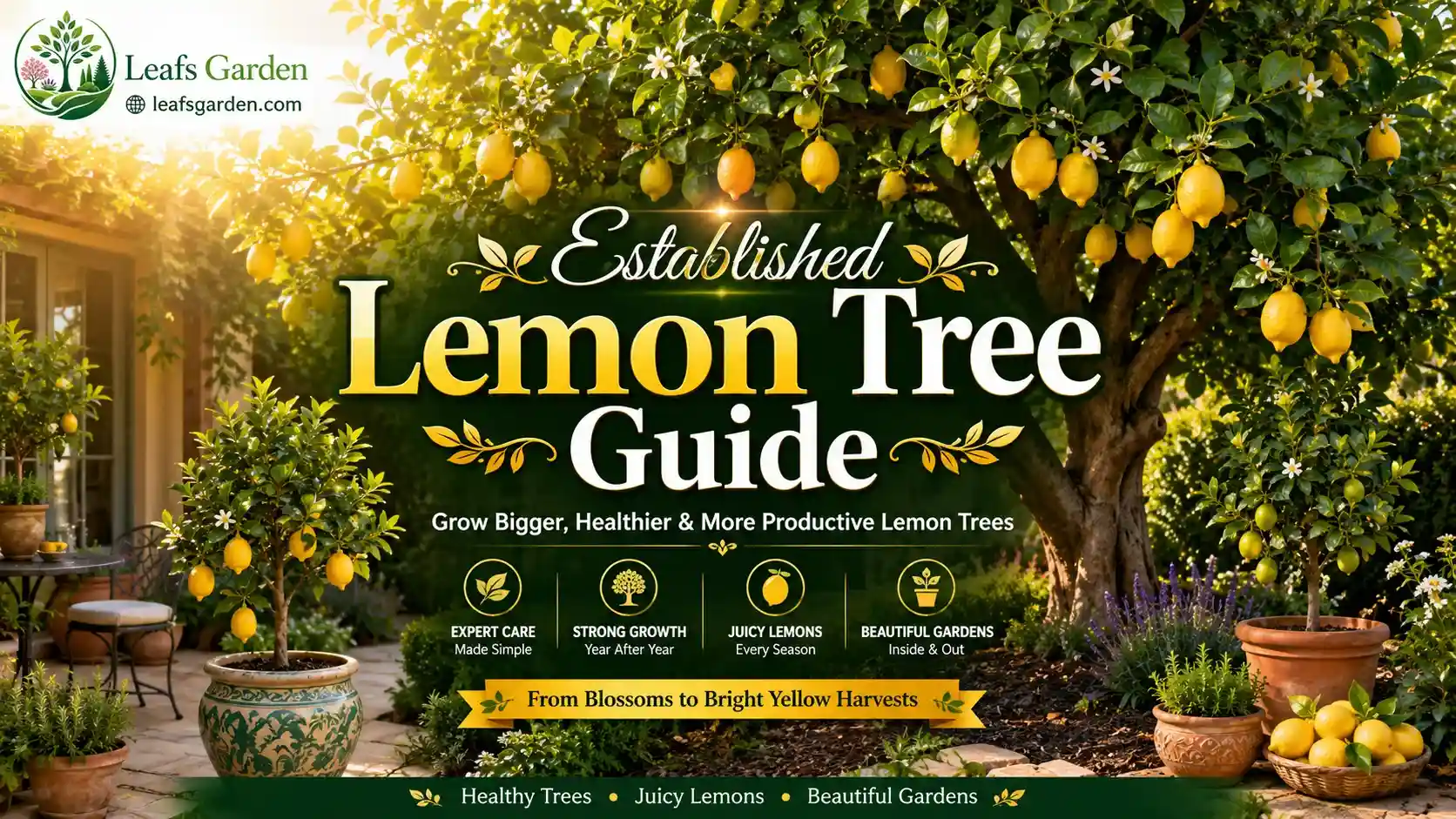
An established lemon tree is a mature citrus tree that produces reliable fruit, develops a stronger root system, and requires different care compared to young lemon plants.
Unlike newly planted citrus trees, mature lemon trees have stable growth patterns, thicker trunks, larger canopies, and deeper roots. These characteristics allow them to handle heat, dry periods, and seasonal climate changes more effectively. Established citrus trees also produce heavier and more consistent harvests compared to younger lemon plants that are still focusing on root and branch development.
Popular varieties such as the Eureka lemon, Lisbon lemon, and Meyer lemon are widely grown in Australian home gardens because of their strong productivity and adaptability. Many gardeners also choose dwarf lemon varieties for patios, balconies, and compact backyard spaces where container growing is preferred.
Australia provides excellent growing conditions for lemon trees due to its warm temperate and subtropical climates. Established lemon trees grow especially well in Sydney, Brisbane, Perth, and Adelaide. In the United States, mature citrus trees also perform successfully in regions such as California, Arizona, Texas, and Florida where winters remain relatively mild.
Mature lemon trees are valued for more than fruit production. Their evergreen foliage, fragrant blossoms, and long lifespan make them popular choices for edible landscaping, backyard orchards, and decorative patio gardens.
| Feature | Established Lemon Tree Overview |
| Mature Size | 2m–6m depending on variety |
| Fruiting Time | Usually after 3–5 years |
| Average Lifespan | 30–50+ years with proper care |
| Best Climates | Warm temperate, Mediterranean, subtropical |
| Popular Varieties | Eureka, Lisbon, Meyer, dwarf lemon trees |
| Best Growing Regions | Australia, California, Florida, Mediterranean-style climates |
An established lemon tree is usually a citrus tree that is at least 3–5 years old with a developed canopy, deeper roots, and regular fruit production. At this stage, the tree becomes more resilient, produces heavier crops, and requires maintenance focused on long-term health rather than early growth support.
Young lemon trees mainly invest energy into root development and branch formation. A full grown lemon tree, however, directs more energy into flowering, fruiting, and sustaining dense evergreen foliage throughout the year.
A mature lemon tree shows several clear signs of long-term healthy growth and stable fruit production.
Common signs include:
Established citrus trees also require less frequent watering compared to newly planted lemon trees because their roots extend deeper into the soil.
Gardeners building a productive citrus collection will find the established lemon tree a rewarding cornerstone among the many versatile fruit trees and edible plants suited to warm Australian climates.
Lemon tree size depends on the variety, climate, pruning habits, and whether the tree is grown in the ground or in containers.
A standard Eureka lemon tree can reach around 4–6 metres tall under ideal Australian conditions. Lisbon lemon trees often grow slightly taller with vigorous upright growth. In contrast, dwarf lemon varieties stay more compact and are easier to manage in smaller gardens.
Large lemon tree varieties are commonly used in backyard orchards and edible landscaping, while dwarf citrus trees are preferred for patios, balconies, and container gardens.
Typical mature lemon tree sizes include:
| Lemon Tree Type | Average Mature Size |
| Standard Eureka Lemon | 4–6m |
| Lisbon Lemon | 4–7m |
| Meyer Lemon Tree | 2–4m |
| Dwarf Eureka Lemon Tree | 1.5–2.5m |
| Miniature Indoor Lemon Tree | 1–2m |
Indoor miniature lemon tree sizes usually remain smaller because container roots restrict overall growth. Regular pruning and pot size also influence final height.
Most lemon trees take between 3–5 years to become fully established and produce reliable fruit harvests. Growth speed varies depending on the lemon variety, climate conditions, sunlight exposure, and care routine.
Meyer lemon trees usually mature slightly faster and are known for earlier fruit production in home gardens. Eureka lemon trees may take longer to fully establish but often become heavier long-term producers once mature.
Dwarf Eureka lemon tree varieties typically begin fruiting earlier because grafted dwarf citrus trees are designed for faster container productivity.
Australian climate conditions strongly affect citrus growth speed. Warmer regions such as Brisbane, Perth, and northern New South Wales usually encourage faster establishment. Cooler climates like Melbourne may slow winter growth and extend the maturity timeline.
| Lemon Type | Mature Height | Fruiting Time | Best Climate |
| Eureka Lemon | 4–6m | 3–5 years | Warm temperate, subtropical |
| Lisbon Lemon | 4–7m | 4–5 years | Cooler citrus climates |
| Meyer Lemon | 2–4m | 2–4 years | Mild temperate regions |
| Dwarf Eureka Lemon | 1.5–2.5m | 2–3 years | Pots, patios, small gardens |
| Miniature Indoor Lemon Tree | 1–2m | 2–4 years | Bright indoor environments |
Eureka lemons are best for continuous fruiting, Lisbon lemons handle colder climates better, and Meyer lemons are sweeter and ideal for home gardens. Each lemon variety has different strengths depending on climate, space, fruit flavor, and maintenance preferences.
Australian gardeners commonly grow Eureka lemon, Lisbon lemon, and Meyer lemon because these citrus varieties adapt well to different growing conditions across the country.
Lisbon lemon and Eureka lemon trees are very similar in appearance and fruit quality, but they differ in climate tolerance, growth habits, and thorn development.
Lisbon lemon trees are generally more cold tolerant and vigorous. They often produce denser upright growth and contain more thorns, especially during early development. This variety performs well in cooler Australian regions and can handle stronger winds and lower winter temperatures.
Eureka lemon trees are more popular for backyard growing because they usually produce fruit throughout the year. Many modern Eureka selections are also partially thornless, making harvesting easier for home gardeners.
Key differences include:
| Feature | Eureka Lemon | Lisbon Lemon |
| Fruit Texture | Thin skin, juicy flesh | Slightly thicker skin |
| Tree Size | Medium-large spreading tree | Taller upright tree |
| Climate Tolerance | Prefers mild climates | Better cold tolerance |
| Thorn Development | Fewer thorns | Thornier branches |
| Fruiting Pattern | Nearly year-round | Heavy seasonal crops |
| Popular Use | Home gardens | Larger citrus plantings |
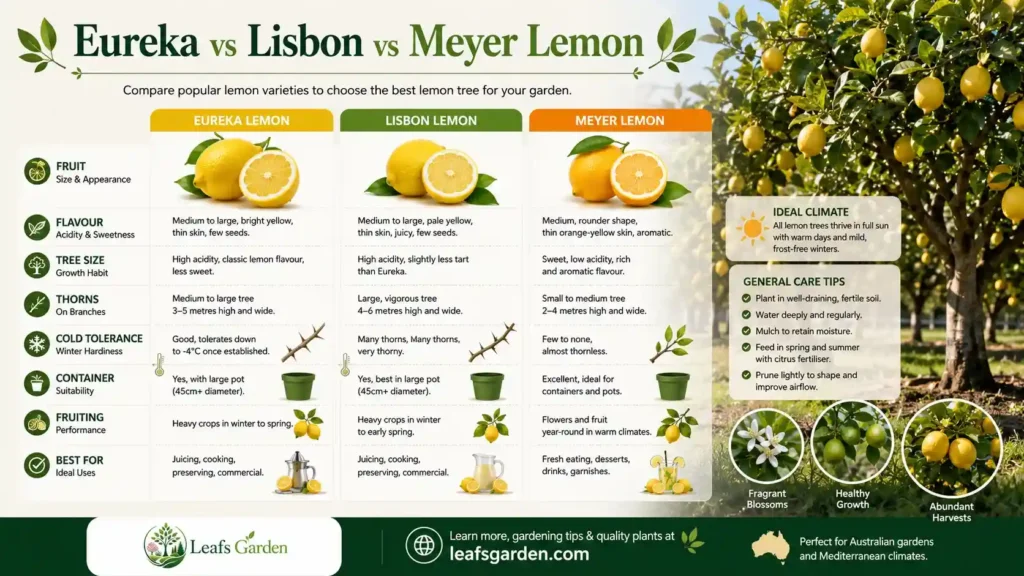
Meyer lemon and Eureka lemons serve different purposes in home gardens and kitchens.
Meyer lemons are slightly sweeter with lower acidity and softer skin. They are commonly preferred for fresh drinks, desserts, and indoor citrus growing. Their compact growth habit also makes them suitable for containers and patios.
Eureka lemons produce stronger acidic flavor and higher juice content, making them popular for cooking, preserving, and regular kitchen use.
For different uses:
Meyer lemon trees are often recommended for beginner gardeners because they remain smaller and require less aggressive pruning than standard citrus trees.
Different Australian climates suit different lemon varieties. Temperature, humidity, frost risk, and seasonal rainfall all influence citrus performance.
Melbourne’s cooler winters favor Lisbon lemon because of its stronger cold tolerance and vigorous growth habit.
Adelaide’s Mediterranean climate supports both Eureka and Lisbon lemon trees. Warm summers and relatively dry conditions help produce excellent fruit quality.
Brisbane’s subtropical climate is ideal for Eureka lemon trees due to their ability to fruit almost continuously in warm conditions.
Perth’s dry summers and mild winters are highly suitable for Eureka lemons and dwarf citrus trees. Deep watering and mulching become especially important during extreme summer heat.
| Growing Need | Best Lemon Variety |
| Best for Pots | Meyer Lemon |
| Best for Cold Climates | Lisbon Lemon |
| Best for Beginners | Meyer Lemon |
| Best Heavy Producer | Eureka Lemon |
| Best Indoor Lemon Tree | Dwarf Meyer Lemon |
| Best Large Backyard Tree | Lisbon Lemon |
| Best Year-Round Fruiting | Eureka Lemon |
Mature lemon trees need full sun, well-draining soil, deep watering, and seasonal feeding for healthy growth and heavy fruiting. Once citrus trees become established, proper environmental conditions play a major role in maintaining strong foliage, flower production, and consistent lemon harvests.
Healthy lemon trees grow best when soil, sunlight, watering, and nutrition remain balanced throughout the year.
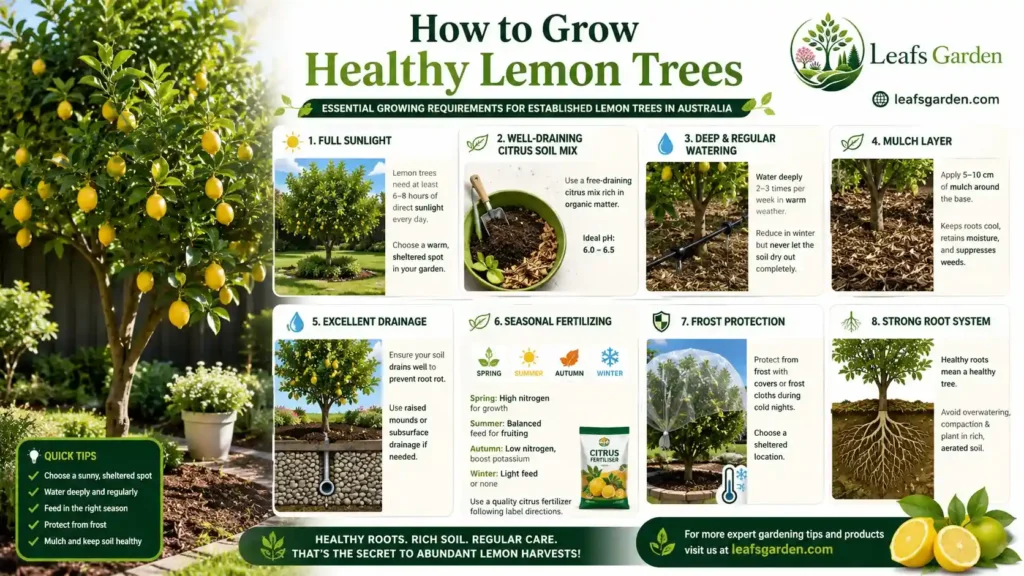
Lemon trees grow best in fertile, well-draining soil with moderate moisture retention. Poor drainage is one of the main causes of weak citrus growth and root diseases.
The ideal soil pH for lemon trees is slightly acidic to neutral, usually between 6.0 and 7.0. Soil outside this range can reduce nutrient absorption and affect fruit quality.
Important soil requirements include:
Many gardeners use specialized citrus soil mixes because they improve drainage while still holding enough moisture for healthy growth. Sandy loam soils are especially suitable for Australian citrus gardens.
Container-grown lemon trees benefit from premium citrus potting mixes that contain:
Established lemon trees require full sun for strong flowering, fruit development, and dense foliage growth. Most mature citrus trees need at least 6–8 hours of direct sunlight daily.
Outdoor lemon trees generally perform better than indoor citrus plants because natural sunlight supports heavier fruit production and healthier canopy development.
Best sunlight practices include:
Indoor lemon plant limitations usually include:
Meyer lemon trees are typically the best option for indoor citrus growing because they adapt better to container conditions and smaller spaces.
Established lemon trees require deep watering rather than shallow frequent watering. Deep irrigation encourages roots to grow further into the soil, improving drought tolerance and long-term tree stability.
Most mature citrus trees prefer:
Summer watering in Australia becomes especially important during extreme heat periods in Perth, Adelaide, and inland regions where soil dries quickly.
Common signs of underwatering include:
Overwatering can be more dangerous because saturated soil may cause root rot and fungal diseases. Good drainage is essential for preventing citrus root problems.
Established lemon trees are heavy feeders and require regular nutrients to maintain fruit production and evergreen foliage.
Most citrus fertilizers contain:
Organic compost also improves soil structure and supports microbial activity around citrus roots.
A basic seasonal feeding guide includes:
| Season | Fertilizer Focus |
| Spring | Strong growth and flowering support |
| Summer | Fruit development and foliage growth |
| Autumn | Moderate feeding before cooler weather |
| Winter | Minimal feeding in colder climates |
Overfertilizing can cause excessive leafy growth with reduced fruit production, so balanced citrus feeding is important.
Established lemon trees grow best in warm temperate, subtropical, and Mediterranean climates. Most citrus varieties prefer mild winters and warm sunny summers.
In Australia, lemon trees grow successfully in:
In the United States, citrus trees commonly grow in:
Frost protection becomes important when temperatures approach freezing conditions. Cold weather may damage flowers, young fruit, and tender branches.
Common frost protection methods include:
| Care Requirement | Recommended Practice |
| Water | Deep watering 1–2 times weekly |
| Mulch | Maintain organic mulch around roots |
| Fertilizer | Feed seasonally with citrus fertilizer |
| Sunlight | Minimum 6–8 hours full sun daily |
| Pruning | Remove dead or crowded branches annually |
Established lemon trees require seasonal pruning, balanced fertilizing, pest control, and proper watering to maintain healthy fruit production. Mature citrus trees become more productive over time, but they also need regular maintenance to support long-term growth, canopy health, and reliable harvests.
Proper lemon tree care improves fruit quality, reduces disease risk, and encourages stronger flowering throughout the growing season.
Large lemon trees benefit from annual pruning to maintain structure, improve airflow, and support healthy fruit production. Pruning also helps reduce overcrowded growth that may block sunlight from reaching inner branches.
The best time to prune mature lemon trees is usually after major fruiting periods or during mild seasonal conditions.
Important pruning practices include:
Light pruning is generally better than aggressive cutting because excessive pruning may reduce flowering and expose branches to sunburn.
Eureka lemon and Lisbon lemon trees often develop vigorous growth and may require more canopy management than dwarf citrus varieties.
Mulching helps established lemon trees retain soil moisture, regulate root temperature, and reduce weed competition. Organic mulch also improves soil quality as it slowly decomposes.
Most citrus trees benefit from a mulch layer around 5–10 cm deep. The mulch should remain slightly away from the trunk to prevent moisture buildup and fungal problems.
Benefits of mulching include:
Heat protection in Australia becomes especially important during extreme summer conditions in Perth, Adelaide, and inland regions where citrus roots can dry quickly.
Common organic mulch materials include:
Dwarf lemon trees require slightly different care because container growing limits root space and soil moisture stability.
Popular dwarf citrus varieties such as dwarf Eureka lemon and dwarf Meyer lemon trees are ideal for patios, balconies, and compact gardens.
Important pot-grown care practices include:
Mini lemon plant maintenance also involves occasional pruning to maintain compact shape and improve light penetration through the canopy.
Container-grown citrus trees may dry out faster than garden-planted trees, especially during hot Australian summers.
Indoor lemon plants require bright light, stable temperatures, and moderate humidity to remain healthy. Most indoor citrus trees struggle when light exposure becomes too limited.
Meyer lemon is one of the best indoor lemon tree options because of its compact growth habit and adaptability to container environments.
Key indoor lemon care requirements include:
Common indoor lemon plant problems include:
Humidity trays, occasional misting, and proper ventilation can help improve indoor citrus health, especially during dry seasons or indoor heating periods.
Yellow leaves, poor fruiting, pests, and green lemons are the most common issues affecting mature lemon trees. Most citrus problems develop from incorrect watering, nutrient imbalance, poor drainage, climate stress, or pest infestations.
Early identification is important because established lemon trees can decline quickly when problems remain untreated for long periods.
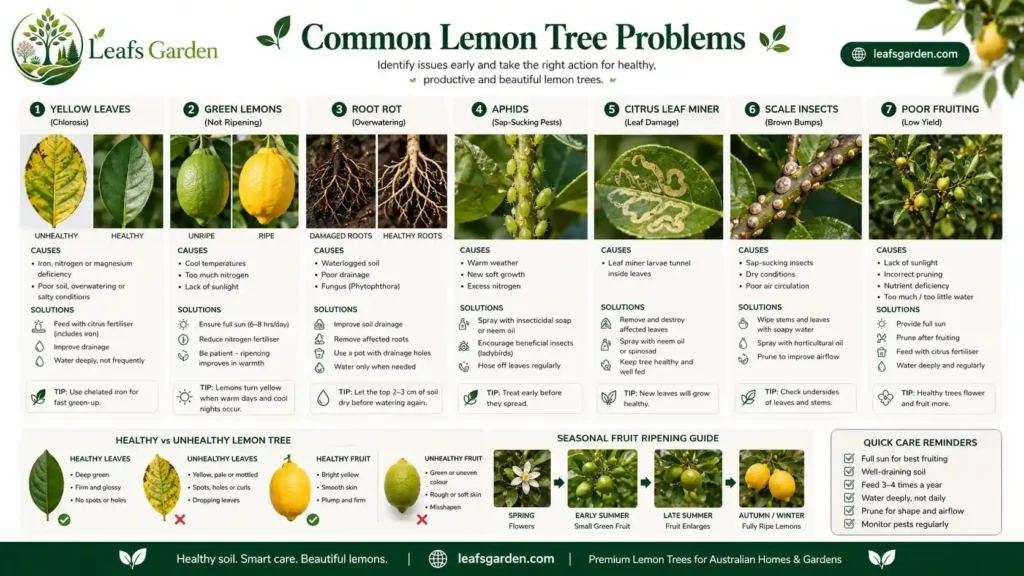
Lemon tree green lemons are often caused by temperature conditions, seasonal timing, or insufficient sunlight exposure. In many Australian climates, lemons may remain green longer during cooler weather or reduced winter sunlight.
Fruit color development usually improves when temperatures become warmer and sunlight exposure increases.
Common causes of green lemons include:
Eureka lemon trees can produce fruit throughout much of the year, so some lemons may naturally stay green longer while ripening gradually.
In subtropical Australian regions, citrus fruit sometimes develops internal ripeness before the outer skin fully turns yellow.
Yellow leaves are one of the most common signs of stress in mature citrus trees. Leaf discoloration usually indicates watering issues, nutrient deficiencies, or root problems.
Common causes include:
Overwatering is especially harmful because constantly wet soil reduces oxygen around citrus roots. This weakens nutrient absorption and may eventually trigger fungal disease.
Signs of watering-related yellowing include:
Improving drainage and adjusting watering schedules often resolves many citrus leaf problems.
Established lemon trees can attract several common citrus pests that damage leaves, flowers, and developing fruit.
Common citrus pests include:
Small sap-sucking insects that cluster on soft new growth and flower stems. Aphids may cause curled leaves and sticky residue.
Larvae tunnel through young leaves, creating visible silver trails and distorted foliage. Young citrus growth is especially vulnerable.
For detailed citrus leaf miner identification and management advice, NSW Department of Primary Industries provides reliable horticultural guidance for Australian home citrus growers.
Scale insects attach to stems and branches while feeding on plant sap. Heavy infestations can weaken mature lemon trees over time.
Pest prevention methods include:
Healthy established citrus trees are generally more resistant to pest pressure than stressed trees.
Root rot is one of the most serious problems affecting established lemon trees. Excess moisture around roots encourages fungal growth that damages root systems and weakens overall tree health.
Common overwatering symptoms include:
Fungal diseases spread more easily in compacted or poorly draining soil conditions.
Prevention methods include:
Warm humid climates can increase fungal disease pressure, especially during prolonged wet periods.
Poor fruiting is usually linked to environmental stress, nutrient imbalance, or reduced pollination activity.
Established lemon trees may flower heavily but still produce limited fruit if growing conditions become unfavorable.
Common causes of poor fruiting include:
Most mature lemon trees require full sun for reliable fruit production. Shaded citrus trees often develop dense foliage with fewer flowers and smaller harvests.
Balanced fertilizing is also important because excessive nitrogen can encourage leafy growth instead of fruit development.
| Problem | Cause | Solution |
| Green Lemons | Cool temperatures or early fruit stage | Increase sunlight exposure and allow more ripening time |
| Yellow Leaves | Nutrient deficiency or overwatering | Improve drainage and apply balanced citrus fertilizer |
| Leaf Curling | Aphids or citrus leaf miner | Use horticultural oils or natural pest control |
| Root Rot | Waterlogged soil | Reduce watering and improve drainage |
| Poor Fruiting | Lack of sunlight or fertilizer imbalance | Increase sunlight and adjust feeding schedule |
| Fruit Drop | Water stress or climate fluctuations | Maintain consistent deep watering |
| Weak Growth | Poor soil nutrition | Add compost and citrus-specific fertilizer |
Dwarf and miniature lemon trees grow well in containers when provided with enough sunlight, drainage, and regular feeding. Compact citrus varieties are ideal for patios, balconies, courtyards, and small Australian gardens where space is limited.
Container-grown lemon trees also allow better mobility, making it easier to protect citrus plants from frost, heavy rain, or extreme summer heat.
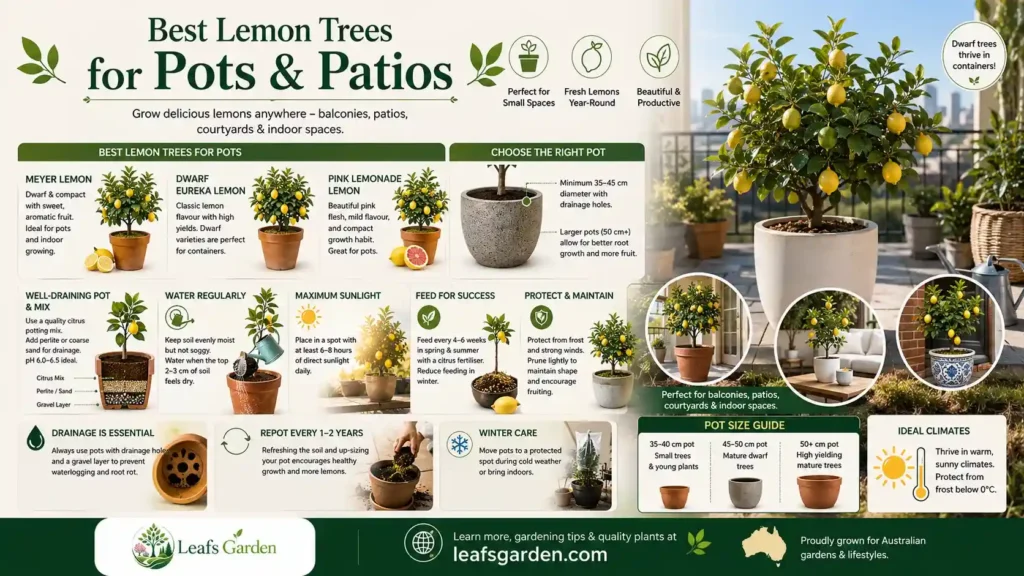
Some lemon varieties adapt especially well to pot growing because of their compact root systems and manageable canopy size.
Popular dwarf lemon trees for containers include:
The dwarf Eureka lemon tree is one of the most popular patio citrus varieties in Australia. It produces reliable fruit while remaining compact enough for medium-sized containers.
Key features:
Meyer lemon trees are highly suitable for pots because they naturally remain smaller than many standard citrus varieties.
Benefits include:
Lemonicious dwarf lemon trees are specifically bred for smaller spaces and decorative citrus gardening. Their compact structure works well for balconies, patios, and urban gardens.
These miniature lemon trees usually require:
Pot size plays a major role in lemon tree health, root development, and long-term fruit production. Containers that are too small can restrict root growth and reduce moisture stability.
Important container considerations include:
Young dwarf lemon trees may begin in smaller pots, but established citrus trees usually need larger containers over time.
General container guidelines:
| Lemon Tree Size | Recommended Pot Size |
| Young dwarf lemon tree | 30–40cm pot |
| Established dwarf lemon tree | 50–70cm pot |
| Large container citrus tree | 70cm+ pot |
Drainage holes are essential because standing water can quickly cause root rot and fungal disease.
Repotting timelines depend on tree growth rate, but most container lemon trees benefit from repotting every 2–4 years when roots become crowded or soil quality declines.
Small lemon trees grow successfully on balconies and patios when positioned correctly. Sunlight access and wind protection are especially important in compact urban spaces.
Best placement practices include:
Balcony citrus trees often dry out faster because containers heat quickly during summer. Regular moisture monitoring becomes important during hot Australian weather.
Wind protection also helps prevent:
Compact citrus trees can also serve as decorative edible plants, combining evergreen foliage, fragrant blossoms, and productive fruiting in smaller outdoor living spaces.
Lemon trees grow well alongside other citrus varieties like Tahitian lime, blood orange, and mandarins in Australian home gardens. Growing multiple citrus trees together can improve garden diversity, extend harvest seasons, and create productive edible landscapes with year-round foliage and fruit.
Most citrus varieties share similar growing requirements, including full sun, well-draining soil, seasonal feeding, and regular watering.
Gardeners looking to expand their backyard citrus collection may also enjoy growing a bush lemon, a hardy drought-tolerant lemon variety that shares similar growing requirements and performs exceptionally well in warm Australian gardens.
This makes companion citrus planting highly practical for Australian backyards and patio gardens.
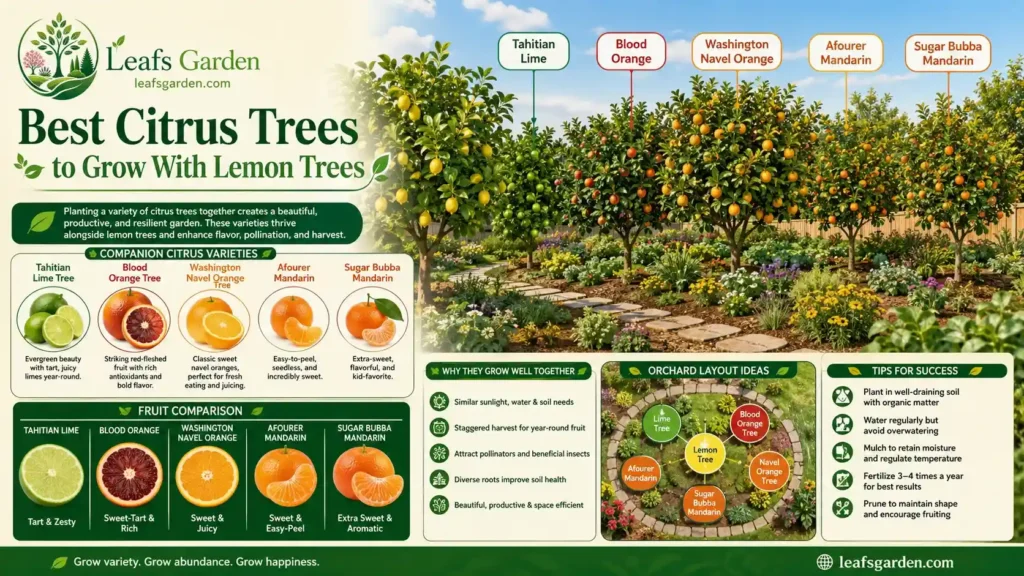
Blood orange trees pair well with lemon trees because they thrive under similar warm temperate and Mediterranean-style conditions.
Popular blood orange varieties include:
The Arnold blood orange is known for its deep red flesh, sweet flavor, and strong ornamental appeal. It grows successfully in many Australian citrus regions with good sunlight exposure.
In Australia, blood orange trees perform best in:
Common characteristics include:
Blood orange trees combine well with Eureka lemon and Meyer lemon trees in mixed citrus gardens.
Tahitian lime trees are one of the most compatible companion citrus varieties for lemon trees. Their growth habits, soil needs, and watering requirements are very similar.
Tahitian lime trees are popular because they:
Lemon and lime trees are commonly planted together because both citrus types benefit from:
This pairing also creates more variety in edible gardens while supporting similar maintenance routines.
Mandarin trees are excellent companion citrus plants because they remain relatively compact and produce sweet easy-to-peel fruit.
Gardeners wanting a compact and sweet-fruiting companion citrus may also enjoy the clementine tree, a popular easy-peel citrus variety that thrives alongside lemon trees in warm sunny Australian gardens.
Popular mandarin varieties include:
Afourer mandarins are known for:
Sugar Bubba mandarins are compact citrus trees suitable for smaller gardens and patio growing. Their manageable size works well alongside dwarf lemon varieties.
Many modern mandarin varieties are bred for low-seed or seedless fruit production, making them highly popular in home gardens.
Mandarin trees generally prefer:
Their smaller canopy size allows them to fit well into mixed citrus landscapes with lemon trees and lime trees.
Washington navel orange trees are one of the most widely grown orange varieties in Australia and pair successfully with mature lemon trees.
Common characteristics include:
Lemon and orange tree combinations are popular in backyard citrus gardens because they:
Mixed citrus gardens often include:
This combination creates productive edible gardens with continuous seasonal fruit availability across much of the year.
Mature lemon trees are valuable for edible landscaping, patio gardens, privacy screening, and decorative citrus displays. Their evergreen foliage, fragrant blossoms, and colorful fruit make them highly versatile plants for both functional and ornamental garden design.
Established lemon trees can serve as productive backyard fruit trees while also improving outdoor aesthetics throughout the year.
Lemon trees are widely used in Australian backyard landscaping because they combine food production with attractive evergreen structure. Both standard and dwarf citrus trees work well in modern outdoor spaces, Mediterranean-style gardens, and compact suburban yards.
Popular citrus garden design ideas include:
Eureka lemon trees are commonly planted as feature citrus trees because of their dense foliage and reliable fruit production. Meyer lemon trees are especially popular for smaller Australian backyards due to their compact size and ornamental appearance.
Lemon trees can also be used for:
Their glossy green foliage provides year-round structure even when fruit is not present.
Miniature lemon plants are increasingly used as decorative indoor citrus features in apartments, patios, and modern homes. Their compact growth habit and fragrant flowers make them visually attractive in bright indoor spaces.
Small citrus trees work best in:
Container aesthetics become important when styling indoor lemon plants. Decorative pots, terracotta containers, and modern planters can improve the overall visual appeal of miniature citrus trees.
Important indoor styling considerations include:
Meyer lemon trees are usually the preferred indoor citrus choice because they remain smaller and adapt better to container environments than many larger citrus varieties.
Established lemon trees provide both practical and ornamental benefits in home gardens and outdoor living spaces.
Key benefits include:
Homegrown lemons provide reliable access to fresh citrus for cooking, drinks, baking, and preserving.
Lemon blossoms produce a strong sweet citrus fragrance that enhances garden environments during flowering seasons.
Citrus flowers attract bees and other pollinators that support healthy garden ecosystems and improve pollination activity.
Lemon trees maintain glossy green leaves year-round, helping gardens remain visually attractive across all seasons.
Additional benefits include:
Mature citrus trees combine productivity and visual appeal, making them one of the most practical fruit trees for Australian home gardens.
Choosing a healthy established lemon tree depends on root health, graft quality, variety selection, and climate suitability. A mature citrus tree with strong structure and healthy growth habits is more likely to establish quickly and produce reliable fruit over the long term.
Selecting the right lemon variety also helps reduce maintenance problems and improves fruit production in different Australian climates.
Healthy established lemon trees show clear signs of vigorous growth, stable structure, and disease-free roots.
Important features to check include:
Strong lemon trees should have:
Sparse foliage or excessive yellow leaves may indicate nutrient deficiencies, root stress, or pest problems.
Most citrus trees are grafted onto rootstock to improve disease resistance and growth performance. A healthy graft union should appear:
Weak graft unions can reduce long-term tree stability and vigor.
Healthy roots are essential for successful citrus establishment.
Signs of healthy root systems include:
Container-grown lemon trees should also have proper drainage and healthy root spread without excessive root circling.
Dwarf and standard lemon trees both have advantages depending on available space, maintenance preferences, and growing goals.
Standard citrus trees generally produce larger canopies and heavier harvests, while dwarf lemon trees are easier to manage in compact gardens and containers.
Key differences include:
| Feature | Dwarf Lemon Trees | Standard Lemon Trees |
| Space Requirements | Smaller patios and balconies | Larger backyards and orchards |
| Mature Size | Usually 1.5–2.5m | Often 4–6m+ |
| Fruit Production | Moderate | Heavy long-term yields |
| Maintenance Level | Easier pruning and harvesting | More canopy management |
| Pot Growing | Excellent | Limited long-term suitability |
| Best Use | Small gardens and containers | Large productive landscapes |
Meyer lemon and dwarf Eureka lemon trees are especially popular for patio and courtyard gardens because of their compact growth habit.
Standard Lisbon lemon trees are better suited to larger Australian landscapes where space allows full canopy development.
Established lemon trees and dwarf citrus varieties are widely available throughout Australia from garden centres, nurseries, and seasonal citrus suppliers.
Many Australian gardeners commonly search for:
These searches usually relate to finding common citrus varieties suitable for Australian climates and backyard gardens.
Popular lemon tree types available across Australia often include:
Availability may vary depending on:
Gardeners in warmer Australian regions generally have access to a wider range of mature citrus varieties because subtropical and Mediterranean climates support stronger lemon tree growth.
Established lemon trees provide years of reliable fruit production when matched with the right climate, proper citrus care, and suitable lemon variety. Mature citrus trees become more productive, resilient, and visually attractive as they develop stronger roots, healthier canopies, and stable seasonal fruiting patterns.
Popular varieties such as the Eureka lemon, Lisbon lemon, and Meyer lemon each offer different advantages depending on garden size, climate conditions, and growing goals. Dwarf lemon trees remain ideal for patios, balconies, and container gardens, while larger citrus trees suit productive backyard orchards and edible landscaping.
Australian conditions are especially favorable for lemon tree cultivation because warm temperate and subtropical climates support strong citrus growth across many regions including Sydney, Brisbane, Perth, and Adelaide. At the same time, established lemon trees also adapt successfully to suitable citrus-growing regions in the United States and other Mediterranean-style climates worldwide.
Long-term citrus success depends on:
Healthy maintenance routines help mature lemon trees produce reliable harvests for decades while maintaining strong evergreen foliage and fragrant blossoms.
Whether grown in backyard gardens, large landscapes, or compact containers, established lemon trees remain one of the most practical and rewarding citrus choices for home growers. Selecting the right variety and maintaining proper citrus care are the key factors behind long-lasting fruit production and healthy tree performance.
Established lemon trees can live for 30–50 years or longer when grown in suitable climates and maintained properly. Healthy citrus trees with good soil, sunlight, watering, and seasonal care often remain productive for decades.
The best lemon tree variety in Australia depends on climate and garden size. Eureka lemon trees are popular for year-round fruiting, Lisbon lemon trees handle cooler climates well, and Meyer lemon trees are ideal for smaller home gardens and pots.
Eureka lemons are usually preferred for continuous fruit production and fewer thorns, while Lisbon lemons are valued for stronger cold tolerance and vigorous growth. Both varieties produce high-quality fruit and perform well in Australian citrus gardens.
Yes, mature lemon trees can grow successfully in large containers when provided with proper drainage, full sunlight, regular feeding, and sufficient root space. Dwarf citrus varieties generally perform better in pots than standard lemon trees.
Flowering without fruiting is often caused by poor pollination, inconsistent watering, lack of sunlight, or excessive nitrogen fertilizer. Temperature fluctuations and young tree age can also reduce fruit development.
Established lemon trees usually require deep watering once or twice weekly during warm weather. Watering frequency depends on climate, soil drainage, rainfall, and whether the tree is grown in the ground or in containers.
Meyer lemon trees produce sweeter, less acidic fruit and remain smaller in size, making them ideal for pots and indoor growing. Eureka lemon trees produce more acidic traditional lemons with heavier long-term fruit production.
Most lemon trees survive Australian winters in warm temperate and subtropical regions. In cooler climates, frost protection may be necessary to protect flowers, fruit, and young branches during cold weather events.