Grow Better Gardens with Smarter Plant Choices
Discover helpful guides on trees, hedges, fruit plants, edible plants, and beautiful landscape greenery.

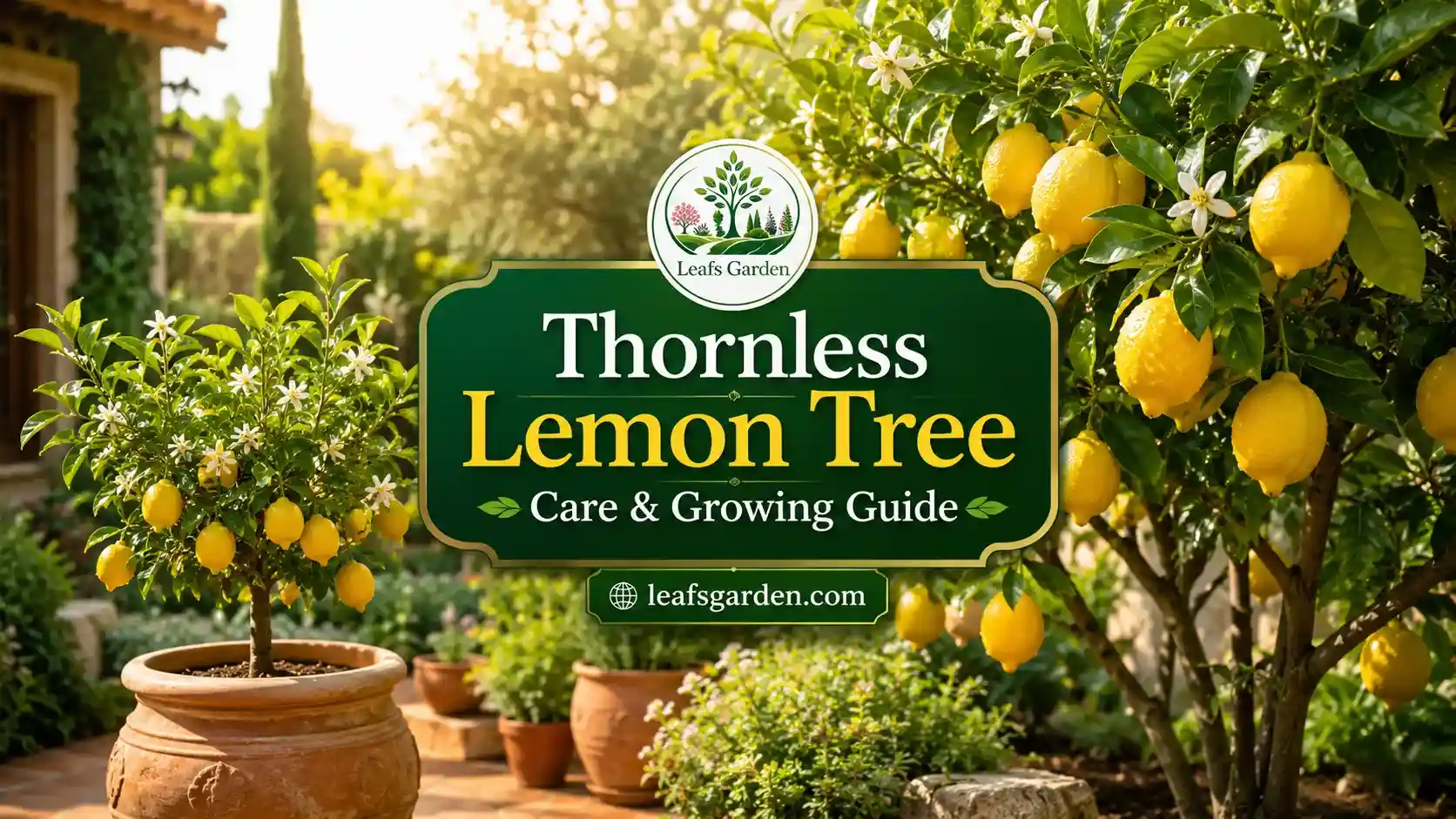
A thornless lemon tree is a citrus variety grown with very few or no sharp thorns, making it safer and easier to manage in home gardens, patios, and containers. These trees are popular for their productive fruiting, compact growth habits, and beginner-friendly maintenance.
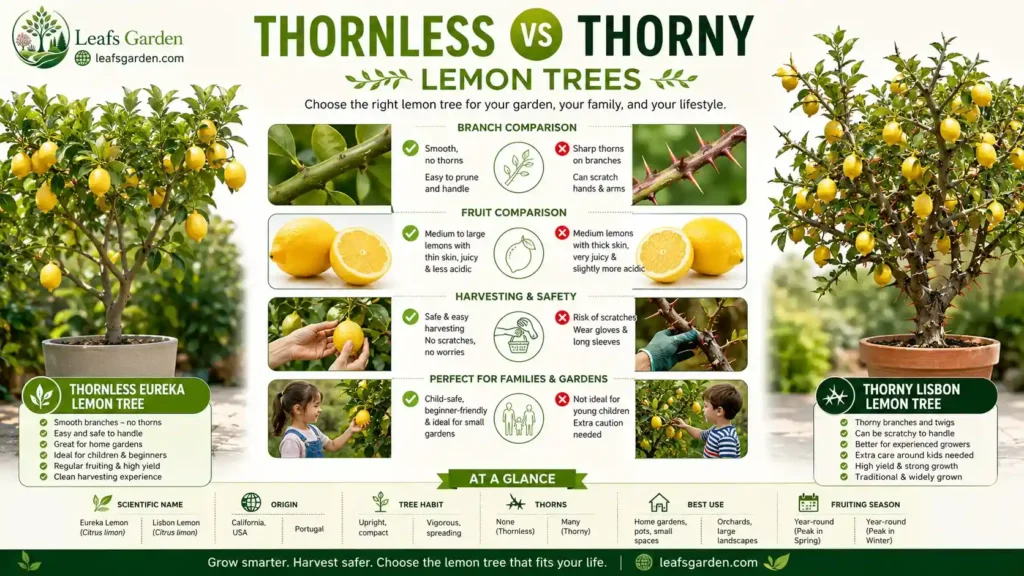
Many gardeners ask, “do lemon trees have thorns?” The answer is yes — most citrus trees naturally develop thorns, especially during their juvenile growth stage. A traditional lemon tree with thorns often produces sharp spines along young branches as a natural defense mechanism.
A lemon tree without thorns is usually a selected or grafted variety bred for easier handling and safer harvesting. Thornless varieties are especially useful in family gardens where children, pets, or small outdoor spaces are involved.
Gardeners exploring the best citrus options for their outdoor spaces will find thornless lemon trees a practical and rewarding addition among the many productive fruit trees and edible plants suited to warm Australian climates.
In Australia, thornless lemon tree Australia varieties are widely grown because they adapt well to warm climates, container gardening, and backyard citrus production. Australian gardeners often prefer thornless types for easier pruning, reduced injury risk, and cleaner maintenance around walkways and patios.
Popular lemon varieties include:
Among these, Eureka and Meyer lemons are commonly chosen for low-thorn or nearly thornless growth habits. Lisbon lemon trees, on the other hand, usually produce stronger growth with more noticeable thorns.
Thornless citrus trees are also highly suitable for pots and compact urban gardens. Many dwarf lemon varieties can thrive in containers while still producing full-sized fruit with proper sunlight, feeding, and watering.
| Lemon Variety | Fruit Quality | Growth Habit | Pot Suitability | Thorn Level |
| Eureka Lemon | Juicy, acidic, thin skin | Open and productive | Excellent | Very low |
| Meyer Lemon | Sweeter, less acidic | Compact and bushy | Excellent | Minimal |
| Lisbon Lemon | Strong acidic flavor | Vigorous upright growth | Moderate | High |
| Dwarf Eureka Lemon | Medium-large fruit | Compact growth | Very high | Very low |
| Dwarf Meyer Lemon | Sweet juicy lemons | Small compact tree | Excellent | Minimal |
A thornless lemon tree is a citrus variety selected or grafted to produce very few sharp thorns while still growing healthy branches, flowers, and edible lemons. These trees are easier to prune, harvest, and maintain compared to traditional lemon trees with thorns.
Most thornless varieties are developed from naturally low-thorn citrus cultivars like Eureka lemon and Meyer lemon. They are commonly grown in home gardens, courtyards, patios, and pots because they are safer to handle and more suitable for compact spaces.
Lemon tree thorns are a natural defense system developed to protect young citrus growth from animals and physical damage. Many citrus species, including lemons, oranges, and limes, produce sharp spines during early growth stages.
Young lemon trees usually grow more aggressively and often develop larger thorns on lemon tree branches. This juvenile stage focuses on survival and fast structural growth.
As the tree matures, thorn production often decreases. Mature citrus trees typically produce fewer and smaller spines compared to juvenile plants.
Common reasons lemon trees develop thorns include:
Many gardeners asking “does a lemon tree have thorns” are surprised to learn that thorn production can vary greatly between varieties.
Some lemon trees with thorns may become nearly thornless as they age, especially with regular pruning and stable growing conditions.
Most thornless lemon trees are not always 100% thorn-free. Some varieties can still produce small soft spines on vigorous new shoots or stressed branches.
Environmental stress can increase thorn development. Factors include:
Rootstock also plays a major role. Grafted citrus trees may occasionally produce thorny shoots from the rootstock rather than the main variety.
If a lemon thorn tree suddenly develops strong thorny branches, those shoots are often rootstock suckers and should be removed early.
In most cases, however, thornless lemon trees remain significantly safer and easier to handle than standard lemon trees with thorns.
Several lemon varieties are known for low-thorn or nearly thornless growth habits. These cultivars are popular for backyard citrus gardening and container growing.
The Eureka lemon tree is one of the most popular thornless citrus varieties. It produces juicy acidic lemons with thin skin and reliable year-round fruiting.
Key features:
Dwarf Eureka lemon trees are compact versions ideal for patios and pots.
Benefits include:
Meyer lemons are sweeter and less acidic than standard lemons. The tree naturally develops fewer sharp spines and works well indoors.
Main advantages:
This variety is widely used as an indoor lemon tree because of its manageable size and productive fruiting.
It is ideal for:
Variegated pink lemons are grown for both ornamental beauty and fruit production. The foliage features cream-colored variegation, while the fruit develops pink flesh during ripening.
These trees usually have relatively low thorn levels compared to vigorous citrus types.
The Lotsa Lemons tree is a productive dwarf citrus variety bred for heavy fruiting in compact spaces.
Popular characteristics include:
Both thornless and thorny lemon trees can produce high-quality fruit, but their maintenance and growth habits differ significantly.
| Feature | Thornless Lemon Trees | Thorny Lemon Trees |
| Fruit Production | High and reliable | High and vigorous |
| Tree Size | Compact to medium | Medium to large |
| Pest Resistance | Moderate | Slightly higher natural protection |
| Pot Growing | Excellent | Moderate |
| Safety for Pets/Kids | Safer handling | Sharp thorn risk |
| Pruning Ease | Easier | More difficult |
| Harvesting Comfort | Comfortable | Requires caution |
Thornless varieties are generally preferred for family gardens, container growing, and urban spaces. Traditional lemon trees with thorns may still be chosen for vigorous outdoor orchard growth and stronger natural protection.
Eureka and Meyer lemon trees are considered the best lemon tree Australia options for most home gardeners because they combine strong fruit production, reliable growth, and adaptability to different Australian climates. Lisbon lemons are also widely grown, especially in cooler regions where stronger cold tolerance is needed.
Among the many lemon tree varieties Australia gardeners grow, each type offers different advantages for fruit flavor, thorn levels, tree size, and container suitability.
Gardeners looking for a hardy low-maintenance lemon option may also find the bush lemon a rewarding choice, as it is one of Australia’s most drought-tolerant lemon varieties that thrives with minimal care in warm backyard gardens.
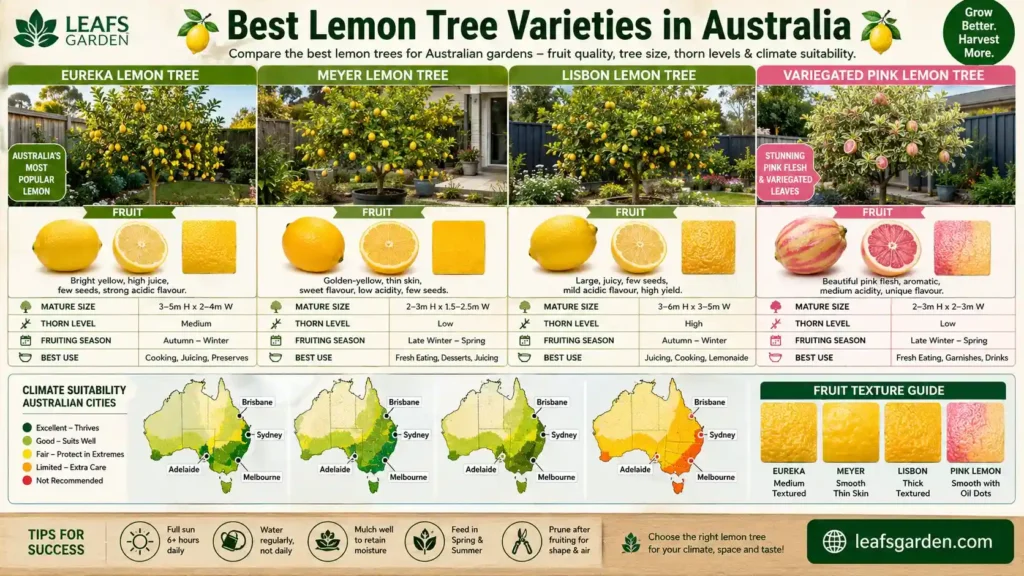
The Eureka lemon tree, scientifically known as Citrus limon Eureka, is one of the most common citrus trees grown across Australia. It is valued for heavy fruit production, fewer thorns, and year-round harvesting.
Eureka lemons are known for:
The fruit is widely used for cooking, drinks, desserts, and fresh juice because of its intense citrus taste.
A full-grown Eureka lemon tree size can reach around 3–6 meters depending on pruning, rootstock, and growing conditions. In backyard gardens, regular pruning usually keeps the tree smaller and easier to harvest.
Typical Eureka lemon tree height:
| Growth Type | Average Height |
| Dwarf Eureka | 1.5–2.5 meters |
| Standard Eureka | 3–6 meters |
Eureka lemons also perform extremely well in pots, making them one of the most versatile types of lemon trees Australia gardeners can grow.
Meyer lemon trees are highly popular because of their sweeter flavor and compact growth habit. They are believed to be a hybrid between a lemon and a mandarin-type citrus.
Compared to standard lemons, Meyer lemons are:
The tree itself stays naturally smaller and bushier, making it ideal for urban gardens and containers.
Meyer lemon trees are especially suitable for:
Their compact structure and lower thorn production make them one of the best choices for beginner gardeners looking for easy citrus maintenance.
Indoor growers often prefer Meyer lemons because they tolerate container conditions better than many vigorous citrus varieties.
Lisbon lemon trees are known for vigorous growth, strong productivity, and better cold tolerance compared to some softer citrus varieties.
Key characteristics include:
Unlike Eureka lemons, Lisbon trees usually produce more noticeable thorny branches. These thornier stems provide extra natural protection but can make harvesting and pruning less comfortable.
Lisbon lemons are highly valued in cooler regions because they tolerate lower temperatures more effectively than many other lemon varieties.
They are commonly chosen for:
Although productive, Lisbon lemons may require more regular pruning due to their stronger vertical growth habit.
Both Lisbon and Eureka lemons are highly productive citrus trees, but they differ in flavor, growth habit, and maintenance requirements.
| Feature | Lisbon Lemon | Eureka Lemon |
| Fruit Taste | Strong acidic flavor | Bright balanced acidity |
| Acidity | Higher | Moderate-high |
| Thorn Level | High | Low |
| Productivity | Very heavy crops | Continuous reliable crops |
| Pot Suitability | Moderate | Excellent |
| Growth Habit | Vigorous upright growth | Open spreading growth |
| Cold Tolerance | Better cold resistance | Prefers warmer climates |
For most home gardeners, Eureka lemons are often preferred for easier handling and container growing. Lisbon lemons are better suited for larger outdoor spaces and cooler areas.
Different Australian climates support different lemon tree varieties. Choosing the right variety improves fruit production, disease resistance, and long-term tree health.
Sydney’s mild climate supports almost all major citrus varieties.
Best choices:
These varieties handle Sydney’s warm summers and moderate winters very well.
Melbourne experiences cooler winters and variable weather conditions.
Recommended varieties:
Lisbon lemons perform well because of their improved cold tolerance and vigorous growth.
Adelaide’s Mediterranean climate is excellent for citrus cultivation.
Top choices include:
The dry summer conditions support strong fruit sweetness and healthy citrus growth.
Brisbane’s subtropical climate allows rapid citrus growth and long fruiting seasons.
Best varieties:
Compact and heat-tolerant varieties usually perform best in humid subtropical conditions.
When gardeners ask “which lemon tree is best,” the answer often depends on climate, available space, and whether the tree will be grown in the ground or in containers.
A full-grown thornless lemon tree can grow between 2–6 meters tall depending on the variety, climate, rootstock, pruning style, and growing conditions. Dwarf lemon trees stay compact for pots and patios, while standard trees can become large productive backyard citrus trees.
Lemon tree size is heavily influenced by sunlight, soil quality, watering consistency, and root space. Trees planted directly in the ground usually grow much larger than container-grown citrus.
A mature lemon tree can develop a broad canopy, dense foliage, and an extensive branching structure when grown under ideal conditions.
Average mature lemon tree dimensions vary by type:
| Lemon Tree Type | Average Height | Average Width |
| Dwarf Lemon Tree | 1.5–2.5 meters | 1–2 meters |
| Semi-Dwarf Lemon Tree | 2–4 meters | 2–3 meters |
| Standard Lemon Tree | 4–6 meters | 3–5 meters |
Large lemon tree varieties like Lisbon lemons often develop upright vigorous growth with dense canopies. Eureka and Meyer lemons usually maintain a more open and manageable structure.
Common factors affecting lemon growth include:
Dwarf trees are commonly used for:
Standard trees are better suited for:
Regular pruning helps control mature lemon tree height while improving airflow and fruit production.
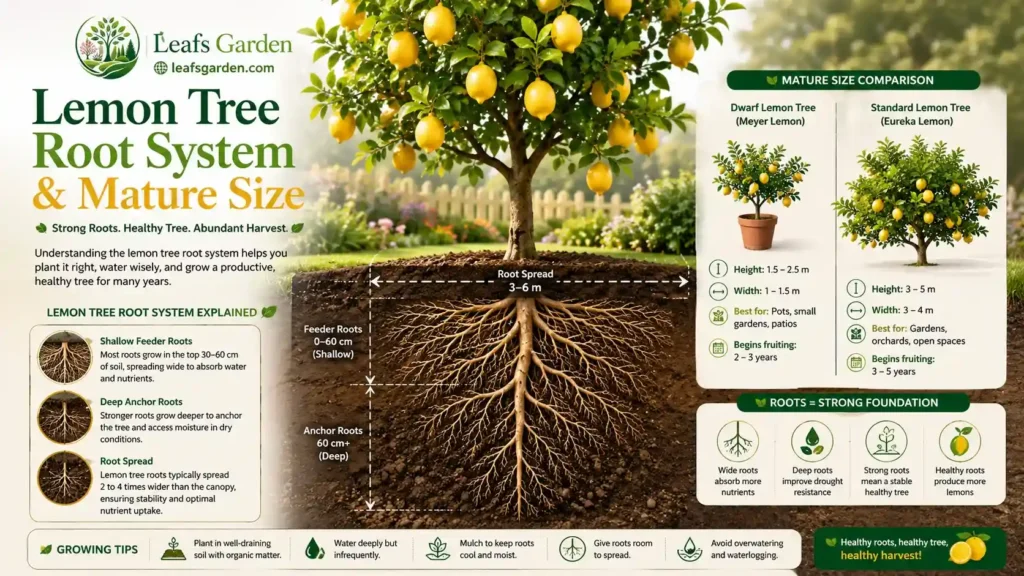
The lemon tree root system is shallow but wide spreading. Most citrus roots grow close to the soil surface where oxygen, moisture, and nutrients are more available.
The root system of a lemon tree usually spreads farther horizontally than many gardeners expect.
Important root characteristics include:
In most cases, lemon tree roots spread approximately 1.5–3 times wider than the tree canopy.
Average root depth:
| Root Type | Typical Depth |
| Surface feeder roots | 15–30 cm |
| Main structural roots | 60–90 cm |
| Deep anchoring roots | Up to 1.5 meters in loose soil |
Because citrus roots stay relatively shallow, they compete strongly with nearby plants for water and nutrients.
Common root competition issues occur near:
The lemon tree root system can also become problematic near foundations, paving, and drainage systems if planted too close to structures.
Recommended planting distances:
Container-grown lemon trees naturally develop smaller and more restricted root systems.
Lemon trees are long-living citrus plants capable of producing fruit for decades with proper care.
The average lifespan of a healthy lemon tree ranges from 30–50 years, although some well-maintained citrus trees can live even longer.
Typical lemon growth timeline:
| Growth Stage | Approximate Time |
| Seedling stage | 0–2 years |
| Early vegetative growth | 2–4 years |
| First fruiting stage | 3–5 years |
| Peak production years | 5–25 years |
| Mature long-term production | 25+ years |
Grafted lemon trees generally begin fruiting much faster than seed-grown trees.
Factors affecting lifespan include:
Healthy mature lemon tree growth usually becomes more stable after the first few years. During peak production years, the tree can produce large annual crops while maintaining dense evergreen foliage.
Consistent pruning, balanced watering, and citrus nutrition are essential for maintaining strong lemon growth and long-term fruit productivity.
Thornless lemon trees grow best in warm frost-free climates with full sunlight, free-draining soil, and regular feeding. Healthy citrus growth depends on proper watering, balanced nutrients, and strong root development.
Successful lemon cultivation starts with choosing the right planting location and maintaining stable growing conditions throughout the year.
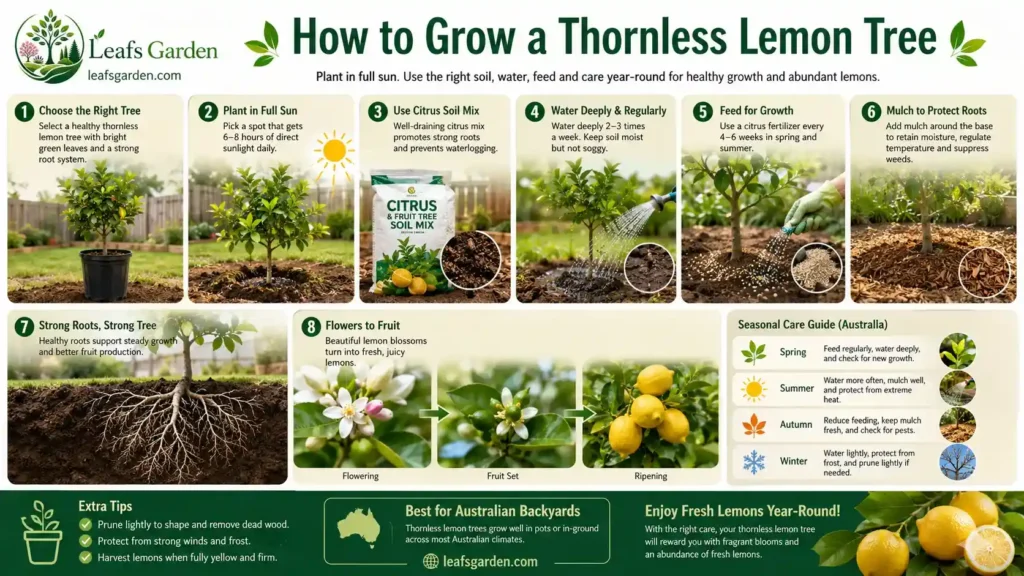
Spring is generally the best time to plant lemon trees because warmer soil temperatures encourage faster root establishment and healthy new growth.
In many Australian regions, planting during spring allows citrus trees to settle before extreme summer heat arrives.
Autumn planting can also work well in mild climates where frost risk is low.
Australian climate timing varies by region:
| Region | Best Planting Time |
| Sydney | Spring or early autumn |
| Melbourne | Mid to late spring |
| Adelaide | Spring |
| Brisbane | Spring to early autumn |
Avoid planting during frost periods or extreme summer heat waves.
Lemon trees need full sun for strong flowering, healthy foliage, and productive fruiting. Most citrus trees require at least 6–8 hours of direct sunlight daily.
Insufficient sunlight often causes:
Outdoor lemon trees usually perform better because they receive stronger natural light and better airflow.
| Growing Condition | Performance |
| Full sun | Best fruiting and growth |
| Partial shade | Reduced fruit production |
| Heavy shade | Poor health and weak growth |
Thornless lemon trees also tolerate heat well when watered correctly. Mature citrus trees adapt to hot Australian summers, although young trees may need temporary protection during extreme heat.
Indoor lemon trees require:
Outdoor placement is usually preferred because natural sunlight improves flowering, pollination, and fruit quality.
Healthy lemon gardening depends heavily on proper soil structure. Citrus trees grow best in loose, fertile, and well-draining soil.
The ideal citrus soil mix should:
Heavy clay soils often cause root stress and fungal problems.
Recommended soil characteristics:
| Soil Factor | Ideal Condition |
| Drainage | Fast-draining |
| Texture | Sandy loam |
| Organic matter | Moderate |
| Soil pH | 6.0–7.0 |
Proper drainage is one of the most important parts of lemon tree plant care. Waterlogged soil can quickly damage citrus roots and reduce tree vigor.
For container growing, use a premium citrus potting mix designed specifically for citrus and fruit trees.
Lemon trees need deep consistent watering, especially during flowering and fruit development stages.
How much water does a lemon tree need depends on:
Young lemon trees require more frequent watering while establishing roots.
General deep watering schedule:
| Tree Age | Watering Frequency |
| Newly planted | 2–3 times weekly |
| Established tree | Once deeply weekly |
| Potted lemon tree | More frequent in summer |
Deep watering encourages stronger root growth and improves drought tolerance.
Signs of underwatering include:
Signs of overwatering include:
Balanced moisture management is essential for successful lemon care and healthy fruit production.
Lemon trees are heavy feeders and require regular nutrients to support flowering, foliage growth, and fruit development.
Citrus fertilizer timing usually follows the active growing season.
Best fertilizing periods:
A quality citrus fertilizer should contain:
Common nutrient deficiencies:
| Deficiency | Symptoms |
| Nitrogen | Pale yellow leaves |
| Iron | Yellowing between veins |
| Magnesium | Leaf edge yellowing |
| Potassium | Weak fruit development |
Overfertilizing can damage roots and reduce fruit quality, so balanced feeding is important in both lemon agriculture and home citrus gardening.
Lemon trees produce fragrant white flowers that later develop into fruit through several growth stages.
The flowering and fruiting cycle depends on:
The process usually begins with:
Healthy lemon flowers are white with a strong citrus fragrance and often appear multiple times per year in warm climates.
From flower to fruit, lemons pass through several visible stages:
| Stage | Description |
| Flowering | White fragrant blooms appear |
| Fruit set | Tiny green lemons form |
| Early fruit growth | Rapid size increase |
| Maturation | Fruit develops juice and color |
| Ripening | Full yellow coloration develops |
Fruit development may take several months depending on temperature and variety.
Proper lemon tree plant care during flowering and fruiting includes:
Consistent lemon care greatly improves fruit size, flavor, and overall tree productivity.
Dwarf thornless lemon trees grow extremely well in containers when they receive full sunlight, quality citrus soil, proper drainage, and regular feeding. Container growing is ideal for patios, balconies, courtyards, and small Australian gardens.
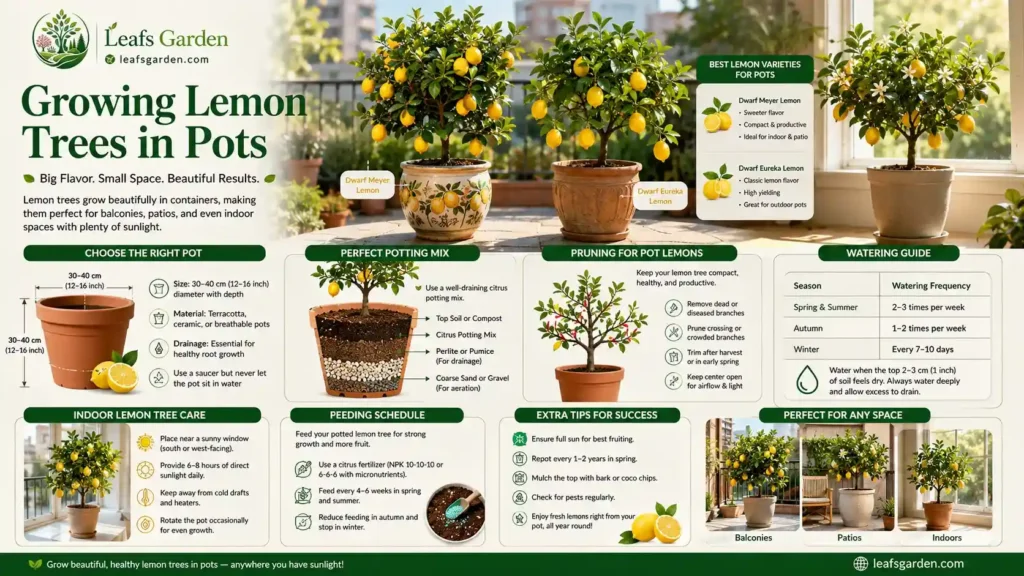
A lemon tree in pot conditions usually stays smaller and easier to manage while still producing full-sized fruit.
Many gardeners choose potted citrus because container growing allows better control over:
Growing lemon trees in pots Australia has become increasingly popular due to limited urban garden space and the strong performance of dwarf citrus varieties.
Choosing the correct container is one of the most important parts of growing a healthy lemon tree in container conditions.
The pot should provide:
| Tree Age | Recommended Pot Size |
| Young lemon tree | 30–40 cm wide |
| Medium tree | 45–60 cm wide |
| Mature potted lemon tree | 60 cm+ wide |
Starting with a slightly larger container helps reduce root restriction during early growth stages.
Drainage holes are essential because citrus roots dislike constantly wet soil.
Poor drainage often causes:
Always avoid sealed decorative containers without proper drainage.
| Pot Type | Advantages | Disadvantages |
| Terracotta | Better airflow and drainage | Dries faster |
| Plastic | Holds moisture longer | Less root aeration |
Terracotta pots are often preferred for citrus because they reduce excess moisture buildup around the roots.
Lemon tree pot soil should be loose, nutrient-rich, and fast draining. Standard garden soil is usually too dense for container citrus.
A quality citrus potting mix should contain:
Good moisture retention is important, but the soil should never stay waterlogged.
Ideal citrus soil characteristics:
| Soil Feature | Ideal Condition |
| Drainage | Fast |
| Moisture retention | Moderate |
| Aeration | High |
| Soil pH | 6.0–7.0 |
Refreshing the top layer of potting mix annually helps maintain nutrients and root health.
Yes, certain dwarf citrus varieties can grow successfully indoors when provided with enough light and warmth.
An indoor lemon tree plant usually performs best near bright north-facing or west-facing windows in Australia.
The best indoor lemon varieties include:
Indoor lemon tree care focuses heavily on sunlight management and airflow.
Indoor citrus trees require:
Limited sunlight is one of the biggest challenges for indoor lemon plants.
Low light can cause:
During winter or cloudy periods, some indoor growers use supplemental grow lights to maintain healthy citrus growth.
Outdoor placement during warmer months can also improve flowering and fruit development.
Container-grown citrus trees are more sensitive to watering mistakes and root stress than ground-planted trees.
Most potted lemon tree problems are related to:
Root rot develops when the soil remains excessively wet for long periods.
Symptoms include:
Improving drainage and reducing watering frequency usually helps prevent root damage.
Yellow leaves commonly result from:
Container citrus trees may require more frequent feeding because nutrients wash out faster during watering.
Slow growth in a lemon tree in container conditions is often caused by:
Repotting and improved sunlight exposure usually restore healthy growth.
Pot-bound roots occur when the root system becomes tightly packed inside the container.
Signs include:
Repotting every few years helps maintain root health and strong fruit production.
Pruning helps maintain compact shape, improve airflow, and support healthy fruiting in container citrus trees.
Regular pruning is especially important for potted lemon tree maintenance because restricted roots naturally limit growth balance.
Main pruning benefits include:
Container lemon trees should maintain a balanced open canopy that allows light to reach all branches.
Remove:
Improved airflow helps reduce fungal diseases and pest problems in humid conditions.
Open branch spacing also improves flower and fruit development.
Selective pruning encourages stronger flowering and healthier fruit growth by directing energy into productive branches.
Avoid heavy pruning during peak flowering periods because it may reduce fruit production.
Most thornless lemon tree problems are linked to fungal infections, watering mistakes, nutrient deficiencies, environmental stress, or pest attacks. Early diagnosis is important because citrus trees often show visible symptoms before serious damage occurs.
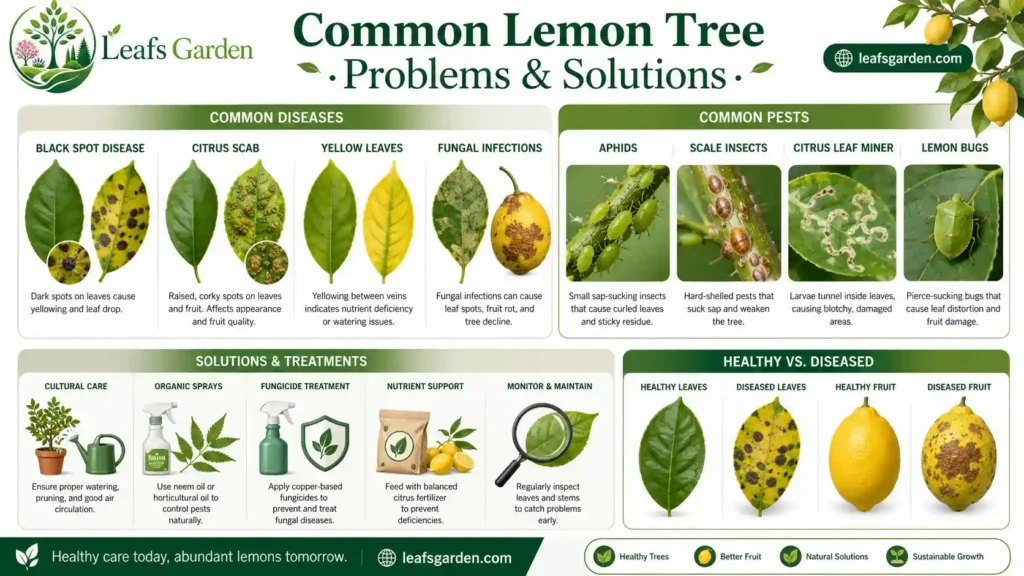
Common lemon tree disease symptoms include:
Proper lemon care and fast treatment help prevent long-term damage to citrus trees.
Yellow leaves are one of the most common citrus problems. In many cases, yellowing is caused by nutrient imbalance or watering issues rather than severe disease.
Nitrogen deficiency usually causes pale green or yellow leaves across the tree.
Common signs include:
Applying balanced citrus fertilizer usually restores healthy green foliage.
Overwatering damages oxygen flow around the roots and weakens the tree.
Symptoms include:
Container-grown citrus trees are especially vulnerable to excessive watering.
Poor drainage often leads to root rot and fungal problems. Waterlogged soil prevents healthy root respiration and increases disease risk.
Improving drainage is essential for long-term lemon tree plant health.
Brown or black spotting is commonly associated with fungal infections and bacterial citrus diseases.
These spots may appear on:
Black spot disease is one of the most recognized citrus diseases affecting lemons.
For detailed citrus disease identification and integrated management guidance, NSW Department of Primary Industries provides reliable horticultural advice for Australian home citrus growers and backyard orchardists.
Symptoms include:
Warm humid weather increases disease spread.
Several fungal pathogens can affect lemon foliage and fruit surfaces.
Common fungal symptoms:
Good airflow and pruning help reduce fungal pressure.
Citrus scab creates rough raised lesions on fruit and leaves.
Affected fruit may become:
Young developing fruit is most vulnerable during humid conditions.
Leaf drop is often a stress response caused by sudden environmental changes or root problems.
A healthy lemon tree normally sheds small numbers of older leaves, but excessive dropping indicates a deeper issue.
Both underwatering and overwatering can trigger rapid leaf loss.
Common symptoms include:
Consistent moisture levels are important for citrus stability.
Sudden temperature changes can stress citrus trees.
Possible causes include:
Indoor lemon trees are particularly sensitive to rapid environmental changes.
Damaged roots reduce water and nutrient absorption.
Root-related issues include:
Healthy roots are critical for maintaining stable foliage and fruit production.
Several lemon tree diseases affect citrus production in home gardens and orchards. Most diseases of citrus trees spread more rapidly in humid or poorly ventilated conditions.
| Disease | Symptoms | Causes | Treatment |
| Citrus Black Spot | Black fruit spots, leaf lesions | Fungal infection | Copper fungicide, pruning |
| Root Rot | Yellow leaves, weak roots | Overwatering, poor drainage | Improve drainage, reduce watering |
| Citrus Scab | Rough raised lesions | Fungal pathogen | Fungicide sprays, sanitation |
| Greasy Spot | Dark oily leaf spots | Humid fungal infection | Improve airflow, fungicide |
| Sooty Mold | Black leaf coating | Honeydew from pests | Control insects, wash foliage |
| Melanose | Rough dark fruit marks | Fungal spores | Pruning and fungicide management |
Common citrus plant diseases often worsen when trees are overcrowded or stressed.
Preventive lemon care practices include:
Healthy citrus management greatly reduces the risk of severe lemon leaf disease outbreaks.
Visual symptom identification is extremely important when diagnosing citrus diseases.
Gardeners commonly search for:
Visual indicators help identify:
| Visual Symptom | Possible Problem |
| Black circular spots | Citrus black spot |
| Yellow leaf veins | Nutrient deficiency |
| White powdery coating | Fungal infection |
| Brown fruit scars | Citrus scab |
| Black leaf coating | Sooty mold |
Comparing symptoms with reliable citrus disease images helps improve treatment accuracy before damage spreads further.
Lemon tree pests commonly attack leaves, young shoots, flowers, and fruit. Early pest control helps prevent serious foliage damage and reduced fruit production.
Common pests of lemon trees include:
These lemon insects weaken tree growth by feeding on plant sap and damaging new foliage.
Citrus leaf miner larvae tunnel through young leaves and create silvery winding trails.
Symptoms include:
Young citrus trees are especially vulnerable.
Aphids are small sap-feeding insects that cluster on soft new growth.
Problems caused by aphids:
Natural predators like ladybirds often help control aphid populations.
Scale insects attach themselves to stems and leaves while feeding on plant sap.
Signs include:
Heavy infestations weaken the entire tree over time.
Lemon bugs are large sap-feeding pests commonly found on citrus trees in Australia.
They damage:
Large bug populations can reduce fruit quality and stunt citrus growth.
Regular inspection and early treatment are essential for controlling bugs on lemon tree branches and maintaining healthy citrus production.
Most lemon tree problems can be corrected naturally through early diagnosis, proper pruning, balanced watering, healthy soil management, and organic pest control methods. Consistent lemon care improves tree recovery and reduces future disease pressure.
Natural citrus management focuses on:
Healthy growing conditions are one of the best long-term defenses against citrus stress and disease.
Organic treatments help manage many common citrus diseases without relying heavily on harsh chemical sprays.
Early treatment is important because fungal infections spread rapidly during warm humid weather.
Neem oil is widely used for natural citrus pest and disease management.
Benefits include:
Neem oil is commonly sprayed on:
Apply during cooler parts of the day to avoid leaf burn.
Copper fungicide is commonly used to manage fungal citrus diseases including:
It works best as a preventative treatment before infections become severe.
Copper sprays are often applied:
Avoid excessive spraying because heavy copper buildup can stress citrus foliage.
Pruning infected branches helps stop disease spread and improves airflow through the canopy.
Remove:
Always disinfect pruning tools between cuts to reduce contamination.
Good airflow reduces humidity around leaves and lowers fungal disease risk.
Root rot is one of the most damaging citrus problems and is usually caused by excessive moisture around the roots.
Healthy roots require oxygen, drainage, and balanced watering.
Fast-draining soil is essential for preventing fungal root diseases.
Improve drainage by using:
Avoid planting lemon trees in heavy compacted clay soils.
Container citrus trees are especially vulnerable to root rot when drainage is poor.
Important pot management practices include:
Terracotta pots often improve airflow and reduce excessive moisture buildup.
Healthy roots are critical for long-term citrus growth and fruit production.
Poor fruiting is usually caused by environmental stress, low sunlight, nutrient imbalance, or weak pollination.
Correcting these problems often restores healthy flowering and fruit set.
Most lemon trees are self-pollinating, but outdoor airflow and insect activity improve fruit production.
Poor pollination may cause:
Indoor citrus trees sometimes benefit from gentle hand pollination using a soft brush.
Lemon trees require strong direct sunlight for reliable fruiting.
Low light conditions often reduce:
Trees should ideally receive at least 6–8 hours of sunlight daily.
Nutrient deficiencies commonly reduce fruit size and flowering.
Citrus trees require regular feeding with:
Balanced citrus fertilizer supports:
Overfertilizing with nitrogen can increase leaf growth while reducing fruit production.
Seasonal maintenance keeps lemon trees healthy throughout changing weather conditions.
Consistent care helps prevent disease, pest outbreaks, and fruiting problems.
| Season | Essential Lemon Tree Care |
| Spring | Fertilize, prune lightly, monitor new growth |
| Summer | Deep watering, pest inspection, mulch application |
| Autumn | Reduce feeding, remove damaged fruit, monitor drainage |
| Winter | Frost protection, reduce watering, protect young trees |
Spring is the main active growth period for citrus trees.
Important spring tasks:
Healthy spring growth strongly influences fruit production later in the season.
Summer heat increases water demand and pest activity.
Focus on:
Mulching helps stabilize soil temperature and reduce water loss.
Cold weather can stress citrus trees, especially young lemon plants.
Winter protection methods include:
Container-grown citrus trees may need temporary shelter during severe cold conditions.
Outdoor lemon trees usually grow faster, larger, and produce heavier crops because they receive stronger sunlight, better airflow, and natural pollination. Indoor lemon trees remain more compact and decorative but require careful light and humidity management to stay healthy.
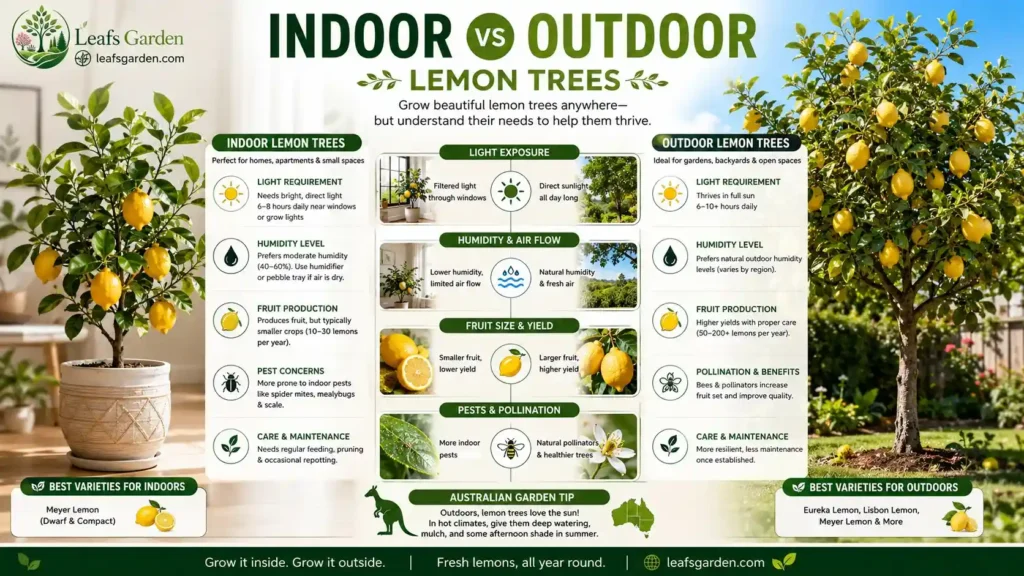
Both growing methods can be successful when the correct citrus variety and environment are chosen.
Some lemon varieties adapt far better to indoor conditions because of their compact growth habits and manageable root systems.
The best indoor citrus choices include:
Meyer lemon trees are widely considered the best indoor lemon option because they naturally stay smaller and tolerate container conditions well.
Main indoor benefits:
Meyer lemons also handle indoor temperature fluctuations better than vigorous outdoor citrus varieties.
Dwarf Eureka lemons are another excellent indoor citrus choice for bright sunny spaces.
Advantages include:
With enough light, a dwarf Eureka can produce reliable crops even as an indoor lemon tree.
Outdoor growing conditions generally provide the healthiest environment for citrus development.
Natural outdoor conditions support:
Outdoor lemon trees benefit from natural pollinators like bees and insects.
Improved pollination often results in:
Natural wind movement also helps flower pollination.
Outdoor citrus trees receive stronger sunlight intensity than indoor plants.
This encourages:
Outdoor lemon trees usually establish themselves more quickly after planting.
Because outdoor trees receive more sunlight and space, they generally produce heavier fruit crops.
Benefits include:
Ground-planted citrus trees also develop larger root systems, supporting stronger long-term fruit production.
Indoor lemon growing can be successful, but citrus trees become more sensitive to environmental stress inside enclosed spaces.
The most common indoor citrus problems involve:
Indoor air is often too dry for healthy citrus growth, especially during winter heating periods.
Low humidity may cause:
Humidity trays or occasional misting may help improve moisture levels around indoor lemon trees.
Limited sunlight is one of the biggest indoor citrus challenges.
Without enough direct light, lemon trees may develop:
Most indoor lemon trees require at least 6–8 hours of bright light daily for stable growth.
South-facing or west-facing windows usually provide the best indoor lighting conditions.
Indoor citrus trees are vulnerable to several common pests because natural predators are limited indoors.
Common indoor citrus pests include:
Regular inspection helps detect pest problems early before infestations spread across the foliage.
Companion plants help improve soil quality, attract pollinators, reduce pest pressure, and support healthier citrus growth around lemon trees. Carefully selected companion plants can also improve moisture retention and create a more balanced garden ecosystem.
Many gardeners researching what to plant under citrus trees Australia conditions choose shallow-rooted herbs and flowering plants that do not heavily compete with citrus roots.
The best companion plants for lemon trees are low-competition species that improve biodiversity without stealing excessive nutrients or water.
Ideal companion plants usually provide:
Gardeners pairing citrus varieties on their patio or in their backyard may also enjoy growing a clementine tree, a compact and sweet-fruiting citrus that shares the same sunny growing requirements and pairs beautifully with thornless lemon trees in Australian edible gardens.
Herbs are excellent citrus companions because most have shallow root systems and natural pest-repelling properties.
Good herb companions include:
Benefits of herbs around citrus trees:
Basil and chives are especially popular in lemon gardening because they may help discourage aphids and soft-bodied insects.
Flowering companion plants attract pollinators and improve the visual appearance of citrus gardens.
Popular flowering companions include:
These flowers help attract:
Marigolds are commonly planted near citrus because they may help reduce certain soil pests naturally.
Pollinator-friendly plants increase insect activity around lemon flowers, improving fruit set and citrus productivity.
Good pollinator plants include:
| Plant | Main Benefit |
| Lavender | Attracts bees |
| Salvia | Supports pollinators |
| Alyssum | Encourages beneficial insects |
| Borage | Improves pollination activity |
| Native flowering herbs | Supports biodiversity |
Low-growing pollinator plants also help cover exposed soil and reduce moisture loss during hot weather.
Some plants compete too aggressively with citrus trees for nutrients, water, and root space. Poor companion choices can weaken lemon growth and reduce fruit production.
Avoid planting species with:
Large aggressive-rooted plants may interfere with the lemon tree root system and reduce nutrient availability.
Plants commonly avoided near citrus include:
These species often dominate soil moisture and reduce citrus root performance.
Plants requiring excessive water can create unstable soil moisture conditions around citrus roots.
Examples include:
Overcrowding around citrus trees may also reduce airflow, increasing fungal disease risk.
Keeping the base area lightly planted and well-ventilated usually produces healthier long-term citrus growth.
Yes, thornless lemon trees produce the same high-quality fruit as many thorny lemon varieties. Fruit flavor, juice content, and productivity depend more on the variety and growing conditions than thorn production. Popular thornless varieties like Eureka and Meyer lemons are known for: Excellent flavor High juice content Reliable fruiting Strong productivity
Meyer lemon trees and Eureka lemon trees are among the citrus varieties with the fewest thorns. Dwarf Meyer lemons are especially popular because they produce very small or minimal spines. Completely thorn-free growth is not always guaranteed, but these varieties are significantly safer and easier to handle than vigorous thorny citrus types like Lisbon lemons.
Yes, thornless lemon trees grow very successfully in containers when provided with: Full sunlight Quality citrus potting mix Good drainage Regular fertilizer Dwarf varieties are best suited for pots because they maintain compact root systems and manageable canopy size. Popular container choices include: Dwarf Meyer lemon Dwarf Eureka lemon Lotsa Lemons tree
Most grafted lemon trees begin producing fruit within 2–4 years after planting. Full maturity and peak fruit production usually develop after 5–7 years. Growth speed depends on: Climate Sunlight Watering Soil quality Fertilization Dwarf container trees may mature slightly faster than large standard orchard trees.
Poor fruiting is usually caused by environmental or nutrient-related stress. Common causes include: Insufficient sunlight Overfertilizing with nitrogen Poor pollination Young tree age Water stress Cold temperatures Healthy citrus trees generally require at least 6–8 hours of direct sunlight daily for reliable flowering and fruit development.
The best lemon tree for Australia depends on climate and available growing space. Common recommendations include: Region/Condition Recommended Variety Warm climates Eureka lemon Cooler regions Lisbon lemon Pots and patios Dwarf Meyer lemon Indoor growing Meyer lemon Eureka and Meyer lemons are among the most popular Australian home garden citrus varieties because of their productivity and adaptability.
Potted lemon trees usually require deep watering once or twice weekly, depending on weather conditions and pot size. During hot Australian summers, container citrus may need more frequent watering because pots dry out faster than garden soil. Important watering guidelines: Water deeply rather than lightly Allow slight surface drying between watering Avoid constantly wet soil Overwatering is one of the most common causes of root problems in potted citrus trees.
Yes, Meyer lemons are generally sweeter and less acidic than Eureka lemons. Meyer lemons have: Mild citrus flavor Slight mandarin-like sweetness Lower acidity Softer skin texture Eureka lemons produce a more traditional sharp lemon flavor with stronger acidity and higher juice intensity.