Grow Better Gardens with Smarter Plant Choices
Discover helpful guides on trees, hedges, fruit plants, edible plants, and beautiful landscape greenery.
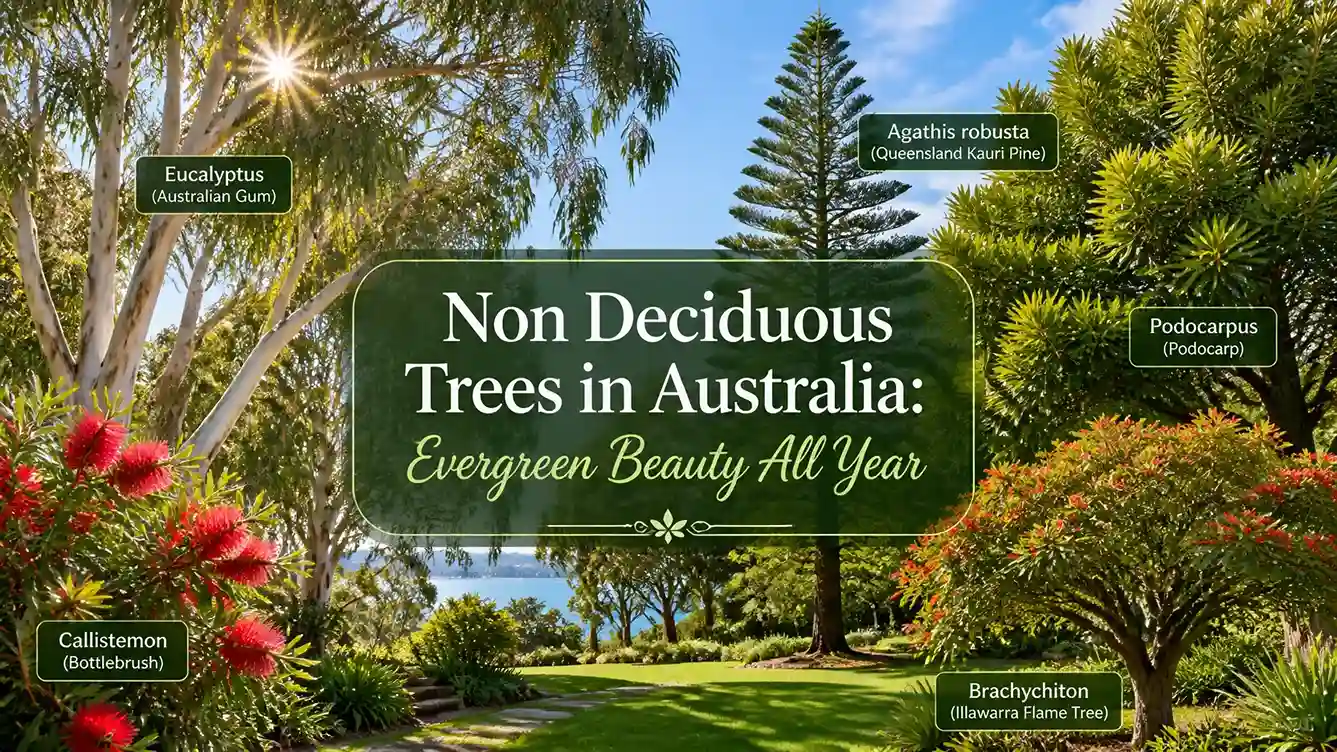
Non deciduous trees Australia refers to trees that retain their foliage throughout the year, unlike deciduous trees that shed their leaves seasonally. These evergreen trees maintain a constant presence in the landscape, providing greenery regardless of the season.
In Australian landscapes, non-deciduous trees play a vital role in enhancing both urban and rural environments. They contribute to the aesthetic appeal of gardens, parks, and streetscapes while also offering practical benefits such as shade and shelter. Their year-round foliage ensures that outdoor spaces remain visually appealing and environmentally functional in every season.
The benefits of non deciduous trees in Australia extend beyond beauty. They provide much-needed shade during hot summers, act as windbreaks, support local wildlife, and improve air quality through carbon absorption. Whether planted in residential gardens, public parks, or along streets, these evergreen trees create a sustainable and attractive landscape that endures all year.
Australia is home to a wide range of evergreen native trees that are well-suited to the continent’s diverse climates. Notable examples include Eucalyptus spp., known for their towering height and aromatic foliage; Callistemon spp., commonly called bottlebrush trees, prized for their vibrant flowers and moderate growth rate; and Agathis robusta, or the Queensland kauri, which is a slow-growing, majestic conifer with dense, glossy leaves. These Australian native trees are valued for their resilience, adaptability, and contribution to local ecosystems, making them popular choices among gardeners and landscapers looking for evergreen trees Australia can rely on year-round.
In contrast, deciduous species like those discussed in Deciduous Trees: Definition, Types & Characteristics offer seasonal foliage changes that create different landscape effects compared to year-round evergreens.
In addition to native species, several evergreen Australian trees originate from other regions but have successfully adapted to the Australian climate. The Olea europaea (Olive tree) is widely cultivated for its ornamental appeal and edible fruit, thriving in sunny, well-drained soils. Similarly, Fraxinus spp. (Ash trees) have proven their versatility across urban and rural landscapes, offering dense foliage and moderate growth rates. These evergreen tree varieties are appreciated for their ability to maintain greenery throughout the year while withstanding local environmental conditions.
For gardeners focused on aesthetics and landscaping impact, ornamental evergreens provide a perfect solution. Podocarpus spp. and Brachychiton spp. are popular choices, offering elegant forms, glossy foliage, and seasonal interest. These trees are particularly valued for their visual appeal in formal gardens, front yards, and public spaces, serving as Australian evergreen trees that enhance property value and curb appeal while contributing to year-round greenery.
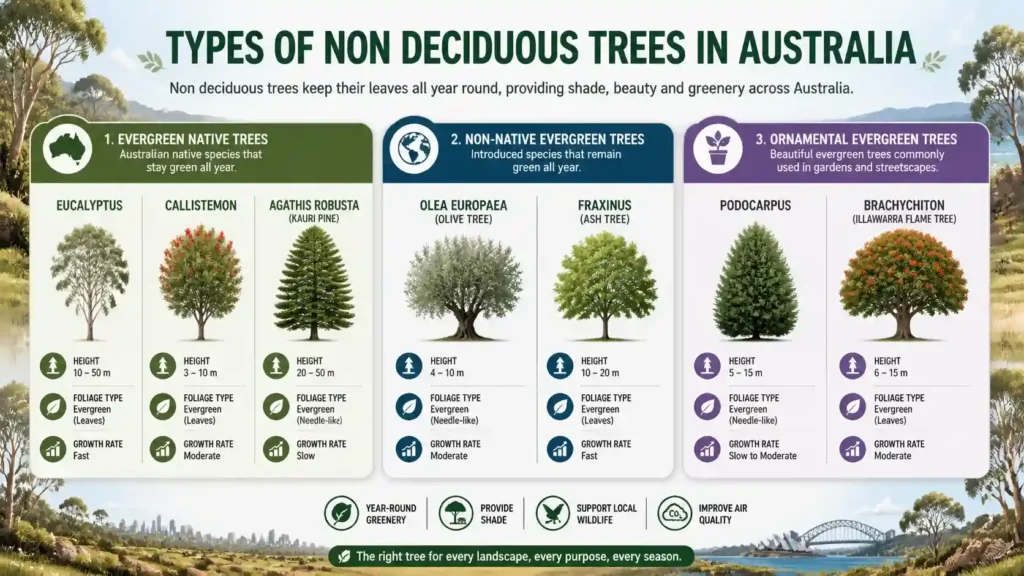
These three categories—native, non-native, and ornamental—cover the main evergreen tree varieties suitable for Australian gardens, streets, and parks, ensuring a diverse selection of evergreen Australian trees for different landscaping needs.
One of the defining features of non deciduous trees is their ability to retain leaves year-round. Unlike deciduous trees that shed their foliage in response to seasonal changes, non deciduous trees Australia maintain a full canopy throughout the year. This continuous leaf cover helps stabilize soil, reduces erosion, and ensures that landscapes remain lush and green in all seasons. The evergreen foliage also provides constant shade and contributes to the visual appeal of gardens, parks, and streetscapes.
Non deciduous trees exhibit varied growth patterns, ranging from fast-growing to slow-growing species. Fast growing evergreen trees Australia such as some Eucalyptus varieties can quickly establish shade and windbreaks, making them ideal for rapid landscaping projects. On the other hand, slower-growing species like Agathis robusta offer long-term stability and grand canopy development. Similarly, quick growing evergreen trees are often selected for gardens where immediate impact is desired, while slower-growing varieties are valued for their longevity and structural beauty.
These differences become even clearer when comparing growth behavior with deciduous species, such as explained in Deciduous vs Evergreen Trees, where seasonal leaf drop and evergreen retention are analyzed in detail.
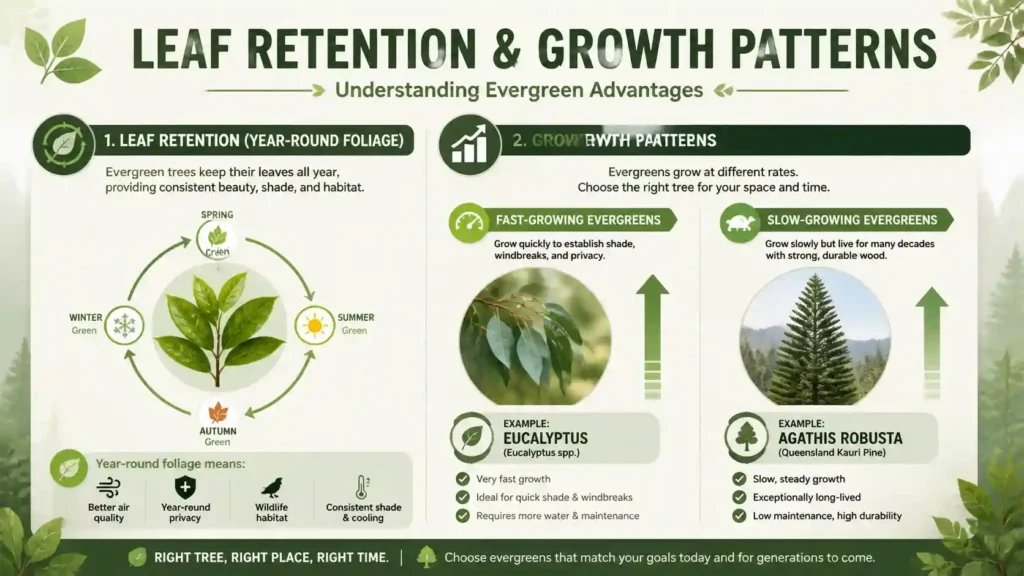
Beyond aesthetics, non deciduous trees offer significant environmental advantages. Their dense foliage provides natural shade, helping to cool outdoor areas and reduce energy costs. They serve as effective windbreaks, protecting homes and crops from strong winds. Evergreen trees also play a role in carbon absorption, contributing to cleaner air and climate mitigation. Additionally, they provide habitat and food for a variety of wildlife, supporting biodiversity in urban and rural settings. These features make Australian evergreen trees essential components of sustainable landscapes.
Choosing the right small evergreen trees Australia can transform limited spaces without overwhelming them. Compact varieties such as dwarf evergreens are ideal for patios, courtyards, and small backyards. These trees provide year-round greenery and aesthetic appeal while remaining manageable in size. Their slow to moderate growth ensures they stay proportionate to smaller gardens, making them perfect choices for homeowners seeking low-maintenance, visually appealing plantings.
For expansive areas like streets, parks, or large private gardens, tall evergreen trees are the preferred option. Species such as Eucalyptus spp. or Agathis robusta can develop impressive canopies, offering ample shade and a commanding presence. Many of these trees are adaptable to a variety of soil types and climates across Australia. Additionally, fast-growing Australian trees are often selected for rapid canopy development, providing shade and environmental benefits in a shorter time frame. These trees are ideal for creating strong visual impact and functional green spaces.
When selecting non deciduous trees, understanding the site’s conditions is crucial. Some trees thrive in full sun, while others are more suited to shaded areas, making shade-tolerant evergreens a versatile choice for varied landscapes. Drought-tolerant species are increasingly important in Australia’s often dry climate, ensuring sustainability with minimal irrigation. Considering soil type, sunlight exposure, and water availability helps ensure healthy growth and longevity for both small evergreen trees and larger landscape specimens.
Proper evergreen tree care is essential to ensure that non deciduous trees thrive and maintain their aesthetic and environmental benefits. Regular pruning and shaping help preserve the tree’s structure, encourage healthy growth, and enhance its ornamental value. For small gardens, this is particularly important for evergreen small trees and shrubs, keeping them proportionate and visually appealing.
Fertilization and consistent watering support vigorous growth. Newly planted trees benefit from a regular watering schedule until established, while mature evergreens require periodic nourishment to maintain foliage health. Applying mulch around the base helps retain soil moisture, regulate temperature, and suppress weeds, contributing to overall soil care.
Pest and disease management is another critical aspect of planting evergreens successfully. Monitoring for common pests, fungal infections, or nutrient deficiencies and addressing them promptly ensures long-term tree vitality. Combining these practices creates a sustainable care routine, keeping non deciduous trees Australia healthy, vibrant, and beneficial to the landscape year-round.
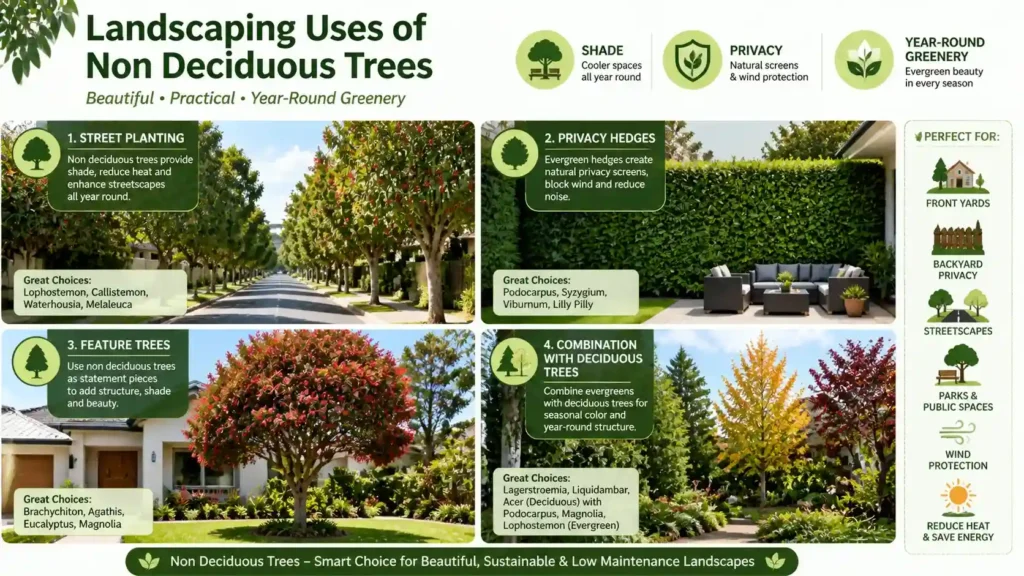
Non deciduous trees offer versatile applications in Australian landscaping, enhancing both functionality and visual appeal. Street planting with tall evergreen species provides shade, reduces noise, and improves air quality, creating a pleasant environment for pedestrians and drivers alike.
In residential gardens, non deciduous trees are ideal for backyard privacy hedges, offering year-round screening from neighbors while adding greenery and texture to outdoor spaces. Smaller varieties, such as front yard small evergreen trees Australia, are perfect for compact yards, providing structure and visual interest without taking up excessive space.
They are often combined with smaller understory plants, such as those explained in Small Australian Native Plants Suitable for Shade, to create layered and shaded garden compositions.
For those looking to make a bold statement, Australian native feature trees or an evergreen feature tree Australia can serve as a central focal point in the garden or front yard. Their year-round foliage and striking forms make them excellent great trees for front yard landscaping, adding elegance and curb appeal.
Combining evergreen trees with deciduous varieties creates a dynamic landscape that offers seasonal variation without sacrificing year-round greenery. This mix ensures that gardens remain attractive throughout the year, balancing flowering displays, autumn colors, and consistent evergreen coverage.
For a deeper understanding of how plant selection, growth patterns, and care strategies influence long-term landscape success, you can explore this complete guide on plant growth, care, and comparisons in gardens and indoor spaces.
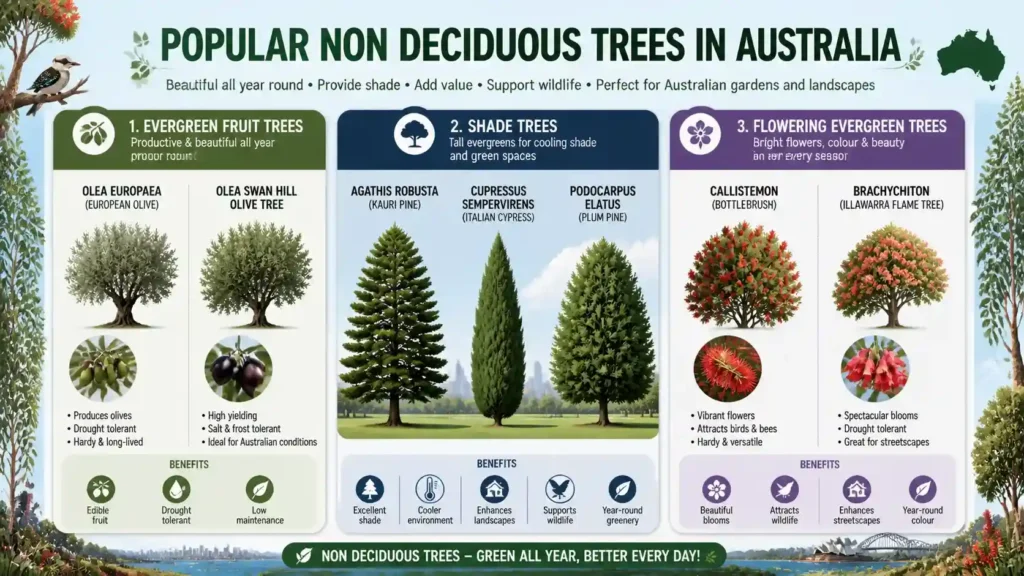
Australia is home to a variety of non deciduous trees that suit different landscaping and functional needs. Among the most popular are evergreen fruit trees, such as the olive tree Australia varieties, including the renowned Olea Swan Hill olive tree. These trees not only provide year-round greenery but also produce edible fruit, making them both practical and attractive for home gardens and orchards. Fast-growing fruit tree varieties are particularly favored for their quick establishment and productive yield.
Shade trees are another popular category, especially in parks, streets, and large gardens. Tall evergreens like Eucalyptus spp. and Agathis robusta create expansive canopies, offering cool refuge from the sun, reducing heat in urban areas, and enhancing outdoor comfort. Many of these trees are also fast growing evergreen tree Australia selections, allowing rapid development of shaded spaces.
For gardens seeking color and biodiversity, flowering evergreen trees are an excellent choice. Species such as Callistemon spp. and Brachychiton spp. combine lush, year-round foliage with vibrant flowers, attracting birds and pollinators while elevating the landscape’s visual appeal. These trees provide a continuous display of greenery with seasonal bursts of color, making them valuable additions to any Australian garden.
Non deciduous trees Australia offer a wide range of benefits, from providing year-round greenery and shade to enhancing the beauty and functionality of landscapes. They support biodiversity, act as natural windbreaks, absorb carbon, and contribute to healthier outdoor environments while adding lasting aesthetic value to gardens, parks, and streets.
Planting these evergreen trees is a simple yet impactful way to improve both the environment and the visual appeal of any space. Whether for small gardens, large landscapes, or urban streetscapes, non deciduous trees Australia ensure continuous greenery, sustainable growth, and long-term benefits for homeowners and communities alike. By choosing the right species and maintaining them properly, you can enjoy the many advantages that these versatile and resilient trees provide throughout the year.
Non deciduous trees in Australia, also known as evergreen trees, are species that retain their leaves throughout the year. Unlike deciduous trees, they do not shed their foliage seasonally, providing continuous greenery, shade, and environmental benefits.
Compact species such as dwarf evergreens, small Eucalyptus varieties, Callistemon spp., and Podocarpus spp. are ideal for small gardens. These small evergreen trees Australia maintain a manageable size while offering year-round greenery and aesthetic appeal.
Growth rates vary depending on species. Some fast-growing evergreen trees Australia, like certain Eucalyptus or Brachychiton varieties, can establish shade and canopy quickly within a few years, while species like Agathis robusta grow slowly but provide long-term structural beauty.
Many Australian native evergreens, such as Eucalyptus and Callistemon, are drought-tolerant once established. Non-native species may require supplemental watering, but selecting drought-adapted varieties ensures survival even in dry conditions.
Species such as Callistemon spp. (bottlebrush), Brachychiton spp., and some Podocarpus varieties are excellent flowering evergreen trees, offering vibrant blooms, year-round foliage, and supporting local biodiversity.
Many evergreen trees are low-maintenance, requiring occasional pruning, fertilization, and monitoring for pests. Smaller species and drought-tolerant varieties generally need less care, making them suitable for urban gardens.
Yes, evergreen trees Australia are excellent for privacy hedges or screens due to their year-round leaf retention. Tall species or dense shrubs create effective barriers against noise, wind, and visibility from neighbors
Tall, robust species like Eucalyptus spp., Agathis robusta, and Olea europaea (Olive tree) are suitable for streetscapes. They provide shade, improve air quality, and enhance the urban aesthetic while tolerating variable soil and climate conditions.